


Why this matters
If you operate a streaming service, an OTT platform, an e-learning library, or a video-conferencing product, bit depth is one of the small decisions that compounds across millions of viewer-hours. Pick the wrong default and you over-spend on storage and CDN bytes you do not need to spend, or you ship a picture with visible banding that your competitors do not have. The decision is not "do we need HDR" — that one is easier. The hard question is "given our 8-bit camera sources and our 8-bit phone displays, does it pay to encode at 10-bit internally?" The math, the encoder behaviour, and the device-support picture have all shifted in the last three years, and the answer for most product teams in 2026 is no longer the answer it was in 2019.
What "8-bit" and "10-bit" actually mean
The phrase "8-bit video" is shorthand for the number of distinct brightness or colour values the format can carry per pixel, per channel. An 8-bit channel can carry 2 to the 8th power values — 256 of them, numbered 0 through 255. A 10-bit channel carries 2 to the 10th — 1,024 values. A 12-bit channel carries 4,096. The same scale, sliced more finely.
A useful analogy. Picture a piano keyboard. An 8-bit channel has 256 keys; a 10-bit channel has 1,024. Both keyboards play the same range of notes, from silence to maximum brightness — they just hit different points on the slope between those two extremes. The 10-bit keyboard can hit a note exactly between two of the 8-bit keys; the 8-bit keyboard has to round to the nearest of its 256 keys.
Video stores three of those channels per pixel — one for brightness (called luma) and two for colour information (called chroma). At 8-bit, every pixel carries 24 bits total — 8 bits times 3 channels. At 10-bit, every pixel carries 30 bits. At 12-bit, 36 bits. A 1080p frame holds about 2 million pixels, so the raw cost of a single frame jumps from 6 MB (8-bit) to 7.5 MB (10-bit) to 9 MB (12-bit). The same ratio holds for 4K, 8K, and any other resolution: 10-bit costs about 25% more raw data than 8-bit before any compression has happened.
That 25% raw-data overhead is exactly the place where the myth begins. Reading the number, a product manager naturally concludes that 10-bit means 25% more storage and 25% bigger streams. The numbers below show why that conclusion is wrong almost every time.
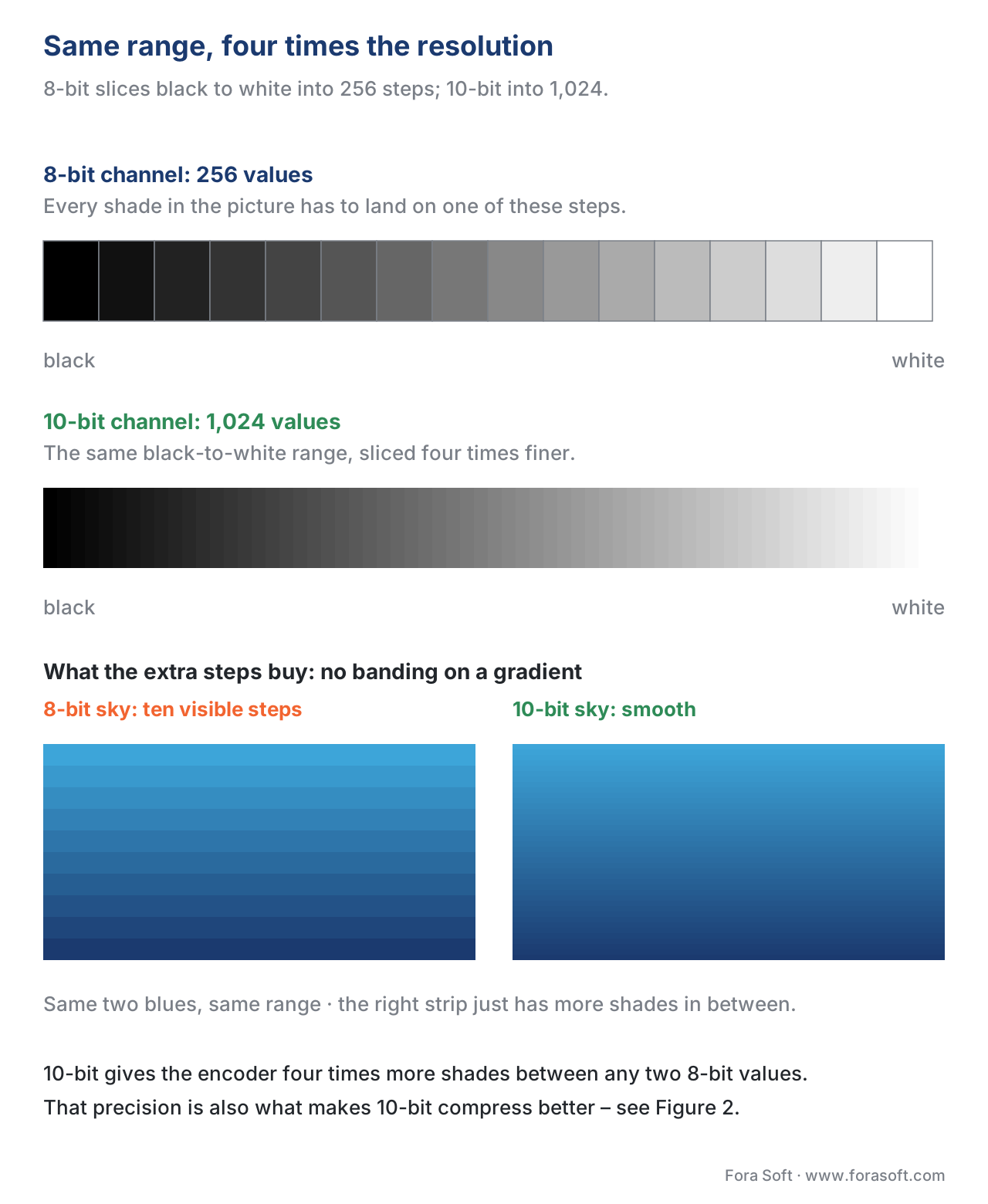 Figure 1. 8-bit and 10-bit cover the same range — they just sample it at different resolutions. The finer sampling is what kills banding on smooth gradients.
The banding problem and where it comes from
Before getting to the compression math, you need to understand the visible symptom that drives most of the case for 10-bit: banding. Banding is the staircase pattern you see on a smooth gradient — a slowly darkening sky, a sunset, a studio backdrop with a soft light fall-off, the inside of a subway tunnel. Instead of a continuous fade, the picture shows distinct horizontal or curved bands separated by visible steps.
The cause is straightforward. A sky might span 60 brightness levels in the real world. At 8 bits, the encoder can only allocate something like 30 of the available 256 levels to that range. If the camera or the master holds 60 levels of detail but the encoder can only represent 30, every other level gets rounded to its neighbour, and adjacent regions that were originally one shade apart now share the same value. The eye, which is unusually good at picking up brightness discontinuities on flat surfaces, sees the rounded transitions as stripes.1
A 10-bit encoder has four times the levels — 1,024 instead of 256. The same 60-level sky now has 240 representational levels available instead of 30. The rounding step is one-quarter as large, the residual error is one-quarter as visible, and the banding usually disappears even before any debanding filter is applied.
That is the visible payoff. The less visible payoff — the one that pays for the format on a CDN bill — is that 10-bit also makes the encoder more efficient on every part of the picture, including the parts that did not have banding to begin with.
Why 10-bit compresses 8-bit content better
The non-obvious part. Even when the source camera shot 8-bit and the target display is 8-bit and there is no HDR anywhere in the pipeline, encoding at 10-bit usually produces a smaller file at the same perceived quality. This is the fact that does not fit the myth, and it has been true since x264's 10-bit build shipped a decade ago.
The mechanism is internal precision. A video encoder does not just store pixels; it performs a long chain of math on them — colour-space conversion, frequency transforms, motion compensation, quantisation, loop filtering. Every one of those steps introduces small rounding errors. At 8-bit internal precision, the rounding errors stack and the encoder spends bits later to undo them. At 10-bit internal precision, the rounding errors are one-quarter as large, the quantisation is more accurate, and the encoder simply does not have to spend those extra bits.2
A second mechanism: the higher-precision representation lets the encoder make better rate-distortion decisions. When the encoder weighs "spend X bits or accept Y distortion", both X and Y are measured with finer resolution. The result is fewer suboptimal mode picks, which translates to fewer wasted bits across the frame.3
The peer-reviewed measurements line up consistently. A widely cited HEVC study on 4K 120 fps content measured 5.8% bitrate savings in all-intra mode, 11.6% in random-access mode, and 12.3% in low-delay-B mode — the three configurations cover VOD packaging, OTT delivery, and live streaming respectively.4 x264's 10-bit build typically shows 5–7% savings on the same content.5 A 2025 study on energy-efficient HEVC encoders found that x265's native 10-bit and bit-shift configurations both deliver higher rate-distortion efficiency than 8-bit and only a "minimal complexity difference" at the CPU level, because both code paths are vectorised the same way.6
The savings are not heroic. 5–12% is not the kind of number a marketing team writes a press release about. But it is free for any team already paying for the encode, it stacks with every other psycho-visual optimisation, and on a multi-petabyte CDN bill it is real money.
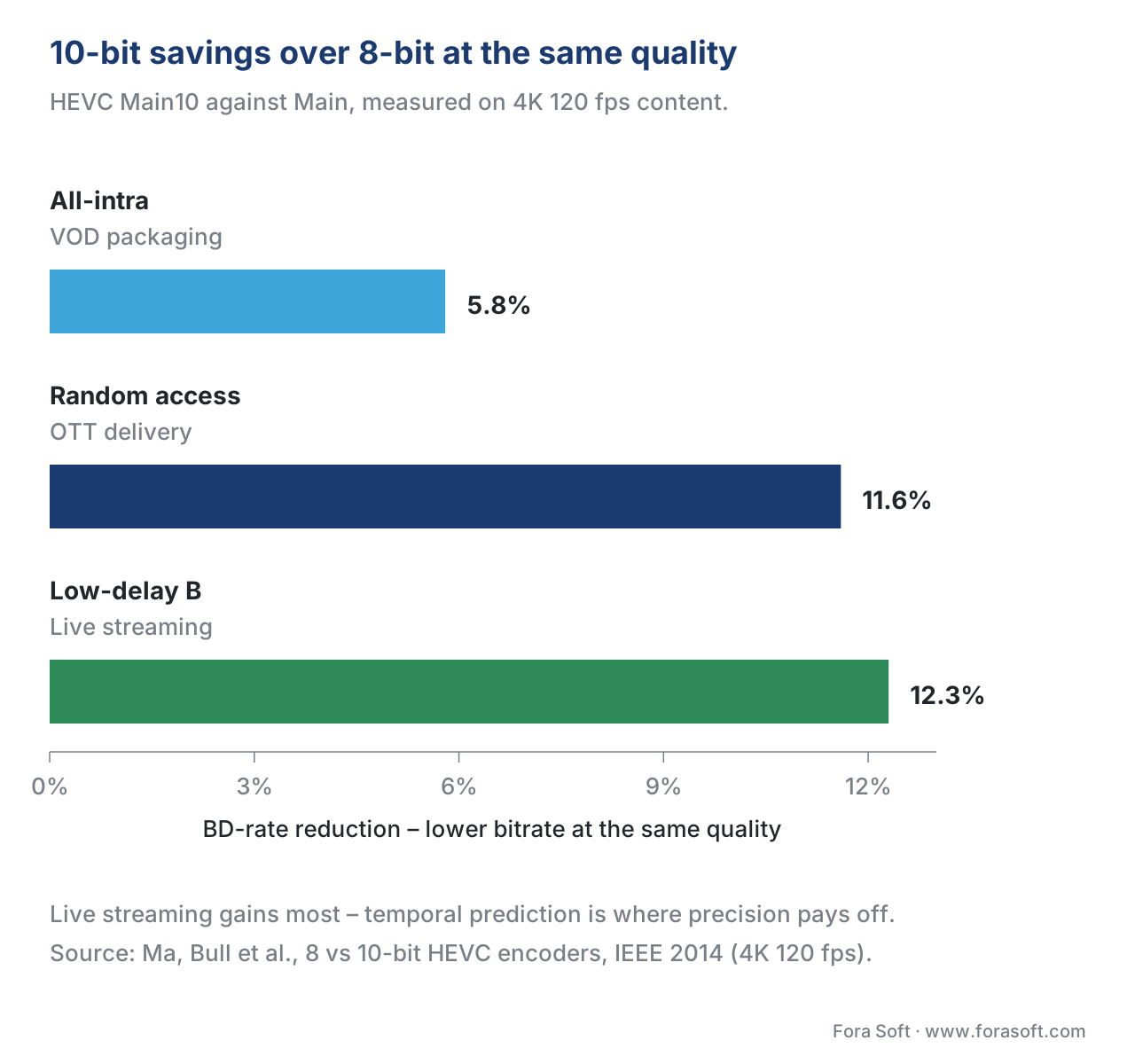 Figure 2. The compression win is real and consistent across encoder configurations. Live streaming benefits most because temporal prediction errors are where the precision pays off.
What "10-bit is just for HDR" got right (and where it stops being true)
The myth started somewhere reasonable. HDR formats — HDR10, HDR10+, Dolby Vision, HLG — all require 10-bit at a minimum because their brightness range is roughly an order of magnitude larger than SDR, and 8 bits over that wider range produces banding even at content the human eye can resolve. The HDR10 specification mandates 10-bit; HDR10+ mandates 10-bit; Dolby Vision can run at 10 or 12. So for HDR, the question is not "8 or 10" — the answer is "10 minimum, 12 if you can".
The myth fills in the converse incorrectly: if you are not doing HDR, then 8-bit is fine. The first half of the sentence is true; the second half does not follow.
Where the myth held up in the past was in three real constraints:
First, hardware decode. Five years ago, a meaningful share of consumer devices could decode 8-bit H.264 but not 10-bit HEVC, and even fewer could handle 10-bit AV1. Pushing 10-bit streams to those devices meant either software fallback (battery-draining on phones) or no playback at all. As of 2026, mobile platforms broadly support 10-bit HEVC and 10-bit AV1 in hardware on flagship chipsets, and Android's MediaCodec exposes HEVC Main10, VP9 Profile 2, and AV1 Main 10 at the maximum supported resolution per device.7 Apple Silicon (M-series and A-series since A12) decodes 10-bit HEVC in hardware; AV1 10-bit decode arrived on A17/M3 and is universal across the 2025 product line.8 The constraint that built the myth is fading.
Second, encoder speed. In the early HEVC days, 10-bit encoding was noticeably slower than 8-bit because the implementations were unoptimised. Today, the picture is different: in x265, the 10-bit and 8-bit code paths are vectorised identically, and the 2025 Fraunhofer study above quantifies the difference in CPU time as "minimal".6 Some encoders still ship with a per-frame speed gap on the order of 10–30%, and you should benchmark your own pipeline before assuming parity, but the days of "10-bit is twice as slow" are over.
Third, the upstream/downstream chain. Capturing 8-bit, encoding 10-bit, playing on an 8-bit display: the gain is real and explained in the previous section. But if any link in the chain truncates back to 8-bit — and YouTube's SDR ingest is exactly such a truncation — the 10-bit savings during the encode disappear in the platform's re-encode.9 For platforms you own the pipeline of, ship 10-bit and reap the gain. For platforms whose ingest will downsample, ship 8-bit and save the encode time.
What Netflix actually does (and what that tells you)
The clearest signal in the industry comes from Netflix, which has spent more engineering on its encoding pipeline than anyone else. Netflix's AV1 streams are encoded at 10-bit for both SDR and HDR at the highest available source resolution and frame-rate.10 Note the word "SDR". This is not an HDR-only decision. Netflix made this call because the perceptual quality gain on SDR content was big enough to justify the slightly larger raw-data cost and the slightly slower encode — exactly the trade-off the academic studies describe.
The scale tells you it works. As of December 2025, AV1 powers 30% of all Netflix streams, and Netflix expects it to become the top codec on the service in the near term.11 The codec they chose for that role, on the largest streaming pipeline in the world, runs at 10-bit on standard-dynamic-range content. That is the most expensive demonstration in production that "10-bit is just for HDR" is not how the industry actually operates.
A second data point: YouTube's encoded VP9 and AV1 streams for the HD and 4K ladders are also 10-bit, even though the user-facing surface is largely SDR.12 The pattern is consistent across the largest streaming services.
The trade-offs that are actually real in 2026
The fact that 10-bit pays off does not mean it is free. Three trade-offs still apply, and the right answer for your product depends on which one bites hardest.
Raw data overhead. 10-bit pixels cost about 25% more raw bits than 8-bit pixels before compression. After compression, that overhead becomes a net 5–12% saving thanks to internal-precision wins, but the file-size win is conditional on the compression having room to work. For very-low-bitrate streams (sub-500 kbps mobile feeds, for instance), the precision benefit can be eaten by the per-pixel overhead and the result lands at parity or slightly worse. Test your low-end ladder before committing.
Encoder speed. Most modern x264, x265, SVT-AV1, and libvpx builds run 10-bit roughly as fast as 8-bit at the same preset — a 5–20% delta depending on the codec and tuning. Hardware encoders (NVENC, QuickSync, VideoToolbox, NETINT VPU) vary more widely; some, like Apple VideoToolbox, run 10-bit HEVC at the same throughput as 8-bit; others, like older NVENC silicon, take a 30–50% throughput hit. Check your specific hardware before sizing the farm.
Toolchain ergonomics. A 10-bit pipeline means 10-bit-capable previews in your editor, 10-bit-capable QC viewers, 10-bit-aware VMAF/PSNR measurement, and a player tested against your 10-bit output. Most modern tools handle this, but the operational cost of upgrading a legacy pipeline is real and should sit in the project plan, not in a footnote.
Device support tail. Even in 2026, a small share of devices in the wild cannot decode 10-bit. For a streaming service serving a long-tail audience, this means you cannot drop the 8-bit ladder yet; you encode both and route by device. The CDN cost of duplicate ladders is bounded — segments are deduplicated by hash and most viewers pull only the 10-bit set — but the storage cost lives in the master library.
| Question | Most teams in 2026 |
|---|---|
| Source camera 8-bit, HEVC encode, AVOD/SVOD pipeline | 10-bit pays off; keep an 8-bit fallback ladder |
| Source 10-bit, HEVC encode, OTT delivery | 10-bit end-to-end |
| Source 8-bit, AV1 encode for premium tier | 10-bit; matches Netflix's choice |
| WebRTC real-time, sub-500 ms latency | 8-bit usually; 10-bit hardware support in real-time profiles is thinner |
| HDR delivery (HDR10, HDR10+, Dolby Vision) | 10-bit minimum, mandated by spec |
| YouTube SDR ingest | 8-bit; YouTube truncates 10-bit on the way in |
| Surveillance / archival evidence chain | 10-bit if the chain supports it; banding hides licence-plate detail |
The pattern is consistent: when you own enough of the pipeline to capture the savings, 10-bit is the right default in 2026. When the platform you ship into will truncate or doesn't decode 10-bit, ship 8-bit.
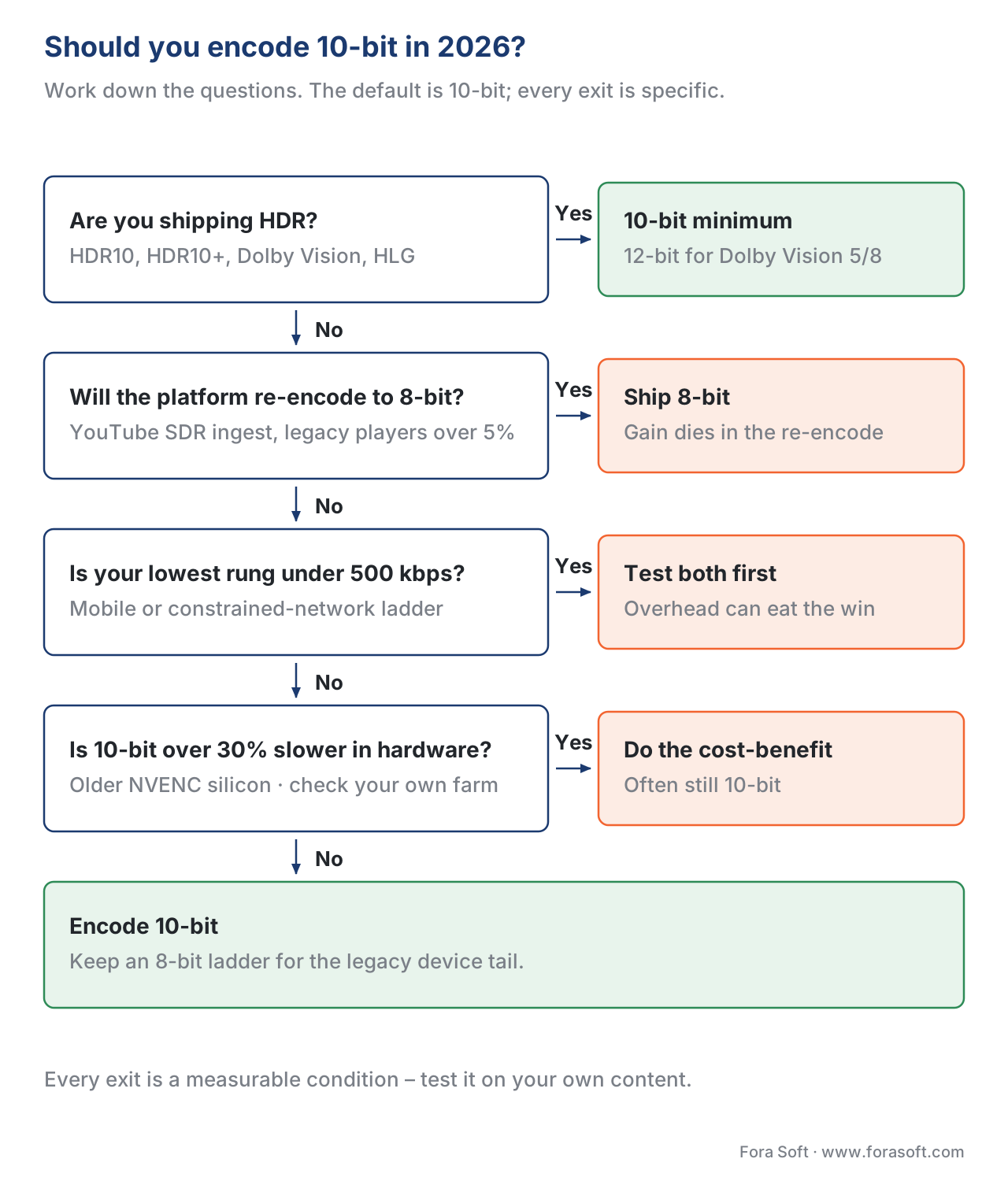 Figure 3. A pragmatic decision tree for 2026. The default is 10-bit; the exceptions are concrete.
A worked example: a 1080p VOD library at scale
To put the percentages in a budget, imagine a streaming service with 100,000 hours of 1080p SDR catalogue and an average HEVC bitrate of 3 Mbps per stream. The catalogue weighs 100,000 × 3,600 × 3,000,000 bits ÷ 8 = 135 TB. The CDN egress at 10× monthly catalogue plays is 1.35 PB.
Switch the encoder to HEVC Main10 with the same quality target (constant-quality, not constant-bitrate). The bitrate savings on the random-access HEVC configuration measure around 11–12% on real content of this type. The new catalogue weighs roughly 135 TB × 0.89 = 120 TB. CDN egress at the same play count drops to about 1.20 PB.
At a typical 2026 CDN price of $0.01 per GB egress on a tier-1 provider, the saving is (1,350,000 − 1,200,000) GB × $0.01 = $1,500 per month, or $18,000 per year, on a relatively small library. Scale the library or the play count by 10× and the saving scales linearly. The encode time and the hardware investment are one-time costs; the bandwidth saving compounds with every viewer-hour.
The arithmetic does not include the secondary win — fewer support tickets about banded skies and gradient artifacts, which a 10-bit pipeline materially reduces. That number is harder to quantify, but in projects we have shipped it shows up in the CSAT scores within a few months.
A common mistake: encoding 10-bit because "the source is 10-bit"
Engineers sometimes default to 10-bit because the camera shot 10-bit, and stop the analysis there. That is not a wrong instinct, but it is incomplete. The compelling case for 10-bit holds even when the camera was 8-bit, because the precision benefit lives in the encoder math, not in the source data. Conversely, a 10-bit camera source does not automatically need to ship as 10-bit — if the delivery target will truncate (consumer SDR display on a YouTube ingest), the 10-bit master is still useful in post-production but not in the final encode.
The right frame is not "match the source bit depth in the encode". It is "pick the bit depth that minimises bitrate at the perceptual quality target, given the encoder, the platform, and the device mix". That frame keeps you correct in every case the source-matching shortcut gets wrong.
Free download: 8-Bit vs 10-Bit Decision Cheat SheetOne-page reference: when 10-bit pays off, when 8-bit is fine, encoder flags per codec (x264, x265, SVT-AV1, libvpx, hardware), and the 2026 device-support floor.Where Fora Soft fits in
We build video-streaming, OTT, e-learning, telemedicine, video-surveillance, and AR/VR systems where bit-depth decisions show up in the line items every month. In OTT and e-learning deployments we routinely encode SDR catalogues at 10-bit HEVC or 10-bit AV1, because the 5–12% bandwidth saving is exactly the kind of structural cost reduction the business plan rewards. In telemedicine and surveillance projects the decision is even sharper — 10-bit reduces banding on the diagnostic imagery and on the low-light footage that surveillance archives live in. The pattern under all of it is the same: measure the savings on your real content, factor in your real encoder throughput, then default to 10-bit unless a specific constraint pushes you back to 8.
The book
Video Encoding: A Complete Guide to Video Compression
This article settles one default; the book carries the measurements behind it. Bit depth gets worked through end to end — what 8, 10 and 12 bits cost in raw samples, why higher internal precision shrinks the residual before quantisation, and where the banding threshold actually sits on the contrast-sensitivity curve. The codec chapters then show the same decision inside each encoder: x265's native 10-bit and bit-shift paths, SVT-AV1's Main 10 profile, and what hardware silicon does to throughput when you flip the flag. Written by Nikolay Sapunov, CEO at Fora Soft.
Is your ladder still 8-bit because nobody re-ran the numbers?
Send us your encoder settings and a couple of representative sources, and we will measure what 10-bit is actually worth on your content: the BD-rate delta at your quality target, what it does to your lowest rung, what your own encoder farm loses in throughput, and how much of your audience still needs the 8-bit ladder. You get numbers from your catalogue, not from a paper. 250+ video products shipped since 2005.
See our case studies
Case study
Worldcast Live
Concert streaming at 1.5 Gb/s with 0.4–0.5 s latency to 10,000 simultaneous viewers. At that egress, the 11–12% a 10-bit ladder returns at matched quality is a line in the monthly invoice, not a benchmark footnote.
Case study
Speed.Space
Remote production used on Netflix, EA and HBO shoots, recording at 1080p / 8 Mbps with per-shoot control of resolution, fps, codec and bitrate. This is the end of the chain where a 10-bit master still has somewhere to go.
Case study
Mindbox
AI video management in 50+ deployments, running RTSP cameras through FFmpeg into HLS. Surveillance archives live in low light, which is exactly the flat, dark gradient where 8-bit quantisation shows its steps.
What to read next
Foundations
Bit Depth: 8, 10, 12 Bits and the Banding Problem
The signal underneath this decision: what a bit of depth buys in the first place, and why the eye finds the seams on a flat gradient.
Foundations
The Complete Guide to HDR: HDR10, HDR10+, Dolby Vision, and HLG
The one branch where 10-bit is not a choice. What each format mandates, and what a 12-bit Dolby Vision pipeline asks of you.
Tooling
Hardware Acceleration: GPU, VPU, ASIC
Where the throughput penalty in the decision tree comes from. NVENC, QuickSync, VideoToolbox and NETINT do not pay for 10-bit the same way.
Delivery
Per-Title and Per-Scene Encoding: Smart Bitrate Ladders
The next lever on the same bill. Once the bit depth is settled, stop spending a fixed bitrate on content whose complexity moves shot by shot.
-
Mannos, J. L., Sakrison, D. J. (1974). "The Effects of a Visual Fidelity Criterion on the Encoding of Images." IEEE Transactions on Information Theory. The eye's contrast sensitivity for smooth gradients explains why banding is so visible on flat surfaces. https://ieeexplore.ieee.org/document/1055349. Accessed 2026-05-16. ↩
-
x265 project documentation — internal-bit-depth and the rationale for 10-bit math on 8-bit content. https://x265.readthedocs.io/en/latest/cli.html. Accessed 2026-05-16. ↩
-
Wang, S., Zeng, K., Rehman, A., Wang, Z. (2017). "Perceptual Evaluation of Psychovisual Rate-Distortion Enhancement in Video Coding." University of Waterloo. Higher-precision rate-distortion decisions reduce suboptimal mode picks. https://ece.uwaterloo.ca/~z70wang/publications/HVEI17_PsyRD.pdf. Accessed 2026-05-16. ↩
-
Ma, D., Bull, D. R. et al. (2014). "Comparative study of 8 and 10-bit HEVC encoders." IEEE conference paper. Measured BD-rate savings of 10-bit Main10 over 8-bit Main on 4K 120 fps content: 5.8% AI / 11.6% RA / 12.3% LB. https://ieeexplore.ieee.org/document/7051626/. Accessed 2026-05-16. ↩
-
x264 development notes and community benchmarks: 10-bit x264 builds typically show 5–7% bitrate savings over 8-bit at matched quality. https://forum.doom9.org/archive/index.php/t-175143.html. Accessed 2026-05-16. ↩
-
Menon, V., Jenkner, C., Ronca, D. et al. (2025). "Do We Need 10 Bits? Assessing HEVC Encoders for Energy-efficient HDR Video Streaming." x265 native-10-bit and bit-shift configurations deliver superior RD efficiency with minimal CPU-cost delta. https://www.researchgate.net/publication/388342061_Do_We_Need_10_Bits_Assessing_HEVC_Encoders_for_Energy-efficient_HDR_Video_Streaming. Accessed 2026-05-16. ↩↩
-
Android MediaCodec documentation — supported codec profiles and the per-device maximum resolution table, including HEVC Main10, VP9 Profile 2, and AV1 Main 10. https://developer.android.com/reference/android/media/MediaCodec. Accessed 2026-05-16. ↩
-
Apple Developer documentation — AV1 hardware decode support across A17/M3 and the 2025 device line. https://developer.apple.com/documentation/avfoundation. Accessed 2026-05-16. ↩
-
YouTube Help — recommended upload encoding settings and BT.709 SDR pipeline. YouTube re-encodes uploads and ships 8-bit SDR output regardless of source bit depth. https://support.google.com/youtube/answer/1722171. Accessed 2026-05-16. ↩
-
Aaron, A. et al. (2020). "Bringing AV1 Streaming to Netflix Members' TVs." Netflix TechBlog. AV1 encoded at 10-bit for SDR at the highest source resolution and frame-rate. https://netflixtechblog.com/bringing-av1-streaming-to-netflix-members-tvs-b7fc88e42320. Accessed 2026-05-16. ↩
-
Netflix Technology Blog (2025-12). "AV1 — Now Powering 30% of Netflix Streaming." AV1 share of Netflix viewing crossed 30% in late 2025. https://netflixtechblog.com/av1-now-powering-30-of-netflix-streaming-02f592242d80. Accessed 2026-05-16. ↩
-
YouTube engineering notes and ffprobe analyses of public VP9 / AV1 streams on the HD and 4K ladders show Profile 2 (10-bit) for higher renditions on most large channels. https://en.wikipedia.org/wiki/VP9. Accessed 2026-05-16. ↩
