


Why This Matters
Every video product team will face the same decision twice a decade: when do we change codec, and how much will it cost. AV2 is the next instance of that decision for anyone shipping streaming, conferencing, surveillance, e-learning, telemedicine, or OTT. The choice ripples through encoding cost, CDN bills, device compatibility, support backlog, and licensing exposure. This article gives product managers, founders, marketing leads, and operations people enough technical grounding to plan with their engineers, talk to vendors, and avoid the two classic mistakes: jumping in too early, or sitting still while a competitor's stream is one-third smaller than yours.
What AV2 Is, in Plain Language
A video codec — short for coder–decoder — is a piece of software (or a chip) that turns raw video into a much smaller stream of bits and then back again on the viewer's device. Think of the codec as a compression algorithm specialised for moving pictures. The codec your service uses today is almost certainly H.264 (also called AVC), H.265 (HEVC), or AV1.
AV2 is the successor to AV1. It is being developed by the Alliance for Open Media (AOMedia), a non-profit consortium founded in 2015 by Amazon, Apple, ARM, Cisco, Google, Intel, Meta, Microsoft, Mozilla, Netflix, NVIDIA and Samsung, joined later by AMD, Tencent, Huawei and others. Its declared mission for AV2 mirrors what AV1 promised in 2018: a modern codec with no per-stream royalty fee, governed in the open, designed for the way people watch video on the modern internet rather than for cable television.
The headline number from AOMedia and from Netflix's Andrey Norkin, who co-chairs the Codec Working Group, is roughly 30% lower bitrate at matched perceptual quality compared to AV1. In the internal AOMedia tests reported in 2025, AV2 showed a 28.63% reduction in PSNR-YUV BD-rate and a 32.59% reduction on the VMAF metric, with some 4K test sets reaching close to 40%.
To make those abstract numbers feel concrete: a 4K stream that needs 12 Mbps on AV1 today should need about 8.4 Mbps on AV2 at the same picture quality. Bitrate is the speed at which video data flows, measured in megabits per second (Mbps). One Mbps is one million bits per second. Lower bitrate at matched quality means smaller storage, cheaper delivery, and more headroom for people on slow Wi-Fi or older mobile networks.
Where AV2 Sits Relative to AV1 and the MPEG Codecs
Modern video has two parallel codec families. AOMedia ships open, royalty-free codecs (VP9, AV1, soon AV2). The Moving Picture Experts Group (MPEG), under ISO/IEC, ships standardised codecs that come with patent royalties (H.264, H.265, H.266 / VVC). For a non-technical reader, the simple model is: AOMedia codecs are free to use but you have to wait for chip vendors to add hardware decoders; MPEG codecs come with a licence fee but historically had a faster path into TVs and set-top boxes.
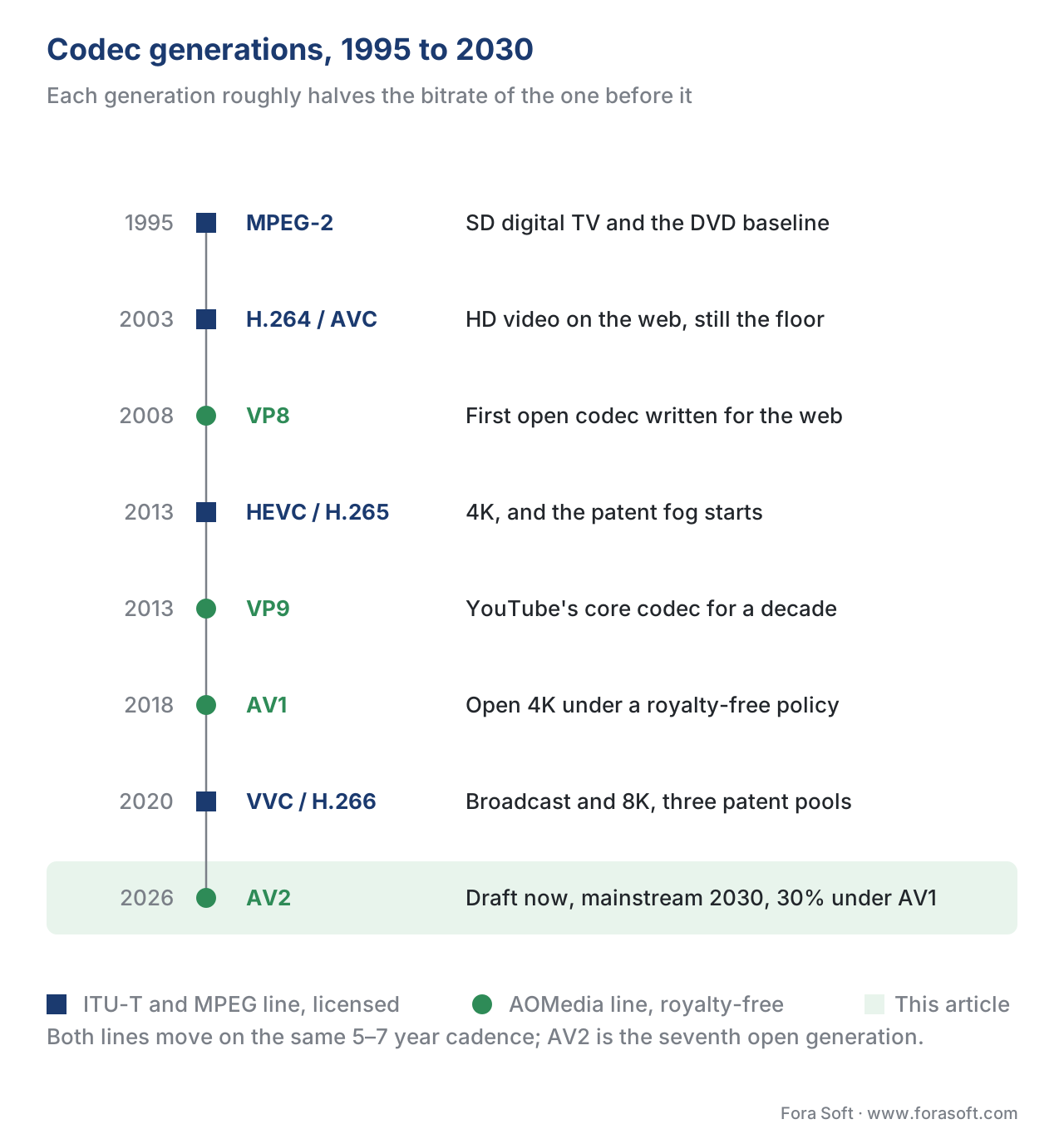 Figure 1. AV2 in the codec generation stack. Each generation roughly halves the bitrate of the one before, on a five-to-seven-year cadence, and the open AOMedia line runs in parallel with the licensed ITU-T and MPEG one.
The shape of the next five years looks like a two-codec world: AV2 on the open-internet side, H.266 / VVC on the broadcast and premium-OTT side. LCEVC sits across both as an enhancement layer rather than a competitor. AV1 itself does not go anywhere in 2026 — it stays the workhorse for new deployments while AV2 hardware is still rolling out.
What Changed Under the Hood
AV2 keeps the hybrid block-based architecture that has powered every mainstream codec since H.261 in 1988. The video is cut into rectangular blocks, each block is predicted from blocks already decoded, the prediction error is transformed and quantised (rounded with controlled loss), the result is run through an entropy coder, and a set of loop filters smooths the output before it is shown to the viewer. Nothing in AV2 throws that architecture away. The 30% gain comes from dozens of small improvements to every stage, not from one revolutionary tool.
The biggest visible changes are the following.
Larger superblocks. A superblock is the largest unit AV2 will analyse as one piece — like the size of the tile a tiler can pick up at once. AV1 stops at 128×128 pixels. AV2 doubles that to 256×256, and lets the encoder split the superblock recursively into many more shapes than AV1 allowed. Larger units help with smooth backgrounds and 4K / 8K content where neighbouring pixels are highly redundant.
A richer transform toolkit. After prediction, the leftover difference between the prediction and the real block is passed through a mathematical transform that concentrates the visible information into a few large numbers. AV2 adds Intra/Inter Secondary Transforms (IST), Adaptive Transform Coding (ATC), and Cross-Chroma Component Transforms (CCTX). It also replaces AV1's recursive quad-tree transform partitioning with a flat partitioning scheme that needs less memory.
Smarter probability modelling. The entropy coder is the final pack-down stage that turns the quantised numbers into the actual bitstream. AV2 keeps AV1's multi-symbol arithmetic coder but adds Probability Adaptation Rate Adjustment (PARA), Forward Skip Coding (FSC), and Parity Hiding (PH) — small tools that each shave a fraction of a percent off the bitrate and add up to a useful share of the overall gain.
Neural in-loop filtering. A loop filter is the post-processing step inside the codec that removes the blocky artefacts you sometimes see at low bitrate. AV2 ships with a small convolutional neural network called SimNet alongside the traditional deblocking, Sample Adaptive Offset (SAO), and Cross-Component Sample Offset filters. SimNet only fires on certain frames; on the rest, the cheaper classical filters do the work. Independent benchmarks report roughly 5–7% extra BD-rate savings from learned in-loop tools.
Better chroma from luma. Human eyes see brightness changes much more sharply than colour changes. Every modern codec exploits that by transmitting brightness (luma) at full resolution and colour (chroma) at lower resolution, then predicting the colour from the brightness. AV2 has a better chroma-from-luma model and partially decouples how luma and chroma are split, which is particularly visible on cartoons, screen content, and faces.
Native multi-stream and immersive support. AV2 adds first-class encoding for stereoscopic 3D, multi-angle sports, and split-screen layouts, with a single bitstream carrying the secondary view as a thin delta. For volumetric and 360° video, the wider quality range and more flexible partitioning matter more than any single new tool.
 Figure 2. AV1 and AV2 share the same hybrid pipeline. Orange marks a stage AV2 rebuilt, green a stage where it brings a tool AV1 did not have.
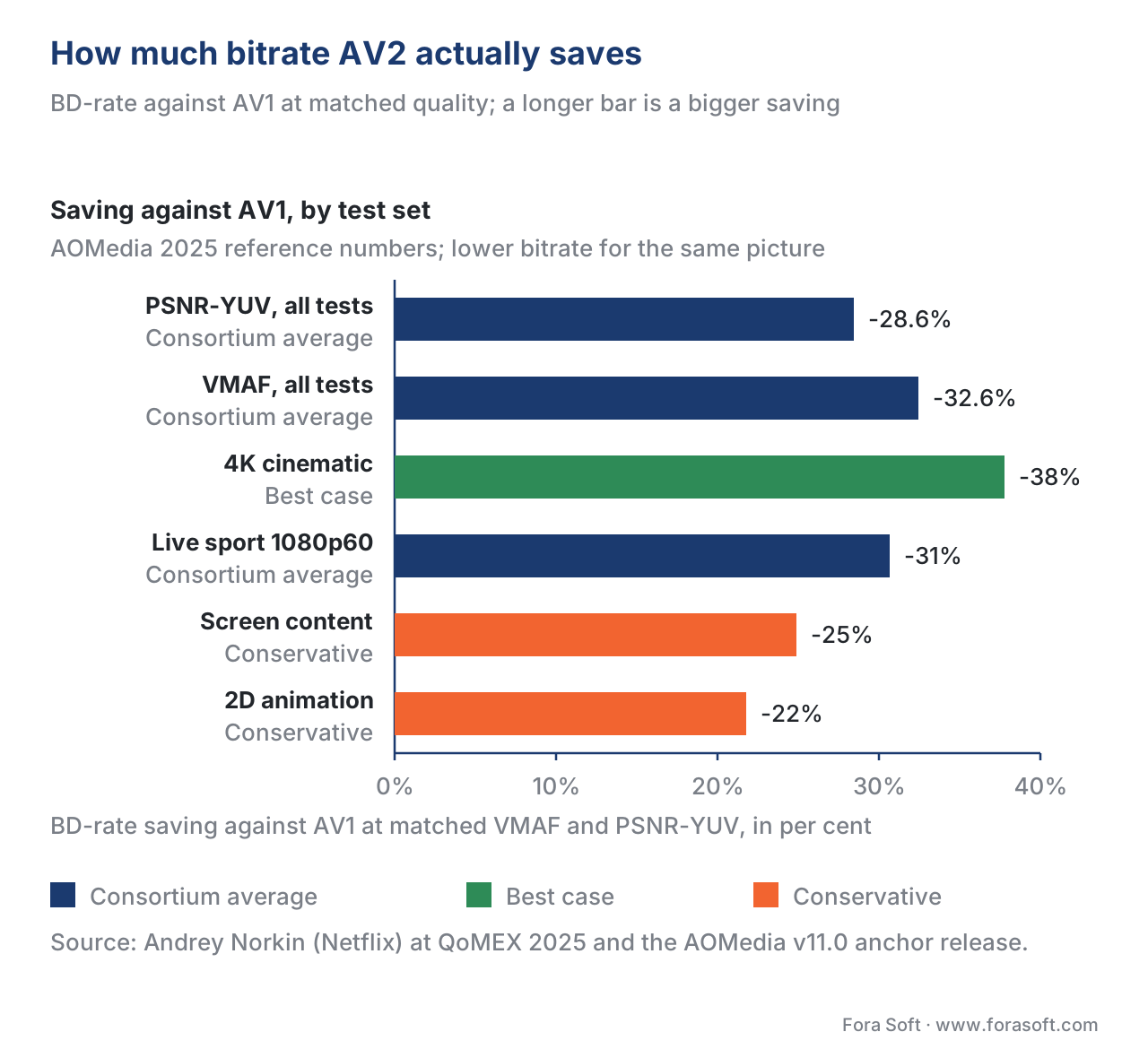 Figure 3. What AV2 saves against AV1, by test set. The consortium averages are 28.6% on PSNR-YUV and 32.6% on VMAF; 4K cinematic reaches 38%, while screen content and 2D animation save the least — which is why “30%” is a planning figure, not a guarantee for your library.
A Worked Example: What a 30% Bitrate Cut Buys You
The 30% bitrate saving sounds abstract until you turn it into money. Consider a regional streaming service that delivers one billion minutes of video per month at an average AV1 bitrate of 3 Mbps for 1080p. Egress traffic with that profile is:
1,000,000,000 min × 60 s × 3 Mbps ÷ 8 bits/byte
= 22,500,000,000 MB
≈ 22.5 PB per month
At a representative tier-1 CDN price of $0.020 per GB, that comes to about $450,000 per month, or $5.4 million per year, in egress alone.
Move the same library to AV2 at 70% of the bitrate (the 30% reduction) and you reach roughly $315,000 per month, a saving of about $135,000 per month or $1.6 million per year, before counting the storage saving, the lower client-side data charges, and the reduced complaint rate from mobile viewers. The other side of the ledger is the encoding cost: AV2 reference software encodes at roughly 0.8–1.2 frames per second for 4K today, which means production deployments will need either large CPU farms or accelerated hardware. Realistically, the savings only break even once the second wave of cloud transcoders ships AV2-capable VPUs, expected in 2027–2028.
The Royalty-Free Promise — and Its Caveats
AV2's most powerful selling point is the same as AV1's: it is being developed under AOMedia's royalty-free patent policy. Every member contributes its patents into a common pool and agrees not to charge per-stream fees. For services that ship hundreds of millions of hours of video per month, that policy alone can be worth more than the bitrate saving.
The caveat is the same one AV1 faced. Royalty-free is a promise from the consortium members, not from every patent holder in the world. The Luxembourg-based licensing firm Sisvel has already announced that it will run an AV2 patent pool, just as it did for AV1, and is signing up patent owners that are not AOMedia members. Sisvel licensed roughly half of the AV1 finished-product market by 2024, although most of those licences are paid by device manufacturers and not by streaming services. Anyone planning an AV2 deployment should treat the licensing posture as "very likely free for streaming services, almost certainly priced for device manufacturers" and have legal counsel monitor the patent-pool announcements quarterly.
A Realistic Adoption Timeline
Codec history has a consistent shape. The specification finalises. Software encoders mature over the next two years. The first dedicated hardware decoder appears 18–36 months after spec finalisation. Mainstream device coverage follows two to three years later. Streaming services typically start serious deployment when 30–40% of their audience has hardware decode, because below that line the CPU cost of software decoding on phones is too painful for battery life.
Mapping that pattern to AV2 gives the picture below.
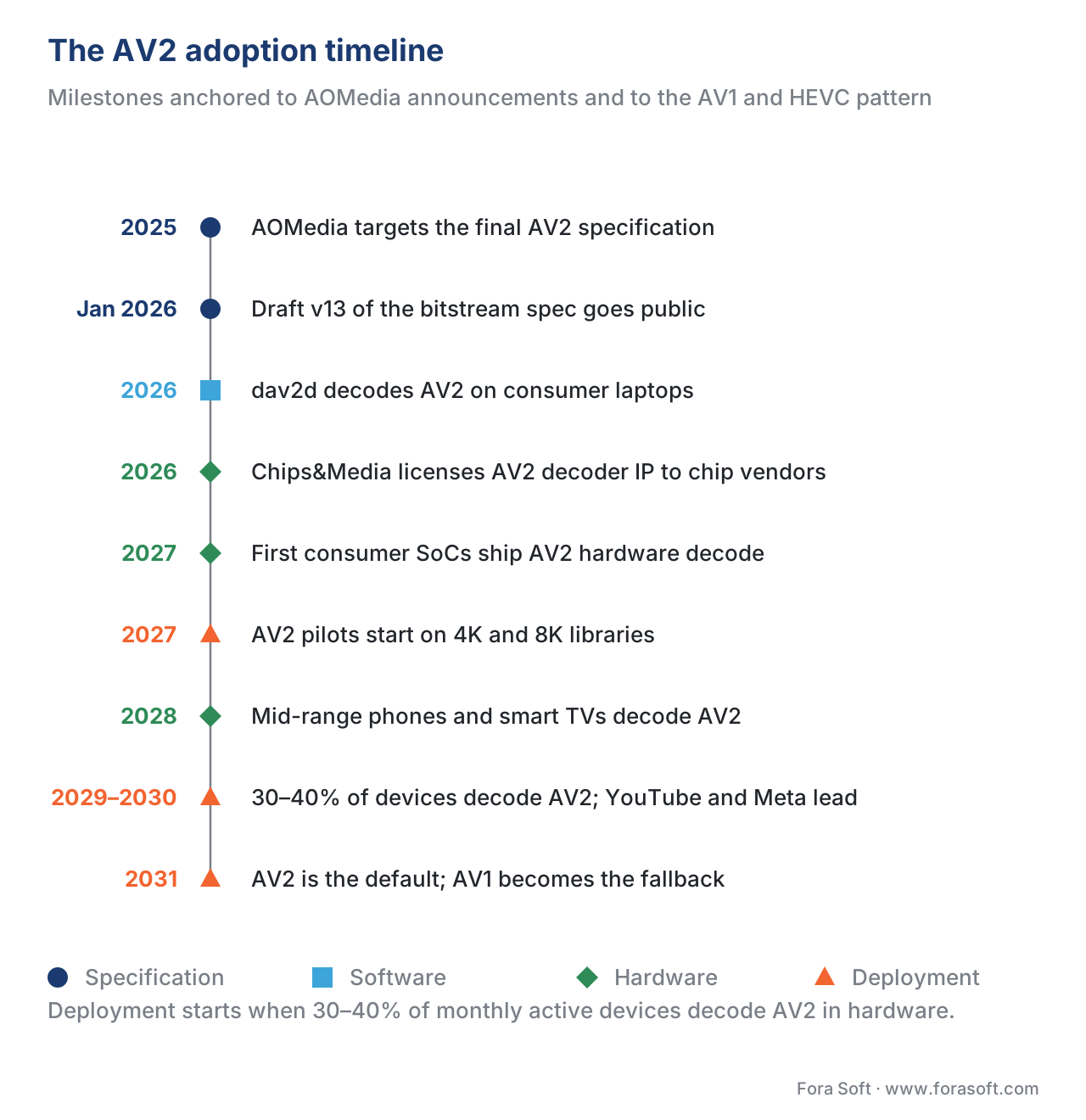 Figure 4. The probable AV2 adoption timeline. Each milestone is anchored to a public announcement or to a well-established adoption pattern from H.265 and AV1.
The dates worth tattooing on a planning document are these. End of 2025: AOMedia's announced target for the AV2 final specification. January 2026: first public draft of the bitstream spec lands. 2026: VideoLAN's dav2d software decoder reaches usable performance on consumer laptops; Chips&Media licenses AV2 hardware decoder IP to chip vendors. 2027: first consumer SoCs ship with AV2 hardware decoders, similar to how the Intel Arc, NVIDIA RTX 40, and AMD RX 7000 generations introduced AV1 decode in 2022–2023. 2028: AV2 hardware decode arrives in mid-range smartphones and smart TVs. 2029–2030: AV2 crosses the 30–40% audience threshold for ad-supported and subscription streaming; YouTube and Facebook lead, premium publishers follow once DRM ecosystems and HDR profiles stabilise. 2031 and beyond: AV2 becomes the default for new deployments, AV1 becomes the legacy fallback, and AOMedia's working groups start sketching the next generation.
This timeline is conservative on purpose. The AV1 schedule slipped repeatedly between 2016 and 2018, and several of the experimental tools that did not make it into AV1 ended up in AV2 instead. There is no reason to assume AV2 will run any faster.
How AV2 Compares to Its Peers
The codec landscape in 2030 will not be AV2 alone. The table below summarises the four codecs a product team has to weigh.
| Codec | Sponsor | Royalty model | Bitrate vs AV1 | Hardware decode timing | Best fit |
|---|---|---|---|---|---|
| AV1 | AOMedia | Royalty-free policy | baseline | Mainstream from 2023 | Today's default for new web streaming |
| AV2 | AOMedia | Royalty-free policy | ~30% lower | Mainstream 2028–2030 | The 2028+ replacement for AV1 |
| H.266 / VVC | MPEG / ISO/IEC | Multi-pool licences | ~10–15% lower | Mainstream 2027–2029 | Broadcast, 8K TV, premium OTT |
| LCEVC (MPEG-5 Part 2) | MPEG / V-Nova | V-Nova fee per device | not directly comparable; adds 20–40% on top of base | Software now | Add-on layer on H.264, HEVC, AV1, or AV2 |
A useful way for a non-technical reader to think about this: AV2 and VVC are roughly the same generation, and most teams will pick one based on licensing posture and audience, not on a 5% bitrate gap. LCEVC is orthogonal to the pick — it can extend whichever base codec a service runs.
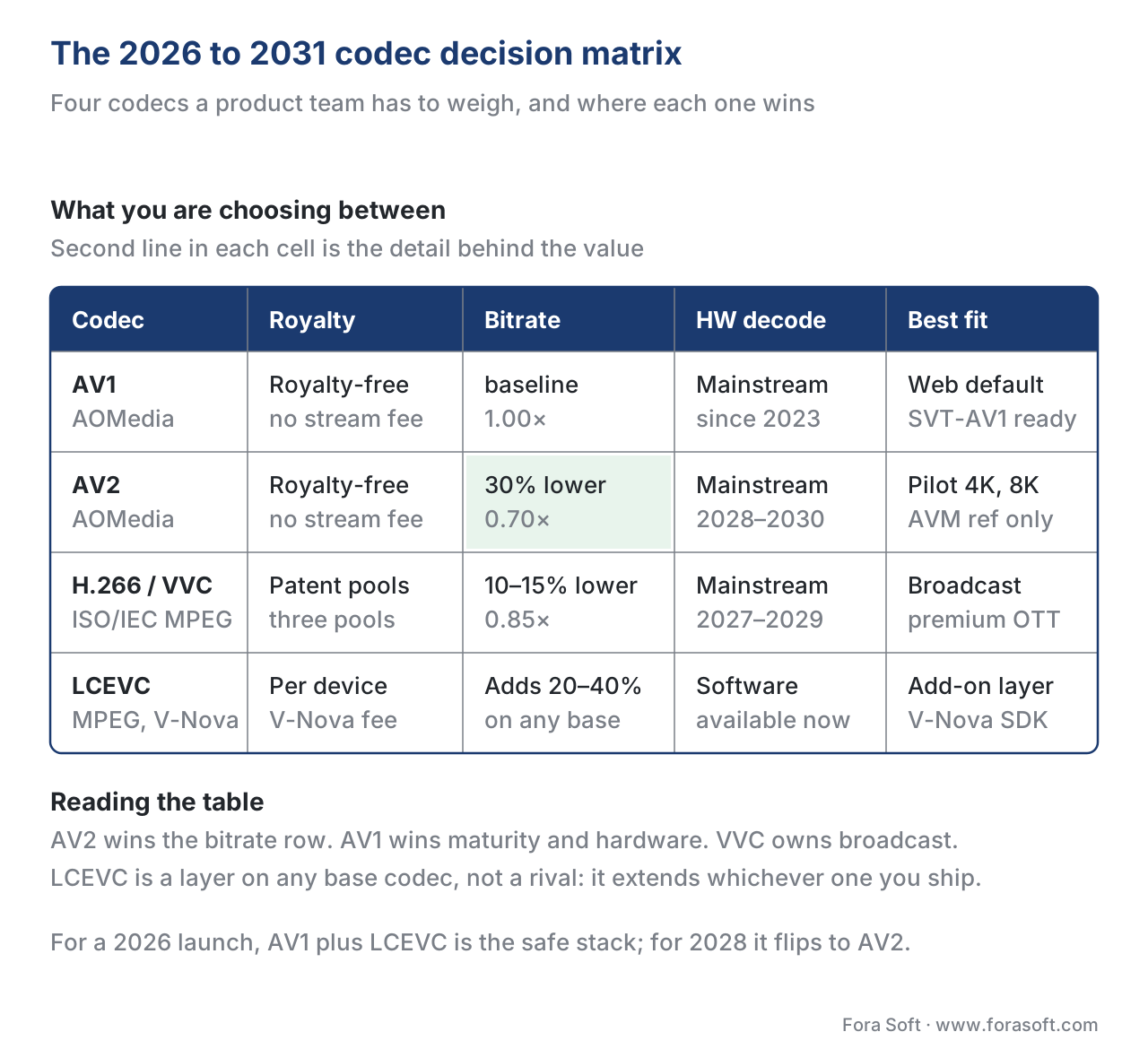 Figure 5. The same four codecs on the dimensions a product team actually weighs. AV2 wins the bitrate row; AV1 wins hardware coverage and encoder maturity, which is why it is still the 2026 pick.
Common Mistake: Treating AV2 as a 2026 Migration Project
The single most expensive mistake we see in client roadmaps is treating AV2 the way teams once treated AV1 in 2020: as something to bolt onto next year's plan. AV2 in 2026 is in the same place AV1 was in 2019 — a draft specification, a slow reference encoder, no consumer hardware decoders, and a tiny addressable audience. Putting AV2 in your 2027 OKRs as a delivery codec will burn engineering hours for no measurable business outcome. The right shape of a 2026 plan is a small AV2 pilot, an explicit metric for when AV2 graduates from pilot to staged rollout (we recommend ≥ 25% of monthly active devices with hardware decode), and a yearly review of that metric against the published silicon roadmap.
What This Means for Different Verticals
Video streaming and OTT. Keep AV1 as the workhorse through 2028, with a software-fallback ladder that already includes H.264. Pilot AV2 on 4K and 8K content from 2027, where the bitrate saving is biggest and the audience is most likely to have AV2-capable hardware.
Video conferencing. AV2 is less interesting in the short term because real-time conferencing is dominated by software encoders, where AV2's 1.2× encode complexity bites hard. The next two product cycles still belong to AV1 and to optimised H.264 / H.265 software stacks.
Live and contribution. AV2 will not be a live codec until 2028 at the earliest. The interesting near-term move is to deploy AV1 in live with hardware-accelerated NETINT, Intel, or NVIDIA encoders, which mature in 2026.
Surveillance, e-learning, telemedicine. These verticals are dominated by H.264 and H.265 for compliance and edge-device reasons. AV2 will show up here last; plan for 2030 at the earliest.
AR / VR and volumetric. This is where AV2 might be adopted earliest in a serious commercial way, because the multi-stream and wider visual-quality features are written for these workloads, and the audience is small enough that software decoding on flagship devices is acceptable.
Free download: AV2 Readiness Scorecard 2026One-page A4 reference: the AV2 identity card, the codec comparison snapshot from this article, a seven-question readiness scorecard, and the 2026–2031 adoption timeline.Where Fora Soft Fits In
Fora Soft has shipped video streaming, WebRTC conferencing, surveillance, e-learning, telemedicine, OTT, and AR/VR systems since 2005, with 239+ projects delivered. The codec layer is one of the most consequential decisions in any of those builds, and AV2 will sit at the centre of it from 2027 onwards. We advise clients on codec roadmap, run side-by-side quality benchmarks on their real content, and design encoding ladders that age well as the silicon landscape shifts. For teams making a codec decision this year, the playbook is more about discipline than ambition: pick what your audience can decode today, build a measurable upgrade path, and resist anything that demands engineering time in advance of business value.

The book
Video Encoding: A Complete Guide to Video Compression
This article names the stages AV2 rebuilt; the book takes each of them apart. Superblock partitioning, the transform toolkit, quantisation, the multi-symbol entropy coder and in-loop filtering all get their own chapters, so the 30% headline reads as arithmetic over six stages rather than as a press number. The measurement chapters explain how a BD-rate figure like 28.6% on PSNR-YUV or 32.6% on VMAF is produced, and what changes when the test set does. It is volume 1 of the seven-volume Fora Soft Video Engineering Handbook, 1,522 pages, written by Nikolay Sapunov, CEO at Fora Soft.
When should AV2 enter your codec roadmap?
Send us your device and browser analytics, your current ladder and your monthly egress, and we will come back with three numbers: what an AV1 rung is already saving you, what share of your audience will have AV2 hardware decode in each of the next five years, and the year at which an AV2 rung starts paying for its own encode cost. You get the dates on your own traffic, not on a consortium test set. 250+ video products shipped since 2005.
See our case studies
Case study
Speed.Space
Remote production recording at 1080p and 8 Mb/s for Netflix, Electronic Arts and HBO shoots, where creators pick resolution, fps, codec and bitrate per stream. This is the ladder question of this article in miniature: which rung carries which codec, and who can play it.
Case study
Worldcast Live
Concert streaming at 1.5 Gb/s with 0.4–0.5 s latency to 10,000 simultaneous viewers. It is the row where AV2 is not an option before 2028: at that latency budget the encoder has to be silicon, and AV2 silicon does not exist yet.
Case study
Mindbox
An AI video management system on RTSP, FFmpeg and HLS with 50+ deployments across transport, pharma and gated communities. Surveillance is the vertical this article puts last for AV2: the edge devices are fixed, H.264 and H.265 are what they speak, and 2030 is the earliest realistic date.
What to read next
Codecs
AV1: The New Internet Standard And Where It Stands In 2026
The codec AV2 is measured against, and the one you actually ship until the silicon arrives: encoders, presets and hardware coverage.
Codecs
H.266 / VVC: Technically Excellent, Market-Weak
The other half of the two-codec world above: same generation as AV2, better broadcast story, three patent pools attached.
Codecs
How To Choose A Codec For Your Service In 2026: A Decision Tree
The matrix in Figure 5, worked through branch by branch, with the numbers behind each decision and the cost of getting it wrong.
Architecture
Hybrid Video Codec Architecture
The pipeline AV2 keeps, stage by stage: what each block does, and why a 30% gain comes from dozens of small changes rather than one.
References
- Alliance for Open Media. AV2 Specification, draft v13. January 2026. https://av2.aomedia.org/v13-public/index.html
- AOMedia. AOMedia Announces Year-End Launch of Next Generation Video Codec AV2 on 10th Anniversary. Press release, 2025. http://aomedia.org/press%20releases/AOMedia-Announces-Year-End-Launch-of-Next-Generation-Video-Codec-AV2-on-10th-Anniversary/
- Norkin, A. AV2 Video Codec Architecture. QoMEX 2025 keynote, Netflix. https://norkin.org/pdf/QoMEX_2025_AV2_Architecture_slides.pdf
- AOMedia. Demonstrating Real-Time AV2 Decoding on Consumer Laptops. AOMedia blog, 2025. http://aomedia.org/blog%20posts/Demonstrating-Real-Time-AV2-Decoding-on-Consumer-Laptops/
- arXiv. Transform and Entropy Coding in AV2, 2601.02712. https://arxiv.org/abs/2601.02712
- Streaming Learning Center. Inside AV2: Architecture, Performance, and Adoption Outlook. 2026. https://streaminglearningcenter.com/codecs/inside-av2-architecture-performance-and-adoption-outlook.html
- Streaming Media. AV2 Arriving: What We Know, and What We Don't Know. 2025. https://www.streamingmedia.com/Articles/News/Online-Video-News/AV2-Arriving-What-We-Know-and-What-We-Dont-Know-171548.aspx
- CNX Software. AOMedia AV2 video codec draft specification release, and a quick try at the reference implementation. February 2026. https://www.cnx-software.com/2026/02/03/aomedia-av2-video-codec-draft-specification-release-and-a-quick-try-at-the-reference-implementation/
- Sisvel. AV2 is coming, Sisvel is prepared. 2026. https://www.sisvel.com/insights/av2-is-coming-sisvel-is-prepared/
- Edge AI and Vision Alliance. Chips&Media Completes Development of Next-Gen AV2 HW Decoder IP. May 2026. https://www.edge-ai-vision.com/2026/05/chipsmedia-completes-development-of-next-gen-av2-hw-decoder-ip/
- OTTVerse. AV2 Video Codec — Early Performance Evaluation of the Research. 2025. https://ottverse.com/av2-video-codec-evaluation/
- Streaming Media. The State of Streaming Codecs 2026. https://www.streamingmedia.com/Articles/Editorial/Featured-Articles/The-State-of-Streaming-Codecs-2026-173838.aspx
