


Why This Matters
If you run a streaming product, a video conferencing service, an OTT or Internet TV platform, an e-learning catalogue, a video surveillance archive, or any product that pushes video over the public internet, the question "should I move to VVC" is the wrong question — and yet you'll see vendors and analyst decks pitching it as if it were the next obvious step after H.264 → HEVC → AV1. The real question is "where does VVC actually win in 2026", and the honest answer has narrowed sharply since the codec was published in 2020. VVC is the right codec for broadcast, satellite, 8K, immersive content, and any pipeline where the encoder runs once on big iron and the decoder is a piece of silicon you control. VVC is not the right codec where the decoder is the end user's web browser, because the end user's browser does not ship VVC and shows no signs of doing so. The cost of getting this wrong is large: a year of engineering spent encoding into a codec your customers' devices cannot play, or — equally bad — a year of CDN egress spent on H.264 fallbacks while a competitor ships AV1 and pays 30% less for the same delivery.
This article is the definitive 2026 map of what VVC actually is, why JVET built it, what its compression engine does differently from HEVC and AV1, where the encoders and decoders are today, who has paid the patent pools, what Brazil's TV 3.0 launch and ATSC 3.0's VVC adoption mean in practice, and how to read the gap between the codec's technical accomplishment and its market position. You do not need prior codec knowledge to follow it — every term is defined in plain language before it appears. If you have not yet read H.265 / HEVC: +50% Over H.264 And The Patent Nightmare, AV1: The New Internet Standard And Where It Stands In 2026, and the Codec Comparison Matrix, those three articles are useful prerequisites. VVC's market-weak position is a direct consequence of decisions made during and after HEVC's licensing collapse, and you cannot understand VVC without that context.
What VVC Actually Is
A codec is a pair of software pieces stitched together: an encoder that takes raw pictures from a camera, an editor, or a screen capture and packs them into a small file or stream; and a decoder that reads the small file and reconstructs the pictures for playback. The name is a portmanteau of coder and decoder. VVC is a codec in that sense, just like H.264, HEVC, VP9, and AV1. All five compete to do the same job: shrink video as small as possible without making the result look noticeably worse.
The full name is Versatile Video Coding, abbreviated VVC. It is published twice — once by the International Telecommunication Union's Telecommunication Standardization Sector (ITU-T) under the designation Rec. ITU-T H.266, and once by the International Organization for Standardization (ISO) jointly with the International Electrotechnical Commission (IEC) under the designation ISO/IEC 23090-3.1 The two publications describe the same bitstream; the dual numbering reflects the long-standing arrangement under which ITU-T and ISO/IEC jointly maintain the H.26x / MPEG video standards through a body called the Joint Video Experts Team (JVET), which is itself the successor of the JCT-VC team that produced HEVC and the JVT team that produced H.264.
VVC was finalized by JVET on 6 July 2020, eight years after HEVC, six years after JVET began the "Future Video Coding" exploration that became VVC, and four years after the formal call for proposals.12 The "Versatile" in the name is not marketing decoration — it reflects an explicit design goal that the codec be efficient across a wider envelope than any previous codec: standard 2D video from low resolution to 16K, screen content, 360° and immersive video, gaming streams, machine-vision streams, HDR and wide colour gamut, and frame rates from 24 fps to 120 fps and above.
The technical target was equally explicit: deliver roughly 50% better compression than HEVC at matched objective quality, while keeping decoder complexity inside a budget that real consumer silicon could meet inside the standard's nominal hardware lifetime.17 Independent measurements have largely confirmed the compression target — academic BD-rate studies on UHD content report VVC averaging 40–50% below HEVC and 25–29% below AV1's reference encoder at matched objective quality.45 The decoder-complexity target was met more narrowly: the VVC decoder runs roughly 1.5–1.8× the cost of an HEVC decoder, which is well inside what a modern smartphone or TV chip can handle, but several times the cost of an AV1 decoder for the kinds of workloads consumer devices care about.7
The licence model is the headline that explains the rest of the article. VVC is not royalty-free. Implementers must obtain licences for the patents essential to the standard, and as of May 2026 those patents are administered through three overlapping pools — VVC Advance (formerly Access Advance's VVC pool, with VCL Advance, the former Via LA pool, consolidated under the same administrator in December 2025), MPEG LA / Avanci Video (now operating as Avanci's streaming-targeted programme), and Sisvel's Video Coding Platform — plus an unknown number of essential patent holders who have declared patents but not joined any pool.121314 The licensing fragmentation is the dominant fact of VVC's market reality and the subject of a long section below.
A Short History: How VVC Got Built
The reason VVC exists is the same reason HEVC existed: every roughly six to eight years, the standards bodies need a new video codec that compresses about twice as efficiently as the previous one, because internet video, broadcast resolution, frame rates, and dynamic range keep climbing. The reason VVC turned out the way it did — technically beautiful, market-troubled — is a direct consequence of what happened to HEVC's licensing in 2013–2016.
HEVC was published in January 2013 with the same 50% compression-over-the-predecessor target VVC would later inherit.4 The industry expected the same simple MPEG LA patent pool that had made H.264 universally deployable. Instead, three things happened in quick succession. MPEG LA announced an HEVC pool at H.264-comparable rates. HEVC Advance — a second pool with different members and explicit per-stream fees on internet video — launched in March 2015 and refused to coordinate with MPEG LA. Velos Media then launched a third pool, and several large patent holders (Technicolor, Samsung, GE) initially refused all pools and went direct. The cumulative cost projection for a large streaming service was on the order of tens of millions of dollars per year, and nobody could promise a single counterparty to pay.414 HEVC adoption on the public internet stalled. The streaming industry's response was the Alliance for Open Media and AV1, which we cover in AV1: The New Internet Standard And Where It Stands In 2026.
VVC's development began inside JVET while AOMedia was forming. The formal "Call for Proposals" for the next-generation codec went out in October 2017. Twenty-one organisations responded with twenty-eight proposals in April 2018. The best-performing tools from those proposals were merged into the VVC Test Model (VTM), the reference implementation that JVET would iterate on for the next two years. The bitstream was frozen in July 2020 and published as ITU-T H.266 and ISO/IEC 23090-3 in the same month.12 A second edition in 2022 added support for 12–16 bit sample depths, a "Multilayer" profile family for scalable and multi-view coding, and several conformance refinements; the conformance specification sits separately as ITU-T H.266.1, second edition published September 2023.3
Patent-pool launches followed the spec, in the same pattern that broke HEVC. MPEG LA announced a VVC patent pool in January 2022. Access Advance announced its competing VVC pool the same year. Sisvel launched a third VVC programme, and Avanci later took over MPEG LA's pool and re-pitched it to streaming companies in 2023.1314 In July 2025, Access Advance announced that both VVC Advance and HEVC Advance rates would be maintained through 2030 for licensees who signed by the end of 2025; in December 2025, Access Advance acquired the administrator of Via LA's HEVC/VVC pool, which now operates as VCL Advance under the same roof. The number of overlapping pools went from three to two, but at the time of writing in May 2026, 17+ essential patent holders are still outside both, which means a 2026 licensee cannot get to certainty by signing two contracts; they get to "two of three" plus an unbounded risk of demand letters from holdouts.1512
Deployment then split into two universes. On one side — broadcast, satellite, contribution — the patent reality is acceptable because broadcasters are accustomed to bilateral licensing, hardware vendors ship VVC silicon to a small known set of TV and STB OEMs, and the compression win is large enough to pay for the licensing complexity. Brazil's TV 3.0 / DTV+ standard, finalised in 2023 and launched commercially on 27 August 2025, mandates VVC as the base codec, layered with MPEG-5 LCEVC to push 4K HDR under 10 Mbps per channel across 200 million viewers using limited terrestrial spectrum.1617 ATSC 3.0 in North America added VVC support to A/345 "VVC Video" on 17 July 2025.18 The DVB consortium finalised commercial requirements for VVC-based UHD-1 and UHD-2 (8K) in 2021 and shipped a full DVB-I VVC specification in 2023.19 MediaTek has shipped Pentonic 700, 800, and 1000 4K TV chips with VVC hardware decode since 2022; smart TVs built on those chips reached retail in 2024–2025.11
On the other side — the open web — adoption has not happened and is not visible on the horizon. None of Chrome, Firefox, Edge, or Safari ship a VVC decoder in 2026. Apple has not added VVC to QuickTime or HLS. Google has not added VVC to Android Media or ExoPlayer's default codec set. Netflix's public 2025 codec-strategy posts focus on AV1 reaching 30% of streaming hours with a goal to overtake H.264 in 2026, and make no mention of VVC.22 YouTube's encoding ladder is heavily AV1, again with no VVC. Twitch, Vimeo, Disney+, Amazon Prime Video, and Apple TV+ have likewise published no VVC plans.15 The "Versatile" in VVC was meant to encompass every imaginable application; the public internet is the one application where it has not landed and may not.
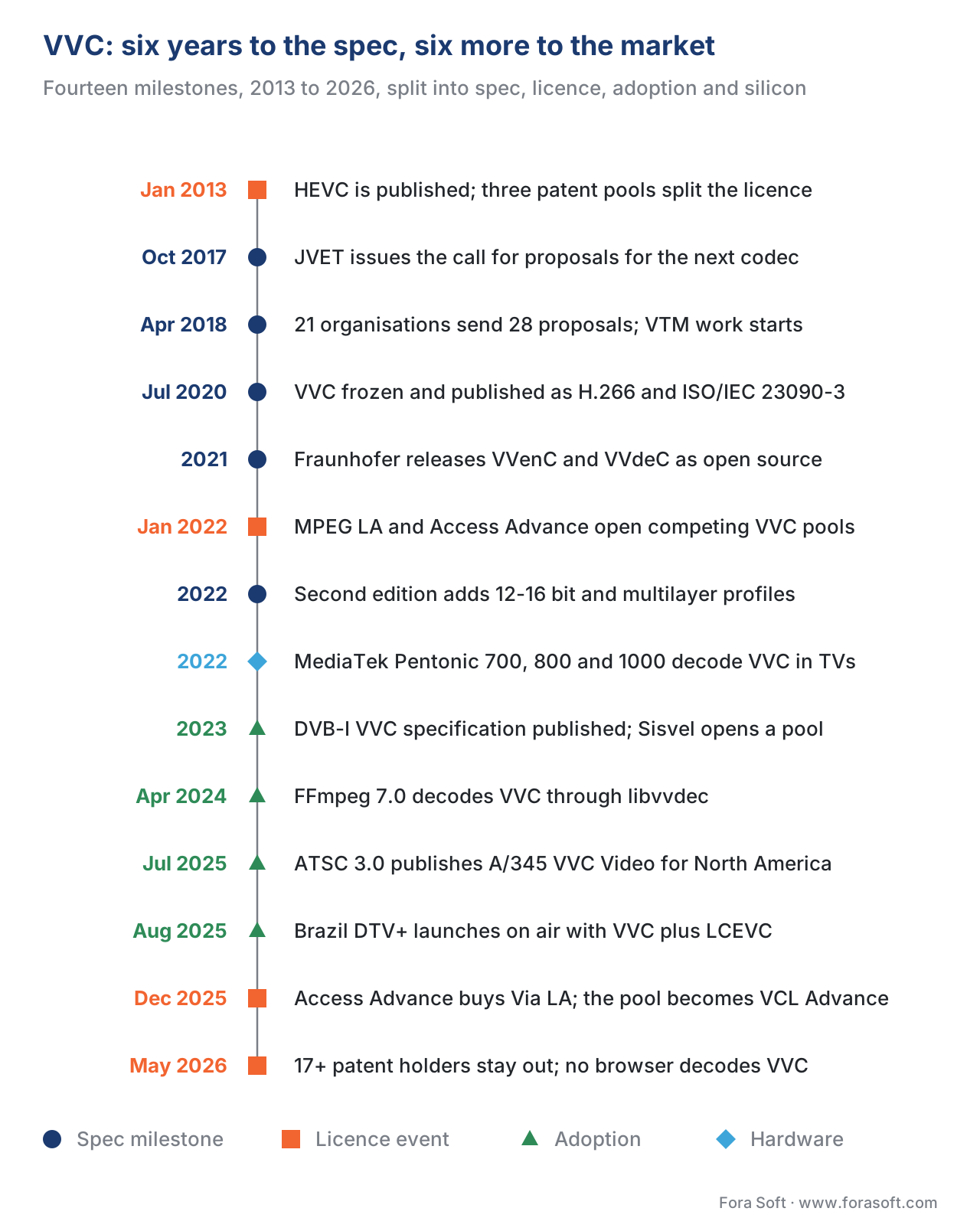 Figure 1. The VVC timeline. Six years from kickoff to spec is faster than HEVC, but six years from spec to "deployed at meaningful scale" is roughly the same lag that haunted HEVC — and on the browser side it has not happened at all.
How VVC Compresses: The Six Things That Make It Work
VVC is a hybrid block-based codec in the same broad architecture as every modern codec since H.264. We unpack the hybrid framework in Hybrid Video Codec Architecture; here the key idea is that VVC splits each picture into rectangular blocks, predicts each block from neighbouring pixels (intra-prediction) or from earlier and later pictures (inter-prediction), encodes only the small leftover (the residual), and uses an entropy coder to pack the residual bits efficiently into the bitstream.
VVC keeps that framework and rebuilds six stages of it. The compression win against HEVC and AV1 is the sum of those six redesigns.
1. The multi-type tree — MTT block partitioning
Every modern codec starts by cutting the picture into squares and then recursively splitting each square as needed to match the content. H.264 used 16×16 macroblocks with no subdivision. HEVC introduced 64×64 Coding Tree Units (CTUs) that subdivide by quadtree — four equal quadrants, recursively, down to 8×8. VP9 used 64×64 superblocks with quadtree plus rectangular two-way splits. AV1 added T-shape three-way splits on top of VP9's set.
VVC keeps 128×128 CTUs and replaces the rigid quadtree with a quadtree plus nested multi-type tree (QT+MTT). The outer quadtree cuts a CTU into four equal quadrants. Inside each quadrant, the multi-type tree allows binary tree (BT) splits — two halves, horizontal or vertical — and ternary tree (TT) splits — three slices, 1:2:1 ratio, horizontal or vertical.223 In plain terms: any block can be split into halves or thirds, in either direction, at any depth, and the encoder picks whichever shape best matches the content.
The mental picture is a chessboard of subdividable squares where every cell can be cut into halves, thirds, quarters, or one of several rectangular configurations — instead of being forced into the rigid quarters HEVC required. On real content with strong horizontal or vertical edges — on-screen text, fence posts, building facades, panning shots, ribbons of UI — the MTT partition matches the edge geometry better than any pure-square or pure-rectangular split could. The compression win is largest on detailed and edge-heavy content; on flat areas like sky, walls, gradients, snow, MTT does not help much, but neither does it hurt.
2. Affine motion compensation
When intra-prediction is not enough, the encoder predicts a block from blocks in earlier or later pictures. This is inter-prediction, and it is where the biggest compression wins live in any codec — temporal redundancy between adjacent frames is far larger than spatial redundancy inside one frame. We cover the full inter-prediction picture in Inter-Frame Coding And Motion Estimation.
Every codec from H.264 onward describes motion between two frames as a translational motion vector — "this 16×16 block of pixels has moved 12 pixels right and 3 pixels down". That works perfectly for cars driving in a straight line and panning shots, and it works terribly for anything with rotation, zoom, perspective change, or shear — a Ferris wheel, a rotating logo, a camera dollying toward an object, a tilting drone shot. HEVC could not model those motions at all; the encoder fell back to splitting the rotating area into many tiny blocks and approximating the rotation as a staircase of separate translations.
VVC introduces affine motion compensation with two models — a 4-parameter affine model (rotation, zoom, uniform scale, but no shear) using two control-point motion vectors, and a 6-parameter model (full affine: rotation, zoom, shear, perspective-flat) using three control-point motion vectors.224 The encoder writes "the top-left corner of this 32×32 block moved (3, -2); the top-right corner moved (5, -1); the bottom-left corner moved (4, 1)", and the decoder reconstructs the full motion field across the block by interpolation. A rotating logo that needed 256 separate translational vectors in HEVC becomes one affine description in VVC, and the compression saving is large on any content with non-translational motion.
This is also where the encoder cost explodes. Searching the affine motion-vector space is computationally much more expensive than searching the translational space, and affine motion estimation is one of the dominant components of VVC's 5× encoding-complexity premium over HEVC.724
3. Subpictures — independently decodable spatial regions
VVC introduces subpictures: a single VVC bitstream can be partitioned into spatial regions, each region encoded so that it can be independently decoded without any other region. Loop filters do not cross subpicture boundaries, motion vectors do not reference outside the subpicture, and the bitstream syntax allows a player to extract or re-mux a subset of subpictures into a smaller valid bitstream without re-encoding.221
This sounds esoteric until you think about 360° video. A spherical 360 stream encoded as an equirectangular flat image is mostly invisible to any given viewer at any given moment — a VR headset shows only the slice the user is looking at, maybe 110° of horizontal field of view. Subpictures let the encoder cut the sphere into a grid of independently-decodable tiles, encode every tile at full quality once, then deliver only the tiles inside the user's current viewport at full quality and the rest at low quality. When the user turns their head, the server swaps in higher-quality tiles for the new viewport. Bandwidth drops by 3–5× for the same perceived quality. A full 8K equirectangular 360 stream at 80–100 Mbps in HEVC reduces to 40–55 Mbps with VVC in flat encode mode and to 15–25 Mbps per viewer with viewport-dependent subpicture delivery.21
The same trick works for gridded surveillance walls, regions of interest in security and medical video, and dynamic windowing in interactive education — anywhere only part of a wide picture is being looked at at any moment. Subpictures are one of the strongest case-by-case arguments for VVC in 2026: there is no equally clean way to do this in HEVC or AV1.
4. Adaptive loop filter (ALF) and luma mapping with chroma scaling (LMCS)
After the encoder reconstructs the picture from the encoded residual, it applies in-loop filters to clean up block-edge artifacts and ringing. We cover the full filter chain in In-Loop Filtering: Deblocking, SAO, ALF, CDEF; here the short version is that VVC keeps HEVC's deblocking and sample-adaptive offset filters and adds two new tools.
Adaptive Loop Filter (ALF) applies a Wiener-style adaptive filter whose coefficients the encoder transmits for each picture or region.2 The decoder applies the same filter as a final clean-up pass before the picture is displayed and used as a reference for the next frame. ALF removes residual blocking and ringing artifacts that the static HEVC filters cannot reach and contributes a measurable fraction of VVC's compression win on detailed and high-motion content.
Luma Mapping with Chroma Scaling (LMCS) is a more subtle tool. Before encoding, the encoder applies a piecewise-linear remapping to the luma (brightness) channel so that the brightness range is distributed more uniformly across the codec's quantisation steps. Chroma samples are then scaled by a factor derived from the local luma, preserving the colour-to-brightness relationship. The decoder reverses both steps. LMCS is particularly effective for HDR content — where the original signal has wildly non-uniform brightness distribution — and is part of why VVC has a meaningful HDR-quality advantage over HEVC and AV1 at the same bitrate.2
5. Cross-component linear model (CCLM) and matrix-based intra-prediction (MIP)
Intra-prediction predicts a block using only the already-decoded pixels above and to the left of the block. H.264 had 9 directional intra modes for 4×4 blocks. HEVC had 35. AV1 has 56 directional plus 3 non-directional. VVC has 65 directional plus a number of non-directional and matrix-based modes, including two that earn most of their keep.223
Cross-Component Linear Model (CCLM) is conceptually the same idea as AV1's "chroma from luma": predict the chroma (colour) channels from the already-reconstructed luma (brightness) channel using a linear model. Most of the time the colour channel of a block is a smooth re-scaling of the brightness channel, and CCLM lets VVC spend almost no bits on colour signal for those blocks.
Matrix-based Intra-Prediction (MIP) introduces a different idea entirely. Instead of choosing between directional modes (this block is mostly an edge running 45° from top-left to bottom-right), the encoder picks a small pretrained matrix from a fixed set, multiplies it by the neighbouring decoded samples, and uses the result as the prediction.2 In effect, MIP is a tiny neural-network-style predictor with weights baked into the standard. It captures small-scale texture patterns that pure directional modes miss — woven cloth, hair, fine grain — and earns a measurable compression win on detail-heavy content. VVC is the first standardised video codec to embed matrix-based prediction in this way, and it foreshadows the path AV2 and the JVET-NN work are taking toward fully learned prediction.
6. Wider colour, deeper bits, scalability, screen content
VVC extends every signal-format dimension HEVC reached. The standard supports 8, 10, 12, 14, and 16 bit sample depths; 4:0:0 (monochrome), 4:2:0, 4:2:2, and 4:4:4 chroma subsampling; resolutions from 128×128 up to 16K (15360×8640); frame rates up to 960 fps; full HDR signal types via the BT.2100 transfer characteristics; wide colour gamut including BT.2020; alpha-channel coding for compositing; multilayer scalable and multi-view profiles in the second edition; and explicit tools for screen content coding (intra block copy, palette mode) and point-cloud / volumetric support through the related MPEG-I family.123
The practical implication: VVC is the first video codec designed from day one for the next generation of content categories simultaneously. Where HEVC needed three separate amendments — Range Extensions, Screen Content Coding, Scalability — to reach into 12-bit, screen, and layered coding, VVC includes them in its base specification.
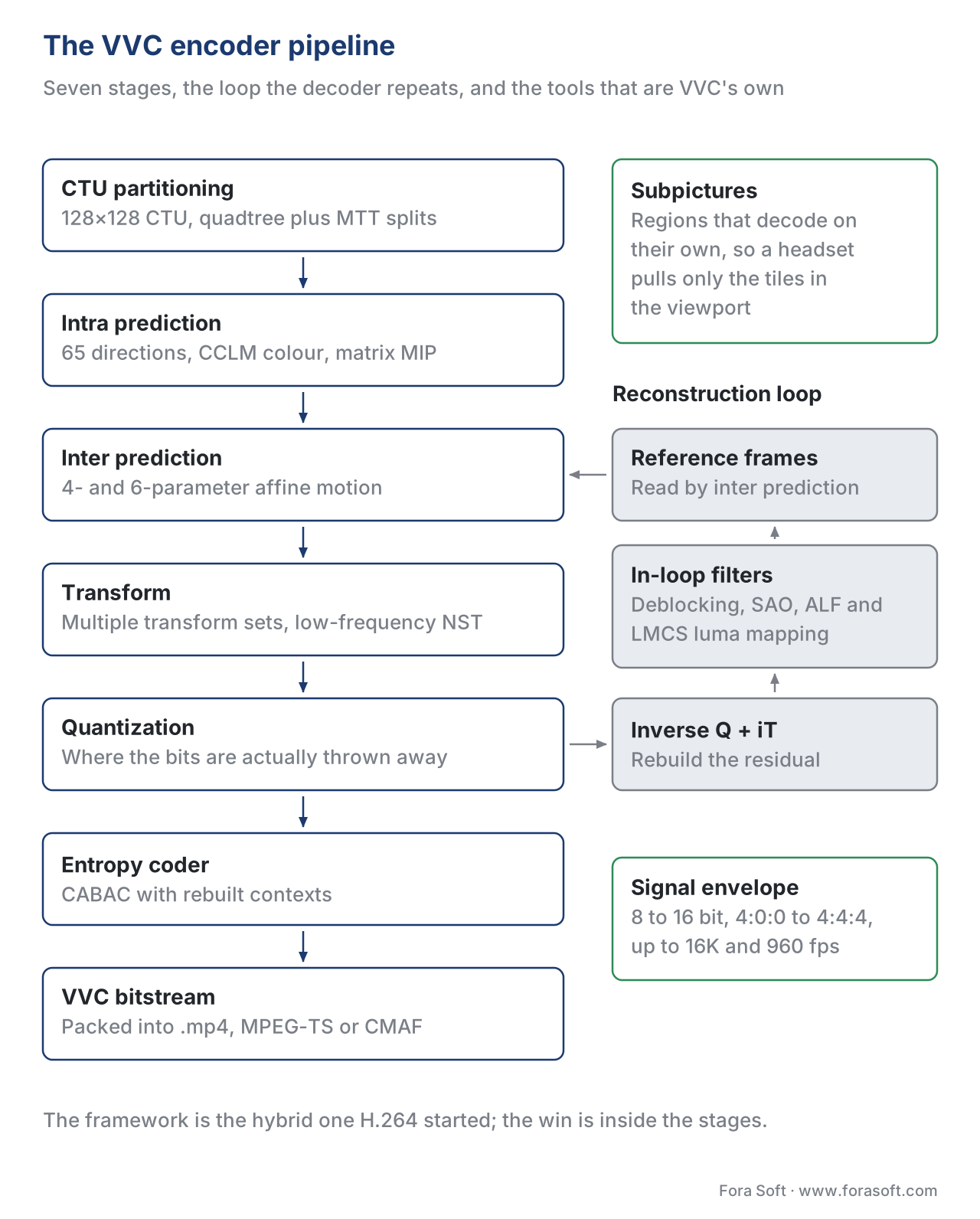 Figure 2. The VVC encoder pipeline, with the six redesigned stages marked. The hybrid framework is the same as H.264 and HEVC; the changes are in how each stage is parameterised and which tools sit inside each stage.
What The Numbers Actually Show: VVC Against HEVC, AV1, And AVC
The compression target was 50% over HEVC at matched objective quality.1 Independent measurements have largely confirmed it, with the usual caveat that codec-comparison numbers depend heavily on the encoder used, the test set, the rate-distortion operating point, and whether quality is measured objectively (PSNR, SSIM, VMAF) or subjectively (mean opinion score). The cleanest aggregates published since 2020 — the MDPI Electronics 2024 comparison on high-resolution content, the IEEE PCS 2018 / 2019 / 2020 subjective-quality series, and the APSIPA 2023 random-access study — converge on a consistent picture.456
At Full HD (1080p), VVC averages 35–40% better compression than HEVC at matched VMAF, 25–30% better than AV1, and roughly 60% better than H.264. At UHD (4K), the VVC advantage widens to 40–45% over HEVC and 27–32% over AV1 — higher resolutions favour codecs with bigger blocks and more sophisticated partitioning. At 8K, the gap widens further: VVC sits at roughly 78% below H.264, AV1 at 63%, HEVC at 53%, which translates into VVC being 46% more efficient than AV1 and 59% more efficient than HEVC at the same VMAF.4
Two practical numbers from production-grade encoders. Spin Digital's Spin Enc Live, a commercial VVC encoder built for live UHD broadcasting, reports 18% bitrate savings at equal quality versus HEVC for 4K live, rising to 27% for 8K live, on the same hardware.20 V-Nova's measurements for Brazil's TV 3.0 trial showed standalone VVC delivering 4K HDR at 12.54 Mbps, with the same perceptual quality reached at 8.08 Mbps when VVC was layered with MPEG-5 LCEVC — VVC + LCEVC is currently the most efficient practical combination available for broadcast.17
The story flips when you look at encoder cost. The MTT partitioning and affine motion search dominate encoder complexity, and academic measurements report VVC encoding running 5× to 7× the wall-clock cost of HEVC encoding at matched preset and quality, and roughly 31× in the worst all-intra configurations.7 Production encoders have closed the gap somewhat — Fraunhofer's VVenC offers five quality/speed presets and reports speedups of 20× to 2400× over the VTM reference, depending on preset, but VVenC's fastest preset still costs roughly 2–3× what SVT-AV1's comparable preset costs and 10–20× what x264's "veryfast" preset costs.87
Decoder cost is more nuanced. VVC decoders run 1.5–1.8× the cost of HEVC decoders on the same content.7 Hardware decoders close this gap to near-parity — a smart-TV chip with a dedicated VVC block decodes 4K60 VVC at roughly the same power as 4K60 HEVC. Software decoders fare worse: testing dav1d (AV1) against VVdeC (VVC) on the same mobile device showed dav1d delivering roughly 3× the battery life at the same playback hours, with dav1d hitting 15% battery after about 21 hours and VVdeC hitting the same threshold roughly three times faster.9 On a phone with no hardware VVC decoder, software VVC playback is a battery problem.
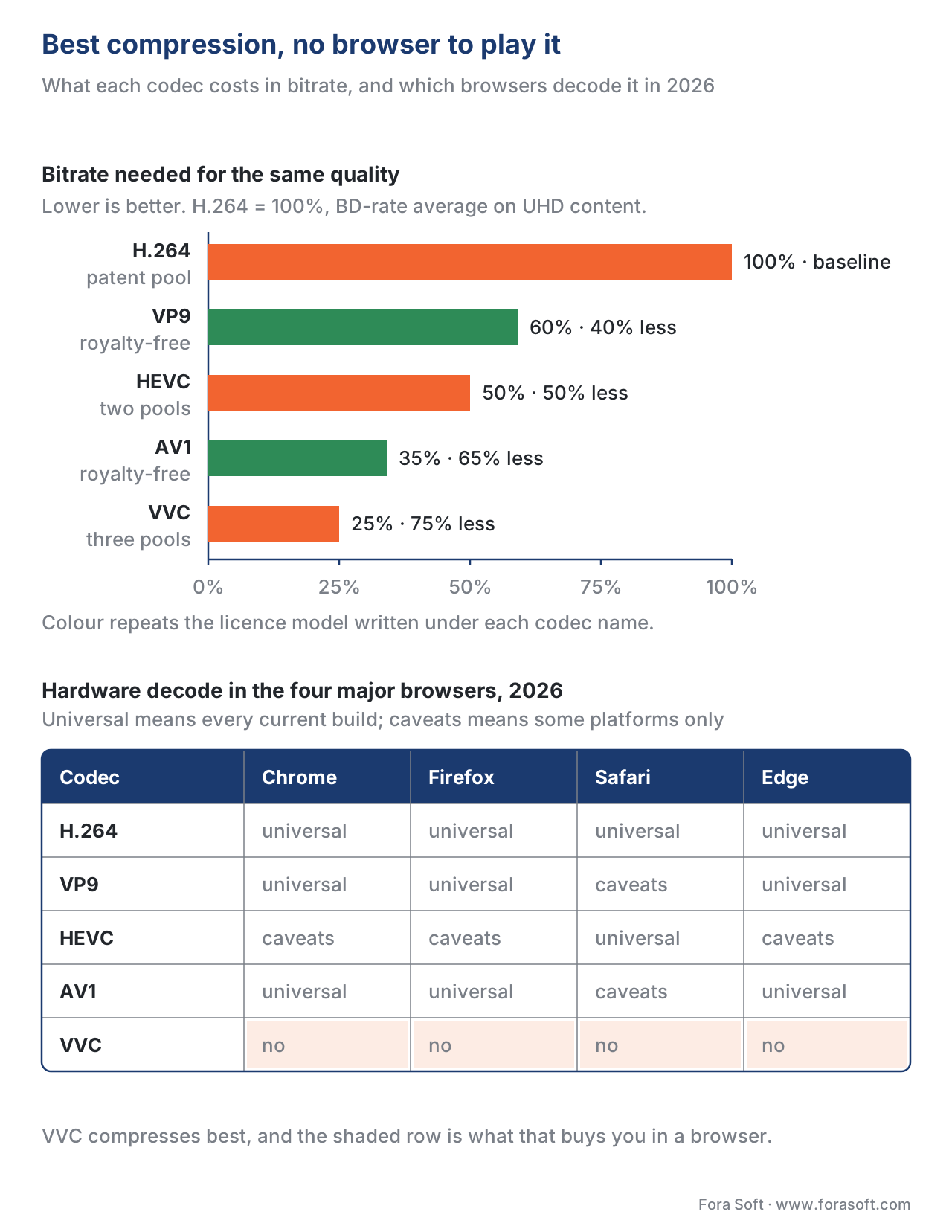 Figure 3. VVC beats AV1 on raw compression by 25–30% and beats HEVC by 40–50%. The bottom matrix is the punchline: none of the four major browsers ship VVC decode in 2026, so on the open web that compression advantage cannot be used at all.
The Encoder And Decoder Ecosystem In 2026
Five encoders and three decoders matter in the VVC ecosystem in May 2026.
On the encoder side, the VVC Test Model (VTM) is the JVET reference, written in C++ and intended for compliance testing and tool evaluation rather than production use; it runs roughly 2000× slower than real-time on a single thread, which makes it useful as ground truth and useless for shipping content.8 Fraunhofer HHI's VVenC, released under a BSD 3-Clause Clear licence in September 2021 and now at version 1.13+ (May 2026), is the standard reference for "production-grade open-source VVC encoder". VVenC is based on VTM but rebuilt for parallelism, with five quality/speed presets, perceptual optimisation using the XPSNR visual model, and frame-level rate control. Fraunhofer reports VVenC running between 20× and 2400× faster than VTM, depending on preset, while staying within roughly 5–10% of VTM's BD-rate at the slowest preset.8 Spin Digital's Spin Enc Live is the leading commercial real-time VVC encoder, reaching 8K60 VVC live on current-generation Intel and AMD server CPUs.20 MainConcept's VVC SDK, Ateme's TITAN Live, and Synamedia's encoders ship VVC for major broadcast and OTT deployments. Hardware VVC encode silicon is rare — there is no consumer GPU shipping VVC encode in 2026; NETINT's ASIC-based transcoders and a small number of broadcast-grade hardware encoders fill that niche.
On the decoder side, VVdeC is Fraunhofer HHI's open-source software decoder, also BSD 3-Clause Clear, with the same multi-threaded design philosophy as VVenC.9 FFmpeg 7.0, released April 2024, added VVC decoding through libvvdec as the first major-distribution open-source path; FFmpeg 7.1+ added libvvenc encoding alongside.10 Major media players — VLC, mpv, MPC-HC — pick up VVC support through FFmpeg. Hardware VVC decode ships in MediaTek's Pentonic 700, 800, and 1000 smart-TV SoCs (2022–2024 generations, deployed in Samsung, LG, Sony, Hisense, and TCL TVs throughout 2024–2025), in Realtek's 4K STB chips, in Synaptics, and as a discrete companion chip in older Pentonic-650 TVs that need firmware updates to enable VVC decode.11 Mobile-side hardware VVC decode is essentially absent in 2026 — Snapdragon 8 Gen 4 and Dimensity 9400 ship HEVC and AV1 hardware decode but not VVC; Apple's A18 / M4 / M5 silicon has no VVC decoder; software VVdeC on a mobile CPU works but eats battery as noted above.
The Patent Pools: Three Of Them, Holdouts, And What A Licensee Pays
VVC's licensing fragmentation is the single biggest reason the codec has not appeared on the open web, and a fair description of where it stands in May 2026 takes some unpacking.
Three pools administer the publicly-declared VVC essential patents:
VVC Advance (administered by Access Advance) launched in 2022, lists 45+ licensors including Samsung, LG, Sony, Canon, Panasonic, MediaTek, ETRI, KDDI, NTT Docomo, JVCKenwood, Mitsubishi, Sharp, Nippon Telegraph and Telephone, Orange, Philips, and many others.12 The pool publishes per-unit and per-year cap rates by product category (consumer device, professional encoder, streaming service, etc.) and announced in July 2025 that current rates would hold through 2030 for licensees signed by 31 December 2025; in December 2025 Access Advance acquired Via LA's HEVC/VVC pool, which now operates as VCL Advance under the same administrator.
VCL Advance (formerly Via LA's pool, now under Access Advance) covers a different but partially overlapping set of patent holders. The consolidation removed one pool from a previously-three-pool landscape, but the two remaining administrators still publish separate rate cards.12
Sisvel's Video Coding Platform runs a third VVC programme alongside its existing HEVC, AV1, and audio pools, with its own rate card and its own list of licensors.13
Avanci Video (which took over MPEG LA's original VVC pool when MPEG LA wound down its operations) targets streaming services rather than device manufacturers — it pitches a single annual licence covering VVC, AV1, and audio for a streaming platform's content distribution, an approach designed to address the long-running argument that streamers like Netflix were the right monetisation target for codec patents rather than the hundreds of millions of device makers.14
And outside all of these: an estimated 17+ organisations that hold declared-essential VVC patents but have joined none of the pools.15 Sisvel has been the most visible historical example — when it launched a VVC pool of its own and previously launched an unexpected AV1 pool in 2020 claiming AV1 implementations infringe Sisvel-administered patents, despite AV1's design intent of royalty-free use. The 17+ holdouts mean that no combination of two signed contracts gives a 2026 implementer total certainty; the right description is "two of three pools plus an unknown bilateral exposure tail".
What does this cost in practice? Rate cards are public but vary by product, region, and volume. A rough envelope for a consumer device shipping VVC decode in 2026 is in the range of $0.20–$0.80 per unit combined across the pools at modest volumes, with annual caps that bring the marginal cost toward $0.05 at high volumes. A streaming service paying Avanci's content-distribution rate for VVC + AV1 + audio is in the low-millions-per-year range for a top-10 streamer. A broadcaster transmitting VVC over the air typically licenses through bilateral agreements with the patent-holding equipment vendors and folds the cost into the encoder purchase. The exact numbers move with each signed bilateral and each pool renewal, and any 2026 deployment must price the licensing in directly through legal review — guessing from prior generations is unsafe.
Common mistake. Treating "VVC is royalty-bearing" as if it were a single number you can plug into a CDN cost spreadsheet. There are at least three pool rate cards, plus unknown bilateral exposure from declared-essential patents that sit outside the pools, plus the practical question of which of your business segments (device, streamer, broadcaster, content owner) the patents reach. The right approach is an actual legal review with your IP counsel, scoped to your specific business model and shipping geography. Anyone giving you a single number for "what VVC costs" is selling you something or has not finished the analysis.
Where VVC Actually Wins In 2026
There are exactly four deployment categories in 2026 where VVC is the right answer, and the rest of the article is honest about why everything else is the wrong fight to pick.
 Figure 4. The four categories where VVC is the right answer in 2026, and the one where it is not. Every green row has the same shape: a decoder you control, and a bitrate number large enough that the licence is worth paying for.
Broadcast and over-the-air television. Brazil's TV 3.0 / DTV+ launch on 27 August 2025 is the proof. The combination of VVC's compression efficiency, MPEG-5 LCEVC's enhancement layer, and ATSC 3.0's transport flexibility lets a broadcaster fit 4K HDR into the spectrum that used to carry 1080p HEVC. VVC's "Multilayer" profile family in the 2022 second edition supports scalable coding — a low-bitrate base layer plus optional enhancement layers — which fits the broadcast use case where one transmission needs to serve receivers of different capabilities. ATSC 3.0, DVB, and Japan's ISDB are all on a path to VVC for next-generation services; ATSC 3.0's A/345:2025-07 added VVC support in July 2025.181619
8K UHD-2 and contribution / mezzanine workflows. At 8K (7680×4320), VVC's compression advantage over HEVC widens to 30%+ at production-grade settings, and 8K content's data-rate budget is brutally tight — even high-end satellite UHD-2 services struggle to deliver 8K under 80 Mbps in HEVC. Spin Digital's 8K60 VVC live encoding gets the same content under 60 Mbps with quality preserved.20 For contribution workflows — pulling 4K or 8K feeds from cameras at venues back to broadcast operations — VVC's "Multilayer" and high-bit-depth profiles match the needs better than HEVC ever did.
Immersive 360° / VR / volumetric video. VVC's subpicture tool is purpose-built for viewport-dependent streaming, and no other deployed codec has an equivalent feature in 2026. AV1 has tiles but no formal subpicture mechanism with the same independence and extraction guarantees. For a VR or 360 video product, VVC is the codec that lets you ship 8K360 content over the bandwidth that today's HEVC 360 stacks consume at 4K360.21
Closed device ecosystems where you control encoder and decoder. Video surveillance archives, body-worn cameras, drone footage, telemedicine recordings, courtroom recording — anywhere the encoder is yours and the decoder is yours and patents are dealt with as a one-time enterprise licence rather than as a per-stream tax. The compression saving lowers storage and bandwidth at constant quality; the licensing exposure is bounded because the bitstreams never leave your perimeter.
For everything else — particularly anything that touches a browser, a public web player, or a phone's default media stack — AV1 is the better choice in 2026 for the next 3–5 years, and HEVC remains the unavoidable middle-layer fallback for compatibility with the long tail of pre-AV1 hardware. The honest decision framework is captured below.
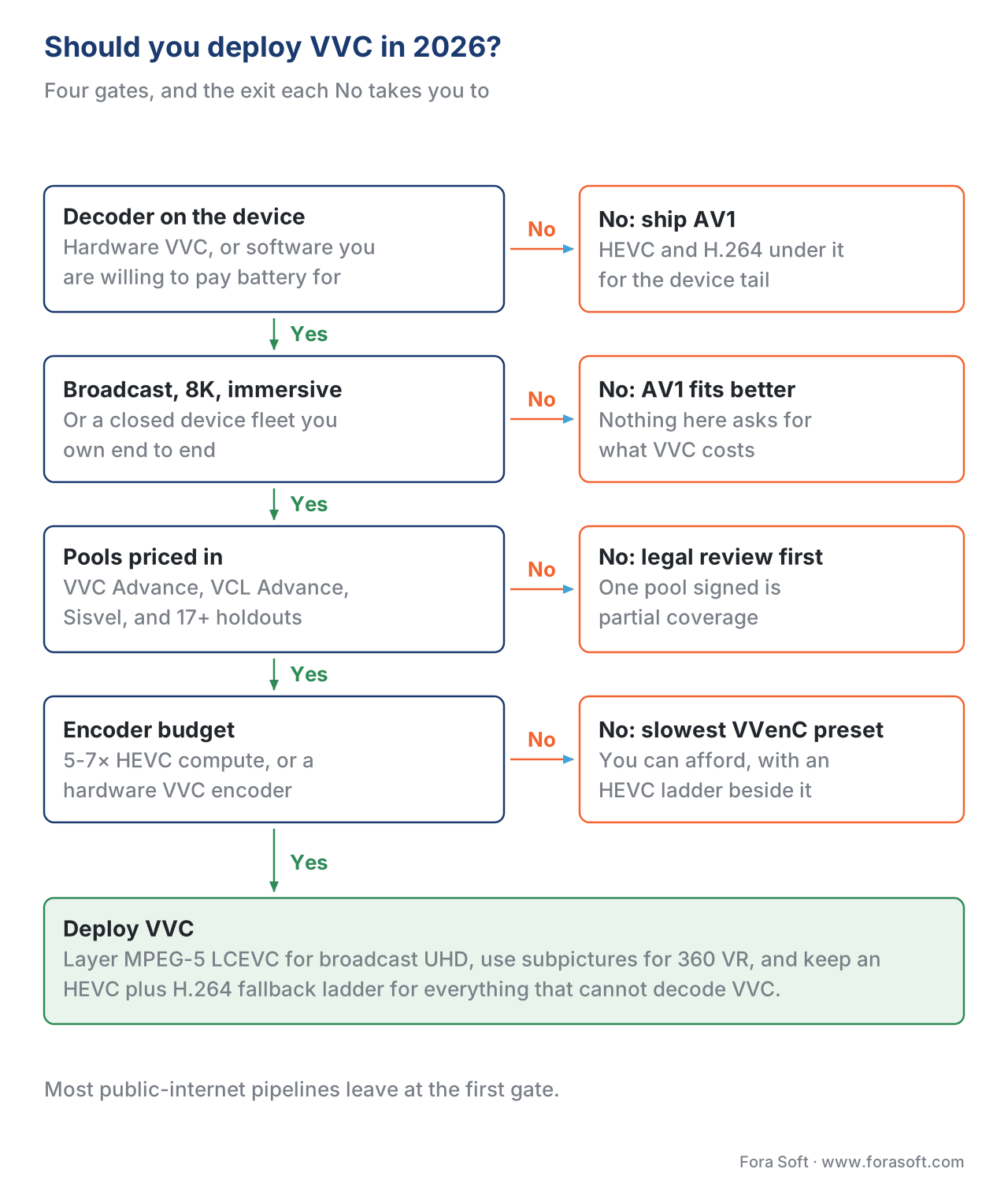 Figure 5. The 2026 VVC deployment decision tree. Most public-internet streaming paths exit the tree at the very first node.
FFmpeg Quick Reference
Two minimal command lines for a developer evaluating VVC in 2026.
# Encode a 1080p25 SDR test clip with VVenC at the production "medium" preset (preset 2 = medium/balanced).
ffmpeg -i input.mp4 -c:v libvvenc -preset medium -qp 32 -c:a copy out_vvc.mp4
# Decode a VVC bitstream back to YUV for VMAF measurement.
ffmpeg -c:v libvvdec -i out_vvc.mp4 -pix_fmt yuv420p10le -f rawvideo out.yuv
VVenC preset names map roughly as follows: faster ≈ preset 4 (fast iteration, lower quality), fast ≈ preset 3, medium ≈ preset 2 (production VOD sweet spot), slow ≈ preset 1 (premium VOD), slower ≈ preset 0 (close to VTM, archive quality).8 QP scale runs 0–63; QP 28–32 is roughly equivalent to HEVC CRF 22–25 for 1080p HD content. Cross-checking with HEVC and AV1 ladders at matched VMAF (using the open-source Netflix VMAF tool) is the only safe way to compare bit budgets across codecs.
Common Mistakes And Pitfalls
Free download: VVC Deployment Readiness Checklist 2026One-page A4 reference: the decoder coverage matrix, the encoder choice, the four deployment categories that pay for VVC, the patent-pool lay-of-the-land, and a fallback ladder template.Mistake 1 — assuming "next generation" is automatically the right deployment choice. VVC's compression is genuinely superior to HEVC and AV1 on paper, but compression efficiency is one input to the deployment decision. Encoder cost, decoder availability, browser support, and patent licensing are the others, and for most 2026 streaming products the other inputs make AV1 the better answer despite VVC's tighter compression.
Mistake 2 — confusing "VVC supported in chip" with "VVC enabled in firmware on the device the customer owns". MediaTek's Pentonic 650 chip supports VVC on paper, but many TVs built on Pentonic 650 shipped without VVC firmware enabled; the chip is capable, the device is not. Plan device certification against actual shipping firmware versions, not against chip datasheets.
Mistake 3 — signing one patent pool agreement and assuming you're covered. Two pools plus an unknown number of holdouts means a single agreement gives you partial coverage. Get an actual legal review.
Mistake 4 — encoding the entire catalogue to VVC for "future-proofing" before the decoder footprint is there. Re-encoding is expensive, and the encoded bitstreams cost storage from day one. Encode VVC only against actual viewer telemetry showing VVC-capable decoders in your audience; let the rest stay HEVC + AV1 until the device base shifts.
Mistake 5 — confusing VVC's compression headline with end-user quality at production bitrates. The 50% number is at matched objective quality. At the bitrates streaming services actually use — well below archival quality — codecs converge: VVC's lead narrows because every codec is closer to its quality floor, and the relative encoder-cost premium of VVC stays large. Always measure on your own content at your own bitrate ladder.
Where Fora Soft Fits In
Fora Soft has shipped video streaming, video conferencing, OTT and Internet TV, video surveillance, e-learning, telemedicine, and AR/VR products since 2005, with 239+ delivered projects spanning live broadcast, on-demand catalogues, peer-to-peer video, and immersive applications. We integrate VVC where the deployment math supports it — broadcast and STB pipelines on MediaTek and Realtek silicon, 8K contribution workflows, viewport-dependent 360 VR experiences with subpicture-based delivery — and we recommend AV1 with HEVC + H.264 fallback for any web-facing streaming product, because in 2026 the open web does not decode VVC and the licensing landscape does not justify the engineering bet. The right codec is the one that gets bits onto the user's screen at the lowest cost without surprising them or your CFO; for VVC in 2026, that means broadcast, 8K, immersive, and closed device ecosystems, and almost never the public internet.
The book
Video Encoding: A Complete Guide to Video Compression
This article names the six things VVC rebuilt; the book takes each of them apart. Multi-type tree partitioning, affine motion, subpictures, ALF and LMCS, CCLM and matrix intra-prediction each get their own chapters, and the comparison chapters carry the BD-rate measurements the bar chart above is built on, with the test sets named and the encoder settings written down. The rate-control and encoder chapters work through the 5–7× compute premium in practice, preset by preset. It is volume 1 of the seven-volume Fora Soft Video Engineering Handbook, 1,522 pages, written by Nikolay Sapunov, CEO at Fora Soft.
Is your pipeline one of the four places VVC pays for itself?
Send us your device and player mix, your current ladder and your storage or egress bill, and we will come back with a straight answer: which of your renditions could move to VVC without stranding viewers, what the encode would cost at the VVenC preset your volume can afford, and what stays on HEVC and H.264. If the answer is that VVC is the wrong fight for your product, we will say so and price the AV1 route instead. You get the numbers on your own traffic, not on a benchmark clip. 250+ video products shipped since 2005.
See our case studies
Case study
Mindbox
Camera video pulled over RTSP, transcoded with FFmpeg and delivered as HLS, in 50+ deployments. This is the closed-ecosystem row of the table above: the encoder and the decoder are both yours, so the compression saving lands on the storage bill instead of on a browser that cannot play it.
Case study
Worldcast Live
Concert streaming at 1.5 Gb/s with 0.4–0.5 s latency to 10,000 simultaneous viewers. The gate that decides everything here is the encoder one: at that latency budget a 5–7× software premium is not on the table, so VVC needs silicon or it needs to wait.
Case study
Speed.Space
Live 1080p at 8 Mb/s for production clients including Netflix, EA and HBO. The ladder question is the one this article ends on: which rungs a browser has to play, and which ones only ever reach a device you picked yourself.
What to read next
Codecs
H.265 / HEVC: +50% Over H.264 And The Patent Nightmare
The licensing collapse that VVC repeated. Read it for why three pools and a holdout tail is a market outcome, not an accident.
Codecs
Comparison Table: MPEG-2, H.264, H.265, VP9, AV1, VVC
The bar chart above with every other dimension attached: decode footprint, encoder cost, container support and licence model, side by side.
Codecs
How To Choose A Codec For Your Service In 2026
The four gates of this article widened to every codec, with the numbers behind each branch and what it costs to answer one of them wrong.
Tooling
Encoder Implementations: x264, x265, SVT-AV1, libaom, vvenc
VVenC and VTM measured against x265 and SVT-AV1 on the flags that matter in production, so the 5–7× premium stops being one number.
-
ITU-T Recommendation H.266: Versatile video coding (2020-08, revised 2022-04). https://www.itu.int/rec/T-REC-H.266 — accessed 2026-05-16. ↩↩↩↩↩↩
-
Media Coding Industry Forum, "Versatile Video Coding technical guidelines for broadcast and streaming applications" (v1.0, 2023). https://www.mc-if.org/wp-content/uploads/2023/09/MC-IF-VVC-guidelines-v1.0-rc.pdf — accessed 2026-05-16. ↩↩↩↩↩↩↩↩↩↩
-
ITU-T H.266.1 (V2): Conformance specification for ITU-T H.266 versatile video coding (2023-09). https://www.itu.int/epublications/es/publication/itu-t-h-266-1-v2-2023-09-conformance-specification-for-itu-t-h-266-versatile-video-coding/en — accessed 2026-05-16. ↩↩
-
Bonnineau et al., "Performance Comparison of VVC, AV1, HEVC, and AVC for High Resolutions", MDPI Electronics 2024 (13:5:953). https://www.mdpi.com/2079-9292/13/5/953 — accessed 2026-05-16. ↩↩↩↩↩
-
Katsenou et al., "Comparison of Compression Efficiency between HEVC/H.265, VP9 and AV1 based on Subjective Quality Assessments", IEEE PCS 2018. https://ieeexplore.ieee.org/document/8463294 — accessed 2026-05-16. ↩↩
-
"Compression efficiency analysis of AV1, VVC, and HEVC for random access applications", APSIPA Transactions on Signal and Information Processing, Cambridge Core 2023. https://www.cambridge.org/core/journals/apsipa-transactions-on-signal-and-information-processing/article/compression-efficiency-analysis-of-av1-vvc-and-hevc-for-random-access-applications/D2345DDC3750055AB0AA3D24FCF743BE — accessed 2026-05-16. ↩
-
"Complexity Analysis Of Next-Generation VVC Encoding And Decoding", IEEE ICIP 2020. https://ieeexplore.ieee.org/document/9190983/ — accessed 2026-05-16. ↩↩↩↩↩↩
-
Fraunhofer HHI, "VVenC – the Fraunhofer Versatile Video Encoder" (project home and v1 whitepaper). https://www.hhi.fraunhofer.de/en/departments/vca/technologies-and-solutions/h266-vvc/fraunhofer-versatile-video-encoder-vvenc.html and https://github.com/fraunhoferhhi/vvenc — accessed 2026-05-16. ↩↩↩↩
-
Streaming Learning Center, "AV1 vs. VVC Mobile Playback: A Quick and Dirty Test" (dav1d vs VVdeC battery comparison). https://streaminglearningcenter.com/codecs/av1-vs-vvc-mobile-playback-a-quick-and-dirty-test.html — accessed 2026-05-16. ↩↩
-
Fraunhofer VVenC / VVdeC FFmpeg integration documentation. https://github.com/fraunhoferhhi/vvenc/wiki/FFmpeg-Integration and https://github.com/fraunhoferhhi/vvdec/wiki/Integration-in-FFmpeg — accessed 2026-05-16. ↩
-
MediaTek Pentonic 700 / 800 / 1000 Smart TV SoC product pages. https://www.mediatek.com/products/smart-home/pentonic-smart-tvs — accessed 2026-05-16. Also HDTVTest: "MediaTek debuts Pentonic 800 SoC with 165Hz VRR, VVC decoding and more". ↩↩
-
Access Advance, "HEVC Advance and VVC Advance Pricing through 2030" (21 July 2025) and "Access Advance Welcomes New VDP Pool Licensors" (23 March 2026). https://accessadvance.com/2025/07/21/access-advance-announces-hevc-advance-and-vvc-advance-pricing-through-2030/ — accessed 2026-05-16. ↩↩↩↩
-
IAM Media, "Clarity needed for complex video-codec patent landscape to thrive" (covers VVC pool fragmentation and Sisvel position). https://www.iam-media.com/article/clarity-needed-complex-video-codec-patent-landscape-thrive — accessed 2026-05-16. ↩↩↩
-
Streaming Media, "Independent Report Compares Codec Royalty Costs Across Two Major Licensing Pools". https://www.streamingmedia.com/Articles/News/Online-Video-News/Independent-Report-Compares-Codec-Royalty-Costs-Across-Two-Major-Licensing-Pools-174221.aspx — accessed 2026-05-16. ↩↩↩↩
-
Streaming Media, "The State of Streaming Codecs 2026" — pool fragmentation, 17+ unpooled essential patent holders, no major browser supports VVC as of March 2026. https://www.streamingmedia.com/Articles/Editorial/Featured-Articles/The-State-of-Streaming-Codecs-2026-173838.aspx — accessed 2026-05-16. ↩↩↩
-
V-Nova, "TV 3.0, the First National Standard Built on MPEG-5 LCEVC" and "Powering Brazil's next-generation UHD with TV 3.0". https://v-nova.com/blog/tv-3-0-lcevc-national-broadcast-standard/ and https://v-nova.com/whitepapers/powering-brazils-next-generation-uhd-with-tv-3-0/ — accessed 2026-05-16. ↩↩
-
V-Nova, "Unlocking UHD with MPEG-5 LCEVC & VVC with TV 3.0 in Brazil" (independent University of Brasilia verification of VVC + LCEVC bitrate savings). https://v-nova.com/blog/unlocking-uhd-with-mpeg-5-lcevc-vvc-with-tv-3-0-in-brazil/ — accessed 2026-05-16. ↩↩
-
ATSC, "ATSC Standards Update: A/345, 'VVC Video,' Finalized" (17 July 2025) and the A/345:2025-07 specification PDF. https://www.atsc.org/news/atsc-standards-update-a-345-vvc-video-finalized/ and https://www.atsc.org/wp-content/uploads/2025/08/A345-2025-07-VVC-Video.pdf — accessed 2026-05-16. ↩↩
-
DVB Project, "DVB adds VVC to its video coding toolbox" and "Commercial Requirements for Next Generation Video Codecs Phase 2". https://dvb.org/news/dvb-adds-vvc-to-its-video-coding-toolbox/ — accessed 2026-05-16. ↩↩
-
Spin Digital, "Real-time VVC and HEVC Encoder – Spin Enc Live" and "Spin Digital Succeeds in Reaching 8Kp60 VVC and 8Kp120 HEVC Live Encoding". https://spin-digital.com/products/spin_enc_live/ — accessed 2026-05-16. ↩↩↩
-
"On Subpicture-based Viewport-dependent 360-degree Video Streaming using VVC", IEEE 2021, Homayouni / Aminlou et al. https://ieeexplore.ieee.org/document/9327952/ — accessed 2026-05-16. ↩↩↩
-
Netflix Technology Blog, "AV1 – Now Powering 30% of Netflix Streaming" (2025). https://netflixtechblog.com/av1-now-powering-30-of-netflix-streaming-02f592242d80 — accessed 2026-05-16. ↩
-
"Low-Complexity Multiple Transform Selection Combining Multi-Type Tree Partition Algorithm for Versatile Video Coding", PMC 2022. https://pmc.ncbi.nlm.nih.gov/articles/PMC9331267/ — accessed 2026-05-16. ↩↩
-
"Fast Affine Motion Estimation for Versatile Video Coding", Ewha 2023. https://dspace.ewha.ac.kr/bitstream/2015.oak/252432/1/Fast%20Affine%20Motion%20Estimation.pdf — accessed 2026-05-16. ↩↩
