


Why this matters
If you are picking a codec for a streaming platform, a videoconferencing product, an OTT app, or a surveillance system, this single decision will shape your bandwidth bill, your device coverage, your legal exposure, and the picture quality your customers see for the next five to ten years. Every other choice — your bitrate ladder, your CDN, your DRM, your encoder farm — follows from the codec. Marketing pages and vendor blogs make every codec sound like the best one. A clean comparison table cuts through that. This article assumes no prior knowledge: we define every term in plain language before we use it, then walk you through the trade-offs the way an experienced video engineer would.
How to read this article
The comparison table sits at the top of the article so you can grab it and go. Underneath, every column has its own short section that explains what the column measures and why a number in that column is good or bad. At the end there is a decision guide, three common mistakes we see Fora Soft clients make, a downloadable one-page version of the table, and a short list of related Learn articles for the columns you want to dive deeper into.
You do not need any prior knowledge of codecs to read this article. If you have time for only one section, read the table and the "Bitrate savings" column underneath it. That's the column that matters most.
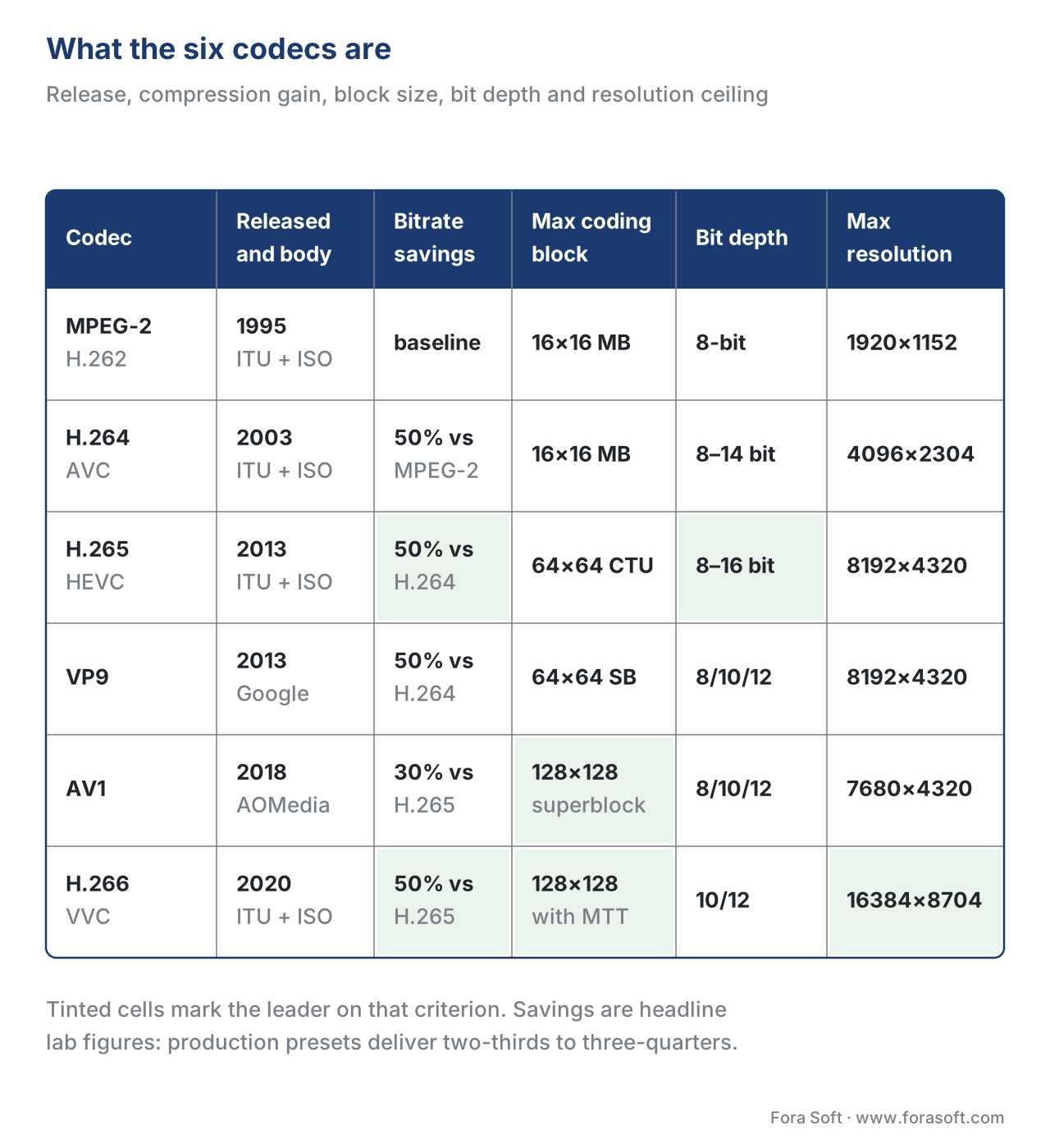 Figure 1. The half of the comparison that describes the codecs themselves: when each one arrived, how much bitrate it claims over its predecessor, and the ceilings written into the spec. Read the savings column first — it is the one that moves your CDN bill.
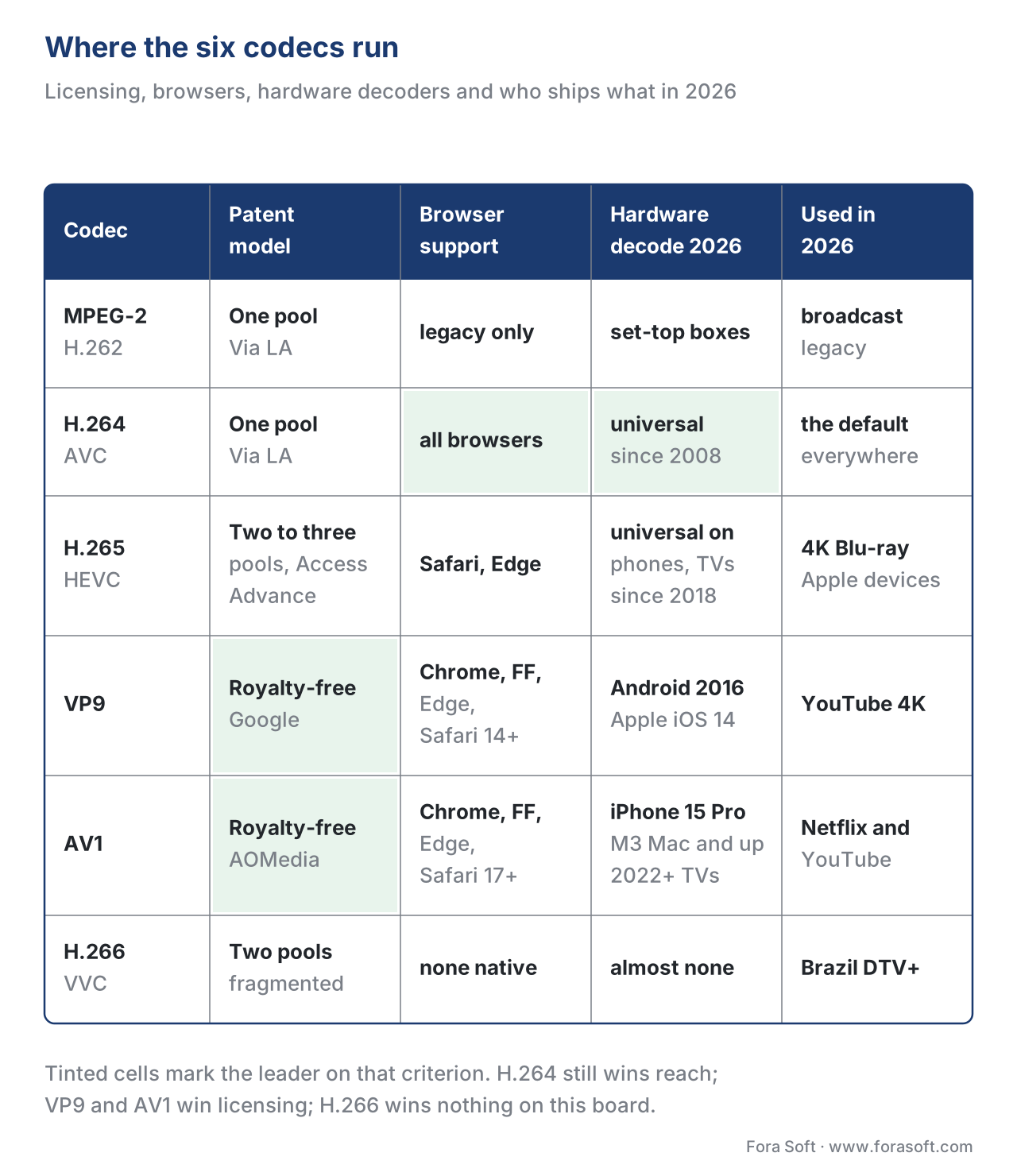 Figure 2. The half that decides what you can actually ship: who you pay, what plays in the browser, what decodes on silicon, and who is using it in production. A codec that wins Figure 1 and loses this one is not a shipping option yet.
The Six Codecs at a Glance
The codecs in this comparison ship under two parallel naming conventions because they were standardised by two different bodies. The ITU-T (the telecoms standards arm of the United Nations) and the ISO/IEC MPEG committee publish a joint standard under two names — the H-dot number comes from ITU-T and the MPEG name comes from ISO. H.264, H.265, and H.266 are the ones that have both names. The Alliance for Open Media (AOMedia) is a separate industry consortium founded in 2015 by Google, Netflix, Amazon, Cisco, Intel, Microsoft, Mozilla, and later Apple. AOMedia publishes the AV1 specification (and the forthcoming AV2) under a single name and a royalty-free patent policy. Google's VPx family — VP8 and VP9 — sits in a third bucket: standardised by Google alone, royalty-free, never blessed by ITU or MPEG. We tell the full story of how these camps formed in A short history of video codecs: from H.120 to AV2.
| Criterion | MPEG-2 (H.262) | H.264 / AVC | H.265 / HEVC | VP9 | AV1 | H.266 / VVC |
|---|---|---|---|---|---|---|
| Year published | 1995 1 | 2003 2 | 2013 3 | 2013 4 | 2018 5 | 2020 6 |
| Governing body | ITU-T + ISO/IEC (joint) | ITU-T + ISO/IEC (joint, JVT) | ITU-T + ISO/IEC (joint, JCT-VC) | Google (open source) | AOMedia | ITU-T + ISO/IEC (joint, JVET) |
| Reference encoders | MainConcept, FFmpeg mpeg2video |
x264, OpenH264, NVENC | x265, HM, NVENC | libvpx-vp9 | libaom, SVT-AV1, rav1e | VVenC, VTM, MainConcept |
| Bitrate savings vs predecessor | baseline | ≈ 50% vs MPEG-2 2 | ≈ 50% vs H.264 3 | ≈ 50% vs H.264 7 | ≈ 30% vs HEVC and VP9 8 | ≈ 50% vs HEVC 9 |
| Max coding block | 16×16 macroblock | 16×16 macroblock (down to 4×4) | 64×64 CTU (down to 4×4) | 64×64 superblock (down to 4×4) | 128×128 superblock (down to 4×4) | 128×128 CTU + multi-type tree |
| Max reference frames | 1–2 | up to 16 | up to 16 (8 active) | 3 active of 8 | 7 named refs | up to 15 |
| Bit depth | 8-bit | up to 14-bit (High 4:4:4) | up to 16-bit | 8 / 10 / 12-bit | 8 / 10 / 12-bit | 10 / 12-bit (Main 10, Main 12) |
| Chroma | 4:2:0 | 4:2:0 to 4:4:4 | 4:0:0 to 4:4:4 | 4:2:0 to 4:4:4 | 4:0:0 to 4:4:4 | 4:2:0 to 4:4:4 |
| Max resolution | 1920×1152 (High profile) | 4096×2304 (Level 5.2) | 8192×4320 | 8192×4320 | 7680×4320 (Level 6.3) | 16384×8704 |
| Patent model | one pool (MPEG LA / Via LA) | one pool (MPEG LA / Via LA) | three pools, partly consolidated 2025 10 11 | royalty-free | royalty-free (AOMedia) | two pools (Access Advance + Via LA, consolidated 2025) 11 |
| Browser support (2026) | none (legacy only) | universal | Safari + Edge; not Firefox; Chrome via OS only | Chrome, Firefox, Edge; Safari since 14 | Chrome 70+, Firefox 67+, Edge 121+, Safari 17+ on HW | none native; experimental via WASM |
| HW decode coverage | TV set-top boxes | universal since 2008 | nearly universal since 2018 | Android dominant; Apple from iOS 14 / tvOS 14 | iPhone 15 Pro+, M3 Mac+, Snapdragon 8 Gen 2+, most 2022+ TVs | almost none in consumer SoCs |
| Encode complexity (relative) | 1× | 1× | 5–10× | 3–5× | 5–30× (SVT-AV1) to 1,000×+ (libaom) | 7–20× (VVenC) |
| Use cases dominant in 2026 | digital TV broadcast, DVD legacy | the universal fallback; most internet video | 4K Blu-ray, Apple, premium 4K OTT | YouTube 4K, Android, fallback for AV1 | Netflix premium, YouTube high-res, Meta short video, Twitch enhanced | Brazil DTV+ broadcast; almost no streaming |
| 2026 production deployment | broadcast-only | ≈ 80% of video providers use it 13 14 | ≈ 65% in production, +20% planned 13 | YouTube + Android first-party | ≈ 17% in production, +40% planning 2026 13 | < 1% streaming; growing in broadcast |
Table 1. Side-by-side comparison of MPEG-2, H.264, H.265, VP9, AV1, and H.266. Sources are footnoted in the References section.
The rest of this article walks each row of the table in plain language so you know what the numbers actually mean.
Year Published — Why the Birth Year Matters
The year a codec was published is also, roughly, the year the world started shipping hardware decoders for it. Decoder chips are easier and cheaper to build than encoders, so silicon vendors usually add a decoder to their flagship phone or TV chip within 18 to 36 months of a codec being ratified. Once a hardware decoder ships, the codec lives in the wild for at least a decade — phones from 2014 still play H.264 because their decoder is still inside them.
This is why old codecs do not die. MPEG-2 was ratified in 1995 and is still inside every digital-TV set-top box in the world thirty-one years later. H.264 was ratified in 2003 and remains the most-used video codec on the internet in 2026, twenty-three years after publication. New codecs do not replace old ones; they are added on top, and the old codec stays as the universal fallback. The Bitmovin annual Video Developer Report confirms this picture year after year — H.264 sits at the top, HEVC and VP9 in the middle, AV1 climbing fast, and VVC barely visible. 14
The practical takeaway: if your audience includes phones, TVs, or browsers older than five years, plan to deliver H.264 as a fallback no matter which codec you pick as your primary.
Governing Body — Why the Patent Math Is Set Here
A codec's governing body decides everything that follows about who pays whom. Three bodies matter.
The ITU-T's Video Coding Experts Group (VCEG) and ISO/IEC's Moving Picture Experts Group (MPEG) are the two formal standards bodies. They produce most of the H-dot codecs jointly — MPEG-2 / H.262, H.264, H.265, and H.266 are all joint products. Their standards are governed by patents owned by member companies. Those companies license their patents through patent pools — administrative bodies that collect royalties and divide them among patent holders. The pool is the legal apparatus that lets you ship a codec without negotiating with each patent holder individually.
The Alliance for Open Media (AOMedia) was founded in 2015 to break out of this loop. Every AOMedia member commits to a royalty-free licence on all essential patents under the AOMedia Patent License 1.0. The result is AV1 and the upcoming AV2 — codecs you can ship without paying anyone, full stop. This is a real legal commitment, not a vague gesture; AOMedia maintains an explicit patent policy and tracks contributor declarations.
Google, separately, released VP8 in 2010 and VP9 in 2013 under a similar royalty-free model. VP8 and VP9 predate AOMedia but seeded the same idea. VP9 in particular runs inside YouTube as the default 4K codec for non-AV1-capable devices.
The reason this matters in 2026: large distributors with deep pockets (Apple, Netflix, Disney+) can absorb patent royalties and ship HEVC. Smaller distributors avoid the pools and ship AV1 instead. The 2025 consolidation in which Access Advance acquired Via LA's HEVC and VVC pool administration shrank three HEVC pools down to two, but did not eliminate the legal uncertainty — many essential patent holders (Apple, Google, Samsung, Microsoft) remain outside every pool. 11 For VVC the same uncertainty has frozen adoption: there is no streaming service in 2026 shipping VVC at meaningful scale, despite the codec being four years old.
Bitrate Savings — The Headline Number
The single most important column in the table. Bitrate savings measures how many fewer bits a new codec needs to deliver the same picture quality. The conventional unit is "percent fewer bits at equivalent perceptual quality", and the conventional measurement method is a Bjøntegaard delta-rate (BD-rate) test, which compares two codecs at matched values of objective quality metrics like Peak Signal-to-Noise Ratio (PSNR) and Structural Similarity Index Measure (SSIM). We cover the metrics themselves in Objective quality metrics: PSNR, SSIM, MS-SSIM, VMAF.
Read these headline numbers carefully. They are the result of careful lab tests with reference encoders at their slowest, highest-quality settings — settings that nobody runs at production scale because they are too slow. Real-world bitrate savings are typically two-thirds to three-quarters of the headline.
Let's walk through the maths so you can see what a savings number actually does for you. Suppose you stream a 1080p movie that uses 4.5 Mbps of H.264. HEVC's headline 50% savings means the same quality fits in:
4.5 Mbps × (1 − 0.50) = 2.25 Mbps of HEVC
In real-world production, HEVC delivers more like 30–40% savings on this kind of content, so a realistic target is:
4.5 Mbps × (1 − 0.35) ≈ 2.9 Mbps of HEVC
AV1's headline number is "30% savings vs HEVC and VP9", measured by AOMedia and confirmed by Meta's 2018 production benchmark on a 400-clip Facebook test set, where libaom-AV1 beat libvpx-VP9 by 34% and x264 High by 46.2% on BD-rate against the Visual Multimethod Assessment Fusion (VMAF) quality metric. 8 At Netflix scale, AV1 sessions in 2025 used roughly a third less bandwidth than AVC and HEVC for matched quality. 12
VVC's design target is another 50% reduction relative to HEVC. Independent confirmations from Fraunhofer HHI and the JVET test set agree. 9 That is the largest codec generation step in two decades. But VVC's near-zero deployment in 2026 means you cannot actually use those savings yet.
The bottom line: a 30% bandwidth saving at scale is a real number. For a streaming service doing 1 petabyte of egress per month, moving from H.264 to AV1 saves roughly 300 terabytes — at typical CDN prices of $0.005 to $0.02 per gigabyte, that's $1,500 to $6,000 per month in bandwidth alone, before any quality improvement.
Max Coding Block — Why Bigger Blocks Save Bits
When an encoder compresses a frame, it does not work on the whole frame at once. It cuts the frame into squares and encodes each square separately. The maximum coding block is how big each of those squares is allowed to be.
A bigger maximum block size is a compression win for one reason: large flat regions of the image — a blue sky, a wall, the carpet on the floor — can be coded as a single block with one motion vector and one set of transform coefficients. A small block size forces the encoder to repeat that information for every small square inside the flat region. The amount of metadata an encoder spends on block headers, motion vectors, and prediction modes goes down quadratically as block size goes up.
The progression across the six codecs is a story of growing block sizes. MPEG-2 and H.264 both use a macroblock — a 16×16 grid of luma samples and the corresponding chroma. H.264 lets the macroblock subdivide down to 4×4 for the parts of the frame that need fine detail. HEVC replaced the macroblock with a Coding Tree Unit (CTU) up to 64×64, recursively split with a quadtree down to 8×8 with predictions down to 4×4 — four times the maximum size of an H.264 macroblock. VP9 uses a superblock of the same size: 64×64. AV1 doubled it again with a 128×128 superblock — sixteen times the area of a macroblock. VVC reached the same 128×128 ceiling but added a multi-type tree that allows binary and ternary splits in addition to the quadtree, giving the encoder much finer control over block shape.
The mechanics of how each codec partitions its blocks are unpacked in Block-based prediction: MBs, CTUs, SBs and superblocks. For the comparison, just remember: every doubling of maximum block size has been worth roughly 10–15% of the headline bitrate savings each new codec delivers.
Bit Depth and Chroma — Where HDR Lives
Bit depth is the number of bits an encoder uses to store the value of one pixel sample. 8 bits gives 256 distinct levels of brightness per channel. 10 bits gives 1024 levels. 12 bits gives 4096. Chroma subsampling is the rule for how many colour samples are stored per brightness sample. 4:4:4 stores full colour. 4:2:2 halves the colour horizontally. 4:2:0 halves it both horizontally and vertically — that's what most consumer video uses, because the human eye can't see the difference.
High Dynamic Range (HDR) needs 10-bit. So does any production workflow that wants to grade colour without introducing visible banding — the stripes you see across a smooth gradient when there aren't enough quantization levels. We cover banding in detail in Bit depth: 8, 10, 12 bits and the banding problem.
The codec implications: MPEG-2 is 8-bit only, which is why nobody uses it for HDR. H.264 supports up to 14-bit in its High 4:4:4 Predictive profile, but its mass-market profile (High at 8-bit) is what's actually in the world. HEVC, VP9, AV1, and VVC all support 10-bit and 12-bit natively in their mainstream profiles (HEVC Main 10, VP9 Profile 2/3, AV1 High/Professional, VVC Main 10/Main 12). If you ship HDR in 2026, you are picking between HEVC, AV1, and possibly VVC. If you ship anything 8-bit, all six codecs are on the table.
Max Resolution — A Spec Number That Rarely Matters
Every codec lists a maximum resolution it supports — 4096×2304 for H.264 Level 5.2, 8192×4320 for HEVC and VP9, 7680×4320 for AV1 Level 6.3, 16384×8704 for VVC. The numbers are correct and almost never bind in practice. You stop being limited by codec ceiling and start being limited by decoder level support — how many macroblocks per second your specific chip can decode. A phone chip that says it does HEVC may only do HEVC up to 4K at 60 fps. The codec spec allows 8K. The chip doesn't.
For everyday product decisions, ignore this column unless you're shipping 8K. If you are shipping 8K, your decoder list is short — AV1 from very recent Apple Silicon, HEVC from recent Apple TV and high-end TVs, VVC almost nowhere.
Patent Model — The Column That Decides Your Lawyer's Mood
A codec is a stack of mathematical algorithms. Many of those algorithms are covered by patents. To ship a codec product, you must licence the essential patents. The codec's governing body determines how you do that.
MPEG-2 and H.264 sit under a single, public, capped patent pool administered by MPEG LA (rebranded Via LA in 2023). MPEG LA negotiated a published rate card and a cap — for H.264, internet streaming of free-to-end-user content was zero, and unit royalties on devices were capped at a few cents. The math was good enough that the codec dominated.
HEVC went off the rails because three pools formed instead of one — MPEG LA, HEVC Advance (renamed Access Advance), and Velos Media — each with different members, different rates, and different terms. Some major patent holders never joined any pool, leaving distributors exposed to surprise infringement claims. Browser vendors stayed out for years; Firefox didn't ship native HEVC playback until very recently. The 2025 consolidation, in which Access Advance acquired Via LA's HEVC and VVC pool administration, brought two of the three pools together — but unpooled patents from Apple, Google, Samsung, Microsoft, and others remain. 11
VVC inherited the same problem in a smaller form. Two pools exist (Access Advance and the former Via LA, now consolidated), some essential holders are outside both, and large streamers have refused to ship the codec at scale. The result is that VVC has technical superiority and almost zero deployment.
VP9 and AV1 are royalty-free. AOMedia members commit to royalty-free licensing on essential patents through the AOMedia Patent License 1.0. The legal commitment is real, but a separate patent holder (Sisvel) has stood up a private licensing programme over AV1 — large distributors with deep legal teams have so far ignored it, and AOMedia continues to assert AV1 is royalty-free in its founding terms. The largest streamers (Netflix, YouTube, Meta) ship AV1 in production with no apparent legal slowdown. Smaller distributors should consult counsel.
The mental model: if your business model can absorb a few cents per device, HEVC is fine. If it can't, ship AV1. If you want to avoid legal correspondence entirely, ship VP9 (royalty-free, well-established, no third-party pool).
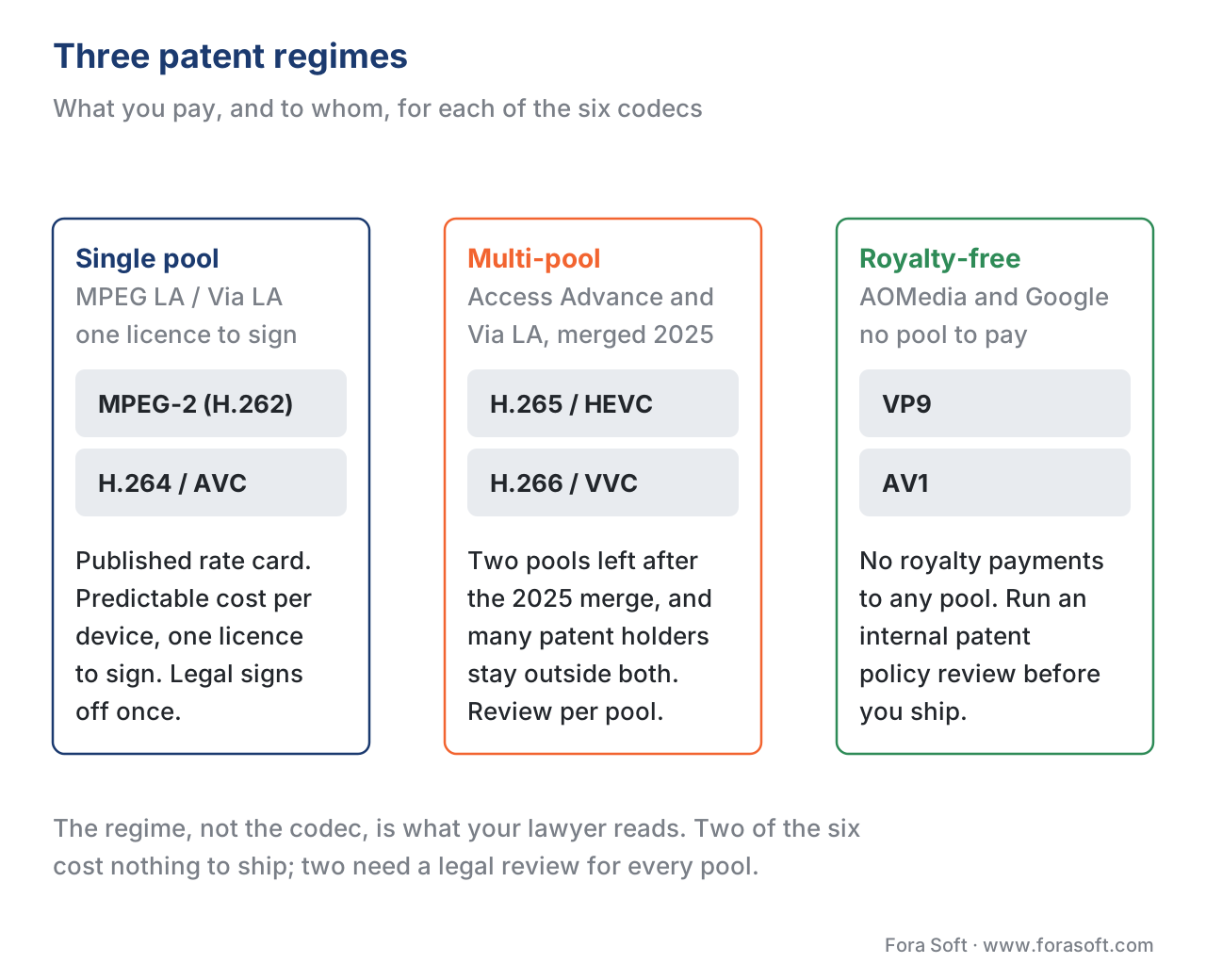 Figure 3. Three patent regimes. Single-pool codecs are simple to licence; multi-pool codecs are not; royalty-free codecs require an internal patent-policy review but no royalty payments to a pool.
Browser Support — Where Most Internet Video Is Actually Watched
This column tells you whether a codec plays in the browser without a plug-in, on the device you care about, in 2026.
H.264 plays in every browser, on every desktop, on every mobile OS released since 2010. There is no asterisk. Hardware decoders are universal.
HEVC plays in Safari natively (Apple paid the licences for its platform), in Microsoft Edge through Windows OS extensions, and on Chrome only via OS-provided hardware decoders — Chrome itself does not include a software HEVC decoder for licensing reasons. Firefox added partial HEVC playback in 2023 through OS bridges but the support is limited and platform-dependent. The result: HEVC is reliable on Apple devices, unreliable on the open web.
VP9 plays in Chrome since version 29 (August 2013), Firefox since March 2014, Edge, and Safari since version 14 (September 2020). It is the closest thing to a universally supported open-web codec besides H.264.
AV1 plays in Chrome since version 70 (October 2018), Firefox since version 67 (May 2019), Edge since version 121 (January 2024), and Safari since version 17 (September 2023) but only on hardware that has an AV1 decoder — currently iPhone 15 Pro and newer, M3 Macs and newer, M4 iPad Pro and newer. Older Apple devices on Safari 17 cannot play AV1; the system has no software fallback. This is a quirk every product team must understand when shipping AV1.
VVC has no native browser support in 2026. Experimental WASM decoders exist but are not production-ready for serious workloads.
The product implication: if you are designing an in-browser player without flash, your codec choice is H.264 (everywhere), VP9 (most browsers), or AV1 (modern Chrome / Firefox / Edge, plus Apple Silicon Safari 17+). HEVC and VVC are not realistic open-web options.
Hardware Decoder Coverage — The Real Bottleneck on AV1
Software decoders run on the device CPU and burn battery. Hardware decoders run on a dedicated piece of silicon and use a fraction of the power. For mobile and connected-TV video, hardware decode is not a nice-to-have — it's the difference between a watchable battery life and a phone that gets warm in twenty minutes.
The progression matches the codec ages. H.264 hardware decoders are universal since roughly 2008. HEVC hardware decoders are universal in the smartphone, set-top, and TV markets since roughly 2018. VP9 hardware decoders ship on most Android devices since 2016 and on Apple platforms since iOS 14 / tvOS 14 / macOS Big Sur in 2020.
AV1 hardware decode is the column where careful product planning still pays off. Apple shipped its first AV1 hardware decoder in the A17 Pro chip (iPhone 15 Pro, September 2023), followed by the M3 family for Macs (October 2023) and the M4 iPad Pro (May 2024). Apple ships no system-wide software fallback, so older Apple devices simply cannot decode AV1. On Android, broad AV1 hardware coverage arrived on Qualcomm Snapdragon 8 Gen 3 (late 2023) and the Google Tensor and recent Samsung Exynos chips. Mid- and low-tier Android SoCs largely lack it. On smart TVs, AV1 hardware decoders are nearly universal on 2022-and-newer Samsung and LG OLED models, and Netflix's certification submissions show 88% of large-screen devices submitted from 2021 to 2025 had AV1, with nearly 100% from 2023 onward. 12
VVC hardware decoders are essentially absent from consumer SoCs in 2026. Brazil's DTV+ broadcast standard, which is the first national-scale VVC deployment, ships dedicated set-top boxes with VVC decoders, but the broader phone, tablet, and TV ecosystem has skipped the codec.
The practical rule: if you are planning AV1 delivery in 2026, segment your audience by device generation. Modern flagship phones and 2022+ TVs decode AV1 in hardware. Everything else needs an H.264 or HEVC fallback.
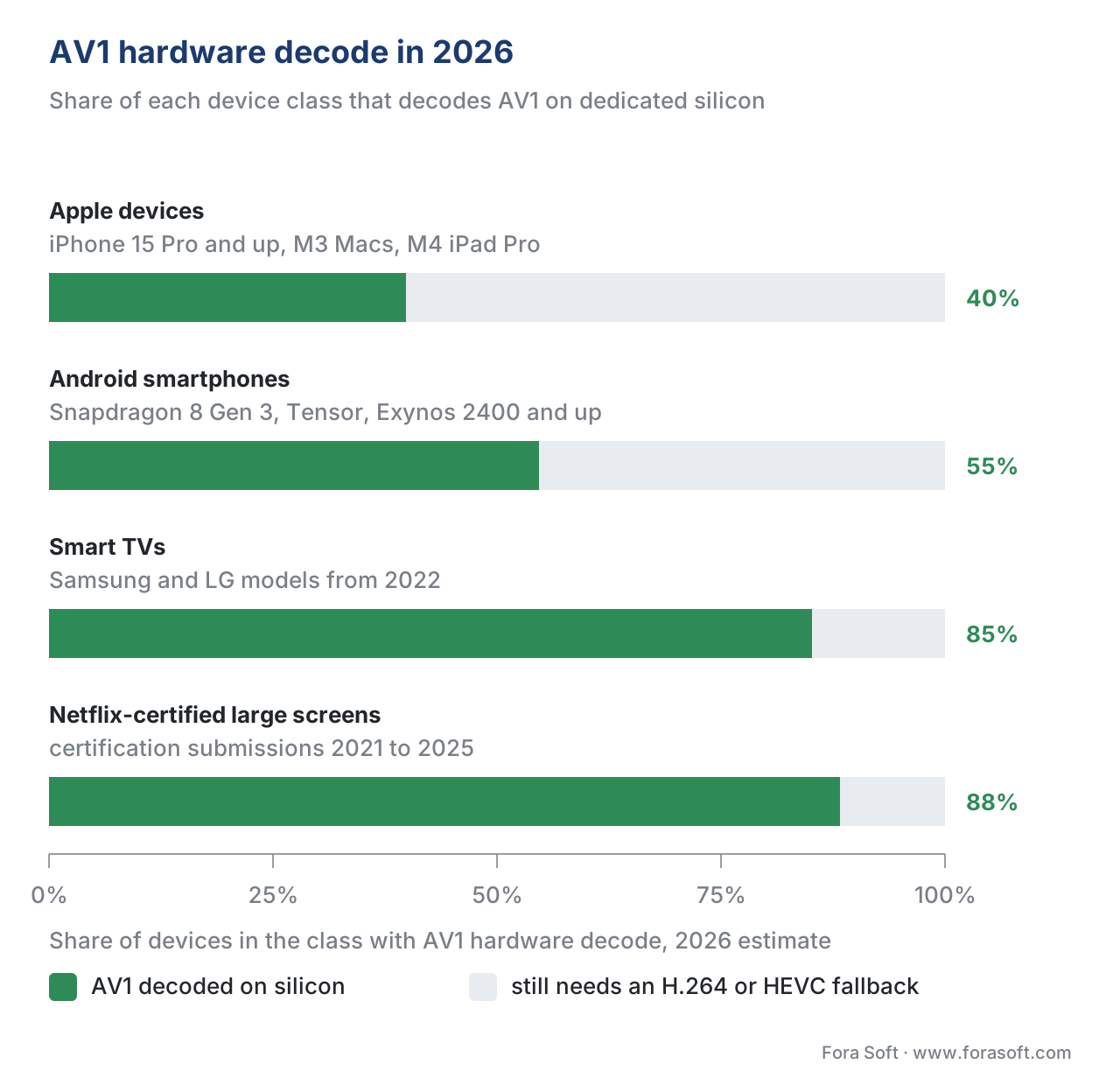 Figure 4. Hardware decoder coverage for AV1 across consumer device categories in 2026. The grey part of each bar is the older devices that still need an H.264 or HEVC fallback path.
Encode Complexity — Why Your Encoder Bill Goes Up
Decoding is cheap. Encoding is the hard work. The encoder has to choose, for every block in every frame, the best prediction mode, the best motion vector, the best transform, and the best quantization step — out of an exponentially large space of possibilities. A more powerful codec has more options to evaluate, which means more compute per frame.
The numbers in the table are rough, because they depend heavily on which encoder you use and which speed preset. Industry consensus in 2026: x265 (HEVC reference encoder) is roughly 5–10× slower than x264 (H.264) at quality-equivalent presets. libaom-AV1 at its slow presets is famously slow — measured at one point at 2,500–3,000× slower than x265 on the same hardware for the same clip. SVT-AV1, the Intel-and-Netflix-developed encoder that now dominates production AV1, runs at presets 4–6 at roughly 30–50× faster than libaom while keeping most of the compression gain, bringing AV1 encoding closer to x265 speeds. 15 VVenC (the open-source VVC encoder) runs roughly 7–20× slower than x265 depending on preset.
What does this mean for your encoding bill? For a VOD service producing thousands of hours of content per month, the encoder cost difference between H.264 and AV1 with SVT-AV1 is real but manageable — a 5–10× cost increase, often offset by bandwidth savings. For a live streaming service, the math is different: AV1 live encoding still requires either purpose-built hardware (NETINT ASIC-based encoders, NVIDIA RTX 40-series), an aggressive speed preset (which gives up most of the compression gain), or a CPU farm an order of magnitude larger than the H.264 equivalent. We cover the production trade-offs in Hardware acceleration: GPU, VPU, ASIC.
Use Cases Dominant in 2026 — Who Actually Uses What
Reading the use-cases row of the table answers the practical "what should I pick?" question for the most common workloads.
Digital TV broadcast still uses MPEG-2 on legacy infrastructure and H.264 or HEVC on newer DVB / ATSC pipes. ATSC 3.0 — the modern North-American broadcast standard — uses HEVC. Brazil's DTV+ is the only national broadcast standard built around VVC; its commercial launch is timed to the 2026 FIFA World Cup. 17
Premium 4K OTT (Netflix, Disney+, Amazon Prime Video 4K, Apple TV+) ships HEVC for the bulk of 4K content, with AV1 layered on top for AV1-capable devices. Netflix announced in December 2025 that AV1 powers about 30% of all its streaming and is on track to become its number-one codec. 12
Mass-market OTT, AVOD, SVOD ships H.264 as the base ladder rung, HEVC on top for premium tiers and Apple devices, and AV1 for modern devices when the platform has rolled it out. Bitmovin's annual surveys show AVOD adoption of AV1 keeping pace with SVOD, with both around 36–37%. 14
YouTube ships AV1 for popular and high-resolution content on AV1-capable devices (8K is AV1-only), VP9 for most 4K and desktop delivery, and H.264 universally as the compatibility fallback. Every YouTube upload gets transcoded to all three.
Twitch in 2026 still requires H.264 for the mandatory ingest path. Enhanced Broadcasting beta supports HEVC and AV1 on NVIDIA RTX 40-series cards, but Twitch is explicitly waiting on broader AV1 device-decode penetration before mainstream rollout. 16
Surveillance and conferencing ship H.264 first and HEVC second; AV1 is rare in real-time use because the encoder math is hard. WebRTC stacks are starting to ship AV1, but H.264 and VP8 are still the universal default.
A Decision Guide in Six Questions
The table is meant to be readable in one pass. If you want a faster route to a decision, work through these six questions in order.
- Are you shipping into a TV broadcast pipe? If yes and the pipe is in Brazil, pick VVC. If yes anywhere else, pick HEVC for new builds and MPEG-2 only for legacy compatibility.
- Do you have to support phones older than 2018? If yes, your base codec is H.264. Everything else layers on top.
- Do you need HDR or 10-bit content? If yes, your codec list is HEVC, AV1, or (in narrow contexts) VVC.
- Are you a small-team distributor who cannot absorb HEVC licence risk? If yes, ship AV1 and VP9 instead. Use H.264 as the fallback.
- Are you running live streaming? If yes, your real-time encoder choice is H.264 or HEVC. AV1 live is possible on dedicated hardware but expensive. VVC live is not realistic in 2026.
- Are you targeting 8K? If yes, your only practical options are AV1 (on Apple Silicon and recent flagships) or HEVC (where the device chain supports it). VVC's 16K theoretical ceiling does not translate into ship-able product yet.
Three Common Mistakes Product Teams Make
Mistake 1: Picking a single codec. No production platform we've shipped ships a single codec. The right answer is a ladder of codecs — H.264 plus one or two newer codecs — selected at request time by the player based on device capability and network conditions. This is what Adaptive Bitrate streaming (ABR) is for. We unpack the mechanics in Adaptive bitrate streaming: how it really works.
Mistake 2: Reading the headline savings number as a guarantee. When AOMedia or Fraunhofer publishes a "50% savings" number, that number is a reference-encoder, slowest-preset, lab-curated result. Real-world production with fast presets delivers two-thirds to three-quarters of the headline. Budget your bandwidth on the realistic number, not the marketing one.
Mistake 3: Picking VVC for "future-proofing". Several Fora Soft clients in 2024–2025 asked whether they should pick VVC as a forward-looking choice. The answer remains no in 2026: VVC has almost no hardware decoder coverage in consumer devices, no native browser support, and competes against AV1's identical bitrate-savings ballpark with a much weaker deployment story. The forward-looking pick in 2026 is AV1 today and AV2 once it lands at the end of 2026 and through 2027.
Free download: Codec Comparison Cheat SheetThe whole comparison on one A4 page: MPEG-2, H.264, H.265, VP9, AV1 and H.266 with bitrate savings, patent model, browser and hardware support, and where each one ships in 2026.Where Fora Soft Fits In
We've shipped video products for two decades, and codec choice is one of the first decisions we make on every new project. For an OTT platform launching in 2026 we typically ship a three-codec ladder — H.264 as the universal fallback, HEVC for premium 4K on Apple devices, AV1 for modern Chrome / Firefox / Edge and recent Apple Silicon Safari, with device-side capability detection deciding which manifest the player asks for. For a WebRTC conferencing product we still default to H.264 and VP8, with AV1 enabled selectively for the devices that can encode it efficiently. For a video surveillance platform we usually pick H.264 plus HEVC, because the recorder hardware in this market still standardises on those two. We've delivered video streaming, OTT/Internet TV, WebRTC conferencing, telemedicine, e-learning, and AR/VR projects across all of these stacks, and we read codec choices the way the rest of this article reads them — as engineering trade-offs, not vendor pitches.
The book
Video Encoding: A Complete Guide to Video Compression
Every column of the table above gets a chapter here: what a coding block is and why a 128×128 superblock saves bits, where bit depth and chroma subsampling change the picture you actually see, and how a bitrate-savings number is measured — which is why the 50 per cent headline shrinks when you switch to a production preset. The codec chapters take MPEG-2, H.264, HEVC, VP9, AV1 and VVC one at a time, and the rate-control and quality-metric chapters give you the arithmetic to run this comparison on your own content instead of trusting anyone else's table. It is volume 1 of the seven-volume Fora Soft Video Engineering Handbook, which walks the whole video stack from the pixel to production. 1,522 pages, written by Nikolay Sapunov, CEO at Fora Soft.
Which codecs should your 2026 ladder actually carry?
Send us your device and player analytics, your current bitrate ladder and your CDN bill, and we will come back with three numbers on your own traffic: the share of your audience that decodes AV1 on silicon today, what HEVC or AV1 on the top rungs is worth against your actual egress, and what the extra encode time costs on your transcode farm. If you are shipping live rather than VOD, we run the same arithmetic against real-time encoder budgets instead, because that is where AV1 stops being free. 250+ video products shipped since 2005.
See our case studies
Case study
Speed.Space
Live 1080p at 8 Mb/s for production clients including Netflix, EA and HBO. This is mistake 1 from the section above answered in production: the ladder carries H.264 for reach and a newer codec on the top rungs, and the player picks per device.
Case study
Worldcast Live
Concert streaming at 1.5 Gb/s with 0.4–0.5 s latency to 10,000 simultaneous viewers. Live is where the encode-complexity column bites: at that latency budget the codec choice is made by what a real-time encoder can finish, not by what compresses best.
Case study
Mindbox
RTSP cameras through FFmpeg to HLS, 50+ deployments. The hardware-decode column decides this one before anyone opens a spec: the cameras emit H.264, so H.264 is the codec, whatever the comparison table says about the newer three.
What to read next
Codecs
AV1: The New Internet Standard And Where It Stands In 2026
The row with the most movement in it: how far AV1 hardware decode has really spread, and what the encode still costs you.
Codecs
H.265 / HEVC: +50% Over H.264 And The Patent Nightmare
The long version of the patent column: how three pools formed, what consolidation changed in 2025, and when HEVC is still the right pick.
Tooling
Hardware Acceleration: GPU, VPU, ASIC
What NVENC, QuickSync, VideoToolbox and NETINT ASICs change about the encode-cost arithmetic behind the comparison.
Quality
Objective Quality Metrics: PSNR, SSIM, MS-SSIM, VMAF
How a bitrate-savings number is measured, so you can run the comparison on your own content instead of trusting a table.
-
ITU-T H.262 / ISO/IEC 13818-2, Generic coding of moving pictures and associated audio information: Video (MPEG-2 Part 2). First edition published 1995. Wikipedia summary. Accessed 2026-05-16. ↩
-
ITU-T H.264 / ISO/IEC 14496-10, Advanced Video Coding. First edition approved March 2003, published May 30, 2003. Wikipedia: Advanced Video Coding. Accessed 2026-05-16. ↩↩
-
ITU-T H.265 / ISO/IEC 23008-2, High Efficiency Video Coding. Ratified January 2013, published June 2013. Wikipedia: High Efficiency Video Coding. Accessed 2026-05-16. ↩↩
-
VP9 bitstream specification (Google, 2016). VP9 Bitstream Specification. Released June 2013; Chrome 29 (August 2013), Firefox (March 2014), Safari 14 (September 2020). Accessed 2026-05-16. ↩
-
Alliance for Open Media, "AV1 Roadmap". AV1 bitstream specification 1.0 frozen 28 March 2018. AV1 Roadmap (AOMedia). Accessed 2026-05-16. ↩
-
ITU-T H.266 / ISO/IEC 23090-3, Versatile Video Coding. Finalised 6 July 2020 by JVET; version 3 published September 2023. Wikipedia: Versatile Video Coding. Accessed 2026-05-16. ↩
-
Mukherjee et al., "A Technical Overview of VP9" (Google, 2015) — VP9 design targets and ≈ 50% reduction vs H.264 in BD-rate tests. Accessed 2026-05-16. ↩
-
David Ronca, "AV1 beats x264 and libvpx-VP9 in practical use case", Meta / Facebook Engineering, 2018. AV1 beat libvpx-vp9 by 34% and x264 High by 46.2% on BD-rate against VMAF on a 400-clip Facebook test set. Meta Engineering blog. Accessed 2026-05-16. ↩↩
-
Fraunhofer HHI, "H.266 / VVC". Design target: ≈ 50% bitrate reduction vs HEVC at equal subjective quality. Fraunhofer HHI VVC page. Accessed 2026-05-16. ↩↩
-
"Video Coding and Related Patent Licensing Pools — Beginner's Guide", Sagacious IP, 2024. Sagacious IP overview. Accessed 2026-05-16. ↩
-
"Access Advance Acquires Via Licensing Alliance's HEVC/VVC Patent Pools" (December 2025) — consolidation of two of the three HEVC pools and both VVC pools. IP Fray report. Accessed 2026-05-16. ↩↩↩↩
-
Netflix Technology Blog, "AV1 — Now Powering 30% of Netflix Streaming" (December 2025). Netflix TechBlog. Accessed 2026-05-16. ↩↩↩
-
NETINT, "2026 State of Video Encoding" survey (286 respondents). H.264 ≈ 80% production deployment; HEVC ≈ 65% production + 20% planned; AV1 17% production + 40% planning. NETINT 2026 State of Video Encoding. Accessed 2026-05-16. ↩↩↩
-
Bitmovin, 8th Annual Video Developer Report 2024/2025 (167 respondents, 34 countries). H.264 ≈ 79% use; HEVC ≈ 49%; AV1 stagnant in deployment but #1 in planned adoption. Bitmovin Video Developer Report. Accessed 2026-05-16. ↩↩↩
-
Streaming Learning Center, "SVT-AV1 vs libaom". SVT-AV1 at presets 4–6 runs ~30–50× faster than libaom while keeping most of the compression gain. SVT-AV1 vs libaom. Accessed 2026-05-16. ↩
-
NVIDIA, "Twitch Multi-Encode AV1 Live Streaming". Twitch Enhanced Broadcasting beta supports HEVC and AV1 on RTX 40-series; mainstream AV1 rollout pending broader device decode penetration. NVIDIA blog. Accessed 2026-05-16. ↩
-
BroadbandTVNews, "Brazil adopts ATSC 3.0–based DTV system" (August 2025). TV 3.0 / DTV+ adopts VVC as primary codec with LCEVC enhancement; commercial launch early 2026 timed to 2026 FIFA World Cup. BroadbandTVNews report. Accessed 2026-05-16. ↩
