


Why this matters
If you build, buy, sell, or operate anything that touches video — a streaming product, a video-conferencing app, a security-camera fleet, an e-learning platform, a live event — bitrate is the lever that controls your bandwidth bill, your video quality, your buffer rate, and the size of every storage invoice you will ever sign. Pick a bitrate that is too high and your costs blow up while half your audience cannot watch on a phone; pick one too low and the picture turns into a mosaic of compression artefacts and your support inbox fills with complaints. The decision touches product managers, founders, marketing leads, and operations people every quarter, often without their realising that the same simple equation drives every codec, every CDN, and every video paywall. By the end of this article you will be able to compute the uncompressed weight of any video format on the back of a napkin, see why a modern codec is a 500× discount, and tell when a vendor's bitrate claim is honest and when it is theatre.
What "bitrate" actually means
A bit is a binary digit: a single zero or one. A digital video file is, at its most basic level, a very long sequence of zeros and ones. Bitrate, often written as bps for "bits per second", is the speed at which that sequence flows — how many of those zeros and ones the file produces, or a network has to carry, every second the video plays.
A useful analogy: think of video data as water flowing through a pipe. The pipe is your internet connection or your hard drive's read speed. The bitrate is the litres-per-second the water is moving at. If the bitrate the video demands is higher than the pipe can carry, the water backs up — in video terms, the player buffers, freezes, or downgrades to a worse-looking version that fits. Get the bitrate right and the water flows smoothly and the picture stays clean.
The standard units climb in steps of one thousand. One kilobit per second (kbps) is a thousand bits. One megabit per second (Mbps) is a thousand kilobits, or one million bits. One gigabit per second (Gbps) is a thousand megabits, or one billion bits. A typical low-quality YouTube clip is one or two Mbps. A 4K Netflix stream is fifteen to twenty-five Mbps. An uncompressed 4K master file in a TV studio is twelve Gbps — a thousand times the Netflix figure. The gap between those last two numbers is the entire reason video compression exists as an industry. 1
A word on bits versus bytes. A byte is eight bits, written with a capital B. Disk sizes are usually given in bytes (gigabytes, terabytes); network speeds are usually given in bits (gigabits, megabits). When somebody says "my home internet is a hundred meg", they almost always mean a hundred megabits per second, not megabytes. To convert a download speed in megabits per second into the file size in megabytes you can save per second, divide by eight. A 100 Mbps connection saves 12.5 megabytes per second, which is why a 1 GB file takes roughly 80 seconds, not 10. Mixing up bits and bytes by a factor of eight is the most common bandwidth mistake in the entire industry and you should expect to catch it in vendor decks at least once a month.
The math of uncompressed video — three multiplications
Every uncompressed video format in the world reduces to one simple equation. A frame is a grid of pixels. Each pixel is described by some number of bits. The video plays at some number of frames per second. Multiply those three numbers together and you have the raw bitrate.
bitrate (bits per second) = width × height × bits per pixel × frames per second
Three multiplications, that is the whole formula. Walk through it once out loud with a real example so the next time you see a vendor claim you can have an "uncompressed live feed" over a 1 Gbps link, you can do the math in your head and call the bluff.
Example one — 1080p at 30 fps, 8-bit RGB colour. A 1080p frame is 1920 pixels wide and 1080 pixels tall. Each pixel in 8-bit RGB is described by three channels — red, green, blue — at 8 bits each, so 24 bits total per pixel. The video plays at 30 frames per second.
bitrate = 1920 × 1080 × 24 × 30
        = 2,073,600 pixels per frame
        × 24 bits per pixel
        × 30 frames per second
        = 1,492,992,000 bits per second
        ≈ 1.49 Gbps
So an uncompressed 1080p30 stream weighs about one and a half gigabits per second — already more than most home internet connections in the world can carry. This is the cheapest case in the table.
Example two — 4K at 60 fps, 10-bit YCbCr 4:2:0. A 4K frame is 3840 × 2160 = 8,294,400 pixels. The 10-bit YCbCr 4:2:0 format used in modern HDR delivery encodes brightness at full resolution and the two colour channels at quarter resolution, which works out to an average of 15 bits per pixel — eight bits for luma plus four for each of the two chroma channels in 8-bit, or twelve bits total scaled up by ten-over-eight for 10-bit. Round to 15 bits per pixel.
bitrate = 3840 × 2160 × 15 × 60
        = 8,294,400 pixels per frame
        × 15 bits per pixel
        × 60 frames per second
        = 7,464,960,000 bits per second
        ≈ 7.46 Gbps
The same calculation done with 12-bit colour for studio-grade HDR comes out closer to 12 Gbps, and the full RGB 12-bit version used in colour-grading suites reaches roughly 18 Gbps. Those last two numbers are why a professional video edit suite needs a Thunderbolt 4 connection (40 Gbps) and not a USB-3 cable (5 Gbps). 2
Example three — 8K at 120 fps, 12-bit RGB. An 8K frame is 7680 × 4320 = 33,177,600 pixels. Twelve-bit RGB is 36 bits per pixel.
bitrate = 7680 × 4320 × 36 × 120
        = 143,327,232,000 bits per second
        ≈ 143 Gbps
This number is roughly the bandwidth of a thirty-two-lane PCIe 4.0 slot, which is to say: it does not fit on any consumer hardware you can buy in 2026. The headline of the table is short — every doubling of resolution multiplies bitrate by four, every doubling of frame rate doubles it, and every extra bit of colour depth adds twelve to fifteen per cent. The numbers grow fast, and they grow without compression on the back of the envelope.
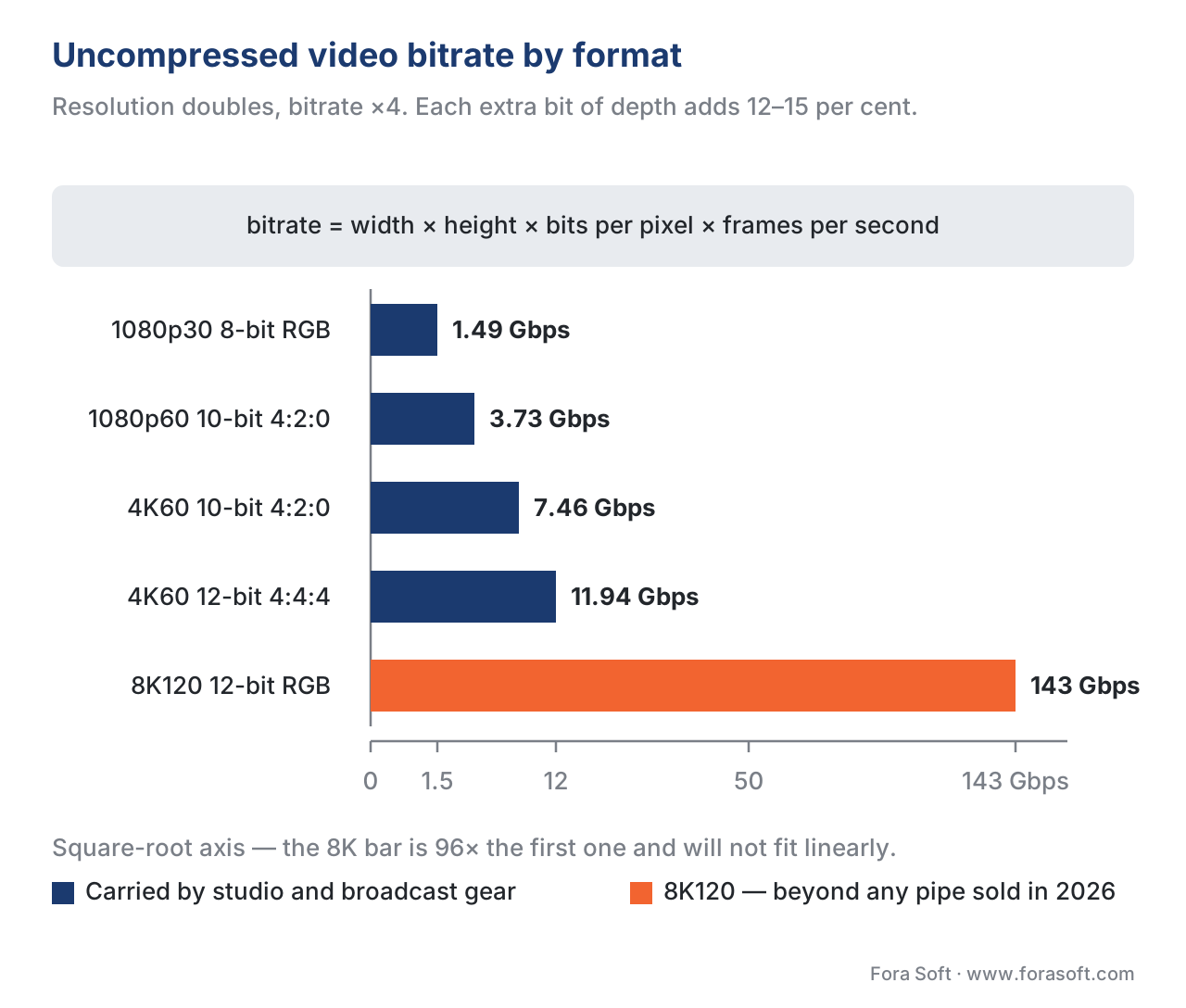 Figure 1. Uncompressed video bitrate climbs faster than anything else in your stack. The same axis that fits 1080p comfortably reaches the edge of the chart at 8K — a 96× jump in a single line.
What we have to flow through: real pipes, real bandwidth
Those uncompressed numbers only matter when you compare them to the pipes available to carry them. The pipes are smaller than people think.
Fixed-line broadband in the United States, as measured by the Federal Communications Commission, was 500 Mbps median download and 20 Mbps median upload as of mid-2024 — the upload number especially is a hard ceiling for anybody trying to push live video out of a home network. 3 The same regulator raised the official "high-speed broadband" definition in 2024 to 100 / 20 Mbps from the prior 25 / 3, recognising that anything below 100 down was effectively unusable for modern video. 4
Mobile networks vary wildly by country. The global median mobile download speed measured by Ookla's Speedtest Global Index, the most-cited public benchmark in the telecoms industry, was about 100 Mbps in late 2025 — but that average hides a 200× spread between the slowest and the fastest national markets. 5 South Korea sits at the top with around 435 Mbps median mobile download. The Gulf states, especially the United Arab Emirates with roughly 690 Mbps median, are the fastest in the world thanks to aggressive 5G build-out. India, Brazil, and Nigeria are still in the low double digits. For a real product the rule is: design for the bottom of your audience's bandwidth distribution, not the top.
Inside a building the picture is different again. Wi-Fi 6 in a quiet apartment delivers 300 to 700 Mbps to a phone or laptop in the same room as the router, but drops below 50 Mbps when the user walks two rooms away or shares the link with three other devices on a video call. Wired ethernet inside a corporate office is usually 1 Gbps per port, but the up-link from the building to the internet is shared between every employee and rarely above 10 Gbps. The fact that nobody in a real product ever delivers uncompressed video — to anyone, on anything — is not a quirk; it is a hard physical consequence of these numbers.
| Pipe | Realistic 2026 speed | Can it carry uncompressed 1080p30 (1.5 Gbps)? | Can it carry uncompressed 4K60 10-bit (7.5 Gbps)? |
|---|---|---|---|
| US median fixed home download | 500 Mbps | No | No |
| US median fixed home upload | 20 Mbps | No | No |
| Global median mobile download | 100 Mbps | No | No |
| 5G mid-band in a good market | 400 Mbps | No | No |
| Wi-Fi 6 in the same room | 600 Mbps | No | No |
| Office ethernet port | 1 Gbps | No | No |
| HDMI 2.1 cable inside a TV | 48 Gbps | Yes | Yes |
| Thunderbolt 4 inside a studio | 40 Gbps | Yes | Yes |
| 12G-SDI in a broadcast truck | 12 Gbps | Yes | Yes (just) |
The table makes the point with no commentary needed. Every consumer pipe is smaller than every uncompressed video format above 1080p, and most are smaller than even 1080p. The job of a video codec is to bridge that gap.
A simple mental formula for compressed bitrate
The compressed bitrate is what you actually ship. There is no closed-form equation for it the way there is for the uncompressed case — modern codecs are nonlinear and content-dependent — but a four-variable mental model gets you within a factor of two of reality, which is good enough for product conversations and budget arithmetic.
bitrate ≈ (target quality × scene complexity × resolution × frame rate)
          ÷ codec efficiency
Read each variable in turn. Target quality is how good you want the picture to look, usually expressed as a VMAF score (see the quality metrics article for the full definition) or a quality preset. Scene complexity is how much new information is in each frame: a static talking-head scene is low complexity, a crowd in a stadium under flashing lights is high complexity, and the bitrate gap between them at the same quality is typically 5 to 10×. Resolution and frame rate multiply in linearly the way they did in the uncompressed equation. Codec efficiency is the only variable that improves over time as the industry releases newer codecs — H.264, H.265, AV1, VVC — each generation about 30 to 50 per cent more efficient than the last on average. 6
The mental model is not a literal formula you should plug into a spreadsheet. It is a way to predict which way the bitrate moves when one variable changes. Double the resolution at the same codec and quality: bitrate roughly quadruples (because the pixel count goes up 4×). Switch from H.264 to AV1 at the same quality: bitrate roughly halves. Move from a talking-head to a sports scene at the same codec, resolution, and quality: bitrate triples or more. Lower the target VMAF from 95 to 80 at the same content: bitrate roughly halves. These are the relationships that make every codec roadmap and every bitrate ladder make sense.
The next section turns the mental model into real numbers from the streaming services that the rest of the industry copies.
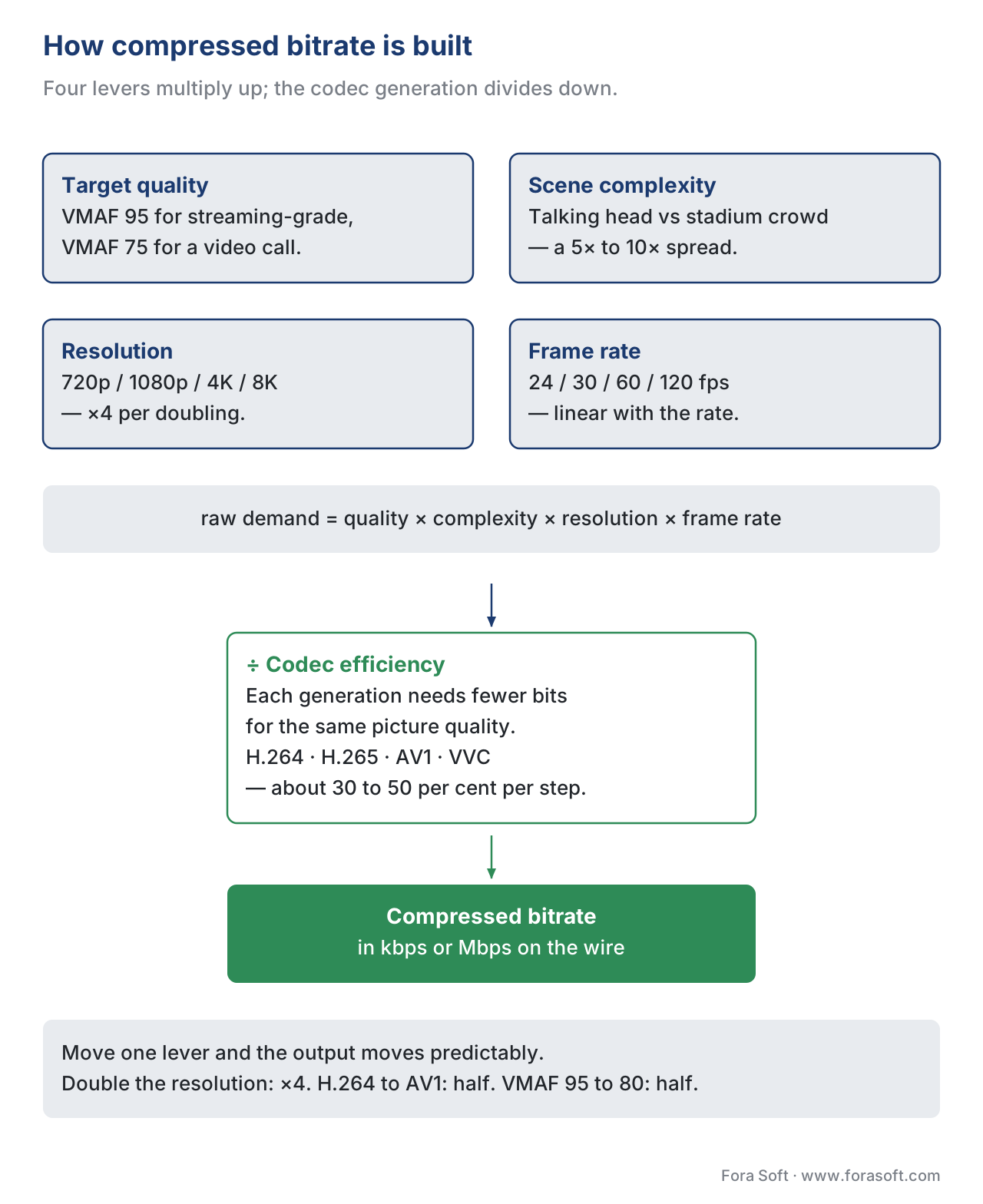 Figure 2. The four input levers that drive compressed bitrate, and the codec generation that divides them. Move one lever, the output moves predictably.
What real services actually use
Numbers from real platforms anchor the math. The table below shows the bitrates that the three biggest names in video each ship today, alongside what their uncompressed equivalent would have weighed. Every figure is from an official source, dated 2024 or 2025 so it survives the next codec cycle. The full source list sits at the bottom of the article.
| Service & format | Codec | Shipped bitrate | Uncompressed equivalent | Compression ratio |
|---|---|---|---|---|
| Netflix 1080p stream | H.264 | 4–6 Mbps | 1,492 Mbps | ≈ 300× |
| Netflix 4K HDR stream | H.265 | 8–16 Mbps avg, peaks ≈ 17 Mbps 7 | 12,000 Mbps | ≈ 1,000× |
| YouTube 1080p60 SDR upload | H.264 | 12 Mbps (recommended) 8 | 2,985 Mbps | ≈ 250× |
| YouTube 4K60 SDR upload | H.264 | 53–68 Mbps (recommended) 8 | 11,943 Mbps | ≈ 200× |
| Zoom HD video call | H.264 / VP8 | 1.2–3.0 Mbps 9 | 1,492 Mbps | ≈ 600× |
| WhatsApp video call | H.264 | 0.3–1.5 Mbps | 600 Mbps | ≈ 500× |
| Broadcast 4K live (DVB-T2) | H.265 | 25–40 Mbps | 12,000 Mbps | ≈ 400× |
| 4K Blu-ray disc | H.265 | up to 128 Mbps peak | 12,000 Mbps | ≈ 100× |
The first thing to notice is that compression ratios on real services land in the 200× to 1,000× range, with a sweet spot around 500× for streaming-grade 4K. Netflix's per-shot encoding pipeline (the "Dynamic Optimizer", or DO) has pushed the average 4K HDR shipped bitrate down to roughly half what its old fixed-ladder bitrates were, and the same fifteen-Mbps figure that used to feel low for 4K is now the median across the catalogue. 7
The second thing to notice is that the same content compressed at the same quality looks very different on different services. Zoom and WhatsApp ship at 1–3 Mbps for 1080p video calls because they prioritise latency and reliability over per-frame sharpness — a single dropped video call destroys far more user trust than a slightly soft picture. Netflix ships 4× to 6× more because its content is recorded, encoded for hours, and meant to look indistinguishable from a Blu-ray. YouTube sits in the middle. The mental formula above explains all three: the "target quality" variable is dialled way down on a video call and way up on a movie.
The third thing to notice is the Blu-ray row. Physical-media discs ship at ratios closer to 100× because storage is fixed — the disc holds what it holds — and quality is the only competitive lever. Streaming services live at ratios closer to 1,000× because bandwidth is metered and quality is "good enough for the device the viewer is using". Two different optimisation problems, two different points on the same compression curve.
Common mistake — confusing average bitrate with peak bitrate
The single most common error in product discussions is treating the shipped bitrate as a single number. It almost never is. Modern codecs use variable bitrate (VBR) encoding: the bitrate goes up during action scenes and down during talking-head scenes, and what is reported is the average over the whole title. A 15 Mbps Netflix 4K average can peak at 25 Mbps for a five-second action burst, drop to 4 Mbps for a quiet dialogue, and average to 15 Mbps over the file. Networks have to size for the peak, not the average — if the user's pipe can only carry 18 Mbps and the codec asks for 25 Mbps mid-scene, the player buffers. The fix is a capped CRF or a constrained VBR encoding setting that lets the bitrate float but never exceeds a hard ceiling. The full topic gets its own article in the rate control section; for now, treat any single bitrate number with suspicion until you know whether it is the average, the peak, or the maximum that the network has to plan for.
Codec efficiency through the generations
The "codec efficiency" lever in the mental formula is the only one that gets cheaper over time. Every new codec generation buys roughly 30 to 50 per cent bitrate savings at the same visual quality, and the savings compound across generations. The compounding is why a 2026 streaming service running AV1 ships about a quarter of the bits a 2010 service running H.264 shipped for the same picture.
| Codec | Year shipped | Approx. bitrate vs H.264 baseline | Typical Netflix 4K HDR Mbps (modelled) |
|---|---|---|---|
| MPEG-2 | 1995 | 200% (i.e. 2× more than H.264) | ≈ 60 |
| H.264 / AVC | 2003 | 100% (baseline) | ≈ 30 |
| H.265 / HEVC | 2013 | 55–60% 10 | ≈ 16 |
| VP9 | 2013 | 65–75% | ≈ 20 |
| AV1 | 2018 | 40–50% 11 | ≈ 12 |
| H.266 / VVC | 2020 | 30–40% 12 | ≈ 9 |
| AV2 (preview) | 2025 | 25–35% (target) | ≈ 7 (projected) |
Two things to notice. First, the percentages are bitrate-at-equal-quality, not file-size-at-fixed-bitrate. A 50 per cent number means the new codec needs only half the bitrate to look the same as the old one — equivalent to saying the new codec is twice as efficient at the same quality. Second, every published number is the average across a wide test set, and the per-content spread is enormous. AV1 saves close to 60 per cent on slow, talky content and only 25 per cent on noisy hand-held sports footage; an honest vendor quotes the range, not the average alone.
The codec roadmap matters to a product manager mainly because each step down the column is a chance to reduce the bandwidth bill without changing the picture. A streaming service that re-encodes its catalogue from H.264 to AV1 cuts its egress cost by roughly half at the same VMAF — frequently the largest line-item cost saving in a streaming budget. The cost of doing the re-encode itself, however, is non-trivial: AV1 encoding is roughly 10× slower per frame than H.264 in software, and only the most recent hardware encoders (NVIDIA Ada-generation, Apple M2 onwards, Intel Arc) ship usable AV1 acceleration. The "is it worth it" calculation is the subject of the codec ROI article.
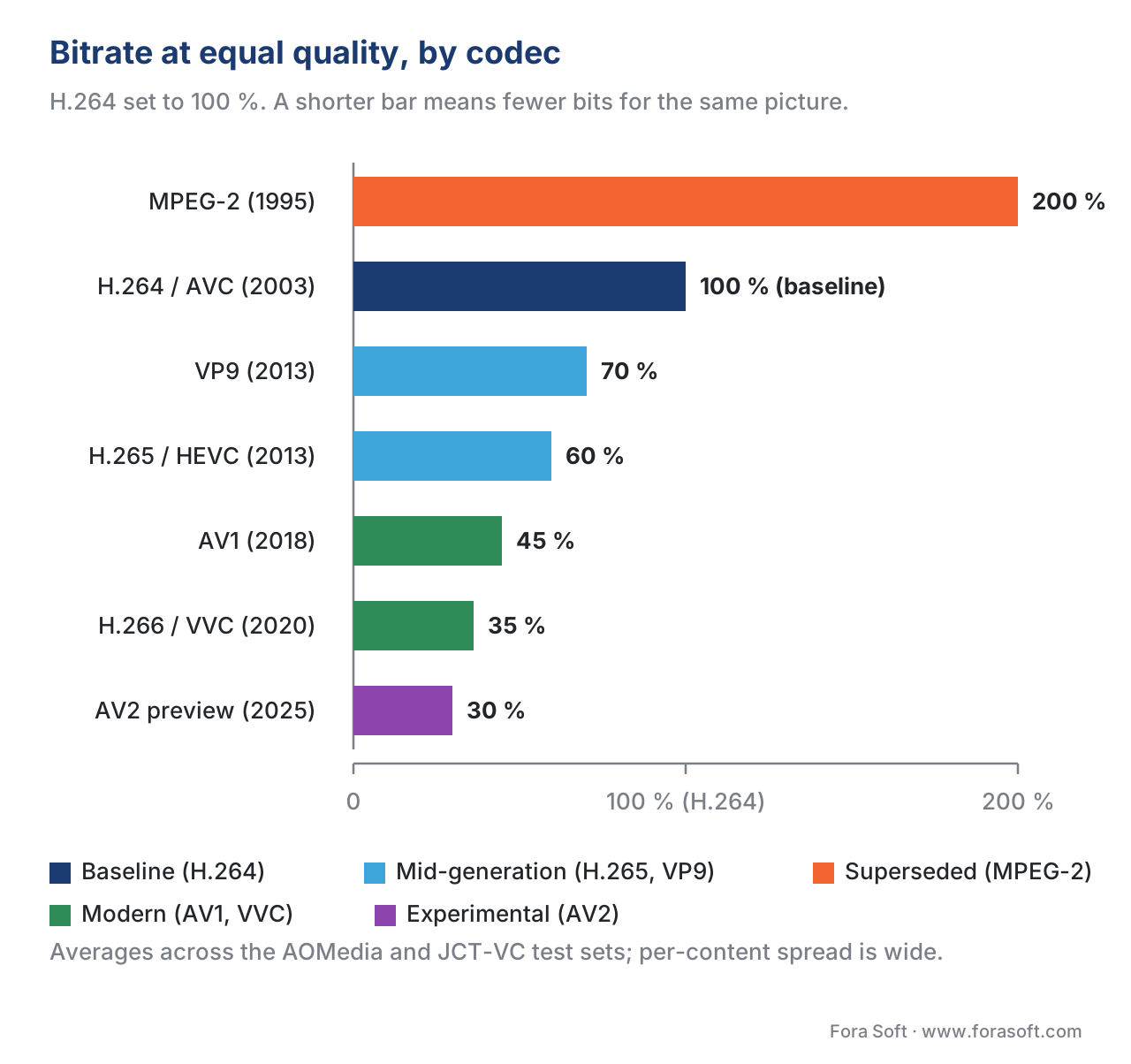 Figure 3. Every codec generation buys roughly half the bitrate of the previous one at the same visual quality. The compounding across generations is why AV1 ships a quarter of what H.264 shipped twenty years ago.
The Shannon limit and where the industry is going
A theoretical question hangs over every codec roadmap: how far can compression go? The answer, surprisingly, has a real lower bound. Claude Shannon's source coding theorem, the 1948 result that founded information theory, says that any data source has an irreducible entropy — a floor below which no lossless codec can compress without losing information. For video, that floor depends on the actual information content of the scene; a single-colour blank frame has near-zero entropy and can be compressed to a handful of bytes, while a hand-held shaky shot of a leaf canopy has near-maximum entropy and resists compression almost completely. 13
Real codecs are nowhere near the entropy floor. The current AV1 vs Shannon-limit gap is estimated at roughly 4–10×, depending on the content class — meaning there is plausibly another 4× compression gain still on the table before the laws of information theory close the door. Neural codecs (end-to-end learned compression) and the next-generation block-based codecs like AV2 are the two paths chasing that remaining gap. The full picture is the subject of the Shannon-limit article later in this series. For now, the takeaway is that we are not at the bottom yet — and the bitrate column above will keep shrinking for at least one more decade.
The other near-term shift is per-title and per-shot encoding, where every piece of content gets its own bespoke bitrate ladder instead of a one-size-fits-all preset. Netflix introduced per-title encoding in 2015 and per-shot in 2019, and the technique now ships every frame of the Netflix HDR catalogue. The reported savings are 20–50 per cent CDN bandwidth at the same VMAF, which is the largest single optimisation a streaming service can deploy without changing its codec stack. 7 The rest of the industry is two to three years behind. Expect the rest of the streaming and OTT world to ship per-shot encoding by 2027, which will pull another 20–30 per cent off the average shipped bitrates in the table above.
Free download: Bitrate Math Cheat SheetA one-page A4 reference with the uncompressed bitrate formula, the four-lever mental model, the bitrates Netflix, YouTube and Zoom actually ship, and the codec efficiency ladder from MPEG-2 to AV2.Where Fora Soft fits in
Fora Soft has been building video products since 2005, and every one of them — video conferencing, video streaming, OTT and Internet TV, video surveillance, e-learning, telemedicine, AR/VR — runs into the same bitrate math the moment it goes live. On WebRTC video conferencing projects the question is how to keep a 1080p call under 2 Mbps so it survives a bad mobile connection; on OTT delivery the question is which codec ladder buys the right VMAF for the lowest CDN bill; on surveillance the question is how to fit thirty H.265 streams over a single uplink without losing the moments the camera was bought to catch. The math in this article is the same math we ran on the first day of every one of those 239+ shipped projects, and it is the math we run on day one of the next one.

The book
Video Encoding: A Complete Guide to Video Compression
This article is the first page of a 1,500-page argument: the three multiplications that give you 1.49 Gbps, and then every mechanism that turns 1.49 Gbps into the 4–6 Mbps a viewer actually receives. The book walks the four levers one at a time — what a VMAF target really buys, how scene complexity moves the number, where rate control decides between average and peak — and then the codec ladder from MPEG-2 to AV2 with the measurements behind each generation’s 30–50%. Written by Nikolay Sapunov, CEO at Fora Soft.
How many bits does your video actually need?
Tell us what you capture, what quality your viewers expect and what pipe they watch over, and we will do this math on your numbers: the bitrate ladder your content needs, what a codec switch is worth against what the re-encode costs, and where your peaks will break someone’s connection. 250+ video products shipped since 2005.
See our case studies
Case study
Worldcast Live
Concert feeds running at 1.5 Gb/s to 10,000 simultaneous viewers with 0.4–0.5 s latency — the case where the peak, not the average, is what the network has to be sized for.
Case study
Speed.Space
Remote production used on Netflix, EA and HBO shoots, recording 1080p at 8 Mbps — the four levers set per shoot, before a single frame is captured.
Case study
Mindbox
AI video management in 50+ deployments, pulling RTSP from cameras of every vintage through FFmpeg into HLS — where dozens of streams have to share one uplink and every Mbps is budgeted.
What to read next
Quality
Objective Quality Metrics: PSNR, SSIM, MS-SSIM, VMAF
The “target quality” lever with a number on it — and how to tell whether a bitrate cut actually looks worse.
Rate control
Rate Control: CBR, VBR, CRF, ABR, Capped CRF
Where average and peak bitrate part company, and the capped-CRF setting that keeps the peak from breaking a player.
Codecs
Comparison Table: MPEG-2, H.264, H.265, VP9, AV1, VVC
The efficiency ladder from the chart above, with the licensing, device support and encode cost that come with each rung.
Tooling
Per-Title and Per-Scene Encoding: Smart Bitrate Ladders
The 20–50% saving Netflix took without changing codec, and what it takes to run the same trick yourself.
-
Netflix Help Center, "Internet connection speed recommendations". Recommends 25 Mbps for 4K, 15 Mbps for HDR, 5 Mbps for full HD. https://help.netflix.com/en/node/306. Accessed 2026-05-16. ↩
-
SMPTE ST 2110 and BT.709 / BT.2020 colour standards, uncompressed 4:2:0 vs 4:4:4 pixel-bit counts. https://www.itu.int/rec/R-REC-BT.2020. Accessed 2026-05-16. ↩
-
Federal Communications Commission, "Measuring Fixed Broadband — Thirteenth Report", May 2025. Median US fixed download 500 Mbps, median upload 20 Mbps as of June 2024. https://www.fcc.gov/reports-research/reports/measuring-broadband-america/measuring-fixed-broadband-thirteenth-report. Accessed 2026-05-16. ↩
-
Federal Communications Commission, "FCC Increases Broadband Speed Benchmark", March 2024. Raised the high-speed broadband definition to 100 Mbps download / 20 Mbps upload from the prior 25 / 3. https://docs.fcc.gov/public/attachments/DOC-401205A1.pdf. Accessed 2026-05-16. ↩
-
Ookla Speedtest Global Index, October 2025. Global median mobile download speed approximately 105 Mbps; South Korea 435 Mbps; UAE 690 Mbps. https://www.speedtest.net/global-index. Accessed 2026-05-16. ↩
-
Alliance for Open Media, AV1 specification overview and bitrate-savings test results vs H.264 / H.265 across the AOM common test conditions. https://aomedia.org/av1-features/. Accessed 2026-05-16. ↩
-
Netflix Technology Blog, "All of Netflix's HDR video streaming is now dynamically optimized", 2023. Per-shot encoding pipeline; HDR-DO ladder occupies 58 per cent of the storage of the prior fixed-bitrate ladder at the same quality. https://netflixtechblog.com/all-of-netflixs-hdr-video-streaming-is-now-dynamically-optimized-e9e0cb15f2ba. Accessed 2026-05-16. ↩↩↩
-
YouTube Help, "Recommended upload encoding settings". 1080p60 at 12 Mbps SDR / 18 Mbps HDR; 4K60 at 53–68 Mbps SDR / 66–85 Mbps HDR. https://support.google.com/youtube/answer/1722171. Accessed 2026-05-16. ↩↩
-
Zoom Help Center, "System requirements for Windows, macOS, Linux". Recommended 1.2 Mbps up / 1.2 Mbps down for 1080p HD video; 1.8/1.8 for group calls. https://support.zoom.us/hc/en-us/articles/201362023. Accessed 2026-05-16. ↩
-
ITU-T Recommendation H.265 v9 (2024) overview; HEVC was designed for 50 per cent bitrate savings vs H.264 at equal subjective quality across the JCT-VC test set. https://www.itu.int/rec/T-REC-H.265. Accessed 2026-05-16. ↩
-
Bitmovin Video Developer Report 2025/2026, 9th edition. H.264 dominant at 80% adoption; AV1 13% in production and 32% in 12-month planning; AV1 reported 40–50 per cent bitrate savings vs H.264 at equal quality in production deployments. https://bitmovin.com/video-developer-report/. Accessed 2026-05-16. ↩
-
Joint Video Experts Team (JVET) of ITU-T VCEG and ISO/IEC MPEG, VVC verification test results. H.266 / VVC designed for 30–50 per cent bitrate savings vs HEVC at equal subjective quality. https://www.itu.int/rec/T-REC-H.266. Accessed 2026-05-16. ↩
-
Claude E. Shannon, "A Mathematical Theory of Communication", Bell System Technical Journal, vol. 27, July and October 1948. Source coding theorem and the entropy floor for lossless compression. https://people.math.harvard.edu/~ctm/home/text/others/shannon/entropy/entropy.pdf. Accessed 2026-05-16. ↩
