


Why This Matters
Picking a codec sets your bandwidth bill, your device coverage, your legal exposure, and the picture quality your customers see for the next five to ten years. Every other infrastructure choice — the bitrate ladder, the CDN (the Content Delivery Network that caches your video close to viewers), the DRM (the Digital Rights Management system that prevents piracy), the encoder farm — follows from the codec. Get this decision wrong and you either burn money on bandwidth, lock out half your audience, or sign a licensing agreement with a seven-figure ceiling. This article assumes no prior knowledge of video engineering. We define every term in plain language before we use it, walk the trade-offs out loud, and end with a decision tree you can apply in twenty minutes to your own product.
How to Read This Article
The decision tree is the centrepiece. We placed it as Figure 1 so you can grab it first if that is all you need. Underneath, every branch of the tree has its own short section that explains the question, the reasoning, and the math. After the tree we run the numbers on bandwidth and licensing — the two things that actually decide most projects — then walk three common mistakes we see Fora Soft clients make. The downloadable one-page cheat sheet lives at the end of the article. We also link out to the deeper Learn articles that cover each codec individually, so you can drill down without re-reading the basics.
You do not need to read the codec deep-dives first. If you want one, the closest companion to this piece is Comparison table: MPEG-2, H.264, H.265, VP9, AV1, VVC — it gives you the technical numbers side by side. This article picks up where that one leaves off, and turns those numbers into a decision you can defend in a product review.
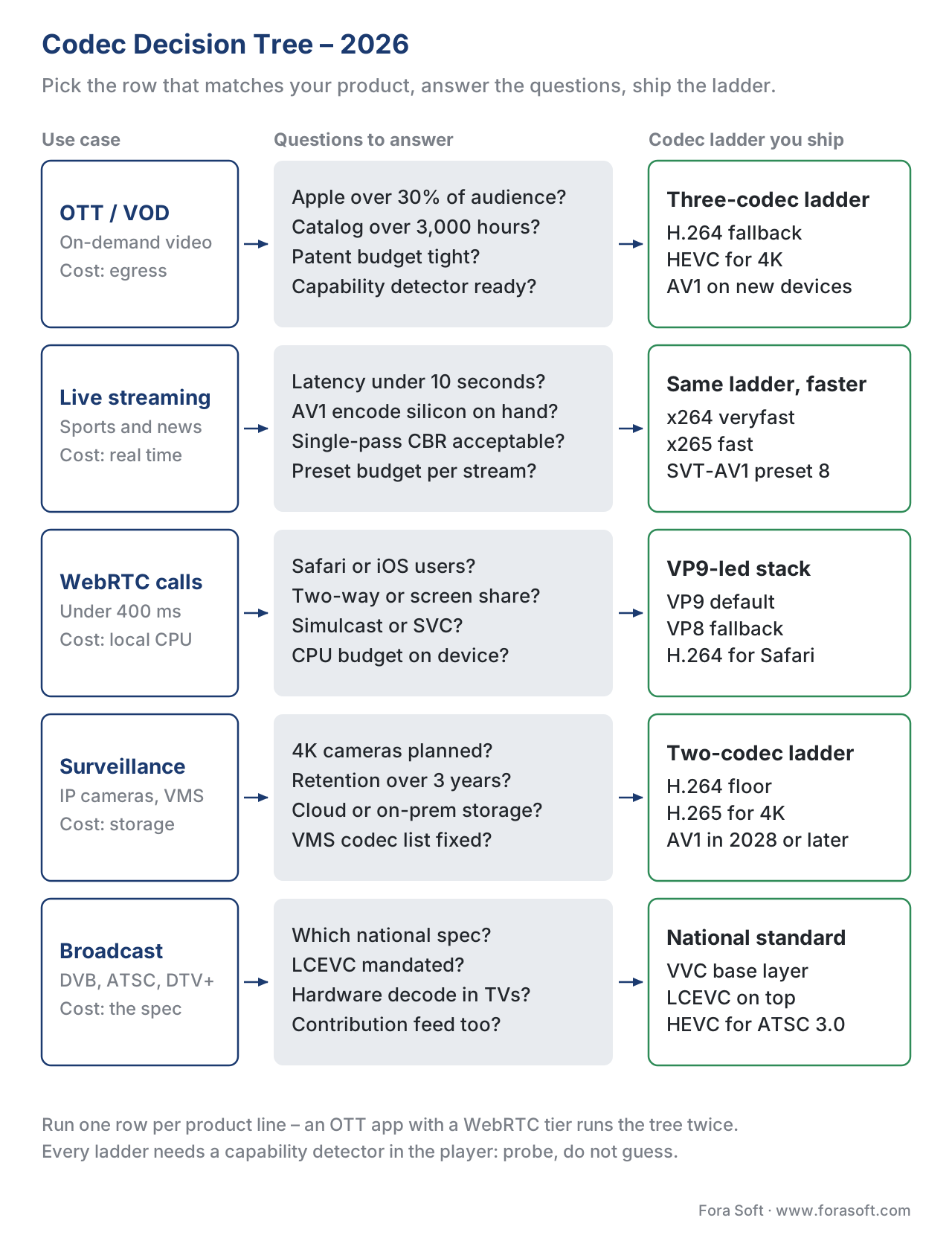 Figure 1. The decision tree, top to bottom. The first branch is the use case; the deepest branches reflect device support, latency, and patent tolerance. Each leaf is a concrete codec ladder you can ship.
The First Question: What Are You Actually Building?
Before any codec talk, name your use case. The codec landscape is not symmetric — the same H.264-versus-AV1 question has different answers in OTT than in WebRTC, and a different answer again in broadcast. Five use-case buckets cover almost every Fora Soft project we have shipped since 2005.
The OTT and VOD bucket — short for Over-The-Top video on demand — means video delivered over the open internet to a consumer device, ranging from Netflix-style subscription apps to ad-supported FAST channels to a TV manufacturer's smart-TV portal. The reader, the device, and the screen size all vary; the encoder runs ahead of time; the latency budget is generous (several seconds is fine); the cost driver is egress bandwidth. This bucket cares most about codec efficiency and device coverage.
The live streaming bucket covers everything that has to go out the door in seconds: sports, news, e-sports, concerts, live shopping. The encoder runs in real time, the latency budget is single-digit seconds, and the codec choice has to keep up with a wall-clock deadline. Live streaming usually leans on the same codecs as OTT but with simpler encoder presets and tighter rate-control.
The WebRTC and real-time conferencing bucket means video calls, telemedicine consultations, live customer support, and any application where the round-trip from camera to screen has to stay under 400 ms. Here the encoder, the network, and the decoder all run inside a browser or a native app, and the codec choice is constrained by what the browser will accept. The cost driver is CPU on the user's device, not bandwidth on the server.
The video surveillance bucket covers IP cameras, body cameras, video management systems (VMS), and the storage and bandwidth behind them. Hardware refresh cycles are slow — a camera deployed in 2026 might still be in service in 2034 — and the cost driver is on-prem or cloud storage. Patent licensing matters less here because the buyer usually pays upfront and never streams to a browser.
The broadcast and contribution bucket means traditional television: terrestrial DVB, ATSC 3.0, Brazil's DTV+, satellite uplinks, and the contribution feeds that move signals between studios and head-ends. The codec is dictated by the national standard or the broadcaster's contribution policy, not by the engineer. Brazil's 2026 mandate for H.266 / VVC layered with MPEG-5 LCEVC is the most aggressive deployment of a new codec anywhere in the world.
Pick one bucket and follow the tree from there. If you are running more than one — a streaming platform with a live channel and an embedded WebRTC product, for example — run the tree once per bucket. You will end up with different codec ladders for different parts of the same stack, and that is normal.
Branch 1 — OTT and VOD: The Three-Codec Ladder
For OTT and VOD, the answer in 2026 is almost always a three-codec ladder. You ship the same content in three encodes, and the player asks for whichever the device can decode. This is what Netflix, YouTube, Disney+, and every serious streaming service does in 2026. The reason is simple: no single codec has 100% device coverage, and bandwidth savings on the codecs that are supported pay for the engineering effort within months.
The default ladder for OTT and VOD looks like this. H.264 / AVC at the bottom as the universal fallback — every browser, every smart TV, every phone made since 2008 decodes it. H.265 / HEVC in the middle for premium 4K, because Apple devices natively decode HEVC but ship AV1 hardware decode only on iPhone 15 Pro and newer, and many smart TVs from 2018–2021 have HEVC hardware but no AV1. AV1 at the top for modern Chrome, Firefox, Edge, and recent Apple Silicon Safari, because AV1 saves another 30% on top of HEVC and is royalty-free, which means you do not pay a patent pool for every hour streamed.
Adoption numbers from the 2026 NETINT State of Video Encoding survey (286 industry respondents) tell you why this ladder is the default: H.264 / AVC has 84% production adoption, HEVC has 65%, VP9 has 15%, and AV1 has 17% in production with another 40% planning deployment by year-end, which would lift AV1 to 57% combined reach. Netflix said in December 2025 that AV1 now powers 30% of its streaming; YouTube delivers an estimated 75% of its high-resolution traffic in AV1. The trend line is clear, but the absolute numbers still demand a fallback. 1 2
Now the math. Suppose you stream a 1080p movie at the H.264 bitrate Netflix uses for a high-quality 1080p tier — about 4.5 Mbps. The headline efficiency numbers are 50% savings for HEVC over H.264 and 30% additional savings for AV1 over HEVC, both measured in the lab. Real-world savings on motion-heavy content are typically two-thirds to three-quarters of the headline:
H.264 at 4.5 Mbps   → baseline
HEVC at 4.5 × 0.65  ≈ 2.9 Mbps  (35% real-world savings)
AV1  at 2.9 × 0.78  ≈ 2.3 Mbps  (≈ 50% off H.264 once you stack both savings)
Multiply by a hundred million hours of streaming per month and the bandwidth bill difference is in the millions of dollars. The Bitmovin Video Developer Report's annual codec usage tracking shows that the providers running the largest libraries are also the most aggressive on AV1 rollout — bandwidth scales linearly, codec investment is fixed. 3
When does the ladder change? If you are shipping only to mobile apps and you control both ends of the pipe, you can drop H.264 and run an HEVC-and-AV1 ladder. If you are a regional service with no Apple users on the roadmap — a Russian or Chinese platform, for instance — you can drop HEVC and run H.264 + VP9 + AV1, which sidesteps the HEVC patent pools entirely. We cover the patent-pool maths in the Patent and Licensing section further down.
What we never recommend in 2026: a one-codec ladder. We have heard the pitch — "everything decodes H.264, let's keep it simple" — and the math kills it inside a quarter. A pure-H.264 service running at scale pays for itself in HEVC and AV1 savings inside three to six months for any catalogue larger than a few thousand hours.
Pitfall — building the ladder without a capability detector. A three-codec ladder is useless if your player cannot tell which codec the device can decode. Use the W3C
MediaCapabilitiesAPI on the web, theMediaCodecListAPI on Android, andAVPlayer/VTDecompressionSessioncapability flags on Apple. Server-side fingerprinting based on the user-agent string is fragile — a 2022 Samsung TV running Tizen 7 may report a generic user-agent but still decode AV1 hardware-side. Probe, do not guess.
Branch 2 — Live Streaming: Same Codecs, Tighter Encoder Presets
Live streaming uses the same three-codec ladder as OTT in 2026, but the encoder runs in real time, which changes the encoder configuration profoundly. The codec choice itself is the same; the work moves from the codec-decision layer to the encoder-tuning layer.
For H.264 live, x264's --preset veryfast or --preset faster is the standard pick — both keep frame budgets predictable on a single CPU core. For HEVC, x265's --preset fast is comparable. For AV1, the picture shifted hard in 2024–2025: SVT-AV1 at presets 6 through 10 is now the production standard for live encoding, with presets 11 and 12 reserved for low-latency 1080p and below. libaom — the AOMedia reference encoder — is still used for VOD where you can afford 100× slower encodes for an extra few percent of efficiency, but it is not a live encoder. 4
Two practical effects on the codec decision. First, hardware acceleration matters more for live than for VOD. NVIDIA NVENC, AMD VCN, Intel Quick Sync, and the dedicated VPUs from NETINT all encode H.264 and HEVC in real time at scale; AV1 hardware encoding is available on NVIDIA Ada Lovelace (RTX 4000-series) and newer, on Apple M3 Pro / Max and newer, on Intel Arc Battlemage, and on AMD RDNA 3 and newer. If your live workload exceeds what a small CPU farm can handle, the hardware support map narrows your codec ladder.
Second, live latency is a constraint AV1 cannot magically solve. The two-pass encoding modes that give AV1 and HEVC their best efficiency are off the table for live. You run single-pass with capped bitrate and a constrained look-ahead, which costs you efficiency. A realistic live AV1 deployment in 2026 delivers about 35% bandwidth savings over live H.264 — meaningful, but not the 50% the lab benchmarks promise.
The decision rule we use at Fora Soft: if your live workload runs on hardware that already has AV1 encode silicon (Ada Lovelace, M3 Pro+, NETINT Quadra T2A), enable AV1 live for the top of the ladder. Otherwise keep AV1 as a VOD-only codec for now and revisit at the next hardware refresh.
Branch 3 — WebRTC and Conferencing: A Different Codec Universe
WebRTC throws out the OTT decision tree and starts over. The codec runs in the browser, the encoder runs in real time on a phone or laptop CPU, the network is best-effort UDP with no buffering, and the patent landscape is different because the browser vendors decide what the browser will accept.
In 2026 the WebRTC codec defaults are as follows. VP8 is still the universal fallback — every WebRTC stack on every platform supports it, it has no patent fees, and its encoder is well-tuned for sub-100 ms latency. H.264 sits next to VP8 because Safari historically preferred it and many SIP-to-WebRTC gateways require it; the iOS Safari stack still ships H.264 as its highest-quality codec. VP9 is supported in Chrome, Firefox, Edge, and Safari, and is the default codec inside Google Meet and Jitsi Meet for users on those browsers. AV1 is supported in Chrome 90+, Firefox 113+, and Edge 116+; Safari supports AV1 decode only on devices with hardware AV1 (iPhone 15 Pro and newer, M3 Mac and newer). AV1 encode in real time is experimental in production stacks — Chrome shipped it behind a flag, then enabled it by default for screen sharing and low-frame-rate calls, but two-way 1080p30 AV1 in WebRTC is still a research deployment in 2026. 5 6
For real-time conferencing in 2026 our default codec list at Fora Soft is VP9 first, VP8 second, H.264 third, AV1 only on devices we can fingerprint as hardware-capable. That order is deliberate. VP9 has the best efficiency-versus-CPU trade for a software-encoded WebRTC stream, supports temporal SVC (Scalable Video Coding) cleanly, and is patent-free in practice. VP8 is the safety net. H.264 keeps the Safari and SIP-gateway paths alive. AV1 in WebRTC is the future, and the future has not arrived in 2026 for two-way calls — we enable it for screen sharing first, where the lower frame rate keeps encode costs manageable.
A common WebRTC mistake is to read the OTT codec rankings and conclude that AV1 is the right call for a video-meeting product. The conclusion does not transfer. WebRTC needs frame-by-frame latency under 100 ms, and the AV1 encoder family — even SVT-AV1 — is tuned for throughput, not for sub-frame latency. Until the browser vendors ship a hardware-backed real-time AV1 path that covers more than a quarter of installed devices, AV1 in WebRTC is selectively enabled, not the default.
We also recommend Simulcast over SVC as the default scaling mechanism in 2026. Simulcast (sending multiple independent encodes of the same source) is cleanly supported in every browser, while SVC (sending one layered encode that can be subsetted) is strong in Chrome and Firefox but limited in Safari. If your audience includes iPhones — and it does — simulcast is the resilient choice. The W3C SVC extension specification is mature and the Chrome implementation works, but cross-browser SVC in production is still a research deployment timeline. 5
Branch 4 — Video Surveillance: Conservative by Design
Surveillance moves slowly. Cameras have eight-to-ten-year deployment lifetimes, VMS platforms standardise their codec list at procurement time, and storage cost — not bandwidth — drives the math. In 2026 the right answer for almost every surveillance project is H.264 plus H.265 / HEVC.
H.264 is the universal floor: an estimated 90% of installed IP cameras decode it natively, every VMS speaks it, and every browser-based viewer client decodes it without a plugin. H.265 / HEVC is the upgrade for new 4K and high-frame-rate deployments — it cuts storage roughly in half at equivalent quality. A 4K surveillance camera shooting 24×7 at 8 Mbps in H.264 burns about 2.6 TB per camera per month; the same camera in H.265 at 4 Mbps burns 1.3 TB. Multiply by a few hundred cameras and the storage savings dominate any codec licensing cost.
AV1 is almost nowhere in surveillance in 2026. The reasons are predictable: AV1 hardware encoders are still rare in the small system-on-a-chip families that power IP cameras (Ambarella, HiSilicon, Novatek); browser-based VMS clients still need H.264 / HEVC fallback for the older devices already in the field; and the patent uncertainty around AV1 in late 2025 and early 2026 — including the Dolby suit against Snap that named AV1 — gave surveillance OEMs a reason to wait. 7 Our advice for surveillance projects in 2026 is to plan for AV1 as an option in 2028–2029, when the SoC vendors and the patent picture both settle, but to build today on H.264 plus H.265.
The exception that proves the rule: cloud-only surveillance products with a managed VMS and a known device fleet — body cameras, dashcams uploaded over LTE, certain access-control-camera-to-cloud pipelines — can ship AV1 today on the upload path because the operator controls both endpoints. If that describes your product, treat it as an OTT project, not a surveillance project, and follow Branch 1.
Branch 5 — Broadcast and Contribution: The National Standard Decides
Broadcast is the one branch where the codec choice is mostly not yours. National regulators or broadcaster consortia decide. The DVB Project (the European broadcast standards body) added H.266 / VVC to its core specification in February 2022, and DVB-compliant set-top boxes and smart TVs in Europe, Australia, and affiliated regions are now required to ship VVC hardware decode. ATSC 3.0 (the US digital-TV standard) standardised on HEVC. Brazil's DTV+ — the standard the country signed into law on August 27 2025 and is rolling out for the 2026 FIFA World Cup — mandates VVC base plus an MPEG-5 LCEVC enhancement layer. 8 9
LCEVC — Low-Complexity Enhancement Video Coding — is the one new codec mechanism in 2026 that does something different from every other codec on this page. Instead of replacing an existing codec, LCEVC sits on top of any base codec (H.264, H.265, VP9, AV1, or VVC) and adds a small enhancement layer that improves quality at the same bandwidth, or cuts bandwidth at the same quality. The bandwidth savings in production are reported at 30–40% on top of the base codec, with a roughly 5–10% added encoding cost. 10 LCEVC is already integrated into GStreamer 1.26 (March 2025), into Shaka Player, into ExoPlayer, and into FFmpeg. Brazil's deployment is the first national-scale production reference; the Globo broadcasting group ran a TV 3.0 live UHD production at the Paris 2024 Olympics at 10 Mbps over-the-air with LCEVC-enhanced VVC. 11
The practical rule for broadcast in 2026: read your national specification, ship the codec it mandates, and budget for LCEVC if your specification names it. Cross-border contribution feeds — moving signals between countries — are still dominated by H.264 and JPEG XS, with HEVC growing for 4K contribution. We have not seen a serious broadcaster move contribution to AV1 in 2026; the contribution chain is risk-averse and tied to broadcast-grade encoding hardware that does not ship AV1 silicon at the contribution-grade bitrate quality the chain demands.
The Five Sub-Questions Inside Every Tree
The branches above all hide the same five sub-questions. If you want to short-circuit the tree, answer these five and the codec ladder falls out.
The device-mix question. What share of your audience is on Safari, Apple TV, iPhone, iPad, and Mac? If the answer is over 30%, you need HEVC in your ladder, because Apple's AV1 hardware coverage only kicks in on the iPhone 15 Pro, M3 Mac, and newer. Below 30%, you can skip HEVC entirely and run H.264 + AV1 — that ladder is a real production pattern on Russian, Chinese, and Indian streaming services in 2026.
The latency question. What is your wall-clock latency budget from glass to glass — that is, from camera lens to viewer's screen? Three buckets: below 400 ms is WebRTC territory, 2–10 seconds is low-latency live streaming (LL-HLS or CMAF-LL with H.264 / HEVC / AV1), more than 10 seconds is regular HLS/DASH and a free choice of codec. Latency below 400 ms forces VP8 / VP9 / H.264 and rules out conventional AV1 encoders.
The premium-4K question. Do you need a premium 4K HDR tier on Apple TV and high-end smart TVs? If yes, HEVC is non-negotiable, because Apple's tvOS HDR pipeline ships with HEVC as the highest-quality codec in 2026. AV1 HDR plays back on the same boxes only if they were certified after 2023 and the OEM enabled the AV1 HDR path. Apple has not yet shipped an AV1 HDR Production Suite on tvOS, so a 4K HDR-first product still ships HEVC at the top of the ladder.
The patent-tolerance question. Can your business model absorb codec-pool royalties, or do you need a royalty-free path? The 2026 cost picture is real. Via LA restructured its H.264 streaming licence in 2025 from a flat $100,000 annual cap to a tiered cap that tops out at $4.5 million per year for the largest implementers (existing licensees as of end-2025 retain old terms). Access Advance raised HEVC rates by 25% for new licensees on January 1, 2026, and its annual cap sits at roughly $63 million. 12 13 If those numbers fit your budget, ship HEVC and H.264. If they do not, ship AV1 and VP9 — and run an extra encode of H.264 only as the fallback for the legacy 10–15% of devices that cannot do anything else.
The encoding-cost question. How much CPU or hardware-encoder time can you afford per hour of video? H.264 is the cheap baseline. HEVC costs about 5–10× more than H.264 to encode at equivalent quality with a software encoder. AV1 costs 5–30× more than H.264 with SVT-AV1, and 100–1,000× more with libaom. If your encoding budget is tight and you do not have hardware AV1 encode silicon, plan for SVT-AV1 at preset 8 or 9 as your AV1 target — that lands inside the 5–10× envelope and is in production at Netflix, YouTube, and Meta. 4
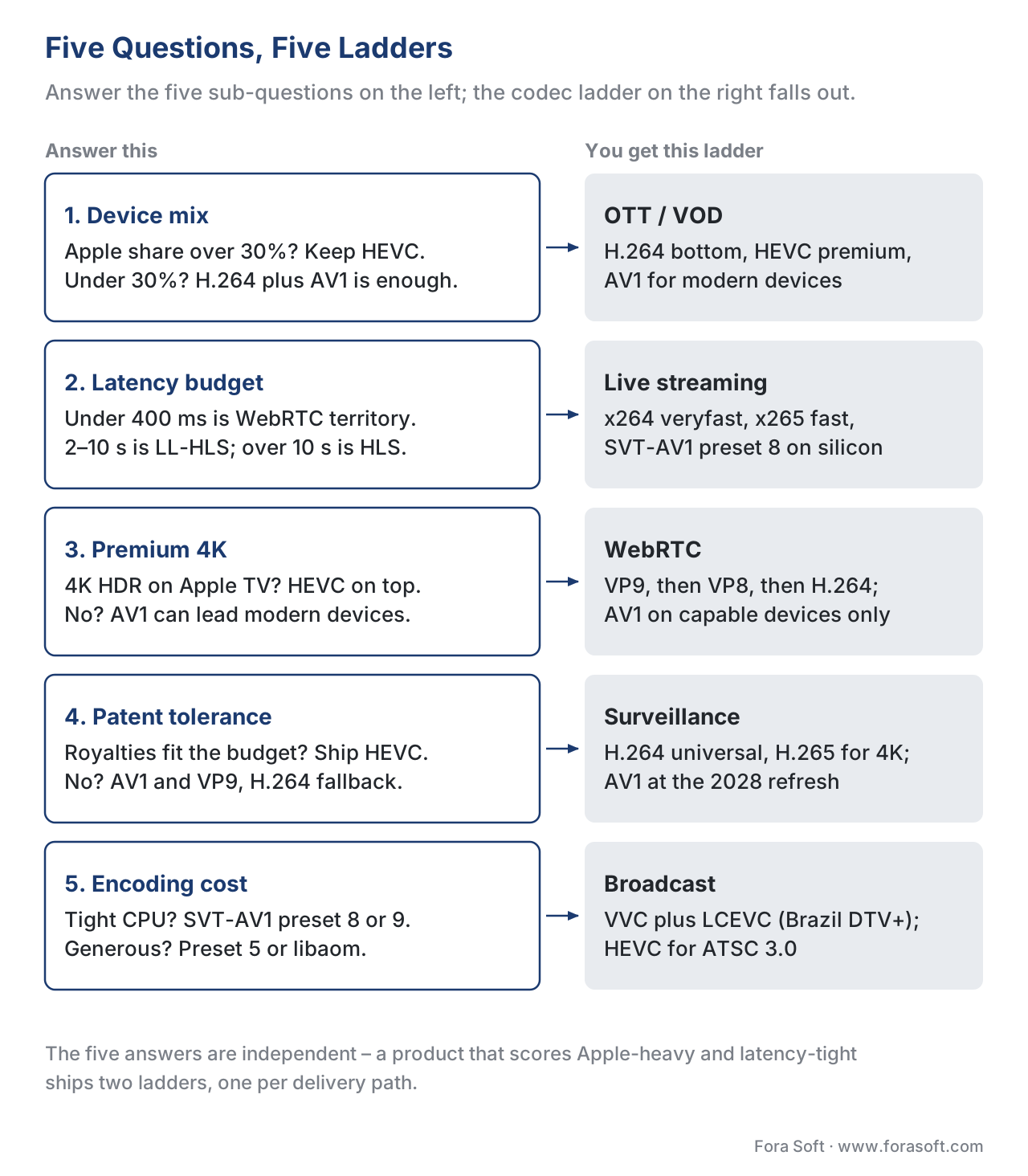 Figure 2. The five sub-questions every codec decision answers — device mix, latency, premium 4K, patent tolerance, and encoding cost — mapped to the typical codec ladders the combinations produce.
Bandwidth and Storage: The First Budget
Codec decisions live or die on bandwidth math. Below is a realistic 2026 cost calculation for a mid-size OTT service streaming 1080p video to 10 million viewers, each watching 30 hours of video per month. CDN egress is priced at $0.020 per GB — a representative number for AWS CloudFront or Cloudflare Stream in the bigger-volume tiers in 2026.
The H.264 baseline:
Bitrate:          4.5 Mbps  (high-quality 1080p)
Per hour:         4.5 Mbps × 3600 s ÷ 8        = 2,025 MB ≈ 2.0 GB/hr
Per viewer/month: 2.0 GB × 30 hr               = 60 GB
Total/month:      60 GB × 10,000,000 viewers   = 600 PB
Egress cost:      600 × 10^6 GB × $0.020       = $12,000,000 / month
Now stack HEVC for the 60% of viewers whose device decodes HEVC natively and AV1 for the 30% whose device decodes AV1 hardware-side:
H.264 viewers (10% legacy):  60 PB at 4.5 Mbps   → $1.20M
HEVC viewers (60% Apple etc): 60% × 600 PB × 0.65 = 234 PB → $4.68M
AV1 viewers (30% modern):     30% × 600 PB × 0.50 = 90 PB  → $1.80M
Total:                                            → $7.68M / month
The three-codec ladder cuts $4.3 M per month off the bandwidth bill at 10 million viewers. Annualised, the savings cross $50 million on this hypothetical service. The encoding cost of the three-codec ladder runs roughly $200,000–$500,000 per year for a catalogue of this size with modern hardware. The ROI math is brutally one-sided. Even at one-tenth the viewer base, the codec investment pays for itself inside the first quarter.
The same math runs for storage in surveillance. A 1,000-camera deployment at 4K, 24×7, in H.264 stores about 2.6 PB per month. The same deployment in H.265 stores about 1.3 PB per month. At cloud-storage prices around $0.020 per GB per month (S3 Standard) or $0.005 per GB per month (S3 Glacier Instant Retrieval), the codec choice is the difference between a six-figure and a five-figure monthly storage bill before any retention tiering.
Patent and Licensing: The Second Budget
The most common mistake we see in 2026 codec decisions is treating licensing as a footnote. It is the second budget. The H.264 pool covers about 80% of essential patents and licensees who held an active AVC contract as of the end of 2025 retain their old fee structure under Via LA's new pricing — but new licensees in 2026 face the tiered cap up to $4.5 million per year. 12 The HEVC picture is messier: three pools shrank to two in 2025 when Access Advance acquired Via LA's HEVC and VVC pool administration, but Apple, Google, Samsung, and Microsoft hold essential patents outside every pool, so HEVC licensing exposure is plural and not yet fully settled. 13
AV1 is royalty-free under the AOMedia Patent License 1.0, signed by every AOMedia member. The legal commitment is real and enforceable — but March 2026 saw Dolby Laboratories file infringement suits against Snap, naming both HEVC and AV1, which is a reminder that the AOMedia patent commitment binds AOMedia members and does not bind non-members. 7 Most AV1 deployers in 2026 treat the AOMedia commitment as adequate; a small minority of risk-averse enterprises are watching the Dolby–Snap case before committing.
LCEVC has its own per-stream royalty model administered by V-Nova and the LCEVC patent pool, distinct from any base-codec licence — when you ship LCEVC you pay the LCEVC pool in addition to whatever you owe for the underlying base codec. The economics still work because LCEVC's added bandwidth savings cover the licence in any catalogue of significant size, but you need to budget it explicitly.
The decision rule we apply at Fora Soft is simple. If you are large enough that codec royalties cross 1% of revenue, you should at minimum add AV1 to your ladder; if codec royalties cross 5% of revenue, you should plan to drop HEVC inside two refresh cycles and migrate to an H.264-plus-AV1 ladder. Below 1% of revenue, ship the technically optimal ladder and treat the royalties as the cost of doing business.
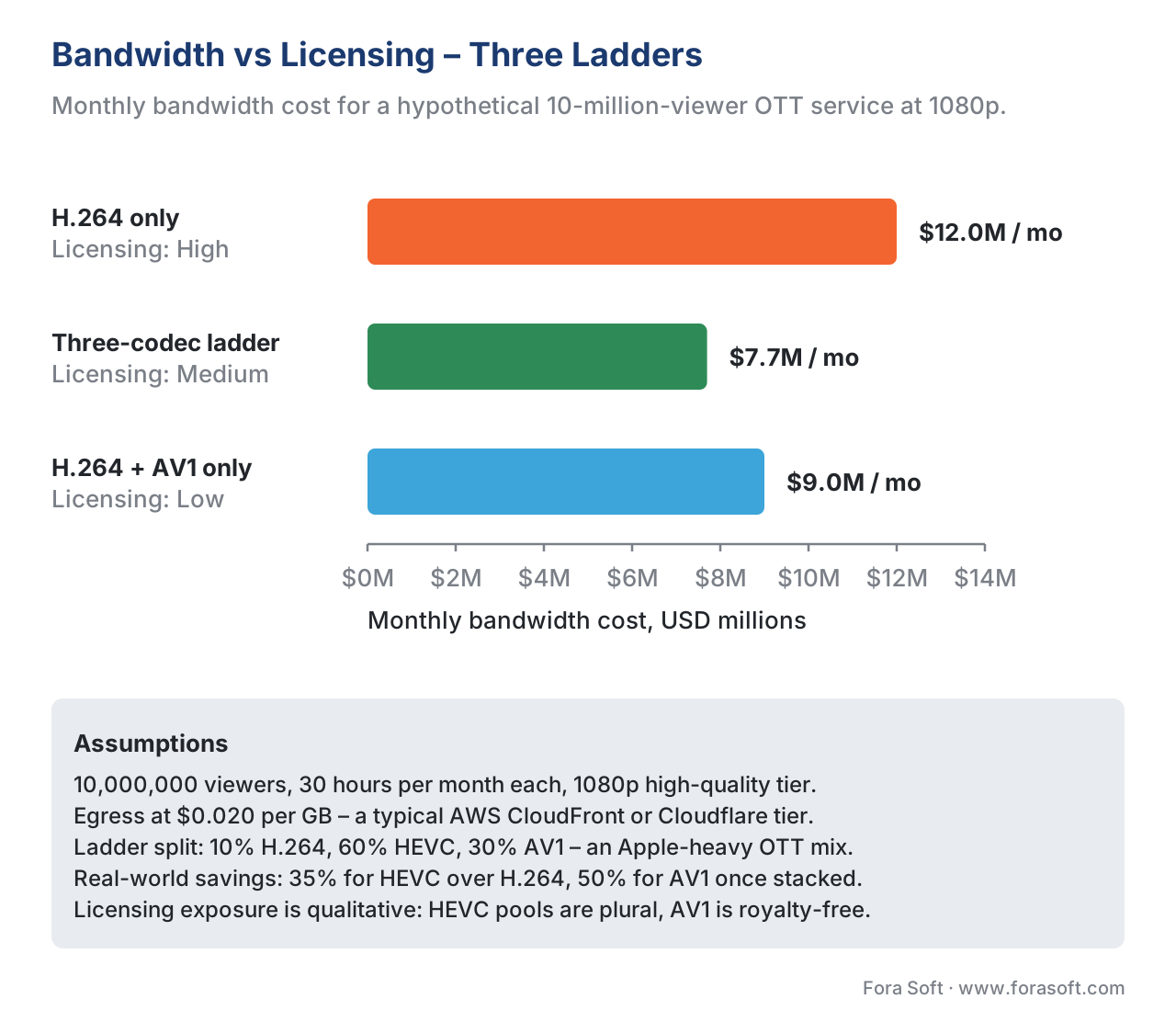 Figure 3. Bandwidth and licensing trade-off for a hypothetical mid-size OTT service. The three-codec ladder dominates pure H.264 on bandwidth, and dominates pure HEVC on licensing exposure.
What About 8K, VR, and Volumetric Video?
The 8K and VR question comes up on roughly a third of our scoping calls and almost never affects the codec decision in practice. Today's 8K production pipelines in 2026 still distribute in H.265 or AV1; H.266 / VVC has the technical advantage at 8K (deeper block sizes, better intra-prediction for ultra-high-resolution detail) but its absence from browsers and from Apple ecosystems keeps it off most distribution chains. VR streaming uses the same codecs as flat video — VR distribution is dominated by stereo H.265 or AV1, with foveated encoding (variable quality across the field of view) handled at the player level. Volumetric video, MPEG-I scene-based coding, and neural codecs are research areas in 2026, not deployment choices for product teams. We cover them in the dedicated Block 6 articles in this Learn section.
The Three Common Mistakes
We have shipped video products for two decades and there are three mistakes that recur often enough to call out by name.
Mistake 1 — assuming one codec is enough. A pure-H.264 ladder feels simple, but on any catalogue larger than a few hundred hours at any meaningful viewer count the bandwidth bill makes it the most expensive option you can pick. The corollary mistake is a pure-AV1 ladder — locks out 15% of devices that have no AV1 decoder. Ship a ladder.
Mistake 2 — picking codecs by lab benchmark instead of by encoder budget. The 50% headline savings of HEVC over H.264 are real in libaom-level encoder settings that nobody runs at production scale. Production HEVC saves 30–40%; production AV1 saves 25–35% over production HEVC; live AV1 saves 25–30% over live HEVC. Plan against the production numbers, not the lab numbers.
Mistake 3 — forgetting the player. A three-codec ladder needs a player that can read device capabilities and pick the right codec at the right bitrate. Shipping a three-codec ladder behind a player that defaults to H.264 always — because no one wired up the capability detector — happens more often than it should. Audit the player before declaring the codec migration done.
Free download: Codec selection cheat sheet 2026The decision tree on one printable page: the five use-case branches, the questions each one asks, and the codec ladder it lands on for OTT/VOD, live streaming, WebRTC, surveillance and broadcast.Where Fora Soft Fits In
Codec choice is one of the first decisions we make on every new video project, and we make it as a joint product, engineering, and finance call — not a pure technical pick. For OTT and VOD platforms launching in 2026 we typically ship the three-codec ladder (H.264 + HEVC + AV1) with device-capability detection in the player. For live streaming we usually ship the same ladder with SVT-AV1 at preset 8 if hardware AV1 encode is available. For WebRTC conferencing we default to VP9 plus VP8 plus H.264, with AV1 enabled selectively on the devices we can fingerprint. For video surveillance we ship H.264 plus H.265 and plan AV1 for the next refresh cycle. We have delivered video streaming, OTT, WebRTC conferencing, telemedicine, e-learning, video surveillance, and AR/VR projects across all of these stacks, and we are happy to walk through the trade-offs for your specific product.

The book
Video Encoding: A Complete Guide to Video Compression
Every branch of the tree above rests on arithmetic this book works out in full: where the 50 per cent headline savings come from and why a production preset returns two-thirds of it, what SVT-AV1 presets 5 through 10 actually trade away, how rate control behaves when a live encoder has one pass and a wall-clock deadline, and how to measure the savings on your own content instead of trusting a vendor chart. It is volume 1 of the seven-volume Fora Soft Video Engineering Handbook, which walks the whole video stack from the pixel to production — encoding here, then delivery, audio and AI — so that the ladder you pick in this article is one you can also build, ship and price. 1,522 pages, written by Nikolay Sapunov, CEO at Fora Soft.
Which branch of the tree is your product actually on?
Send us your device and player analytics, your latency budget and your current CDN or storage bill, and we will walk the tree on your numbers: which bucket you are in, what share of your audience decodes HEVC and AV1 on silicon today, what a second or third rung is worth against your own egress, and what the extra encode time costs on your farm. If you run more than one delivery path — a VOD catalogue with a live channel, or an app with a WebRTC tier — we run it once per path, because the answers differ. 250+ video products shipped since 2005.
See our case studies
Case study
Speed.Space
Live 1080p at 8 Mb/s for production clients including Netflix, EA and HBO. Branch 1 and Branch 2 in one product: the ladder carries H.264 for reach and a newer codec on the top rungs, and the player picks per device rather than by user-agent string.
Case study
Worldcast Live
Concert streaming at 1.5 Gb/s with 0.4–0.5 s latency to 10,000 simultaneous viewers. The latency question decides this one before any efficiency table does: at that budget the codec is whatever a real-time encoder can finish inside the frame deadline.
Case study
Mindbox
RTSP cameras through FFmpeg to HLS, 50+ deployments. Branch 4 in practice: the cameras emit H.264, the VMS codec list was fixed at procurement, and storage — not egress — is the number the codec choice moves.
What to read next
Codecs
AV1: The New Internet Standard And Where It Stands In 2026
The rung that moves most between 2026 and 2028: how far AV1 hardware decode has really spread, and what the encode still costs you.
Codecs
H.265 / HEVC: +50% Over H.264 And The Patent Nightmare
The long version of the patent-tolerance question: how the pools formed, what the 2025 consolidation changed, and when HEVC is still the right pick.
Architecture
Rate Control: CBR, VBR, CRF, ABR, Capped CRF
Once the branch is picked, rate control is the next dial: what single-pass CBR costs a live ladder, and where capped CRF wins for VOD.
Tooling
Hardware Acceleration: GPU, VPU, ASIC
What NVENC, Quick Sync, VideoToolbox and NETINT ASICs change about the encoding-cost question behind every branch of the tree.
-
NETINT Technologies, 2026 State of Video Encoding (286 industry respondents). H.264/AVC 84% production adoption; HEVC 65%; VP9 15%; AV1 17% production + 40% planning. https://netint.com/2026-state-of-video-encoding/ (accessed 2026-05-16). ↩
-
Netflix corporate communication, December 2025: AV1 powers ≈ 30% of Netflix streaming. Reported by Broadband TV News and TV Tech, December 5, 2025. https://www.broadbandtvnews.com/2025/12/05/netflix-says-av1-now-powers-30-of-its-streaming/ (accessed 2026-05-16). ↩
-
Bitmovin, Video Developer Report (annual). Codec usage tracking, 2025 edition: H.264 down for first time year-over-year; AV1 plans up sharply. Streaming Media coverage: https://www.streamingmedia.com/Articles/News/Online-Video-News/H.264-Usage-Drops-for-First-Time-in-Bitmovin-Video-Developer-Report-150364.aspx (accessed 2026-05-16). ↩
-
Alliance for Open Media, SVT-AV1 documentation. Preset table (−1 to 13), production guidance. https://gitlab.com/AOMediaCodec/SVT-AV1/-/blob/master/Docs/CommonQuestions.md (accessed 2026-05-16). See also OTTVerse preset analysis, https://ottverse.com/analysis-of-svt-av1-presets-and-crf-values/. ↩↩
-
W3C, Scalable Video Coding (SVC) Extension for WebRTC recommendation. Browser support map. https://www.w3.org/TR/webrtc-svc/ (accessed 2026-05-16). ↩↩
-
Tsahi Levent-Levi, WebRTC video codec generations, BlogGeek.me. Recommended priority order for WebRTC in 2026. https://bloggeek.me/webrtc-video-codec-generations/ (accessed 2026-05-16). ↩
-
Dolby Laboratories v. Snap Inc., patent infringement complaint filed March 23, 2026. Cited in webrtc.ventures coverage: https://webrtc.ventures/2026/04/should-you-still-consider-av1-codec-in-your-webrtc-architecture/ (accessed 2026-05-16). ↩↩
-
Versatile Video Coding (H.266), Wikipedia. DVB Project added VVC to its core specification, February 2022. https://en.wikipedia.org/wiki/Versatile_Video_Coding (accessed 2026-05-16). ↩
-
V-Nova, TV 3.0, the First National Standard Built on MPEG-5 LCEVC. Brazilian presidential decree, August 27, 2025; commercial readiness target mid-2026 for FIFA World Cup. https://v-nova.com/blog/tv-3-0-lcevc-national-broadcast-standard/ (accessed 2026-05-16). ↩
-
V-Nova, LCEVC GStreamer and Shaka Player Integration Guide. GStreamer 1.26 (March 2025), bandwidth savings 30–40%. https://v-nova.com/blog/lcevc-gstreamer-shaka-player-open-source-integration/ (accessed 2026-05-16). ↩
-
V-Nova, Powering Brazil's next-generation UHD with TV 3.0 white paper. Globo's Paris 2024 Olympics TV 3.0 production. https://v-nova.com/white_paper/powering-brazils-next-generation-uhd-with-tv-3-0/ (accessed 2026-05-16). ↩
-
Tom's Hardware, Firm quietly boosts H.264 streaming license fees from $100,000 up to staggering $4.5 million, January 2026. Via LA tiered streaming license restructuring. https://www.tomshardware.com/service-providers/streaming/h264-streaming-license-fees-jump-from-100000-to-4-5-million (accessed 2026-05-16). ↩↩
-
Access Advance press release, HEVC Advance and VVC Advance Pricing through 2030, July 21, 2025. 25% rate adjustment for HEVC effective January 1, 2026; pool covers ~75–80% of essential HEVC patents. https://accessadvance.com/2025/07/21/access-advance-announces-hevc-advance-and-vvc-advance-pricing-through-2030/ (accessed 2026-05-16). ↩↩
