


Why This Matters
If you build, fund, or sell anything that touches video, you'll meet codec names in your bills, your bug reports, and your engineering meetings. "We're moving to AV1." "Our CDN charges more for HEVC." "The Chinese browser doesn't decode VVC." None of those sentences makes sense without the history behind the names. This article gives you that history. By the end you'll know which codec generation each name belongs to, why it was invented, who fought over its patents, and how to read a 2026 codec choice the way an experienced engineer reads it — as a trade between compression efficiency, hardware availability, licensing risk, and political alignment. That knowledge changes how you negotiate with vendors, how you spec a streaming platform, and how you read the next codec announcement that lands in your inbox.
You don't need any prior knowledge of compression to read this article. We'll define every term in plain language before using it, and we'll walk the timeline one generation at a time.
What a Video Codec Actually Is
Before we open the history book, let's pin down the word. A codec is two things glued together: an encoder that takes a stream of raw pictures and packs them into a small file, and a decoder that reverses the process to put the pictures back on a screen. The name is a portmanteau — coder + decoder. Hardware codecs run inside chips. Software codecs run as libraries (FFmpeg, libx264, libaom). The pair is what we mean.
Raw video is enormous. A single second of plain HDTV (1920 × 1080 pixels, 30 frames per second, 24 bits of colour per pixel) takes about 186 megabytes uncompressed. That's roughly 1.5 gigabits per second — more than any home broadband can pull and more than any disc could hold. To make video shippable at all, every stage of the digital era needed a codec that could cut the bit count by a factor of 50 or more, with no visible loss of quality. The full bitrate math is laid out in Why we compress video: the math of bitrate. For this article, just hold the headline number: raw HD video is roughly a hundred times too big to send.
Two scientific tricks unlocked everything that followed. The first is the discrete cosine transform (DCT) — a piece of mathematics from 1972 that takes an 8 × 8 patch of pixels and re-expresses it as a small list of frequency coefficients, most of which can then be thrown away because the human eye is insensitive to them. The second is motion compensation — instead of storing each frame from scratch, the encoder describes a new frame as "the previous frame, but shifted slightly to the right here, and copied from over there." Every codec from H.261 onward is a refinement of those two ideas. We unpack the mechanics in Hybrid video codec architecture.
That's the whole conceptual foundation. Now to the story.
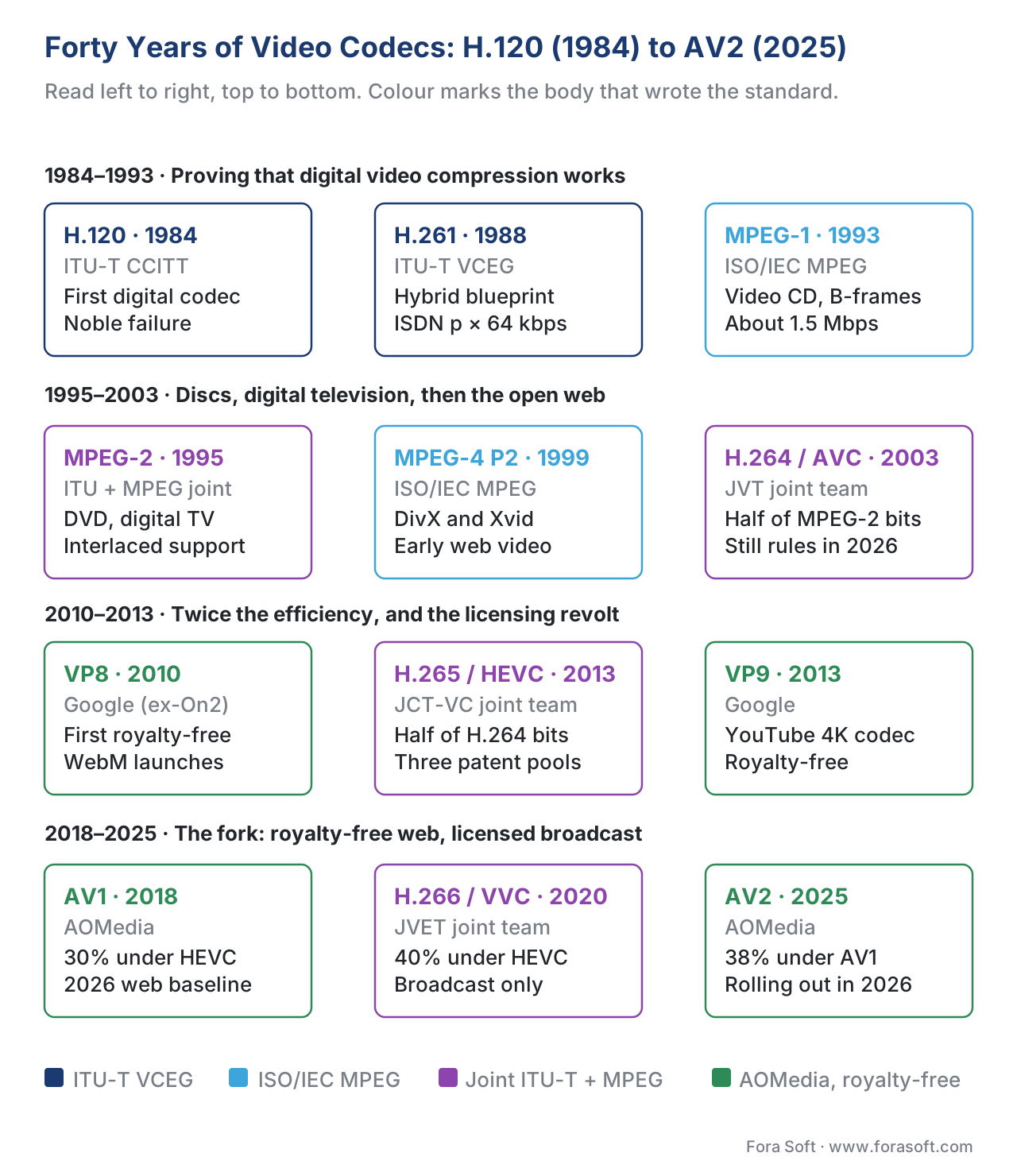 Figure 1. The forty-year codec timeline. Each box marks the year a codec specification was published. Colour bands group codecs by governing body: ITU-T (the telecoms standards arm of the United Nations), the ISO/IEC MPEG committee, joint ITU+ISO efforts, and the royalty-free Alliance for Open Media.
Generation Zero — H.120 (1984): the codec nobody used
The story starts with a codec that failed in the market and changed the industry anyway.
H.120 was the first digital video compression standard ever published. It came out of COST 211, a European research project, and was ratified by the CCITT — the ancestor of today's International Telecommunication Union Telecommunication Standardization Sector (ITU-T) — in 1984. 1 It targeted videoconferencing over dedicated digital telephone lines at 1.544 megabits per second (the American "T1" speed) or 2.048 megabits per second (the European "E1" speed). The encoder was a refrigerator-sized box of analog and early digital electronics.
H.120 used three techniques that look primitive today: conditional replenishment (only send a block of pixels if it changed since the last frame), differential pulse-code modulation (send the difference between each pixel and its neighbour rather than the pixel itself), and variable-length coding (use shorter codes for common patterns). A 1988 revision added crude motion compensation — the idea that a moving object in the new frame could be described as a copy of the same object from the previous frame, shifted by a few pixels.
The pictures it produced looked, in the polite words of contemporary reports, "not of adequate quality". Almost nobody bought it. The codec disappeared from commercial use within a few years.
So why does it matter? Because H.120 proved that digital video compression was technically possible at telecoms data rates, and it exposed every weakness that the next generation had to fix. The team that designed it — and especially the engineers in ITU Study Group 16 — went on to design H.261. That second attempt finally worked.
Generation 1 — H.261 (1988): the architecture that still rules
H.261, ratified by ITU-T in November 1988, is the codec that all subsequent video compression standards descend from. 2 It was the first to combine two techniques into one machine, in the pattern that the industry now calls hybrid block-based coding:
- Motion-compensated prediction. Cut every frame into 16 × 16 squares called macroblocks. For each macroblock, search the previous frame for the closest-looking 16 × 16 region. Write down the small displacement (the motion vector) and only the difference between the prediction and the truth. This handles redundancy between frames.
- DCT transform of the difference. Apply the discrete cosine transform to that residual difference, then chop the high-frequency coefficients away with a step called quantization. This handles redundancy within the residual.
Both steps were known in the 1970s and early 1980s as separate research topics. H.261 was the first standard that combined them into a single pipeline, ran it at videoconferencing bitrates of p × 64 kilobits per second (where p could be 1 through 30), and shipped it in actual hardware. The 64-kbps multiple was not coincidental — it matched the ISDN telephone-line speed that European telcos were rolling out at the time.
The hybrid block-based architecture invented for H.261 is the same architecture used by every codec we'll discuss for the rest of this article. Every codec from MPEG-1 in 1993 to AV2 in 2025 is, at its heart, a more powerful version of the same idea: predict, transform, quantize, code. The forty-year improvement in compression efficiency has come from making each of those four steps smarter — better predictions, larger and adaptive block sizes, more accurate transforms, smarter quantization. The skeleton is unchanged.
H.261 was also the first standard where the ITU's Video Coding Experts Group (VCEG) showed it could lead the world. VCEG would go on to co-author every "H-dot" codec for the next forty years.
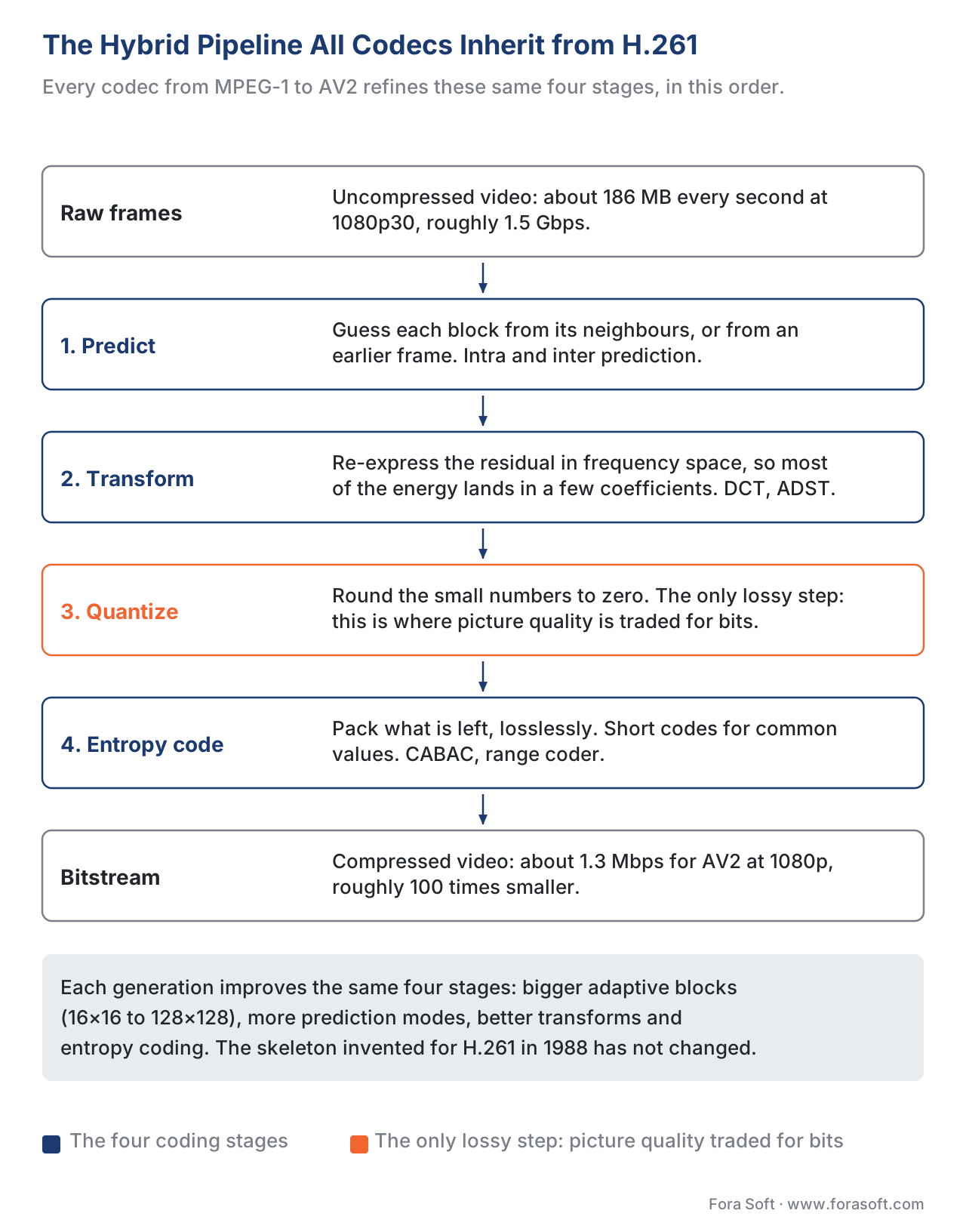 Figure 2. The four-stage hybrid pipeline H.261 invented in 1988. Every codec in the rest of this article — MPEG-1, MPEG-2, H.264, HEVC, AV1, VVC, AV2 — is a more powerful version of these same four steps, in this order.
Generation 2 — MPEG-1 (1993) and MPEG-2/H.262 (1995): video on a disc, then on a satellite
While ITU-T was working on videoconferencing, a parallel committee inside the International Organization for Standardization — the Moving Picture Experts Group, universally called MPEG — was working on a different problem: how to put video on consumer media. Tapes were analog. Audio CDs had just been invented. The MPEG-1 mandate was to fit a usable colour movie onto a CD-ROM.
MPEG-1 was published as ISO/IEC 11172 in 1993. It produced acceptable VHS-quality video at about 1.5 megabits per second on the Video CD format, which became a hit in Asia in the mid-1990s. Architecturally MPEG-1 is a refinement of H.261 with a critical addition: B-frames (bidirectionally predicted frames) which use both a past and a future frame as references. B-frames give a big compression win at the cost of needing to decode frames out of order — we explain the mechanics in GOP structure: I, P, B-frames, open vs closed GOP.
The breakthrough that funded the entire digital-television revolution arrived two years later. MPEG-2 Part 2 — also published as ITU-T H.262 in 1995 — was the first codec produced by a joint VCEG–MPEG team, a pattern that would repeat for H.264, H.265, and H.266. 3 MPEG-2 added support for interlaced video, the legacy scan pattern used by every analog television; without that addition, broadcasters could not have moved their content into digital pipes. The standard powered DVD-Video, digital cable, digital satellite (DirecTV, SkyTV), and the first wave of digital terrestrial broadcasting (ATSC in the US, DVB-T in Europe). It is still in use today on legacy broadcast infrastructure thirty-one years later.
The numbers were transformative. MPEG-2 fit a feature-length movie on a 4.7-GB DVD at 4–8 megabits per second with picture quality that consumers happily accepted as "near-VHS or better". A satellite transponder that previously carried one analog channel could now carry six to ten compressed digital channels. That bandwidth multiplier is exactly what made satellite television profitable in the late 1990s.
Generation 3 — H.263 (1995), MPEG-4 Part 2 (1999), and the wild-west era
Two parallel codecs targeted lower-bitrate use cases in the same decade.
H.263, finalised by ITU-T VCEG in 1995, was a low-bitrate refinement of H.261 designed for videoconferencing over plain old analog phone lines (using POTS modems at 28.8 kbit/s and up). It later became the codec inside 3GPP mobile video and inside Flash Video — the format that powered the early YouTube. If you watched a video on the internet between 2005 and 2010, you almost certainly watched H.263 inside Adobe Flash.
MPEG-4 Part 2, also called MPEG-4 Visual, was published by ISO in 1999. It was based heavily on H.263 and added more efficient coding tools for medium bitrates. MPEG-4 Part 2 is the codec inside DivX and Xvid — the two open-source implementations that powered the era of pirated TV episodes traded over peer-to-peer networks. DivX itself originated when a French hacker reverse-engineered an early Microsoft MPEG-4 codec around 1999, and the open-source Xvid project forked from the same code in 2001. By 2003, "burn DivX to a DVD-R" was how a whole generation of consumers shipped video to friends and family.
This was also the period when proprietary codecs from individual companies briefly competed for the streaming market — RealVideo from RealNetworks, Windows Media Video (later standardised as SMPTE VC-1) from Microsoft, Sorenson Spark inside Adobe Flash, and a handful of others. None survived the next generation. Their failure mode was always the same: a proprietary codec needs a critical mass of devices to be worth supporting, and no single vendor could deliver that scale against a real standard.
Generation 4 — H.264 / AVC (2003): the codec that ate the internet
In December 2001, VCEG and MPEG combined forces into the Joint Video Team (JVT), chaired by Gary Sullivan (Microsoft), Thomas Wiegand (Fraunhofer HHI), and Ajay Luthra (Motorola). 4 Their charter was to build a codec that doubled the compression efficiency of MPEG-2.
They delivered H.264 / Advanced Video Coding (AVC) in May 2003 — published jointly as ITU-T H.264 and ISO/IEC 14496-10 (MPEG-4 Part 10). The brief is now famous in the industry: H.264 halved the bitrate needed for the same visual quality, again. A satellite channel that used 6 Mbps of MPEG-2 could now run at 3 Mbps and look identical, doubling the number of channels per transponder. An iPhone could play 1080p video for the first time.
H.264 won at every layer of the internet for one reason: it was good enough to ship absolutely everywhere. YouTube switched its primary codec to H.264 in 2007, replacing the older Flash/H.263 path. Apple put a hardware H.264 decoder in every iPhone from 2007 onward and made it the only codec the device supported. Blu-ray Disc adopted H.264 (alongside MPEG-2 and VC-1). Every modern smartphone, browser, smart TV, game console, action camera, dashcam, and surveillance camera shipped between 2008 and 2025 has hardware H.264 support.
The result is that more than two decades after its publication, H.264 is still the dominant video codec on the internet in 2026. The Bitmovin Video Developer Report consistently shows H.264 used by more than three-quarters of surveyed video providers, ahead of any newer codec on the market. 13 Its replacement curve is one of the slowest in software history, and the reason is hardware: there are too many H.264 decoders already installed in the world to abandon. Every codec since has had to start by playing second fiddle to the workhorse.
H.264 also created the licensing template the industry still wrestles with. The standard is covered by patents from dozens of companies; those companies pooled their patents into MPEG LA, a single licensing administrator that offered a published, capped, predictable royalty schedule. Streaming services pay a few cents per device, and the math works. The MPEG LA H.264 pool was, by industry consensus, the best-designed video-codec patent pool ever assembled. Its successors would not be so lucky.
Generation 5 — H.265 / HEVC (2013): twice the efficiency, three patent pools
The next codec generation began work in 2010 inside the Joint Collaborative Team on Video Coding (JCT-VC) — a successor to JVT, again co-chaired by Sullivan and Wiegand. The brief: another halving of bitrate against H.264, this time to make 4K streaming viable.
H.265 / High Efficiency Video Coding (HEVC) was ratified by ITU-T in January 2013 and formally published in June 2013. 5 The headline number held up: at matched perceptual quality, HEVC needs roughly 50 percent fewer bits than H.264. A 4K stream that takes 25–35 Mbps of H.264 drops to 12–16 Mbps of HEVC. A 1080p stream drops from 4.5–6 Mbps to 2.25–3 Mbps.
Architecturally, HEVC replaced the fixed 16 × 16 macroblock of H.264 with Coding Tree Units of up to 64 × 64 pixels, recursively subdivided into smaller blocks as needed. It added more accurate intra-frame prediction, more reference frames for motion compensation, and a new Sample-Adaptive Offset in-loop filter that compensated for ringing artefacts on the decoded image. We unpack each of those tools in H.265 / HEVC: +50% over H.264 and the patent nightmare.
And then licensing went off the rails. Instead of one MPEG LA pool with a published rate card, three separate pools emerged: MPEG LA, HEVC Advance (now Access Advance), and Velos Media. 6 Each had different members, different rates, different terms. Some major patent owners — Nokia, Microsoft, Texas Instruments — joined no pool at all. Velos never even published its rates publicly. Streaming services trying to ship HEVC at scale had to figure out which pools each of their patents fell into and negotiate separate licences with each, all while bearing the risk that an unaffiliated patent holder might appear with an infringement claim.
The result was predictable and damaging. Browser vendors refused to add HEVC playback for years; Mozilla Firefox in particular stayed out for nearly a decade. Streaming services who could technically deliver HEVC chose not to, because the cost and risk were unbounded. By 2026, HEVC is dominant on Apple devices (where Apple paid licences upfront on behalf of the platform), strong on smart TVs and set-top boxes, and quietly avoided on the open web. The codec is technically excellent. The legal apparatus around it almost killed it.
Generation 5b — The royalty-free counter-revolt: VP8, VP9, and the founding of AOMedia
The HEVC licensing fiasco produced an industry rebellion. Google had bought On2 Technologies in February 2010 for about $124.6 million, acquiring the VPx family of proprietary codecs. 7 In May 2010 Google released the latest of those — VP8 — as an open, royalty-free format, alongside an irrevocable patent promise on Google's own implementing patents.
VP8 alone did not move the needle; its compression efficiency roughly matched H.264 but its ecosystem was nowhere as broad. The successor codec — VP9 — was a different story. Released by Google in June 2013, VP9 targeted HEVC-class efficiency. Google needed it for one specific job: YouTube was about to roll out 4K streaming, and using HEVC at YouTube's scale would have cost a fortune in licences. Chrome enabled VP9 decoding in August 2013, Firefox followed in March 2014, and by 2015 the first generation of 4K-capable smart TVs (Samsung, Sony, LG, Sharp, Philips) shipped with VP9 hardware decoders so they could play YouTube 4K. 8 Apple held out until 2020, when iOS 14 and tvOS 14 finally added VP9.
VP9's importance is mainly strategic. It proved a major proprietary codec ecosystem could be flipped to royalty-free by a single big enough player. That precedent set up the next move.
In September 2015, seven companies — Amazon, Cisco, Google, Intel, Microsoft, Mozilla, and Netflix — founded the Alliance for Open Media (AOMedia), an industry consortium chartered to design and ship a next-generation royalty-free codec free of the licensing chaos that had crippled HEVC. Apple joined in 2018. The output was AV1.
Generation 6 — AV1 (2018) and H.266 / VVC (2020): the great split
Two parallel codec efforts produced two products at the end of the 2010s.
AV1 was finalised by AOMedia on March 28, 2018. 9 It hit the brief: roughly 30 percent better compression than HEVC at matched perceptual quality, fully royalty-free, with the patents of every founding member contractually pooled into AOMedia's royalty-free patent policy. Architecturally, AV1 combined techniques from Google's experimental VP10, Cisco's Thor, and Mozilla's Daala, with new tools like a 128 × 128 superblock size, more intra-prediction modes, advanced motion-vector reference handling, and a new Constrained Directional Enhancement Filter.
For its first three years AV1 was painfully slow to encode and had limited hardware decoder coverage. By 2022 AV1 hardware decoders were shipping in mainstream silicon — Intel 11th-gen and 12th-gen CPUs, AMD Ryzen 6000, NVIDIA RTX 30/40 series, Apple Silicon M3, every flagship Android SoC since Snapdragon 8 Gen 1, every Samsung TV from 2020 onward. By 2025 Netflix had pushed AV1 to 30 percent of all streams and confirmed it was on track to overtake H.264 as their most-used codec. 11 YouTube reportedly encodes more than 75 percent of new uploads in AV1 in 2026. Chrome, Edge, Firefox, and Safari all decode AV1 natively.
The competing track produced H.266 / Versatile Video Coding (VVC), finalised by the Joint Video Experts Team (JVET) on July 6, 2020. 10 VVC delivered another 40–50 percent bitrate reduction against HEVC — a stunning engineering result on paper. It added flexible block partitioning down to wedges and triangles, affine motion compensation that can model rotation and zoom, and explicit support for 360-degree video, screen content, and HDR up to 16 stops of dynamic range.
VVC's adoption picture in 2026 is shaped almost entirely by licensing. The patent situation looks more like HEVC's than H.264's: multiple patent pools, complex terms, and unaffiliated patent owners. Browser support is nonexistent — Chrome, Firefox, Edge, and Safari all refuse to decode VVC natively. Where VVC has gained ground is broadcast: the DVB Project and ATSC 3.0 broadcast standards have mandated VVC hardware in next-generation receivers, and Intel Lunar Lake plus MediaTek Pentonic chipsets ship with VVC decoders for connected-TV use cases. We unpack the trade-off in H.266 / VVC: technically excellent, market-weak.
The 2020 split is the single biggest divergence in codec history. For the first time, the next-generation codec for the open web (AV1) and the next-generation codec for traditional broadcast (VVC) were different codecs, each shipping in their own ecosystem with limited cross-pollination.
Generation 7 — AV2 (2025): the next leap, royalty-free, just in time
On AOMedia's tenth anniversary in September 2025, the alliance announced that AV2 would be released by year-end. 12 As of May 2026 the AV2 specification is in its final drafting stage, with conformance test vectors expected in the second half of the year.
AV2 is, in compression terms, what AV1 was for HEVC. Google's internal tests show AV2 needs about 38 percent fewer bits than an improved AV1 implementation at matched perceptual quality. The codec adds chroma formats 4:2:2 and 4:4:4 (AV1 supported only 4:2:0), significantly improved lossless and film-grain synthesis modes, extended recursive block partitioning, semi-decoupled luma/chroma partitioning, and new inter-prediction modes. It explicitly targets AR/VR, split-screen multi-view, and screen-content delivery as first-class use cases.
The strategic posture is the same as AV1's: royalty-free under AOMedia's patent policy, open governance, open reference implementation. Surveys of AOMedia members report 53 percent plan to deploy AV2 within 12 months of release and 88 percent within two years. As with AV1, the rollout will start with the founding members — Meta, Netflix, YouTube — who control both content libraries and playback environments, and will only reach premium DRM-protected services once Widevine, FairPlay, and PlayReady are integrated.
For a deeper look at what's actually inside the AV2 toolkit, see AV2: what to expect in the next 5–10 years.
Who Killed Whom: A Compact Score-Card
Here is the codec ecosystem as of 2026, viewed from the question "what beat what".
| Codec (Year) | Beat | Lost to | Status in 2026 |
|---|---|---|---|
| H.120 (1984) | nothing | H.261 | Historical only |
| H.261 (1988) | analog | MPEG-1/-2 | Replaced |
| MPEG-1 (1993) | nothing | MPEG-2 | Replaced |
| MPEG-2 / H.262 (1995) | analog TV | H.264 | Legacy broadcast only |
| H.263 (1995) | analog conf. | H.264 | Replaced |
| MPEG-4 Part 2 / DivX (1999) | MPEG-2 for web | H.264 | Replaced |
| VC-1 / WMV (2006) | nothing structurally | H.264 | Niche / archival |
| H.264 / AVC (2003) | MPEG-2 | being displaced | Dominant baseline |
| H.265 / HEVC (2013) | H.264 | licensing | Apple + broadcast |
| VP8 (2010) | H.264 (failed) | VP9 | Replaced |
| VP9 (2013) | nothing structurally | AV1 | Legacy on YouTube |
| AV1 (2018) | HEVC, VP9 | (being extended by AV2) | Modern royalty-free baseline |
| H.266 / VVC (2020) | HEVC technically | Web rejection | Broadcast only |
| AV2 (2025) | AV1 | (n/a) | Rolling out 2026 |
The pattern is clear: every five to ten years a new generation arrives that halves the bitrate of the last. Whichever codec catches the wind of a mass-market device platform survives; the others fade.
The Geopolitics of Standards
The forty-year history splits into three governing camps.
ITU-T VCEG is part of the UN's telecommunications body. It produced H.120, H.261, H.262 (jointly), H.263, H.264 (jointly), H.265 (jointly), and H.266 (jointly). VCEG is funded mostly by telecoms and broadcast companies and tends to value standards stability and inter-operator agreements.
ISO/IEC MPEG is part of the international standards body. It produced MPEG-1, MPEG-2 / H.262 (jointly), MPEG-4 Visual, MPEG-4 Part 10 / H.264 (jointly), and shares H.265 and H.266 through joint teams. MPEG is funded by consumer-electronics and software companies and tends to value licensing pragmatism and richness of features.
Where the two bodies cooperate — H.262, H.264, H.265, H.266 — the result is a single global standard with broad industry support. Where they don't, the result is licensing fragmentation. That fragmentation is what motivated the third camp.
The Alliance for Open Media is an industry consortium founded in 2015. It is neither part of the UN nor part of ISO. It exists specifically because the licensing apparatus around HEVC made the codec commercially unusable on the open web. AOMedia's two outputs — AV1 (2018) and AV2 (2025) — explicitly compete with the H-dot codec on technology while excluding the H-dot codec's licensing model on philosophy.
The current state of play is a fork. The web runs AV1 today and AV2 tomorrow. Broadcast and connected TV will keep deploying HEVC and VVC. The remaining hard question for every streaming service is how many codec ladders to maintain in parallel, because every codec generation you ship at scale costs you encoding cycles, storage, and CDN egress, but every codec generation you skip costs you delivery efficiency to the devices that do support the newer codec. We cover that decision-tree in detail in How to choose a codec for your service in 2026.
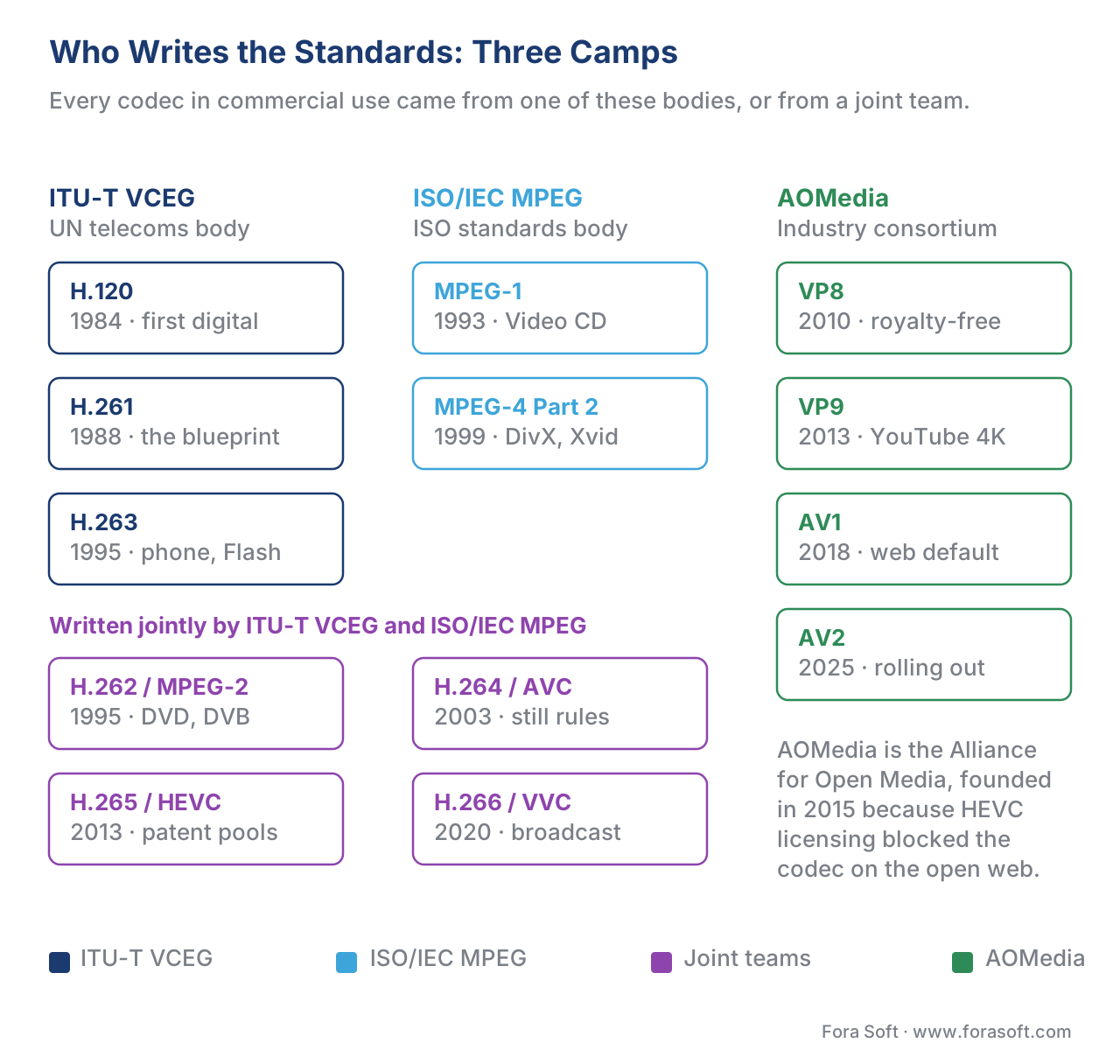 Figure 3. The three governing camps. ITU-T (telecoms-driven) on the left, ISO/IEC MPEG (electronics-driven) in the centre, and the Alliance for Open Media (web-driven) on the right. Codecs that span columns are joint efforts.
A Worked Example: Bitrate Across Generations for the Same 1080p Clip
To make the half-the-bits-every-generation pattern concrete, here is what it costs to encode the same one-hour 1080p movie at visually comparable quality on each codec. The numbers below are typical streaming ladder midpoints — exact mileage varies with content type.
| Codec | Bitrate (Mbps) | File size for one hour (GB) | Bitrate vs predecessor |
|---|---|---|---|
| MPEG-2 (1995) | 12 | 5.4 | baseline |
| H.264 / AVC (2003) | 6 | 2.7 | −50% |
| H.265 / HEVC (2013) | 3 | 1.4 | −50% |
| AV1 (2018) | 2.1 | 0.95 | −30% |
| H.266 / VVC (2020) | 1.8 | 0.8 | −40% (vs HEVC) |
| AV2 (2025) | 1.3 | 0.6 | −38% (vs AV1) |
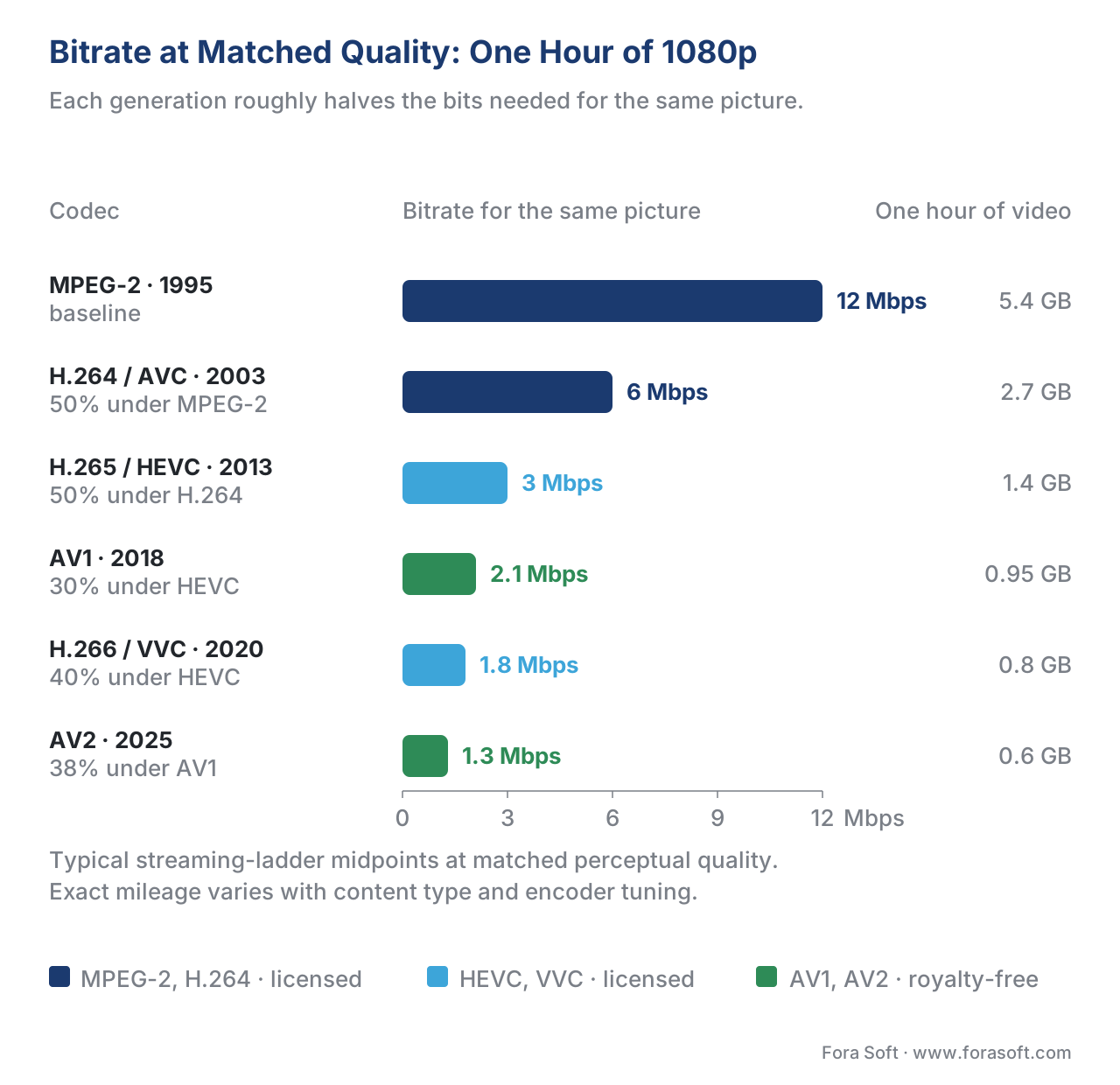 Figure 4. The same table as a picture: what one hour of 1080p costs on each generation at matched quality, and what that is in gigabytes on disk.
A back-of-envelope arithmetic example: a Netflix-sized service streaming one billion hours per month at 6 Mbps of H.264 needs 6 exabits of CDN egress per month. Move the same content to AV1 at 2.1 Mbps and the egress drops to 2.1 exabits — a 65 percent reduction. At CDN list prices of around $0.005 per gigabyte, that 4 exabits saved is roughly $2.5 million of monthly savings, before any storage win. That single arithmetic is why Netflix, YouTube, and Meta have been so aggressive about AV1 deployment — and why they have already started funding AV2 trials.
A Common Pitfall: "We'll Switch to AV1 Next Quarter"
The single most common mistake we see in product roadmaps is treating a codec migration as a software task that engineering can finish in a sprint. It isn't. A codec migration is device coverage first, software second.
The decision tree we ask product teams to run is:
- What fraction of your viewers' devices have hardware AV1 decode? In 2026 that's around 70 percent of large-screen TVs and 60 percent of smartphones sold since 2023. Hardware decode means no significant battery hit, no CPU spike, no decode-side stutter. Software AV1 decode is fine on a modern laptop but punishes a 2019 Android phone.
- Do you keep encoding H.264 in parallel for the long tail of devices? Yes, you do, basically forever. You are not migrating from H.264, you are adding AV1 on top.
- How do you trigger which codec a viewer gets? Your player and your manifest need to negotiate codec support per session. Most streaming stacks already support this (HLS and DASH both have codec-tag fields). Your encoder needs to produce both ladders. Your storage cost roughly doubles for any title encoded in both.
Anyone proposing to "switch to AV1" without that triangulation is proposing a partial outage for the slowest 20 percent of your viewers. Don't.
Free download: Codec History Cheat SheetOne-page A4 timeline of every major video codec from H.120 (1984) to AV2 (2025), with governing body, headline bitrate saving, and 2026 status.Where Fora Soft Fits In
We've been building video products since 2005, across video streaming, video conferencing, OTT/Internet TV, video surveillance, e-learning, telemedicine, and AR/VR. That spans every codec generation in this article. In our shipped projects we still encode H.264 by default on every product, layer HEVC where Apple devices dominate the viewer mix, and add AV1 wherever the encoding cost can be amortised over millions of views. We've delivered live WebRTC pipelines, multi-codec adaptive bitrate ladders for OTT platforms, and surveillance backends that retain footage for years; codec choice in each of those jobs is a different decision shaped by different constraints. When a client asks "what codec should we use", our first three questions are about their viewer device mix, their content shelf life, and the legal jurisdictions they ship into. The answer almost never starts with the codec.

The book
Video Encoding: A Complete Guide to Video Compression
This article walks the timeline; the book works through what each generation on it actually changed. The codec chapters take H.264, HEVC, VP9, AV1, VVC and AV2 one at a time — which coding tools each added, where its headline bitrate saving was measured, and what its licensing costs in practice — while the earlier chapters build the hybrid pipeline this whole history is a story about, from pixels and colour through prediction, transform, quantization and entropy coding. By the end you can read a codec announcement the way the engineers who wrote it do. Written by Nikolay Sapunov, CEO at Fora Soft.
Which codec generations should your service actually ship in 2026?
Tell us what your viewers watch on and what your CDN invoice looks like, and we will work out which ladders are worth encoding in parallel: what AV1 buys you against the hardware-decode coverage you really have, how long H.264 has to stay underneath it, and what HEVC or VVC adds in licensing on top. You get the arithmetic on your own numbers instead of on a test set. 250+ video products shipped since 2005.
See our case studies
Case study
Worldcast Live
Concert streaming at 1.5 Gb/s with 0.4–0.5 s latency to 10,000 simultaneous viewers. At that egress, the half-the-bitrate step between two codec generations is the difference between a workable unit economic and an impossible one.
Case study
Speed.Space
Remote production used on Netflix, EA and HBO shoots, recording at 1080p / 8 Mbps with per-shoot control of resolution, fps, codec and bitrate. Picking the codec per job, rather than once for the platform, is the practical version of this timeline.
Case study
Mindbox
Video management in 50+ deployments, pulling RTSP cameras through FFmpeg into HLS. Cameras ship H.264 and will keep shipping it for years — the long tail this article warns you not to migrate away from.
What to read next
Codecs
Comparison Table: MPEG-2, H.264, H.265, VP9, AV1, VVC
The same six generations side by side, with licensing, hardware decode support and encode cost next to the bitrate numbers.
Codecs
AV1: The New Internet Standard And Where It Stands In 2026
The deep dive on the codec that won the web, including the device-coverage numbers behind the migration warning above.
Decisions
How to Choose a Codec for Your Service in 2026
The decision tree behind a real codec selection: how many ladders to run, which devices force your hand, and what each one costs.
Architecture
Hybrid Video Codec Architecture
Inside the four-stage pipeline H.261 invented: what predict, transform, quantize and entropy code actually do to your pixels.
-
ITU-T H.120, "Codecs for videoconferencing using primary digital group transmission", March 1993 (final revision). Wikipedia summary: H.120. Accessed 2026-05-15. ↩
-
ITU-T H.261, "Video codec for audiovisual services at p × 64 kbit/s", November 1988. Wikipedia: H.261. Accessed 2026-05-15. ↩
-
ITU-T H.262 / ISO/IEC 13818-2, "Information technology — Generic coding of moving pictures and associated audio information: Video", July 1995. ITU page: H.262 recommendation. Accessed 2026-05-15. ↩
-
ITU-T H.264 / ISO/IEC 14496-10, "Advanced Video Coding", first edition May 2003. Wikipedia: Advanced Video Coding. Accessed 2026-05-15. ↩
-
ITU-T H.265 / ISO/IEC 23008-2, "High Efficiency Video Coding", ratified January 2013, published June 2013. Wikipedia: High Efficiency Video Coding. Accessed 2026-05-15. ↩
-
"Video Coding and Related Patent Licensing Pools", Sagacious IP, 2024. Sagacious IP article. Accessed 2026-05-15. ↩
-
"VP8", Wikipedia. Google acquired On2 Technologies in February 2010 for approximately $124.6 million; VP8 released as royalty-free in May 2010. VP8 on Wikipedia. Accessed 2026-05-15. ↩
-
"VP9", Wikipedia. Chrome enabled VP9 decoding in version 29 (August 2013); Firefox in March 2014. VP9 on Wikipedia. Accessed 2026-05-15. ↩
-
AOMedia, "AV1 Roadmap" and the AV1 specification, finalised March 28, 2018. AV1 Roadmap (AOMedia). Accessed 2026-05-15. ↩
-
ITU-T H.266 / ISO/IEC 23090-3, "Versatile Video Coding", finalised July 6, 2020. Wikipedia: Versatile Video Coding. Accessed 2026-05-15. ↩
-
Netflix Technology Blog, "AV1 — Now Powering 30% of Netflix Streaming", December 2025. Netflix TechBlog post. Accessed 2026-05-15. ↩
-
AOMedia, "AOMedia Announces Year-End Launch of Next Generation Video Codec AV2 on 10th Anniversary", September 2025. AOMedia AV2 announcement. Accessed 2026-05-15. ↩
-
Bitmovin, "9th Annual Video Developer Report 2025/2026". Bitmovin Video Developer Report. Accessed 2026-05-15. ↩
