


Why This Matters
If you ship video on televisions, set-top boxes, Apple devices, or 4K/HDR content, you almost certainly ship HEVC today. It is the only codec that combines wide hardware decode (every TV, every iPhone since 6s, every smart-TV chipset since 2015, every console since the PlayStation 4) with a 50%-class compression win over H.264. But you also pay for it. Three patent pools means three sets of contracts, three audit rights, and three lines on your video budget — and roughly 20–25% of essential HEVC patents are held outside any pool, which is the part that keeps lawyers awake at night.1615
This article explains what HEVC is in plain language, walks through the five technical changes that produced the 50% compression win, lays out the profile / tier / level matrix the way the spec actually uses it, and then tells the licensing story honestly — what each pool charges, where the legal exposure sits in 2026, and how a video product team should choose between HEVC, AV1, and "stay on H.264 until 2027". You do not need prior knowledge of codecs to follow it. Every term is defined in plain language before it appears. If you have not yet read H.264 / AVC: The Workhorse Of The Internet, that is the prerequisite: HEVC is its direct successor and shares the same broad blueprint.
What HEVC Actually Is
A codec is two things glued together: an encoder that takes raw pictures and packs them into a small file, and a decoder that reverses the process to put the pictures back on a screen. The name is a portmanteau — coder + decoder. HEVC is the codec the standards bodies designed between 2010 and 2013 to replace H.264 in the same way H.264 had replaced MPEG-2 a decade earlier. The target was halved bitrate at the same perceptual quality on the same content. The result, as we will see in a moment, hit that target — but only on the technical side.
The standard is published under two parallel names because the same two standards bodies that wrote H.264 wrote HEVC together. The Moving Picture Experts Group (MPEG) sits inside the International Organization for Standardization (ISO) and the International Electrotechnical Commission (IEC). The Video Coding Experts Group (VCEG) sits inside the Telecommunication Standardization Sector of the International Telecommunication Union (ITU). The two groups formed a Joint Collaborative Team on Video Coding (JCT-VC) in January 2010, specifically to write a successor to H.264, and the result was published as ITU-T Recommendation H.265 on the ITU side and as ISO/IEC 23008-2 — Part 2 of the wider MPEG-H suite — on the ISO side in 2013.1 Both documents are word-for-word identical. The standard now sits at its eighth edition (2024), but the core normative bitstream syntax has been stable since the first edition.2
The official long name is High Efficiency Video Coding, abbreviated HEVC. In product work you will see all three names — H.265, HEVC, MPEG-H Part 2 — used interchangeably, sometimes in the same paragraph. They all refer to the same standard. The chair team of JCT-VC was Gary Sullivan of Microsoft (who had also chaired the H.264 effort) and Jens-Rainer Ohm of RWTH Aachen, with Thomas Wiegand of Fraunhofer HHI in Berlin again contributing many of the core compression ideas.1 First version of the spec was approved by ITU-T on 13 April 2013 and published by ISO/IEC in June 2013.1
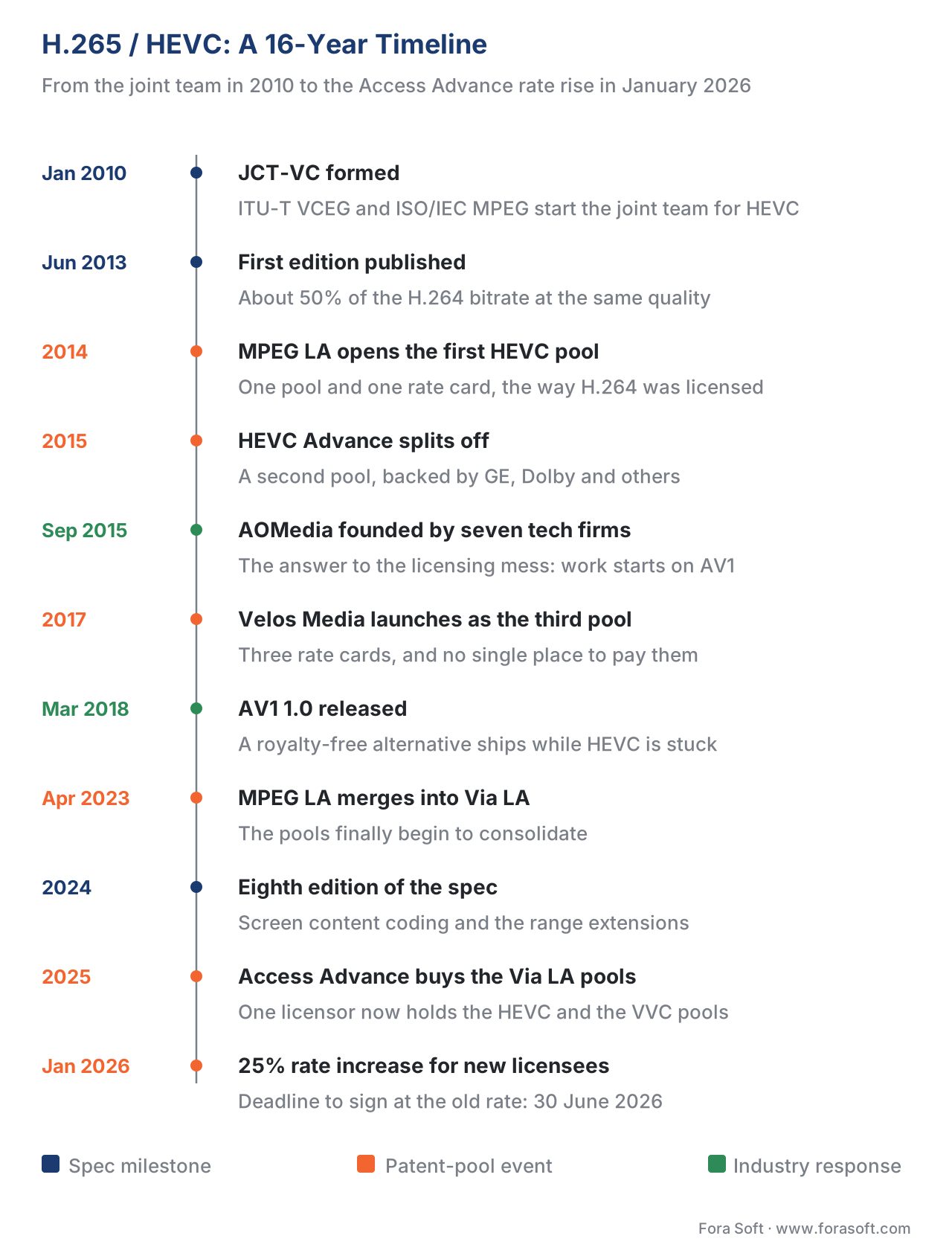 Figure 1. The HEVC timeline. Technically a strong success — every milestone above represents a feature shipped on schedule. Commercially the picture is dominated by the three-pool licensing structure that took eight years to begin consolidating.
A Short History: From "Successor To H.264" To Patent Pool Chaos
By 2010 the streaming industry had a clear problem. H.264 was working brilliantly, but ultra-high-definition (UHD) television — 3840×2160 at 60 frames per second, on its way to consumers — needed roughly four times the bitrate of 1080p high-definition (HD) video, which strained every cable system, every broadband line, and every disc format. The industry wanted a codec that would deliver UHD at the same bitrate that H.264 needed for HD. MPEG and VCEG convened JCT-VC with that explicit goal in January 2010, asked for proposals in April 2010, and locked the core design between 2010 and 2012.1
The technical effort was deliberate and unhurried. JCT-VC accepted Coding Tree Units (CTU) as the headline replacement for H.264's 16×16 macroblocks (we explain this in detail in the next section), absorbed the 35 intra-prediction modes that the proposal from Samsung and Microsoft converged on, and added two new in-loop filters — Sample Adaptive Offset (SAO) in addition to the deblocking filter. The verification testing program that JCT-VC ran in 2013 — a formal subjective test on ten reference video clips encoded by multiple HEVC implementations and compared against H.264 — measured an average bitrate saving of around 50% at the same Mean Opinion Score (MOS), which is the headline number that has followed HEVC ever since.3
The commercial rollout was a different story. Three things went wrong, in sequence.
First, the patent pools fragmented. H.264 had been administered by a single pool — MPEG LA — whose 2010 royalty waiver for free-to-end-user internet video unblocked YouTube, Vimeo, and the entire web video industry. The expectation was that HEVC would follow the same model. MPEG LA announced its HEVC pool in 2014 with rates very close to the H.264 schedule. But a group of patent holders led by GE, Technicolor, Dolby, Mitsubishi, and Philips were dissatisfied with the MPEG LA rate and split off to form a competing pool — HEVC Advance — in March 2015. A third pool — Velos Media — followed in 2017, backed by Ericsson, Panasonic, Qualcomm, Sharp, and Sony.10 A small number of patent holders, including Technicolor (which left HEVC Advance) and a handful of academic and industry rights holders, declined to join any pool. By 2017 a product manager who wanted to ship HEVC had to negotiate with three pools and several independent holders, with overlapping coverage, ambiguous rates for streaming services, and no single-window licence that resembled the clean MPEG LA model.
Second, content fees appeared and then receded. Both HEVC Advance and Velos Media initially proposed royalties on streaming and broadcast content — a per-stream or per-subscriber fee on top of the device royalty — which terrified streaming operators. HEVC Advance softened its content royalties in 2016 and again in 2017 under industry pressure; Velos Media eventually adopted a no-content-royalty stance.10 But the damage to industry trust was already done, and "HEVC has uncertain content royalties" became the line every legal department repeated for the next five years.
Third, AV1 happened. In September 2015 — six months after HEVC Advance launched and one year before MPEG LA had published its final HEVC rates — Amazon, Cisco, Google, Intel, Microsoft, Mozilla, and Netflix founded the Alliance for Open Media (AOMedia) with an explicit goal: build a royalty-free successor to H.264 and HEVC that would never need a patent licence. The founding members named the licensing chaos around HEVC as the direct trigger. AV1 1.0 was published in March 2018 and is now the codec every streaming-first operator (YouTube, Netflix, Meta, Vimeo) reaches for when they want bitrate savings without per-stream royalties. We unpack AV1 in detail in AV1: The New Internet Standard And Where It Stands In 2026.
The 2025 acquisition consolidated the picture a little. Access Advance (the corporate parent of HEVC Advance) acquired Via Licensing Alliance's HEVC and VVC pools — which by then included what was left of the MPEG LA HEVC pool, since MPEG LA had folded into Via LA in April 2023.11 As of January 2026 the practical landscape is two pools — Access Advance (formerly HEVC Advance, now also administering the former Via LA pool under the name VCL Advance) and a small number of bilateral holders — plus the 25% rate increase that Access Advance scheduled for new licensees effective 1 January 2026.1213 The deadline to lock in pre-increase rates was extended to 30 June 2026 in late January 2026, which is the live window product teams must decide inside as of this writing.13
That is the licensing story behind every "should we ship HEVC?" conversation in 2026. The compression is excellent. The licence is solvable but expensive. The reputational damage to HEVC's prospects has been permanent — every streaming-first vendor has either deployed AV1 or has a dated plan to do so, and there will be no "HEVC moment" of universal browser adoption like the one H.264 had between 2010 and 2013.
How HEVC Compresses 50% Better Than H.264, In Plain English
HEVC is still a hybrid block-based codec — the same broad architecture that MPEG-2 introduced and H.264 refined. Every frame is cut into blocks, each block is predicted from neighbours, the small leftover (the residual) goes through a frequency transform, the transform output is quantized (rounded), and the rounded numbers are written to a compressed bitstream by an entropy coder. We unpack the full hybrid architecture in Hybrid Video Codec Architecture. HEVC keeps the same five stages and rebuilds each one. There are five places where HEVC earns its 50% bitrate win over H.264.
1. Bigger, smarter blocks: Coding Tree Units
H.264 cut each frame into fixed 16×16 macroblocks, which the encoder could further split into rectangles down to 4×4 pixels for motion compensation. HEVC throws out the fixed 16×16 outer block and replaces it with a Coding Tree Unit (CTU) that can be 64×64 pixels, 32×32 pixels, or 16×16 pixels — chosen per video sequence at the encoder's discretion, though 64×64 is the default for HD and above.6 The CTU is then recursively split into a quadtree of smaller Coding Units (CU) down to 8×8 pixels.
The mental picture is a chessboard whose squares can be subdivided into smaller chessboards on the fly. A patch of blue sky uses one big 64×64 CU and is described by a handful of numbers; a patch with intricate motion — a football match, a crowd shot, ripples on water — recursively subdivides into many small 8×8 CUs that each describe one piece of motion. The encoder gets to choose the split per region. On HD and UHD content this is where most of the win sits: large, flat regions of the picture compress dramatically better when the encoder can write them as one big block instead of forcing each 16×16 macroblock to repeat itself sixteen times.
2. More directions for intra-prediction
When the encoder predicts a block from neighbours inside the same frame — intra-prediction — H.264 offered 9 directional modes (plus DC and planar averages). HEVC offers 35 modes: 33 angular directions plus DC and Planar.7 More directions means the encoder can match the actual edge direction in the picture more precisely, which leaves a smaller residual to encode. The improvement is largest on content with diagonal edges and textured regions — think rooftops, fences, herringbone-pattern clothing. We unpack the mechanics in Intra-Frame Coding: How A Single Frame Is Compressed.
3. Finer motion compensation
For inter-prediction (predicting a block from a similar patch in a previous or future frame), HEVC uses quarter-pixel motion vectors like H.264 did, but the interpolation filter that builds the sub-pixel positions is significantly better: an 8-tap filter for luma and a 4-tap filter for chroma, designed to preserve high-frequency detail through the interpolation step.6 HEVC also allows Advanced Motion Vector Prediction (AMVP), which lets the encoder describe each motion vector as a small offset from a list of predicted vectors derived from spatial and temporal neighbours, and merge mode, where a block simply reuses the motion vector of a neighbour without writing one of its own. On slow-moving or repetitive motion (long takes, dialogue scenes) merge mode alone saves a measurable percentage of the bitstream. See Inter-Frame Coding And Motion Estimation for the broader topic.
4. Two in-loop filters instead of one
H.264 had one in-loop filter — a deblocking filter that smooths the edges between blocks where heavy quantization would leave visible block boundaries. HEVC keeps the deblocking filter, but adds a second filter called Sample Adaptive Offset (SAO) that runs after deblocking. SAO classifies pixels by their relationship to their neighbours (edge offset) or by their value (band offset) and adds a small per-class offset that the encoder picks to minimise the difference from the original picture.6 On smooth gradients — sunsets, skin tones, lit walls — SAO removes the faint banding that H.264 leaves behind, which lets the encoder use a coarser quantizer at the same perceived quality. We cover the whole in-loop filtering family in In-Loop Filtering: Deblocking, SAO, ALF, CDEF.
5. Parallelism, finally
H.264 was largely a serial decoder: each macroblock depended on its left and top neighbours, so the decoder had to march through the frame in raster order. HEVC was designed for the multi-core era and offers three parallel-processing tools the encoder can switch on: Tiles (the picture is divided into rectangular regions decoded independently), Wavefront Parallel Processing (WPP) (each CTU row starts as soon as the second CTU of the row above is decoded), and Dependent Slices (the picture is split into stripes that share entropy-coder state).6 On a 16-core decoder this is the difference between a single thread saturating at 1080p60 and easily decoding 4K60.
The cost of all five wins is encoder complexity. A fair estimate is that HEVC encoding is 2× to 10× slower than H.264 at comparable presets, because the CTU quadtree search alone is a much larger optimisation problem than H.264's macroblock-mode search.8 Decoder complexity is more modest — roughly 1.5× to 2× the work of an H.264 decoder, well within the budget of any chip designed after 2014.
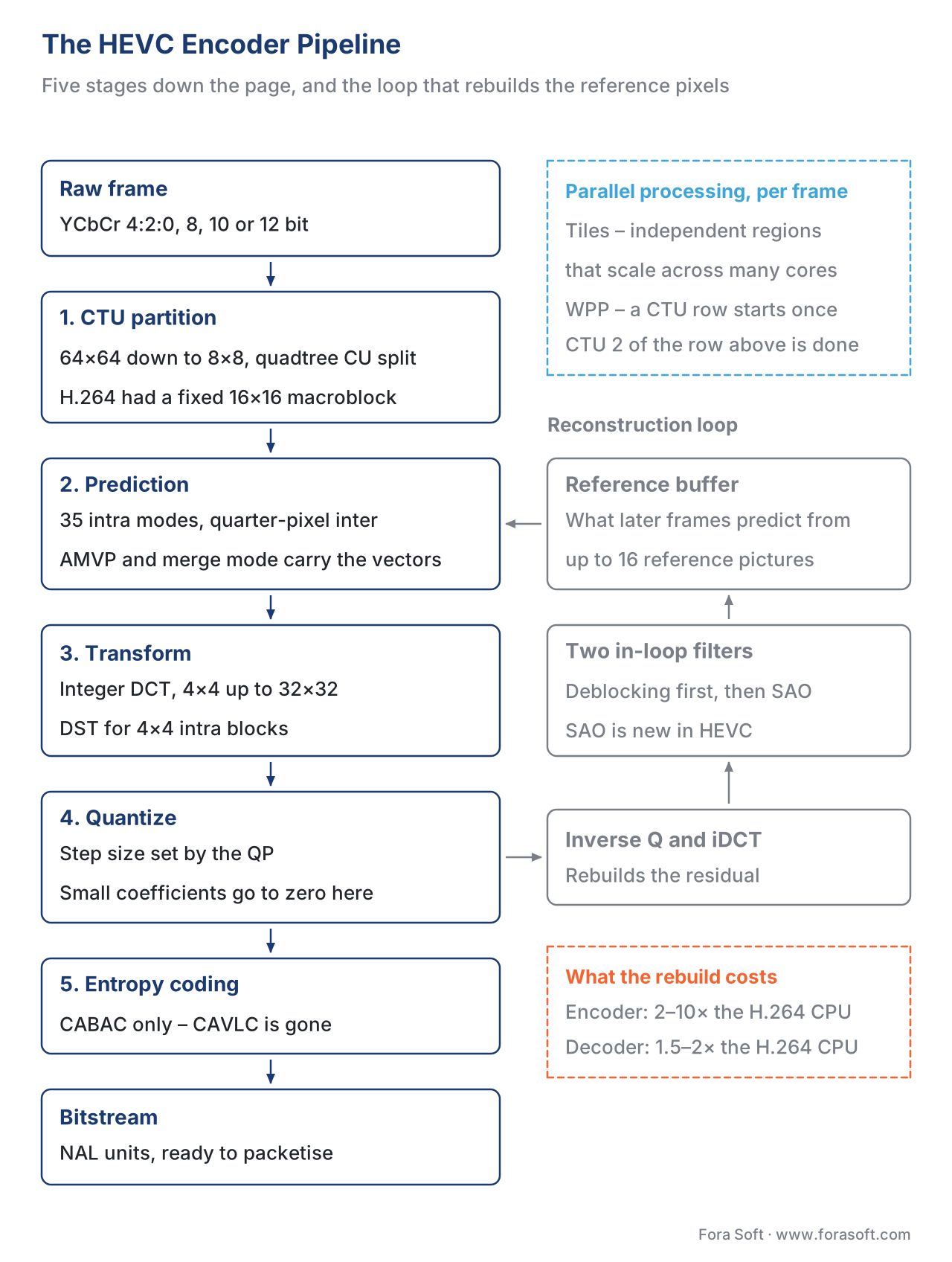 Figure 2. The HEVC encoder pipeline. The five stages are the same as H.264 — predict, transform, quantize, code, filter — but each stage was redesigned for roughly twice the compression, at the cost of 2–10× the encoder CPU.
The exact compression number — and where it falls short
The "50%" headline is an average; the actual saving depends heavily on content and resolution. The 2013 JCT-VC verification tests, performed on ten reference clips with multiple HEVC implementations and compared against optimised x264 encodes at matched MOS, measured an average bitrate saving in the 40–50% range for HD content and slightly higher (often 45–60%) at UHD.3 Independent academic comparisons since 2013 have broadly confirmed those numbers using the Bjøntegaard Delta Bitrate (BD-rate) methodology, the standard way to compare codecs at matched objective quality (PSNR or VMAF).4 On low-resolution, low-bitrate content — sub-720p, sub-2 Mbps — the saving narrows to 20–35%, because much of HEVC's win comes from large CTUs that small frames cannot fit. On high-resolution, high-motion content the saving widens. We unpack PSNR, SSIM, and VMAF in Objective Quality Metrics: PSNR, SSIM, MS-SSIM, VMAF.
Profiles, Tiers, And Levels: How One Codec Ships Across 100 Use Cases
A codec spec the size of HEVC has to cover everything from a 176×144 video call on a feature phone to an 8K 120-fps studio master. To keep decoder chips affordable, HEVC slices its feature set into a three-axis grid: Profiles (which coding tools you may use), Tiers (which bitrate ceiling applies at each resolution — Main tier is for typical applications, High tier is for professional applications that need more headroom), and Levels (the resolution, frame rate, and maximum bitrate cap).9 A decoder is built to a specific Profile @ Tier @ Level combination, and an encoder must stay inside that envelope.
HEVC currently defines around 20 profiles (most added by later editions of the spec for specialised content), 2 tiers (Main and High), and 13 levels (Level 1 through Level 6.2). The combinations that have actually shipped in volume are a much shorter list — and they are what you need to know in practice.
| Profile | What it adds | Where it ships in volume |
|---|---|---|
| Main | The minimum subset — 8-bit per sample, 4:2:0 chroma subsampling, all the basic intra and inter tools | Default for SDR streaming up to 4K; default Apple HEVC profile |
| Main 10 | Main + 10-bit per sample, 4:2:0 chroma | The default for HDR delivery (HDR10, Dolby Vision Profile 5/8.1); 4K Blu-ray; UHD broadcast |
| Main 4:2:2 10 | Main 10 + 4:2:2 chroma subsampling | Broadcast contribution, professional studio links, Sony XAVC-HS |
| Main 4:4:4 | Main + 4:4:4 chroma, 8-bit | Niche professional and archival use |
| Main 4:4:4 10 | Main 4:4:4 + 10-bit | Reference-quality post-production |
| Main 4:4:4 12 | Main 4:4:4 + 12-bit | High-end mastering |
| Main 4:4:4 16 Intra | All-intra (no temporal prediction), 16-bit, 4:4:4 | Studio mastering, mathematically near-lossless |
| Screen-Content Coding (SCC) | Special tools for graphics, screen capture, desktop content — palette mode, intra-block-copy | Remote desktop, cloud gaming, slide-share streaming |
Table 1. The HEVC profiles you will actually meet in product work. The full spec defines another dozen specialised profiles (scalable HEVC, multi-view, range extensions, screen content extensions) that ship in niche use cases.
Main 10 is the practical default for almost any new HEVC deployment in 2026. Even on SDR content the 10-bit pipeline produces better gradients (less visible banding) at the same bitrate, which is why we recommend Main 10 over Main even when the source is 8-bit — a point we explore in 8-Bit Vs 10-Bit Encoding: The "10-Bit Is Just For HDR" Myth.
Tiers add the second axis. Main tier is for typical applications and caps bitrate at moderate values — at Level 5.1 (the 4K @ 60 fps cap), Main tier limits you to 40 Mbps. High tier is for professional applications and raises the cap to 160 Mbps at the same Level 5.1.9 Most consumer hardware is Main tier; broadcast contribution gear, professional cameras, and post-production tools commit to High tier.
Levels add the third axis — the resolution and frame-rate cap.
| Level | Max resolution @ fps | Max bitrate (Main / High tier) | Typical use |
|---|---|---|---|
| 3.1 | 1280×720 @ 33 fps | 10 / — Mbps | Mobile video, low-latency streaming |
| 4.0 | 2048×1080 @ 30 fps | 12 / 30 Mbps | First-generation 1080p HEVC |
| 4.1 | 2048×1080 @ 60 fps | 20 / 50 Mbps | 1080p60 streaming |
| 5.0 | 4096×2160 @ 30 fps | 25 / 100 Mbps | 4K30 streaming |
| 5.1 | 4096×2160 @ 60 fps | 40 / 160 Mbps | 4K60 streaming, 4K Blu-ray, UHD broadcast |
| 5.2 | 4096×2160 @ 120 fps | 60 / 240 Mbps | 4K120 |
| 6.0 | 8192×4320 @ 30 fps | 60 / 240 Mbps | 8K30 broadcast |
| 6.1 | 8192×4320 @ 60 fps | 120 / 480 Mbps | 8K60 |
| 6.2 | 8192×4320 @ 120 fps | 240 / 800 Mbps | 8K120, future high-frame-rate UHD |
Table 2. The HEVC levels you will see in practice. The full standard now defines additional 12K and 16K levels (6.3 to 7.2) for future display sizes, but no consumer hardware decodes them yet.
The bitrate math is direct. A 90-minute movie encoded at 8 Mbps Main 10 @ Main Tier Level 4.1 (1080p60 SDR) occupies:
8 Mbps × 90 min × 60 s = 43,200 Mb total
43,200 Mb ÷ 8          = 5,400 MB ≈ 5.27 GB
The same movie at 4K60 HDR Main 10 @ Main Tier Level 5.1 at 25 Mbps:
25 Mbps × 90 min × 60 s = 135,000 Mb total
135,000 Mb ÷ 8          = 16,875 MB ≈ 16.5 GB
Compare those numbers to the equivalent H.264 encodes: roughly 10 GB for 1080p60 H.264 at the same perceived quality, and roughly 33 GB for 4K60 (which H.264 cannot actually deliver above 30 fps in any volume profile). HEVC's compression win is real, and most visible at UHD where H.264 starts to fail.
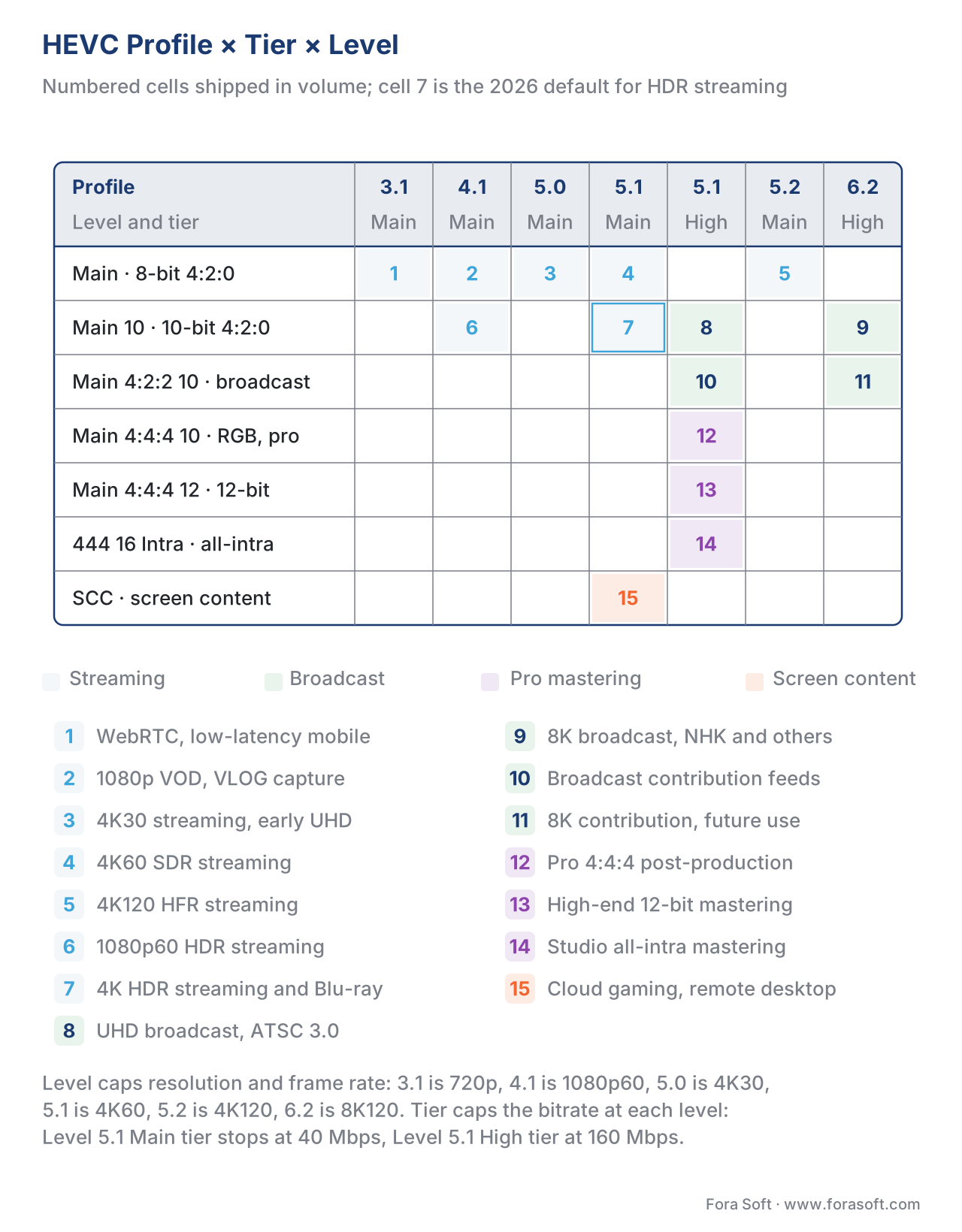 Figure 3. The Profile × Tier × Level matrix. Each tinted cell is a combination that actually shipped in volume; the white cells are theoretical combinations the spec allows but the market never used.
The Patent Pool Story In 2026, Honestly
This is the section that decides whether HEVC ends up in your product. The technical case for HEVC is clear; the commercial case is a math problem with several inputs.
There are now two active HEVC patent pools, after the consolidation moves of 2023 and 2025.
Access Advance (formerly HEVC Advance) is the dominant pool. It represents around 80% of essential HEVC patents by the most cited industry estimates, including patents formerly administered by MPEG LA (which merged into Via LA in 2023) and by Via LA (whose HEVC and VVC pools were acquired by Access Advance in 2025).1112 Access Advance now offers two umbrella programmes — HEVC Advance (legacy) and VCL Advance (Video Codec Licensing, the former Via LA pool) — but a single licensee can take a multi-codec Bridging Agreement that covers both, plus VVC, at a discounted combined rate.14
Velos Media is the smaller pool, still active in 2026, with a different set of patent holders (Ericsson, Panasonic, Qualcomm, Sharp, Sony).10 Velos has a flat $0.20 per device royalty cap, no content royalty, and a public rate card.
A residual 15–25% of essential HEVC patents are held outside both pools, by individual companies (Samsung in some jurisdictions, a handful of academic and consortium rights holders) who licence bilaterally. Industry analyst estimates have varied from "10%" to "40%" of essential patents being outside the pools depending on how you count; the GreyB 2024 analysis put the in-pool share at roughly 65% — meaning the out-of-pool share is meaningful and is the part that drives the risk premium most legal departments price in.16
For a streaming operator, the actual numbers as of January 2026 look roughly like this (these are illustrative — your legal team will negotiate the real numbers).
| Cost line | What you pay | Notes |
|---|---|---|
| Device royalty (Access Advance) | ~$0.40–$1.20 per encoder/decoder unit | Tiered; volume discounts kick in over 100k units/year. Rates rose 25% on 1 Jan 2026 for new licensees, with a 30 June 2026 deadline to lock pre-increase rates. |
| Device royalty (Velos Media) | $0.20 per unit, capped | Flat, no tier structure. |
| Content royalty (Access Advance) | Tiered by subscriber base | Materially softened since 2017; in practice many streaming services pay only the device royalty. |
| Out-of-pool exposure | Variable, often $0 in practice | Real risk if a non-pool patent holder asserts post-launch; this is where the legal premium sits. |
| Implementation cost | Engineering time + libraries (x265, MainConcept, NVIDIA NVENC, Intel QSV) | x265 is GPL/commercial dual-licensed; MainConcept ships with most commercial encoders. |
Three practical takeaways come out of these numbers.
First, for any device manufacturer shipping HEVC, the two-pool plus residual structure is now solvable with a single Access Advance + Velos Media pair of contracts plus a freedom-to-operate review for the residual. The deadline that matters in 2026 is 30 June — sign with Access Advance before that date to lock pre-increase rates.13
Second, for streaming-first companies (you encode, store, and serve video but do not ship devices), HEVC's commercial profile is much weaker than it looks. You pay nothing for software-decode HEVC on Apple devices (the licence flows through the device manufacturer). You pay for HEVC encode if you use a commercial encoder like MainConcept; you pay nothing if you use x265 under GPL. The content royalty has receded but has not disappeared. And the alternative — AV1 — is royalty-free for both encode and decode, has hardware decode in every shipping 2026 smart TV, every iPhone since 15 Pro, every Pixel since the Pixel 6, and every PC GPU since RTX 30 / RX 6000 / Arc.
Third, the AOMedia legal indemnity for AV1 (the Alliance for Open Media offers its members and licensees a pooled defence against patent assertions on the AV1 bitstream) is structurally absent from HEVC. There is no central body that will defend you against a Sisvel or a Sony assertion on an HEVC patent that none of the pools cover. The risk is real but small; the lack of pooled defence is what keeps it psychologically large.
The honest summary is the one most video product teams already say out loud in 2026: HEVC is the technically excellent codec the industry needed in 2013, distributed under a licensing model the industry actively dislikes. It still ships everywhere because the install base is there. But every greenfield streaming deployment with the option to skip it does skip it, in favour of AV1 plus an H.264 fallback, until the rest of the long-tail HEVC content fades out around 2030.
Where HEVC Earns Its Keep In 2026
Knowing the licence story does not change the fact that HEVC is the right choice for several real-world use cases in 2026.
4K/HDR over-the-top (OTT) and broadcast. Every 4K UHD Blu-ray, every cable and satellite 4K UHD channel, every linear 4K HDR feed (DAZN, Sky, BT Sport, Comcast Xfinity 4K, Verizon Stream TV, the Apple TV app's 4K HDR catalogue) ships HEVC Main 10. The DVB and ATSC 3.0 broadcast standards specify HEVC as their primary 4K codec.1920 If your product ingests, transcodes, or distributes UHD broadcast or premium VOD, HEVC is unavoidable.
Apple ecosystem. Every iPhone since 6s, every iPad since 2017, every Apple TV 4K (and every Mac with hardware HEVC decode since 2017) records and plays HEVC natively. Apple's HEIF still-image format and the .heic photo extension are HEVC-encoded I-frames. If you build for iOS, macOS, or tvOS, HEVC is the default codec that comes out of the camera and that AirPlay 4K to Apple TV requires.
Disc playback and ingest. 4K Ultra-HD Blu-ray specifies HEVC Main 10 @ Main Tier Level 5.1 as its mandatory video codec — at up to 108 Mbps (which the spec lifts to "High tier" by treating the 108 Mbps cap as a disc-specific extension).21 Every 4K UHD player and home-theatre receiver decodes HEVC by design.
Live UHD events. Live sports, concerts, conferences, and broadcast contribution links between studio and master control are dominated by HEVC Main 4:2:2 10 @ High Tier today, because the live-encode hardware ecosystem (NETINT Quadra, NVIDIA NVENC, Intel QSV, MainConcept-based broadcast encoders) supports HEVC's professional profiles natively and at lower licensing exposure than VVC.
Adaptive bitrate ladders that include 4K. Every modern ABR ladder that goes above 1080p typically includes HEVC renditions for the 1080p60+ and 4K rungs, with H.264 fallback for the 720p and below rungs. AV1 ladders increasingly displace HEVC for the 1080p and above rungs at OTT operators that have shipped the AV1 transition, but the install base of HEVC-only hardware is still large enough that an HEVC rung is the practical middle ground for the next two to three years.
Where HEVC stops earning its keep
WebRTC has no mandatory HEVC support — the IETF mandatory-to-implement video codecs are H.264 and VP8.17 HEVC has been optional in WebRTC since 2024, but no major browser advertises it in the SDP offer/answer exchange by default. We unpack the SDP and ICE story in WebRTC In Depth: SDP, ICE, STUN/TURN, SFU Vs MCU.
Browser support is partial. Safari has played HEVC natively since 2017. Edge added HEVC decode on Windows in 2018. Firefox 134 (January 2025) added hardware HEVC decode on Windows and macOS. Chrome on Windows plays HEVC when the OS provides hardware decode (since Chrome 105, 2022). Chrome on Linux still does not play HEVC by default in 2026, because no royalty-free decoder ships with Chromium and Google has not paid for one.18
Royalty-free is non-negotiable. If your product cannot pay royalties (public-broadcast, embedded medical, academic distribution, FOSS user-generated content), HEVC is the wrong choice. The royalty obligation is real, the pool structure is opaque, and the out-of-pool exposure is unbounded. Use AV1 or VP9 instead.
Common pitfalls (read before encoding)
A short list of mistakes we have repeatedly seen video teams make when they adopt HEVC.
Pitfall: shipping Main profile when you meant to ship Main 10. Main is 8-bit only. If the source is 10-bit (HDR, ProRes 422 HQ, or any modern professional camera), encoding to Main profile drops 2 bits of luma per sample and produces visible banding on gradients. Always encode HDR or 10-bit sources to Main 10.
Pitfall: assuming "HEVC" means "HDR". HEVC is an SDR codec by default. HDR comes from the transfer function (PQ for HDR10/Dolby Vision, HLG for broadcast HDR) signalled in the VUI and SEI metadata, plus 10-bit samples (Main 10 profile), plus mastering display metadata in the bitstream. Encoding to Main 10 without setting the transfer function and primaries produces a 10-bit SDR file, not an HDR file. See The Complete Guide To HDR: HDR10, HDR10+, Dolby Vision, HLG.
Pitfall: choosing the wrong tier for 4K. 4K @ 60 fps at high bitrates needs Main Tier Level 5.1 at minimum, and High Tier Level 5.1 for professional contribution. Encoders that default to Main Tier Level 5.0 silently cap your bitrate at 25 Mbps, which produces visible compression artefacts on real UHD content. Check the level explicitly in your FFmpeg or x265 command line.
Pitfall: forgetting that AAC and Dolby audio are licensed separately. HEVC patents are one chain; AAC audio (MPEG LA, Via LA) is another; Dolby Audio, Dolby Atmos, and Dolby Vision are three further chains. A clean "HEVC product" royalty calculation must include the audio and HDR-metadata chains in the same model.
Pitfall: storing the HEVC bitstream in MP4 with the wrong codec parameter. The MP4 container needs the codec parameter
hev1orhvc1in the sample description — they describe different ways of carrying the parameter sets (VPS/SPS/PPS). Apple devices preferhvc1(parameter sets in the sample description); some streaming systems requirehev1(parameter sets inline with the samples). Mismatching the two against your CDN's expectations produces silent playback failures on iOS. See Containers: MP4, FMP4, MKV, WebM, MOV, MPEG-TS.
HEVC In FFmpeg: The Commands You Will Actually Use
Three commands cover roughly 90% of the HEVC encoding work most video teams do. The encoder we use here is x265, the open-source HEVC reference implementation distributed under GPL v2 with a commercial licence option through MulticoreWare. All three commands assume FFmpeg 6 or later with x265 enabled at compile time.
# 1) High-quality 1080p60 VOD encode at CRF 22, Main 10 profile
ffmpeg -i in.mov -c:v libx265 -preset slow -crf 22 \
  -profile:v main10 -pix_fmt yuv420p10le \
  -x265-params "level=4.1:bframes=8:ref=5:psy-rd=2.0" \
  -tag:v hvc1 -c:a aac -b:a 128k -movflags +faststart out.mp4
The -crf 22 flag (Constant Rate Factor 22) is a quality target — lower numbers mean higher quality and larger files; CRF 22 is roughly visually transparent at 1080p. The -tag:v hvc1 tag is the one that makes Apple devices accept the file. We cover rate control modes in Rate Control: CBR, VBR, CRF, ABR, Capped CRF.
# 2) 4K HDR10 master, Main 10, High Tier, Level 5.1
ffmpeg -i in_master.mxf -c:v libx265 -preset slower \
  -profile:v main10 -pix_fmt yuv420p10le \
  -x265-params \
  "level=5.1:tier=high:colorprim=bt2020:transfer=smpte2084:\
colormatrix=bt2020nc:master-display='G(13250,34500)B(7500,3000)R(34000,16000)\
WP(15635,16450)L(10000000,1)':max-cll=1000,400" \
  -tag:v hvc1 -c:a copy out_4khdr10.mp4
The master-display and max-cll strings carry the HDR10 static metadata (primaries, white point, peak luminance, frame-average light level) inside the HEVC bitstream as SEI messages. Without these your file looks dim and grey on every HDR display because the panel does not know how to interpret the 10-bit samples.
# 3) Live RTMP ingest, 1080p30, Main Tier Level 4.0, ABR-friendly
ffmpeg -re -i input -c:v libx265 -preset veryfast \
  -profile:v main -pix_fmt yuv420p \
  -x265-params "level=4.0:no-scenecut=1:keyint=60:min-keyint=60" \
  -b:v 5500k -maxrate 5500k -bufsize 11000k \
  -tag:v hvc1 -f flv rtmp://ingest.example.com/live/streamkey
The fixed two-second keyframe interval (keyint=60 at 30 fps) is what makes the stream segment-able for HLS or DASH downstream. See Streaming Protocols: The 8 That Matter In 2026.
HEVC Vs The Field: Codec Comparison In 2026
The honest comparison includes all five codecs your product manager will mention in a budget meeting.
| Criterion | H.264 | HEVC | VP9 | AV1 | VVC |
|---|---|---|---|---|---|
| Year first shipped | 2003 | 2013 | 2013 | 2018 | 2020 |
| Compression vs H.264 | baseline | ~50% better | ~40% better | ~60–70% better | ~50% better than HEVC |
| Hardware decode share 2026 | ~100% | ~95% | ~85% | ~80% | <10% |
| Browser support 2026 | universal | partial (Safari, Edge, Firefox 134+, Chrome Win) | universal (Chrome, FF, Edge; Safari since 2024) | universal (FF, Chrome, Edge; Safari since macOS 14/15 M3+) | none |
| Royalty model | MPEG LA pool, free-to-EU internet video | 2 pools + residual; ~$0.40–$1.20/device | royalty-free | royalty-free (AOMedia) | 2 pools (Access Advance, Via LA) |
| WebRTC mandatory | yes | no | yes (Chrome/FF) | optional | no |
| Mandatory in 4K UHD Blu-ray | no | yes | no | no | no |
| Encoder CPU vs H.264 | 1× | 2–10× | 3–8× | 5–20× | 10–40× |
Table 3. Codec landscape in 2026. HEVC's technical position is strong; its commercial position is weakest of the three production codecs in 2026 because of the patent-pool overhead and the AV1 alternative. We maintain a live version of this table at Codec Comparison Matrix.
The reading of this table that we offer in product reviews: HEVC is the present default; AV1 is the next default; VVC is unlikely to displace AV1 in consumer streaming (we cover VVC's commercial difficulties in H.266 / VVC: Technically Excellent, Market-Weak).
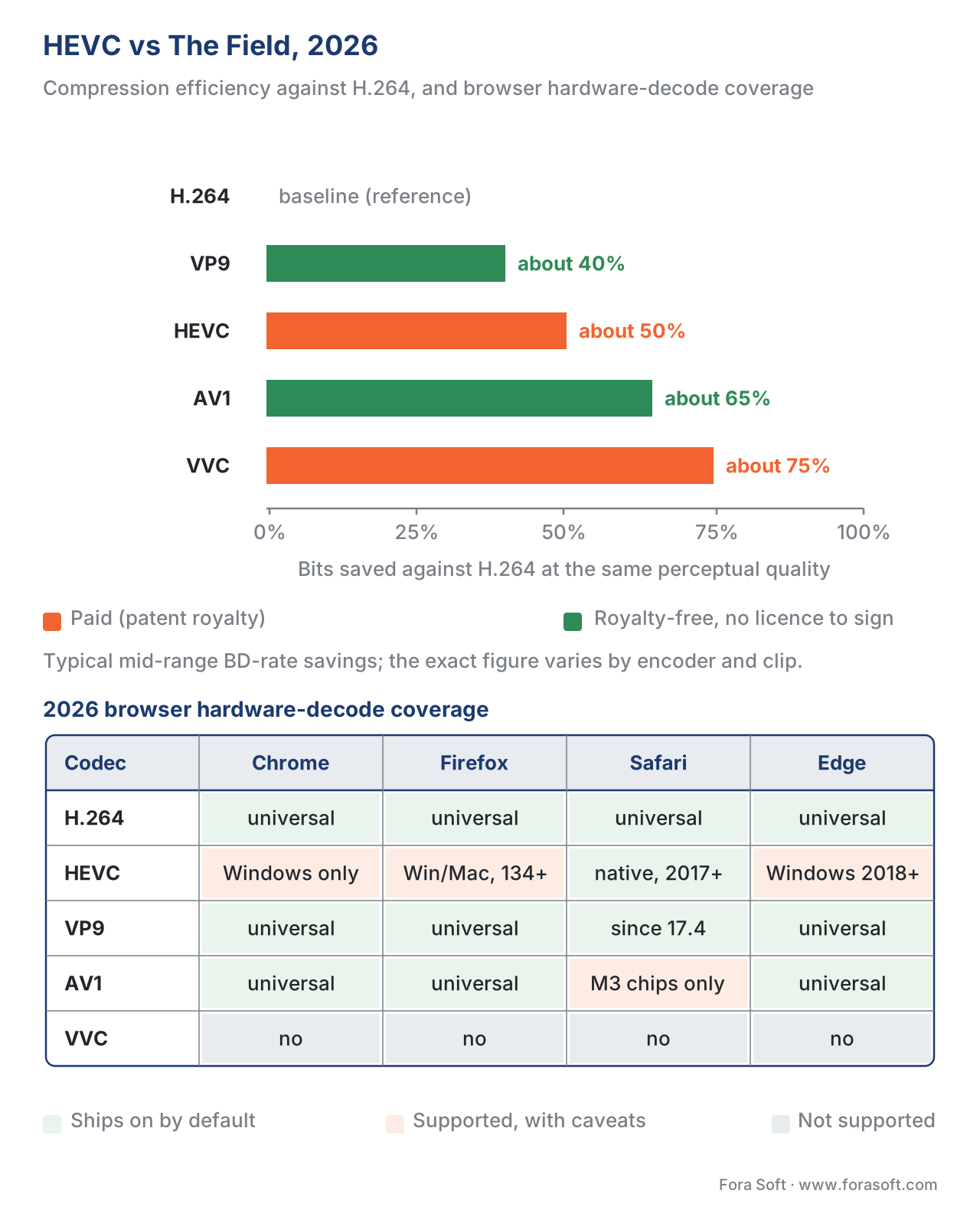 Figure 4. The codec landscape in 2026 at a glance. HEVC is the second-best on compression efficiency but the worst-positioned on royalty model among the three production codecs.
Where Fora Soft Fits In
We have been building video products since 2005 and shipped 239+ projects across video streaming, OTT and Internet TV, video conferencing, video surveillance, e-learning, telemedicine, and AR/VR. HEVC sits in the technical core of almost every UHD pipeline we have delivered in the last decade — in the 4K HDR ABR ladders we build for OTT operators, in the broadcast contribution gear we integrate for live-event clients, and in the medical archive systems where bandwidth is metered and HEVC's 50% saving pays for itself on the first month's storage bill. We have also helped clients walk the patent-pool conversation end to end: which pool to sign with, which deadline to hit, how to structure the device versus content royalty, and whether AV1 makes more sense for the next ladder generation. The choice is real and contextual; if your team is wrestling with it, that is a conversation we have several times a quarter and one we are happy to have with you.

The book
Video Encoding: A Complete Guide to Video Compression
This article gives HEVC one sitting; the book gives it chapters. The CTU quadtree, the 35 intra modes, merge mode and AMVP, the two in-loop filters and the tiles-versus-WPP choice each get their own worked example, the full profile, tier and level tables are printed out, and the x265 presets that move each of them are set against measured bitrate and encode time. It is volume 1 of the seven-volume Fora Soft Video Engineering Handbook, 1,522 pages, written by Nikolay Sapunov, CEO at Fora Soft.
Is HEVC worth the licence for your product in 2026?
Send us your device list, your audience split and the ladder you ship today, and we will come back with what an HEVC rung would cost you and what it would save. That means counting the share of your viewers who get hardware decode rather than a battery-draining software fallback, working out which pool you would owe and under which of the two rate cards, and comparing that against adding AV1 instead or alongside. You get the numbers on your own catalogue and your own audience. 250+ video products shipped since 2005.
See our case studies
Case study
Speed.Space
Remote production used on Netflix, EA and HBO shoots, recording at 1080p / 8 Mbps with per-shoot control of resolution, fps, codec and bitrate. Those controls are the matrix in Figure 3 turned into a choice someone makes on the day: which profile carries the bit depth and chroma the shoot needs, and which level and tier the recorder can actually sustain.
Case study
Worldcast Live
Concert streaming at 1.5 Gb/s with 0.4–0.5 s latency to 10,000 simultaneous viewers. It is the case where HEVC’s 2–10× encoder cost is the whole argument: at sub-second latency you cannot spend the CPU on a deeper quadtree search, so the bits you save on paper are not the bits you save on air.
Case study
Mindbox
Video management in 50+ deployments across transport, pharma and gated communities, pulling RTSP cameras through FFmpeg into HLS. Moving an estate like this to HEVC is a hardware question before it is a codec one: the saving lands only where the camera encodes it and the viewing device decodes it in silicon.
What to read next
Architecture
Block-Based Prediction: MBs, CTUs, SBs and Superblocks
Stage 1 of Figure 2 on its own: why the 64×64 CTU and its quadtree buy most of HEVC’s gain on UHD content, and what AV1 and VVC do with the same idea.
Codecs
AV1: The New Internet Standard And Where It Stands In 2026
The royalty-free answer that the three-pool mess produced, and where it has actually landed: encoder speed, hardware decode coverage, and what it costs to add a rung.
Decision
How to Choose a Codec for Your Service in 2026: A Decision Tree
What to do with Figure 4 in practice: when HEVC earns its licence, when H.264 alone is still right, and what a second rendition costs to encode and to store.
Tooling
Encoder Implementations: x264, x265, libvpx, SVT-AV1, rav1e, libaom, vvenc
The other half of the FFmpeg commands above: what x265 presets and tunes actually change, and how the encoders compare at a fixed quality target rather than a fixed preset.
-
Wikipedia. "High Efficiency Video Coding." Accessed 2026-05-16. https://en.wikipedia.org/wiki/High_Efficiency_Video_Coding ↩↩↩↩
-
ITU-T. "Recommendation H.265: High efficiency video coding." 8th edition, 2024. https://www.itu.int/rec/T-REC-H.265 ↩
-
Tan, T.K., et al. "Video Quality Evaluation Methodology and Verification Testing of HEVC Compression Performance." IEEE Transactions on Circuits and Systems for Video Technology, vol. 26, no. 1, January 2016. ↩↩
-
Bjøntegaard, G. "Calculation of average PSNR differences between RD-curves." ITU-T VCEG-M33, April 2001 (the standard methodology for codec compression comparison still used in 2026). ↩
-
Bitmovin. "Video Developer Report 2025." Streaming codec adoption survey, conducted September–December 2024. https://bitmovin.com/video-developer-report-2025/ ↩
-
Richardson, I.E.G. "HEVC: An Introduction to High Efficiency Coding." Vcodex BV technical brief. https://www.vcodex.com/hevc-an-introduction-to-high-efficiency-coding ↩↩↩↩
-
Ant Media. "H.265 Codec Explained: High Efficiency Video Coding (HEVC) Guide." Technical reference. https://antmedia.io/h265-hevc-codec-explained/ ↩
-
Bossen, F., et al. "HEVC Complexity and Implementation Analysis." IEEE Transactions on Circuits and Systems for Video Technology, vol. 22, no. 12, December 2012. ↩
-
Wikipedia. "High Efficiency Video Coding tiers and levels." Accessed 2026-05-16. https://en.wikipedia.org/wiki/High_Efficiency_Video_Coding_tiers_and_levels ↩↩
-
Ozer, J. "Balance of Power Shifts Among HEVC Patent Pools." Streaming Media. https://www.streamingmedia.com/Articles/News/Online-Video-News/Balance-of-Power-Shifts-Among-HEVC-Patent-Pools-136123.aspx ↩↩↩
-
ip fray. "BREAKING: Access Advance acquires Via Licensing Alliance's HEVC, VVC patent pools." 2025. https://ipfray.com/breaking-access-advance-acquires-via-licensing-alliances-hevc-vvc-patent-pools/ ↩↩
-
Access Advance. "Access Advance Announces HEVC Advance and VVC Advance Pricing through 2030." Press release, 21 July 2025. https://accessadvance.com/2025/07/21/access-advance-announces-hevc-advance-and-vvc-advance-pricing-through-2030/ ↩↩
-
Access Advance. "Access Advance Extends HEVC Advance Rate Increase Deadline." 27 January 2026. https://accessadvance.com/2026/01/27/access-advance-extends-hevc-advance-rate-increase-deadline/ ↩↩↩
-
Access Advance. "Multi-Codec Bridging Agreement (MCBA)." Royalty rate structure document. https://accessadvance.com/mcba-royalty-rate-structure/ ↩
-
Access Advance. "HEVC Advance Patent Pool: Royalty Rates Summary." https://accessadvance.com/hevc-advance-patent-pool-detailed-royalty-rates/ ↩
-
GreyB. "HEVC Patent Landscape Analysis." Industry analyst report. https://greyb.com/resources/reports/hevc-patent-landscape-analysis/ ↩↩
-
IETF. "RFC 7742: WebRTC Video Processing and Codec Requirements." March 2016. https://datatracker.ietf.org/doc/html/rfc7742 ↩
-
caniuse.com. "HEVC/H.265 video format." Browser support tables. https://caniuse.com/hevc ↩
-
DVB Project. "Commercial Requirements for UHD-1 Phase 2 Services." Specification of HEVC as the primary 4K video codec. https://dvb.org/ ↩
-
ATSC. "A/341: Video — HEVC. ATSC Standard." Mandatory HEVC for ATSC 3.0 video. https://www.atsc.org/atsc-documents/a3412017-video-hevc/ ↩
-
Blu-ray Disc Association. "Ultra HD Blu-ray Format Specifications." HEVC Main 10 mandatory codec for 4K UHD Blu-ray. https://www.blu-raydisc.com/ ↩
