


Why this matters
Every streaming, surveillance and conferencing team faces the same arithmetic. Bandwidth is expensive, CDN bills grow linearly with watch time, and the next-generation codec — VVC, AV1, or a future AV2 — needs years of hardware refresh cycles before most viewers can decode it. LCEVC offers a different deal: you keep the H.264 or HEVC hardware decoder you already ship on every phone, browser and TV, and you bolt a software layer onto it that recovers 30 to 50 percent of the compression gap to AV1 today, on devices you've already shipped. This article is for the product manager picking a codec roadmap, the streaming engineer trying to cut a bandwidth bill in half without breaking the iOS-and-Roku install base, and the founder of an OTT service who has read the AV1 hype and wants to know whether LCEVC is a shortcut or a distraction.
What LCEVC actually is
The full name is Low Complexity Enhancement Video Coding. The standard number is ISO/IEC 23094-2:2021 — part of the MPEG-5 family. The body that ratified it is ISO/IEC JTC1 SC29, the same committee that ratified MPEG-2, H.264 and HEVC.
LCEVC is not a codec in the usual sense. A codec, like H.264 or AV1, takes a raw video on one side and produces a self-contained compressed bitstream on the other. LCEVC takes two inputs and produces an enhancement bitstream. The two inputs are the original full-resolution video and the output of some other codec — call it the base codec — that has compressed the same video at a lower resolution. The job of LCEVC is to encode the difference between those two pictures cheaply enough that the bandwidth it adds is far less than the bandwidth its companion codec saves by running at a lower resolution.
If the base codec is H.264 and we run it at half-resolution along each axis (a quarter of the pixels), and we add an LCEVC enhancement layer to bring the result back up to full resolution, we typically come out 28 to 40 percent ahead of running H.264 at full resolution. The picture looks better and the file is smaller. Encoding is faster, because the heavy lifting happens at quarter pixel count.
This idea — "use a familiar codec at low resolution and patch it up with a thin layer" — is what the LCEVC team calls codec-agnostic enhancement. It is not new in principle. Scalable Video Coding (SVC) added scalable extensions to H.264 and HEVC. What is new is that LCEVC's enhancement layer was designed from the start to run in pure software at sustainable power, while the heavy base decode keeps using the hardware silicon already in the device. Nobody needs to ship new chips.
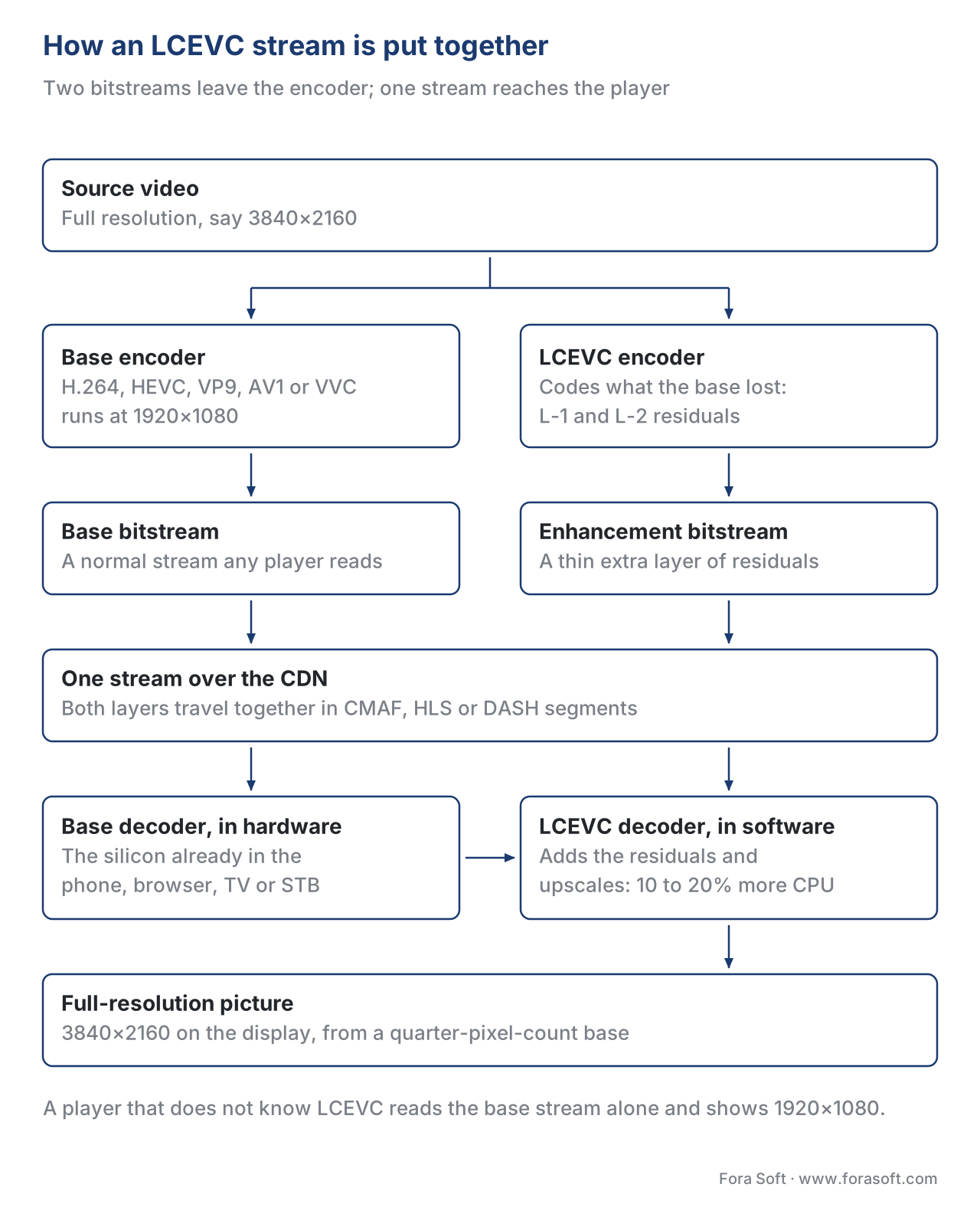 Figure 1. LCEVC architecture: the base codec encodes a quarter-pixel-count version of the source; the LCEVC encoder produces an enhancement layer of residuals; on the decode side the base hardware decoder runs as normal and the LCEVC software decoder adds two layers of residuals before the final upscale.
A short history
The work started inside V-Nova, a London-based company founded in 2011 by Guido Meardi and Pierdavide Marcolongo. V-Nova brought its underlying technology, called Perseus, into MPEG as a proposal for an enhancement codec in 2018. MPEG opened a Call for Proposals in October 2018, finalised the technical specification at its 132nd meeting in October 2020, and published the standard as ISO/IEC 23094-2 in November 2021. A 2024 amendment added more profile levels for higher resolutions and higher bit depths.
The reference encoder is called LTM (LCEVC Test Model). The reference decoder, LCEVCdec, is open source under the BSD-3-Clause licence at github.com/v-novaltd/LCEVCdec. V-Nova ships a commercial encoder SDK that plugs into the major base encoders — x264, x265, libvpx, libaom, SVT-AV1, NVENC, Intel Quick Sync, Xilinx, MainConcept and NETINT.
How LCEVC works, step by step
We will walk through encoding from the top of the pipeline to the bottom, with one new concept per step.
Step 1 — downscale
The encoder takes the original full-resolution video and shrinks each frame by a factor of two along each axis. A 3840×2160 (UHD) frame becomes 1920×1080. A 1920×1080 frame becomes 960×540. The downscaler is not standardised — the encoder can use any filter it likes, typically Lanczos or a simple bilinear filter. Quarter pixel count means roughly a quarter of the encoding work for the base codec.
Step 2 — base encode
The downscaled video is fed into a base codec — H.264, HEVC, VP9, AV1, EVC, or VVC. The base codec does whatever it normally does: motion estimation, prediction, transform, quantization, entropy coding. Its output is a perfectly normal H.264 (or HEVC, or AV1, or VVC) bitstream that any existing decoder in the world can play back. If a player does not know what LCEVC is, it sees a low-resolution stream and renders it. The signal is forward-compatible by design.
Step 3 — base decode (inside the encoder)
The LCEVC encoder needs to know what the base decoder will produce, so it runs the base decoder on its own output. The output is a reconstructed low-resolution video, slightly worse than the input to step 2 because of base-codec quantization losses.
Step 4 — sub-layer 1 residuals
The encoder subtracts the reconstructed low-resolution video from the downscaled input. The difference is called a residual — a sparse, mostly-zero image full of edges, ringing and texture that the base codec lost. This residual is the first sub-layer, called L-1. It is transformed by a small Hadamard-style 2×2 or 4×4 transform, quantized, and entropy-coded with a fast specialised coder. The result is added back to the reconstructed low-resolution video. Call this output the corrected base.
Step 5 — upscale
The corrected base is upscaled by a factor of two along each axis using a normative upscaler. "Normative" means the standard prescribes the exact mathematical filter — every conformant decoder upscales the same way, so the encoder knows precisely what picture the decoder will see at the next step. The standard supports a small handful of upscale kernels, and the encoder can signal which one to use per frame.
Step 6 — sub-layer 2 residuals
The upscaled corrected base is now at full resolution but still missing detail. The encoder subtracts it from the original input, producing a second residual — the sub-layer 2 (L-2) residual, also sparse and full of edge detail. The L-2 residual is transformed, quantized, and entropy-coded.
Step 7 — temporal prediction (optional)
Before the L-2 residual is encoded, the encoder can choose, per 32×32 block, to subtract the corresponding residual from the previous frame. Many residuals do not change between adjacent frames — an edge in the same place still produces the same edge in the residual — so subtracting yesterday's residual from today's residual produces a smaller signal to encode. This is called temporal prediction. It uses zero motion vectors — no motion search, no per-pixel compensation, just "this 32×32 block looks like last frame's same 32×32 block". The encoder can turn it on or off per block and per frame, signalled with a single bit.
That is the entire pipeline. No deblocking filter, no SAO, no ALF, no rate-distortion search over hundreds of prediction modes. The L-1 and L-2 residual codecs are intentionally tiny — that is where the low complexity in the name comes from.
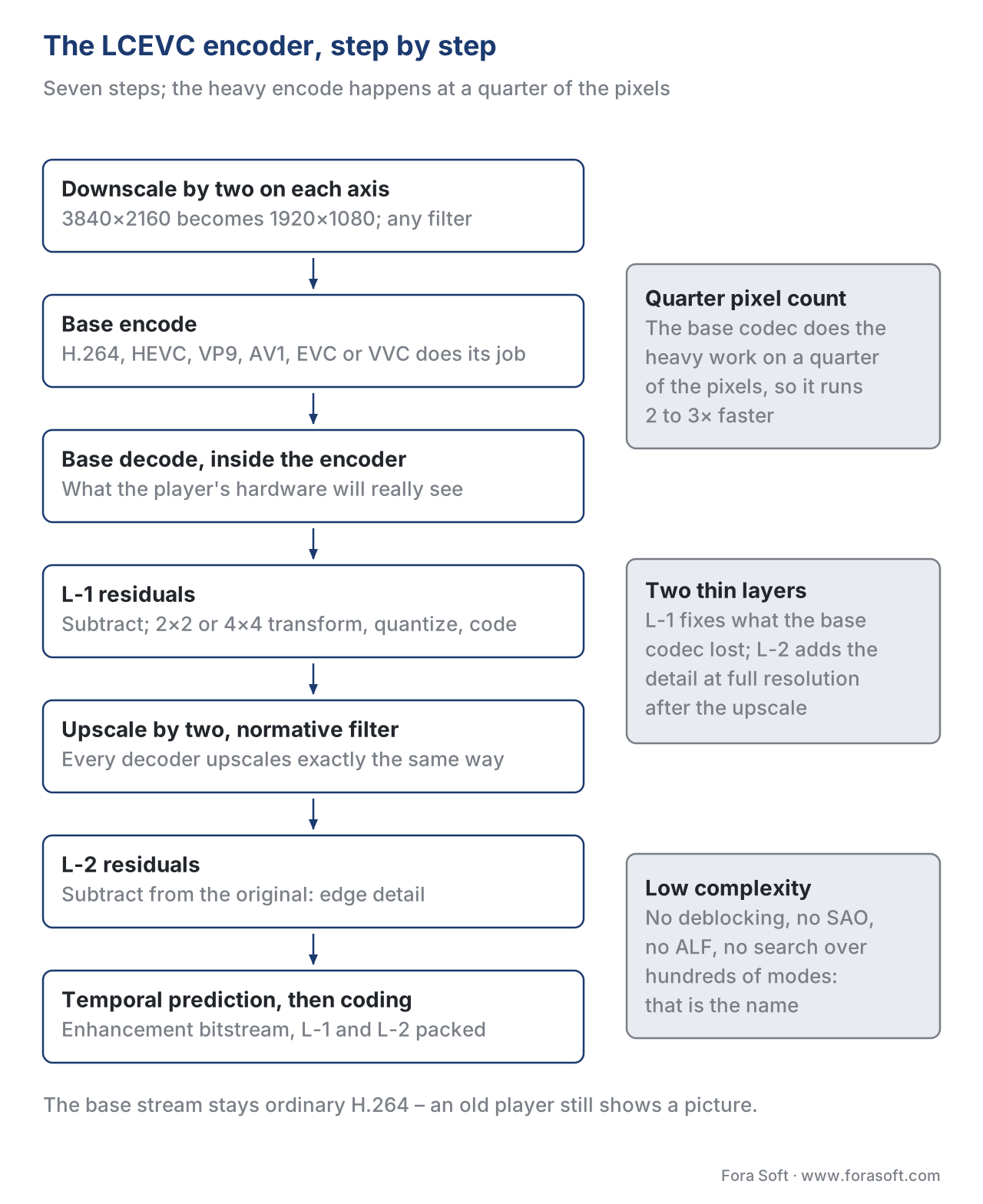 Figure 2. LCEVC encoder pipeline. Quarter-resolution base encode does the heavy lifting; two small residual streams correct artefacts and add detail.
Decoding
The decoder runs the same pipeline in reverse. The base decoder — almost always a hardware H.264, HEVC or VVC decoder already on the device — decodes the low-resolution stream. The LCEVC decoder, in software, decodes the L-1 residuals and adds them to the base reconstruction; upscales; decodes the L-2 residuals; adds temporal prediction if enabled; produces a full-resolution frame for the display.
Crucially, the base decode runs in hardware and consumes the bulk of the cycles. The LCEVC software layer adds only 10 to 20 percent overhead on top of that. On a mid-range Android phone or a 5-year-old smart TV, that is well within budget — the device was already capable of decoding the higher-resolution stream natively. With LCEVC the picture comes out the same, the bitrate is lower, and the energy use is often lower too because the base decode runs at a quarter of the pixel count.
The numbers — performance in 2026
LCEVC's performance is the single most-quoted statistic about it and also the most misquoted. The honest summary is: it depends on the base codec, the content and the bitrate range. The cleanest published numbers come from the MPEG verification tests in 2021 and from peer-reviewed evaluations since.
BD-rate savings (lower bitrate at matched quality)
Bjontegaard Delta rate (BD-rate) is the standard way to compare codecs at matched quality. A BD-rate of −30 percent means "this codec uses 30 percent less bitrate than the reference to achieve the same quality across a sweep of operating points". A negative number is a saving.
| Base codec | Resolution | Content | BD-rate vs base (lower = better) | Source |
|---|---|---|---|---|
| x264 | 1080p60 | Live gaming | −42.1% (VMAF) | V-Nova / SPIE 2022 |
| x265 | 1080p60 | Live gaming | −38.9% (VMAF) | V-Nova / SPIE 2022 |
| H.264 AVC | 1080p / 2160p | MPEG verification set | −22% to −34% | MPEG-5 Part 2 verification test 2021 |
| HEVC | 2160p | MPEG verification set | −10% to −25% | MPEG-5 Part 2 verification test 2021 |
| VVC | 2160p | MPEG verification set | −8% to −20% | MPEG-5 Part 2 verification test 2021 |
| SVT-AV1 | 2160p | SDR + HDR | −12% to −22% | MHV 2024 SPIE proceedings |
| VVC (TV 3.0 stress test) | 2160p UHD | Live sport, worst case | −54% (vs VVC alone) | V-Nova / Brazil TV 3.0 whitepaper |
The pattern is consistent: LCEVC's gain over the base codec is largest when the base codec is the oldest (H.264) and smallest when the base codec is the newest (VVC). Intuition: a low-resolution H.264 stream leaves a lot of detail on the floor; LCEVC has plenty to recover. A low-resolution VVC stream is already very good; less to recover.
Encoding speed
A 2022 SPIE paper benchmarked LCEVC-x264 versus native x264 on an Intel Xeon E3-1505M with 32 GB RAM at 1080p60. LCEVC-x264 ran in 42 percent of the time native x264 took at full resolution. That is a 2.4× speed-up, because the heavy x264 work happens at a quarter of the pixel count.
For a streaming service that transcodes thousands of hours of video per day, a 2× to 3× speed-up converts directly into cloud-encode cost. NETINT's 2024 economics paper estimates 50 to 70 percent CPU/energy reduction on encoding workloads when LCEVC replaces native encoding at the same quality.
Decoding overhead
Decoding overhead is the question that decides whether LCEVC is shippable. On every reference platform V-Nova has measured — Android, iOS, Apple TV, web, Linux — the LCEVC software layer adds 10 to 20 percent CPU on top of the existing hardware base decode. That is the budget a low-end Android phone has to spare. On a desktop browser or smart TV the budget is much larger.
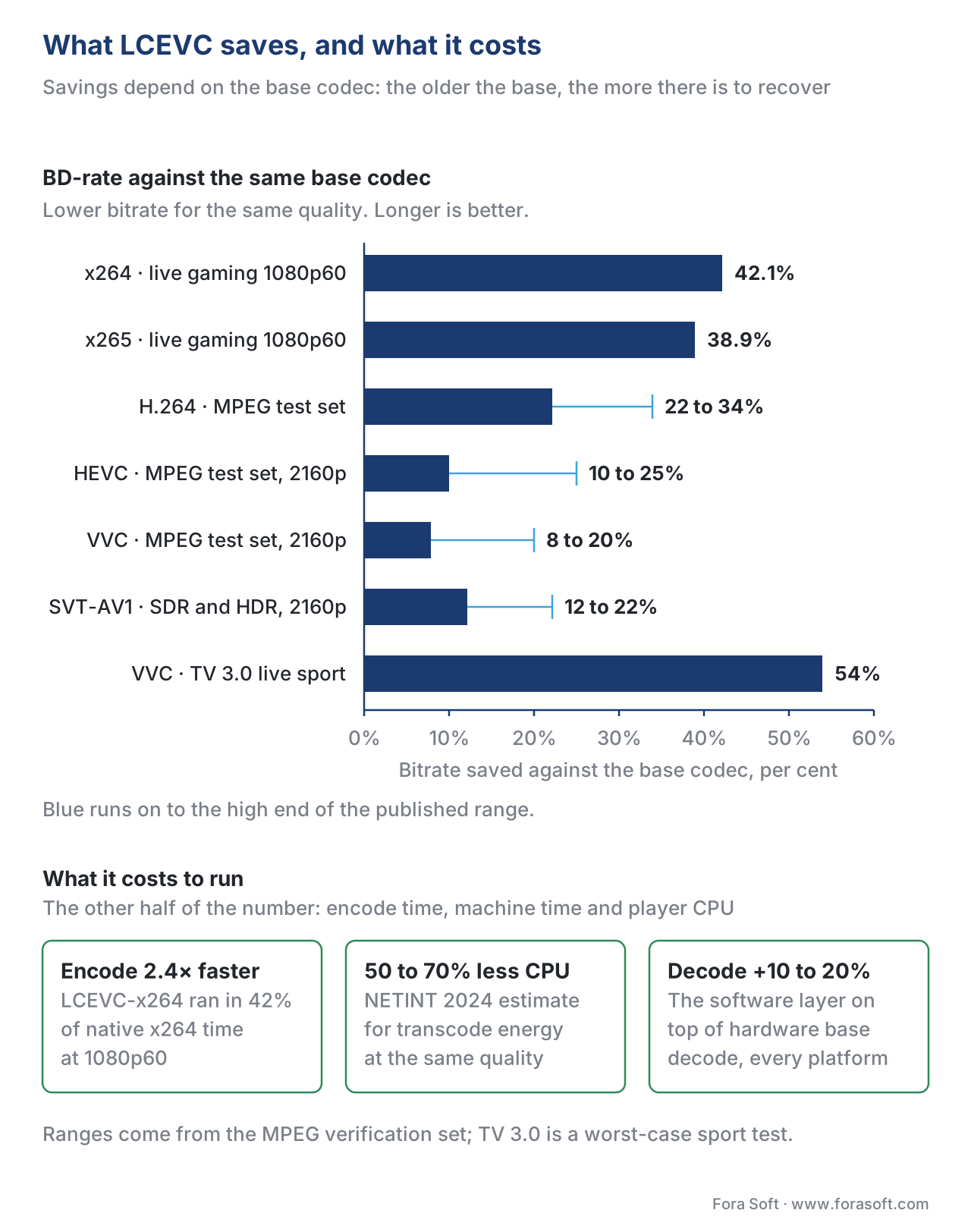 Figure 3. LCEVC BD-rate savings over each base codec, normalised against the base running at full resolution. Savings shrink as the base codec gets stronger.
Where LCEVC fits — five plausible deployment shapes
LCEVC is most useful in scenarios where the base codec install base is locked in and the operator cannot wait for a hardware refresh.
Shape 1 — extend the life of H.264 hardware
You operate an OTT service whose audience is 80 percent on legacy smart TVs and STBs that ship H.264 hardware decode and no AV1. You cannot ship AV1 to that audience for years. You can ship LCEVC-on-H.264 today: it is purely a stream-format change at the CDN and a software player update. Every viewer with a player that knows LCEVC pays 30 to 40 percent less for the same picture; every other viewer still gets H.264 at low resolution and a watchable picture.
Shape 2 — push UHD onto bandwidth that cannot fit it
This is the Brazil TV 3.0 / DTV+ shape. The Brazilian government adopted ATSC 3.0 transport plus VVC as the base codec plus LCEVC as the enhancement layer plus MPEG-H Audio in August 2025. The TV 3.0 broadcast tests during the Paris 2024 Olympics delivered UHD at 10 Mbps over the air — less than the 14 Mbps that the existing HD service uses. The combined VVC + LCEVC chain saves up to 54 percent against VVC alone on demanding sports content. The first DTV+ STBs and TVs from Hisense ship in late 2026; commercial service is targeted for the FIFA World Cup window. This is the first national broadcast standard that requires LCEVC by law.
Shape 3 — cut encoding cost on a per-title pipeline
You run a content library — a media archive, a corporate video platform, a Russian video-conferencing recording service, a telemedicine archive. You re-encode thousands of hours a day. A 2× to 3× encode speed-up on the same hardware is a real budget number. NETINT and V-Nova both publish case figures of 50 to 70 percent compute reduction.
Shape 4 — improve AV1 reach on devices that have AV1 but at slow rates
A handful of Android phones and TVs ship AV1 hardware decode but only at lower profile levels. LCEVC + AV1 lets you give those devices a full UHD picture from a base AV1 stream at, say, 1080p, and a software LCEVC layer. The mobile chip handles the AV1 it can; the LCEVC layer brings it up to 4K.
Shape 5 — surveillance and conferencing at the edge
A surveillance NVR or a WebRTC SFU often re-encodes hundreds of streams in parallel. The CPU budget is tight, the codec is usually H.264 or H.265, and the picture needs to be useful for AI inference. The Edge AI and Vision Alliance has been publishing case studies through 2026 of LCEVC pipelines feeding both human viewers and downstream object detectors at lower bitrate and lower compute. The same principle works in WebRTC, where the base codec is H.264 or VP8 and the LCEVC layer is added per stream.
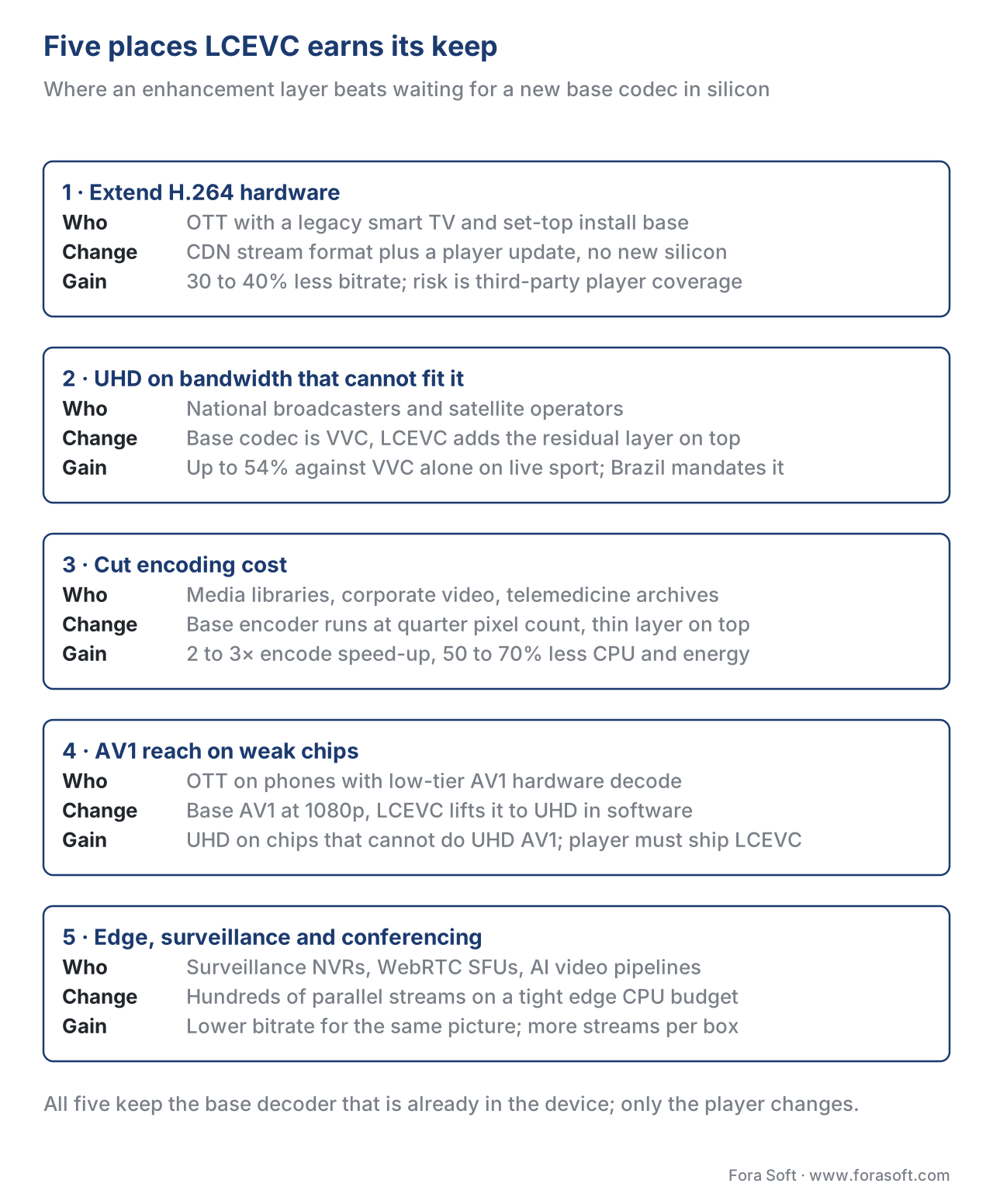 Figure 4. Five deployment shapes. Every one of them keeps the base decoder that is already in the device and changes only the stream format and the player — which is why the gain arrives in weeks rather than after a silicon refresh cycle.
Licensing — the part everyone gets wrong
LCEVC is a patented technology with a single primary patent holder, V-Nova. There is no multi-pool fragmentation comparable to HEVC. V-Nova has published a written licence framework, which makes LCEVC the simplest licence story of any modern codec.
The headline numbers, published 7 August 2025:
- Free integration. Implementing LCEVC into a product is free. Encoders, decoders, players, transcoders — no per-implementation fee.
- Free for free-to-air broadcasters. No royalty on terrestrial, satellite or cable services that the viewer does not pay for. This is the clause that unblocks Brazil's DTV+.
- Consumer device royalty. Pay-TV STBs, smart TVs, smartphones, tablets — $0.20 per device, with an "open-access discount" already baked in for devices that expose LCEVC to all base codecs.
- Video Distribution royalty. Streaming services pay a per-subscriber fee with a discount cap of $8M per service per year for early signers (before 31 December 2026).
For comparison: HEVC's pool licensing through MPEG-LA, Velos Media, and Access Advance plus 17+ unpooled holders made HEVC's effective consumer-device royalty closer to $0.40 to $1.20 on TVs and STBs by 2025 (Access Advance Lite + MPEG-LA combined), and the streaming-service royalty was where the deadlock was. LCEVC's single-pool simplicity is one of the reasons Brazilian regulators chose it.
Common mistake. Engineers ask "is LCEVC free like AV1?" It is not. AV1 is royalty-free from a publicly-defended pool (AOMedia). LCEVC is royalty-bearing but from a single, written, predictable schedule. Free integration plus a small per-device fee plus a usage-based service fee is what you sign up for. In practice the cost is well below HEVC's and the friction is far below HEVC's.
How to evaluate LCEVC for your service — a checklist
This is the practical version of the question "should we add LCEVC to our pipeline?" Use it in a 30-minute meeting with the streaming, product and finance leads. The downloadable PDF below is the printable one-page version.
- What is your dominant base codec? H.264 → strong fit. HEVC → useful fit. AV1 → smaller fit but interesting on UHD. VVC → small absolute saving but matters when bandwidth is the binding constraint.
- Where are your viewers? Mobile-heavy, legacy-STB-heavy, browser-heavy → LCEVC integrations exist (Shaka Player 4.3+, GStreamer 1.26, ExoPlayer, VLCKit, dash.js). Apple TV native is integrated through V-Nova SDK; iOS apps use the LCEVC SDK directly.
- What is your encode budget? Cloud transcode hours scale linearly with money. A 2× speed-up at matched quality is a budget halving.
- What is your CDN bill sensitivity? A 30 percent bitrate drop at matched quality drops your CDN bill by roughly 30 percent on egress. Plug your own numbers in.
- Do you have player control? LCEVC requires a player that knows about it. If you ship your own player, you control this; if you depend on third-party set-top firmware, check vendor roadmaps.
- What is your licensing tolerance? Are you willing to pay $0.20 per device and a per-subscriber service fee in exchange for the bitrate / encode gains? For most services the math works.
- What is your testing budget? Plan a 4-week pilot with a 5 percent traffic slice on a known A/B segment. Measure VMAF on a fixed encoder ladder, CDN bytes, viewer QoE (rebuffer, startup) and CPU on the player side.
Download the LCEVC Deployment Readiness Checklist (PDF)
Common pitfalls
Pitfall — comparing LCEVC + H.264 against AV1 at the same bitrate but on different hardware. AV1 hardware decode is in maybe 30 percent of the addressable device base in 2026 (Edge AI and Vision Alliance, January 2026 survey). LCEVC + H.264 is decoded on essentially 100 percent of devices in software. The fair comparison is "what does this picture look like on my user's device today", not "what does the codec spec say in isolation".
Pitfall — assuming the standardised downscaler is fixed. It is not. The encoder picks the downscaler; the upscaler is standardised. A good Lanczos downscale on the encode side is part of the perceived-quality story and it is the encoder operator's choice.
Pitfall — treating LCEVC as a competitor to AV1 or VVC. It is not a competitor. It is a layer. LCEVC sits on top of whichever base codec you have and improves it. The product question is "AV1 or VVC, with or without LCEVC?", not "LCEVC or AV1?"
Pitfall — forgetting the player. A non-LCEVC player playing an LCEVC stream sees a low-resolution base stream and renders it. The picture works but is not at the target resolution. Either ship a player that knows LCEVC to everyone, or run a parallel ladder for legacy players.
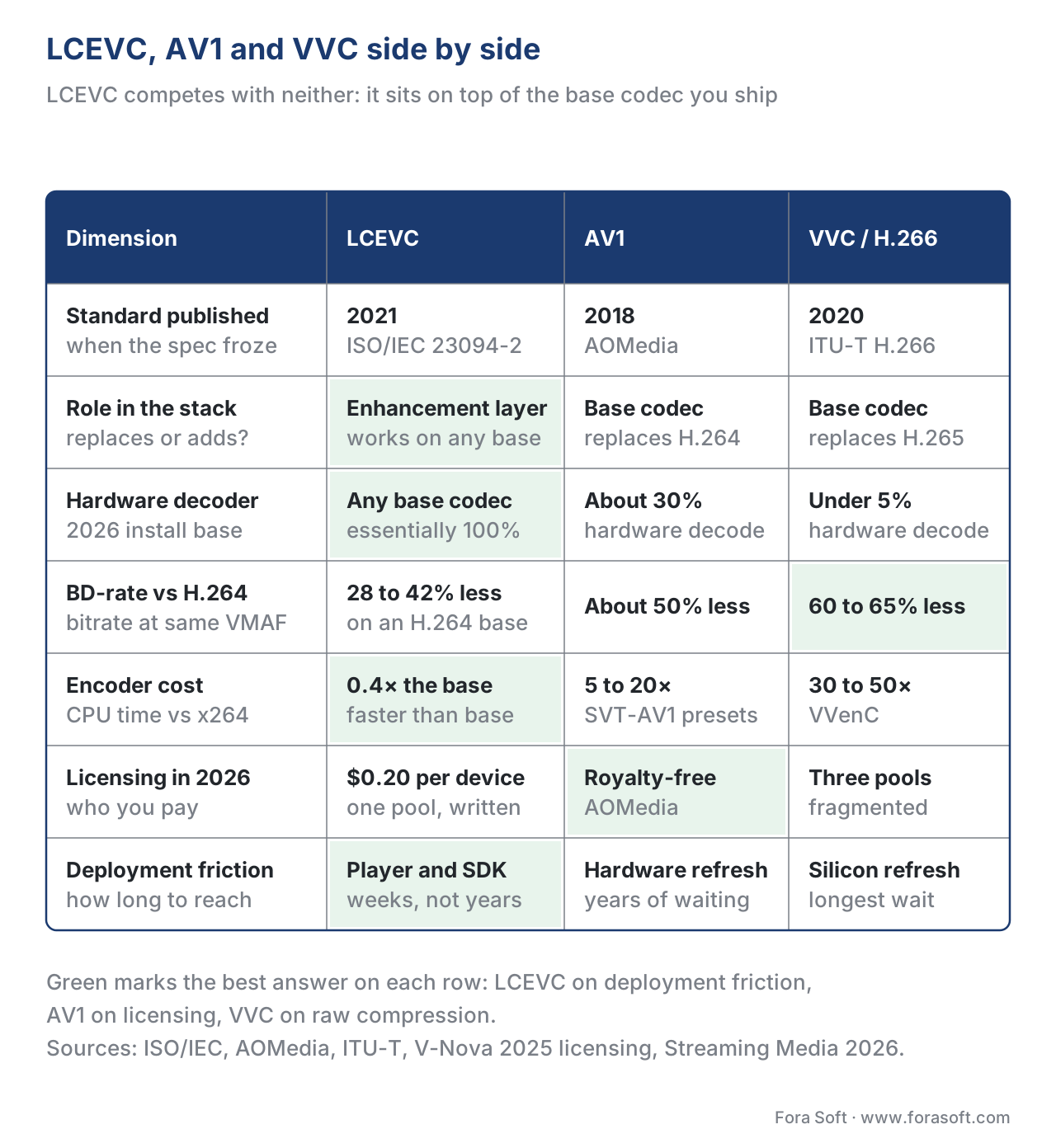 Figure 5. The three technologies on the dimensions a product team actually weighs. VVC compresses best, AV1 is free to license, and LCEVC is the only one of the three that reaches the devices you have already shipped.
Where Fora Soft fits in
In video conferencing and surveillance projects we have shipped, the binding constraint is almost never the latest codec — it is the install base of decoder hardware in the field. LCEVC matches that constraint. We have prototyped LCEVC-on-H.264 inside WebRTC SFU pipelines and on telemedicine archive servers; in both cases the engineering integration is bounded — one SDK, one stream-format change, one player update. For e-learning and OTT customers we evaluate LCEVC against an AV1 software-decode fallback path on a per-territory basis. The right answer is rarely the same on every device; it is rarely the same in every market.
The book
Video Encoding: A Complete Guide to Video Compression
LCEVC only makes sense once you know what the base codec throws away, and that is what this volume is about: residuals, transforms, quantization and entropy coding get a chapter each, and the rate-control chapters explain why a quarter-pixel-count base plus two thin residual layers can beat a full-resolution encode at the same VMAF. The BD-rate chapters cover how the numbers in the chart above are measured and what a verification test set is. It is volume 1 of the seven-volume Fora Soft Video Engineering Handbook — the series walks the whole video stack from the pixel to production, and volume 3 carries the CDN, player and DRM chapters an LCEVC rollout touches next. 1,522 pages, written by Nikolay Sapunov, CEO at Fora Soft.
Would LCEVC cut your bill, or only your encode time?
Send us your player mix, your device analytics and your current ladder, and we will come back with three numbers on your own traffic: the share of your viewers whose players could carry an LCEVC layer today, what a 30 per cent bitrate cut is worth against your actual CDN egress, and what the SDK integration costs in engineering weeks on the platforms you ship. If encode cost is the binding constraint rather than delivery, we run the same arithmetic on your transcode farm instead. 250+ video products shipped since 2005.
See our case studies
Case study
Worldcast Live
Concert streaming at 1.5 Gb/s with 0.4–0.5 s latency to 10,000 simultaneous viewers. This is shape 2 from the figure above: egress is the bill, the audience cannot wait for new silicon, and a layer that takes 30 per cent off the stream pays for itself on one event.
Case study
Speed.Space
Live 1080p at 8 Mb/s for production clients including Netflix, EA and HBO. The ladder question here is the one the comparison table ends on: which rungs stay H.264 for reach, which move to HEVC or AV1, and where an enhancement layer is cheaper than a new base codec.
Case study
Mindbox
RTSP cameras through FFmpeg to HLS, 50+ deployments. Shape 5 in practice: the codec is H.264 because the cameras say so, the CPU budget is whatever the box has left, and the picture still has to be good enough for an object detector downstream.
What to read next
Codecs
AV1: The New Internet Standard And Where It Stands In 2026
The codec LCEVC is most often compared against: how far hardware decode has actually spread, and what the software encode still costs.
Codecs
Comparison Table: MPEG-2, H.264, H.265, VP9, AV1, VVC
The table above with every production base codec in it, on the dimensions a product team weighs before it picks a ladder.
Quality
Objective Quality Metrics: PSNR, SSIM, MS-SSIM, VMAF
What a BD-rate number is measured against, and how to run the pilot in step 7 of the checklist so the result means something.
Tooling
Per-Title And Per-Scene Encoding: Smart Bitrate Ladders
The other way to take 20 to 30 per cent off a ladder without changing the codec — and it stacks with an enhancement layer.
References
- ISO/IEC. "ISO/IEC 23094-2:2021 — General video coding — Part 2: Low complexity enhancement video coding." Published November 2021. https://www.iso.org/standard/79143.html
- Battista, S. et al. "MPEG-5 part 2: Low Complexity Enhancement Video Coding (LCEVC): Overview and performance evaluation." MMTAP 2020. https://www.researchgate.net/publication/343805282
- Battista, S., Meardi, G., Ferrara, S., et al. "Overview of the Low Complexity Enhancement Video Coding (LCEVC) Standard." IEEE Trans. CSVT, vol. 32, no. 11, Nov. 2022. https://ieeexplore.ieee.org/document/9795094
- MPEG. "MPEG-5: Low Complexity Enhancement Video Coding — Part 2." mpeg.org. https://www.mpeg.org/standards/MPEG-5/2/
- V-Nova. "MPEG-5 LCEVC Documentation — Overview." docs.v-nova.com. Accessed 2026-05-16. https://docs.v-nova.com/technologies/mpeg-5.lcevc
- V-Nova. "LCEVCdec — open-source decoder, BSD-3 licence." github.com/v-novaltd/LCEVCdec. Accessed 2026-05-16.
- V-Nova. "MPEG-5 LCEVC Consumer Device Licensing Program." 2025. https://v-nova.com/licensing-lcevc-dlp/
- V-Nova. "MPEG-5 LCEVC Video Distribution Licensing Program." 2025. https://v-nova.com/licensing-lcevc-vdlp/
- V-Nova. "TV 3.0, the First National Standard Built on MPEG-5 LCEVC." 2025. https://v-nova.com/blog/tv-3-0-lcevc-national-broadcast-standard/
- V-Nova. "Powering Brazil's next-generation UHD with TV 3.0." Whitepaper, 2025. https://v-nova.com/whitepapers/powering-brazils-next-generation-uhd-with-tv-3-0/
- ATSC. "Brazil Officially Adopts ATSC 3.0 Technologies For Its Next-Generation Television System." 2025. https://www.atsc.org/news/brazil-officially-adopts-atsc-3-0-technologies-for-its-next-generation-television-system/
- Ozer, J. "I Analyzed LCEVC with V-Nova and the Results Were Impressive." Streaming Learning Center, 2024. https://streaminglearningcenter.com/codecs/i-analyzed-lcevc-with-v-nova-and-the-results-were-impressive.html
- Ozer, J. "The State of Streaming Codecs 2026." Streaming Media, 2026. https://www.streamingmedia.com/Articles/Editorial/Featured-Articles/The-State-of-Streaming-Codecs-2026-173838.aspx
- NETINT Technologies. "MPEG-5 LCEVC and Video Compression Economics." 2024. https://netint.com/mpeg-5-lcevc-compression/
- Damnjanovic, U. et al. "Enhancing SVT-AV1 with LCEVC to improve quality-cycles trade-offs." SPIE Applications of Digital Image Processing XLV, 2022. https://www.spiedigitallibrary.org/conference-proceedings-of-spie/12226/122260S/
- V-Nova / Collabora. "LCEVC GStreamer and Shaka Player Integration Guide." 2025. https://v-nova.com/blog/lcevc-gstreamer-shaka-player-open-source-integration/
- Shaka Player project. "LCEVC integration design document." 2025. https://github.com/shaka-project/shaka-player/blob/main/docs/design/current/lcevc-integration.md
- MainConcept. "LCEVC | Enhanced Video Quality and Compression Efficiency." 2025. https://www.mainconcept.com/lcevc
- OTTVerse. "Comprehensive Guide to LCEVC (MPEG-5 Part 2)." 2023, updated 2025. https://ottverse.com/lcevc-mpeg5-part2-low-complexity-enhancement-video-coding-guide/
- Edge AI and Vision Alliance. "MPEG-5 LCEVC: A practical shift for industrial AI video pipelines." April 2026. https://www.edge-ai-vision.com/2026/04/mpeg-5-lcevc-a-practical-shift-for-industrial-ai-video-pipelines/
- Streaming Media. "V-Nova LCEVC Royalty Structure Announced." August 2025. https://www.streamingmedia.com/Articles/News/Online-Video-News/V-Nova-LCEVC-Royalty-Structure-Announced-147003.aspx
- V-Nova. "Spatial Scalability with AV1: A Comparison between Scalable AV1 and MPEG-5 LCEVC." MHV 2024 SPIE proceedings. https://www.lcevc.org/wp-content/uploads/MHV24_ScalableAV1_LCEVC-1.pdf
