


Why this matters
If your team pays a content delivery network bill, content-aware encoding is the cheapest large dollar-saving you can make in your video pipeline this year. The savings are concentrated in your most-watched titles, the engineering work is incremental rather than a full re-platform, and the technology is mature enough that every major cloud encoder offers a turnkey version. Context-aware encoding is the second lever — it stops you from sending a 4K rung to a viewer who is decoding on a 720p phone screen on a 4G connection, which is the silent waste in most "we already encode in HD/SD/4K" pipelines.
This article is for product managers, founders, video operations leads, and engineering managers who need to read a vendor pitch — "AI content-aware encoding, 40% bitrate savings" — and know which lever the vendor is pulling, what is real, and what to ask next. We start from the simplest version of "encode each video to its own complexity", walk through how that idea expanded into per-scene, then into region-of-interest, then into delivery-context optimisation, and finish with a decision tree for which approach to deploy first.
Two words, two meanings — and the industry has been sloppy
The phrase "content-aware encoding" is older than "context-aware encoding" by about a year, and the industry has used both terms loosely enough that a third meaning sometimes shows up — context-aware recording, which is a different problem entirely. Before going further, lock down the definitions, because every "AI encoder" pitch you will read this year mixes them.
Content-aware encoding looks at properties of the video itself. Cartoon or sports? Talking head or aerial drone shot? Dark interior or bright exterior? Flat sky or grass texture? The encoder uses those properties to decide how many bits to spend on the whole title, on each scene, or even on each region inside each frame. The technology is also called content-adaptive encoding (CAE), per-title encoding, per-scene encoding, shot-based encoding, region-of-interest encoding, and content-aware bitrate ladder generation. Those are not synonyms — they sit at different levels of granularity — but they all share the same definition: the input is the source video, the output is a bitrate-allocation decision driven by what the encoder sees.
Context-aware encoding looks at properties of delivery — who will receive the video, on what device, over what network. A phone on 4G with a 6-inch 720p screen does not need a 4K rung; a 65-inch TV on fibre does not need a 360p rung. The technology was named by Yuriy Reznik at Brightcove in 2017, and the cleanest published definition is in his DASH-IF 2019 workshop slides: context-aware encoding "exploits diversity of properties of delivery devices… and access networks", with the objective of "generating a multiset of encoded sequences, which can be optimally used for ABR streaming to devices and access networks of each kind". 6 The input is the device-and-network mix of your audience; the output is the adaptive bitrate ladder — the set of resolution and bitrate rungs your player can switch between during playback.
The two are complementary. Content-aware encoding tells you, for this video, what the optimal rate-quality curve looks like. Context-aware encoding tells you, for this audience, which rungs along that curve you should actually ship. In production, leading streaming platforms apply both, often inside a single pipeline. The 2019 Streaming Media "Buyers' Guide" was the first piece to name this distinction in writing; six years later most marketing pages still smudge it together as "CAE", which is why product teams routinely buy one when they wanted the other. 8
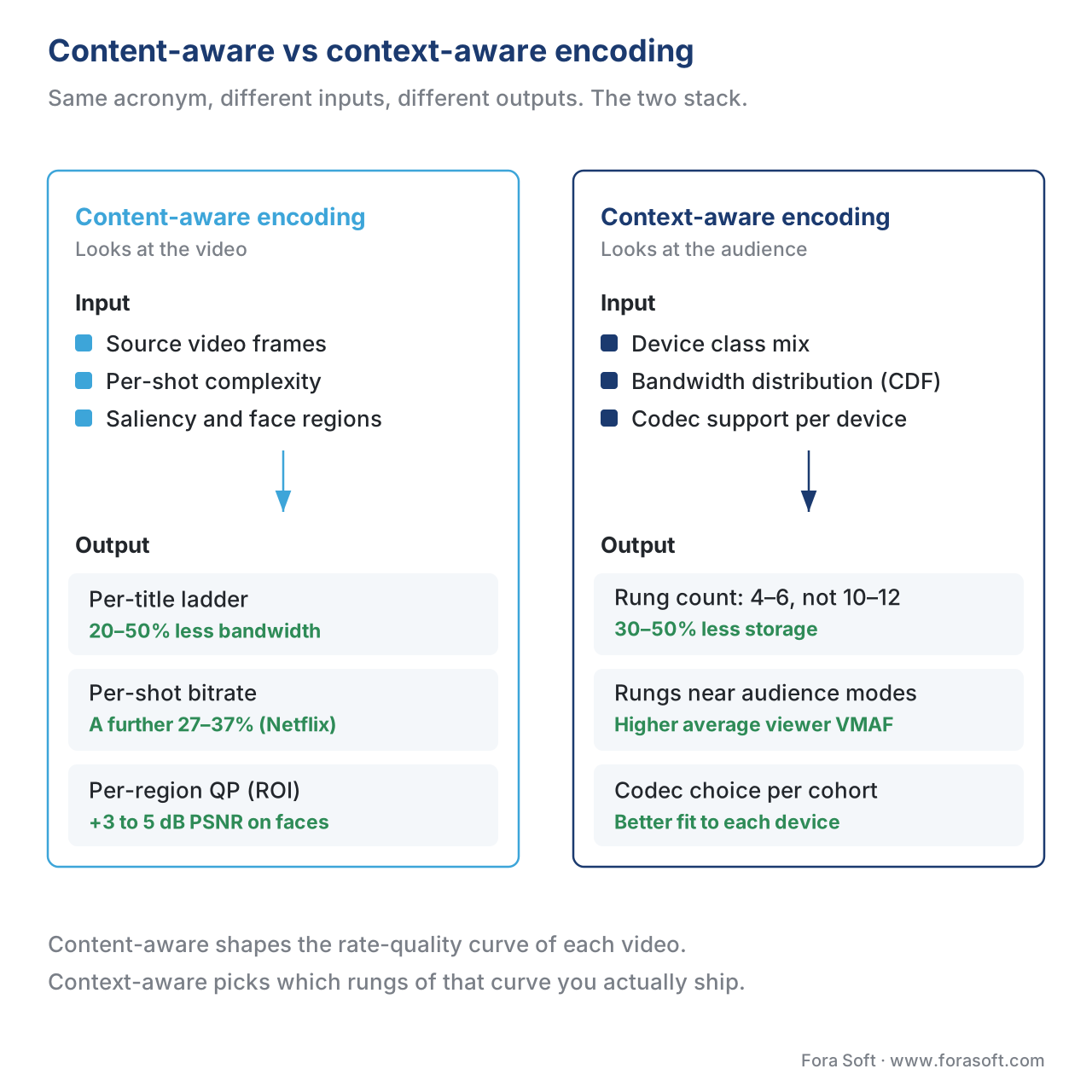 Figure 1. The two ideas share an acronym but solve different problems. Content-aware encoding decides how many bits to spend on each part of the source video. Context-aware encoding decides which rungs of the resulting bitrate ladder to actually ship to your audience, given the devices and networks they use.
Content-aware encoding — three levels of granularity
Content-aware encoding has three working depths, and you should know all three because the savings, the engineering cost, and the operational risk scale with the depth.
The shallowest is per-title encoding, where the pipeline picks a single bitrate ladder for the whole video based on its global complexity. Netflix published the first widely-cited per-title paper in December 2015 and triggered the industry-wide adoption of content-aware techniques. 1 The recipe: encode the title at several resolutions and several quality settings to produce a cloud of (resolution, bitrate, quality) points; draw the convex hull (the outer envelope of the best-of-best points) on a rate-quality plot; place ladder rungs along that envelope at the bitrates your audience actually uses. The quality score is VMAF (Video Multi-method Assessment Fusion), Netflix's open-sourced perceptual metric that scores 0–100 where 93 is broadcast-grade and 95 is near-indistinguishable from the source. 4 Per-title typically saves 20–50% bandwidth at the same VMAF.
The middle is per-scene or shot-based encoding, where the pipeline picks a fresh bitrate for every shot. A shot is one continuous camera capture, and a typical 90-minute film contains 700–1,200 shots at an average of about four seconds each. Netflix's Dynamic Optimizer, deployed in production in 2018, encodes each shot at several quality points, runs a Lagrangian optimisation across all shots in the title — picking the per-shot quality that minimises total bits for a target average VMAF — and stitches the result back together. 2 3 Netflix reported a further 27–37% bitrate reduction on top of per-title for x264, x265, and VP9, measured by VMAF. 2 Bitmovin's commercial Per-Scene Adaptation reports comparable numbers — up to 30% bandwidth savings with a typical range of 5–15% — and Mux, AWS Elemental, Brightcove, Harmonic, and Ateme all ship their own versions. 5
The deepest is region-of-interest (ROI) encoding, where the encoder varies the quantization parameter (the knob that controls how aggressively each block is compressed) inside a single frame. The classical use case is video conferencing: spend more bits on the face, fewer on the background. A face-detector — modern pipelines use a small CNN like RetinaFace or MediaPipe Face Detector running once every few frames — labels the face region, and the encoder lowers the QP inside that region and raises it outside. Published academic ROI implementations report 3–5 dB PSNR improvement and 15–20% SSIM improvement in the face region at the same total bitrate. 10 11 ROI encoding ships today in Hikvision and Axis surveillance cameras, in Zoom and Teams conferencing pipelines, and as an optional pass in AWS Elemental's MediaConvert. It is the deepest, most expensive form of content-aware encoding because the encoder must run the detector and feed its output into the rate-distortion loop, but for verticals where the viewer's eye is reliably on one region — faces in a call, license plates in surveillance, the puck in hockey — the perceptual gain is large.
These three depths nest. Per-scene encoding builds on top of per-title (you still need a sensible per-title ladder to know what bitrates to target); ROI encoding builds on top of per-scene (you apply ROI passes inside the per-shot encodes). A mature 2026 pipeline runs all three: it picks a per-title ladder, splits the title into shots, runs a Lagrangian optimisation over the shots, and then applies ROI inside each shot for verticals where the face/object-of-interest gain pays for the detector compute.
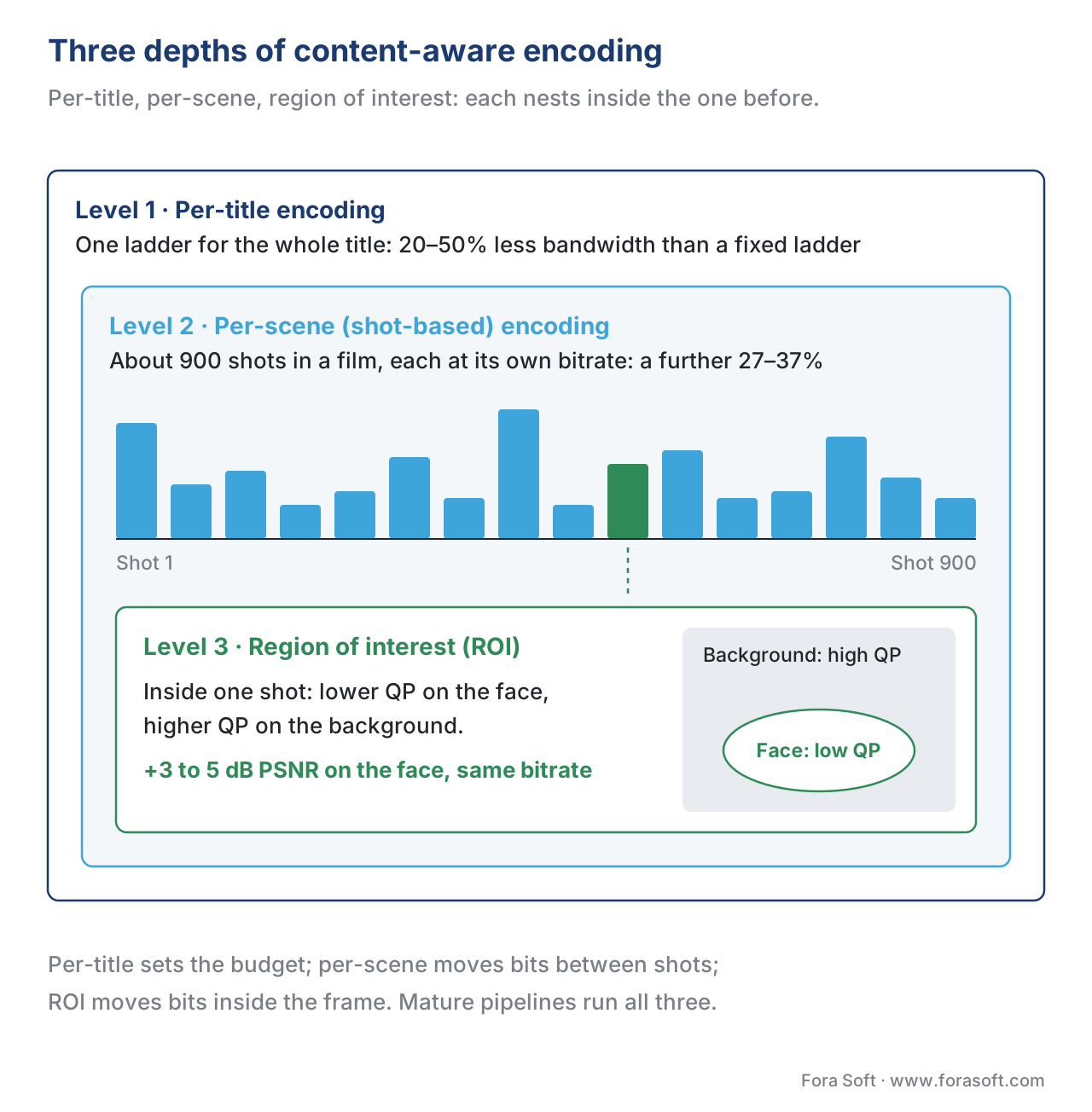 Figure 2. The three depths of content-aware encoding nest inside each other. Per-title sets the overall budget. Per-scene redistributes the budget across shots. ROI redistributes bits inside each frame toward the regions the viewer looks at.
Show me the math — per-scene savings in one paragraph
Take a 90-minute drama with a per-title 1080p bitrate of 4 Mbps. The total payload for one viewer is:
size = bitrate × time
     = 4 Mbps × 5,400 seconds
     = 21,600 megabits
     = 2,700 megabytes
     ≈ 2.70 GB
Now split the title into 900 shots and assume the per-scene optimiser saves 17% on average — the figure Netflix reported on top of per-title with its Dynamic Optimizer. 2 The new payload is:
size_new = 4 Mbps × (1 − 0.17) × 5,400 s
         = 3.32 Mbps × 5,400 s
         = 17,928 Mb
         = 2,241 MB
         ≈ 2.24 GB
That is a 459 MB per-view saving. At one million views per year and a CDN price of one cent per gigabyte, the saved bandwidth is worth:
savings = 0.459 GB × 1,000,000 × $0.01
        = $4,590 per year per title
The arithmetic — per-view delta × view count × unit cost — is the entire business case in one line. The percentage gain looks small on a single title; the dollar value scales with viewership and concentrates in the catalogue's most-watched titles. For a streaming service with 1,000 active titles and a long-tail viewership distribution, the savings stack to mid-six-figures annually for an engineering investment that is mostly one quarter of pipeline work.
Context-aware encoding — encoding for the audience you actually have
Context-aware encoding starts from a question that fixed bitrate ladders never ask: who is going to watch this rung, and on what? A 4K rung is wasted on a viewer whose phone has a 720p screen and a 4G connection. A 360p rung is wasted on a viewer with a 65-inch TV and gigabit fibre. The Apple HLS Authoring Specification's default ladder ships rungs from 145 kbps at 416×234 up to 7.8 Mbps at 1920×1080, and most pipelines copy them verbatim regardless of who their audience is. 9 Context-aware encoding throws out the fixed list and computes a ladder tailored to your viewers' actual devices and networks.
Reznik's 2017 Brightcove formulation, which is still the cleanest in the literature, models the audience as a joint distribution over device class (mobile, tablet, PC, connected TV), screen resolution, and access-network bandwidth (the empirical CDF of bandwidth across your viewers). The ladder is then designed as an optimisation problem: minimise the expected distortion over that distribution, subject to a constraint on the number of rungs and the maximum bitrate. The solution typically has 4–7 rungs (not the 9–12 of the Apple default), with rung spacing that hugs the modes of the viewer-bandwidth distribution and resolutions that match the modal screen sizes. 6 7
The user-visible effect is twofold. First, for the same total storage budget, viewers see better quality on average because the rungs are placed where the audience actually sits on the bandwidth distribution. Second, for the same average quality, total storage drops because redundant rungs are removed — a typical context-aware pipeline ships 4–6 rungs instead of 10–12, cutting storage by 30–50% before any per-title savings are applied. The two saves compose: if per-title saves 30% per rung and context-aware halves the number of rungs, total storage falls by 60–70% versus a fixed-ladder baseline. 7
The pitfall here is the easiest to hit. Context-aware encoding is sensitive to the audience distribution you measure, and the distribution drifts. If you build a ladder against a 2022 audience that was 60% mobile, then your audience shifts to 40% mobile and 30% TV by 2026, your ladder is now wrong for the people you actually have. The fix is operational: re-measure the device-and-network mix at least quarterly, re-run the optimisation, and stage the new ladder behind a feature flag so you can roll back if the player picks up the wrong rung for a measurable cohort. 7
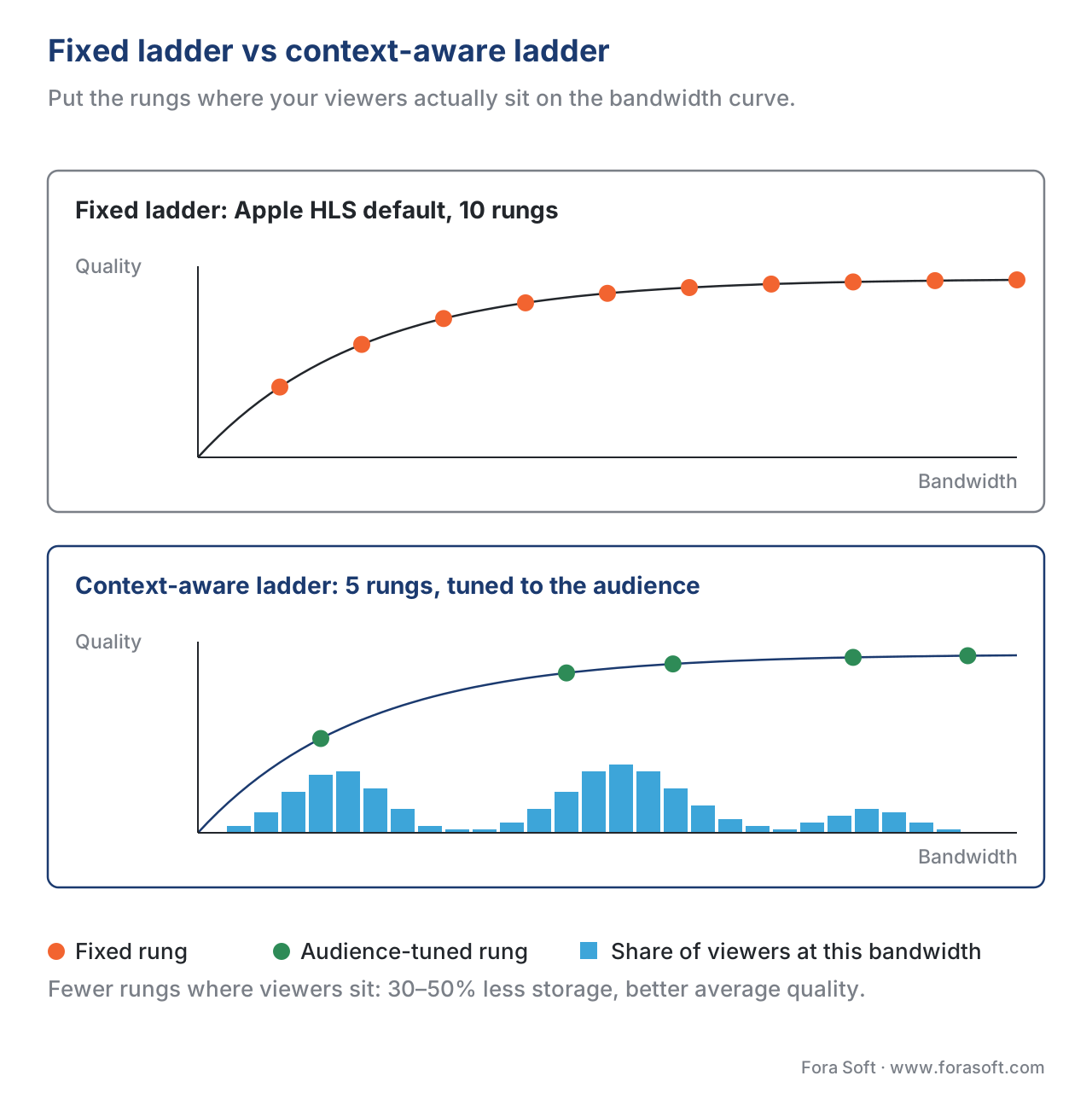 Figure 3. A fixed ladder spaces rungs evenly along the rate-quality curve. A context-aware ladder packs rungs near the modes of the audience-bandwidth distribution and skips bitrates that no viewer can actually consume. The total storage drops; the average viewer's perceived quality rises.
Common mistake: confusing content-aware with context-aware in a vendor pitch
A specific pitfall every product team hits when buying or building an encoding pipeline: a vendor pitch says "CAE — 40% bandwidth savings" and the team does not ask which CAE. Content-aware and context-aware solve different problems and stack on top of each other; if you buy one thinking it is the other, you do not get the savings you signed up for.
The simple test, drawn from the Reznik framework: ask the vendor what their tool's input is and what its output is. A content-aware tool takes the source video and outputs an encoding plan (bitrate per scene, QP per region). A context-aware tool takes audience statistics and outputs a ladder design (rung resolutions and bitrates). If the vendor cannot answer that question directly — or if the answer is "we use AI" — assume the product is one of the two and ask which.
A second tell: published numbers. Content-aware encoders publish results in BD-rate or VMAF-at-bitrate terms ("17% bitrate reduction at the same VMAF"). Context-aware encoders publish results in rungs-removed and expected-distortion-over-audience terms ("ladder cut from 11 rungs to 5, average viewer VMAF up 1.8 points"). A vendor that publishes neither is a vendor whose technology is not yet measured against its own claim.
Where the AI fits — and where it does not
Both content-aware and context-aware encoding existed before the modern deep-learning wave. Netflix's 2015 per-title was a brute-force search over resolution and bitrate; Reznik's context-aware was a mathematical optimisation over a measured audience distribution. Neither required a neural network. In 2026 the picture is more nuanced, and the marketing has run ahead of the engineering.
The places AI genuinely earns its keep in content-aware encoding are three. First, content-complexity prediction — instead of brute-forcing every resolution and bitrate combination, a small CNN predicts the convex hull from a single fast analysis pass, cutting the encode time of per-title from "encode the whole catalogue ten times" to "encode the whole catalogue once plus a few seconds of analysis per title". 12 Second, saliency-driven ROI — a saliency CNN trained on eye-tracking data predicts which regions of a frame viewers will look at, and the encoder bumps bit allocation there. KTH's 2023 study on visual-attention-guided x265 reported 3–8% VMAF improvement at the same bitrate. Third, shot-boundary detection — a small classifier outperforms the classical frame-difference heuristic on fades, dissolves, and high-motion shots, which is where per-scene optimisation gains the most. We covered the first and third of these in detail in AI Inside the Encoder.
The place AI is mostly marketing, today, is "AI-driven context-aware encoding". The audience distribution is well-modelled by classical statistics; the ladder optimisation is a convex problem that any solver handles in milliseconds. A vendor pitching a neural network to do this is solving a problem that does not need a neural network. The honest version of "AI context-aware" is "we use ML to measure the audience distribution more accurately" — clustering viewer cohorts, predicting tomorrow's mix from today's logs — and the gains from that are real but small. If a vendor claims a 40% ladder-storage win from AI alone, the headline is almost certainly content-aware, not context-aware, hiding inside a context-aware label.
How to decide which to add first
The decision tree, drawn from how mature streaming platforms actually deploy these technologies:
If your pipeline still ships a copy of the Apple HLS default ladder and you have not measured content complexity, start with per-title. The engineering cost is one to two engineer-quarters; the dollar savings concentrate in your top 10% of titles by viewership; the technology is offered as a turnkey feature by every major cloud encoder (AWS Elemental's Automated ABR, Bitmovin's per-title, Mux's automatic ladder). 13 Skip to per-scene only after per-title is in production and stable, because per-scene needs reliable shot detection, an optimisation framework, and a quality model — and most of the catalogue gain is already captured by per-title.
If you have per-title in production, add per-scene next if your catalogue contains content with large within-title complexity swings (sports, action, anything with cuts between calm and busy scenes). For talking-head content, the gain is small enough that the engineering cost is not worth it.
If your service is conferencing, surveillance, or any vertical where the eye reliably lands on a known region, add ROI before or instead of per-scene. The face-detection or object-detection model is the long pole, but most pipelines already have one for other reasons (mute-when-not-looking, background blur, motion alerts).
Layer context-aware on top once your audience is large enough that the device-network distribution is statistically meaningful — practically, once you have more than around 100,000 monthly viewers. Below that, the variance in your audience-mix measurement is larger than the gain from rung-tailoring. Above that, a 4–6-rung context-aware ladder versus a 10–12-rung fixed default is a 30–50% storage saving for one engineer-quarter of work.
Finally, measure with the right metric. Content-aware and ROI both deliberately shift bits away from regions the eye does not notice — they will raise PSNR-measured distortion on purpose. Benchmark with VMAF or SSIMULACRA2, not PSNR. See Objective Quality Metrics for why these metrics exist and when to use which.
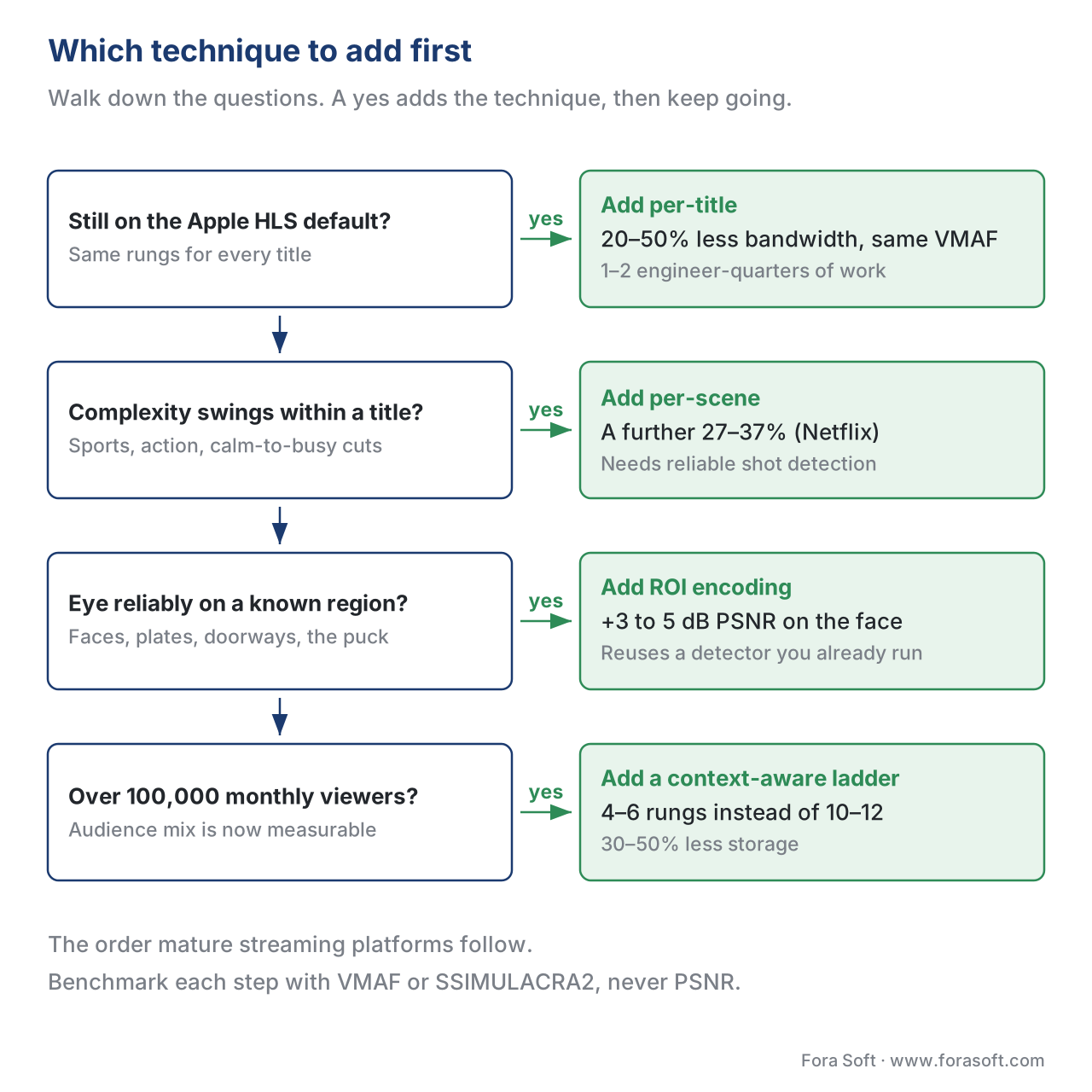 Figure 4. The decision tree mature streaming platforms follow when adding content-aware and context-aware techniques to their pipeline. Per-title first; per-scene if complexity swings inside a title are large; ROI for face- or object-centric verticals; context-aware once audience size makes the distribution measurable.
Where Fora Soft fits in
Content-aware and context-aware encoding cut directly across the verticals Fora Soft builds in. Video conferencing and telemedicine are the natural homes of ROI encoding — the face is reliably the region of interest, and the bit-allocation gain matters most at the low end of the bitrate range where consumer connections live. Video streaming and OTT are where per-title and per-scene pay back fastest, because catalogue size makes the percent gains compound into real CDN savings. Video surveillance uses ROI for motion-tracked regions and object-of-interest detection (license plates, doorways, perimeters). AR/VR and e-learning sit between conferencing and streaming, with mixed live and on-demand needs that combine per-scene encoding with audience-aware ladder design. We have shipped pipelines that combine all of these on top of FFmpeg, GStreamer, x265, SVT-AV1, and the major cloud encoders.
The book
Video Encoding: A Complete Guide to Video Compression — From Pixels and Color to H.264, HEVC, AV1, Quality Metrics, and AI
Volume 1 takes the rate-quality curve apart: how rate control and QP turn a bitrate budget into pictures, why a convex hull of encodes beats any fixed ladder, and how VMAF and BD-rate let you check a “40% savings” claim instead of taking it on trust. It is the ground floor under per-title, per-scene and ROI encoding, so you can size each lever for your own catalogue before you commit a quarter of engineering to it. Written by Nikolay Sapunov, CEO at Fora Soft.
Which lever would cut your CDN bill first: per-title, per-scene, ROI or a new ladder?
Send us your current ladder, a rough view count per title and your device mix — we will tell you which technique pays back first, what it should save in bandwidth and storage, and what to ask a vendor who promises 40%. 250+ video products shipped since 2005.
See our case studies
Case study
Worldcast Live
Concert streaming at 1.5 Gb/s with 0.4–0.5 s latency and 10,000 simultaneous viewers — the audience size at which a ladder tuned to real devices and networks starts paying for itself.
Case study
Perspire.tv
Live fitness classes plus an on-demand workout library watched on phones, tablets and desktops — the mix of calm and fast-moving content where per-title and per-scene encoding earn their keep.
Case study
Mindbox
An RTSP to FFmpeg to HLS pipeline across 50+ deployments with face recognition in the loop — the face detector you already run is exactly what region-of-interest encoding needs.
What to read next
Tooling
Per-Title and Per-Scene Encoding: Smart Bitrate Ladders
How the convex hull and shot-based encodes are built in practice.
Quality and AI
AI Inside the Encoder: Mode Decision, Partitioning, Scene-Cut
Where machine learning genuinely speeds up content-aware pipelines.
Quality
Objective Quality Metrics: PSNR, SSIM, MS-SSIM, VMAF
Why every step here is benchmarked on VMAF, not PSNR.
Codec internals
Rate Control: CBR, VBR, CRF, ABR, Capped CRF
The encoder knob that turns a per-shot bitrate decision into bits.
-
Netflix Technology Blog, "Per-Title Encode Optimization", 2015. https://netflixtechblog.com/per-title-encode-optimization-7e99442b62a2 ↩
-
Netflix Technology Blog, "Dynamic Optimizer — a perceptual video encoding optimization framework", 2018. https://netflixtechblog.com/dynamic-optimizer-a-perceptual-video-encoding-optimization-framework-e19f1e3a277f ↩↩↩
-
Netflix Technology Blog, "Optimized shot-based encodes: Now Streaming!", 2018. https://medium.com/netflix-techblog/optimized-shot-based-encodes-now-streaming-4b9464204830 ↩
-
Netflix, "VMAF: Perceptual video quality assessment based on multi-method fusion." https://github.com/Netflix/vmaf ↩
-
Bitmovin, "Per-Scene Adaptation: Going Beyond Bitrate". https://bitmovin.com/per-scene-adaptation-going-beyond-bitrate/ ↩
-
Y. Reznik, "Context-Aware Encoding and 5G", DASH-IF Workshop, 2019. https://dashif.org/docs/workshop-2019/03-Reznik-DASH-IF-workshop-2019-CAE.pdf ↩↩
-
Y. Reznik et al., "Improving Context-Aware Encoding by Adaptation to True Bandwidth Distribution", SMPTE Media Technology Summit, 2023. https://www.reznik.org/papers/SMPTE_MTS2023_Improving_Context_Aware_Encoding.pdf ↩↩↩
-
J. Ozer, "Buyers' Guide to Content- and Context-Aware Encoding 2018", Streaming Media Global. https://www.streamingmediaglobal.com/Articles/Editorial/Featured-Articles/Buyers-Guide-to-Content--and-Context-Aware-Encoding-2018-123407.aspx ↩
-
Apple Inc., "HLS Authoring Specification for Apple Devices". https://developer.apple.com/documentation/http-live-streaming/hls-authoring-specification-for-apple-devices ↩
-
MDPI Applied Sciences, "Region-of-Interest Based Coding Scheme for Live Videos", 2024. https://www.mdpi.com/2076-3417/14/9/3823 ↩
-
Hikvision, "ROI (Region of Interest) Encoding Technology V0.5 White Paper". https://www.hikvision.com/content/dam/hikvision/usa/white-papers/hikvision_roi_encoding_technology_v0.5.pdf ↩
-
H. Amirpour et al., "Towards Sustainable Video Streaming: Evaluation of AI Approaches for Content-Aware Encoding", IEEE 2024. https://ieeexplore.ieee.org/document/10389538/ ↩
-
AWS Elemental, "Automated ABR Configuration in AWS Elemental MediaConvert". https://aws.amazon.com/blogs/media/introducing-automated-abr-adaptive-bit-rate-configuration-a-better-way-to-encode-vod-content-using-aws-elemental-mediaconvert/ ↩
-
NETINT, "2026 State of Video Encoding". https://netint.com/2026-state-of-video-encoding/ ↩
