

Key takeaways
• An AI fire detection camera sees the fire, it doesn’t wait to smell it. Software runs a computer-vision model on a normal camera feed and flags the visual signature of smoke or flame at the source, instead of waiting for particles to drift up to a ceiling sensor. In an open or high-ceilinged space that can mean an alarm seconds after ignition rather than minutes.
• It complements code detection, it doesn’t replace it. NFPA 72 recognizes video image detection, but only as a performance-based design with UL-268-listed components. The winning pattern is code-required detectors for compliance plus cameras for early visual warning where spot detectors are weak.
• The hard engineering is false alarms, not detection. Steam, dust, welding arcs, and headlights all look a little like fire to a naive model. Independent datasets show raw per-frame false-alarm rates near 19% falling to about 9% once you add temporal validation, and a human still confirms before anyone dispatches.
• Pricing is opaque, and that’s the whole build-vs-buy story. Wildfire networks like Pano AI run about $50,000 per station per year; enterprise analytics from Bosch, Hikvision, IntelliSee, and Visionify are quote-only. When every option is a custom quote, pricing a build alongside them costs you almost nothing.
• Buy when a product fits your site; build when detection is your product or your constraints are unusual. A single warehouse buys an appliance. A company selling fire detection, or one with cameras a vendor can’t support, edge-hardware limits, or data-residency rules, builds.
A fire is smallest, coolest, and easiest to stop in its first minute. That is also the minute a ceiling-mounted smoke detector is most likely to miss it — because in a warehouse with a 40-foot roof or an open yard, smoke needs time to travel to the sensor, and sometimes it never gets there at all. An AI fire detection camera attacks that gap from the other side. It watches the scene and reacts to the first wisp of smoke or flicker of flame it can see, wherever in the frame it appears.
We’ve built real-time video and computer-vision systems since 2005, including large-scale video surveillance platforms and live incident-detection pipelines. So this is an engineer’s guide, not a brochure: what an AI fire detection camera actually is, how the computer vision works, how it compares to a smoke detector, what the accuracy numbers really say, where the codes and standards draw the line, what it costs, how the vendors stack up, and when a company is better off building its own instead of buying one.
Scoping AI fire or smoke detection?
Tell us the site — a warehouse, a construction yard, a data center, or a wildfire perimeter — and we’ll give you a straight read on whether to buy an appliance or build custom, with the detection, false-alarm, and integration tradeoffs behind the call.
Why Fora Soft wrote this guide
We’re a video and AI software company: 250+ projects since 2005 and a team of 50+ in-house specialists. A large share of that work is the exact plumbing an AI fire detection system needs — pulling many live camera streams at once, running computer-vision models on them in real time at the edge, and routing an event to the right person or system fast enough to matter. When a client asks us to watch a scene and act on what appears in it within seconds, we’ve usually built the underlying pieces already.
Our home turf is real-time video and video surveillance, including anomaly detection in video and edge AI surveillance architecture. Fire and smoke detection is one vertical of that broader problem: a specific thing to look for, with unusually high stakes and an unusually strict regulatory frame around it.
We don’t sell a boxed fire-detection product, and we’re not a listed fire-alarm manufacturer — so there’s nothing to push here. For many sites, buying a certified appliance is the right answer, and we’ll say so plainly. What we build is the custom version, which means we’ve earned the right to be honest about when you don’t need one.
What an AI fire detection camera is (and what it isn’t)
An AI fire detection camera is software running a computer-vision model on live video that recognizes the visual signature of smoke or flame and raises an alert, rather than waiting for combustion products to reach a fixed sensor. It comes in two shapes: a self-contained camera with the model onboard (Bosch’s AVIOTEC is the best-known example), or an analytics layer that runs on the feeds from cameras you already own. Either way the job is the same — turn pixels into an early, trustworthy warning.
The term covers two related detections that behave differently. Video image smoke detection (VISD) looks for the drifting, shape-shifting plume of smoke; video image flame detection (VIFD) looks for the color, flicker, and motion of visible fire. Smoke is usually the earlier signal and the harder computer-vision problem, because smoke has no fixed shape, an unremarkable color, and a texture that a naive model confuses with steam or dust.
It helps to be precise about what this is not. It is not a heat or smoke detector with a camera bolted on — the sensing is the vision model, not a physical particle sample. It is not a thermal camera; most AI fire cameras analyze ordinary optical video, though thermal is a complementary sensor. And on its own it is not a code-compliant fire alarm system: in almost every jurisdiction it supplements certified detection under a performance-based design rather than replacing it. Everything practical about deploying one flows from that last distinction.
The short answer: buy a camera, buy analytics, or build
Buy a certified camera or appliance (Bosch AVIOTEC, Hikvision A.I. Tech, and peers) when you protect one site with a standard layout and want detection that already carries the UL and FM listings your fire marshal will ask about. You get hardware and a trained model deployed in weeks, at a per-camera quote — and for most single buildings this is the right call.
Buy an analytics layer (IntelliSee, Visionify, and similar) when you already run a fleet of cameras and want fire and smoke detection added on top of the feeds you have, alongside other analytics. It reuses your camera investment and centralizes alerts, at a per-camera or per-site subscription you’ll have to request.
Build a custom system when detection is strategic rather than a purchase — when fire detection is part of a product you sell, when your cameras or edge hardware aren’t what a vendor supports, when data-residency or air-gap rules keep video off a vendor cloud, or when subscription fees across a large fleet have outgrown a one-time build. The rest of this guide is the evidence behind those three paragraphs.
How AI fire and smoke detection actually works
The loop is short: a camera streams frames, a detection model scores each frame for smoke and flame, a temporal filter checks that the signal persists and grows the way real fire does, and only then does an alert fire — usually for a human to confirm before anything automatic happens. Everything else is detail in service of making that loop fast and hard to fool.
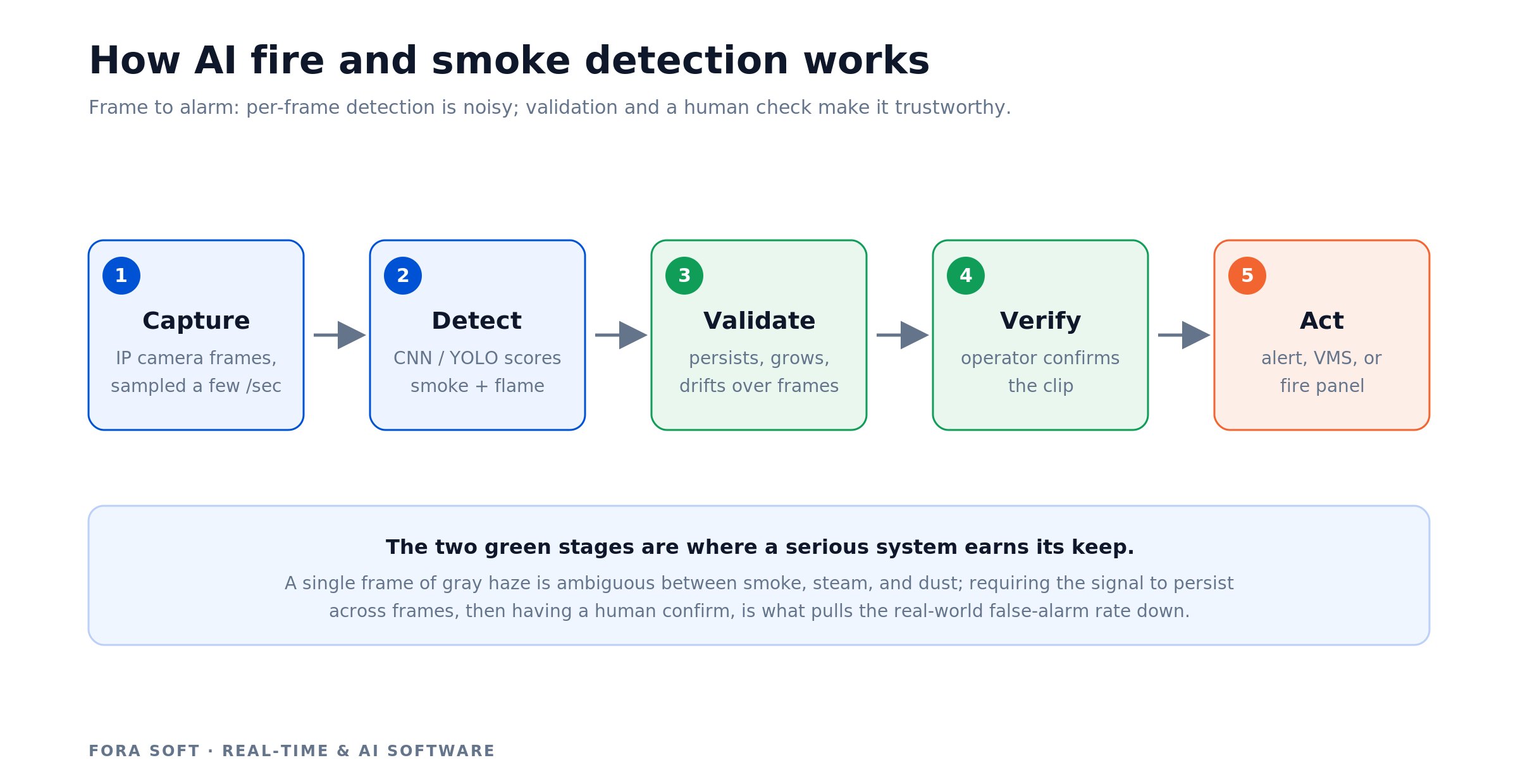
Figure 1. The detection pipeline. The model finds candidate smoke and flame per frame; temporal validation and a human check are what turn a noisy guess into a trustworthy alarm.
Capture and pre-process. The system ingests frames from an IP camera, normalizes exposure and resolution, and often samples a few frames per second rather than every frame — fire develops over seconds, so you trade frame rate for the compute headroom to watch more cameras.
Detect. A convolutional model — commonly a YOLO-family object detector — scores each frame for smoke and flame and draws boxes around candidates. This is the part vendors show in demos, and on its own it is the least reliable part: a single frame of gray haze is genuinely ambiguous between smoke, steam, and dust.
Validate over time. This is where a serious system earns its keep. Real smoke persists, spreads, and drifts with a characteristic motion; a forklift crossing the frame or a shaft of sunlight does not. Temporal validation — requiring the signal across consecutive frames, checking growth and motion — is what pulls the false-alarm rate down, and it’s the same discipline behind general video anomaly detection.
Verify and act. A validated detection raises an alert to a monitoring operator, a video management system, or a building’s fire panel. In wildfire and facility deployments a human confirms the clip before dispatch or suppression, which is why practical false-alarm rates end up far below the raw model’s. A person is the last, cheapest filter.
AI cameras vs traditional smoke detectors
The honest comparison is not “camera beats detector.” It’s that they fail in opposite places, so the right answer is usually both. A spot smoke detector is cheap, certified, and unbeatable in a small enclosed room. A camera wins exactly where that detector struggles: big open volumes, tall ceilings, and outdoor areas where there is no ceiling to mount a sensor on.
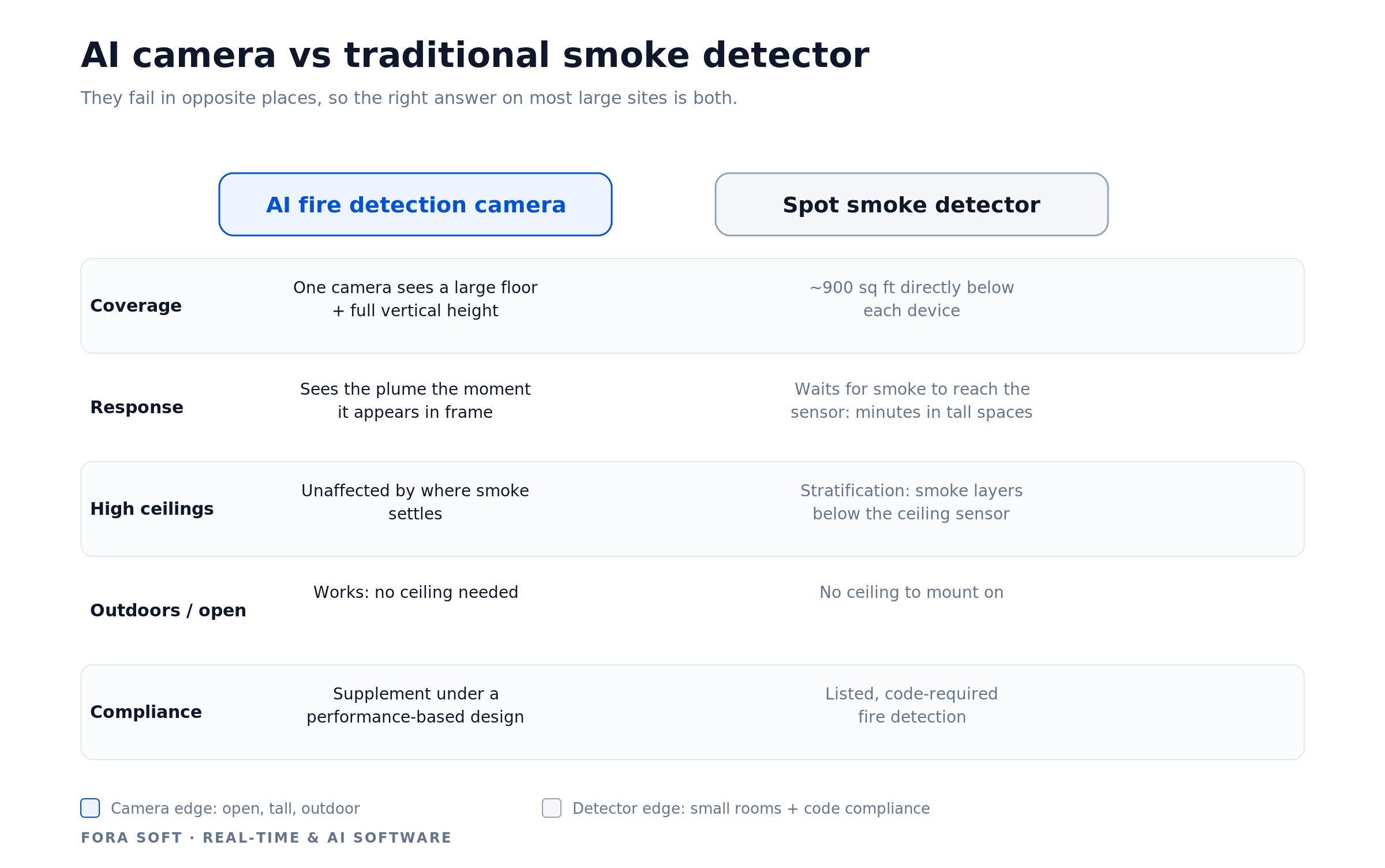
Figure 2. Where each approach is strong. The camera’s edge is open, tall, and outdoor spaces; the spot detector’s edge is small enclosed rooms and code compliance.
Coverage. A spot smoke detector protects the area directly beneath it, roughly 900 square feet per fire-engineering practice, with heat detectors covering 400 to 2,500 square feet (Jensen Hughes, 2022). One camera can watch a large floor and its full vertical height in a single field of view. That is why video image detection is recommended mainly for large-volume spaces, typically above a 15-foot ceiling.
Response time and the stratification trap. A point detector reacts only when enough smoke physically reaches it. In tall spaces that can take minutes — and worse, smoke rising through cooler air can reach thermal equilibrium partway up and spread sideways in a stable layer below the ceiling, so a roof-mounted sensor sits above the smoke sampling clean air while the fire grows underneath. NFPA 72’s own guidance tells designers to plan for this stratification with detectors at intermediate heights (IntelliSee, 2026). A camera doesn’t care where the smoke settles; it sees the plume the moment it appears in frame.
Read vendor timing claims carefully: you’ll see “detects within 2 to 4 seconds” and “up to 5 minutes before a traditional alarm.” Those are best-case numbers with a clear line of sight to the fire and no obstruction — the camera has to be able to see the smoke or flame. Behind a rack, around a corner, or through heavy dust, a spot detector can still win. Treat the seconds-vs-minutes gap as real but conditional, not a guarantee.
Does it actually work? Accuracy, datasets, and false alarms
Yes, with a caveat that is the whole engineering story: detecting fire is comparatively easy, and not raising an alarm at every plume of steam is hard. Published models detect fire and smoke well on curated data, but the number that decides whether a deployment survives contact with a real building is the false-alarm rate — and that only comes down with temporal validation and a human in the loop.
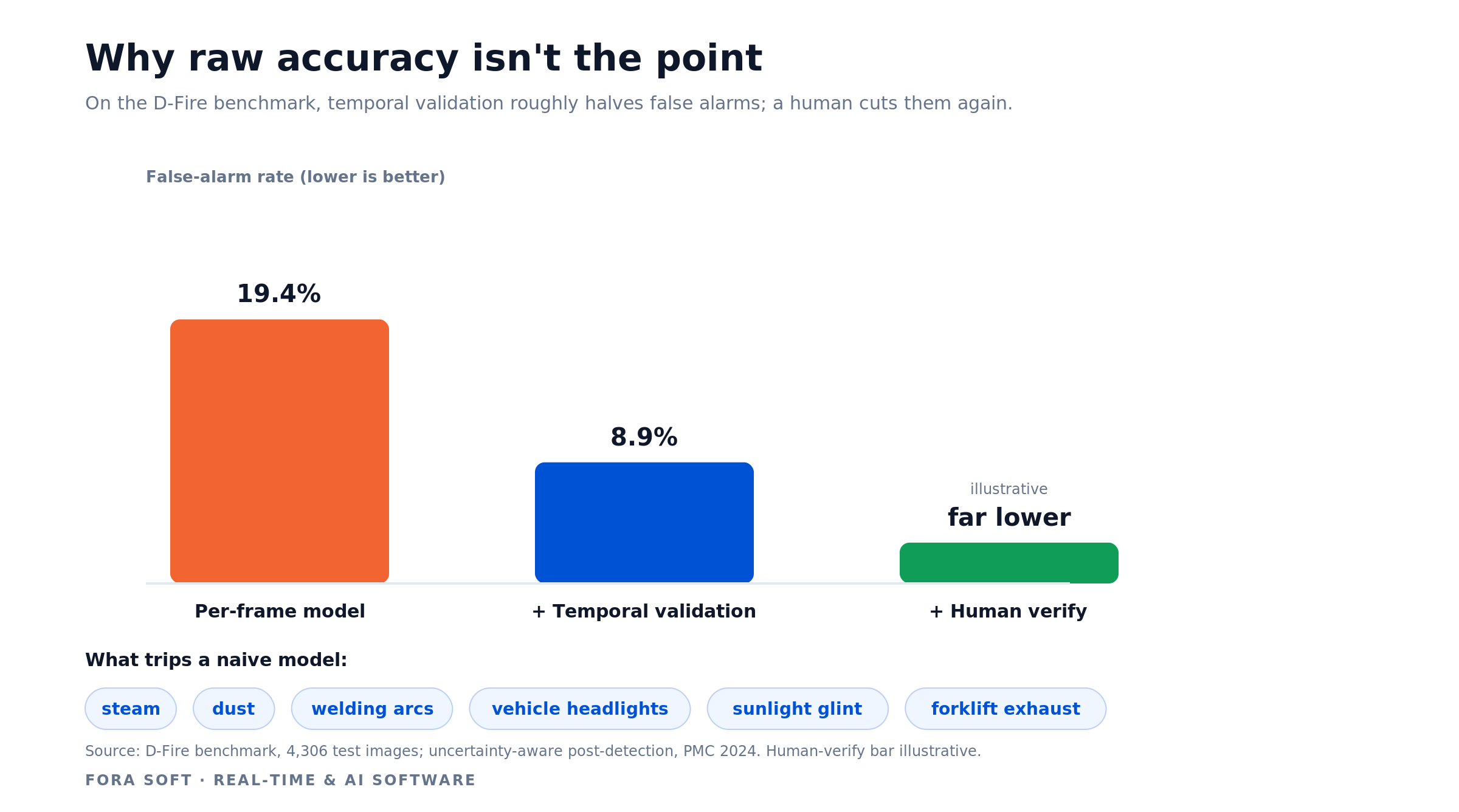
Figure 3. Why raw model accuracy isn’t the point. Per-frame detection is noisy; temporal filtering roughly halves false alarms on the D-Fire benchmark, and human verification cuts them again.
What the benchmarks say. On the open D-Fire benchmark (4,306 test images, about 2,005 with no fire), an uncertainty-aware post-detection stage lifted a YOLOv8n model’s mAP@50 from 0.625 to 0.651 and precision from 0.712 to 0.845, and per-frame temporal filters cut the false-alarm rate from 19.4% to 8.9% (PMC, 2024). On the 100,000-image FASDD dataset, a YOLOv5x detector reached about 80% mAP@0.5 across heterogeneous images (ESSD, 2023). Top curated results reach the high-80s to low-90s in mAP, but those are clean-data ceilings, not field guarantees.
What trips a naive model. Welding arcs, steam from a washdown, forklift and vehicle exhaust, sunlight glinting off metal, airborne dust, and headlights all resemble fire or smoke in a single frame. A model trained without enough of these negatives cries wolf; a site that gets too many false alarms turns the sensitivity down, and now it misses the early fire it was bought to catch. That trade is the central design tension.
The honest framing: a “99% accurate” headline usually means per-frame classification accuracy on a balanced test set. It says nothing about how many times a day the system will page a security guard for a puff of steam across a 200-camera site. Ask any vendor for false alarms per camera per day in a scene like yours — and if they can’t answer, that’s your answer.
Anatomy of an edge fire-detection deployment
A production fire-detection system is four layers: the cameras in the field, an inference tier that runs the model (usually at the edge), an alerting and integration layer that reaches operators and fire systems, and a management layer for tuning, audit, and health monitoring. The physical setting — a warehouse, a construction site, a wildfire ridge — changes the hardware, but the layers stay the same.
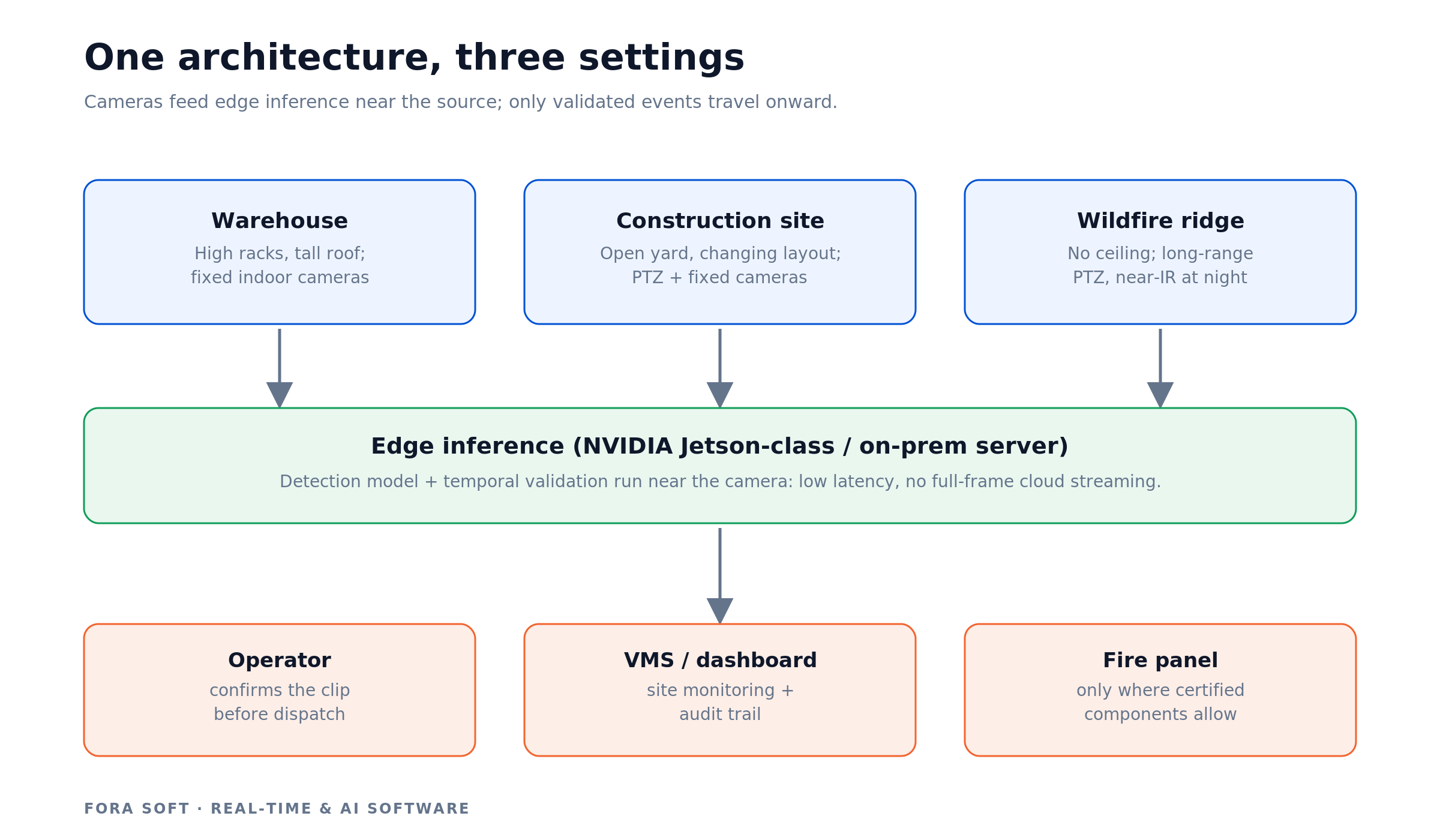
Figure 4. One architecture, three settings. Cameras feed edge inference near the source; only validated events travel onward to operators, a VMS, or a fire panel.
Cameras. Optical IP cameras with good low-light or infrared performance for night coverage; pan-tilt-zoom units for wide outdoor perimeters like wildfire watch towers, fixed cameras for indoor bays. Thermal cameras are an optional second sensor where smoke may be invisible — smoldering behind material, or at night in an unlit yard.
Edge inference. Running the model near the camera — on an NVIDIA Jetson-class device or an on-prem server — keeps latency low and avoids streaming every frame to the cloud, which matters when bandwidth is thin at a remote site and when you don’t want to depend on a network link during an emergency. This edge-first pattern is the same one behind edge AI surveillance architecture generally.
Alerting and management. Validated events flow to a monitoring station, a site video-monitoring dashboard, mobile push, or — where certified — a fire alarm panel. The management layer handles model tuning per scene, health checks so a blinded or offline camera is noticed, and an audit trail of every alert and who acted on it. That last piece is what separates a demo from a system you can defend after an incident.
Need detection to run at the edge, on your cameras?
We’ve built real-time computer vision on live video and edge hardware. If you’re scoping a fire-detection build, we’ll walk you through camera choice, edge inference, and the false-alarm design before a line of code is written.
The alert path: from pixel to a verified alarm
Because a false alarm is expensive — an evacuation, a fire-department roll, a suppression discharge — the path from a model’s guess to a real-world action is the safety-critical core of the system. It runs through a sequence of filters, and each one exists to remove a class of mistake before it reaches anyone.
Detection to validation. A per-frame hit is only a candidate. The system requires the signal to persist across frames and behave like fire, growing and drifting and radiating, before it becomes an alert. Tune this too tight and you miss the early cue that buys response time; too loose and you drown operators in noise until they stop trusting it.
Human verification. In most facility and wildfire deployments a person looks at the clip before anything irreversible happens. This is why real-world false-dispatch rates are far below the raw model’s false-positive rate: a validated alert is a request for a human decision, not an automatic command. ALERTCalifornia’s statewide network works this way — AI surfaces the candidate, an operator confirms.
Action and escalation. A confirmed event routes to the right response: an operator dispatches, a fire panel annunciates, mobile alerts reach a site manager, or an integration triggers suppression where that’s designed and certified. The design rule is the same as any alerting system — the alert must reach a named responder and confirm receipt, because an alarm no one acknowledged is a silent hole in the safety model.
Design rule: decide early what the system is allowed to do on its own. Surfacing a clip for a human is low-risk and always defensible. Automatically discharging suppression or cutting power on an AI detection is a different risk class entirely, and in most codes it requires certified components and a performance-based design signed off by a fire engineer — not a model you trained last month.
Standards and code: NFPA 72, UL 268, FM 3260
This is the part that separates a security add-on from a fire system, and it’s where a lot of AI-camera enthusiasm meets reality. Video image detection is recognized by fire code — but as a supplement under a performance-based design, with listed components, not as a drop-in replacement for the detectors your authority having jurisdiction requires.
NFPA 72. The National Fire Alarm and Signaling Code recognizes both video image smoke detection and video image flame detection. Because the technology’s performance varies so much by scene, NFPA 72 requires a performance-based design and mandates that systems be inspected, tested, and maintained per the manufacturer’s published instructions (Jensen Hughes, 2022).
UL 268 and FM 3260. For components to count as fire detection, they generally need to be UL listed as a smoke detector — video smoke detection has been listed under UL’s category for smoke detectors for special applications, tied to UL 268. Flame and radiant-energy detectors fall under FM 3260. A camera that isn’t listed can still be a useful early-warning tool, but it counts as security analytics, not certified fire detection — a distinction your insurer and fire marshal will make even if a vendor doesn’t.
Build implication: a custom model you train is almost never going to be a UL-268-listed fire detector, and pursuing that listing is a long, expensive certification project. Most custom builds are honest about being early-warning and situational-awareness systems that sit alongside a certified fire alarm — not a replacement for it. Decide which one you’re building on day one, because it changes the whole compliance and liability picture.
Where it fits: warehouses, wildfire, data centers, tunnels
AI fire detection pays off wherever a fixed detector is slow, blind, or impossible — big volumes, outdoor areas, and places where a few minutes of early warning changes the outcome. The strongest cases share that shape.
Warehouses and manufacturing. High racking and tall roofs are the classic stratification trap, and a fire among stored goods grows fast. Cameras watching the aisles see smoke rise long before it reaches a roof sensor, and they add the location (which bay, which rack) that a point detector can’t. This overlaps with the broader push toward construction and site video monitoring that already runs cameras on these sites.
Wildfire and open land. There is no ceiling to mount a detector on, so vision is essentially the only early option at distance. ALERTCalifornia runs more than 1,200 pan-tilt-zoom cameras with near-infrared night vision that sweep 360 degrees roughly every two minutes and see up to 60 miles by day; in 2025 the network detected 915 fires before any public 9-1-1 call, and CAL FIRE reports that more than half the time an alert arrived before a call came in (ALERTCalifornia; BusinessWire, 2026).
Data centers, tunnels, and energy. These share high value, fast escalation, and environments where early localization matters, whether a battery-storage yard, a cable tunnel, or a turbine hall. Video image detection has been used in exactly these critical-infrastructure settings for years, often where the aesthetics or geometry of the space make conventional detection awkward (Jensen Hughes, 2022).
The economics: what fire-detection cameras cost
The blunt truth is that almost nobody publishes a price, which tells you something: pricing is bespoke, tied to camera count, scene difficulty, and integration. The two public reference points bracket the range, and everything in between is a quote.
The wildfire end. Pano AI — the top-ranked name for “AI fire detection” and a 2024 MIT Technology Review climate-tech pick — charges about $50,000 per year all-in per station, covering the dual-camera station hardware, software, maintenance, and monitoring services (MIT Technology Review, 2024). That’s a wide-area outdoor service, not a per-camera indoor product, but it sets the upper anchor.
The enterprise end. Bosch AVIOTEC, Hikvision A.I. Tech, IntelliSee, and Visionify are all quote-only as of mid-2026, priced by camera count and deployment. A camera-based approach reuses cameras you may already own, so the marginal cost is often software and integration rather than new hardware in every room. Because there’s no list price to compare, the practical move is to collect quotes — and, once you’re doing that, to price a build alongside them.
The vendors compared: Pano AI, Bosch, Hikvision, IntelliSee, Visionify
The market splits into three shapes: certified cameras with the model onboard, analytics that run on your existing cameras, and outdoor wildfire services. The single most useful thing to know before you shop is that none of them publish transparent pricing, which is exactly why the build-vs-buy question is worth taking seriously.
| Vendor | Shape | Pricing (2026-07-16) | Where it fits |
|---|---|---|---|
| Bosch AVIOTEC | Certified camera, model onboard | Quote (per camera) | Indoor industrial; detection at the source; IR for darkness |
| Hikvision A.I. Tech | Camera + analytics (AI-FIRE) | Quote | Sites standardized on Hikvision hardware |
| IntelliSee | Analytics on existing cameras | Quote (subscription) | Multi-hazard overlay on an existing camera fleet |
| Visionify | Analytics (workplace-safety suite) | Quote | EHS teams wanting fire plus other safety use-cases |
| Pano AI | Outdoor wildfire service | ~$50K/station/yr, all-in (2024) | Utilities, land managers, wildfire perimeters |
| Custom build | Your model, your cameras, your infra | One-time build + run cost | It’s your product, unusual cameras, or data residency |
Every headline accuracy or speed claim on these vendors’ pages is self-reported; use them to frame questions, not to close the decision. The practical takeaway is that comparing options requires a formal quote from each, and once you’re collecting quotes, the incremental effort to scope a build is small.
Build vs buy: when a custom system wins
For a single site that just wants earlier warning, buying is almost always right — a certified appliance is deployed in weeks and carries listings you don’t have to earn. Building makes sense when one of a few specific conditions is true, and it’s worth being strict about them, because a build you didn’t need is the most expensive way to save money.
Build when: fire or smoke detection is part of a product you sell; your cameras, edge hardware, or scenes aren’t what a vendor supports and you need control of the model; data-residency, sovereignty, or air-gap rules keep video off a vendor cloud; or you run enough cameras that per-camera subscription fees over several years clearly exceed a one-time build plus its run cost.
Buy when: you’re protecting one or a few sites, a certified appliance fits your layout, you want the UL/FM listings handled for you, and you’d rather spend on coverage than on a computer-vision team. For most single buildings this is the honest answer, and we’ll tell you so before you spend a dollar with us.
There’s a hybrid worth naming: buy certified detection where code requires it, and build the analytics, tuning, and integration layer on top — the scene-specific model, the alert routing, the audit trail. Most of a custom system’s value is in that layer and in the false-alarm engineering, not in reinventing video transport, so that’s where a build should concentrate.
What a custom fire-detection build costs
Two numbers decide a build’s payback: how much you spend to build and tune it, and how much subscription you avoid at your camera count. The figures below are illustrative, not a quote, but they show why the math tends to favor buying at small scale and building at large scale.
The build cost. A custom system’s one-time cost concentrates in four places: the detection model (data collection and labeling of your scenes, training, and the false-alarm tuning that actually earns trust), the edge inference deployment, the alerting and integration layer, and the management and audit tooling. Reusing proven real-time video infrastructure instead of building capture and streaming from scratch is the biggest lever on that number, and gathering enough negative examples (steam, dust, and headlights from your own sites) is usually the slow part.
The subscription you avoid. Vendor analytics is typically priced per camera per year. At ten cameras, a subscription is trivially cheaper than any build. At several hundred cameras across many sites over a multi-year horizon, the recurring fee starts to rival, then exceed, a one-time build plus its run cost — and that’s before counting the strategic reasons to own the model. We keep these estimates conservative on purpose.
The break-even. Because both sides are ultimately software plus some hardware, the real comparison is build cost versus years of subscription at your camera count. At a handful of cameras, buy. At a large fleet, over years, a build — or the buy-certified-plus-build-analytics hybrid — starts to pencil out, and the strategic reasons (product ownership, unusual cameras, data residency) often decide it before the raw dollars do.
Want the build-vs-buy numbers for your fleet?
Give us your camera count, site types, and integration constraints, and we’ll model a build against the vendor quotes you’re gathering — conservatively, with the assumptions on the table.
Mini-case: real-time incident detection on live video
The closest analog in our own work is real-time incident detection on live camera feeds — the same shape of problem as fire and smoke detection, minus the specific thing being detected. In our anomaly detection in video surveillance work, the hard part was never spotting the obvious event in a clean frame; it was keeping the alert stream trustworthy when a scene is full of ordinary motion that a naive model mistakes for a threat.
That experience maps directly onto fire detection. Watching many camera streams at once has to stay smooth when a whole site is live. Detection has to run near the camera to keep latency low and survive a thin or flaky network. And the difference between a demo and a system people trust is the temporal validation and human-in-the-loop review that stop a puff of steam from paging the fire department — exactly the engineering we spend most of our time on.
We’re being deliberately careful here: we haven’t shipped a UL-listed fire detector, and we won’t claim we have. What we have built is the real-time video and edge computer-vision backbone a fire-detection system runs on, plus the false-alarm discipline that decides whether it survives in the field. When a client asks whether a custom fire-detection build is realistic, that’s the honest basis for our answer.
A fire-detection decision framework in five questions
Before you talk to a vendor or a build team, five questions will tell you which path you’re actually on.
1. Does this need to be code-compliant fire detection? If it must satisfy your fire marshal and insurer, you need listed components under a performance-based design — buy certified, and treat any custom work as a supplement, not a replacement.
2. What’s the scene? Small enclosed rooms favor ordinary detectors. Open volumes, tall ceilings, and outdoor areas are where cameras earn their place — and where the stratification gap makes point detectors weak.
3. How many cameras, over how many years? A handful points to buying. Hundreds across many sites, over a multi-year horizon, is where a build or hybrid competes on cost alone.
4. Is detection your product, or your operation? If you sell fire detection, you build. If you’re protecting your own site, you almost certainly buy.
5. Where must the video and compute live? If data-residency, sovereignty, or air-gap policy forbids a vendor cloud, or your edge hardware is fixed, your options narrow fast and a custom build may be the only fit.
When NOT to build (or rely on) AI fire detection
The technology is genuinely useful, which is exactly why it’s worth being clear about its limits. Don’t build when a certified appliance already fits your site — you’d be paying to re-earn listings and validation that Bosch and its peers spent years on. Don’t treat a camera as a replacement for code-required detection; it supplements, it doesn’t substitute, and betting a building’s safety case on an unlisted model is a liability decision, not a technical one.
Be especially careful where the camera can’t see. Smoke behind racking, a smoldering fire with no visible plume, a scene choked with steam or dust, a lens fogged or blinded overnight: these are the conditions a vision model fails in, and they’re common in exactly the industrial spaces where fire risk is highest. A camera is a line-of-sight sensor, so where line of sight is unreliable, keep the physical detectors doing the work.
Finally, resist the temptation to automate irreversible actions on an AI detection. Surfacing a clip for a human to confirm is safe and defensible. Auto-discharging suppression, cutting power, or dispatching on a raw model output invites the false-alarm failure mode at its most expensive — and in most codes it isn’t permitted without certified components anyway. Keep the human in the loop until the evidence and the listings say otherwise.
FAQ
What is an AI fire detection camera?
It’s software running a computer-vision model on live video that recognizes the visual signature of smoke or flame and raises an alert, instead of waiting for smoke to reach a fixed sensor. It comes either as a camera with the model built in (like Bosch AVIOTEC) or as an analytics layer added to cameras you already run. It works best at detecting fire early in large, open, or high-ceilinged spaces where point detectors are slow.
How does AI smoke detection work?
A camera streams frames, a convolutional model (often a YOLO-family detector) scores each frame for smoke and flame, a temporal filter checks that the signal persists and behaves like real fire across several frames, and only a validated detection raises an alert — usually for a human to confirm. The temporal validation and human check are what keep steam, dust, and headlights from constantly triggering it.
Is an AI camera better than a smoke detector?
Neither is simply better — they fail in opposite places. A spot detector is cheap, certified, and excellent in a small enclosed room. A camera wins in large open volumes, tall ceilings, and outdoors, where smoke takes minutes to reach a sensor or there is no ceiling at all. The recommended approach is both: certified detectors for code compliance plus cameras for early visual warning where detectors are weak.
How accurate is AI fire detection, really?
On curated datasets, models reach roughly 80% to low-90s mAP; on the D-Fire benchmark, temporal filtering cut the false-alarm rate from 19.4% to 8.9% and lifted precision to about 0.85 (PMC, 2024). Field performance depends on the scene and on how well the model was trained against local false triggers. Judge a system by false alarms per camera per day in a scene like yours, not by a headline accuracy figure.
Does AI fire detection meet NFPA 72 and UL 268?
NFPA 72 recognizes video image smoke and flame detection, but only under a performance-based design, and components generally must be UL listed as a smoke detector (tied to UL 268), with flame detectors under FM 3260. A certified appliance can count as fire detection; an unlisted custom model counts as early-warning security analytics that supplements a certified alarm, not a replacement for it. Confirm listings with your authority having jurisdiction.
How much does an AI fire detection system cost?
Most vendors price by quote, not a public list. Enterprise camera analytics (Bosch AVIOTEC, Hikvision, IntelliSee, Visionify) is quoted per camera or per site; the outdoor wildfire service Pano AI runs about $50,000 per station per year all-in (2024 figure). Because pricing is opaque and per-camera, comparing quotes — and pricing a build alongside them at large camera counts — is worthwhile.
Can AI fire detection work for wildfire monitoring?
Yes — outdoors it’s often the only early option at distance, because there’s no ceiling for a detector. ALERTCalifornia runs 1,200+ pan-tilt-zoom cameras that see up to 60 miles by day, and in 2025 detected 915 fires before any public 9-1-1 call (ALERTCalifornia / CAL FIRE, 2026). Wildfire systems pair AI detection with human confirmation before dispatch, which is why their real-world false-dispatch rate stays low.
Should we build our own fire-detection model or buy one?
Buy a certified appliance if you protect one or a few sites and want listings handled for you — that’s most single buildings. Build when fire detection is part of a product you sell, your cameras or edge hardware aren’t what vendors support, data-residency rules keep video off a vendor cloud, or per-camera fees across a large fleet exceed a one-time build. A common middle path is to buy certified detection and build the analytics and integration layer on top.
What to read next
Computer vision
Anomaly Detection in Video Surveillance
The general problem fire detection is a vertical of — spotting the event that matters without drowning in false alarms.
Architecture
Edge AI Video Surveillance Architecture
Where the inference runs, and why edge-first is the pattern behind low-latency detection.
Site safety
Construction Site Video Monitoring
The cameras many industrial sites already run — a natural place to layer fire detection.
Computer vision
Hard Hat Detection in Video Surveillance
Another safety-vision use-case that runs on the same detection-plus-alert backbone.
The bottom line on AI fire detection
An AI fire detection camera earns its place by seeing a fire in the seconds after ignition, in exactly the open and tall spaces where a ceiling detector is slowest. But the value isn’t in the detection demo — it’s in the false-alarm engineering and the verified alert path that keep the system trustworthy across hundreds of cameras and thousands of ordinary hours. Build those well, respect the codes, and everything else is refinement.
Buy a certified appliance when a product fits your site; buy analytics when you want detection on cameras you already own; build when detection is your product or your constraints are unusual. If you’re not sure which side of that line you’re on, we’ll help you decide before you commit — you can book a 30-minute call or explore our computer vision for video surveillance work to see where we’d start.
The handbook · 7 volumes
Fora Soft Video Engineering Handbook
Whether you buy, add analytics or build, a fire-detection camera is one part of a full video system, from encoder to alert. We wrote a seven-volume handbook on that stack, covering encoding, delivery, audio and AI. Start with Volume 6 on detection, segmentation and model deployment at the edge, then Volume 1 for camera encoding and Volume 7 for real-time pipelines and compliance. Written by Nikolay Sapunov, CEO at Fora Soft.
Browse the handbook on Amazon →7 volumes · 9,000+ pages · Kindle & paperback
Let’s scope your fire-detection system
Whether you’re choosing a vendor or building detection into your own product, we’ll give you an honest read in 30 minutes — buy or build, with the detection, false-alarm, and compliance tradeoffs to back it.