Key takeaways
• Bland’s one flat rate is its whole pitch. $0.14/min on Start, $0.12 on Build ($299/mo), $0.11 on Scale ($499/mo) covers the LLM, speech-to-text, and text-to-speech in a single number, with telephony billed on the side (bland.ai/pricing, July 2026).
• Flat does not mean cheapest. On Vapi and Retell the advertised fee ($0.05 and $0.055/min) is a platform slice you stack models on top of; a tuned Retell stack lands near $0.10/min all-in. Bland trades that shopping discount for predictability and zero provider bills.
• The best Bland AI alternative depends on one question: do you want more model control (Vapi), a richer managed builder (Retell), or the per-minute fee gone entirely (custom on open-source frameworks)? None is “best” in the abstract.
• The switch math turns near 100,000–150,000 minutes a month. Below roughly 50,000/mo, a managed platform beats paying engineers. Above it, a self-hosted build erases the per-minute tax and earns back its cost inside a year.
• Cost is only half the decision. Model choice, data ownership, latency you can tune, and compliance paperwork (Bland ships SOC 2 and a BAA; Vapi charges $2,000/mo for HIPAA) decide as many switches as the invoice does.
If the move is already decided, here’s what we charge to build Vapi and Retell alternatives on your own stack. Or start from all vendor comparisons.
A team ships a phone agent on Bland in an afternoon, loves how little there is to wire, and three months later asks the question that sends everyone to Google: is there a better Bland AI alternative, and what is this actually costing us per minute? Sometimes the answer is no, stay put. Sometimes the flat rate that felt simple at 2,000 minutes is the biggest line on the bill at 200,000, or a model you can’t swap is holding back the agent. We’ve built voice agents on managed platforms and from scratch for clients in healthcare and consumer apps, and the regret is almost always the same: nobody priced the alternatives before the volume arrived.
This is a straight comparison of Bland AI against the three routes people weigh when they outgrow it: Vapi, Retell AI, and a custom build. Every price is dated and pulled from each vendor’s own page in July 2026, with the cost math shown out loud so you can drop in your own minutes. No option wins on paper. One wins for your call volume, your control needs, and your team, and by the end you’ll know which.
Why Fora Soft compared Bland AI
We’re a software team that has built real-time and AI products since 2005: 250+ projects, 50+ in-house specialists, and a specialty in the seam where voice, video, and models meet. Voice agents are a large slice of what clients ask us to build now, and the first real decision on every one is the same. Buy a managed platform, or build. We’ve made that call enough times, and watched enough invoices, to have opinions with numbers behind them.
Some of what we know comes from products, not slides. BlaBlaPlay, an anonymous voice social app we built, runs OpenAI models and Whisper across thousands of users, so we’ve watched real-time voice behave at scale rather than in a demo. We’ve also shipped an AI appointment-booking voice agent (client under NDA) that answers the phone and books slots end to end, the exact workload people prototype on Bland, Vapi, and Retell first.
Every price below is dated and taken from the vendor’s own pricing page, not a third-party post that copied a number from 2024. Where we do the cost math, the arithmetic is on the page so you can plug in your own volume. For the engineering underneath, our AI-for-video-engineering hub goes deeper; if you’d rather we scope the right route for your case, that’s what our AI integration team does.
Outgrowing Bland, or just second-guessing it?
Tell us your call volume and what the agent has to do. We’ll run the numbers on Bland, Vapi, Retell, and a custom build, and tell you which one fits before you migrate a thing.
The short answer: keep Bland or switch?
If you want the verdict before the evidence: stay on Bland when the flat per-minute rate and a single vendor are worth more to you than model choice, and your volume is under roughly 50,000 minutes a month. Move to Vapi when your engineers want to pick every model and bring their own API keys. Move to Retell AI when you want a richer managed builder with workflows and analytics but still no infrastructure to run. Go custom on open-source frameworks when the per-minute fee has grown into real money, or when data ownership, model freedom, or latency control force the build.
The honest framing is not “which platform is best.” It’s “how many minutes a month will this agent run, and who needs to own the stack.” At low volume, managed almost always wins, because the platform fee is cheaper than paying engineers to build and run infrastructure. At high volume, that same fee compounds, and a custom build earns its cost back. Bland sits at one end of the managed spectrum: the least to assemble, the least to tune.
So the rest of this page is the evidence. What Bland really charges, why teams leave, what each alternative wins and breaks on, the head-to-head matchups, a cost table you can reuse, and a five-question test to settle it in an afternoon.
What is Bland AI, in one screen?
Bland AI is a managed voice platform for phone agents that runs its own models end to end. Where Vapi hands you a toolbox and asks you to bring the parts, Bland ships a vertically integrated stack: its own speech-to-text, its own language model, and its own text-to-speech, wired into telephony and an agent builder called Conversational Pathways. That integration is why Bland can quote one flat per-minute rate instead of a fee plus a pile of provider bills, and it’s the single fact that explains most of the trade-offs later on this page.
A production voice agent is five layers stacked in a loop. Telephony gets the call in and out (a SIP or PSTN line, usually via Twilio). Speech-to-text turns the caller’s audio into words. An LLM decides what to say and which tools to call. Text-to-speech turns the reply back into a voice. And an orchestration layer ties it together: turn-taking, interruptions, tool calls, and state. Bland owns four of those five and bills telephony separately; the others bundle them differently, and that difference is the whole comparison.
Bland targets teams that want a phone agent live fast without stitching providers together: receptionists, outbound sales, lead qualification, IVR replacement. It sells self-serve plans and an Enterprise tier with dedicated infrastructure. The question this article answers is what happens after the easy afternoon, when volume climbs or a limit bites, and whether one of the alternatives fits your case better than the flat rate does.
Bland AI pricing, decoded per minute
How much does Bland AI cost per minute? Bland charges a flat per-minute rate that already includes the LLM, speech-to-text, and text-to-speech, with no token charges and no model-provider pass-throughs; telephony is the one thing billed on the side. The rate drops as you commit to a higher tier: $0.14/min on Start with no platform fee, $0.12/min on Build with a $299/month fee, and $0.11/min on Scale with a $499/month fee (bland.ai/pricing, July 2026).
| Plan | Per-minute rate | Platform fee | Concurrency | Daily cap | Transfer |
|---|---|---|---|---|---|
| Start | $0.14/min | $0 | 10 calls | 100 calls | $0.05/min |
| Build | $0.12/min | $299/mo | 50 calls | 2,000 calls | $0.04/min |
| Scale | $0.11/min | $499/mo | 100 calls | 5,000 calls | $0.03/min |
| Enterprise | Custom | Contracted | Sized to you | Unlimited | Custom |
Bland AI plans and per-minute rates, from bland.ai/pricing on 2026-07-16. Telephony is billed separately on all tiers.
Here’s the catch worth naming. Bland’s flat rate is higher per minute than the platform fee its rivals advertise, because it’s covering the models too. On Vapi the $0.05/min is hosting only, with models passed through at cost; on Retell the $0.055/min is a voice-infra floor with LLM, TTS, and telephony added on top. Bland’s own pricing FAQ argues that once you add provider rates, most production stacks reach roughly $0.13–$0.30/min on Vapi and $0.11–$0.25/min on Retell (bland.ai/pricing, July 2026). That’s Bland’s framing, and it’s directionally fair, but a tuned Retell setup with a cheap model can land near $0.10/min all-in, so read the anatomy below before you take any single number at face value.
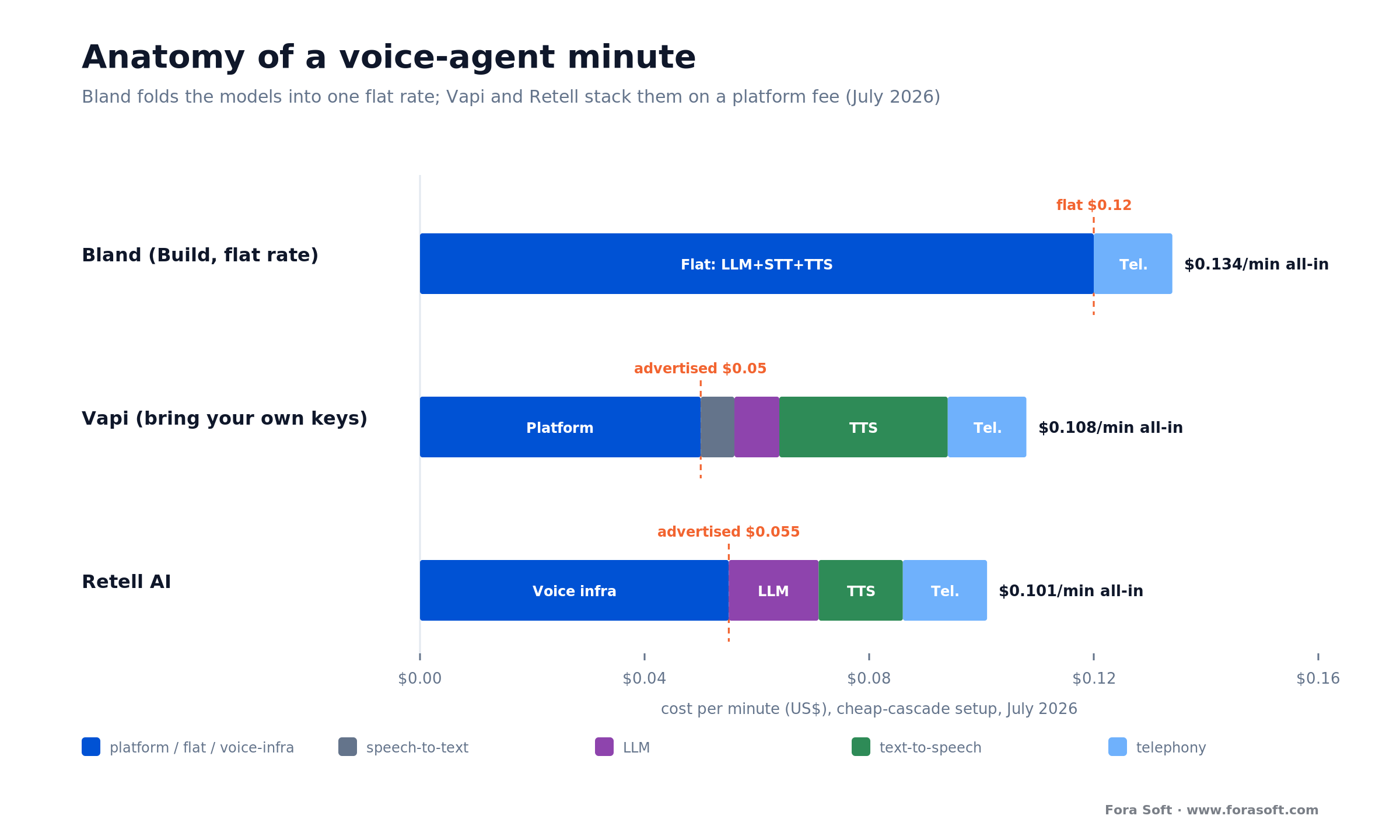
Figure 1. Bland folds the model layers into one flat bar; Vapi and Retell show a thin platform fee with STT, LLM, TTS, and telephony stacked on top. The advertised number is never the whole minute.
Why teams look for a Bland AI alternative
Why would anyone leave a platform that runs a phone agent in a day? Four reasons come up again and again, and only one is price. The most common is model control: Bland runs its own models, so if you want a specific LLM for reasoning quality, or a specific voice from ElevenLabs or Cartesia, the integrated stack is the wrong shape. Teams that care which model answers the phone tend to want Vapi.
The second is cost at volume. A flat $0.11–$0.14/min is easy to accept at a few thousand minutes. At six figures of minutes a month it’s a five-figure invoice, and every one of those minutes is paying for orchestration you could own. The third is data and deployment: regulated teams that need on-prem or VPC deployment, a signed BAA, or full data residency hit the point where they want the stack in their own cloud, which is a custom build or Bland’s Enterprise tier, not self-serve. The fourth is feature ceilings: warm transfers, SMS nodes, guardrails, and advanced monitoring sit on higher tiers, and some teams outgrow what the builder can express.
None of these is a knock on Bland. They’re the natural edges of any managed platform: you trade control for speed, and eventually a project needs the control back. The rest of the article is about where each alternative gives it back, and at what cost.
The Bland AI alternatives, at a glance
There are three serious alternatives, and they map cleanly onto the three reasons above. Vapi is the composable, bring-your-own-model orchestrator for teams that want to pick every part. Retell AI is the other opinionated managed builder, a close sibling to Bland with a different pricing structure and a deeper workflow layer. Custom means self-hosting on open-source frameworks like Pipecat or LiveKit Agents, which removes the per-minute platform fee entirely in exchange for running the infrastructure yourself.
A quick word on who’s missing. There are dozens of voice AI startups, but most are thin wrappers over the same underlying models, and comparing them one by one is a way to burn a week without a decision. The three routes here are the ones that actually change your economics or your control, which is what a real alternative has to do. If you also want the Vapi-versus-Retell question settled on its own terms, our Vapi vs Retell vs custom guide goes deep on that pair.
Reach for Bland when: you want a phone agent live this week, you’d rather see one predictable number on the invoice than manage several provider bills, and you don’t need to hand-pick the model or voice. The flat rate and the integrated stack are the point, not a compromise.
Vapi: where it wins, where it breaks
Vapi is a developer-first voice orchestration platform. You bring your own models: pick the STT, LLM, and TTS providers you want, plug in your own API keys, and Vapi wires them into a real-time call. Pricing reflects that philosophy, a thin $0.05/min hosting fee with model costs passed straight through (“at cost, $0 if you bring your own API key,” vapi.ai/pricing, July 2026). Concurrency is 10 lines included plus $10/line/month, and Vapi raised a $50M Series B, listing Amazon Ring, Intuit, and ServiceTitan as customers.
Where it wins against Bland: total model freedom. If the difference between a good agent and a great one is swapping in a sharper reasoning model or a specific cloned voice, Vapi lets you do it without leaving the platform. Where it breaks: you now own several provider relationships and several bills, and the “$0.05/min” on the homepage is not what you’ll pay. HIPAA is a $2,000/month add-on, and call history defaults to 14 days. It rewards teams with an engineer who enjoys owning the stack, and punishes teams who wanted one number.
Reach for Vapi when: you have engineers who want to choose every model, bring their own API keys, and tune the flow, and you’d rather manage a few provider bills than accept a bundled rate you can’t break apart. Control is the whole reason to switch here.
Retell AI: where it wins, where it breaks
Retell AI is Bland’s closest sibling: an opinionated managed platform with a drag-and-drop builder, workflows, call transfer, a knowledge base, analytics, and compliance in the box. The structure differs, though. Retell charges a $0.055/min voice-infra floor and then adds the LLM, TTS, and telephony you choose, so the bill is itemized rather than flat (retellai.com/pricing, July 2026). A cheap-model stack (GPT-4.1-mini at $0.016, platform TTS at $0.015, BYO telephony) lands near $0.11/min all-in; concurrency is 20 free, then $8/month each.
Where it wins against Bland: a deeper workflow and analytics layer, per-second billing, and a pricing model that lets a frugal team pick a cheap LLM and pay less than Bland’s flat rate. Where it breaks: the itemized bill is less predictable than Bland’s single number, Retell bills during silence and hold while STT stays active, and add-ons (knowledge base, denoising, PII removal, QA) each tack on per-minute cents that quietly add up. It’s the alternative for teams who like managed but want the itemized control Bland doesn’t give.
Reach for Retell when: you want a managed builder like Bland but with a deeper workflow layer and an itemized bill you can optimize model by model, and you’re comfortable trading Bland’s one predictable number for line items you can tune down.
Custom and self-hosted: where it wins, where it breaks
The custom route means owning the orchestration yourself with an open-source framework instead of renting it per minute. Pipecat (BSD-2) and LiveKit Agents (Apache-2.0) give you the real-time glue, and you bring your own STT, LLM, and TTS, running the whole thing on your own infrastructure. There’s no per-minute platform fee: a fixed VM (roughly $60/month at modest scale) replaces it, and you pay only provider costs on top, so the marginal minute costs about what the models cost. Our Pipecat vs LiveKit Agents comparison covers the frameworks in detail.
Where it wins against Bland: the per-minute tax is gone, you own your data and models outright, and there’s no ceiling on concurrency or features except the ones you write. Where it breaks: you run it. Turn-taking, barge-in, retries, monitoring, and uptime are now your problem, and that’s engineering time before it’s a running agent. Custom pays off at volume or when data ownership is non-negotiable, and it’s the wrong call for a team that just needs a receptionist answering calls next week.
Reach for custom when: your monthly minutes have pushed the per-minute fee into real money, or data ownership, model freedom, and latency control matter more than a fast start, and you have (or can hire) a team to run the infrastructure. This is the route that removes the tax, not just lowers it.
Bland vs Vapi, head to head
Bland vs Vapi is the clearest contrast in this comparison: an integrated appliance against a composable toolbox. Bland gives you one flat rate and its own models; Vapi gives you a thin hosting fee and every model you want to plug in. If you can’t decide, the tiebreaker is a single question: do you have an engineer who wants to own the model stack? If yes, Vapi’s control is worth the extra bills. If no, Bland’s one number is worth the lost flexibility.
On raw price the two are closer than the headlines suggest. Bland’s Build rate is $0.12/min all-in for the models; a real Vapi stack (hosting plus a mid-tier LLM, Deepgram STT, a good TTS, and telephony) lands in the same neighborhood once you total the pass-throughs. The difference is where the complexity lives. Bland hides it inside one rate; Vapi exposes it so you can optimize it. Neither is cheaper by a wide margin at typical volume; they’re priced for different temperaments.
One practical note for regulated teams: Bland includes a BAA and SOC 2 on its plans, while Vapi gates HIPAA behind a $2,000/month add-on. If you’re in healthcare and comparing the two on compliance alone, that line item can flip the math before latency or models enter the picture.
Bland vs Retell AI, head to head
Bland and Retell are the two managed builders in the field, so this matchup is about structure, not philosophy. Bland bets on simplicity: one flat rate, its own models, the fewest decisions. Retell bets on itemized control: a voice-infra floor plus the models you pick, a deeper workflow layer, and per-second billing. A frugal team that pairs Retell’s $0.055/min floor with a cheap LLM can undercut Bland’s flat rate; a team that wants zero decisions and a predictable invoice will prefer Bland.
The hidden cost sits on Retell’s side. Its add-ons (knowledge base, advanced denoising, safety guardrails, PII removal, AI quality assurance) are each a few cents a minute, and they’re easy to switch on and forget. Bland’s flat rate absorbs more of that into one number. So the real question is temperament again: do you want a bill you can tune line by line and the discipline to keep it tuned, or a bill that’s higher but never surprises you? Both ship SOC 2 and HIPAA-readiness, so compliance rarely decides this one.
Bland vs Vapi vs Retell vs custom, side by side
Here are the four routes on the dimensions that decide a switch. Read the pricing-model and data rows first: they explain most of the rest. Green means strong out of the box, amber means a trade-off you should price in.
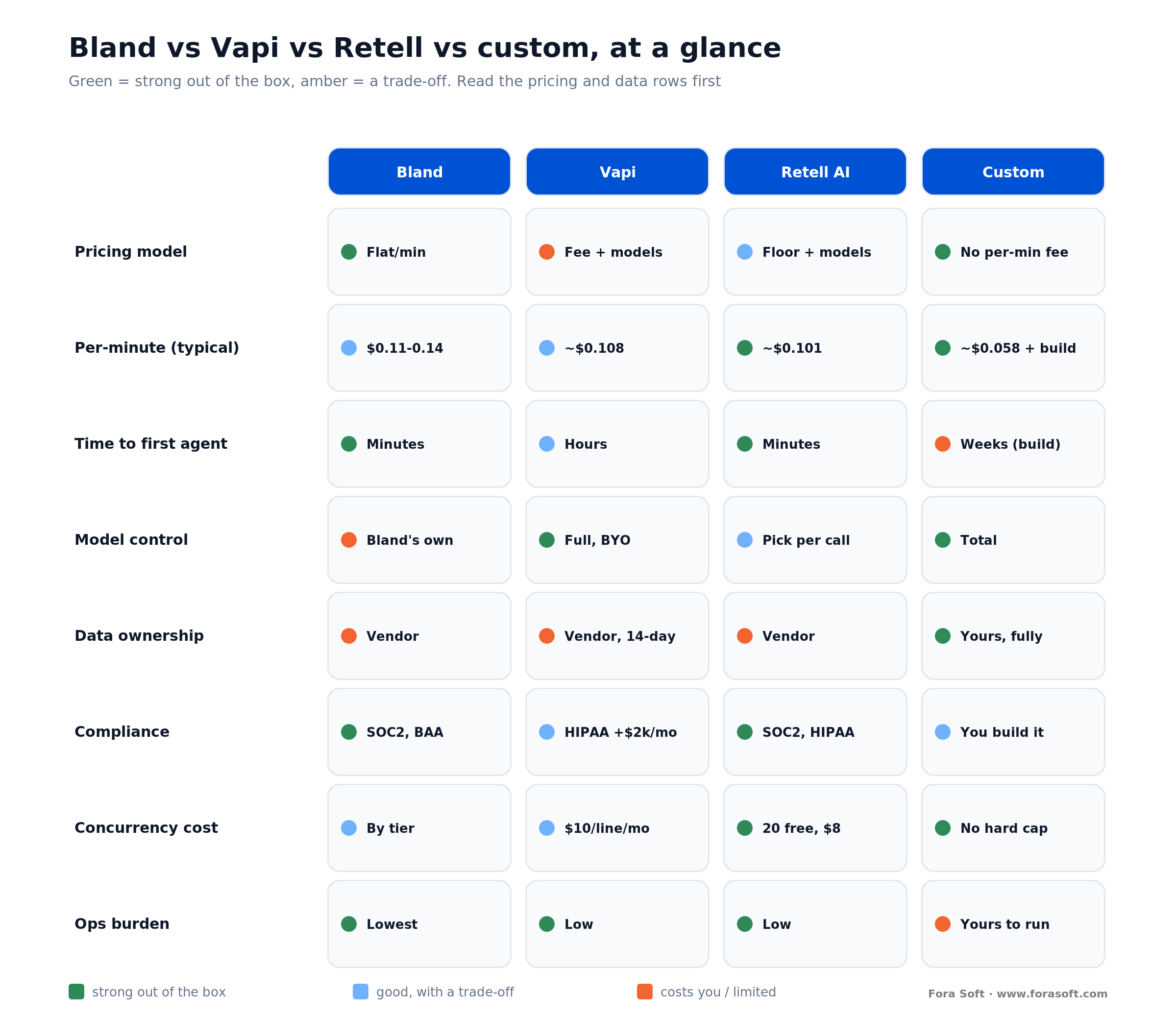
Figure 2. A traffic-light read of the four routes. Bland leads on simplicity and predictable pricing; custom leads on data ownership and removing the per-minute fee; Vapi and Retell trade control for a managed start.
The pattern is consistent. Bland and Retell win the top of the funnel (fast, managed, compliant) and lose the bottom (per-minute tax, vendor-held data). Vapi splits the difference with more control and more bills. Custom inverts everything: slow and demanding up front, cheapest and most owned at scale. Where you sit on that curve is a function of one number, which the next section makes concrete.
The cost math at 10k and 100k minutes
Let’s put real numbers on it. Take Bland’s Build plan ($0.12/min plus a $299/month fee) and add telephony at roughly $0.014/min for US Twilio. At 10,000 minutes a month: 10,000 × $0.12 = $1,200, plus $299, plus about $140 of telephony, so around $1,639/month. On Start (no platform fee, $0.14/min) the same volume is about $1,540/month. For comparison, a tuned Retell stack runs near $0.101/min all-in (about $1,010/month) and Vapi BYOK near $0.108/min (about $1,080/month), from our component-level cost work.
| Route | All-in per min | 10,000 min/mo | 100,000 min/mo | Notes |
|---|---|---|---|---|
| Bland (Build) | ~$0.12 + fee | ~$1,639 | ~$13,699 | +$299/mo, +telephony |
| Bland (Scale) | ~$0.11 + fee | — | ~$12,899 | +$499/mo, best at high volume |
| Retell (tuned) | ~$0.101 | ~$1,010 | ~$10,100 | cheap-model stack |
| Vapi (BYOK) | ~$0.108 | ~$1,080 | ~$10,800 | + provider bills to manage |
| Custom (self-hosted) | ~$0.058 | ~$640 | ~$5,860 | + one-time build + ops |
Conservative estimates, July 2026 vendor rates. Bland telephony at ~$0.014/min US Twilio; custom excludes the one-time build and engineering time. Your model and voice choices move these.
Two things fall out of the table. First, Bland’s flat rate is not the cheapest per minute; it’s the most predictable, and you’re paying a premium for that plus the integrated models. Second, the gap to custom widens fast with volume. At 10,000 minutes the spread between Bland and custom is around $1,000/month, which is less than a week of an engineer’s time; at 100,000 it’s roughly $8,000/month, which pays back a build in months.
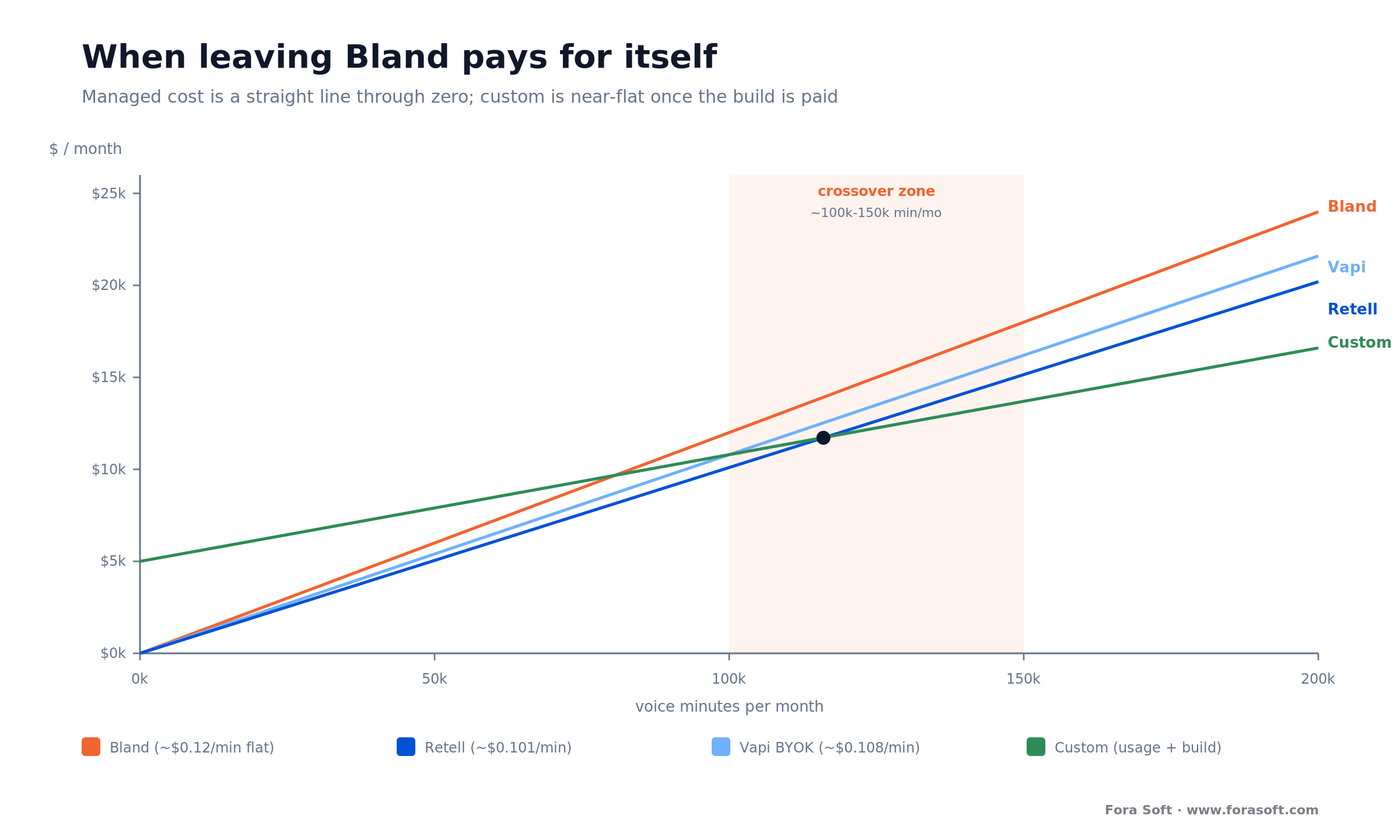
Figure 3. Managed cost is a straight line through the origin; custom is near-flat, lifted by the one-time build. The crossover zone sits around 100,000–150,000 minutes a month.
Want the crossover math on your real minutes?
Send us your monthly volume, models, and compliance needs. We’ll hand back the all-in cost for Bland, Vapi, Retell, and a custom build, and the point where building beats renting.
Latency and control: what you can tune
Does the platform you pick change how fast the agent feels? Yes, and it’s one of Bland’s quieter advantages. Because Bland runs its own STT, LLM, and TTS on its own infrastructure, it controls the whole path and can shave the handoffs between layers that add delay on a bring-your-own-model setup. The target everyone chases is human turn-taking: people leave about a 200 ms gap between conversational turns (Stivers et al., PNAS, 2009), and anything past roughly 800 ms starts to feel like a bad phone connection.
The trade is the mirror image of the pricing one. On Bland you get a tuned path but little say in it; on Vapi or a custom build you can choose faster models and regional endpoints, but you own the tuning, and a careless stack can be slower than the managed default. Latency is also load-dependent: any of these can spike at the 95th percentile under concurrency, which is exactly when it matters. If sub-second response is a hard requirement, benchmark your own traffic rather than trusting a homepage number, and read our AI receptionist build guide for the latency budget in practice.
Compliance and data ownership
For regulated teams, compliance often decides the platform before cost does. Bland ships SOC 2 Type I and Type II, is HIPAA-eligible with a signed BAA, and covers GDPR and PCI DSS, with on-prem and VPC deployment plus data residency on Enterprise (bland.ai, July 2026). That’s a strong out-of-the-box posture, and it’s a real point in Bland’s favor against Vapi, where HIPAA is a $2,000/month add-on on top of usage.
The deeper question is ownership. On any managed platform, call recordings, transcripts, and metadata sit in the vendor’s systems under the vendor’s retention policy. A signed BAA covers the legal handling, but it doesn’t make the data yours to hold. Teams with strict residency needs or a policy that customer audio never leaves their cloud eventually reach the point where self-hosting is the only clean answer. That’s not a Bland shortcoming; it’s the nature of managed. If data must live in your own VPC, price the custom route or Bland’s Enterprise tier, not self-serve.
Migrating off Bland without a rewrite
If you decide to switch, the good news is that a voice agent is more portable than it looks, because the hard-won part is the prompt logic and the tool integrations, not the platform wiring. Your Conversational Pathways logic maps to a state machine or a workflow graph on any target; your tool calls (calendar, CRM, database) are HTTP endpoints that don’t care who calls them; your phone numbers port. What changes is the orchestration layer and the model choices, which is exactly the part you’re switching to control.
The pragmatic path is to migrate one agent, not all of them, and run it in parallel on real traffic before you cut over. Keep the prompts and tools identical so you’re comparing platforms, not rewrites, and measure the two things that actually differ: all-in cost per minute and perceived latency. If the new route wins on both for a week of live calls, cut over; if it doesn’t, you’ve learned that Bland’s flat rate was buying you more than you thought. Our AI call assistant API guide covers the integration layer under any of these platforms.
Mini-case: a booking agent’s platform call
A client of ours (under NDA) needed a voice agent that answers the phone and books appointments end to end: greet the caller, check availability against a calendar, offer slots, confirm, and log the result. The situation was the one this whole article is about. They’d prototyped on a managed platform in a couple of days, it worked, and the question was whether to stay managed or build as volume grew toward tens of thousands of minutes a month.
Our plan was to decide with numbers, not taste. We modeled all-in cost per minute across the managed options and a self-hosted build, projected it against their real volume curve, and weighed it against latency and their data-handling requirements. Because their projected volume sat below the crossover zone and they had no appetite to run infrastructure, the honest recommendation was to stay managed for now and revisit at a defined volume trigger, rather than build a stack they’d have to operate. The lesson from BlaBlaPlay sat underneath it: we’ve run real-time voice with OpenAI models and Whisper across thousands of users, so we know the managed-versus-custom line is about operational appetite as much as price.
The result was a decision the client could defend to their board: a dated cost model, a named trigger to reassess, and no premature engineering. That’s the same exercise we’ll run for you on a call, with your numbers instead of a generic table. Book a 30-minute call and we’ll model your case honestly, including the answer “stay on Bland” when that’s the right one.
A decision in five questions
You can settle this in an afternoon by answering five questions in order and stopping at the first firm yes. One: is your volume under ~50,000 minutes a month and likely to stay there? If yes, stay managed; the fee is cheaper than engineers. Two: do you need to hand-pick the model or voice? If yes, Vapi. Three: do you want a managed builder with an itemized, tunable bill? If yes, Retell. Four: is data ownership or on-prem deployment non-negotiable? If yes, custom or Bland Enterprise. Five: none of the above, and you value one predictable number over everything else? Stay on Bland.
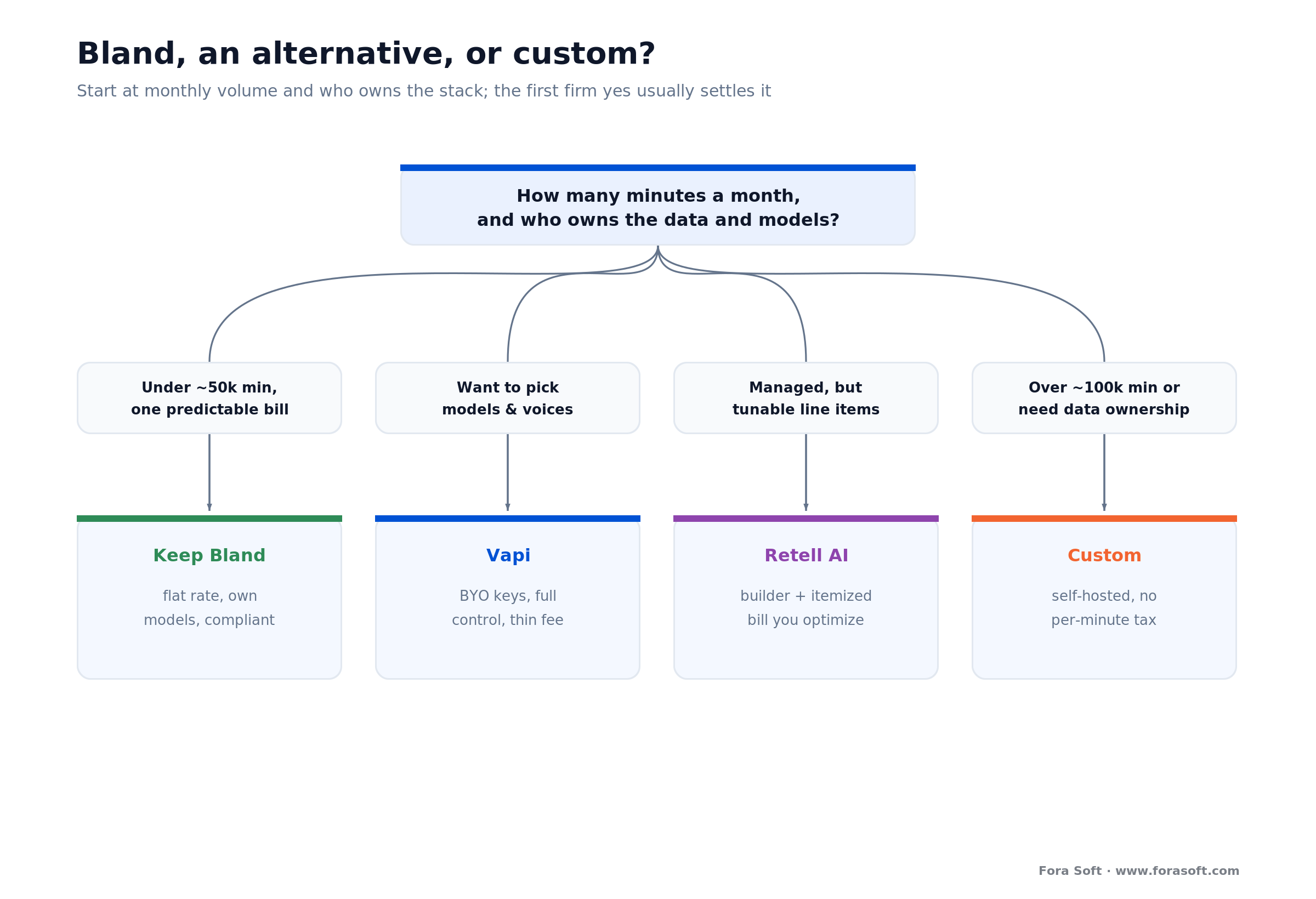
Figure 4. Start at monthly volume and who owns the stack. The first firm yes usually settles which of the four routes fits.
If two answers pull in different directions, volume breaks the tie. Below the crossover zone, lean managed and pick on control and compliance; above it, lean custom and treat the per-minute fee as the thing you’re removing. And if you’re still torn, that’s a sign the decision deserves your real numbers rather than a rule of thumb.
When NOT to leave Bland
Switching for its own sake is a good way to spend a month and end up where you started. Don’t leave Bland if your volume is modest and stable: the flat rate is a rounding error next to an engineer’s salary, and the predictability has real value at budget time. Don’t leave if the reason is a single missing feature that sits one tier up; upgrading is cheaper than migrating. And don’t leave if nobody on your team wants to own infrastructure, because a custom build you can’t operate is worse than a managed bill you grumble about.
The honest test is whether the thing pushing you off Bland is structural or emotional. Structural reasons (volume past the crossover, a model you must control, data that must live in your cloud) justify the work. Emotional ones (the flat rate feels high, a competitor uses something else) usually don’t survive the cost model. Run the five questions, and if they all point back to Bland, that’s a valid answer, not a failure to optimize.
FAQ
How much does Bland AI cost per minute?
Bland charges a flat per-minute rate that includes the LLM, speech-to-text, and text-to-speech: $0.14/min on the Start plan (no platform fee), $0.12/min on Build ($299/month), and $0.11/min on Scale ($499/month), per bland.ai/pricing in July 2026. Telephony is billed separately, on your own carrier or Bland’s Twilio at pass-through cost.
Does Bland AI have a free plan?
There’s no perpetual free tier, but the Start plan requires no card and includes two credits plus an inbound phone number valued at $15/month, so you can build and test a first agent before paying for volume (bland.ai/pricing, July 2026).
Vapi vs Bland: which is cheaper?
They’re close at typical volume. Bland’s Build rate is $0.12/min all-in for the models; a real Vapi stack (its $0.05/min hosting fee plus a mid-tier LLM, STT, TTS, and telephony passed through at cost) lands in the same range once you total the parts. Vapi can be cheaper if you optimize the models, but you manage several bills to get there; Bland trades that for one number.
Is Bland AI HIPAA compliant?
Bland is HIPAA-eligible with a signed BAA, and also holds SOC 2 Type I and Type II, GDPR, and PCI DSS (bland.ai, July 2026). Compliance documentation is available under NDA on the Enterprise tier. For healthcare teams, that built-in posture is a cost advantage over Vapi, which gates HIPAA behind a $2,000/month add-on.
Can I bring my own telephony to Bland?
Yes. Bland integrates with your existing Twilio account or SIP trunks from any provider, and bring-your-own-telephony customers don’t pay transfer fees. You handle carrier costs directly and Bland charges only its per-minute AI rate, or you can use Bland’s built-in Twilio at pass-through cost.
What is the best Bland AI alternative?
There isn’t one best; there’s a best for your case. Choose Vapi if you want to control the models, Retell if you want a managed builder with an itemized bill, and a custom self-hosted build on Pipecat or LiveKit Agents if your volume is high enough that removing the per-minute fee pays for the engineering. Cost, control, and data ownership decide it.
Is Bland AI worth it versus building custom?
Below roughly 50,000 minutes a month, yes: Bland’s flat rate is cheaper than paying engineers to build and run infrastructure. The math starts to favor a custom build around 100,000–150,000 minutes a month, where removing the per-minute fee saves enough to earn back a build inside a year. Data ownership or model control can justify building sooner.
How does Bland’s flat rate compare to Retell’s pricing?
Bland gives you one flat rate covering the models; Retell charges a $0.055/min voice-infra floor plus the LLM, TTS, and telephony you choose. A frugal Retell stack with a cheap model can undercut Bland per minute (near $0.10/min), but the bill is itemized and add-ons accumulate. Bland is more predictable; Retell is more tunable.
What to read next
Comparison
Vapi vs Retell vs Custom
The managed-vs-build decision, priced out in full.
Frameworks
Pipecat vs LiveKit Agents
The open-source frameworks behind the custom route.
Cost
OpenAI Realtime API Pricing
The speech-to-speech cost math, per minute.
Build guide
How to Build an AI Receptionist
The telephony stack and latency budget behind a phone agent.
Bland, an alternative, or custom?
Start from your volume, not the demo. Stay on Bland when the flat rate and one vendor are worth more than model choice and your minutes are modest. Move to Vapi when engineers want to own the model stack, or to Retell when you want a managed builder with an itemized bill. Go custom when the per-minute fee has grown into real money, past roughly 100,000–150,000 minutes a month, or when data ownership and model freedom force the build. Below ~50,000 minutes, managed almost always wins, and there’s no shame in paying the fee while it’s cheaper than engineers.
The comparison on this page is yours to reuse: pull your real minutes, models, and compliance needs, run them through the cost table and the five questions, and you’ll have a defensible answer. But if you’d rather hand it to a team that has shipped voice agents both ways and watched the invoices, that’s us. We’ll model the all-in cost, name the route that fits, and build the version that’s right, including “keep Bland” when that’s the honest call.

The book · Volume 7 of 7
AI for Video: A Complete Guide to Intelligence in Video Products: From Real-Time Pipelines and Agents to Serving, Cost, Compliance, and Verticals
Whether you stay on Bland, move to Vapi or Retell, or build your own, the engineering underneath a voice agent stays the same. Volume 7 covers agent loop primitives, frameworks, memory and tools, plus serving infrastructure and cost per stream-hour, so you can price a custom agent before you commit. Written by Nikolay Sapunov, CEO at Fora Soft.
Read it on Amazon →Kindle & paperback · Fora Soft Video Engineering Handbook
Let’s pick your voice-agent route, honestly
Bring your call volume and constraints. We’ll hand back the all-in cost for Bland, Vapi, Retell, and custom, and the crossover point where building beats buying.