

Key takeaways
• The headline price is not the price. Vapi’s “$0.05/min” is a hosting fee on top of the models you bring; Retell’s “$0.07/min” is a $0.055/min voice-infra floor plus LLM, TTS, and telephony. Real all-in lands near $0.10–$0.31/min (vendor pages, July 2026).
• Vapi is a toolbox, Retell is an appliance. Vapi hands you a bring-your-own-model orchestrator and full control; Retell hands you a builder, workflows, and compliance in the box. One rewards engineers, the other rewards speed.
• The per-minute platform fee is a tax that scales with you. That $0.05–$0.055/min is ~$500/mo at 10,000 minutes, ~$5,000/mo at 100,000, and ~$25,000/mo at 500,000. Volume is exactly when managed stops being cheap.
• Custom pays back around 100,000–150,000 minutes a month. Below ~50,000/mo, stay managed: the platform tax is cheaper than engineers. Above it, a self-hosted build on open-source frameworks erases the tax and earns back its cost in months.
• It’s not only cost. Data retention limits, model lock-in, concurrency fees, compliance add-ons ($2,000/mo HIPAA on Vapi), and P95 latency you can’t tune are the walls managed platforms hit — sometimes before the money math even flips.
If the move is already decided, here’s what moving off a managed platform costs and how long it takes. Or start from all vendor comparisons.
Here’s the trap we watch teams walk into. They ship a voice agent on Vapi or Retell in an afternoon, love it, scale it, and six months later the invoice is five figures a month and the per-minute fee they waved off in the demo is now the biggest line on the bill. Or worse: they hit a wall that isn’t about money at all. A data-retention limit. A model they can’t swap. A compliance add-on that doubles the cost. We’ve built voice agents on managed platforms and from scratch for clients in healthcare and consumer apps, and the regret is almost always the same: nobody did the crossover math before the volume arrived.
This is a straight comparison of the two most-asked-about managed voice platforms, Vapi and Retell AI, against the custom route, current to July 2026, with the real per-minute pricing pulled from each vendor’s own page and the cost math shown out loud. No option is “best.” One is best for your call volume, your control needs, and your team, and by the end you’ll know which one, and exactly where the line sits.
Why Fora Soft wrote this comparison
We’re a software team that has built real-time and AI products since 2005: 250+ projects, about 50 engineers, and a specialty in the seam where voice, video, and models meet. Voice agents are a big part of what clients ask us to build now, and the first real decision on every one of them is the same — buy a managed platform, or build. We’ve made that call enough times, and watched enough invoices, to have opinions with numbers behind them.
Some of what we know comes from products, not slides. BlaBlaPlay, an anonymous voice social app we built, runs OpenAI models and Whisper across thousands of users, so we’ve watched real-time voice behave at scale rather than in a demo. We’ve also shipped an AI appointment-booking voice agent (client under NDA) that answers the phone and books slots end to end — the exact workload people prototype on Vapi and Retell first.
Every price below is dated and pulled from the vendor’s own pricing page on 2026-07-13, not a third-party blog that copied a number from 2024. Where we do the cost math, we show the arithmetic so you can plug in your own volume. For the engineering fundamentals under all of it, our AI-for-video-engineering hub goes deeper; if you’d rather we just scope the right route for your case, that’s what our AI integration team does.
Not sure whether to buy or build your voice agent?
Tell us your call volume and what the agent has to do. We’ll run the crossover math and tell you whether Vapi, Retell, or custom wins — before you commit a cent.
The short answer: Vapi, Retell AI, or custom
If you want the verdict before the evidence: pick Retell AI when you want a phone agent live this week with workflows, analytics, and compliance already wired, and you’re fine trading low-level control for speed. Pick Vapi when you have engineers who want to choose every model, bring their own API keys, and orchestrate a custom flow, knowing you’ll absorb managing several provider bills. Go custom (self-hosted on open-source frameworks) when your volume is high enough that the per-minute platform fee has become a tax worth removing, or when data ownership, model freedom, or margins force your hand.
The honest framing isn’t “which platform is best.” It’s “how many minutes a month will this agent run, and who owns the stack when it matters.” At low volume, managed always wins — the platform fee is cheaper than paying engineers to build and run infrastructure. At high volume, that same fee compounds into real money, and a custom build earns its cost back. The whole game is knowing where your line sits.
So the rest of this article is the evidence: what each platform really charges, where each wins and breaks, the crossover math with numbers you can reuse, the five non-cost walls managed platforms hit, and a five-question test to settle it in an afternoon. If you’re weighing Bland specifically, our Bland AI alternatives and pricing guide runs the same buy-versus-build decision Bland-first.
What a voice agent actually needs under the hood
Before you can compare prices, you need the parts list, because every platform charges for these pieces, they just bundle them differently. A production voice agent is five layers stacked in a loop. Telephony gets the call in and out (a SIP/PSTN phone line, usually via Twilio). Speech-to-text (STT) turns the caller’s audio into words. An LLM decides what to say and which tools to call. Text-to-speech (TTS) turns the reply back into a voice. And an orchestration layer ties it together: turn-taking, interruptions, tool calls, and state.
That orchestration layer is the product Vapi and Retell actually sell. The models underneath are the same ones everyone uses: Deepgram or a native engine for STT, GPT or Claude or Gemini for the LLM, ElevenLabs or Cartesia for TTS. What you’re paying a platform for is the hard real-time glue: sub-second turn detection, barge-in when the caller interrupts, call transfer, retries, and a dashboard. When we say “custom,” we mean owning that glue yourself with an open-source framework instead of renting it per minute.
Keep this parts list in your head, because it’s the key to reading any voice-AI pricing page honestly. When a platform advertises one number, the first question is always: which of these five layers does that number cover, and which are billed separately? For Vapi and Retell, the answer is different — and that difference is the whole comparison.
What Vapi and Retell AI actually are
Vapi is a developer-first voice orchestration platform. You bring your own models: pick the STT, LLM, and TTS providers you want, plug in your own API keys, and Vapi wires them into a real-time call and handles the orchestration. Its pricing reflects that philosophy: a thin $0.05/min hosting fee, with model costs passed straight through (“at cost, $0 if you bring your own API key,” per vapi.ai/pricing, 2026-07-13). It’s the choice for teams who want maximum control and don’t mind assembling and managing the pieces. Vapi raised a $50M Series B and lists Amazon Ring, Intuit, and ServiceTitan among its customers.
Retell AI is an opinionated, managed voice platform. Instead of a toolbox, it hands you an appliance: a drag-and-drop agent builder, workflows, call transfer, a knowledge base, analytics, testing, and compliance features, with the voice infrastructure bundled in. Pricing is usage-based and starts at $0 with no contract, but the structure is a $0.055/min voice-infra floor plus the LLM, TTS, and telephony you choose (retellai.com/pricing, 2026-07-13). It’s the fastest path from signup to a live phone agent, and it trades away some low-level control to get there.
The one-sentence version: Vapi optimizes for engineers who want to own the stack; Retell optimizes for teams who want it owned for them. Both are managed, and both charge a per-minute fee to run the orchestration. That shared trait is exactly what the custom route removes. Which brings us to the money.
What Vapi and Retell AI really cost per minute
How much does Vapi or Retell actually cost per minute? The advertised numbers ($0.05 for Vapi, $0.07 for Retell) are the platform’s slice, not the bill. The real all-in rate is the platform fee plus every model layer, and it lands between roughly $0.10 and $0.31 a minute depending on which LLM and voice you pick. Here’s the anatomy, straight from each vendor’s pricing page on 2026-07-13.

Figure 1. The headline price is the thin band at the bottom. The real per-minute cost stacks the platform fee under the STT, LLM, TTS, and telephony you actually run.
Vapi keeps its own fee simple and pushes the rest onto the models you bring. On the Build plan it’s $0.05/min for hosting, 10 concurrent lines included ($10/line/month beyond that), and STT/LLM/TTS billed at provider cost — or $0 to Vapi if you supply your own API keys. Compliance is an add-on: HIPAA at $2,000/month, Zero Data Retention at $1,000/month. Call history is retained 14 days on Build.
| Vapi (Build), July 2026 | Rate | Notes |
|---|---|---|
| Platform (hosting) | $0.05 / min | Excludes model costs |
| STT + LLM + TTS | At provider cost | $0 to Vapi if you bring keys (BYOK) |
| Concurrency | 10 free + $10 / line / mo | Per extra concurrent line |
| HIPAA add-on | $2,000 / mo | Zero Data Retention: $1,000 / mo |
| Data retention | 14 days (calls) | Scale plan: custom |
Source: vapi.ai/pricing, captured 2026-07-13.
Retell AI unbundles the same layers with its own line items. The voice engine is a fixed $0.055/min. TTS is $0.015/min for platform, Cartesia, or OpenAI voices, or $0.040/min for ElevenLabs. LLMs range from $0.003/min (GPT 5 nano) through $0.016/min (GPT 4.1 mini) up to $0.16/min (GPT 5.5). Telephony is $0.015/min through Twilio, or free if you bring SIP trunking. A typical mid-tier setup (GPT 4.1 mini + a platform voice + Twilio) lands at about $0.10/min; Retell’s own calculator shows ~$0.11/min for its pricier default models.
| Retell AI component, July 2026 | Rate |
|---|---|
| Retell voice infra (always on) | $0.055 / min |
| TTS (platform / Cartesia / OpenAI) | $0.015 / min (ElevenLabs $0.040) |
| LLM (GPT 5 nano → GPT 5.5) | $0.003 → $0.16 / min |
| Telephony (Twilio) | $0.015 / min (SIP: free) |
| Concurrency | 20 free, then $8 / line / mo |
| Add-ons (KB, denoise, guardrails, PII) | +$0.005 to +$0.01 / min each |
Source: retellai.com/pricing, captured 2026-07-13. Speech-to-speech (GPT Realtime) is priced separately at $0.07–$0.345/min.
Read those two tables side by side and the pattern is clear. Vapi’s fee is lower and flatter but assumes you’ll manage the model bills yourself; Retell’s is higher but bundles the plumbing and the compliance. At a cheap-cascade setup, both land near $0.10–$0.11/min all-in. The difference that matters shows up not per minute, but per hundred thousand minutes, which is the section after next.
Vapi: where it wins, where it breaks
Vapi wins on control and price-per-minute discipline. Because you bring your own models and keys, you choose exactly which STT, LLM, and TTS to run, tune each one, and pay providers directly — Vapi’s cut stays a flat $0.05/min no matter how expensive your models get. For an engineering team that wants to squeeze latency and cost, that transparency is the draw: nothing is hidden inside a bundled rate, and you can swap a $0.03/min TTS for a $0.009/min one without asking permission.
It’s also genuinely flexible. Vapi supports custom LLMs, complex tool calls, and bespoke call flows, so if you can spec the architecture, you can usually build it. Teams that outgrow the no-code builders tend to land here because it doesn’t fight them.
Where it breaks: that flexibility is also the tax. A production Vapi deployment means managing several vendor relationships (your STT bill, your LLM bill, your TTS bill, your telephony bill, plus Vapi) and reconciling four or five invoices when something spikes. Tuning it to hit sub-second latency reliably takes real expertise; the “under 500ms” demos are optimized configurations, not defaults. And compliance is pay-to-play: HIPAA is a $2,000/month add-on, so a small regulated workload carries a big fixed cost before the first call.
Reach for Vapi when: you have engineers who want to own the model stack, bring their own API keys, and build a custom flow — and you’d rather manage several provider bills than accept a bundled rate you can’t tune.
Retell AI: where it wins, where it breaks
Retell wins on time-to-live and everything-in-the-box. A drag-and-drop builder, prebuilt templates, and simulation testing get a phone agent running in minutes, and the parts you’d otherwise wire yourself — call transfer, knowledge base, post-call analysis, quality assurance, IVR navigation — are native features, not integrations. For a support or sales team that needs an agent live now, that head start is the whole value.
It also treats compliance as table stakes rather than an upsell. Retell is SOC 2 certified and HIPAA-ready with a BAA available, and safety guardrails and PII redaction are add-ons measured in fractions of a cent per minute rather than a $2,000 monthly line. For regulated workloads at modest volume, that structure is far friendlier than a flat compliance surcharge.
Where it breaks: you’re renting an opinion. The $0.055/min voice-infra floor is charged on every minute whether you use the fancy features or not, and it’s the line that compounds at scale. Deep customization runs into the edges of what the builder anticipated, and you don’t control the underlying infrastructure — when you need behavior the platform didn’t design for, you’re filing a request, not editing code. Billing also runs during silence and hold because the STT stays active, which nudges the effective per-call cost above the sticker rate.
Reach for Retell AI when: you want a phone agent live this week with workflows, analytics, and HIPAA-ready compliance already built — and you’re at a volume where paying for the plumbing beats paying engineers to own it.
Custom and self-hosted: where it wins, where it breaks
Custom means building the orchestration layer yourself on an open-source framework (Pipecat, LiveKit Agents, or the OpenAI Agents SDK) and running it on your own infrastructure. The models are still the same providers; what changes is that no one charges you a per-minute fee to hold the pieces together. Instead of $0.05–$0.055/min forever, you pay a roughly fixed hosting bill — a Hetzner-class VM runs about $60/month and handles many concurrent sessions, because the heavy compute is the model API, not the glue.
Custom wins on three things managed can’t match: cost at volume (the platform tax is gone), full ownership of data and retention (nothing leaves your infrastructure unless you send it), and zero model lock-in (swap any layer, run anything, no roadmap risk). For high-volume or regulated workloads, those aren’t nice-to-haves — they’re the reason to build. We break down the framework choice in detail in our Pipecat vs LiveKit Agents comparison.
Where it breaks: you own it now. There’s an upfront build (turn detection, barge-in, retries, transfer, a dashboard) and an ongoing ops burden to keep it running at 3 a.m. Below a certain volume, that engineering time costs more than the platform fee you’d have paid, which is exactly why we tell most early-stage clients to start managed. Custom is a decision you grow into, not a default.
Reach for custom when: your volume is high enough that the per-minute platform tax outweighs a build, or when data ownership, model freedom, or unit economics matter more than shipping this week — and you have (or hire) a team to run it.
Vapi vs Retell AI vs custom, side by side
Here’s the whole comparison in one table, then the same picture as a diagram. Read the “per-minute platform tax” and “data ownership” rows first — they decide more than the rest combined.
| Dimension | Vapi | Retell AI | Custom (self-hosted) |
|---|---|---|---|
| Model / shape | BYOK orchestrator | Managed appliance | Open-source framework you run |
| Per-minute platform tax | $0.05 / min | $0.055 / min (voice infra) | None (fixed hosting) |
| Time to first agent | Hours (some assembly) | Minutes | Weeks (build) |
| Control / customization | High | Medium (builder edges) | Total |
| Data ownership | Vendor (14-day retention) | Vendor (custom on Enterprise) | Yours, fully |
| Compliance | HIPAA +$2,000/mo | SOC 2, HIPAA-ready, BAA | Whatever you build |
| Ops burden | Low (managed) | Lowest (managed) | Yours (you run it) |
| Best fit | Engineer-led custom flows | Fast, compliant phone agents | High volume / data / margins |
Sources: vapi.ai/pricing and retellai.com/pricing, captured 2026-07-13; custom figures from our own builds.

Figure 2. A traffic-light read of the same dimensions — green where an option is strong out of the box, amber where it’s a trade-off, and where the per-minute tax lives.
Want the math run against your real numbers?
Send us your monthly minutes, models, and compliance needs. We’ll hand back the all-in cost for Vapi, Retell, and custom — and tell you honestly which one wins.
The cost math: when managed stops being cheaper
This is the section that actually decides it. The platform fee feels trivial per minute and becomes the biggest number on the invoice at volume, because it’s a flat tax on every minute you’ll ever run. Let’s do the arithmetic at three volumes, cheap cascade, prices dated 2026-07-13.
Start with the all-in per-minute rates. On Retell, a GPT 4.1-mini setup is $0.055 (voice infra) + $0.016 (LLM) + $0.015 (TTS) + $0.015 (telephony) = $0.101/min. On Vapi with your own keys, it’s $0.05 (platform) + roughly $0.008 (LLM) + $0.006 (STT) + $0.03 (TTS) + $0.014 (telephony) ≈ $0.108/min. On custom self-hosted, the platform line becomes a fixed VM (~$60/mo) and you pay only models + telephony ≈ $0.058/min in usage. Now multiply.
| Monthly voice minutes | Retell (~$0.101/min) | Vapi BYOK (~$0.108/min) | Custom (~$0.058/min + ops) |
|---|---|---|---|
| 10,000 | ~$1,010 | ~$1,080 | ~$640 |
| 100,000 | ~$10,100 | ~$10,800 | ~$5,860 |
| 500,000 | ~$50,500 | ~$54,000 | ~$29,060 |
Custom column is usage + a ~$60/mo VM; it excludes the one-time build and your ops time, which is the honest catch — see below.
Look at the gap. At 10,000 minutes, custom saves ~$370–440/month, not enough to justify building and operating anything. At 100,000 minutes the gap is ~$4,200–5,000/month; at 500,000 it’s ~$21,000–25,000/month, which is $250,000–300,000 a year of pure platform tax. That’s the number a custom build erases. Isolate just the platform fee and it’s stark: $500/mo at 10k minutes, $5,000/mo at 100k, $25,000/mo at 500k. You’re paying it whether or not you touch a single premium feature.
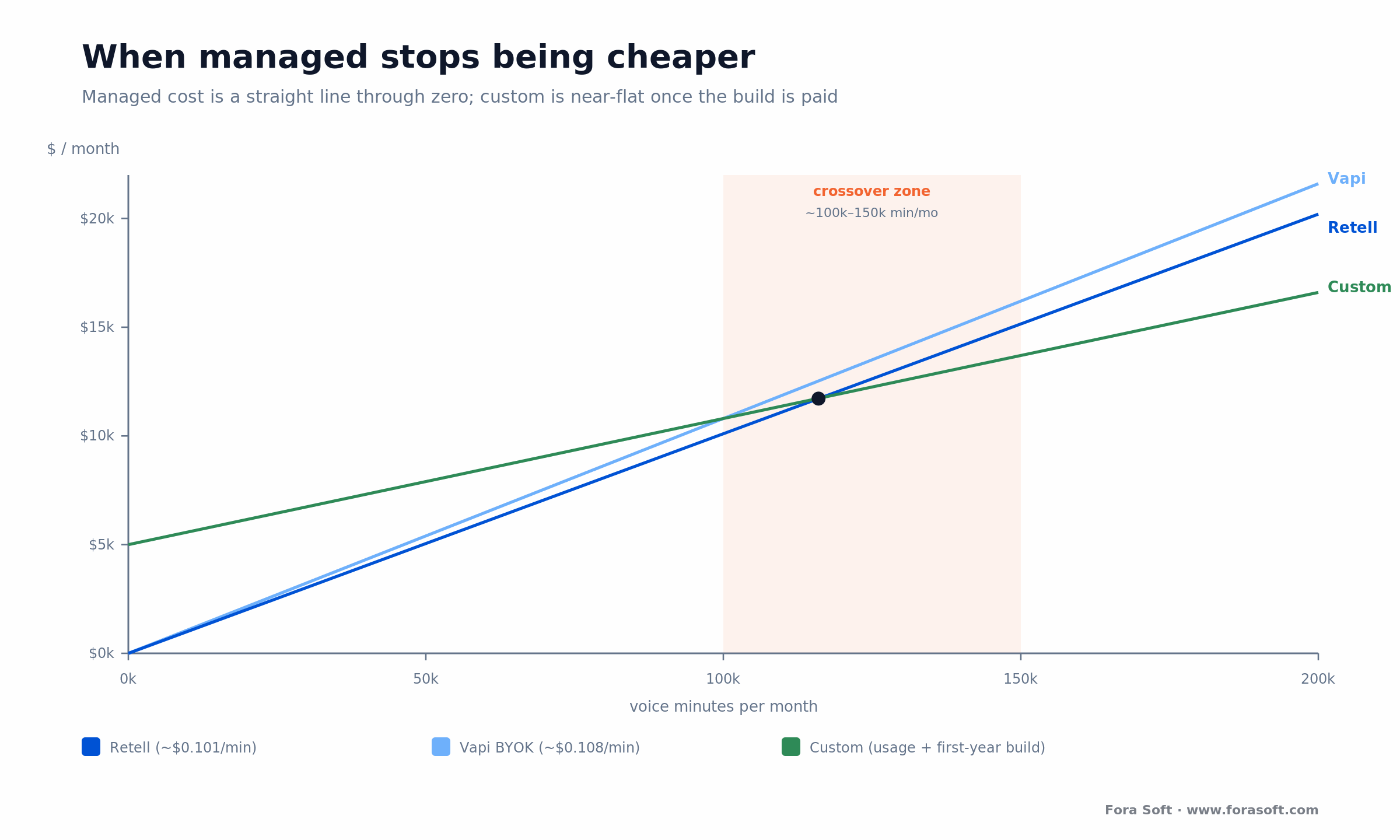
Figure 3. Managed cost is a straight line through the origin; custom is a near-flat line lifted by the one-time build. Where they cross is your decision point.
So where’s the crossover? Fold in a conservative custom build (with Agent Engineering we scope these faster and cheaper than a typical shop, in the low five figures), plus ~$60–200/month to operate. Payback under a year shows up around 100,000–150,000 voice-minutes a month. Below roughly 50,000/month, the tax is smaller than the engineering, and managed wins clearly. The exact line moves with your models and how much of the build you reuse, but that band is the honest answer for most teams.
Reach for a managed platform when: you’re under ~50,000 minutes a month and your team’s hours are worth more than the ~$0.05/min tax. It’s the same build-versus-buy line we walk through for the media layer in LiveKit versus Agora.
Five walls managed platforms hit at scale
Cost is the wall everyone sees coming. These are the four that ambush teams, plus the money one, in the order they tend to bite.
1. The per-minute tax. Covered above: a flat fee on every minute that turns into five figures a month at volume. It’s the wall that’s pure arithmetic, so it’s the one you can plan for.
2. Data ownership and retention. Your call recordings and transcripts live on the vendor’s infrastructure under their rules: Vapi’s Build plan keeps call history 14 days, and custom retention is an Enterprise conversation. If your compliance team wants recordings in your own bucket with your own retention policy, a managed platform fights that by design.
3. Model lock-in and roadmap risk. You can pick models from a menu, but you’re on the platform’s timeline for new ones, and a pricing or policy change lands on you with no recourse. When a better or cheaper model ships, you wait for support rather than wiring it in yourself.
4. Concurrency ceilings and per-line fees. Both platforms meter simultaneous calls: Retell includes 20 then charges $8/line/month, Vapi includes 10 then $10/line/month. A campaign that spikes to hundreds of concurrent calls turns concurrency into its own budget line, separate from minutes.
5. Latency you can’t tune. On a managed stack you get the platform’s tuning, not yours. When P95 latency climbs under load, you can change models but you can’t re-architect the pipeline — and past a certain scale, that ceiling is real. More on that next.
Latency: what you can and can’t tune on a managed platform
Which platform is faster? In third-party tests from mid-2026, a tuned Vapi stack (Deepgram + a small GPT + ElevenLabs Flash) landed around 500–700 ms median, and Retell’s managed stack around 600–620 ms out of the box — close enough that the median doesn’t decide anything. The number that matters is the target: people leave about a 200 ms gap between conversational turns (Stivers et al., PNAS 2009), which is why sub-second feels natural and a two-second pause feels broken.
The catch is P95, not median. Those same tests noted latency can exceed 1.5 seconds at the 95th percentile under load — and P95 is where customers actually hang up, because one slow turn in twenty is enough to sound broken. On a managed platform, your levers are limited: swap the LLM, pick a faster TTS tier, and hope. You don’t control the media path, the turn-detection model, or how sessions are scheduled, so when the tail latency climbs, you’re tuning within someone else’s architecture.
Custom flips that. Owning the pipeline means you can profile every hop, pin a speech-to-speech model to collapse the cascade, colocate services to cut network time, and control concurrency so a load spike doesn’t blow out the tail. It’s more work, and most teams don’t need it — but if natural turn-taking under heavy load is core to your product, the ceiling on a managed platform is a real reason to build. We go deep on the model-stack side of this in our OpenAI Realtime API pricing breakdown.
What the pricing page doesn’t tell you
The sticker rate assumes a clean call. Real deployments carry surcharges the calculator doesn’t default to, and they add up fast. Billing during silence and hold is the big one: Retell bills the full call duration because the STT stays active even when no one’s talking, so a call with long hold music costs more per useful second than the rate implies.
Add-ons stack. On Retell, a knowledge base is +$0.005/min, advanced denoising +$0.005/min, safety guardrails +$0.005/min, PII removal +$0.01/min, and AI quality assurance $0.10/min after the first 100 free minutes. Turn on a few and a $0.10/min agent quietly becomes $0.13–$0.14. Compliance is a fixed floor: Vapi’s $2,000/month HIPAA add-on is cheap at a million minutes and brutal at ten thousand, because it doesn’t scale with usage — it’s a toll for entering the regulated lane at all.
None of this is a gotcha; it’s all on the pricing pages if you read the component tables, which is exactly why we pulled the real line items above instead of the headline. The point is to model your actual call: your average duration, your hold time, your add-ons, your compliance needs. That’s the number to compare, not the number on the banner.
Migrating off a managed platform without a rewrite
Does starting managed lock you in forever? Mostly no, if you build for it. The valuable part of a voice agent (the prompts, the tools, the booking or support flow, the business logic) is portable. It’s plain code that doesn’t care whether Vapi, Retell, or your own framework is moving the audio. Keep that logic in your own modules rather than scattered through a platform’s visual builder, and a migration is a transport swap, not a ground-up rebuild.
What’s sticky is the platform-specific surface: the drag-and-drop workflow you built in Retell’s canvas, the dashboards, the analytics wiring. Rebuilding those on a custom stack is real work, which is why the smart pattern is to treat a managed platform as the fast start and design as if you’ll outgrow it — export your call data regularly, keep prompts and tool definitions in version control, and avoid leaning on any one platform’s proprietary feature as load-bearing.
Our rule of thumb: prototype on Retell or Vapi to prove the flow and the ROI, then migrate to custom when the crossover math flips. Done right, that migration is measured in weeks, not quarters — and it’s how we build so clients keep the option open instead of getting trapped by the tool that got them started.
Mini-case: a booking agent that outgrew its platform
A client came to us (under NDA) with a manual scheduling desk: staff answering the phone all day to book and reschedule appointments. They wanted an AI agent to take those calls end to end. The right first move wasn’t to build — it was to prove the concept fast, so a managed platform was exactly the tool to validate that callers would accept an AI booking their slots before anyone invested in infrastructure.
Once the flow worked and call volume climbed, the arithmetic shifted. The per-minute platform fee that was noise in the pilot was becoming a standing monthly line, and the requirements had grown teeth: they wanted call recordings in their own storage and tighter control over the model stack than a managed menu allowed. That’s the crossover in the wild — not a cost spreadsheet alone, but cost plus data ownership plus control arriving together.
So we moved the conversation logic, already kept in its own modules, onto a self-hosted pipeline: SIP telephony in, streaming STT, one LLM with the booking tools, low-latency TTS out. The agent still answers, checks availability, books, and reschedules without a human in the loop, but now the recordings live in the client’s infrastructure and the per-minute tax is gone. The lesson generalizes: start managed to learn, build custom to scale. Want us to map where your line sits? Grab 30 minutes with us and we’ll run your numbers.
Outgrowing Vapi or Retell?
We migrate managed voice agents to self-hosted stacks that erase the per-minute tax — without a rewrite, and without breaking what already works.
A decision in five questions
Answer these in order. The first one that points somewhere with conviction usually settles it.
1. How many minutes a month, realistically? Under ~50,000, stay managed: the platform tax is cheaper than building. Over ~100,000–150,000, custom starts paying for itself. In between, it depends on the next four answers.
2. Who owns the call data? If recordings and transcripts must live in your infrastructure under your retention rules, custom is the honest fit and managed will fight you. If vendor storage is fine, managed stays on the table.
3. How much control do you need over the stack? Full control of models and pipeline → Vapi (managed) or custom. A guided builder with the plumbing hidden → Retell. Somewhere between → start Vapi, keep custom in view.
4. Do you have engineers to run infrastructure? No one to own a 3 a.m. page → managed, full stop. A team that can operate services → custom becomes viable exactly when the volume justifies it.
5. How fast do you need to launch? This week → Retell. Soon, with a custom flow → Vapi. You’ve got a runway and volume is coming → build custom from the start and skip the migration.
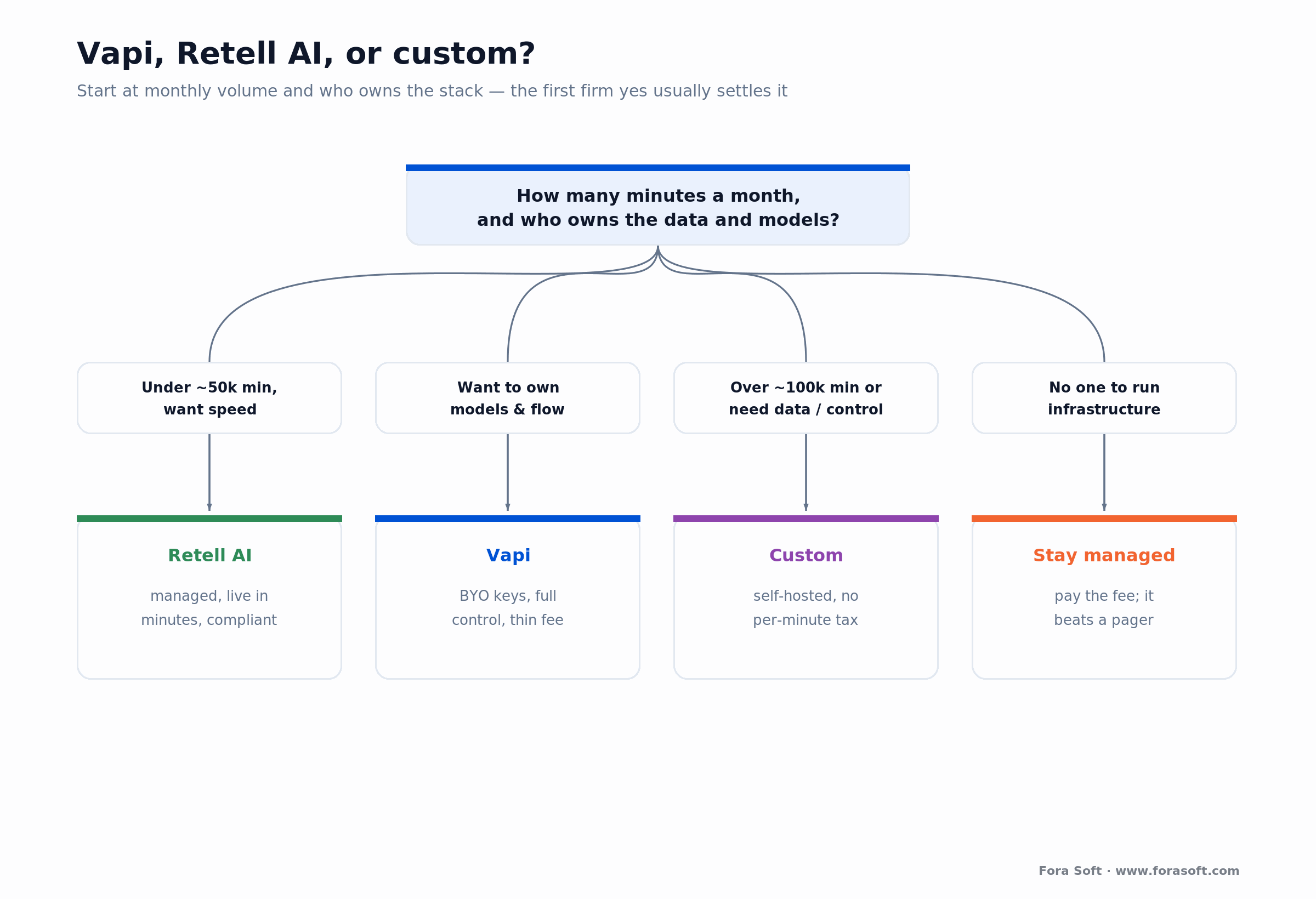
Figure 4. The same five questions as a decision tree — start at monthly volume and follow the branch to a route.
When NOT to build custom
We build custom voice agents for a living, and we still talk clients out of it regularly. If you’re pre-launch and don’t yet know whether callers will even accept an AI agent, building your own stack is expensive guessing. Prototype on Retell or Vapi, prove the flow, learn what real calls look like, and let the volume tell you when to switch. A build before product-market fit is a rewrite waiting to happen.
Skip custom, too, if you’re under ~50,000 minutes a month with no line of sight to more. At that volume the platform tax is a few hundred to a couple thousand dollars — cheaper than the engineering hours to build and the ops hours to run, every month, forever. Paying the tax is the rational choice until the math flips, and there’s no prize for owning infrastructure you didn’t need.
And skip it if you have no one to operate it. A self-hosted agent is a production service with uptime, monitoring, and on-call attached. If nobody on your team wants that pager, a managed platform’s reliability is worth every cent of the fee — and honesty about that is part of why clients trust us to tell them when not to hire us.
FAQ
What is Vapi?
Vapi is a developer-first voice AI platform that orchestrates a real-time phone or web call from the STT, LLM, and TTS models you bring. You supply your own API keys, and Vapi charges a $0.05/min hosting fee on top, passing model costs through at provider cost (vapi.ai/pricing, July 2026). It targets engineering teams that want full control over the stack rather than a no-code builder.
Is Retell AI cheaper than Vapi?
At a comparable setup they’re close. A cheap-cascade agent lands around $0.101/min on Retell (voice infra $0.055 + LLM + TTS + telephony) and around $0.108/min on Vapi with your own keys (July 2026). Vapi’s $0.05 platform fee is lower than Retell’s $0.055 voice-infra floor, but Vapi’s total depends on the model prices you bring. The bigger cost lever is volume, not the platform choice.
Vapi vs Retell: which is better?
Neither is universally better. Retell is better when you want a phone agent live in minutes with workflows, analytics, and HIPAA-ready compliance bundled in. Vapi is better when you have engineers who want to bring their own models, control every layer, and build a custom flow. Choose Retell for speed and a managed experience, Vapi for control and a bring-your-own-model stack.
How much does Vapi really cost per minute?
Vapi’s own fee is $0.05/min, but that excludes models. Add STT, LLM, TTS, and telephony and a real all-in rate is roughly $0.10–$0.25/min depending on how premium your models are (July 2026). Bringing your own API keys zeroes Vapi’s model markup but not the providers’ charges. Compliance is extra: HIPAA is a $2,000/month add-on regardless of volume.
What does Retell AI cost per minute?
Retell advertises $0.07–$0.31/min. The floor is $0.055/min for voice infrastructure, plus your LLM ($0.003–$0.16/min), TTS ($0.015/min, or $0.04 for ElevenLabs), and telephony ($0.015/min via Twilio, free with your own SIP) — retellai.com/pricing, July 2026. A common GPT 4.1-mini setup is about $0.11/min. Add-ons like a knowledge base or PII removal add fractions of a cent each.
Can you self-host Vapi or Retell?
No. Both are managed cloud platforms, and you can’t run their orchestration on your own servers. The self-hosted route is a different build: open-source frameworks like Pipecat, LiveKit Agents, or the OpenAI Agents SDK that you deploy on your own infrastructure. That’s what “custom” means in this comparison, and it’s how you remove the per-minute platform fee entirely.
When should you build a custom voice agent instead of using Vapi or Retell?
When the per-minute platform tax outweighs a build, roughly 100,000–150,000 minutes a month for payback under a year, or when data ownership, model freedom, or latency control matter more than shipping fast. Below ~50,000 minutes a month, stay managed. The trigger is usually cost and a non-cost requirement (data or control) arriving together, not cost alone.
Do you get locked into a managed platform?
Not if you build for portability. Your prompts, tools, and conversation logic are plain code that moves across platforms; the sticky parts are the visual workflows, dashboards, and analytics you built on the vendor’s canvas. Keep logic in your own modules and export call data regularly, and migrating to a custom stack is a matter of weeks, not a full rewrite.
What to read next
Build guide
How to Build an AI Receptionist
The telephony stack and costs behind a phone agent.
Frameworks
Pipecat vs LiveKit vs OpenAI
The open-source frameworks behind the custom route.
Cost
OpenAI Realtime API Pricing
The speech-to-speech cost math, per minute, in production.
APIs
AI Call Assistant APIs Compared
The API layer under voice-agent platforms.
Voice AI
Voice AI Agents with LiveKit
Orchestrating agents once you outgrow a platform.
Vapi, Retell AI, or build your own?
Start from your volume, not the demo. Retell if you want a compliant phone agent live this week and low-level control isn’t the point. Vapi if your engineers want to own the model stack and bring their own keys. Custom when the per-minute tax has grown into real money — roughly past 100,000–150,000 minutes a month — or when data ownership, model freedom, or latency control force the build sooner. Below ~50,000 minutes, managed almost always wins, and there’s no shame in paying the tax while it’s cheaper than engineers.
The comparison on this page is yours to reuse: pull your real minutes, models, and compliance needs, run them through the cost table and the five questions, and you’ll have a defensible answer. But if you’d rather hand it to a team that has shipped voice agents both ways and watched the invoices, that’s us. We’ll model the all-in cost, name the route that fits, and build the version that’s right — managed today, custom when it pays, and no upsell either way.

The book · Volume 7 of 7
AI for Video: A Complete Guide to Intelligence in Video Products: From Real-Time Pipelines and Agents to Serving, Cost, Compliance, and Verticals
Choosing custom over Vapi or Retell means owning the agent loop, the media path and the per-minute cost yourself. This volume is written for that moment: agent primitives, frameworks, memory and tools, the latency budget of a call and where AI fits into a WebRTC pipeline, plus serving infrastructure and cost per stream-hour. Written by Nikolay Sapunov, CEO at Fora Soft.
Read it on Amazon →Kindle & paperback · Fora Soft Video Engineering Handbook
Let’s pick your voice-agent route, honestly
Bring your call volume and constraints. We’ll hand back the all-in cost for Vapi, Retell, and custom — and the crossover point where building beats buying.