

Key takeaways
• Conversation intelligence software records sales calls, scores them, and coaches reps. It sits on top of a transcript and turns talk into a grade, a coaching note, and an updated CRM record.
• Transcription is the easy part; judgment is the hard part. Speech-to-text now runs at 8–10% word error rate (AssemblyAI, 2026). Attribution (who said what) and useful scoring are where most builds struggle.
• Buy when it’s an internal tool; build when it’s your product. Gong runs roughly $135k in year one for 50 reps; a custom platform is a 4–6 month build you then run for a fraction of that — and own.
• The category is large and crowded. The market is put at about $32B in 2026 (The Business Research Company). Gong leads; Chorus, Salesloft, Avoma, and Fireflies fill the rest.
• Consent is architecture, not a checkbox. Twelve US states require all-party consent in 2026, GDPR Article 7 governs Europe, and card numbers spoken aloud pull your recordings into PCI scope.
Why Fora Soft wrote this guide
We build real-time video and AI products for a living. Fora Soft has shipped 250+ projects since 2005, and a growing share of them do exactly what conversation intelligence software does: capture a live conversation, pull out the words, and turn them into something a manager can act on. When a founder asks us “how do we score every sales call and push the summary into Salesforce automatically,” we’ve answered it in code, not in a pitch deck, through custom speech-to-text development wired into the CRM.
One of those builds was Meetric, an AI sales-video platform that captures calls across Zoom, Google Meet, and Microsoft Teams, analyzes them, and automates 80–100% of CRM data entry. It raised SEK 21M and lifted client close rates by 25%. That project taught us where the real work lives: not in the transcript, but in speaker attribution, a scoring rubric that matches how a team actually sells, and writing clean data back to the system of record.
This guide is the honest version of that knowledge. It explains what conversation intelligence software is, how a platform turns a call into a score, what the vendors cost in 2026, and when you should build your own instead of renting seats. No vendor is paying us to say any of this.
Deciding between Gong and a custom build?
We’ll map your calls, CRM, and scoring needs and tell you which path is cheaper at your seat count — in one call.
What conversation intelligence software actually is
Conversation intelligence software is a system that records sales and support calls, transcribes and labels them by speaker, analyzes what was said, and turns each conversation into a score, a coaching cue, and a CRM update. Gong, Chorus, and Salesloft are the names most people know. Under the branding, they all do the same six things in the same order.
Think of it as the analytics layer that sits on top of call capture. Getting audio and a transcript out of a meeting is a separate job — the one a meeting bot API handles for you. Conversation intelligence starts where that ends: it takes the transcript and asks the questions a sales manager cares about. Did the rep talk too much? Did they mention the competitor? Did they book a next step? Is this deal at risk?
The payoff is time. Reps spend only 28–30% of their week actually selling, and about 17% of it on CRM data entry, per Forrester’s activity study of 3,031 reps cited in Salesforce’s State of Sales. A conversation intelligence platform gives managers a searchable, scored record of every call without a rep typing notes, and it hands the coaching signal back automatically.
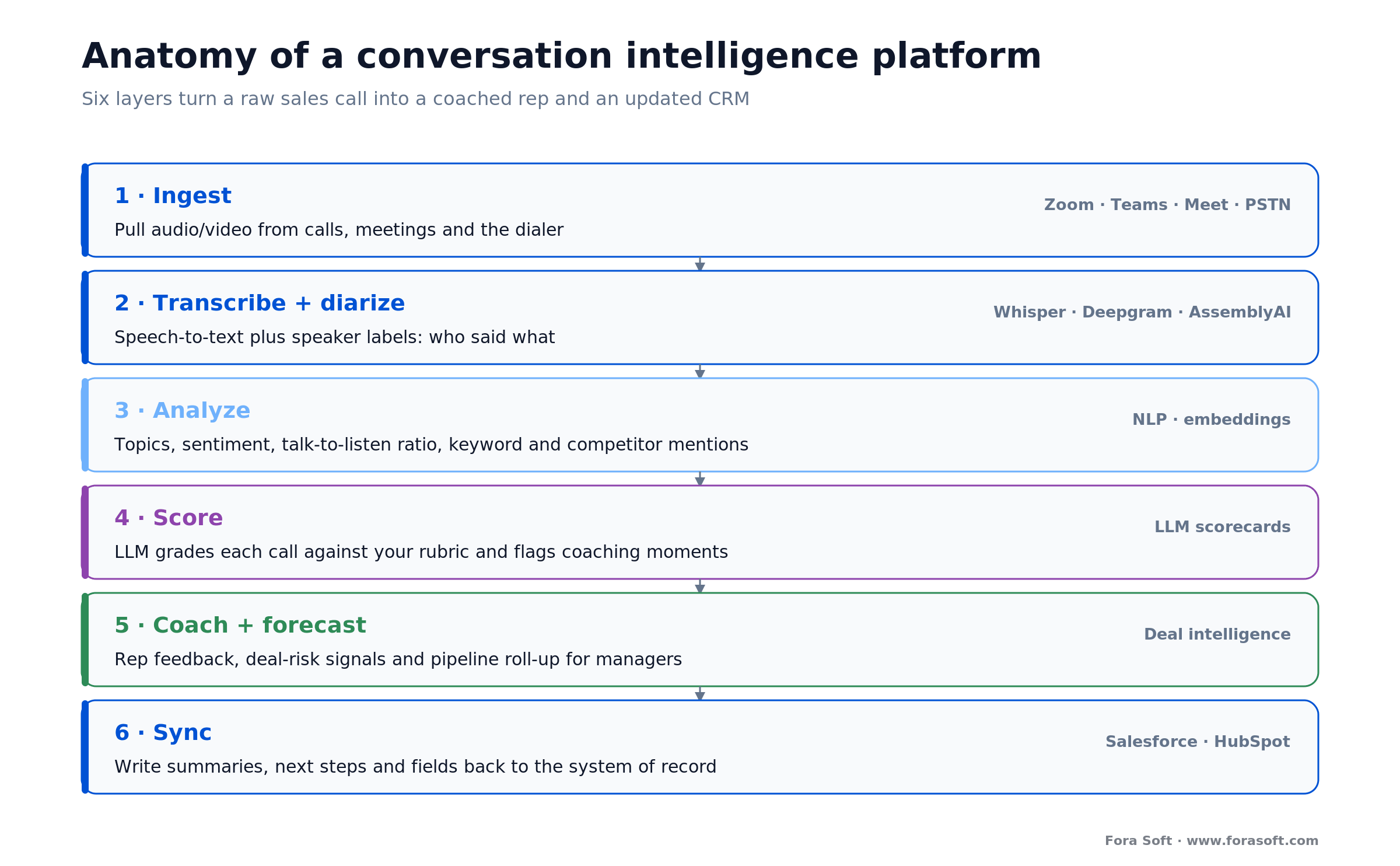
Figure 1. The six layers of a conversation intelligence platform, from pulling audio off the call to writing scored summaries back into Salesforce or HubSpot.
How call scoring AI turns a call into a grade
Call scoring AI runs a conversation through five stages: transcribe it, split it by speaker, extract signals, grade it against a rubric, and surface a coaching note. The first two stages are near-solved commodities. The last three are where a platform is actually worth paying for, or worth building.
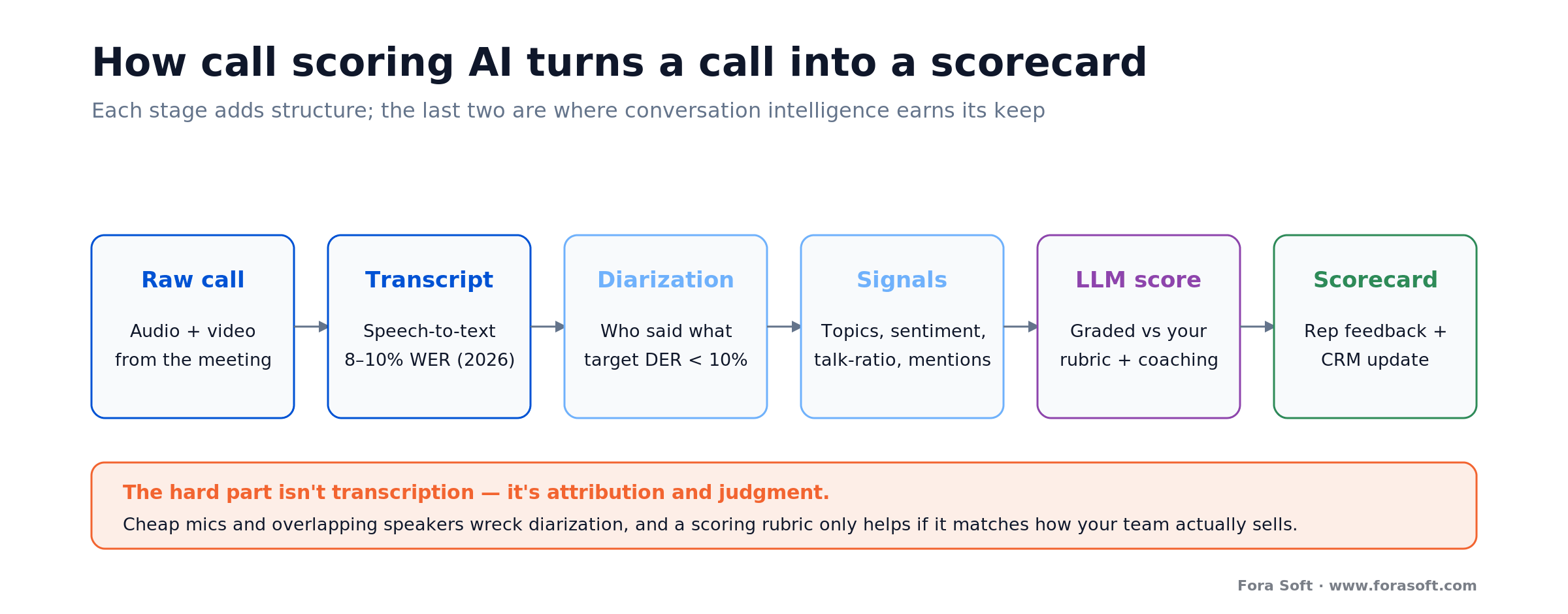
Figure 2. Each stage adds structure. The hard, valuable work is attribution and judgment, not transcription.
Signals. Once you have a labeled transcript, you extract measurable things: talk-to-listen ratio, longest monologue, topics discussed, sentiment, competitor mentions, and whether a next step was set. These are mostly deterministic or classifier-driven, and they’re the numbers a manager scans first.
The rubric score. This is the part that used to need a human. A language model reads the transcript and grades the call against your criteria: discovery questions asked, objections handled, pricing discussed, MEDDIC or BANT fields filled. An LLM does this well now, but only if the rubric is written for how your team actually sells. A generic scorecard produces generic, ignored scores.
The coaching cue. The final step turns a grade into an action: “you talked 71% of the call — ask more questions,” or “the buyer raised budget twice and you didn’t address it.” This is where retrieval helps too: once calls are stored and scored, you can let managers query past conversations in plain language to find every call where a deal stalled on the same objection.
The architecture: six layers you have to own or rent
Every conversation intelligence platform is built from the six layers in Figure 1, and for each one you decide to build it, rent it, or skip it. The trick to a sane budget is renting the commodity layers and spending your engineers only on the layer that makes your product different.
Ingest. You need audio. For virtual calls that means a capture layer for Zoom, Teams, and Meet; for phone sales it means tapping your dialer or telephony provider. Most teams should not build capture from scratch. It’s a fleet-scaling problem best rented from a meeting-bot vendor and reserved for a custom build only when capture itself is your moat.
Transcribe and diarize. Speech-to-text plus speaker labels. This is a solved, rentable commodity: Deepgram, AssemblyAI, and self-hosted Whisper all do it well. The real-time transcription pipeline is its own engineering effort if you need live scoring, and the diarization step deserves real attention — more on that below.
Analyze, score, and sync. The signal extraction, the LLM rubric, and the CRM write-back are the layers where your product earns its keep. This is where you spend engineering time, because a generic version already exists in every vendor. Your reason to build is a scoring model and workflow that fit your business, plus data that stays in your infrastructure.
Reach for a rented STT and diarization API when: you’re early, your call volume is modest, and English-heavy clean audio is your norm. Self-host only when data residency, cost at scale, or a niche language forces your hand.
Build vs buy: the honest trade-off
Buy conversation intelligence when it’s a tool your team uses; build it when it’s a product you ship or a feature inside your own app. That’s the one-line rule. A sales team that wants call scoring for its own reps should almost always buy. A software company that wants to put call scoring inside its product, or a business that can’t send customer audio to a third party, should build.
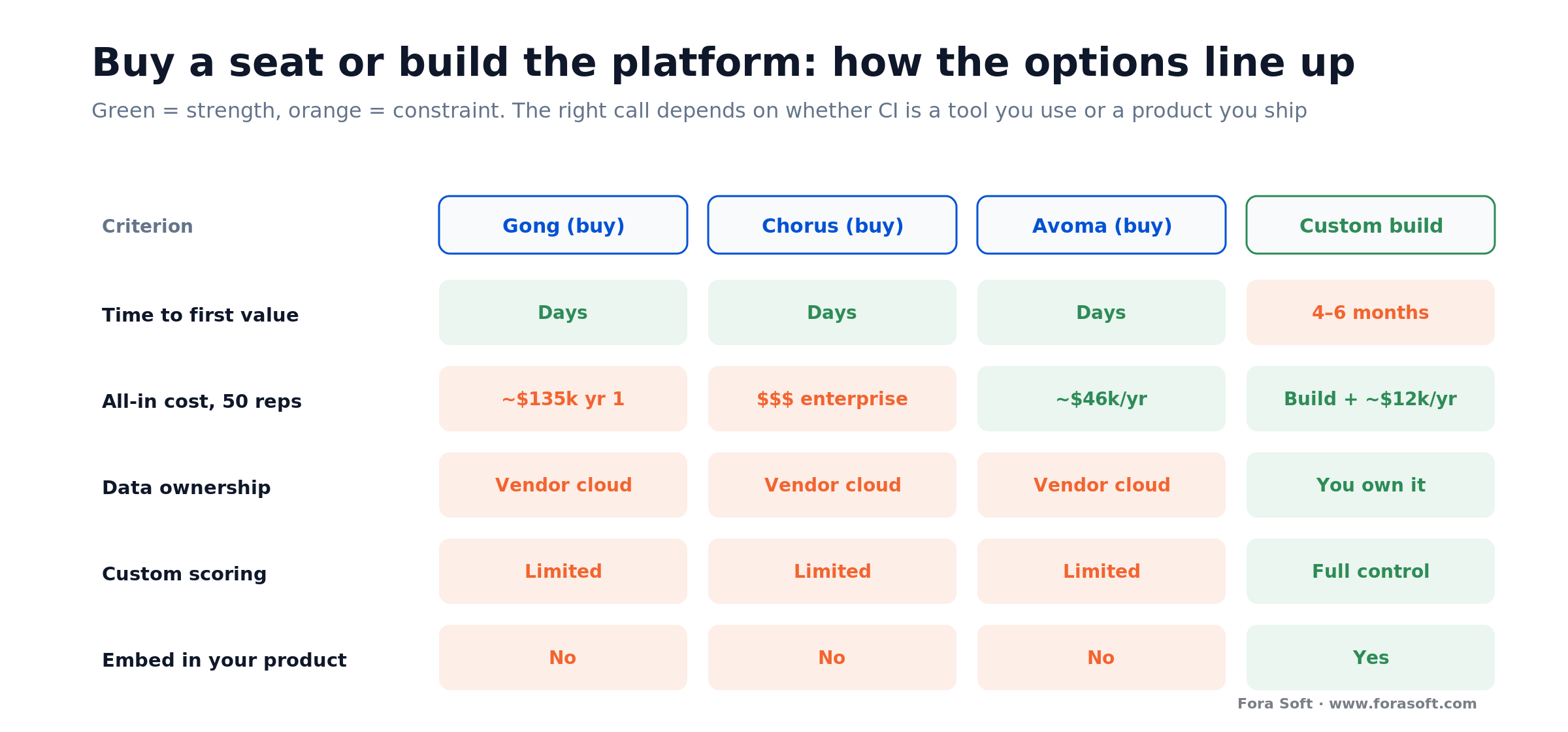
Figure 3. Where buying wins (speed) and where building wins (ownership, customization, and embedding CI in your own product).
Reach for buying when: your reps need scoring on internal calls, you want value this week, and your data can live in a vendor’s cloud. A tool like Gong or Avoma pays for itself in saved rep time before you’d finish a build.
Reach for building when: conversation intelligence is a feature of the product you sell, you need a custom scoring model, data residency rules out a vendor, or you want to stop paying per seat forever on a large team.
Gong, Chorus, Salesloft, Avoma, Fireflies compared
Gong leads on depth and enterprise polish; Avoma and Fireflies win on price; Chorus rides ZoomInfo’s data. If you’re buying, the right pick depends on your budget per seat and whether you need forecasting or just call notes. Prices below were captured from vendor and comparison pages on July 16, 2026, and seat pricing moves — confirm before you commit.
| Tool | Indicative price (2026) | Strength | Watch out for |
|---|---|---|---|
| Gong | ~$1,200–$1,600/user/yr + $5k–$50k platform fee | Deepest analytics, forecasting, market leader | Platform fee + implementation; no public pricing |
| Chorus (ZoomInfo) | Enterprise, quote-based | ZoomInfo data, 14 CI patents, deal intelligence | Best value only if you’re on ZoomInfo already |
| Salesloft Conversations | ~$125–$165/user/mo | Built into a full sales-engagement suite | Priced for the whole platform, not CI alone |
| Avoma | $19 base + $29 CI + $29 revenue = ~$77/user/mo | Modular, mid-market friendly, transparent pricing | Costs stack as you add modules |
| Fireflies.ai | Free tier + ~$10–$19/user/mo | Cheapest, quick to adopt, strong transcription | Lighter on deal analytics and coaching |
| Custom build | 4–6 mo build + ~$12k/yr to run (50 reps) | You own the data, the model, and the roadmap | You own the maintenance too |
Two honest caveats. Gong doesn’t publish list pricing, so the numbers above are third-party estimates, so expect the effective per-user cost to land two to three times the headline seat rate once the platform fee and implementation are in. And Chorus makes the most sense as an add-on if your team already lives in ZoomInfo; standalone, Gong usually wins the bake-off.
What building a conversation intelligence platform really costs
At 50 reps, buying Gong runs about $135k in year one and roughly $105k a year after; building your own is a 4–6 month project you then run for about $12k a year. The build looks more expensive until you notice it never charges per seat and the data stays yours. Let’s do the arithmetic out loud.
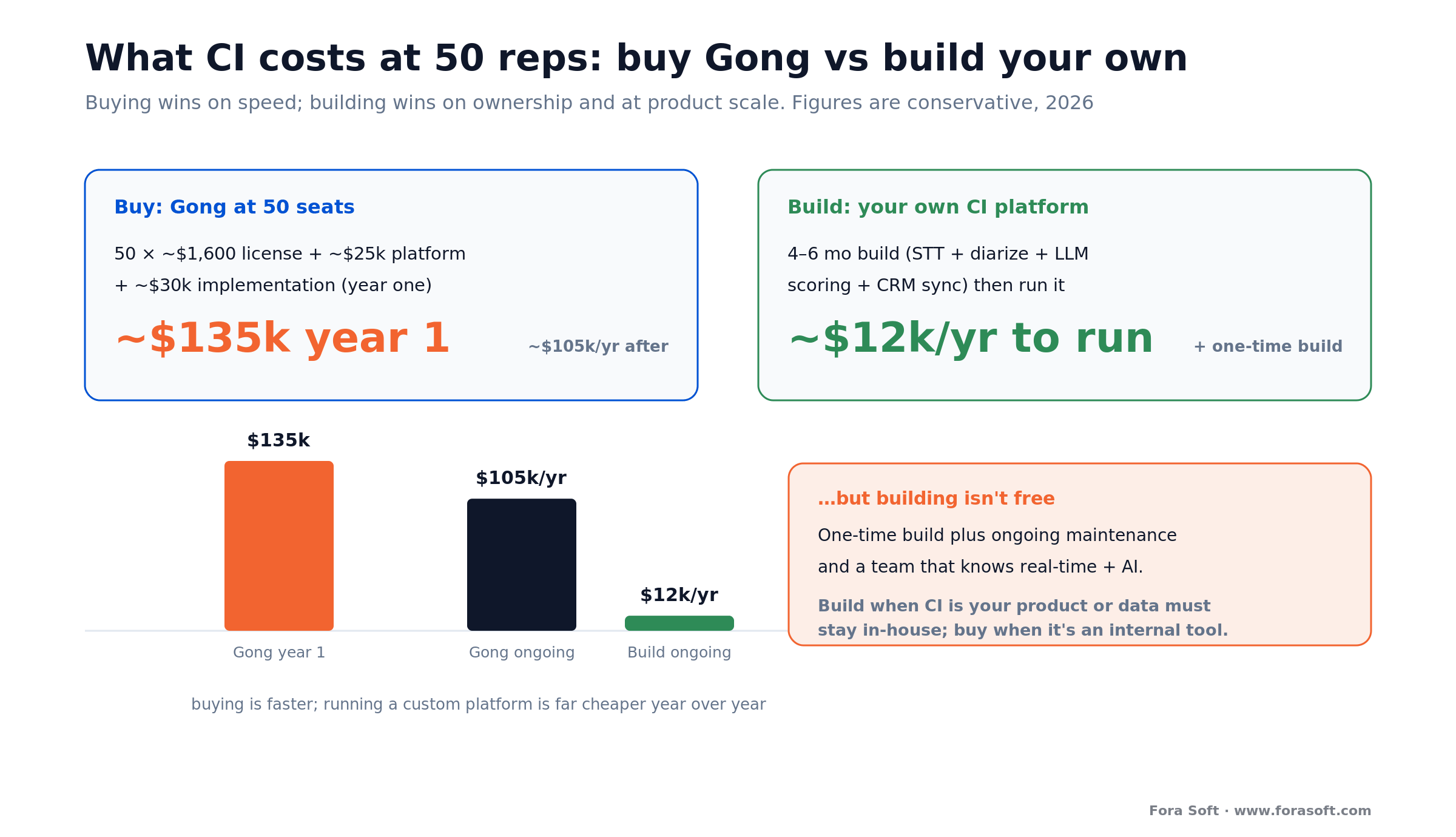
Figure 4. The same 50-rep team priced two ways. Buying is faster; running a custom platform is far cheaper year over year — but the build and its maintenance are real.
Buy. 50 seats × ~$1,600/user/yr = $80,000, plus a platform fee around $25,000 and roughly $30,000 of implementation in year one. That’s about $135,000 year one, then ~$105,000 a year for license and platform. Fast, supported, no engineers.
Build: running cost. Rent the commodities. For 50 reps doing ~40 calls a month at half an hour each, that’s ~1,000 call-hours a month. Transcription and diarization at ~$0.30/hour = $300/month. LLM scoring at ~$0.20 per call × 2,000 calls = $400/month. Infra, storage, and CRM sync ~$300/month. Total ~$1,000/month, or ~$12,000/year to operate.
Build: the one-time part. The honest cost is the build itself: a focused platform that ingests calls, transcribes and diarizes, scores against your rubric, syncs to your CRM, and shows a dashboard. With our Agent Engineering approach that’s a 4–6 month effort, and we keep the estimate conservative rather than sell you a bigger build than you need. Add ongoing maintenance as models and CRMs change.
Where it pays off. The running gap is stark: ~$105k/year rented versus ~$12k/year owned. If conversation intelligence is a feature you resell, or your seat count keeps climbing, the build amortizes fast. If you’re a 15-person sales team that just wants call notes, it never will — buy. We’ll tell you which case you’re in on a call.
Want the break-even for your team?
Tell us your seat count, call volume, and CRM. We’ll model buy vs build and hand you the real number — not a sales pitch.
What building a CI platform takes: team and timeline
A working conversation intelligence platform is a 4–6 month build for a small cross-functional team: two backend engineers, one ML/LLM engineer, a frontend engineer, and a part-time designer and QA. That’s the shape of the Meetric build, and it’s the shape we’d scope for most first versions. You don’t need a research lab; you need people who’ve wired STT, an LLM, and a CRM together before.
The timeline splits cleanly. Weeks 1–2 go to consent design and the data model, because getting those wrong is expensive to unwind. The next month wires ingest, transcription, and diarization — mostly integration work against rented APIs. The heavy lift is the middle stretch: the scoring rubric, the LLM prompts, and the CRM write-back, tuned against your own calls. The last few weeks are dashboards, QA on real audio, and the security review.
Most of the calendar goes where the value is. Transcription is a week of plumbing; a scoring model your reps trust is two months of iteration. Budget your best engineering time for the layers a vendor can’t copy, and rent everything else. That’s how Agent Engineering keeps our estimates below the industry norm without cutting the parts that matter.
Closing the loop: CRM sync and revenue intelligence
The value of conversation intelligence shows up when the score and summary land in the CRM without a rep typing. That last hop, writing the call summary, the next step, and the deal risk back into Salesforce or HubSpot, is what turns a call recorder into a revenue tool. On Meetric we automated 80–100% of that data entry, which is where most of the time savings came from.
Two flavors exist. Post-call sync is the default: the call ends, the platform generates a summary and updates fields a few minutes later. Real-time scoring acts during the call — live objection alerts, a battlecard when a competitor is named, or a nudge when the rep is talking too much. Real-time is harder and more expensive, and it needs the per-speaker, low-latency pipeline that batch scoring doesn’t.
Reach for real-time scoring when: you sell in high-stakes live calls where an in-the-moment nudge changes the outcome. If you only review calls after the fact, batch scoring is cheaper and simpler — don’t pay for latency you won’t use.
Integrations: the sales stack a CI platform plugs into
A conversation intelligence platform is only as useful as its connections: it has to pull calls in from wherever they happen and push results out to wherever your team works. Two integrations are non-negotiable — the source of calls and the CRM — and a few more make the difference between a tool people love and one they ignore.
Call sources. For virtual meetings that’s Zoom, Teams, and Meet capture; for phone sales it’s your dialer or telephony provider (Twilio, Aircall, or a contact-center platform). Each has its own auth, media format, and rate limits, which is why teams that need every channel usually rent capture rather than build it per source.
CRM write-back. Salesforce and HubSpot are the common targets. The integration isn’t just “attach a recording” — it maps call outcomes to fields, updates deal stages, and logs next steps, ideally without creating duplicate activities. This is fiddly, high-value work, and it’s the first thing reps notice when it’s wrong.
Where the team lives. Slack or Teams alerts for at-risk deals, a BI export for RevOps, and single sign-on for the whole company round out a real deployment. None of these are hard on their own; together they’re what turns a scored transcript into a habit.
Accuracy: why “who said what” is the hard part
Transcription is close to solved; speaker attribution is not. In 2026, AssemblyAI’s Universal-3 Pro Streaming posts an 8.14% word error rate versus Deepgram Nova-3’s 9.87% across 4M+ production calls, and clean-audio accuracy sits at 95–98%. Anything under a 10% word error rate is usable; under 5% is strong. Raw words are the easy win.
Diarization, deciding which words belong to which person, is where quality lives or dies. A good target is a diarization error rate under 10%; independent testing put Fireflies at 92.8% accuracy (a 7.2% error rate) over 500+ hours in 2026. On messy audio (cheap laptop mics, people talking over each other, a room with two people on one device), diarization degrades fast, and a score attributed to the wrong speaker is worse than no score. If attribution matters to your product, choosing the right engine is a real decision; we broke down the options in our speaker diarization API comparison.
Test diarization on your real calls early, not on clean demo audio. The gap between a benchmark and your actual sales floor is the number that will surprise you. Audio quality upstream matters more than most teams expect, which is why we treat audio engineering as a first-class part of the build, not an afterthought.
KPIs: what a healthy CI platform looks like
Three numbers tell you whether your platform is working: capture quality, adoption, and the business metric your team actually buys. Pick one hard figure in each and watch it weekly — a scored call nobody reads is worth nothing.
Capture quality. Word error rate and diarization error rate on your real calls, plus the share of calls that get captured and scored end to end. If 8% of calls silently fail to record, you’re coaching on a biased sample and don’t know it.
Adoption. The percentage of reps and managers who open a scorecard each week. Conversation intelligence lives or dies on whether people trust the scores enough to act on them. Low adoption almost always traces back to a rubric that doesn’t match how the team sells.
Business impact. The metric your team was hired to move — for Meetric that was close-rate lift and the share of CRM data entry automated. Tie the platform to a dollar outcome or nobody will fund the next improvement.
Consent, PCI, and GDPR you can’t skip
Recording a sales call is a legal act, and consent design is part of the architecture, not a footnote. If your platform records people, you need to collect, log, and honor consent from the first line of code — retrofitting it after launch is how projects end up in front of lawyers.
All-party consent. Twelve US states require every participant to consent to recording in 2026: California, Connecticut, Delaware, Florida, Illinois, Maryland, Massachusetts, Montana, New Hampshire, Oregon, Pennsylvania, and Washington. One rep clicking “record” isn’t enough — the buyer has to be notified and agree, and your app has to log it.
Europe is stricter. GDPR Article 7 requires consent that is specific, informed, freely given, and unambiguous, and Germany’s §201 StGB makes unauthorized recording of private speech a criminal offense. Build clear notice, easy withdrawal, and encrypted storage from day one.
PCI, if cards get spoken. If a customer reads a card number aloud on a recorded call, that recording and its transcript fall into PCI-DSS scope. You need to detect and redact the PAN and CVV before storage, or keep those recordings out of your general store entirely. Plan the redaction step; don’t discover it in an audit.
Mini-case: sales-call analytics for Meetric
A client came to us with a strong sales-presentation tool and one hard requirement: run the same deep analytics on every call, whether it happened on Zoom, Google Meet, or Microsoft Teams, and push the results into the CRM automatically. That’s conversation intelligence in its purest form — capture across three platforms, uniform scoring out the other end.
We built Meetric with proprietary live video conferencing plus capture across all three platforms, then layered engagement tracking, speech analysis, and automated post-meeting reports on top. During calls it measures attention and talk-time balance; after calls it generates a summary of objections, pain points, and next steps, and writes them back to the CRM. Consent, encryption, and GDPR alignment were designed in, not bolted on.
The outcome: 25% higher close rates, coaching made roughly 30× more efficient, and 80–100% of CRM data entry automated straight from the conversation. The platform raised SEK 21M. A basic build of this kind takes about 2–4 months; the full version with AI analytics and multi-platform capture ran 4–6 months. Want a similar assessment of your call stack? Grab a 30-minute call.
A decision framework in five questions
Five questions decide your path: who uses it, data rules, custom scoring, real-time need, and seat count. Answer them in order and the choice — buy a tool or build a platform — usually makes itself.
1. Who uses it? If it’s your own reps, buy. If it’s a feature inside a product you sell to customers, build — you can’t resell someone else’s vendor seat.
2. Where can the data live? If contracts or regulation forbid sending customer audio to a third party, a custom build in your own infrastructure is the only path.
3. How custom is your scoring? If a generic scorecard fits, a vendor is fine. If you sell in a way no off-the-shelf rubric captures, you need a model you control.
4. Real-time or after the fact? Live in-call guidance pushes you toward a custom low-latency pipeline. Post-call review works on almost any tool.
5. How many seats, and growing? Under ~20 reps, per-seat pricing is cheap next to a build. Into the hundreds, the per-seat bill starts to fund an owned platform outright.
When NOT to build a conversation intelligence platform
Don’t build if conversation intelligence is a tool your team uses rather than a product you sell, your seat count is small, and your data can live in a vendor’s cloud. In that case a custom platform is a maintenance burden you’ll carry forever for no competitive gain. Honesty here saves you a 4–6 month build.
If you’re a sales team that wants call scoring for your own reps, buy Avoma or Fireflies and spend the engineering budget on your actual product. If you record a few hundred calls a month, the per-seat fee is rounding error next to a developer’s salary. And if your requirements are generic, a vendor already built a better version of the thing you were about to spec.
Build when conversation intelligence is the product: you’re embedding call scoring in your own app, you need a rubric no vendor offers, data residency rules out a third party, or your seat count makes per-seat pricing hurt. Everywhere else, buying is the smarter engineering decision — and we’ll say so on the call rather than sell you a build you don’t need.
Five pitfalls that sink CI projects
Most conversation intelligence builds don’t fail at the demo; they fail a few months in, on the same five problems. Knowing them upfront is the difference between a launch and a rewrite.
1. Treating diarization as solved. “Who said what” breaks on real, messy calls. Test it on your own audio before you promise per-rep scoring.
2. A generic scoring rubric. A scorecard that doesn’t match how your team sells produces scores nobody trusts. Co-design the rubric with your best reps.
3. Skipping consent until legal review. Recording without logged consent is a lawsuit risk in all-party states. Design consent capture before the capture code.
4. Half-built CRM sync. If the summary doesn’t land cleanly in Salesforce or HubSpot, reps go back to manual notes and your ROI evaporates. Treat the write-back as a core feature.
5. Building the commodity layers. Writing your own speech-to-text to save a few cents an hour burns months you should spend on scoring. Rent the plumbing.
FAQ
What is conversation intelligence software?
It’s software that records sales and support calls, transcribes and labels them by speaker, analyzes what was said, and turns each conversation into a score, a coaching cue, and a CRM update. Gong, Chorus, Salesloft, Avoma, and Fireflies are the best-known tools. It sits on top of call capture and answers the questions a sales manager cares about.
How does call scoring AI work?
A call is transcribed, split by speaker, and reduced to signals like talk-to-listen ratio and competitor mentions. A language model then grades it against your rubric — discovery questions, objections handled, next steps set — and produces a coaching note. The transcription is a commodity; the rubric and the coaching are where the value is.
What’s the best conversation intelligence software in 2026?
There’s no single winner. Gong leads on depth and forecasting but is the priciest and hides its pricing. Avoma is the transparent mid-market pick at ~$77/user/month fully loaded. Fireflies is the cheapest at ~$10–$19/user/month. Chorus is strongest if you’re already on ZoomInfo. Build your own when CI is a feature of your product.
How much does conversation intelligence software cost?
For buyers, per-seat pricing runs from ~$10–$19/user/month (Fireflies) to ~$77 (Avoma), ~$125–$165 (Salesloft), and a Gong bundle around $1,200–$1,600/user/year plus a $5k–$50k platform fee (all captured July 2026). Building your own for 50 reps is a 4–6 month project plus about $12,000/year to run.
Should I build or buy a conversation intelligence platform?
Buy when it’s a tool your own reps use; build when it’s a feature inside a product you sell, when data can’t leave your infrastructure, when you need custom scoring, or when your seat count makes per-seat pricing painful. Most sales teams should buy. Software companies embedding CI in their app should build.
How accurate is call transcription and speaker labeling?
Transcription is strong: leading engines hit 8–10% word error rate and 95–98% accuracy on clean audio in 2026. Speaker diarization is harder — aim for a diarization error rate under 10%, and expect it to degrade on cheap mics and overlapping speakers. Test attribution on your real calls, not demo audio.
Is it legal to record and analyze sales calls?
Only with proper consent. Twelve US states require all-party consent in 2026, GDPR Article 7 governs Europe, and Germany adds criminal penalties for unauthorized recording. If card numbers are spoken, recordings fall into PCI scope and need redaction. Build consent capture, logging, easy withdrawal, and encryption in from day one, and consult a lawyer for your jurisdictions.
How long does it take to build a conversation intelligence platform?
A basic version (capture, transcription, diarization, scoring, and CRM sync) takes about 2–4 months. A full platform with custom AI analytics and multi-platform capture runs 4–6 months, which is the range our Meetric build landed in. The commodity layers are rented; the time goes into the scoring model and the CRM write-back.
What to read next
AI & agents
Meeting bot API architecture
The capture layer under conversation intelligence — how to get audio out of Zoom, Teams, and Meet.
Audio
Speaker diarization APIs compared
AssemblyAI vs Deepgram vs Pyannote for the “who said what” layer.
AI & agents
RAG over call recordings
Let managers query every past conversation in plain language.
Audio
Speech-to-text for live streaming
The real-time transcription pipeline that feeds live call scoring.
Ready to score every call?
Conversation intelligence software records calls, scores them, coaches reps, and updates the CRM without anyone typing. Transcription is a solved commodity; the value is in speaker attribution, a rubric that fits your team, and a clean write-back to Salesforce or HubSpot. For most sales teams a tool like Gong or Avoma beats building. When CI is your product, your data must stay in-house, or your seat count is large, owning the platform wins.
Whichever way you’re leaning, get consent design right, test diarization on real calls, and rent the commodity layers. Our AI integration team has built call analytics end to end — if you want a second opinion on buy vs build, that’s a conversation we enjoy having.
The book · Volume 6 of 7
AI for Video: A Complete Guide to Intelligence in Video Products: From Models and Inference to Computer Vision, Speech, Search, and Generative Video
A call score is only as good as the transcript and the speaker labels under it. Volume 6 of our handbook covers speech recognition, diarization and TTS, search and RAG over recorded conversations, and the lifecycle of an AI feature from model choice to deployment topology. It is the reference for teams deciding which parts of a CI pipeline to own. Written by Nikolay Sapunov, CEO at Fora Soft.
Read it on Amazon →Kindle & paperback · Fora Soft Video Engineering Handbook
Let’s design your call-analytics stack
Bring your seats, call volume, and CRM. We’ll tell you buy or build, what to rent, and what it’ll actually cost — no obligation.