
Key takeaways
• Match the tool to the job, not the demo. Cartesia wins at real-time voice agents, OpenAI at cheapest-and-bundled, Google at languages and a free tier, Azure at compliance and custom brand voices, PlayHT at cloning breadth, Murf at a studio UI for teams, and open-source at data control.
• Compare per 1M characters, not per subscription. ElevenLabs bills $0.10 per 1K characters ($100/1M) on Multilingual v2/v3 and $0.05 ($50/1M) on Flash (elevenlabs.io, July 16, 2026). Google WaveNet is $4/1M, OpenAI’s gpt-4o-mini-tts works out to roughly $16/1M. The spread is more than 20×.
• Latency and per-character cost pull in opposite directions. ElevenLabs Flash streams first audio in ~75ms; its higher-quality Multilingual model sits at ~250–300ms. Cartesia advertises ~40ms but a public production benchmark measured a 188ms median. Budget the number you’ll actually ship, not the marketing one.
• Do not build a custom pipeline to save money on synthesis. The cheap managed APIs already cost cents. You self-host or build for data residency, voice ownership, sub-100ms control, or freedom from per-character metering at high volume, not to undercut a $16/1M API.
• Sometimes the answer is: don’t switch. If ElevenLabs’ expressiveness is your product’s edge and your volume is modest, staying put is the right call, and we say so below with the math.
Voices are one line on the bill. All vendor comparisons, priced the same way.
Why Fora Soft wrote this comparison
Every vendor on the first page of Google for “elevenlabs alternative” ranks itself first. Cartesia’s list crowns Cartesia, WellSaid’s crowns WellSaid, Murf’s blog compares everyone to Murf, and the free-tool videos push whatever has an affiliate link. Nobody in that top ten prices the options per million characters, measures real time-to-first-audio, or treats the choice every engineering team eventually faces: self-hosting or building the pipeline yourself. That gap costs money. Picking the wrong lane at 10 million characters a month is a five-figure annual mistake.
We’re Fora Soft, a 50-person team building video, real-time and AI software since 2005, with 250+ shipped projects. We don’t sell a text-to-speech product, so we have no dog in this fight. What we do sell is AI integration work: we’ve wired these speech APIs into production products, from voice assistants to real-time interpretation, and we get paged when they misbehave at 2 a.m. When a vendor stops fitting, our custom text-to-speech development team builds the self-hosted pipeline described below.
So this review does what the vendor lists won’t: every price below was pulled from the vendor’s own pricing page on July 16, 2026, with the date attached; every latency figure names whether it’s a marketing claim or a measured benchmark; and the “build or self-host” option gets the same honest treatment as the managed tools, including the many cases where it’s a bad idea. If you want a listicle of ready-made voice apps to click around in, our roundup of synthetic voice library apps covers that. This piece is for the person who has to put a voice API into a product and defend the bill.
ElevenLabs alternatives at a glance
The best ElevenLabs alternative in 2026 depends on what you’re building: Cartesia for low-latency real-time voice agents, OpenAI’s gpt-4o-mini-tts when you want the cheapest option bundled with the model you already call, Google Cloud TTS for language coverage and a genuinely useful free tier, Azure AI Speech for compliance and trainable brand voices, PlayHT (now Play.ai) for voice-cloning breadth and turnkey agents, Murf for a studio UI your marketing team can drive without code, and an open-source stack (Chatterbox, Kokoro, Orpheus) when audio must stay on your own hardware. Past serious volume, or when you need control the managed tiers won’t sell, a custom pipeline beats all of them, though rarely on synthesis cost alone.
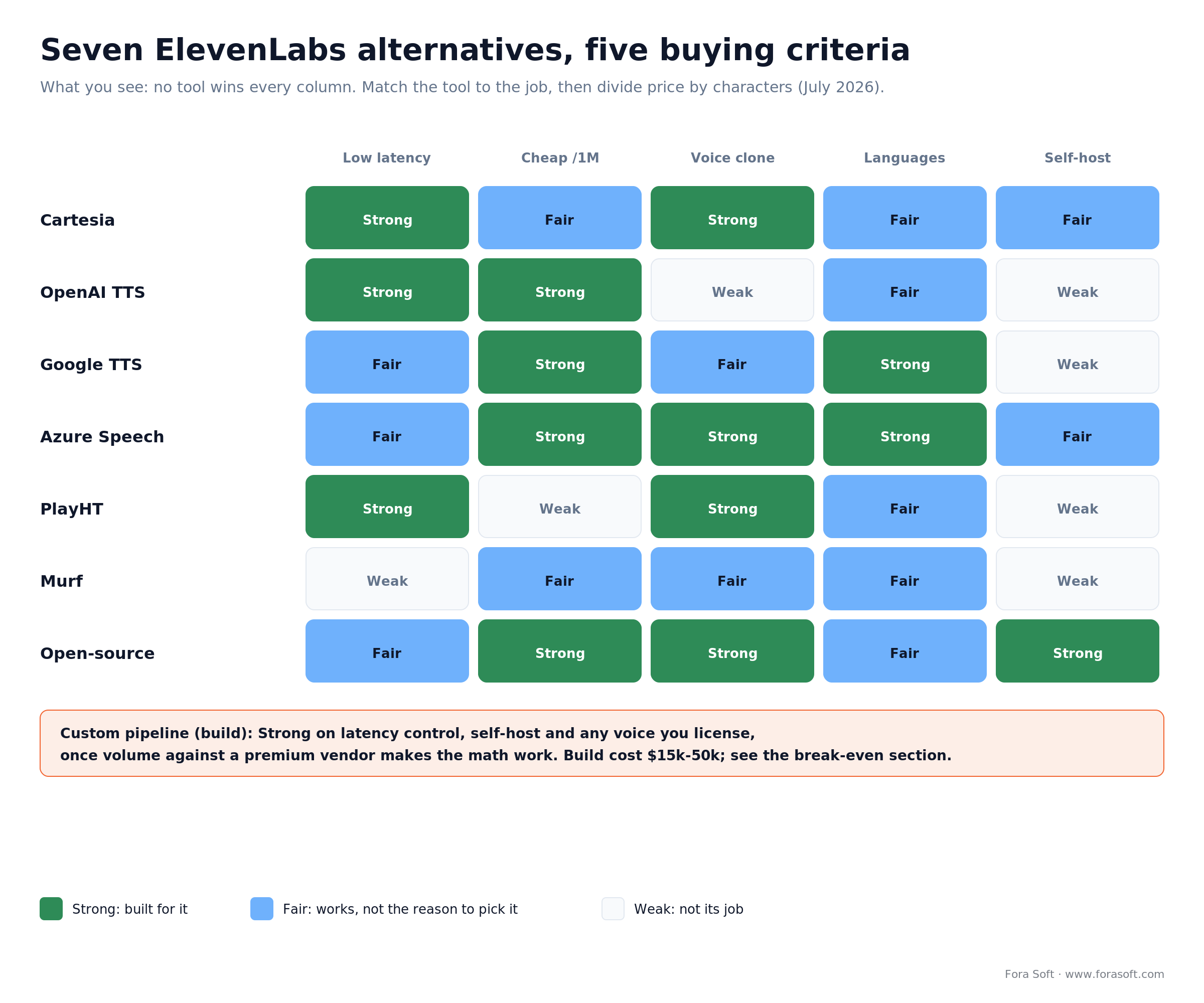
Figure 1. The seven text-to-speech alternatives, five buying criteria. No tool scores green everywhere, which is exactly why per-subscription comparisons mislead.
Why teams leave ElevenLabs
Three reasons come up in nearly every migration conversation we have. First, per-character cost at scale. ElevenLabs bills $0.10 per 1,000 characters on its high-quality Multilingual v2/v3 model and $0.05 on the faster Flash and Turbo models (published API rates, July 16, 2026). That’s excellent for a demo and painful for a product streaming millions of characters a month. At 10 million characters, Multilingual is $1,000 a month before you’ve shipped a single new feature.
Second, the quality-versus-latency fork. The voice everyone falls in love with in the ElevenLabs demo is the Multilingual model, which streams first audio around 250–300ms. Drop to Flash for the ~75ms that a live voice agent needs and the delivery gets noticeably flatter. Teams building conversational products discover the voice they demoed isn’t the voice they can afford to run in real time, and start shopping for one engine that does both.
Third, control. The cloned voice you train lives inside ElevenLabs; you can’t export a model and run it on your own hardware. For healthcare, banking, government or anyone with a data-residency clause, “the audio and the voice model sit on a third-party cloud” is sometimes a hard no. That’s the point where the open-source and custom lanes stop being hypothetical and become the requirement.
How we evaluated the tools
Honesty first: we’re not a review farm running the same paragraph through twenty voices. We’re an engineering shop that integrates these APIs into client products, so our lens is a buyer’s lens. We weighted five things: price per million characters (from vendor pricing pages, July 16, 2026), latency and whether the vendor’s number is a marketing claim or a measured benchmark, voice-cloning terms including who owns the trained voice, language coverage, and deployment options, meaning whether you can ever run it on your own infrastructure.
One caveat worth stating plainly: speech models update constantly and quality opinions age fast. Prices below carry their pull date, latency figures name their source, and where we haven’t run a tool in production we say so rather than invent an anecdote. Voice quality itself is subjective, so we point to published blind tests rather than pretend our ears are the standard.
Paying ElevenLabs more each month than the feature earns back?
Send us your monthly character volume and use case; we’ll map it against every option in this article and tell you which lane is cheapest, in one call.
1. Cartesia: real-time voice agents
Cartesia built Sonic for one job the studio-first vendors treat as an afterthought: streaming speech fast enough that a live conversation doesn’t feel laggy. Its state-space model architecture is engineered for time-to-first-audio, and it’s become a default choice inside voice-agent stacks for exactly that reason. If your product is someone talking to your app and expecting an answer, Cartesia is the first name on the list.
Pricing (cartesia.ai, July 16, 2026). Free: 20,000 credits a month. Pro: $5/month for 100,000 credits (~133 TTS minutes) with a commercial license and instant voice cloning. Startup: $49/month for 1.25M credits (~1,667 minutes) plus professional voice cloning. Scale: $299/month for 8M credits (~10,667 minutes) with high concurrency. At one credit per character, the Scale tier works out to about $37 per million characters; professional cloning costs 1.5 credits per character.
Where it wins: latency, developer experience, and the fact that Cartesia will discuss on-premises and VPC deployment with a SOC 2 Type II posture, which matters when audio can’t leave your cloud. Where it breaks: the advertised ~40ms time-to-first-audio is a best case. A public production benchmark (Coval, captured May 4, 2026) measured Sonic-3’s median at 188ms with real jitter, so size your latency budget from the measured number, not the headline.
Reach for Cartesia when: you’re building a real-time voice agent, latency is the metric your users feel, and you want a vendor that will actually talk about running the model near your data.
2. OpenAI TTS: cheapest and bundled
If you’re already calling OpenAI for the language model, its text-to-speech is the path of least resistance and, for many workloads, the cheapest option on this page. The gpt-4o-mini-tts model produces natural, steerable speech (you can prompt the delivery style), and it lives in the same SDK and billing account as everything else you’re building.
Pricing (platform.openai.com, July 16, 2026). gpt-4o-mini-tts is token-based: $0.60 per 1M text-input tokens plus $12 per 1M audio-output tokens, which works out to roughly $0.015 per minute of audio, or about $16 per million characters on our conversion (see the cost section for the assumption). For live conversation, GPT-Realtime models price audio separately at $32/$64 per 1M input/output tokens, and a dedicated GPT-Realtime-Translate line runs $0.034 per minute.
Where it wins: price, zero new vendor to onboard, and prompt-steerable delivery. Where it breaks: there’s no arbitrary voice cloning (a deliberate safety choice), so you’re limited to the preset voices; the voices are good but not the most expressive on the market; and a 2,000-token input limit means you chunk long scripts yourself. For teams already deep in the OpenAI stack, our breakdown of what the Realtime API actually costs in production covers the conversational half in detail.
Reach for OpenAI when: you already call OpenAI, cost matters more than a bespoke cloned voice, and preset voices with prompt-controlled delivery clear your quality bar.
3. Google Cloud TTS: languages and free tier
Google Cloud Text-to-Speech is the workhorse when you need breadth: the widest language and locale coverage here, a tiered menu of engines from cheap-and-cheerful to LLM-grade, and a free monthly allowance big enough that a lot of the “free ElevenLabs alternative” chatter online is really people discovering Google. It’s the enterprise-safe default with IAM, VPC Service Controls and predictable per-character billing.
Pricing (cloud.google.com, July 16, 2026). Chirp 3: HD voices cost $30 per 1M characters (first 1M free each month). The legacy menu is cheaper still: Neural2 at $16/1M (1M free), WaveNet and Standard at $4/1M (4M free), Studio at $160/1M. The newer Gemini-TTS models are token-based (from $0.50/1M text-in plus $10/1M audio-out). For plain narration at volume, WaveNet at $4/1M is one of the lowest managed rates you’ll find anywhere.
Where it wins: language coverage, the generous free tier, cost at the low end, and enterprise governance. Where it breaks: the top-tier voices are expressive but the brand personality is muted next to ElevenLabs or Cartesia; custom voice creation is gated; and the sheer size of the voice catalog means picking the right one is its own small project.
Reach for Google when: you need many languages, a real free tier, the lowest per-character rate for narration, or enterprise controls that a procurement team will sign off on.
4. Azure AI Speech: compliance and custom voice
Azure AI Speech is the pick when the buyer is a compliance officer as much as an engineer. It ships a HIPAA BAA, FedRAMP authorizations and on-prem container deployment, and its Custom Neural Voice lets a brand train and own a signature voice under a gated, consent-checked process. For regulated industries that already run on Azure, it’s the fewest-new-approvals option.
Pricing (azure.microsoft.com, ~March 2026 update). Standard prebuilt Neural voices are $16 per 1M characters. Neural HD voices dropped to $22/1M in March 2026 (from $30). Commitment tiers cut the effective rate as low as $7.50/1M at volume, and the free tier covers 500,000 characters a month. Custom Neural Voice carries its own training and hosting fees on top.
Where it wins: compliance surface, commitment-tier economics at scale, on-prem containers, and a genuine own-your-brand-voice path. Where it breaks: the developer experience is heavier than Cartesia or OpenAI, Custom Neural Voice access is deliberately slow to grant (for good anti-abuse reasons), and out-of-the-box expressiveness trails the newest LLM-grade engines.
Reach for Azure when: you’re in a regulated industry, already live on Azure, or need a legally owned custom brand voice with a BAA behind it.
5. PlayHT / Play.ai: cloning and agents
PlayHT, now branded Play.ai, competes most directly with ElevenLabs on voice cloning and has leaned hard into turnkey voice agents. Its selling points are a large instant-clone library, a low-latency model tuned for conversation, and an agent product that packages speech-to-text, an LLM and text-to-speech so you can stand up a phone agent without assembling the stack yourself.
Pricing (play.ht / play.ai, July 16, 2026). Creator runs about €31/month for 3 million characters a year and ten instant voice clones; an Unlimited personal tier is about €49/month. Metered API access on premium voices is comparatively expensive per character (third-party trackers put it near $1.20 per 1,000 characters), so confirm the current rate on the vendor’s own page before you commit; the price you’re paying is cloning breadth and the agent layer, not raw synthesis.
Where it wins: instant cloning at volume, a conversational model, and a ready-made agent product. Where it breaks: per-character API pricing on the best voices is steep next to OpenAI or Google, the frequent rebranding and plan reshuffles make budgeting harder, and if all you need is narration you’re paying for features you won’t use.
Reach for PlayHT when: voice cloning breadth is central to your product, or you want a managed voice-agent stack rather than parts you wire together yourself.
6. Murf: studio for teams
Murf is the alternative for teams that want a product, not an API. Its timeline editor, voice library and collaboration tools are built for marketers, L&D teams and video producers creating voiceover without touching code. Think of it as the studio lane: the people who’d otherwise hire a voice actor, not the engineers wiring speech into an app.
Pricing (murf.ai, July 16, 2026). Studio plans: Free, Creator at $29/month ($19 annual, about 24 hours of generation a year), Business at $99/month ($66 annual, about 96 hours a year), and custom Enterprise. Murf also exposes an API: standard text-to-speech at $0.03 per 1,000 characters ($30/1M), a cheaper Falcon conversational model at $0.01/1K ($10/1M), plus translation and voice-changer endpoints.
Where it wins: a genuinely usable studio UI, team workflows, and a mid-priced API if you later want to automate. Where it breaks: the studio hours-per-year model is awkward if your usage is spiky, expressiveness sits mid-pack, and developers will find the API less mature than the dedicated infrastructure vendors.
Reach for Murf when: non-engineers own your voiceover, a polished editor beats an API, and you value collaboration over raw per-character price.
7. Respeecher: speech-to-speech for screen work
Every other tool in this comparison starts from text. Respeecher starts from a performance: an actor reads the line, and the model converts it into a different voice while keeping the timing, breath and intent of the original take. For film, TV and games that distinction is the whole job, and Respeecher’s own credits run to Oscar-winning features and an Emmy for the technology. It also now ships Respeecher Space, a real-time text-to-speech API, so one vendor can cover both the studio work and the in-product voice.
Pricing (respeecher.com, September 15, 2026). Two products, two models. The studio speech-to-speech work is custom-priced on volume, licensing and voice customisation. Respeecher Space, the real-time text-to-speech API, is pay-as-you-go at $2 per 60,000 characters, which Respeecher puts at roughly $2 an hour of audio, so about $33 per million characters with no subscription.
Where it wins: performance conversion, and provenance. Voices are licensed and their origin is documented, which matters when a studio has to answer for who owns the voice in a shipped title. Where it breaks: speech-to-speech needs a source performance, so it is not a drop-in for a product that generates speech from text alone; the studio side carries no public price, so budgeting it means a conversation rather than a calculator; and the sub-200ms latency is vendor-stated.
Reach for Respeecher when: the output is going on a screen, the voice has to carry an actor’s performance, and you need to prove where that voice came from.
8. Open-source: Chatterbox, Kokoro and friends
The self-hosted lane matured fast in 2026. Chatterbox from Resemble AI (MIT license) does zero-shot voice cloning from about five seconds of audio, with emotion control and 23 languages; Resemble’s own blind test reports listeners preferred its Turbo model 65.3% of the time versus ElevenLabs at 24.5% (a vendor-run test, so weigh it accordingly). Kokoro-82M (Apache-2.0) is tiny at 82 million parameters, runs faster than real time on ~2–3 GB of VRAM, and sounds excellent, but it doesn’t clone voices. Orpheus (Apache/MIT) is a 3B speech-LLM with cloning, guided emotion and streaming, and it wants real GPU headroom.
Watch the license. This is where teams get burned: XTTS-v2, still a popular cloning model, ships under Coqui’s non-commercial Public Model License, and Coqui the company shut down in early 2024. Chatterbox, Kokoro and Orpheus are the commercial-safe picks. The economics flip here: synthesis stops being metered. A rented RTX 4090 runs $0.34–$0.69 an hour and an L40S about $0.99 (RunPod, July 2026), and faster-than-real-time models put raw GPU cost per million characters in the low single digits. What you pay instead is engineering: pipeline glue, retries, QA on pronunciation and prosody, plus the licensing and consent workflow the SaaS bundled for you (our voice cloning guide walks through those traps).
Reach for open-source when: data residency or per-character cost at scale is the blocker, you have GPU access and an engineering owner, and a commercial-safe license (Chatterbox, Kokoro, Orpheus, not XTTS) is non-negotiable.
Comparison matrix
All prices pulled from vendor pricing pages on July 16, 2026. “Cost per 1M chars” uses the headline API rate for the named engine; token-based models are converted with the assumption stated in the cost section.
| Tool | Cost per 1M chars | Latency (TTFB) | Voice cloning | Self-host | Best for |
|---|---|---|---|---|---|
| ElevenLabs (baseline) | $50 Flash / $100 Multilingual | ~75ms Flash / ~250–300ms Multi | Yes (in-platform) | No | Best-in-class expressive voice |
| Cartesia (Sonic-3.5) | ~$37 (Scale tier) | ~40ms adv / 188ms P50 (benchmark) | Instant + pro | On-prem/VPC (Enterprise) | Real-time voice agents |
| OpenAI (gpt-4o-mini-tts) | ~$16 (token-based) | Low; realtime line available | No (preset voices) | No | Cheapest + bundled with LLM |
| Google Cloud TTS | $4 WaveNet / $16 Neural2 / $30 Chirp3 HD | ~200–400ms | Instant custom ($60/1M) | No | Languages, free tier, low cost |
| Azure AI Speech | $16 Neural / $22 HD (to $7.50 committed) | ~200–400ms | Custom Neural Voice (owned) | Containers | Compliance, custom brand voice |
| PlayHT / Play.ai | ~$1,200 metered / flat tiers | Low (conversational model) | Instant (large library) | No | Cloning breadth + agents |
| Murf | $30 API / $10 Falcon | Studio (async) | Limited | No | Studio UI for teams |
| Respeecher | ~$33 (Respeecher Space TTS API, PAYG $2/60k); speech-to-speech custom | Under 200ms, vendor-stated (real-time TTS API) | Yes, speech-to-speech plus licensed voice library | Cloud, on-prem, or self-hosted | Game and film voice work |
| Open-source (Chatterbox, Kokoro) | GPU only (~cents–low $) | Depends on your GPU | Yes (Chatterbox, Orpheus) | Fully | Data control, on-prem |
| Custom pipeline (Fora Soft) | $15k–$50k build, cents/1M run | Yours to tune | Any model you license | Fully | Voice as core product |
Not sure which of these fits your stack?
Thirty minutes with our engineers: we map your use case, character volume and compliance constraints to a shortlist, and tell you if staying put is the right call.
The per-character math that decides
Take a concrete workload: a product generating 10 million characters a month, roughly 185 hours of audio (English speech runs about 900 characters per spoken minute, the assumption behind every conversion here). Here’s what that costs across the lanes at July 2026 rates.
ElevenLabs: Multilingual at $0.10/1K = $1,000/month ($12,000/year); Flash at $0.05/1K = $500/month. Cartesia Scale tier ≈ $37/1M = ~$370/month. Google: Chirp 3 HD ~$270/month after the free million, Neural2 ~$160, WaveNet just ~$40/month. Azure: Neural ~$160/month, HD ~$220, or ~$75 on a commitment tier. OpenAI gpt-4o-mini-tts ≈ ~$165/month. Murf API ~$300/month, Falcon ~$100. The 25× spread between WaveNet and ElevenLabs Multilingual is the whole ballgame.
Self-hosted open-source: those 185 audio-hours cost only GPU time. A faster-than-real-time model like Kokoro on a rented L4 lands in the $20–$80/month range; a heavier cloning model like Chatterbox costs more but stays well under the managed rates. The money moves to engineering: a first production pipeline runs $15k–$50k to build on an API-first architecture (our published range, which we stand behind because Agent Engineering keeps our builds in weeks, not quarters).
The break-even formula is one line: months = build_cost ÷ (managed_monthly − self_host_monthly). Against ElevenLabs Multilingual: $15,000 ÷ ($1,000 − $100) ≈ 17 months. But against a cheap managed API like OpenAI or Google WaveNet at $40–$165/month, the denominator nearly vanishes and break-even runs into years. That’s the honest headline: you don’t build a custom TTS pipeline to beat a $16/1M API on price. You build it for data residency, voice ownership, latency you control, or freedom from metering, and only when volume against a premium vendor makes the math work.
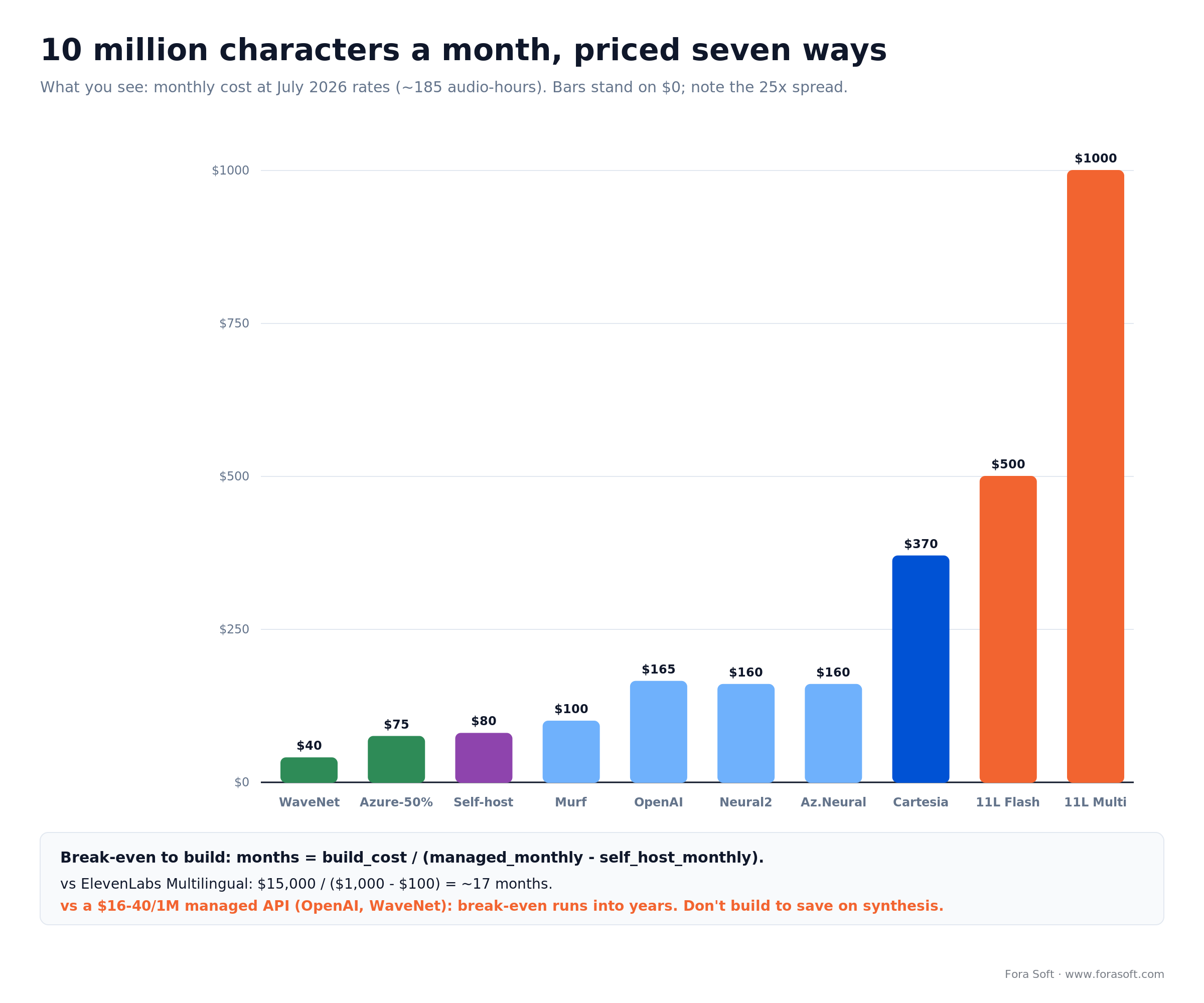
Figure 2. The same 10M-character workload priced across the seven text-to-speech tools, and why “build it ourselves” only pays against the premium end of the market.
Latency: what “real-time” really costs
For narration, latency barely matters; a batch job that finishes in two seconds instead of one is nobody’s problem. For a live voice agent, it’s everything. The full loop of hearing the user, thinking, and speaking has to land in well under a second or the conversation feels broken, and text-to-speech is only one slice of that budget. Reserve roughly 300ms for speech recognition, 200–400ms for the language model’s first token, and whatever’s left for speech synthesis onset and network.
That’s why the time-to-first-audio number matters more than voice quality for agents. ElevenLabs Flash streams first audio around 75ms; its prettier Multilingual model sits at 250–300ms, often too slow once you’ve spent budget upstream. Cartesia advertises ~40ms but benchmarked at a 188ms median in production (Coval, May 2026). Treat vendor headline latency as a best case and test with your own concurrency, because a number measured on an idle endpoint is not the number your users feel at peak. We built the real-time transport layer for exactly this class of product, which we cover in our guide to what the OpenAI Realtime API costs in production, and the model-family fundamentals live in our free audio-for-video course.
Our Solution: a custom TTS pipeline
We deliberately kept Fora Soft out of the numbered ranking: we’re not a text-to-speech vendor, and it would be dishonest to pretend otherwise. What we build is the eighth option, a pipeline you own, assembled from the best current parts. A rendering core that starts on a managed API for speed and swaps to a self-hosted model (Chatterbox for cloning, Kokoro for fast narration) when volume or data rules justify it. Consent capture, watermarking and moderation baked in, because voice-likeness misuse is a lawsuit, not an edge case. And a routing layer that picks the cheapest engine that clears the quality bar for each request.
The two-phase pattern matters more than any single component: start managed, instrument everything, then replace the metered stage first. Your first version calls a vendor API and ships in weeks. Metering data then tells you exactly which stage burns money, and that’s the one you take in-house. Teams that skip phase one build the wrong pipeline; teams that never leave phase one donate margin to their vendor forever. A voice feature of this class takes us 3–5 weeks to a first production version, landing in the $15k–$50k range we publish for AI integration projects. The same speech stack carries our dubbing and localization work, which we detail in our guide to AI video dubbing and lip sync.
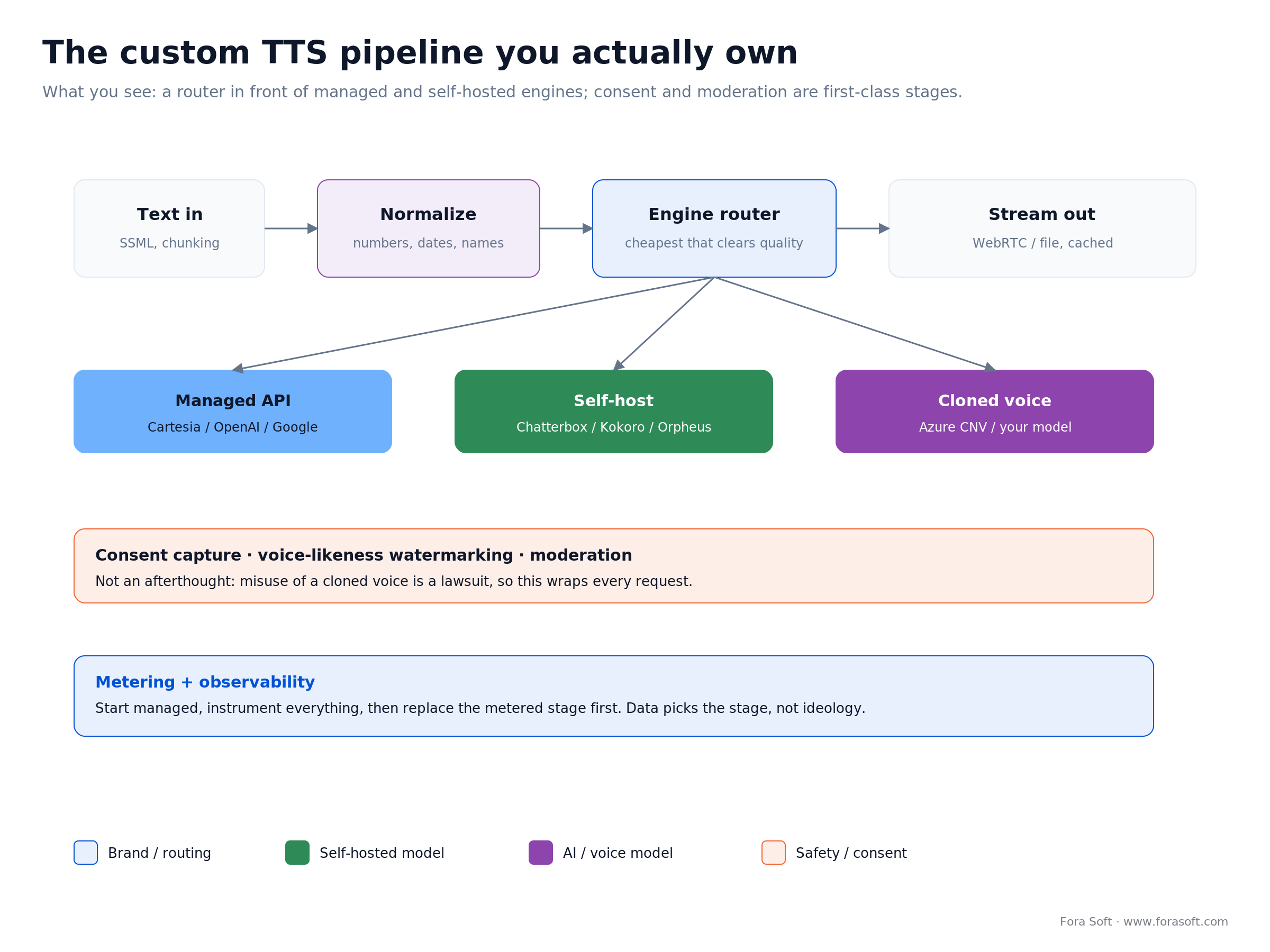
Figure 3. The pipeline you actually own: a router in front of managed and self-hosted engines, with consent and moderation as first-class stages, not afterthoughts.
Mini-case: TransLinguist
TransLinguist is a speech platform serving live interpretation across 62 languages, and it’s our clearest proof of the buy-then-build pattern this article recommends, on the same pipeline stages a TTS product uses: speech in, AI in the middle, speech out. The team started where we tell voice teams to start, on managed vendor APIs, with a cascade across several speech providers doing the heavy lifting.
Volume exposed the metered bottleneck. Interpretation punishes delay, and the all-vendor chain ran around 900ms end-to-end. We rebuilt the latency-critical path (streaming architecture, model routing per language pair, aggressive turn detection) and kept vendors only where they earned their per-minute fee. Result: latency down from ~900ms to ~380ms, word error rate held under 6%, and per-minute economics that survive scaling. The build sits on our Video Interpretations project line.
Swap “speech recognition” for “speech synthesis” and the playbook transfers one-to-one: instrument the vendor stage, find the line item that scales against you, replace that stage and only that stage. Want the same assessment run on your voice stack? Book a 30-minute architecture call and we’ll tell you which stage to keep buying.
Decision framework: five questions
1. How many characters a month, honestly? Under a million: stay on whatever you already use, the free tiers cover you. Low millions: pick the specialist that fits your use case. Tens of millions on a premium vendor: run the break-even formula from the cost section, because that’s where self-hosting starts to pay.
2. Is this narration or live conversation? Batch narration: optimize for price and quality (Google WaveNet, OpenAI, Azure). Real-time agents: optimize for time-to-first-audio first (Cartesia, ElevenLabs Flash, or a tuned pipeline) and test at your real concurrency.
3. Does the audio have somewhere it can’t go? Healthcare, banking, government: if recordings or the voice model can’t transit a third-party cloud, the open-source or on-prem lane (Azure containers, Cartesia VPC, self-hosted models) stops being optional.
4. Do you need to own a specific voice? If a signature brand voice is the product, you want either Azure Custom Neural Voice (owned, compliant) or a self-hosted cloning model you control, not a voice that lives inside a vendor you can’t export from.
5. Who owns it when it breaks? No engineering owner: stay managed, full stop. An owner but no team: an agency-built pipeline with a support contract splits the difference, and that’s the shape most of our voice engagements take. It’s a 30-minute conversation to scope.
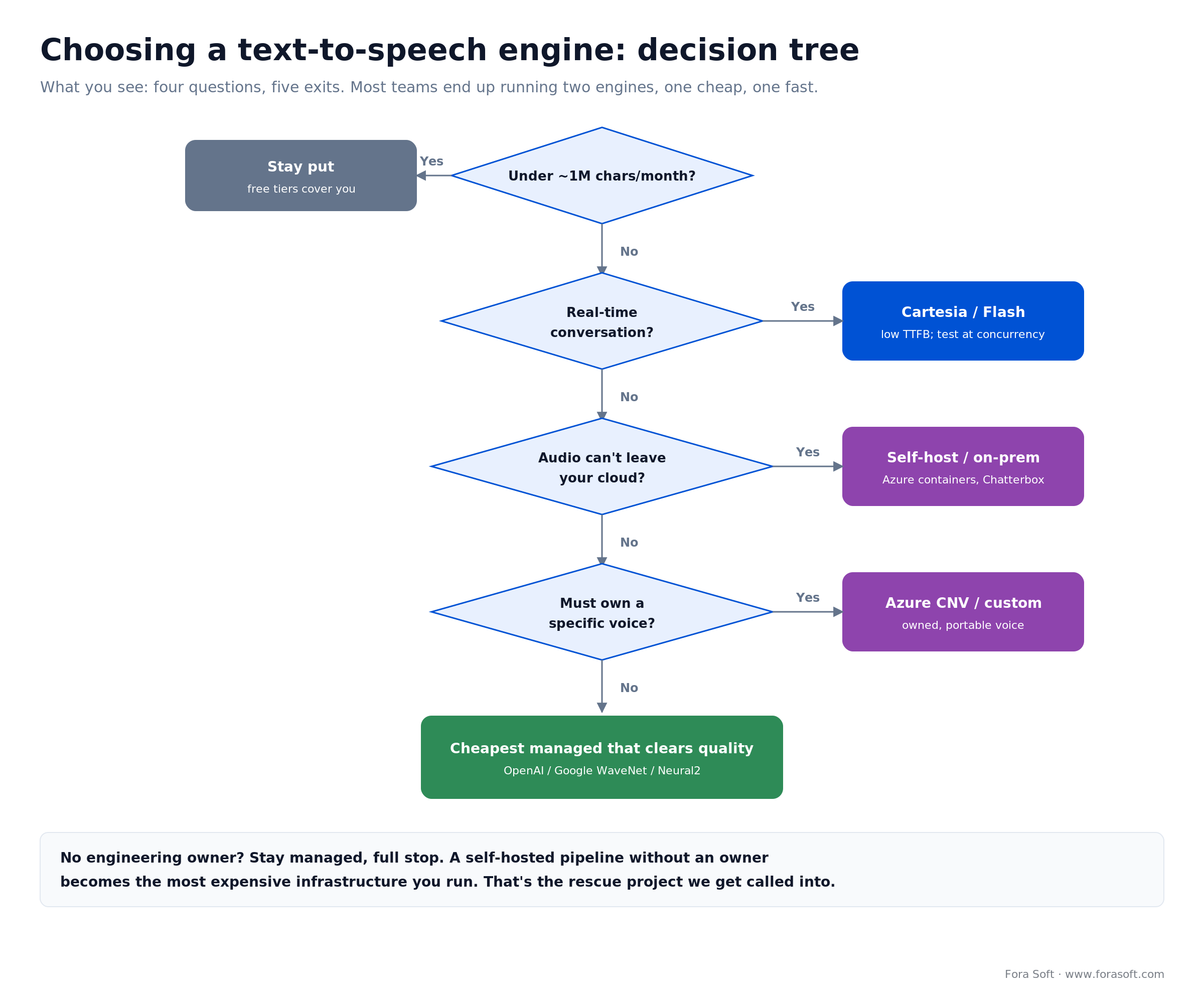
Figure 4. From monthly volume to voice ownership: most teams exit with two engines, a cheap one for narration and a fast one for the live path.
Want the break-even math run on your real numbers?
Bring your monthly character volume and use case; we’ll model managed vs self-hosted vs custom for your workload and hand you the spreadsheet either way.
When NOT to leave ElevenLabs
A comparison that never says “stay put” is an ad. So: stay on ElevenLabs if its expressiveness is your product’s edge. On emotional range and sheer naturalness the flagship Multilingual voice still leads much of the field in mid-2026. If your audience notices, audiobooks, character voices, premium brand content, the per-character premium is defensible.
Stay if your volume is modest. Under a couple million characters a month, the difference between $100/1M and $16/1M is real money but not migration-worthy money. No switch on earth pays back a problem you don’t have yet.
Stay if you need the whole toolbox. ElevenLabs bundles dubbing, voice changer, sound effects and a mature studio. Replacing one API is easy; replacing an ecosystem your team relies on is a project of its own.
And stay if there’s no engineering owner. A self-hosted pipeline without an owner rots into the most expensive infrastructure you’ve ever run. That’s not hypothetical; it’s the rescue project we get called into more than once a year.
Five pitfalls when switching
1. Comparing subscriptions instead of cost per million characters. A $29 plan means nothing until you divide by the characters it includes. WaveNet at $4/1M and ElevenLabs Multilingual at $100/1M are a 25× spread hiding behind similar-looking monthly prices.
2. Trusting headline latency. Vendors quote time-to-first-audio on an idle endpoint. Measure it yourself at your real concurrency, because the 40ms in the datasheet can be 188ms in production, and your users feel the second number.
3. Assuming your cloned voice migrates. It doesn’t. Every platform trains a proprietary voice from your samples and none exports a portable model. What’s portable is the consent recording itself: keep the raw audio and you can re-train on any platform, or on a model you host, in days.
4. Ignoring the open-source license. XTTS-v2 is popular and non-commercial; shipping it in a product is a legal problem, not a technical one. Confirm the license (Chatterbox, Kokoro and Orpheus are commercial-safe) before you build on a model.
5. Forgetting text normalization. The unglamorous work that decides whether “$1,499.99” and “Dr.” and “2026” sound right lives in your pipeline, not the model. Budget for a normalization and pronunciation layer, or every engine will mangle the same edge cases differently.
What to measure after the switch
Quality KPIs. A small human panel scoring naturalness monthly (engines update, so your scores should too), pronunciation-error rate on your domain vocabulary, and, for cloned voices, a similarity check against the source. Ears drift; keep a fixed test script.
Business KPIs. Cost per million characters (the number this whole article optimizes), cost per finished minute of published audio, and localization cost per language, the metric that usually justifies the whole program once you’re producing in more than a handful of languages.
Reliability KPIs. Synthesis success rate (alert under 99%), p95 time-to-first-audio for streaming, and p95 end-to-end latency with a sub-second ceiling for live agents. If you can’t chart these, you haven’t left the demo phase yet.
FAQ
What is the best free ElevenLabs alternative?
For a managed free tier, Google Cloud TTS is the most generous, with 1–4 million free characters a month depending on the engine (WaveNet gives 4M free at $4/1M after that). Much of the “free alternative” talk online is people discovering Google’s allowance. For genuinely unlimited free generation, a self-hosted open-source model like Kokoro or Chatterbox on your own GPU is the real answer: free in license fees, paid in setup time (July 2026).
What is the best open-source ElevenLabs alternative?
Chatterbox (Resemble AI, MIT license) is the most complete option for cloning: zero-shot from about five seconds of audio, emotion control, 23 languages, and commercial-safe. Kokoro-82M (Apache-2.0) is the fastest and lightest if you don’t need cloning, and Orpheus 3B adds streaming and guided emotion. Avoid XTTS-v2 in commercial products: its Coqui license is non-commercial.
Which ElevenLabs alternative is cheapest per character?
Among managed APIs at July 2026 rates, Google WaveNet at $4 per million characters is the lowest, followed by OpenAI’s gpt-4o-mini-tts at roughly $16/1M and Azure/Google Neural at $16/1M. Self-hosted open-source is cheaper still per character (GPU time only) but adds engineering overhead. ElevenLabs Multilingual at $100/1M is 25× the WaveNet rate.
Is Cartesia better than ElevenLabs?
For real-time voice agents, Cartesia is the stronger pick: it’s engineered for low time-to-first-audio and will discuss on-prem deployment. For maximum expressiveness in narration and character work, ElevenLabs’ flagship Multilingual voice still leads. They’re optimized for different jobs, so “better” depends on whether latency or naturalness is your priority.
How much do ElevenLabs alternatives cost per million characters?
At July 16, 2026 rates: Google WaveNet $4, OpenAI gpt-4o-mini-tts ~$16, Google Neural2 and Azure Neural $16, Azure Neural HD $22, Google Chirp 3 HD $30, Murf API $30, Cartesia Scale ~$37, and ElevenLabs $50 (Flash) to $100 (Multilingual). PlayHT’s metered premium rate is far higher per character but bundles cloning and agents.
How much does a custom TTS pipeline cost to build?
A first production pipeline typically lands at $15k–$50k on API-first architecture (engine routing, consent workflow, text normalization and monitoring included), with self-hosted run costs of $20–$80/month for a 10-million-character workload. It pays back against a premium vendor like ElevenLabs in roughly 17 months at that volume, and rarely pays against a cheap $4–$16/1M managed API.
Can I export my cloned voice from ElevenLabs?
No. Cloned voices are trained per platform and no vendor exports a portable model. Keep the raw consent recording of the speaker and you can re-train an equivalent voice on another platform, or on an open model you host yourself, in days. If owning the voice matters, Azure Custom Neural Voice or a self-hosted model is the path.
What is the best ElevenLabs alternative for voice agents?
Cartesia, if you want the lowest streaming latency as a managed service. OpenAI’s Realtime models, if your agent already runs on OpenAI. PlayHT/Play.ai, if you want a packaged agent stack. A custom pipeline on a low-latency model, if you need sub-100ms control, higher concurrency or on-prem deployment.
What to Read Next
Voice AI
Synthetic Voice Library Apps
The consumer-facing side: ready-made voice apps to click around in, not APIs to build on.
Audio AI
Voice Cloning & Synthesis
The cloning tech behind every custom voice, the vendor options, and the licensing traps.
Localization
AI Video Dubbing & Lip Sync
Where the TTS layer plugs into a full localization pipeline at scale.
Real-Time AI
OpenAI Realtime API Pricing
What voice agents really cost in production once the meter is running.
Services
AI Integration at Fora Soft
How we put speech and AI features into production products, with real budgets.
Ready to outgrow per-character pricing?
The short version: pick Cartesia for real-time agents, OpenAI when cost and bundling win, Google for languages and a free tier, Azure for compliance and owned voices, PlayHT for cloning breadth, Murf for a studio UI, and open-source when the audio can’t leave home. Divide every subscription by its included characters before comparing anything, measure latency at your real concurrency, keep your consent recordings portable, and re-run the numbers at every volume doubling.
And when the voice stops being a nice-to-have and becomes the product, or the monthly invoice crosses the break-even line, that’s the moment to own the pipeline. We’ve built that exact transition for speech platforms across 250+ projects since 2005; the text-to-speech version is the same architecture with a different model in the middle.
The book · Volume 6 of 7
AI for Video: A Complete Guide to Intelligence in Video Products: From Models and Inference to Computer Vision, Speech, Search, and Generative Video
Choosing between Cartesia, Azure and an open-source model is the first step; running TTS inside a product is the second. Our AI capabilities volume covers speech end to end, from ASR and TTS to diarization, plus model artifacts, deployment topologies and the lifecycle of an AI feature, so the voice you pick keeps working after launch. Written by Nikolay Sapunov, CEO at Fora Soft.
Read it on Amazon →Kindle & paperback · Fora Soft Video Engineering Handbook
Ready to own your voice pipeline?
Thirty minutes with our CTO: we’ll pressure-test your use case, price the build honestly, and tell you if staying managed is the smarter play.