

Key takeaways
• The best Twilio alternative depends on what you own. Want the same APIs for roughly half the per-minute cost, switch to Telnyx, SignalWire, or Plivo; building a real-time AI voice agent, reach for LiveKit plus a SIP trunk; running huge volume with data and carrier control, build your own stack.
• Price is the top reason teams leave, and it’s real. Twilio US outbound runs $0.014/min; Telnyx blends to about $0.007/min and SignalWire or Plivo drop to $0.003/min over SIP (vendor pricing pages, checked October 2026). At 100,000 minutes a month that’s roughly $1,125 vs $300–$700.
• Migration is mechanical, not magical. Telnyx, SignalWire, and Plivo all expose Twilio-compatible APIs; the move is porting numbers, repointing webhooks, swapping credentials, and re-registering A2P 10DLC — number porting is the slow part.
• An AI voice agent changes the math. The telephony line is a rounding error next to STT, LLM, and TTS; pick your carrier for cost and reliability, then spend your attention on the model stack and latency budget. Even the AI layer is cheaper off Twilio: Telnyx Conversation Relay costs $0.05/min vs $0.07/min for Twilio ConversationRelay (October 2026).
• Twilio Video is not dead. The video-vs-voice confusion trips people up: Twilio announced Programmable Video’s end-of-life, then reversed it in 2024. If you need a video-SDK swap, that’s a different article — this one is voice, SMS, and AI.
Updated October 2026: every vendor rate re-checked (Telnyx STT now $0.005/min, LiveKit sells US numbers), plus new sections on call recording and transcription, numbers outside the US, and Bandwidth and Sinch.
Past the comparison stage? Our Twilio development and migration team can price a move off Twilio against your real invoice — or keep you on Twilio and cut the bill where the move doesn’t pay.
Why Fora Soft wrote this guide
We build voice and real-time communication products, and telephony is not a side quest for us — it’s the plumbing under a lot of what we ship. Over 250+ projects since 2005, our team of 50+ in-house specialists has wired up PSTN calling, SIP trunks, WebRTC media, and AI voice agents on top of Twilio and, increasingly, on the alternatives you’re about to read about.
One of those is Nucleus, an on-premise communication platform where AI phone agents handle 600M+ call minutes a month across 5,000+ businesses — built directly on SIP and WebRTC rather than a per-minute CPaaS, part of our AI and telephony integration work. We’ve also written the Twilio→Telnyx migration guide and run Telnyx integration and migration as a service. So this is a vendor-neutral engineering read, not a listicle: real prices with dates, the build-vs-buy math, and how the switch actually goes.
Overpaying Twilio and not sure where to move?
Send us your call volume and what your app has to do. We’ll tell you which alternative fits and what it’ll actually cost — before you touch a line of code.
The short answer: who should leave Twilio
If you want a drop-in Twilio alternative that speaks the same API and costs less, Telnyx is the default pick — it owns its network and blends to about half Twilio’s per-minute rate. If you want deep telecom control, SignalWire (built by the creators of FreeSWITCH) gives you SIP and call-flow primitives few others expose. If cost is the whole story, Plivo is the low-priced CPaaS with a Twilio-compatible surface. If you’re building a real-time AI voice agent, LiveKit plus a SIP trunk is the modern shape. And if you run enough volume to justify it, a custom SIP stack removes the per-minute platform tax entirely.
Who should stay on Twilio? Teams that value one vendor across voice, SMS, verification, and a contact center, and aren’t price-sensitive enough for a five-figure annual saving to matter. Twilio’s breadth and documentation are still the best in the category. The rest of this guide is the reasoning behind those calls.
Why teams look for a Twilio alternative in 2026
The number-one reason is the bill. Twilio’s per-minute and per-message rates sit at the premium end of the market, and once you’re past a few hundred thousand minutes a month the gap to a leaner carrier turns into real money. 1. Price. US outbound voice at $0.014/min and SMS around $0.008 per segment add up fast when a competitor charges a third of that over SIP.
2. Margin stacking. A pure CPaaS resells carrier capacity and adds a markup. Providers that own their network — Telnyx and SignalWire among them — skip a layer of that margin, which is where the savings come from. 3. Product changes and trust. Twilio’s on-again, off-again handling of Programmable Video (announced dead, then kept alive in 2024) rattled teams who’d bet on it, and some started auditing their whole dependency on a single vendor. 4. Support at your tier. Below enterprise pricing, support is self-serve; a smaller vendor hungry for your business can feel more responsive. 5. AI-native tooling. A new wave of providers builds voice-agent primitives — low-latency media, in-call STT and TTS — as first-class features rather than bolt-ons.
Reach for a Twilio alternative when: your monthly telephony bill has three commas of minutes behind it, you keep the same programmable APIs, and a 40–70% per-minute cut would fund an engineer or two.
Twilio Voice vs Twilio Video: which alternative you actually need
Before you compare vendors, name the product you’re replacing, because “Twilio alternative” means two different things. Twilio Programmable Video (the WebRTC SDK for building video calls) is a separate line from Twilio’s voice, SMS, and telephony APIs. In December 2023 Twilio announced Programmable Video would reach end-of-life, pushed the date out to December 2026 in March 2024, then reversed the decision on October 21, 2024 — Video remains a standalone product, still billed at $0.004 per participant-minute (twilio.com, October 2026).
The scare still sent teams shopping, so if you need a video-SDK replacement, read our dedicated guide to Twilio Video competitors and alternatives — that’s where LiveKit, Agora, Daily, and building your own SFU belong. This article is about the other side of the house: phone calls, text messages, SIP, and AI voice agents. Keep the two straight and the shortlist gets a lot shorter.
The field: six credible Twilio alternatives
Among the many Twilio competitors, six names cover almost every real decision. Telnyx and SignalWire own network infrastructure; Plivo and Vonage are CPaaS players; LiveKit is the real-time AI layer; and “custom” is the self-hosted route. The matrix below is the fast read — per-minute cost, numbers, API compatibility, and what each is genuinely best at — and the sections after it go deep on each. Longer “Twilio competitors” lists pad this out with contact-center apps; we cover the API-level carriers that matter beyond these six — Bandwidth and Sinch — in their own section.
Telnyx: the carrier-grade cost play
Telnyx is the alternative most Twilio teams end up on, for a simple reason: it runs its own private global IP network instead of reselling someone else’s. Voice API Call Control is $0.002/min plus an Elastic SIP Trunking fee, which blends to roughly $0.007/min for US outbound — about half Twilio’s $0.014 (Telnyx pricing, October 2026). Its migration page at telnyx.com/switch advertises about 50% lower cost and 40–60% savings against Twilio.
On the AI side, Telnyx launched Conversation Relay in June 2026 — a direct counterpart to Twilio’s ConversationRelay that streams transcribed call text over WebSockets to your own LLM — at $0.05/min against Twilio’s $0.07/min. Its managed Voice AI agent engine is also $0.05/min, and in-network STT (Deepgram Nova-3, Flux or AssemblyAI) now costs $0.005/min (Telnyx voice pricing, October 2026). That makes it a full voice-agent carrier, not just a pipe. It carries ISO, PCI, HIPAA, GDPR, and SOC2 Type II attestations. The trade-off vs a flat CPaaS is that its pricing has more line items — call control, trunking, channels, add-ons — so model your specific traffic rather than trusting one headline number.
Reach for Telnyx when: you want a near drop-in Twilio replacement that cuts per-minute cost by about half, and you value owning-the-network reliability plus HIPAA/PCI without moving to a niche vendor.
SignalWire: FreeSWITCH-deep control
SignalWire was founded by the people who created FreeSWITCH, the open-source telecom engine that quietly powers a large slice of the industry. That heritage shows: its “Call Fabric” platform and Compatibility APIs mirror Twilio’s TwiML while exposing SIP and call-control primitives at a depth most CPaaS vendors hide. US local voice runs $0.0066 inbound / $0.008 outbound, and SIP or WebRTC legs are a flat $0.003/min (signalwire.com pricing, October 2026). Local numbers are $0.50/month, toll-free $0.80.
It also ships a full-stack AI Agent SDK ($0.16/min for the managed agent runtime) and live transcription and translation as metered features. If your team thinks in SIP dialplans and wants to shape call flows precisely — not just call a REST endpoint — SignalWire gives you the most rope of the compatible options. The flip side is that its power rewards telecom fluency; a team that just wants an SMS endpoint may find it deeper than they need.
Reach for SignalWire when: you want Twilio-compatible APIs plus genuine SIP and FreeSWITCH-grade control, and your team is comfortable shaping call flows rather than only calling REST endpoints.
Plivo: the low-cost CPaaS
Plivo competes almost purely on price with a Twilio-compatible API surface. US local calling is $0.0115/min outbound and $0.0055/min inbound, browser-SDK and SIP legs are $0.0033/min, local numbers are $0.50/month, and call recording, answering-machine detection, and conferencing are free (plivo.com pricing, checked October 2026). Its own SIP-trunking calculator (May 2026) puts 100k outbound plus 100k inbound minutes at $740 on Plivo, $820 on Telnyx, and $1,340 on Twilio — a vendor’s own comparison, so read it as directional, but the ranking matches everyone else’s rate cards.
Plivo is the pragmatic swap when you mostly need voice and SMS to keep working while the invoice drops, and you don’t need Telnyx’s owned-network story or SignalWire’s SIP depth. It also ships voice-AI tooling and BYOC, so it scales past “cheap Twilio.”
Reach for Plivo when: cost is the dominant factor, your workload is mainstream voice and SMS, and a Twilio-compatible API with the lowest sticker rate is exactly enough.
Vonage, Bandwidth, and the enterprise incumbents
Vonage (owned by Ericsson) rounds out the field as an enterprise-leaning CPaaS. Voice API bills per second, with a US rate below Twilio’s list price (Vonage publishes it as a downloadable rate sheet rather than on the page), and it sells the same omnichannel breadth Twilio does — voice, SMS, verification, video, and network APIs — often bundled into larger telco relationships. The rate undercuts Twilio, but the reason to pick Vonage is usually a procurement one: an existing Ericsson footprint, carrier partnerships, or an omnichannel contract, rather than a pure developer-experience or cost win.
Amazon Connect and Amazon Chime SDK deserve a mention in the same breath: if your infrastructure already lives in AWS, keeping telephony inside that bill and IAM boundary can beat a standalone CPaaS on operational simplicity, even when the raw per-minute rate isn’t the cheapest. “AWS Twilio alternative” is a real search for a reason.
Bandwidth, Sinch, and other Telnyx alternatives
If Telnyx doesn’t fit, the next carriers to price are SignalWire, Plivo, and Bandwidth. Bandwidth built its own nationwide all-IP voice network in the US and lists local calls at $0.010/min outbound and $0.0055/min inbound (Bandwidth pricing, October 2026). Its API (BXML) isn’t Twilio-compatible, so moving there is a real rewrite rather than a credential swap — worth it at US enterprise volume, rarely for a small app.
Sinch lists US outbound voice from $0.01/min and is strongest where SMS and verification at global scale matter more than voice-agent tooling; Infobip and Bird (formerly MessageBird) play in the same omnichannel-messaging space. Contact-center apps such as CloudTalk, Aircall, or RingCentral also show up on many Twilio-alternatives lists, but they are finished products you buy seats for, not APIs you build on. They belong on your shortlist only if you were using Twilio Flex as a contact center.
LiveKit: when the product is a real-time AI voice agent
LiveKit is a different kind of alternative. It’s the WebRTC media and AI Agents layer — open-source (Apache-2.0) and self-hostable — not a PSTN carrier. You bring a SIP trunk (Twilio, Telnyx, or another) for the phone leg, and LiveKit runs the real-time agent: STT to LLM to TTS, in-call, at low latency. SIP minutes cost $0.004/min on the Ship plan and $0.003/min on Scale, on top of whatever the trunk charges (~$0.007), and the free Build plan includes 1,000 SIP minutes and one US phone number (LiveKit pricing, October 2026). Since November 2025 LiveKit also sells US local and toll-free numbers directly — launched for inbound calls, so outbound still runs through a trunk — and in January 2026 it raised $100M at a $1B valuation to scale the platform.
So LiveKit isn’t a like-for-like swap for Twilio’s REST voice or SMS APIs — if you just send appointment texts, it’s the wrong tool. But if the product is the conversation — a phone agent that listens, thinks, and speaks — pairing LiveKit Agents with a cheap SIP trunk is the shape we reach for most in 2026. For the deeper wiring of SIP, WebSockets, and the OpenAI Realtime API, see our Realtime API integration guide.
The same shape covers AI-powered call routing and after-hours support: the agent answers, works out what the caller needs, books or resolves what it can, and warm-transfers to a human during business hours. For comparison, managed voice-agent platforms charge a platform fee on top of models and telephony — Vapi $0.05/min, Retell $0.055/min (vendor pricing pages, October 2026). If you would rather own that pipeline without assembling it yourself, our AI call agent development team builds it on LiveKit Agents with the SIP trunk of your choice — the same approach behind the Nucleus agents described below.
Reach for LiveKit when: the product is a real-time AI voice agent, you want to own the media pipeline and model choices, and you’re happy to attach a low-cost SIP trunk for the phone leg.
Twilio alternatives compared
Read the per-minute and control rows first — they settle most decisions. Green means strong out of the box, amber means a trade-off worth pricing.
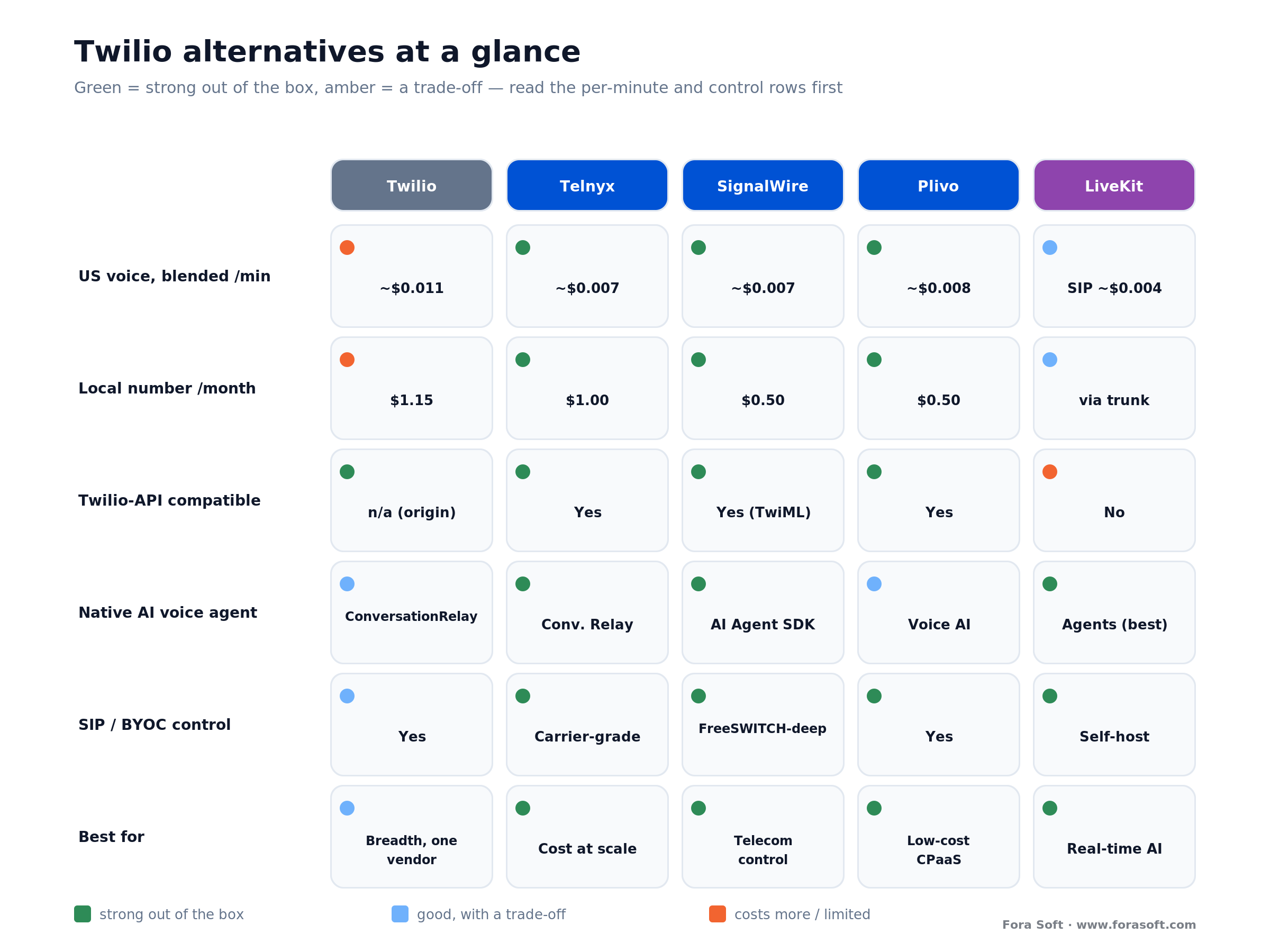
Figure 1. The fast read across the six routes. Twilio wins on breadth; the alternatives win on price, control, or AI-native design.
The same numbers in a table, so you can copy them into your own model:
| Provider | US voice /min | Local number /mo | Twilio-API | Best for |
|---|---|---|---|---|
| Twilio | $0.014 out / $0.0085 in | $1.15 | Origin | Breadth, one vendor |
| Telnyx | ~$0.007 blended | $1.00 | Yes | Cost at scale, owned network |
| SignalWire | $0.008 out / $0.0066 in; SIP $0.003 | $0.50 | Yes (TwiML) | Telecom control |
| Plivo | $0.0115 out / $0.0055 in; SIP $0.0033 | $0.50 | Yes | Low-cost CPaaS |
| Vonage | Rate sheet, below Twilio | Varies | Partial | Enterprise / omnichannel |
| Bandwidth | $0.010 out / $0.0055 in | On request | No (BXML) | US carrier, own network |
| LiveKit + trunk | SIP $0.003–$0.004 + trunk | 1 free US, then $1 | No | Real-time AI agents |
Vendor rates from each provider’s pricing page, checked October 2026. Vonage publishes a downloadable rate sheet; Bandwidth quotes numbers on request. Blended and SIP figures depend on your traffic mix.
Twilio alternatives for call recording and transcription
The best Twilio alternative for call recording and transcription is usually a cheaper carrier for the recording plus a dedicated speech-to-text API for the transcript. Plivo includes recording at no per-minute charge, Telnyx records for $0.002/min, and Twilio charges $0.0025/min; for the transcript, Deepgram Nova-3 streams at $0.0048/min on its current promotional rate (Deepgram pricing, October 2026), and Telnyx bundles Nova-3, Flux, or AssemblyAI at $0.005/min inside its network.
| Provider | Call recording | Transcription option |
|---|---|---|
| Twilio | $0.0025/min | Add-on or your own STT |
| Telnyx | $0.002/min | In-network Deepgram Nova-3, Flux or AssemblyAI at $0.005/min |
| Plivo | Free (storage free for 90 days) | Your own STT via media streams |
| Any carrier + Deepgram | Carrier rate | Nova-3 streaming $0.0048/min (promo; $0.0077 standard) |
Vendor pricing pages, checked October 2026.
In the UK and the EU, recording is a compliance question before it is a pricing one. The audio and the transcript are personal data under GDPR, so pick a provider that lets you choose the storage region and set retention, and tell callers the call is recorded. Webhooks matter too: every provider above posts a recording-completed or transcription-completed event to your URL, which is what you wire into your CRM or ticketing system.
Accent coverage decides transcript quality. For Australian English, Deepgram Nova-3 (en-AU), AssemblyAI (en_au), and Google Chirp 3 (en-AU) each ship a regional model, while Deepgram’s Flux turn-taking model covers English accents under one “en” code (vendor docs, October 2026). Pair the STT with a low-latency TTS — ElevenLabs Flash lists $0.04 per 1,000 characters — and test on your own recorded calls: word error rate on real 8 kHz phone audio differs from vendor benchmarks.
Phone numbers and outbound calling outside the US
The cheapest way to buy local phone numbers and make outbound calls via API is a carrier that sells numbers directly and bills per minute without a platform markup. In the US a local number costs $0.50/month on SignalWire or Plivo, $1.00 on Telnyx, and $1.15 on Twilio (October 2026), and LiveKit now includes one free US number on every plan for inbound AI agents.
Outside the US — Singapore, the Netherlands, the UK, Australia — the price list is the easy part. Many countries require a regulatory bundle before a number goes live: a local address or business registration, sometimes an end-user identity document, and approval that can take days. Twilio, Telnyx, Plivo, and Vonage each publish per-country number requirements; check them for your target market before you commit, because coverage for local numbers (not just toll-free or mobile) differs by provider and by country.
For outbound calling, check two more things: whether the provider terminates the call locally or hauls it through another region (latency and caller-ID presentation), and the caller-ID rules where you call. In the US, the FCC ruled in February 2024 that AI-generated voices count as “artificial” under the TCPA, so AI outbound calls need prior express consent, and its May 2026 proposal (FCC 26-32) would tighten STIR/SHAKEN caller-ID authentication further.
What a voice minute actually costs
A “voice minute” isn’t one thing. It’s carrier termination (the cost of reaching the phone network), an API or call-control fee on top, and — if there’s an AI agent involved — speech-to-text, an LLM, and text-to-speech. Twilio bundles carrier and API into one premium rate. Telnyx splits them, which is why it can price the API at $0.002 and let the SIP trunk carry the rest. Over pure SIP or WebRTC, SignalWire and Plivo drop to $0.003/min because there’s no PSTN markup at all.
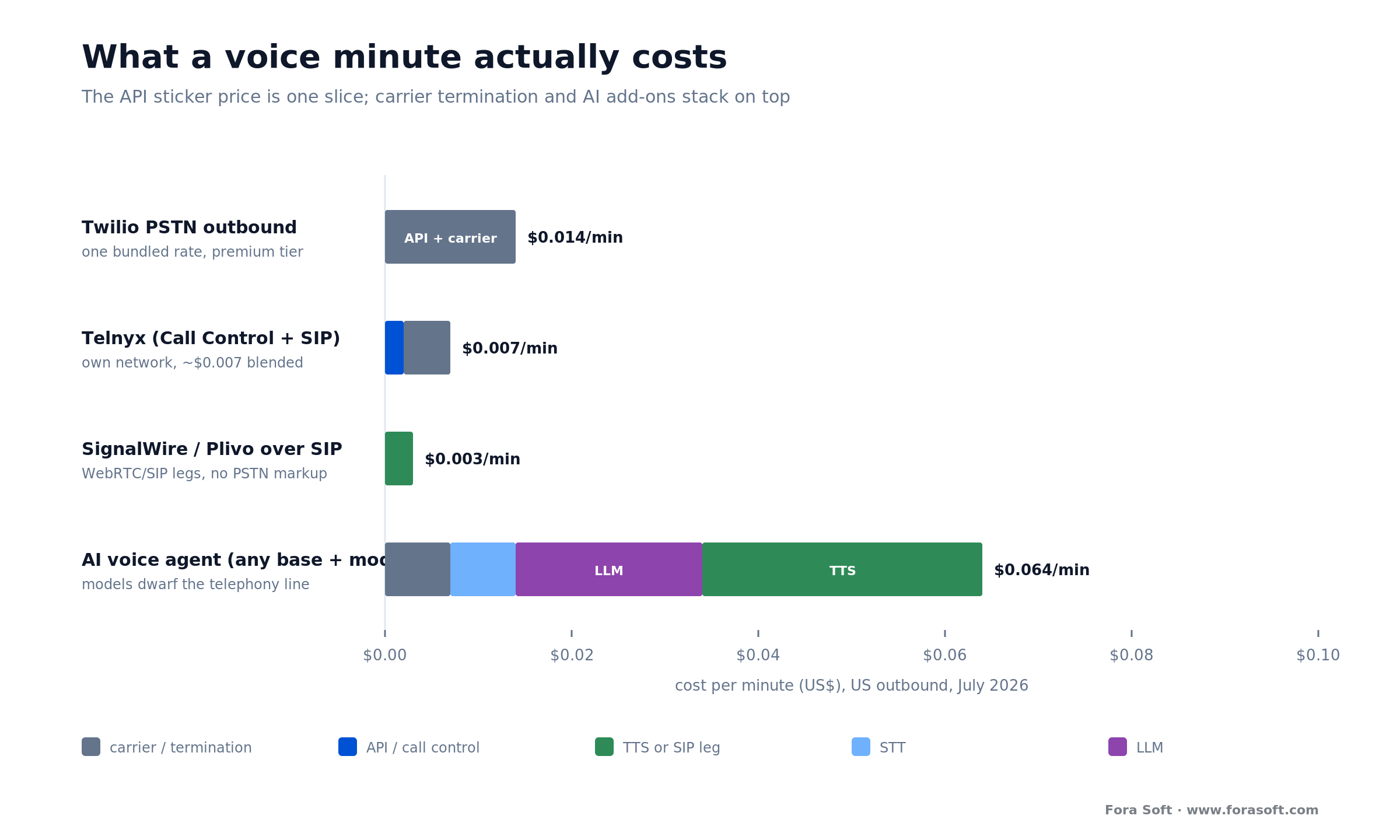
Figure 2. For plain calling the carrier line dominates. Add an AI agent and the model layers dwarf the telephony — which changes which decision matters.
The lesson: for plain calling, chase the carrier rate. For an AI agent, the telephony line is roughly a tenth of the total; the STT, LLM, and TTS stack is where your money goes, so pick the trunk on reliability and move your attention to the model choices.
Cost math: Twilio vs the alternatives at 100,000 minutes
Take a mid-size workload: 100,000 US-local voice minutes a month, split roughly half outbound, half inbound. On Twilio that’s about 50k × $0.014 + 50k × $0.0085 = $700 + $425 = ~$1,125/month, before numbers and add-ons. Telnyx at a blended ~$0.007/min lands near $700/month — roughly $425–$500 a month saved, call it $5,000–$6,000 a year. SignalWire local comes in around $730; over SIP, SignalWire and Plivo drop to ~$300–$330/month.
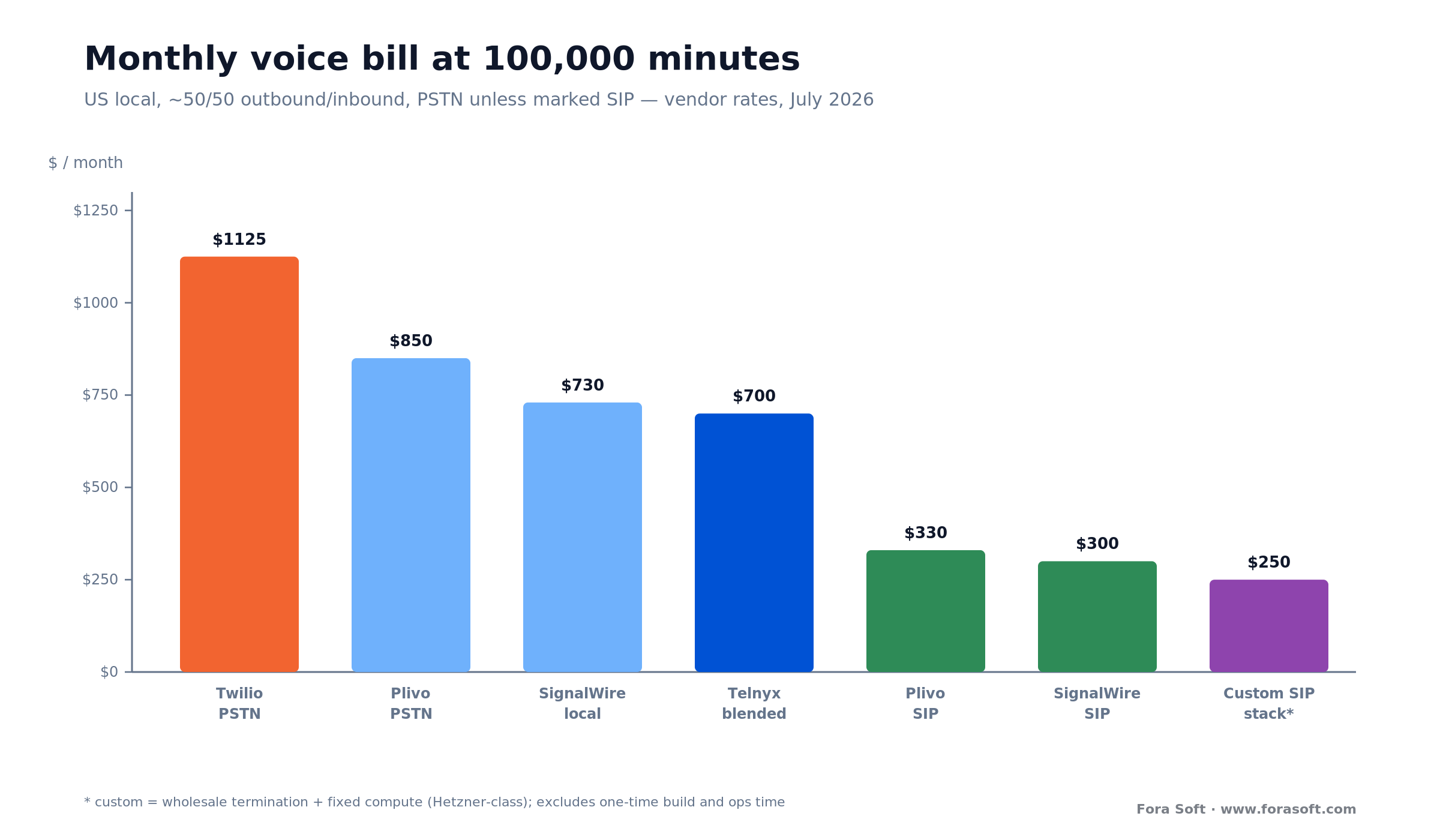
Figure 3. The same 100k-minute workload priced across providers. PSTN rates cluster high; SIP and a custom stack sit far lower — but the custom bar excludes build and ops time.
Two honest caveats. First, these are US-local, plain-calling numbers; toll-free, international, and messaging change the picture, so model your own mix. Second, the custom-stack bar (~$250) is wholesale termination plus fixed compute only — it ignores the one-time build and the ops time to run it, which is exactly what the next section prices.
Build vs buy: when a custom SIP stack pays off
You can skip the CPaaS entirely: run FreeSWITCH or Asterisk (or LiveKit for the media plane) on your own servers, buy wholesale minutes from a carrier, and pay a fixed compute bill instead of a per-API-call fee. Wholesale termination runs roughly $0.004–$0.006/min, and a fixed monthly bill for a couple of dedicated servers replaces the platform tax. On paper that’s the cheapest column in Figure 3.
On paper. The build is real engineering — SIP signaling, media handling, failover, number provisioning, A2P compliance, monitoring, and someone on call when a trunk misbehaves at 2 a.m. Conservatively, the payback vs a low-cost CPaaS shows up in the high-hundreds-of-thousands to low-millions of minutes a month range, and only once you also value control and portability, not just per-minute price. Below that, Telnyx, SignalWire, or Plivo win on total cost of ownership. Build when telephony is a core competitive surface — like it was for Nucleus — not merely to shave a per-minute rate.
Reach for a custom stack when: volume is in the millions of minutes, you need to own routing, data, and carrier relationships, and telephony is a product surface you’ll invest in — not a line item you want to forget.
Weighing switch vs build?
We’ve shipped both — CPaaS migrations and self-hosted SIP stacks at 600M+ minutes a month. We’ll run your numbers and give you a straight recommendation.
How to migrate off Twilio without downtime
Because Telnyx, SignalWire, and Plivo all expose Twilio-compatible APIs, the code change is smaller than teams fear. The move has five moving parts. 1. Provision numbers. Buy new numbers to test, then port your production numbers — local number portability is the slow step, measured in days to weeks, so overlap old and new to avoid a gap. 2. Repoint webhooks. Swap your voice and messaging webhook URLs and status callbacks to the new provider; the TwiML/verbs are largely compatible, but diff the edge cases.
3. Swap SDK and credentials. Change the client library and API keys; keep both providers live behind a feature flag so you can roll back. 4. Re-register A2P 10DLC. Brand and campaign registration is a carrier requirement, not a vendor one, so it has to be redone per provider — start it early because approval isn’t instant. 5. Cut over and watch. Shift traffic gradually, monitor answer-seizure ratio and latency, and keep the old account warm until the new one proves itself. Our Twilio→Telnyx migration guide walks the whole path, and the AI-for-engineering primer covers the model side if an agent is part of the move.
Mini-case: a carrier-grade comms stack at scale
Nucleus is a secure, on-premise communication platform built for Fibernetics, a Canadian telecom that processes 2 billion+ calls a year on its own national network. The brief wasn’t “wire up a CPaaS” — it was a full workspace with chat, video, SIP calling to cellular and landline, chat-to-SMS bridging, and AI phone agents, running on infrastructure the customer controls.
We built it on WebRTC and SIP directly (Kurento media, Linphone, a Nest.js and PostgreSQL backend) rather than on a per-minute platform, with SOC II, GDPR, and HIPAA compliance baked in. Today those AI phone agents handle 600M+ call minutes a month across 5,000+ businesses. At that volume, a per-minute CPaaS markup would have been the single largest line in the P&L — owning the stack was the difference between a viable business model and an unviable one. That’s the build-vs-buy line from earlier, in production. Want a similar assessment? Grab 30 minutes with us.
A decision framework in five questions
1. How many minutes a month? Under ~50k, the savings rarely justify moving — unless you’re unhappy for other reasons. Over a few hundred thousand, the cost gap alone pays for the migration.
2. Do you need the same APIs? If a drop-in matters, stay inside the Twilio-compatible set — Telnyx, SignalWire, Plivo. If you’re rebuilding anyway, LiveKit or custom open up.
3. Is there an AI voice agent? If the product is the conversation, optimize for the model stack and latency; the carrier becomes a commodity you pick on reliability and price.
4. How much of the stack must you own? Regulatory, data-residency, or carrier-relationship needs push you toward SignalWire’s depth or a self-hosted stack.
5. Who runs it at 2 a.m.? If you have no one to own telephony infrastructure, a managed alternative beats a pager — pay the fee and sleep.
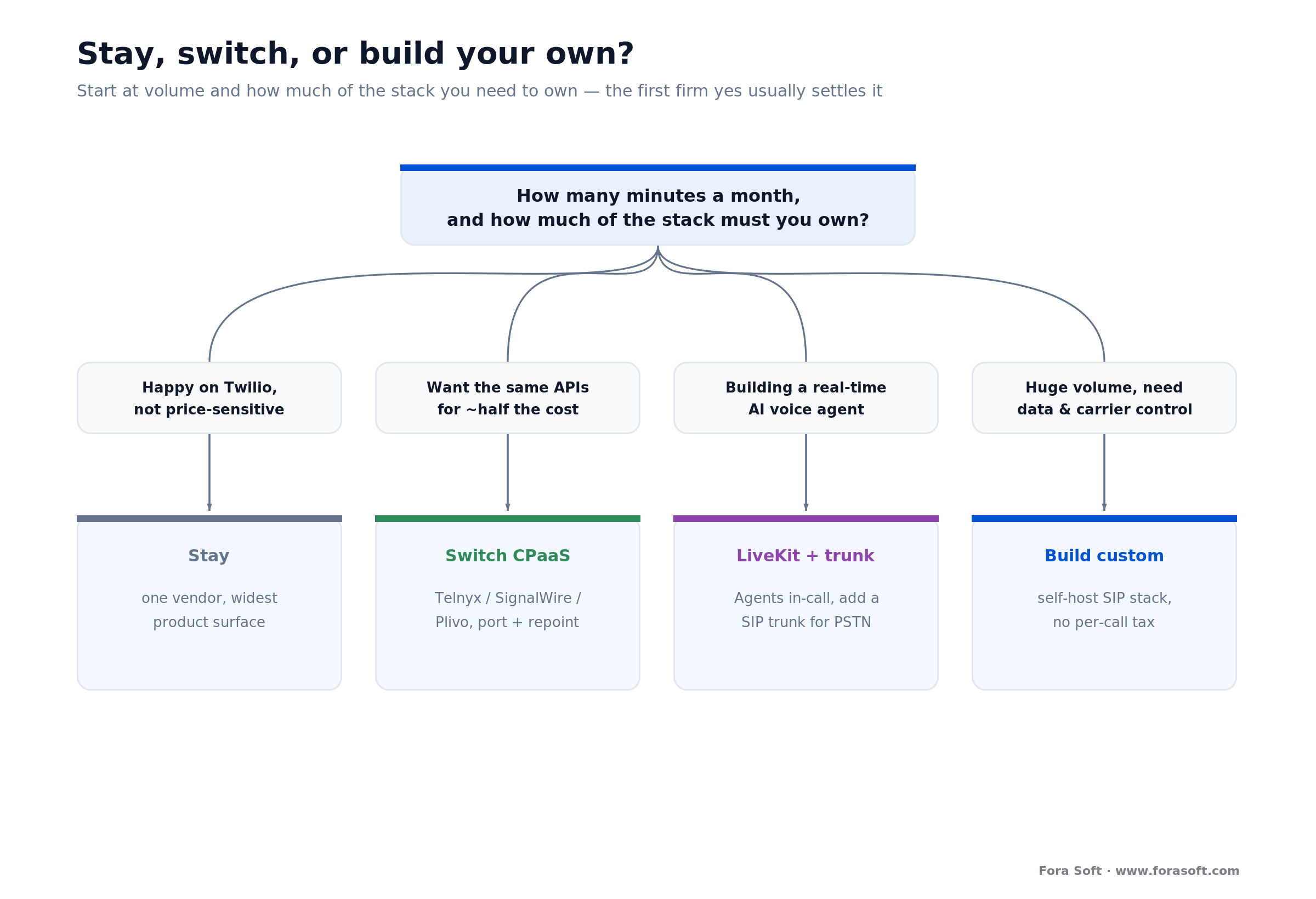
Figure 4. The five questions as a tree — start at volume and how much of the stack you need to own, then follow the first firm yes.
When NOT to leave Twilio
Switching has a cost, and sometimes it’s not worth paying. If your volume is modest, the per-minute saving might be a few hundred dollars a month against real engineering hours and porting risk — that math often favors staying put. If you lean on Twilio’s wider surface — Verify, Segment, Flex, its ecosystem of integrations — a voice-only alternative fragments your vendor list and can cost more in glue than it saves in minutes.
And if you’re on a committed-use contract with 20–40% off, your effective Twilio rate may already be close to the alternatives’ list prices. Re-price your actual invoice before assuming a move saves money. The right time to switch is when the numbers are large, the dependency is narrow, and the saving clears the migration cost with room to spare.
FAQ
What is the best Twilio alternative in 2026?
For a drop-in replacement that cuts cost, Telnyx is the most common pick — same-style APIs, its own network, and roughly half Twilio’s per-minute rate. SignalWire wins for deep SIP control, Plivo for lowest price, and LiveKit for real-time AI voice agents. There’s no single “best” — it depends on volume and how much of the stack you need to own.
Is there a cheaper alternative to Twilio for voice and SMS?
Yes. Telnyx blends to about $0.007/min for US outbound vs Twilio’s $0.014, and SignalWire or Plivo drop to $0.003/min over SIP (vendor pages, October 2026). Plivo’s own calculator (May 2026) puts 200k mixed minutes at $740 vs Twilio’s $1,340. Model your specific traffic — toll-free, international, and messaging shift the ranking.
Is SignalWire really Twilio-compatible?
SignalWire’s Compatibility APIs mirror Twilio’s TwiML and REST surface, so much of your code ports with credential and endpoint changes. It also exposes deeper SIP and call-fabric primitives, since the company was founded by the creators of FreeSWITCH. Diff the edge cases, but the core is compatible by design.
How hard is it to migrate off Twilio?
The code change is small when you move to a Twilio-compatible provider: swap SDK and credentials, repoint webhooks, and re-register A2P 10DLC. The slow part is porting phone numbers, which can take days to weeks, so overlap old and new and cut over gradually. Nothing about it is inherently risky if you keep a rollback path.
Is Twilio Video shutting down?
No. Twilio announced Programmable Video’s end-of-life in late 2023, then reversed the decision in October 2024 — Video remains a standalone product and existing customers continue unchanged. If you’re shopping for a video SDK anyway, that’s a separate decision from voice and telephony; see our dedicated Twilio Video alternative guide.
What’s the best Twilio alternative for an AI voice agent?
For a real-time phone agent, LiveKit Agents plus a low-cost SIP trunk is the modern shape — it owns the media pipeline and lets you pick STT, LLM, and TTS. Telnyx and SignalWire also ship native voice-agent runtimes if you’d rather keep it with the carrier. The telephony line is minor next to the model stack, so optimize the models and latency first.
Is there an AWS alternative to Twilio?
Amazon Connect and the Amazon Chime SDK cover telephony and real-time media inside AWS. If your infrastructure already lives there, keeping voice within the same bill and IAM boundary can beat a standalone CPaaS on operational simplicity, even when the raw per-minute rate isn’t the lowest. It’s a strong option for AWS-native teams specifically.
Should we build our own telephony stack instead?
Only at scale. A self-hosted FreeSWITCH or LiveKit stack with wholesale minutes removes the per-minute platform fee, but the payback vs a low-cost CPaaS shows up in the high-hundreds-of-thousands to low-millions of minutes a month — and only once you value owning routing and data, not just price. Below that, a managed alternative wins on total cost.
What is the best Twilio transcription alternative?
Record on a cheaper carrier and transcribe with a dedicated speech-to-text API. Deepgram Nova-3 streams at $0.0048/min on its current promotional rate, and Telnyx bundles Nova-3, Flux, or AssemblyAI at $0.005/min in-network, while Twilio charges $0.0025/min just for the recording (October 2026).
What are the best Telnyx alternatives?
SignalWire for SIP depth, Plivo for the lowest CPaaS rates, Bandwidth for a US carrier with its own network, and Twilio itself when breadth matters more than price. For AI voice agents, LiveKit plus any of those SIP trunks.
SignalWire vs Twilio: which is cheaper?
SignalWire. US local calls cost $0.008/min outbound and $0.0066/min inbound on SignalWire, $0.003/min over SIP or WebRTC, with $0.50 local numbers; Twilio charges $0.014, $0.0085, and $1.15 (October 2026). SignalWire’s Compatibility API mirrors TwiML, so the code change is small.
What is the cheapest way to buy phone numbers and make outbound calls via API?
Use a carrier that sells numbers directly: US local numbers are $0.50/month on SignalWire or Plivo and $1.00 on Telnyx, against $1.15 on Twilio, and outbound minutes run $0.007–$0.0115 versus Twilio’s $0.014 (October 2026). Outside the US, budget time for each country’s regulatory bundle.
Which voice API is best for a call center?
To build one, use a Twilio-compatible carrier (Telnyx, SignalWire, Plivo) with your own routing, or LiveKit Agents when AI should answer first and cover after-hours calls. To buy one, pick a contact-center product such as Twilio Flex or Amazon Connect rather than raw voice APIs.
What to read next
Migration
Migrating from Twilio to Telnyx
The step-by-step path: numbers, webhooks, and 10DLC.
Video
Twilio Video alternatives
Need a video SDK, not voice? Start here instead.
Voice AI
Vapi vs Retell AI vs custom
When managed voice-agent platforms stop scaling.
Integration
OpenAI Realtime: SIP + WebRTC
Wiring a Realtime voice agent to the phone network.
Real-time
LiveKit vs Agora cost analysis
Pricing the real-time media layer for 2026.
Ready to move off Twilio?
The choice comes down to three forks. If you want the same APIs for less, a Twilio-compatible carrier — Telnyx, SignalWire, or Plivo — cuts the per-minute bill by roughly half to two-thirds, and the migration is mechanical: port numbers, repoint webhooks, re-register 10DLC. If the product is a real-time AI voice agent, put LiveKit and a cheap trunk under it and spend your effort on the model stack. And if you run millions of minutes with a reason to own the pipe, a custom SIP stack drops the per-minute tax to near zero.
The one thing not to do is switch on a hunch. Re-price your actual invoice, name whether you’re replacing voice or video, and clear the migration cost with room to spare. Do that, and leaving Twilio is a good, boring engineering decision — the best kind.

The book · Volume 7 of 7
AI for Video: A Complete Guide to Intelligence in Video Products: From Real-Time Pipelines and Agents to Serving, Cost, Compliance, and Verticals
Once you pick the telephony layer, the hard part of a voice AI product moves to the agent itself. This volume covers what comes next: where AI sits in a real-time call pipeline and its latency budget, agent loops with memory and tools, serving on vLLM and Triton, and cost per stream-hour. It helps teams leaving Twilio keep their agent fast and their bill predictable. Written by Nikolay Sapunov, CEO at Fora Soft.
Read it on Amazon →Kindle & paperback · Fora Soft Video Engineering Handbook
Let’s price your move off Twilio
Tell us your volume and stack. We’ll show the numbers on Telnyx, SignalWire, Plivo, or a custom build — and handle the migration if you want us to.