
Key takeaways
• A video interview platform is really two products. One-way (async) interviews are a store-and-forward recording problem; live interviews are a real-time WebRTC problem. Most buyers want both, and the two share storage, review, and ATS plumbing but almost nothing in the media layer.
• The one-way lane is cheap to build. A single publisher and no live viewer means no media server — just MediaRecorder in the browser, a resumable upload, and a transcode step. That’s why async scales to thousands of candidates on a small bill.
• ATS integration decides adoption, not video quality. If interviews don’t land inside Greenhouse, Lever, or Workday next to the candidate, recruiters won’t use the tool. Off-the-shelf platforms start around $75–$409/month (vendor pages, July 2026); a custom first year runs into six figures.
• Compliance is a build requirement, not a footnote. Illinois’ AI Video Interview Act, NYC’s bias-audit Local Law 144, EEOC ADA guidance, and the EU AI Act (hiring is high-risk) all bite the moment you add scoring. HireVue dropped facial analysis in 2021 for exactly this reason.
• We build the whole stack, and we’ll tell you when to just buy Hireflix. Fora Soft has shipped video and real-time systems since 2005; below is the honest build-vs-buy math, not a pitch to build no matter what.
Why Fora Soft wrote this guide
We build video products for a living. Since 2005 we’ve shipped 250+ projects, and a large share of them are exactly the pieces a video interview platform is made of: browser recording, WebRTC calls, transcode pipelines, transcripts, and integrations into someone else’s system of record. So when a client asks us to build a one-way video interview tool — a HireVue-style recorder where candidates answer preset questions on their own time — we’re not starting from a blank page.
We wrote this because the public writing on the topic is almost all candidate advice (“how to ace your one-way interview”) or vendor landing pages. There’s very little that treats the platform as an engineering decision: what the async lane and the live lane actually require, where a SaaS tool stops fitting, and what the compliance layer costs you if you bolt on AI scoring. That’s the gap this guide fills. Our video conferencing team and our AI group both weighed in.
One project shaped a lot of the thinking here: Career Point, an AI coaching platform where people record themselves answering questions and get structured feedback. It isn’t a hiring tool, but the shape is identical to a one-way video interview: record in the browser, store and transcode, then layer analysis on top. We’ll come back to it as a mini-case.
Scoping a video interview platform?
Tell us your volume, your ATS, and whether you need live, async, or both. We’ll map it to a build-vs-buy call and a real number in 30 minutes.
What a one-way video interview actually is
A one-way video interview — also called an on-demand, async, or pre-recorded interview — is a screening step where the candidate records video answers to a fixed set of questions on their own schedule, and the hiring team reviews the recordings later. Nobody is on the other end in real time. The candidate gets the questions, a set amount of think time, and one or more takes; the platform stitches the answers into a single reviewable submission.
The point is to replace the phone screen. Instead of a recruiter spending 20 minutes each on 40 candidates, every applicant answers the same five questions, and the recruiter watches the strongest few at double speed. It standardizes the early round, removes scheduling entirely, and lets a small team screen a big funnel. HireVue — the tool people picture when they say “HireVue-style” — reports that 47% of its interviews were completed on mobile in one 2024 quarter, which tells you the candidate side has to work perfectly on a phone.
That’s the whole idea, and it’s deceptively simple. The engineering interest is in everything around the recording: making the upload survive a bad hotel Wi-Fi connection, turning a raw camera capture into something that plays instantly for a reviewer, keeping the videos long enough to be useful and deleting them when the law says to, and pushing the result into the recruiter’s existing system. Get those right and the video is the easy part.
One-way vs live: two products in one platform
Most teams that ask for a “video interview platform” actually want two things: the async one-way recorder for early screening, and a live interview room for later rounds. It’s tempting to treat them as one feature. They aren’t. They diverge exactly where the hard engineering lives — the media layer — and converge everywhere the boring-but-important work is.
One-way is store-and-forward. There is one person recording and zero live viewers. You never need to move media between two people in real time, so you never need a media server. The browser records to a file, the file uploads, and a human watches it hours later. This is why async is cheap: the expensive part of real-time video simply isn’t in the picture.
Live is real-time. Two or more people share audio and video with sub-second latency, which is a WebRTC problem, and multi-party rounds (a panel) need a selective forwarding unit to route everyone’s streams efficiently. Recording a live interview is its own task on top. If you already know this territory, our video chat app development guide covers the live stack in depth. The takeaway for planning: budget the async lane and the live lane separately, because one is a weekend and the other is a project.
Reach for one-way (async) when: you’re screening a big top-of-funnel, the questions are the same for everyone, and scheduling is the bottleneck. It shines at volume and dies at senior roles where a conversation matters.
Anatomy of a video interview platform
Strip away the marketing and every video interview platform is six layers. The bottom three are media plumbing, the top three are product and governance, and the same stack serves both the one-way and live lanes — only the media layer swaps parts.
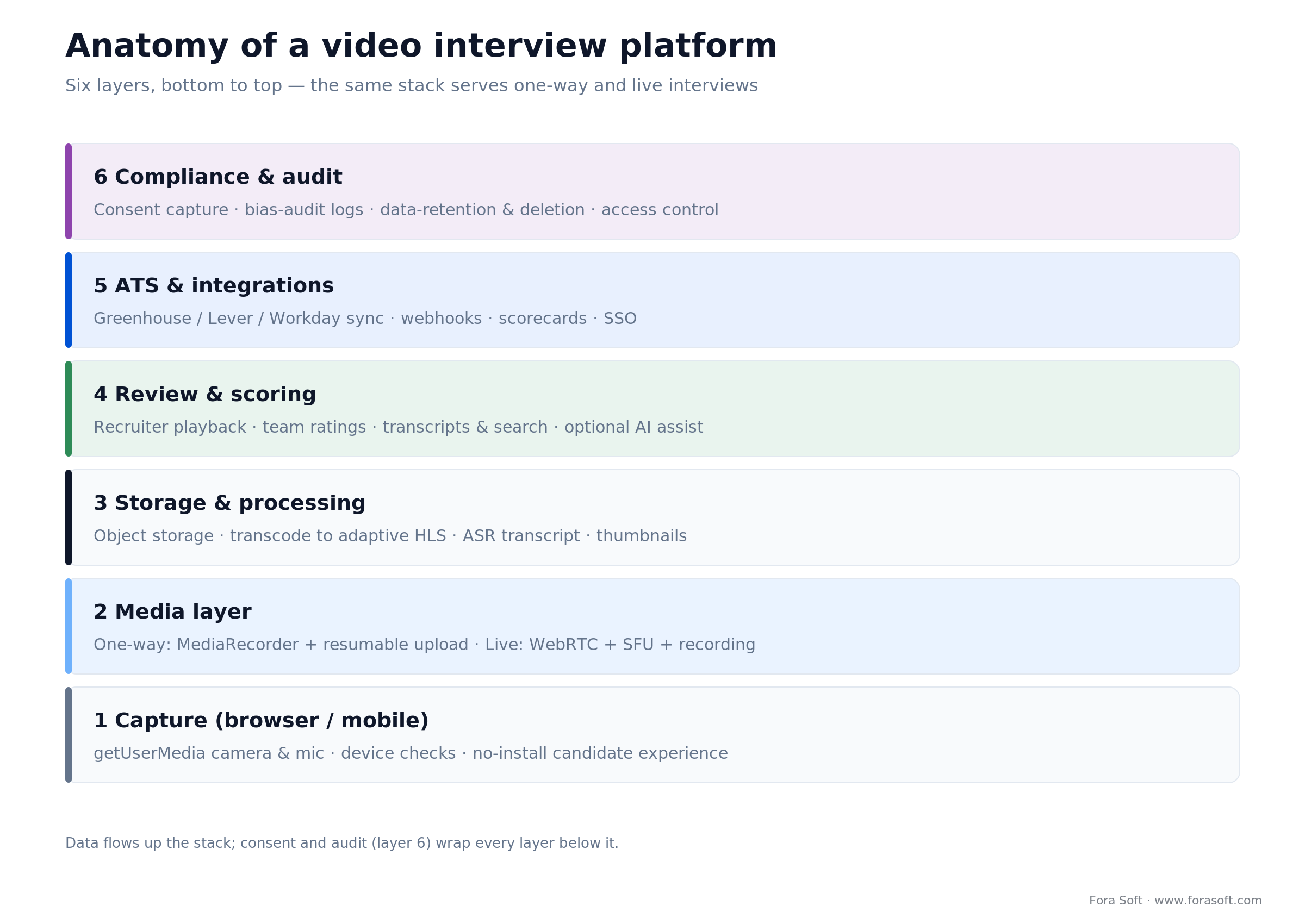
Figure 1. The six layers of a video interview platform. Capture, media, and storage are the engineering core; review, ATS, and compliance are where the product is won or lost.
Capture runs in the candidate’s browser or phone with getUserMedia, plus a camera and mic check so nobody records five minutes into a dead microphone. The media layer is where the lanes split: async records locally and uploads; live opens a WebRTC session. Storage and processing takes raw uploads, transcodes them to adaptive HLS so they play instantly, and runs speech-to-text for a searchable transcript.
Review and scoring is the recruiter’s workspace: playback, team ratings, scorecards, and shareable links. ATS and integrations push all of that into Greenhouse, Lever, or Workday so it lives next to the candidate record. Compliance and audit wraps everything below it — consent, retention, deletion, and the logs you’ll need if a rejected candidate ever asks how a decision was made.
How a one-way interview works end to end
Here’s the async lane, start to finish. The candidate opens a link, passes a device check, and records each answer with the browser’s MediaRecorder API — one question at a time, with a countdown and a capped number of takes. As they record, the video is sliced into chunks and uploaded so a dropped connection near the end doesn’t lose the whole answer.
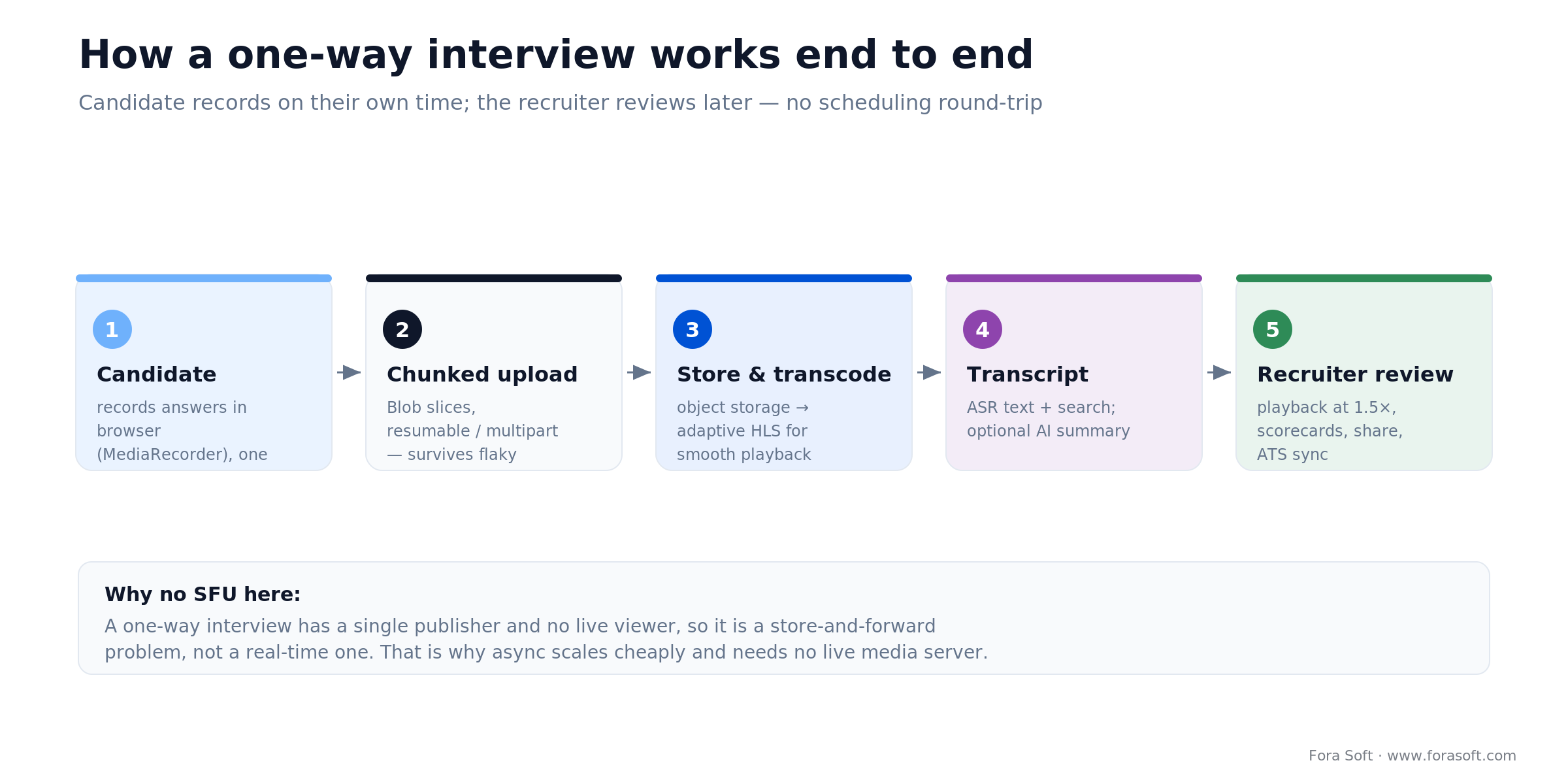
Figure 2. The one-way pipeline. A single publisher and no live viewer make this store-and-forward, so no media server is needed — which is exactly why async scales cheaply.
The uploads land in object storage (S3 or equivalent). A transcode step converts each raw file — whatever codec the browser produced — into adaptive HLS (the same delivery approach we cover in our video streaming guide) so a reviewer anywhere gets smooth playback instead of a spinning wheel. In parallel, a speech-to-text pass produces a transcript, which makes answers searchable and feeds any later summarization. If you want the mechanics of accurate transcription and multi-speaker attribution, our speaker diarization comparison goes deep.
Finally the recruiter reviews: playback at 1.5×, a scorecard per question, comments the panel can leave asynchronously, and a share link. The engineering lesson is the one Figure 2 makes: because there’s a single publisher and no live viewer, the whole thing is store-and-forward. You are building a resilient uploader and a transcode pipeline, not a low-latency media network. That’s the difference between a few weeks and a few months.
How live and panel interviews work
The live lane is a different animal. A one-on-one live interview is a WebRTC peer connection: two browsers exchange audio and video directly (or through a TURN relay when a firewall blocks the direct path), aiming for the sub-second latency that makes a conversation feel natural. Nothing about the async uploader helps you here; you’re now in real-time territory.
Add a third person — a panel — and mesh connections stop scaling, because every participant would have to send their stream to every other participant. That’s where a selective forwarding unit (SFU) comes in: each person sends one stream up, and the server forwards the right streams down to everyone else. Recording a live interview then means either capturing each stream and compositing server-side, or recording in the browser. We cover the SFU-versus-mesh trade-offs and recording patterns in the video chat build guide.
For planning, the important thing is that the live lane carries the ongoing cost that async doesn’t: media servers, TURN bandwidth, and the operational care that real-time systems demand. A lot of teams launch with async only, prove the funnel value, and add live rounds once the platform earns its keep.
Reach for live interviews when: the round is a real conversation — final-stage, senior, or client-facing roles — where two-way rapport and follow-up questions matter more than screening speed.
ATS integration: the feature that decides adoption
Here’s the thing nobody puts on the hero image but everybody discovers in month two: recruiters live inside their applicant tracking system, and a video interview that doesn’t show up there is a video interview they’ll forget to watch. Integration with Greenhouse, Lever, Workday, SmartRecruiters, and the rest isn’t a nice-to-have. It’s the difference between a tool that gets used and one that gets a renewal cancelled.
A good integration does three things: it triggers an interview invite when a candidate reaches a stage, it writes the recording (or a deep link to it) and the scorecard back onto the candidate’s record, and it keeps status in sync so the two systems never disagree about where someone is in the funnel. Under the hood that’s their API plus webhooks; the off-the-shelf platforms advertise dozens of these connectors precisely because it’s the feature buyers check first. Hireflix, for instance, exposes a GraphQL API with webhooks and pre-built connectors to Lever, Greenhouse, JazzHR, Ashby, and more (vendor page, July 2026).
If you build custom, this is where a chunk of the budget goes — not the video. Each ATS has its own API quirks, its own certification process for the partner marketplace, and its own webhook reliability story. Plan for it as a first-class workstream, not a Zapier afterthought, or your beautiful recorder will sit unused next to the system recruiters actually open.
AI scoring, transcripts, and where to stop
The moment you add AI to a video interview, you change what you’re building — legally and ethically, not just technically. There’s a safe zone and a danger zone, and the line between them is sharper than most vendors admit.
The safe zone is assistance. Transcribe every answer so recruiters can read and search instead of scrubbing video. Summarize long responses. Flag which candidates answered which questions. Auto-generate a first-draft scorecard the human edits. All of this speeds up review without letting a model make the call, and it maps to our AI integration work.
The danger zone is automated evaluation of the person. Scoring “employability” from facial expressions, tone, or body language is the feature that got the whole category in trouble. HireVue built facial analysis, then dropped it in 2021 after an independent audit found the visual signal added roughly 0.25% to predictive power — not worth the bias risk. We treat affect and emotion inference the same way, and explain our caution in this piece on emotion detection in video. If you must score, score the content of answers, keep a human in the loop, and be ready to prove the tool doesn’t discriminate — which is the whole next section.
Want AI in the loop without the legal risk?
We design transcript, summary, and scorecard assist that speeds recruiters up while keeping the hiring decision human and defensible.
The compliance layer you cannot skip
Video interviewing is one of the most regulated corners of HR tech, and the rules multiplied fast. If you record candidates and especially if you score them, five regimes matter. Treat this as design input, not legal advice — we’re engineers, not your counsel — but ignore it and you ship a liability.
1. Illinois AI Video Interview Act. In force since January 1, 2020, it requires employers who use AI to analyze video interviews to notify the candidate beforehand, explain how the AI works and what it evaluates, and get consent — and to delete a candidate’s videos within 30 days of a request, including backups. Your platform needs consent capture and a real deletion path, not a soft-delete flag.
2. NYC Local Law 144. Enforced since July 5, 2023, it bars using an automated employment decision tool unless it passed an independent bias audit in the prior year, the results are published, and candidates get notice. Penalties run $500–$1,500 per violation, per day. If your scoring qualifies as an AEDT, the bias audit is a recurring, external requirement you have to design around.
3. EEOC and the ADA. The EEOC’s May 2022 technical assistance warns that hiring tools can violate the Americans with Disabilities Act if they screen out people who could do the job with a reasonable accommodation — think a speech difference, or a candidate who needs more time. A follow-up in May 2023 covered adverse impact under Title VII. Accessibility and accommodation paths are compliance features, not polish.
4. The EU AI Act. Recruitment AI — CV filtering, ranking, and interview scoring including voice and video analytics — is classified high-risk under Annex III, with obligations like human oversight, transparency, and candidate notice. Those obligations were originally set for August 2, 2026, but the EU’s Digital Omnibus package (Council approval June 2026) deferred the high-risk deadline to December 2, 2027. The classification hasn’t changed — only the enforcement date — and a human making the final call doesn’t remove it.
5. Biometric privacy (BIPA and kin). If any feature touches faceprints or voiceprints, Illinois’ Biometric Information Privacy Act and similar state laws demand consent and strict handling — another reason the industry retreated from facial analysis. The safe default: don’t process biometrics at all unless a feature genuinely requires it, and if it does, gate it behind explicit consent.
Build the compliance layer first when: you operate in the US or EU and plan any scoring. Consent capture, per-jurisdiction retention, hard deletion, and audit logs are far cheaper to design in than to retrofit after a complaint.
The platforms compared: HireVue, Spark Hire, Willo, Hireflix, custom
Before you build, know what you’d be replacing. The off-the-shelf market spans a cheap unlimited-usage tier (Hireflix), mid-market assessment suites (Willo, Spark Hire), and enterprise AI platforms (HireVue). Prices below are from each vendor’s own pricing page, captured July 15, 2026 — check them before you quote, because SaaS pricing drifts.
| Option | Entry price | One-way | Live | Best for |
|---|---|---|---|---|
| Hireflix | $75/mo (billed yearly, <50 staff); $150/mo mid | Yes, unlimited | No | Pure one-way at low cost |
| Willo | $279/mo (Growth), $409/mo (Scale) | Yes | Limited | Async + AI transcribe/summarize |
| Spark Hire | From $299/mo (annual); monthly capped | Yes | Yes | Interviews + assessments + ATS |
| HireVue | Enterprise / custom quote | Yes | Yes | Enterprise volume + assessments |
| Custom build | ~$120k first year, then maintenance | Your rules | Your rules | Own brand, data, scoring, workflow |
The pattern is clear. If you just need one-way screening with ATS hooks, Hireflix at $75–$150/month is impossible to beat on cost, and you should not build. As you climb toward custom scoring, your own branding on the candidate experience, data that never leaves your infrastructure, or a workflow no SaaS models, the case for building strengthens. The next section makes that call explicit.
Build vs buy: when a SaaS stops fitting
For most teams, most of the time, buy. A one-way tool at a flat monthly fee handles screening at volume with zero engineering, and the per-month price is trivial next to a developer’s week. Building to save that fee is almost always a mistake. So when does building actually make sense?

Figure 3. The build-vs-buy map. The more control and differentiation you need — and the less you need to launch this week — the further toward a custom build you belong.
Three forces push you toward building. Differentiation: the interview experience is part of your product, not just internal HR — a coaching app, a marketplace that vets providers, an assessment company whose scoring is its moat. Control: data residency or privacy rules mean candidate video can’t sit on a third party’s cloud, or your scoring logic is proprietary and you won’t hand it to a vendor. Fit: your workflow is genuinely unusual — multi-language at scale, an odd approval chain, deep integration with a system no SaaS supports.
A common middle path is hybrid: buy a capture-and-recording SaaS for the commodity part and build only the layer that’s yours — usually scoring, analytics, or a branded candidate front end wired to the vendor’s API. It gets you most of the control for a fraction of the build.
Reach for a SaaS platform when: video interviewing is an internal hiring tool, your volume fits a plan, and you need it live this month. Don’t build what Hireflix or Spark Hire already does well.
Reach for a custom build when: interviewing is part of your product, your data can’t leave your cloud, or your scoring and workflow are the differentiator you’re unwilling to rent.
What building one actually costs
Let’s put rough numbers on it, conservatively. A one-way MVP — browser recording, resilient upload, transcode, a review dashboard, and one ATS integration — is a small-team project, typically a few months of two or three engineers. That’s roughly the six-figure first year you see in the table. The live lane, media servers, extra ATS connectors, and AI scoring each add to it. Ongoing cost is mostly storage, transcoding, and a bit of infrastructure — low for async, higher once live rounds bring TURN bandwidth and media servers.

Figure 4. Illustrative three-year cost. A subscription is a flat line; a custom build front-loads year one, then drops to maintenance. Where the lines cross depends on your volume and how much you build.
The honest read of Figure 4: a mid-volume team pays roughly $30k/year for a capable SaaS tier — about $90k over three years — while a custom build might run $120k in year one and settle into $25k/year maintenance, so around $170k over three years. On pure cash, buying wins at this volume, and it isn’t close. The build case is not “it’s cheaper.” It’s “we need control, differentiation, or a fit no vendor offers, and we’re willing to pay for it.” These figures are illustrative, not a quote; your real numbers depend on volume, retention rules, and how much scoring you build in-house.
Mini-case: Career Point
Career Point is an AI coaching platform we built where users record themselves answering questions and get structured feedback to improve. It isn’t a hiring tool, but architecturally it’s a one-way video interview turned inward: the same record-in-browser capture, the same store-and-transcode pipeline, the same layer of AI analysis on top of the recording — only the audience for the feedback is the speaker, not a recruiter.
Two lessons carried straight over. First, the capture experience is everything: if recording on a phone is even slightly awkward, people abandon, and in a hiring funnel an abandoned candidate is a lost hire. We spent real effort on device checks, retakes, and graceful handling of flaky networks — the unglamorous work that makes the “video” part feel invisible. Second, AI is most valuable as assistance, not judgment. Structured feedback on the content of an answer helps; a black-box “score” erodes trust. That’s exactly the line we’d draw for a hiring product.
The transfer isn’t one-to-one — a hiring platform adds consent, bias-audit logging, retention, and ATS sync that a coaching app doesn’t need. But the media core, the pipeline, and the “assist, don’t judge” philosophy are the same, which is why we can move fast on a one-way video interview build. Want a similar assessment for your use case? Grab 30 minutes and we’ll scope it.
A decision framework in five questions
Five questions get most teams to the right path without a month of deliberation.
1. Is interviewing part of your product, or an internal HR task? Part of the product pushes toward building; internal-only pushes toward buying. This one question decides more than the other four combined.
2. Do you need one-way, live, or both? One-way only means a cheap SaaS almost certainly wins. Needing polished live and panel rounds narrows the field and, if you build, adds the real-time lane and its ongoing cost.
3. Where must candidate video live? If privacy, residency, or contracts forbid a third-party cloud, that alone can force a build regardless of cost.
4. Which ATS must it integrate with, and how deeply? If your ATS has a solid off-the-shelf connector, buying gets easier. Deep, custom, or unsupported integration is a build cost either way — count it.
5. Are you scoring people with AI? If yes, the compliance layer — consent, bias audits, deletion, audit logs — is mandatory, and you must decide whether to trust a vendor’s controls or own them. If no, you’ve just made the whole project dramatically simpler.
Five pitfalls that wreck video interview projects
1. Treating async and live as one feature. They share a product shell but split at the media layer. Estimate them separately, or your “simple” recorder secretly becomes a real-time media project mid-sprint.
2. A fragile uploader. Candidates record on phones over hotel Wi-Fi. If a dropped connection loses a five-minute answer, they don’t retry — they leave, and you never know you lost a good hire. Chunked, resumable uploads are non-negotiable.
3. Skimping on the ATS integration. The prettiest recorder dies if recruiters have to leave their system to use it. Integration is the adoption feature; fund it like one.
4. Adding AI scoring without the legal work. Bolting on a “candidate score” without consent, bias audits, and deletion isn’t a feature — it’s exposure to Illinois, NYC, EEOC, and EU rules at once. Build the guardrails first or don’t score.
5. Ignoring retention and deletion. “Delete my video” has to mean it — including backups, within the window the law sets. A soft-delete flag is a compliance failure waiting for a complaint.
KPIs: what to measure
Funnel KPIs. Candidate completion rate is the number that matters most — if people start an interview and don’t finish, your capture experience is broken. Track completion by device (phone vs desktop), time-to-complete, and drop-off per question. A completion rate below the high-80s says fix the recorder before anything else.
Business KPIs. Time-to-hire and recruiter hours saved per requisition are why the platform exists. Measure the phone-screen hours you removed and how much faster the early round now moves. If the tool doesn’t compress screening, it isn’t earning its cost.
Reliability KPIs. Upload success rate, playback start time, and transcode turnaround. A failed upload is a lost candidate; slow playback wastes reviewer time; late transcripts stall the whole review. These are the technical numbers that quietly decide whether the product feels premium or flaky.
When you don’t need to build one
If video interviewing is an internal hiring task and your volume fits a subscription, don’t build — buy Hireflix, Willo, or Spark Hire and spend the engineering budget on your actual product. Building to save a few hundred dollars a month is a false economy that ends with you maintaining a hiring tool instead of shipping features.
You also may not need video at all for some roles. For high-volume, low-complexity screening, a structured text or skills assessment can out-predict a talking-head video and sidesteps the whole compliance surface. And for senior or relationship-driven roles, skip async entirely and go straight to a live conversation — a one-way recording of a VP candidate answering scripted prompts is worse than a 30-minute call, not better.
The point of this section is trust: we’d rather tell you to buy a $75/month tool than sell you a build you’ll regret. When a custom platform is genuinely the right call, the reasons are control, differentiation, and fit — not cost.
Not sure whether to build or buy?
We’ll run your five questions live and give you a straight answer — even when the answer is “buy the SaaS.”
FAQ
What is a one-way video interview?
It’s a screening step where a candidate records video answers to preset questions on their own time, and the hiring team reviews the recordings later. No one is on the other end live. It replaces the phone screen and lets a small team evaluate a large applicant pool with standardized questions.
How much does it cost to build a video interview platform?
A one-way MVP with recording, resilient upload, transcode, a review dashboard, and one ATS integration is typically a few months of a small team — roughly a six-figure first year, then maintenance. Live rounds, extra ATS connectors, and AI scoring add to that. Off-the-shelf tools start at $75–$409/month (vendor pages, July 2026), which is why most teams should buy unless they need control or differentiation.
Do I need a media server for one-way interviews?
No. A one-way interview has a single publisher and no live viewer, so it’s a store-and-forward problem: record in the browser with MediaRecorder, upload in chunks, transcode, and review later. You only need a WebRTC media server (an SFU) for live multi-party rounds.
Is AI video interview scoring legal?
It’s regulated, not banned. Illinois’ AI Video Interview Act (2020) requires notice and consent; NYC Local Law 144 (enforced July 2023) requires an annual independent bias audit; the EEOC warns about ADA and Title VII impact; and the EU AI Act treats hiring AI as high-risk (its compliance deadline was deferred from August 2, 2026 to December 2, 2027 by the Digital Omnibus, but the high-risk status stands). Scoring the content of answers with a human in the loop is defensible; inferring traits from facial expressions is the practice the industry retreated from. This is design input, not legal advice — involve counsel.
Why did HireVue drop facial analysis?
HireVue announced in January 2021 that it removed facial analysis from its assessments. An independent audit found the visual signal contributed only about 0.25% to predictive power — up to roughly 4% for highly interactive roles — which wasn’t worth the bias and privacy risk. It’s the clearest signal in the industry that scoring faces is a liability, not a feature.
How does ATS integration work?
Through the ATS’s API and webhooks. A good integration triggers an interview invite when a candidate hits a stage, writes the recording and scorecard back to the candidate record, and keeps status in sync. Platforms like Hireflix and Spark Hire ship pre-built connectors to Greenhouse, Lever, Workday, and others because it’s the first feature buyers check.
One-way vs live: which should I build first?
Usually one-way first. It’s cheaper (no media server), it delivers the biggest time-saving at the top of the funnel, and it proves the platform’s value before you take on the ongoing cost of real-time infrastructure. Add live rounds once async has earned its place.
How long does a one-way interview MVP take?
For a focused scope — browser recording, resumable upload, transcode and playback, a review dashboard, and one ATS integration — a small team ships an MVP in a few months. Compliance features, live rounds, and AI assist extend it. The recording itself is the fast part; upload resilience, integration, and governance take the time.
What to read next
Development
Video Chat App Development
The live-video lane in depth: WebRTC, SFU vs mesh, and recording.
Case study
Career Point: AI Coaching Platform
The same record-and-analyze pipeline, turned toward feedback.
AI & agents
Emotion Detection in Video Calls
Why we’re cautious about inferring traits from faces in hiring.
AI & agents
Speaker Diarization APIs Compared
Accurate transcripts and who-said-what for panel recordings.
Ready to build your video interview platform?
The short version: a video interview platform is two products in one. The one-way lane is cheap store-and-forward — browser recording, resilient upload, transcode — while the live lane is a real-time WebRTC build with ongoing cost. ATS integration decides whether recruiters actually use it, and the compliance layer decides whether you ship an asset or a liability.
For most teams, a $75–$409/month SaaS is the right answer, and we’ll say so. Build when interviewing is part of your product, when your data can’t leave your cloud, or when your scoring and workflow are the differentiator — not to save a subscription. If any of that describes you, we’ve built the pieces before and can move fast.
The handbook · 7 volumes
Fora Soft Video Engineering Handbook
Once you have split the platform into an async recording lane and a live WebRTC lane, each lane carries its own engineering depth. We wrote the seven-volume Fora Soft Video Engineering Handbook on the full video stack: encoding, delivery, audio and AI. Start with Volume 3 for WebRTC, players and delivery economics, then Volume 1 for transcoding recorded answers and Volume 6 for speech recognition. Written by Nikolay Sapunov, CEO at Fora Soft.
Browse the handbook on Amazon →7 volumes · 9,000+ pages · Kindle & paperback
Let’s scope your video interview platform
Bring your volume, ATS, and compliance needs. You’ll leave the call with a build-vs-buy answer and a realistic number.