
Key takeaways
• Redaction is a legal obligation, not a nicety. Hand over CCTV or bodycam footage with a bystander’s face in it and you’ve likely breached their privacy, whether the law is GDPR, a state public-records act, or FOIA.
• Automation turns days into minutes. Redacting one hour of video by hand takes an analyst 5–10 hours (Veritone, 2026). An AI detect-and-track pass does the same work in 15–30 minutes, then a human checks it.
• 99% recall is not 100%. The best detectors report over 99% recall on identifiable faces (Secure Redact, 2026), but one missed face in one frame is a leak. A human review step is not optional.
• If you can un-blur it, it isn’t redacted. Compliant redaction is irreversible: the pixels are gone, not hidden under a peelable layer. Reversible privacy masking is a different tool for a different job.
• Buy to start, build when volume bites. Off-the-shelf tools get you redacting this week. A custom pipeline pays off once per-seat or per-hour fees, data ownership, or workflow control start to hurt.
A records officer hits “release” on a bodycam clip, and a bystander’s face — a minor, a witness, someone who was just walking past — goes out with it. That is not a clerical slip. Under GDPR it can be a reportable breach carrying fines up to €20 million or 4% of global turnover, and under a US public-records law it can expose a person the statute was meant to protect. Video redaction software exists to stop that moment from happening, by finding every face, license plate, and screen full of PII and blurring it out before the file leaves the building.
We’ve built video and surveillance software since 2005, including VALT, an evidence-recording platform used by 770+ organizations to capture police interviews and child-advocacy sessions. So we’ve lived the redaction problem from both sides: the compliance deadline and the engineering. This is the honest guide — how the tools work, where they fail, what they cost, and when it’s smarter to build your own.
Drowning in a video redaction backlog?
Tell us your footage volume and deadlines. We’ll show you what an automated pipeline would clear per week and whether buying or building fits your case.
Why Fora Soft wrote this guide
We’re a video and AI software company: 250+ projects since 2005, 400+ clients, a team of 50. A big chunk of that work is computer vision and surveillance — object detection, tracking, and the kind of privacy plumbing that decides whether a system is legal to ship. When a security team asks us to blur faces in a live feed or an agency asks how to clear a public-records backlog, we’ve usually built the underlying pieces already: our AI video recognition software work covers face, plate and object detection with tracking, the same models a redaction pipeline runs on.
The clearest example is VALT, the recording and observation platform we’ve built and maintained for Intelligent Video Solutions for over a decade. It runs in 770+ US organizations with 50,000+ active users, and it records exactly the footage that later has to be redacted: police interviews, child-advocacy interviews, medical simulations, behavioral research. The people using VALT don’t just store sensitive video, they have to hand controlled copies to courts, defense counsel, and researchers without exposing everyone else in the room.
We don’t sell a redaction product, so we’ve no dog in the “our tool is best” fight. We’ll tell you when an off-the-shelf app is the right call, which is more often than a vendor would admit, and we’ll tell you when the per-seat math stops making sense. What we build is the custom version, and we’ve earned the right to be honest about when you don’t need one.
What video redaction software actually does
Video redaction software automatically finds and permanently obscures personal information in footage — faces, heads, license plates, tattoos, ID badges, computer screens, and spoken names in the audio — then exports a new file where that information is gone for good. The point is to share a recording (as evidence, in response to a records request, or to answer a privacy request) without exposing the identity of people who aren’t the subject of the release.
Old-school “redaction” meant loading a clip into a video editor and hand-drawing a black box over a face, frame by frame, as it moved. That still works, and it’s still how a lot of small agencies do it. It also does not scale: a person walks, turns, and gets partly hidden behind a door, and you’re keyframing a mask across hundreds of frames for one bystander in one minute of footage. Automated tools replace that grind with object detection and tracking, which is where the time savings live.
Here’s the difference in plain numbers before we go deeper.

Figure 1. The same one-hour clip, done by hand versus by an AI pass. The machine does not replace the reviewer; it removes the frame-by-frame drudgery so the reviewer can focus on the misses.
The short answer: build, buy, or use a managed service
Reach for an off-the-shelf desktop tool (CaseGuard, and similar) if you redact occasionally, want your data to stay on your own machine, and one or two analysts can handle the volume. It’s the fastest way to stop redacting in a general video editor.
Reach for a SaaS or managed service (Veritone, Secure Redact, VIDIZMO) if you have real volume, want the vendor to carry the infrastructure, and can accept your evidence being processed in someone else’s cloud under a contract. A managed “send us the files, get back redacted ones” option exists too, for teams with no appetite to run software at all.
Reach for a custom build when redaction is core to your product (a VMS, an evidence platform, a body-camera back end), when per-seat or per-hour fees have outgrown a one-time build, or when you need the redacted output wired into your own chain-of-custody and access controls rather than a vendor’s. The rest of this guide is the evidence behind those three sentences.
Why redaction is the law, not a nice-to-have
Faces in video are personal data. That single fact is what turns redaction from a courtesy into a legal control. In the EU, the EDPB’s Guidelines 3/2019 on video devices confirm that footage of an identifiable person is personal data, and that it becomes special-category biometric data the moment you run facial recognition on it for unique identification. Plain video of a face is already regulated; matching that face against an identity raises the stakes further.
Three request types force the issue in practice. A GDPR subject access request gives a person the right to a copy of footage of themselves, but you must not hand over other people’s faces in the process, so you redact the bystanders. A US public-records or FOIA request compels release of, say, bodycam video, but privacy interests of uninvolved people still have to be protected first. A disclosure to a court or opposing counsel has to protect witnesses and minors who aren’t part of the matter. Miss the redaction in any of these and you can breach the very law you were trying to satisfy.
The penalties are not theoretical. GDPR tops out at €20 million or 4% of global annual turnover, whichever is higher. Beyond fines, an unredacted release of a minor or a confidential informant is the kind of mistake that ends careers and lawsuits. Redaction software is cheap insurance against an expensive category of error.
Not sure your process would survive an audit?
We’ll review how you capture, redact, and release footage, and flag the gaps a regulator or a defense lawyer would find first.
Manual vs automated: the real cost of redacting by hand
Hand redaction is expensive because it scales with frames, not with clips. Industry figures put manual redaction at roughly 5 to 10 hours of analyst work per hour of video (Veritone, 2026), and a single one-minute clip with a couple of moving faces can eat 30 minutes on its own. A complex ten-minute scene can run to a full working day. Multiply that by a public-records queue and you get the backlogs that agencies quietly sit on.
Put a dollar figure on it. Take an agency clearing 500 hours of footage a year. At the low end of 5 analyst-hours per hour, that’s 2,500 hours of skilled work; at a loaded rate near $40 an hour, roughly $100,000 a year in labor, and that’s the optimistic end. Automation is what breaks that curve: CaseGuard reports its AI processes an hour of bodycam in about 15 to 30 minutes and cuts redaction time by 90 to 95% versus frame-by-frame work (CaseGuard, 2026).
The trap is reading “90% faster” as “no humans needed.” It isn’t. The machine drafts the redaction; a person still scrubs the timeline to catch what it missed. The win is that your analysts spend their hours reviewing instead of keyframing, which is the difference between clearing a backlog and feeding it.
How automated video redaction works
Automated redaction is a four-step pipeline with an audit trail bolted across it: detect the sensitive object, track it through every frame, apply the mask, and export a flattened file. The reason it beats hand-editing is step two — the software finds a face once and follows it as it moves, rotates, shrinks, and gets briefly hidden, instead of asking a person to re-draw the box each frame.

Figure 2. The pipeline. Detection is the step that decides whether the release is safe, which is why recall matters more than raw speed.
1. Detect. A computer-vision model scans each frame for the object classes you care about: faces and heads, license plates, bodies, sometimes screens or documents. Good tools let you pick the classes so you’re not blurring things that don’t need it. If you want to go deeper on how detection and tracking are built, our guide to object-recognition camera solutions walks through the model side.
2. Track. Each detected object gets an identity that persists across frames, so one person is one tracked object from the moment they appear until they leave. This is what makes the mask follow a moving subject smoothly instead of flickering on and off.
3. Redact. The tool applies the obscuring effect over each tracked region: a Gaussian blur, a pixelated mosaic, or a solid box. For audio, it mutes or bleeps spoken names and numbers, usually driven by a transcript. Blur looks softer; a solid box is the most unambiguous.
4. Export and log. The redaction is burned into a new video file, so the obscured pixels are actually gone rather than layered on top. Every action — who redacted what, when, and what was released — is written to an audit log, which is what makes the output defensible later.
Detection accuracy and why 99 percent is not 100 percent
No automated redactor is perfect, and the honest vendors say so. Secure Redact reports recall above 99% of identifiable PII in security video, while noting that no tool hits 100% across the full mess of real-world CCTV, bodycam, and dashcam footage (Secure Redact, 2026). For most metrics, 99% is excellent. For redaction, it’s the problem, because the 1% is a face that shipped.
Detection quality swings with the footage. Low light, motion blur, a face turned away from the camera, a plate at a sharp angle, someone small in the far background — all of these push recall down. Professional tools expose a confidence threshold, often adjustable somewhere between 25% and 90%, so you can trade precision for recall. Set it aggressive and the tool blurs everything face-shaped, including false positives, which is exactly what you want when a miss is worse than an over-blur.
Reach for a low confidence threshold when: the cost of one missed face outweighs the annoyance of reviewing extra blurs — which, for evidence and public records, is almost always. Tune for recall first, then trim false positives by hand.
This is why the human-in-the-loop step is non-negotiable for anything going out the door. The machine gets you from a blank timeline to 99% in minutes; the reviewer’s job is to find the frames where a face slipped through, because in redaction the last percent is the whole point. Teams that treat the AI output as final are the ones that end up in the news.
Reversible vs irreversible redaction
For a compliant release, redaction has to be irreversible: the personal data is permanently removed from the exported file, not hidden under an overlay that someone can peel back. A blur that can be reversed, or a black box sitting on top of the original pixels in a layered format, does not meet the anonymization bar that GDPR expects. The UK ICO’s video surveillance guidance is blunt that disclosing third-party data you failed to obscure is a problem, and a reversible obscure is, legally, barely an obscure at all.
Reversible masking still has a legitimate home — just not on the export you release. Genetec’s KiwiVision Privacy Protector, for example, anonymizes faces in the live monitoring view and only lets an authorized operator lift the mask when an incident justifies it, with the un-masking written to an audit trail (Genetec, 2026). That’s privacy-by-design for the people watching a feed, and it’s a genuinely good pattern. It is not the same job as producing a permanent, un-recoverable copy for a court or a records requester — the same permanent-export discipline a remote deposition platform needs before a recording with a witness’s face is filed.
Reach for reversible masking when: you’re protecting privacy in a live or internal monitoring view and a vetted operator may need to see the original under audit. For anything you hand to an outside party, export irreversibly instead.
The practical rule we give clients: keep the untouched master under access control, and treat every redaction as a separate, flattened derivative. Never edit the original in place. That way the master survives for legitimate re-processing, and the thing you release can’t be un-redacted by anyone who receives it.
Redaction for law enforcement and FOIA
Law enforcement is the biggest single market for video redaction software, because bodycam and interview footage is both discoverable and full of people who aren’t the subject. Public-records law increasingly forces timely release, and redaction is the only way to comply without exposing bystanders. California’s AB 748, in force since July 2019, requires critical-incident body-camera video to be released within 45 days and explicitly permits agencies to use “redaction technology, including blurring or distorting images or audio” to protect privacy before disclosure. The clock and the carve-out both assume you can redact at speed.
This is where chain of custody stops being a buzzword. Redacted evidence has to be defensible: you must be able to show the original was never altered, who produced the redacted copy, and exactly what was obscured. That means the redaction tool lives inside a workflow that logs every step and keeps the master untouched.

Figure 3. Redaction inside the chain of custody. The audit trail is what turns a blurred clip into evidence a court will accept.
The volume problem is real. Once an agency deploys bodycams across a force, footage arrives faster than analysts can hand-clear it, and the public-records deadline doesn’t care. This is the exact pressure that pushes law enforcement toward automated video redaction software, and, for larger deployments, toward digital evidence management software built around their chain of custody rather than a standalone app. Our write-up on AI video surveillance covers the detection stack that feeds this workflow.
Redaction for GDPR and DSAR requests
Under GDPR, a subject access request gives someone the right to a copy of the footage you hold of them — but not of everyone else in the frame. So the redaction job is inverted from a surveillance blur: you keep the requester visible and obscure every third party. Hand over the raw clip with other identifiable faces and you’ve satisfied one person’s rights by breaching everyone else’s, which regulators treat as its own violation.
The commonly missed identifiers go beyond faces. Reflections in glass, a name badge, a tattoo, a car’s license plate, a visible screen or document, and audio — a spoken name or address can identify someone as surely as their face. A DSAR-grade redaction pass has to cover the soundtrack, not just the picture, which is why serious tools pair visual detection with transcript-driven audio redaction.
Reach for audio redaction when: the recording contains speech — interviews, calls, bodycam. A perfectly blurred face next to an audible full name and address is not a compliant release.
DSAR clocks are tight (a month under GDPR, extendable in limited cases), so the same speed argument as FOIA applies. If your organization runs CCTV and gets access requests, the choice isn’t whether to redact, it’s whether to do it fast enough to hit the deadline without a backlog.
The tools compared: CaseGuard, Veritone, Secure Redact, VIDIZMO
Four names come up most for automated video redaction, plus the custom option. They all detect faces and plates, all export irreversibly, and all keep an audit log. Where they differ is deployment, how they charge, and how much of your data and workflow they own. Prices below were pulled from each vendor’s own pages on 2026-07-13; treat them as a snapshot, because tiers and quotas move.
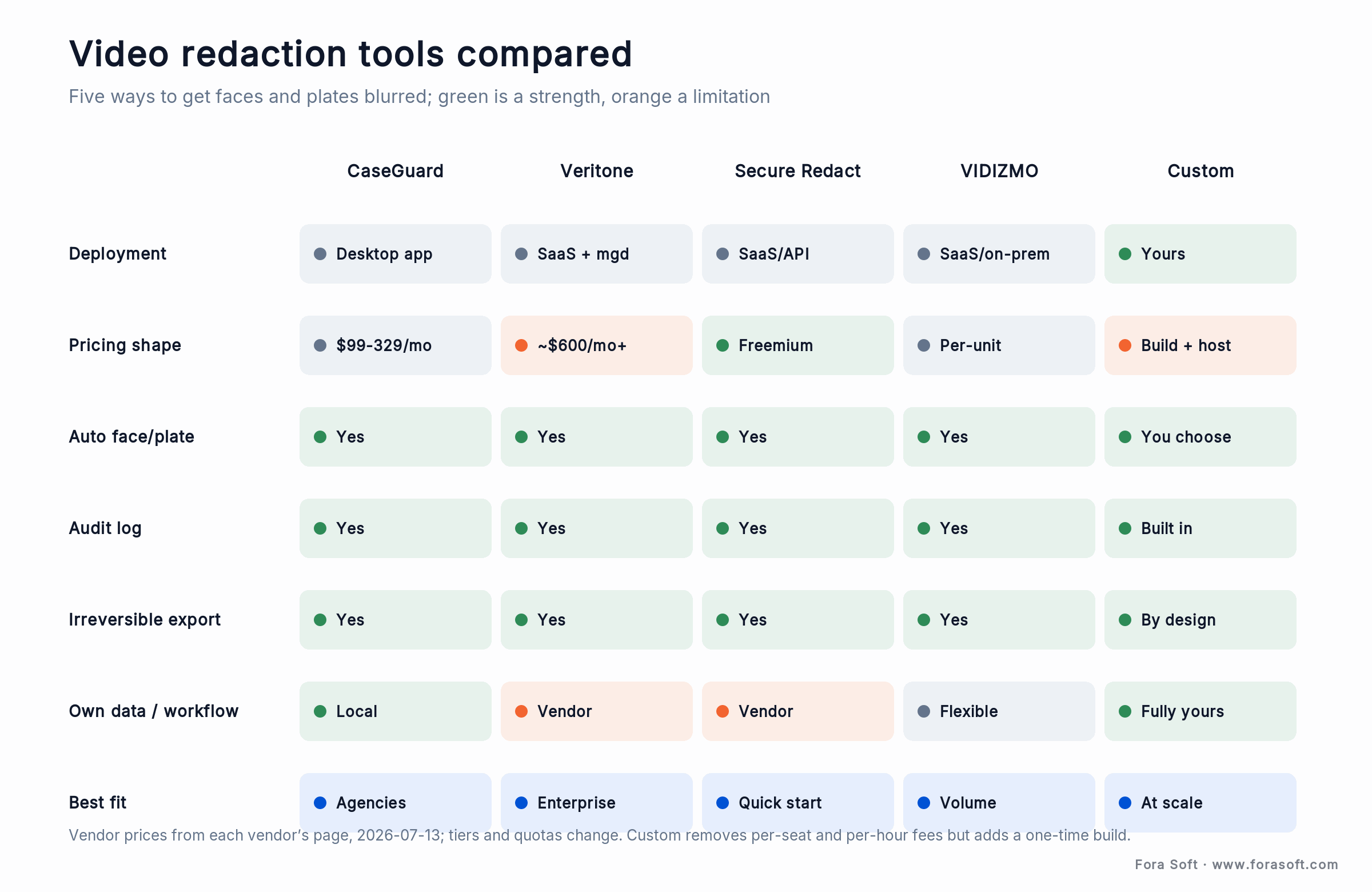
Figure 4. The five options at a glance. Green is a strength for that row, orange a limitation; the differences that matter are pricing shape and who owns the data.
| Tool | Deployment | Pricing (2026-07-13) | Where it wins | Where it breaks |
|---|---|---|---|---|
| CaseGuard | Desktop app | $99–$329/mo per seat | Data stays local; 12 PII classes; all-in-one video, audio, docs | Per-seat cost grows with a team; you run the machine |
| Veritone Redact | SaaS + managed | From ~$600/mo; ~$9.5K/yr per 100 hrs listed | Built for law enforcement; managed option; strong audit | Evidence sits in vendor cloud; enterprise pricing |
| Secure Redact | SaaS / API | Freemium; free credits then bundle or pay-as-you-go | Fast to trial; API for automation; CCTV and bodycam focus | Cloud processing; costs scale with volume |
| VIDIZMO | SaaS / on-prem | Per-unit tiers; 7-day free trial | On-prem option; OCR and NLP for names and PII | Processing-unit model needs volume planning |
| Custom build | Your infrastructure | One-time build + near-zero per-hour cost | Own the data, workflow, and chain of custody; no per-seat tax | Upfront cost and time; you carry maintenance |
Our read: start on Secure Redact or a CaseGuard seat to prove the workflow this month. Move to Veritone or VIDIZMO when volume and procurement justify it. Consider a build when redaction is part of a product you’re shipping, or when the running fees have quietly passed what a one-time build would have cost.
Build vs buy: when a custom pipeline wins
Most teams should buy. If you redact a few requests a month, an off-the-shelf tool is faster and cheaper than anything we could build you, and we’ll say so on the call. Building makes sense when redaction stops being an occasional task and becomes part of your product or your daily operation at scale. Four honest decision rules:
Reach for a managed service when: you have volume but no desire to run software, and you’re comfortable with evidence being processed under contract in a vendor’s cloud. You trade control for zero operational burden.
Reach for an off-the-shelf desktop tool when: one or two analysts handle the load, you want data to stay on your machines, and you’d rather pay a monthly seat than manage infrastructure.
Reach for a SaaS API when: you need redaction to happen automatically inside another system — a VMS, a case-management app — and you can send footage out to an endpoint. You’re buying automation, not a UI.
Reach for a custom build when: redaction is a feature of your own product, your evidence can’t leave your environment, or per-seat and per-hour fees have grown past a one-time build — and you want the output wired into your own access controls and audit trail.
The build case is strongest for platforms, not end users. If you’re building a VMS, a body-camera back end, or an evidence system, redaction that’s native to your product beats bolting on a third-party tool your customers also have to license. That’s the same logic behind our edge AI surveillance architecture, where the analytics belong inside the system rather than outside it.
Want the build-vs-buy math for your volume?
Send us your hours-per-month and where the footage has to live. We’ll model buy, managed, and custom side by side, with the break-even, and no sales theater.
What a custom redaction build costs
A custom redaction pipeline is a one-time build followed by near-zero marginal cost per hour of footage. The question is where that one-time cost crosses the running fees you’d otherwise pay forever. Let’s do the arithmetic with the same 500-hours-a-year agency, using conservative numbers and a vendor list price as the comparison anchor.
The buy side. A managed service listed around $9,500 per 100 hours (Veritone via AWS Marketplace, early 2026) works out to roughly $47,500 a year for 500 hours at list — before any volume discount, and you’re still reviewing the output. That fee recurs every year, and it climbs as your hours climb.
The build side. A focused redaction tool — face and plate detection on proven models, tracking, a review UI, an audit log, and irreversible export — is a low-five-figure to mid-five-figure build in our experience, not the six-figure platform vendors imply, because the hard parts (detection, tracking) are solved components we assemble rather than invent. After that, inference runs on your own GPU or cloud capacity for a few hundred dollars a month, and the ten-thousandth hour costs essentially the same as the first.
The crossover. Against a ~$47,500-a-year managed bill, a mid-five-figure build plus modest hosting tends to pay for itself inside the first year or two, and every year after that runs dramatically cheaper. Below a few dozen hours a month, the math flips the other way and you should just buy. We won’t hand you a fixed number here because scope drives it — how many object classes, what accuracy bar, what it has to integrate with — and quoting a precise figure sight-unseen would be dishonest.
Reach for a build when: your redaction bill is heading past roughly $30–50K a year in fees, or the footage legally can’t leave your environment. Below that, buying wins on speed and simplicity.
Mini-case: redacting interview footage at VALT scale
The situation. VALT, the recording platform we’ve built and run for Intelligent Video Solutions for over a decade, sits in 770+ US organizations with 50,000+ active users. It records the sensitive stuff by design: police interviews, child-advocacy interviews, medical simulations, behavioral research. Those recordings routinely have to be shared — with a court, a defense team, a researcher — and the people in the room who aren’t the subject have a right not to be exposed.
The engineering. The disciplines that make VALT trustworthy are exactly the ones redaction demands: a master recording kept under strict access control, HIPAA and GDPR compliance baked in rather than bolted on, and an audit trail behind every access and export. Redaction fits that model as a derivative-generating step, never an edit of the master — you produce a separate, flattened copy for release and leave the original untouched and logged.
The result. A decade of shipping VALT (most recently version 6.5 in 2025) is why we’re comfortable saying the hard part of a redaction system usually isn’t the blur — it’s the chain of custody around it. Want the same rigor applied to your footage? That’s a good 30-minute call.
A redaction decision framework in five questions
1. How much footage, how often? A handful of clips a month points to an off-the-shelf seat. Hundreds of hours a year, or a steady inbound queue, justifies automation and eventually a build.
2. Where is the footage allowed to live? If policy or law keeps evidence on-premises, rule out cloud-only SaaS and look at on-prem tools or a custom build. If cloud is fine, the managed options open up.
3. What’s your deadline pressure? A 45-day public-records clock or a one-month DSAR window means manual redaction will bury you. Speed is the whole reason to automate.
4. Does redaction touch your product? If you’re building a VMS or evidence platform, native redaction beats a bolt-on. If it’s an internal compliance chore, buy a tool.
5. What does a miss cost you? Exposing a minor or an informant is a different risk class than blurring a car in a marketing video. The higher the stakes, the more you invest in review, audit, and control — and the more a custom pipeline earns its keep.
Five pitfalls to avoid when redacting video
1. Trusting the AI pass as final. The detector will miss a face in low light or at a bad angle. Ship without human review and you’ll eventually release the one frame that mattered. Budget review time; it’s the point, not the overhead.
2. Reversible “redaction.” A blur or box that can be lifted, or an overlay in a layered file, is not anonymized. Always export a flattened, irreversible copy for anything leaving your control.
3. Forgetting the audio. A spoken name, address, or badge number identifies a person as clearly as their face. Redact the soundtrack, not just the picture.
4. Editing the master. Never redact in place. Keep the original untouched under access control and generate a separate derivative, or you’ll destroy the evidentiary value of the source.
5. No audit trail. If you can’t show who redacted what and when, a defense lawyer or regulator can challenge the release. The log is part of the deliverable, not an afterthought.
When NOT to build custom redaction
Don’t build if your volume is low. If you clear a few requests a month, a CaseGuard seat or a Secure Redact bundle will out-run a custom tool on both cost and time-to-value, and you’ll have it working this week instead of next quarter. Paying us to build something a $99 app already does well would be a bad trade, and we’d tell you that.
Don’t build if a managed service already fits your compliance posture. When your evidence is allowed in a vendor cloud and the per-hour fee is comfortable, a managed option removes the operational burden entirely. Building only pays when control, integration, or long-run economics demand it.
Do revisit the decision as you grow. The buy-versus-build line moves when your hours climb, when fees compound, or when redaction becomes part of a product you sell. The right answer this year isn’t automatically the right answer next year, which is exactly why we start with the math rather than a pitch. For the broader detection context, our piece on anomaly detection in video surveillance and the video surveillance learning track are good next stops.
FAQ
What is video redaction software?
Video redaction software automatically detects and permanently obscures personal information in footage — faces, license plates, and spoken names among them — then exports a new file where that data is gone. It lets you share a recording as evidence, or in response to a records or privacy request, without exposing people who aren’t the subject of the release.
What is the best video redaction software for FOIA responses?
For FOIA and public-records video, agencies most often use CaseGuard, Veritone Redact, or Secure Redact, because they combine automatic face and plate detection with the audit logging that defensible releases require. The best fit depends on volume and whether your evidence can be processed in a vendor cloud; high-volume forces frequently move to a system built around their evidence management.
How do I redact video for a GDPR DSAR?
Keep the requester visible and obscure every third party — their faces, plus plates, badges, screens, and any spoken names in the audio. The redaction must be irreversible, and you should hand over a flattened copy while retaining the untouched original. Disclosing other people’s identifiable data to satisfy one person’s request is itself a GDPR breach.
Is there free video redaction software?
Sort of. You can hand-redact in a general editor for free, but it’s slow and error-prone. Several tools offer freemium tiers — Secure Redact gives free starter credits, and VIDIZMO offers a trial — which are fine for occasional clips. For any regular or compliance-grade workload, a paid tool or a custom build is what keeps you fast and defensible.
How accurate is automatic face blurring?
Leading tools report over 99% recall on identifiable faces in security video (Secure Redact, 2026), but none is 100% across all footage. Low light, motion blur, odd angles, and small distant faces all reduce detection. That’s why a human reviews the automated pass before release — the last percent is where the compliance risk lives.
Is blurring reversible, and does that matter for compliance?
It matters a lot. For a compliant release the redaction must be irreversible — the pixels removed and the file flattened, so no one can recover the original. Reversible masking (used to anonymize a live monitoring view and un-mask under audit) is a legitimate but separate tool. Never release a copy whose blur can be lifted.
Can it redact audio too?
Yes, and it should. A spoken name, address, or phone number identifies a person as surely as their face, so serious tools pair visual redaction with transcript-driven audio redaction that mutes or bleeps the sensitive words. A perfectly blurred face over an audible full name is not a compliant release.
What does video redaction software cost for law enforcement?
Desktop tools run roughly $99–$329 per seat per month (CaseGuard, 2026). Managed law-enforcement platforms start higher — Veritone Redact lists from around $600 per month, with an annual listing near $9,500 per 100 hours (2026). For large forces, those recurring fees are often what tips the decision toward a custom build with near-zero per-hour cost.
What to read next
Surveillance
AI Video Surveillance
The detection stack that feeds redaction: how faces and objects are found in the first place.
Computer vision
Anomaly Detection in Video Surveillance
Where automated video analytics earns its keep, and where accuracy limits bite.
Architecture
Edge AI Video Surveillance Architecture
When to process video on the edge vs the cloud, and what it means for privacy.
Development
Building an Object-Recognition Camera Solution
How the detection and tracking behind redaction actually gets built.
Ready to ship redaction you can defend?
Video redaction software earns its place by turning a legal obligation into a fast, repeatable step: detect the faces and plates, track them across frames, blur them permanently, and log every action for the chain of custody. Automation cuts a 5-to-10-hour manual job to well under an hour, but the human review stays, because 99% recall still means one face can slip through.
Buy a tool to start clearing your backlog this week. Keep the redaction irreversible and the master untouched. And when volume, data-residency, or a product you’re building tips the math, that’s when a custom pipeline — with detection, review, audit, and export wired into your own system — starts to pay. If you want a straight answer on which side of that line you’re on, we’re happy to run the numbers with you. Explore our video surveillance development services to see where we’d start.
The book · Volume 6 of 7
AI for Video: A Complete Guide to Intelligence in Video Products: From Models and Inference to Computer Vision, Speech, Search, and Generative Video
Automated redaction is detection and tracking with a legal deadline attached. Volume 6 of our handbook covers the capabilities underneath it: computer vision for detection, tracking, segmentation and OCR, plus speech recognition and diarization for the audio track. It helps teams judge which accuracy figures a vendor or an in-house model can actually reach. Written by Nikolay Sapunov, CEO at Fora Soft.
Read it on Amazon →Kindle & paperback · Fora Soft Video Engineering Handbook
Let’s make your footage safe to release
Whether you need help choosing a tool or building redaction into your own platform, we’ll give you an honest read in 30 minutes — buy, managed, or build, with the math to back it.