

Key takeaways
• The video call is the easy 10%. Video remote interpreting (VRI) puts a qualified interpreter on a live video session with a limited-English or Deaf participant. Any developer can stand up a WebRTC call in a week; the product is everything around it: matching the right interpreter in seconds, meeting a legal video-quality bar, and proving it all happened.
• Video quality is a legal requirement, not a feature. Under ADA rule 28 CFR 36.303(f), VRI has to deliver real-time, full-motion video with no lag or choppiness and an image sharp enough to show a signer’s hands and fingers. Miss that bar in a hospital and it’s a compliance failure, not a bad user review.
• “Qualified” is a defined word. The 2024 Section 1557 rule for healthcare bans low-quality VRI and unqualified interpreters outright. Your routing engine can’t just find any free person who speaks Spanish; it has to find a qualified one, and log that it did.
• Buy the service for one clinic; build the platform when you sell access. If you just need interpreters, contract a provider like LanguageLine or Boostlingo. Build when interpreting is the product you’re selling, when you run your own interpreter pool, or when per-minute fees at your volume have outgrown a one-time build.
• We’ve built three of these. TransLinguist (75+ languages, 30,000+ interpreters, the UK NHS national framework), Rafiky (200+ languages, 30,000+ events), and a hospital phone-interpreting system. This guide is the honest version of what that took.
A nurse in an emergency room has a patient who signs ASL and a treatment decision that can’t wait. She taps a tablet, and within a few seconds a certified interpreter appears on screen, sees the patient’s hands and the nurse’s face clearly, and the three of them get through the conversation. That’s video remote interpreting, and the part that looks like magic, the interpreter showing up instantly on a clean video feed, is the part that’s genuinely hard to build.
We’ve built video and real-time communication software since 2005, including three interpreting platforms in production. So this isn’t a listicle of vendors. It’s a builder’s guide: what a VRI platform actually is, how the interpreter-matching engine works, the video and compliance bars you have to clear, what it costs to build versus buy, and the honest cases where you shouldn’t build at all.
Scoping a video interpreting platform?
Tell us your languages, your compliance floor (ADA, Section 1557, courts), and your call volume. We’ll tell you honestly whether to buy the service, license a platform, or build — with the routing and cost math behind the call.
Why Fora Soft wrote this guide
We’re a video and AI software company: 250+ projects since 2005, a team of 50+ in-house specialists. A lot of that work is exactly the plumbing a VRI platform needs, low-latency WebRTC, media servers, call routing, transcription, and the compliance and audit layers that decide whether a healthcare buyer will trust you.
More to the point, we’ve built interpreting platforms specifically. TransLinguist is a video interpreting platform we developed that carries 75+ languages, a marketplace of 30,000+ certified interpreters, and won the UK’s NHS national framework for language services, covering hospitals, councils, schools, and police. Rafiky is a simultaneous-interpretation platform we took over and stabilized that now runs 30,000+ events across 200+ languages. And we built a hospital phone-interpreting system that routes a doctor from a landline to a live interpreter in seconds.
So we’ve lived the parts that don’t show up in a demo: the interpreter who doesn’t answer, the hospital network that can’t hold a clean video call, the auditor who wants proof the interpreter was qualified. We build custom platforms for a living, and we’ll still tell you when buying the service is the smarter move. This guide keeps that balance.
What video remote interpreting actually is
Video remote interpreting is a service that connects two or more people who don’t share a language to a qualified interpreter over live video, on demand or by appointment. It’s used when an in-person interpreter isn’t available fast enough or isn’t worth the travel: a hospital with a Deaf patient, a court intake window, a bank onboarding a refugee client, an insurer taking a claim. Video matters because so much interpreting depends on seeing people, sign language is entirely visual, and even spoken-language interpreting leans on facial expression and gesture.
As software, a VRI platform is three systems wearing a trench coat. There’s a real-time video layer that connects participants and the interpreter. There’s a routing and scheduling engine that finds the right interpreter for the language, skill, and moment. And there’s an operations layer, the interpreter accounts, availability, call records, quality monitoring, and billing, that turns a video call into a business. The video is the demo. The other two are the product.
One clarification up front, because buyers conflate them: VRI is not machine translation. The interpreter is a human (or, increasingly, an AI in low-stakes settings, more on that later). The platform’s job is to deliver that interpreter reliably and provably, not to replace them. Get that framing wrong and you build the wrong thing.
VRI vs VRS vs OPI: what you’re actually building
Three acronyms get mixed up constantly, and building the wrong one is an expensive mistake, so pin them down first. VRI (video remote interpreting) is a fee-based service where an interpreter joins a video session to help people communicate, often in the same room or a video meeting. OPI (over-the-phone interpreting) is the same idea over audio only, cheaper, faster to connect, and fine when you don’t need to see anyone. VRS (video relay service) is a different animal entirely.
VRS is a free, US federally funded telecom service, paid for through the FCC’s Telecommunications Relay Service fund, that lets a Deaf person make a phone call to a hearing person in another location through an ASL interpreter. It’s regulated as a telephone-equivalent, and the FCC prohibits using it when both parties are in the same room. That last rule is why hospitals can’t just tell staff to use a patient’s VRS app: VRS is for phone calls between separated parties, VRI is for shared or scheduled situations that the provider is legally responsible for.
For a builder, the practical takeaway is that VRS is a closed, regulated, funded system you don’t build; VRI and OPI are the commercial services you do. Most platforms we’ve worked on offer VRI and OPI together and let the requester pick, because the same interpreter pool and routing engine serve both. Deciding whether video is required or audio will do is the first branch in your product tree.
The short answer: build, buy, or extend
Buy the service if you’re an end user, a clinic, a court, a company, that just needs interpreters on demand. Contract a video remote interpreting services provider like LanguageLine, Sorenson, or a Boostlingo-powered service, pay per minute, and you’re compliant this week. For a single organization that consumes interpreting, this is almost always the right call.
License a platform if you’re a language service provider (LSP) who employs interpreters and wants to run your own scheduling, routing, and video, but doesn’t want to build the software. Interpreter management systems like Boostlingo exist exactly for this, and extending one with your workflow is often smarter than starting from zero.
Build a custom platform when interpreting is the product you sell, when you run a large interpreter marketplace whose economics or workflow no off-the-shelf tool fits, when you need to embed interpreting inside your own app, or when per-minute and per-seat fees at your scale have quietly passed what a one-time build would cost. The rest of this guide is the evidence behind those three paragraphs.
Anatomy of a VRI platform
A VRI platform is a request that travels from “I need an interpreter” to a billed, recorded session, with a quality-and-audit band running under every step. The figure below is the working shape we start from when scoping one.
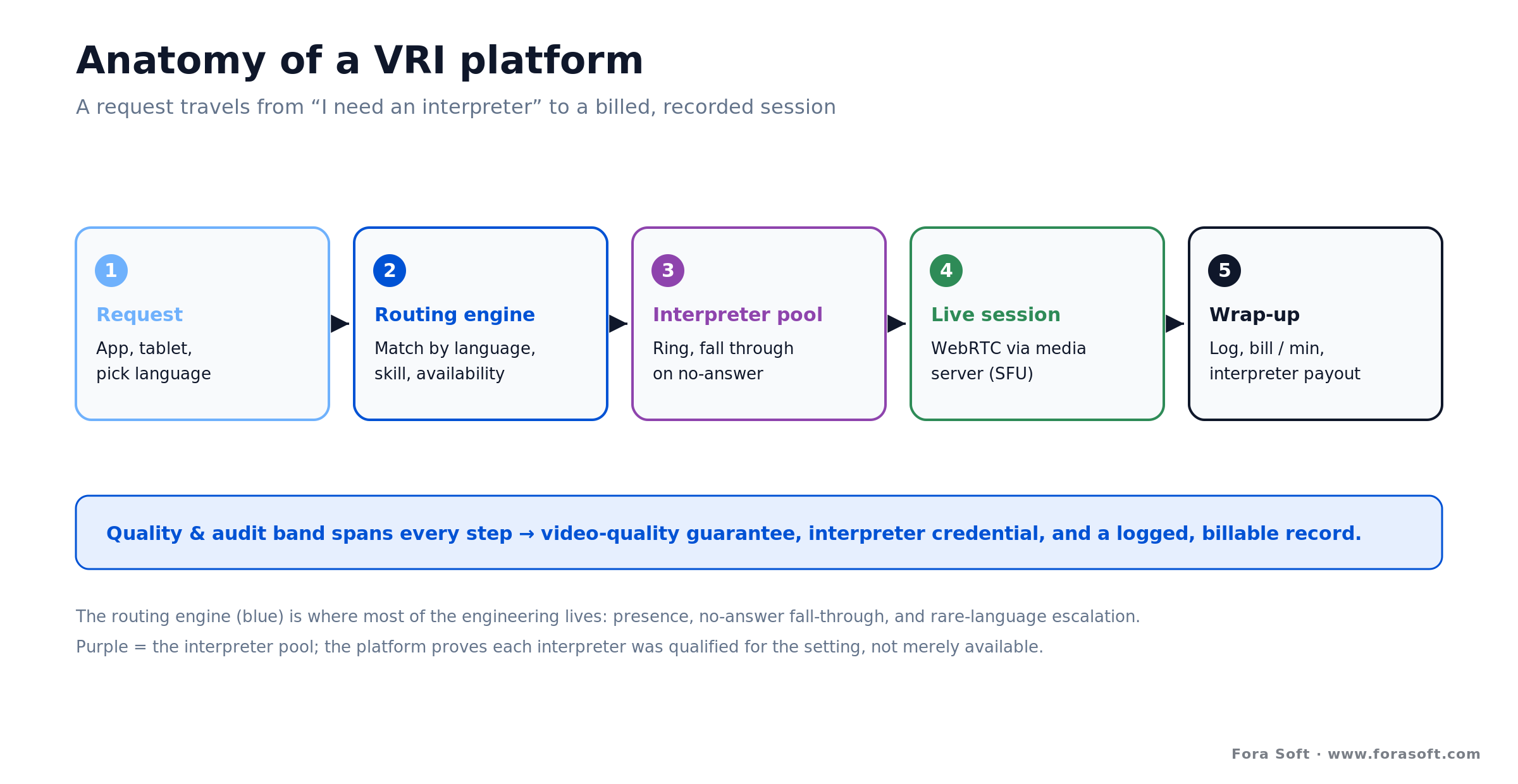
Figure 1. The path of a VRI request. The routing engine in the middle is where most of the engineering, and most of the value, lives.
Request layer. A user asks for an interpreter from a web app, a mobile app, a tablet kiosk, or an SDK embedded in your own product, choosing language and, for sign language, modality (ASL, for example). Speed of this step is a feature: in an ER, the difference between five seconds and ninety seconds is the difference between a tool people use and one they abandon.
Routing engine. The request hits a matching service that knows which interpreters are online, qualified for that language and setting, and free right now. It rings the best candidates, handles no-answers by falling through to the next, and escalates if nobody picks up. This is the hard part and gets its own section next.
Session layer. Once matched, participants and interpreter join a live WebRTC session, usually through a media server (an SFU) so quality and recording are under your control. This layer carries the video-quality burden the law cares about, plus features interpreters need: a way to manage turn-taking, see everyone clearly, and hand off if a call runs long.
Operations layer. When the call ends, the platform logs duration, participants, language, and interpreter, computes billing (per-minute to the client, payout to the interpreter), captures a quality signal, and files the record for compliance. Skip this layer and you have a video toy; build it well and you have a business that can pass an audit.
Matching a caller to the right interpreter in seconds
Here’s the question that decides whether your platform is any good: a request for a Vietnamese medical interpreter arrives at 2 a.m.; how fast, and how reliably, do you connect it to a qualified person? Everything else is table stakes. This is where platforms win or lose.
The routing engine has to weigh several things at once: language and dialect, the modality (spoken vs a specific sign language), the interpreter’s qualifications for the setting (a medical or legal certification, not just fluency), who’s currently online and idle, and business rules like preferred interpreters for a given client or gender preferences a patient has requested. It then places what is effectively a call to the best-ranked available interpreter, and, crucially, handles the common case where they don’t answer.
No-answer handling is the make-or-break detail. Interpreters miss calls; a naive system that rings one person and waits will strand users. A good one rings the top candidate for a few seconds, falls through to the next on timeout, can ring several in parallel for rare languages, and escalates to a scheduled callback or a partner network if the pool is empty. On the platforms we’ve built, this fallthrough logic and the presence system behind it, knowing in real time who is genuinely available, took more engineering than the video itself.
Rare languages are the stress test. Common ones like Spanish have deep pools and connect instantly; an uncommon language or dialect at an odd hour may have two available interpreters worldwide. Your routing has to degrade gracefully, widen the search, queue with an honest wait estimate, or fall back to phone audio, rather than fail. How you handle the long tail is what separates a serious platform from a pretty prototype.
Video quality is a legal requirement, not a feature
On most video products, quality is a matter of user satisfaction. On a VRI platform serving US public accommodations, it’s the law. The ADA regulation at 28 CFR 36.303(f) spells out four performance standards VRI must meet to count as effective communication.
First, real-time, full-motion video and audio over a dedicated high-speed, wide-bandwidth connection, with no lags, no choppy or blurry or grainy images, and no irregular pauses. Second, a sharply delineated image large enough to show the face, arms, hands, and fingers of both the interpreter and the person signing, whatever their body position. Third, a clear, audible transmission of voices. Fourth, staff trained to set it up and use it quickly. The Justice Department also notes plainly that VRI may simply not be effective for complex information, multiple parties, or deaf-blind individuals, situations where you route to in-person instead.
Translate that into engineering and it’s specific. Sign language is visual and continuous, so it’s far less forgiving of dropped frames than audio: professional ASL video is shot around 30 frames per second at 1080p or better, and your pipeline has to protect frame rate and sharpness even on a hospital’s congested Wi-Fi. That means adaptive bitrate that favors frame rate for sign language, resilient codecs, a media server you control rather than a random peer-to-peer path, and honest network diagnostics that warn staff before a call, not after it failed.
This is also the strongest argument against the “just use a generic video SDK” instinct. A consumer video call that degrades to a frozen, blocky image is a minor annoyance on a normal call and a legal problem on a VRI call for a Deaf patient. Building for the 36.303(f) bar from the start, and being able to prove you meet it, is a core requirement, not polish.
Compliance: ADA, Section 1557, HIPAA, and the courts
Interpreting sits on top of a stack of rules because the moments it’s used, medical, legal, financial, are exactly the moments where getting communication wrong causes real harm. The regimes below are the ones that shape a VRI build, and they stack on one platform.
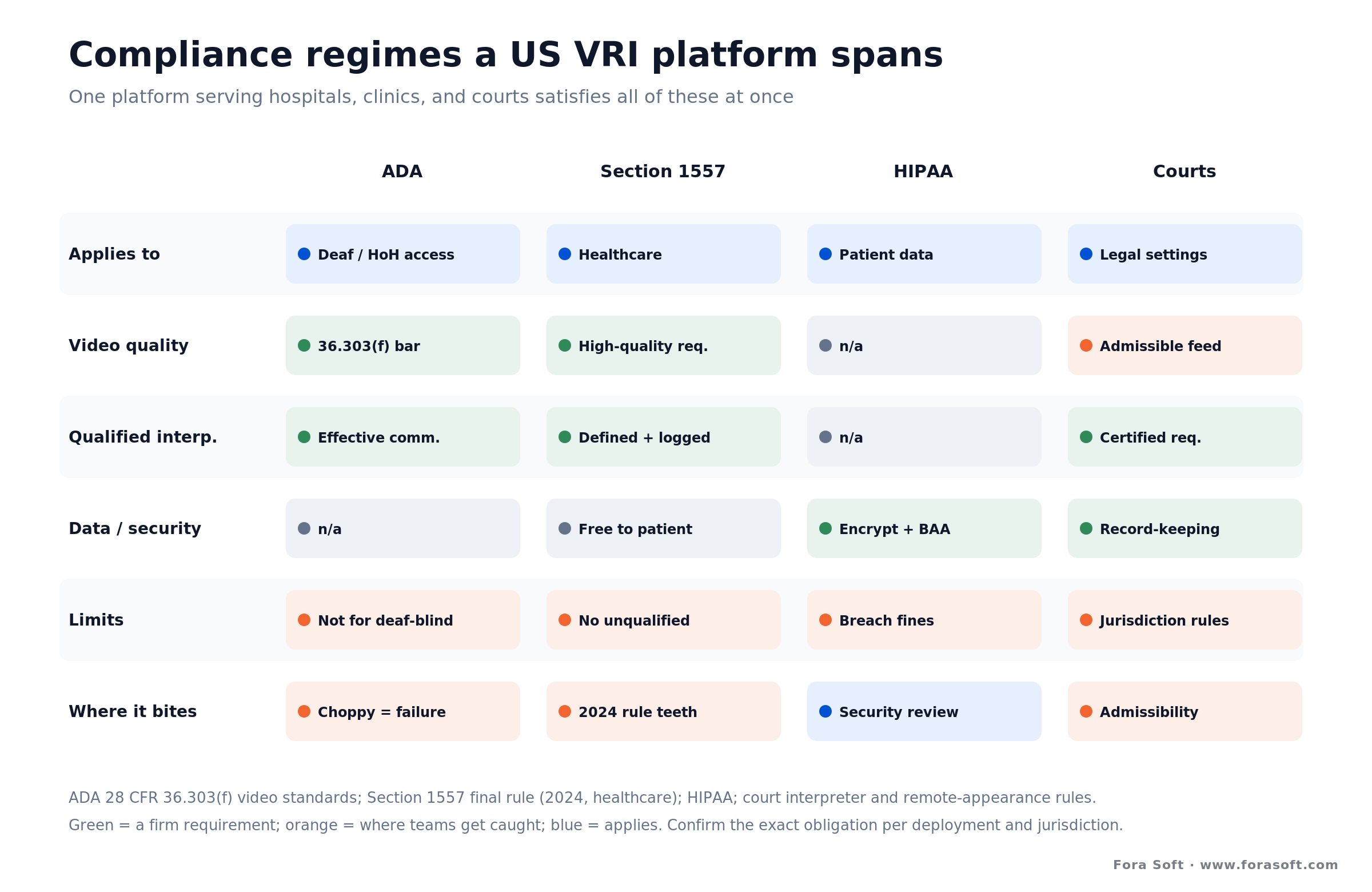
Figure 2. The regimes a US VRI platform commonly spans. The column that catches teams out is “qualified interpreter”, which is a defined legal standard, not a nice-to-have.
The ADA requires effective communication for people who are Deaf or hard of hearing, and, through 28 CFR 36.303(f), sets the video-quality bar from the last section. Section 1557 of the Affordable Care Act, whose 2024 final rule tightened this considerably, governs interpreting in healthcare. It defines a “qualified interpreter”, requires that language assistance be free to the patient, and expressly prohibits low-quality VRI and the use of unqualified interpreters such as untrained staff or a patient’s family members. Covered health entities had to have language-access policies in place by mid-2025.
That “qualified” requirement is the one with teeth for builders. It means your platform can’t simply connect the first available Spanish speaker; it has to track interpreter credentials (medical certification, ASL certification through bodies like RID for sign language), route only qualified interpreters into regulated settings, and keep a record proving it did. Credentialing and audit stop being paperwork and become data models.
HIPAA applies the moment a session touches patient information, which is most healthcare calls, so you need encryption in transit and at rest, access controls, audit logs, and a business associate agreement with anyone who touches the data, including cloud providers. Courts add their own layer: legal interpreting has admissibility and record-keeping expectations, and many jurisdictions have their own certified-interpreter and remote-appearance rules. One platform serving hospitals, clinics, and courts has to satisfy all of this at once, which is precisely the kind of multi-regime problem off-the-shelf products struggle with.
Need ADA and Section 1557 built in, not bolted on?
We’ll review how you’d handle video-quality guarantees, interpreter credentialing, HIPAA, and audit against the actual rules — and flag the gaps a healthcare buyer’s security team would find first.
Human, AI, or hybrid interpreting
AI speech-to-speech interpreting got good enough in the last couple of years to belong in this conversation, and every VRI vendor is now asked about it. The honest answer is that AI expands what a platform can offer without replacing the human where the human is legally and practically required.
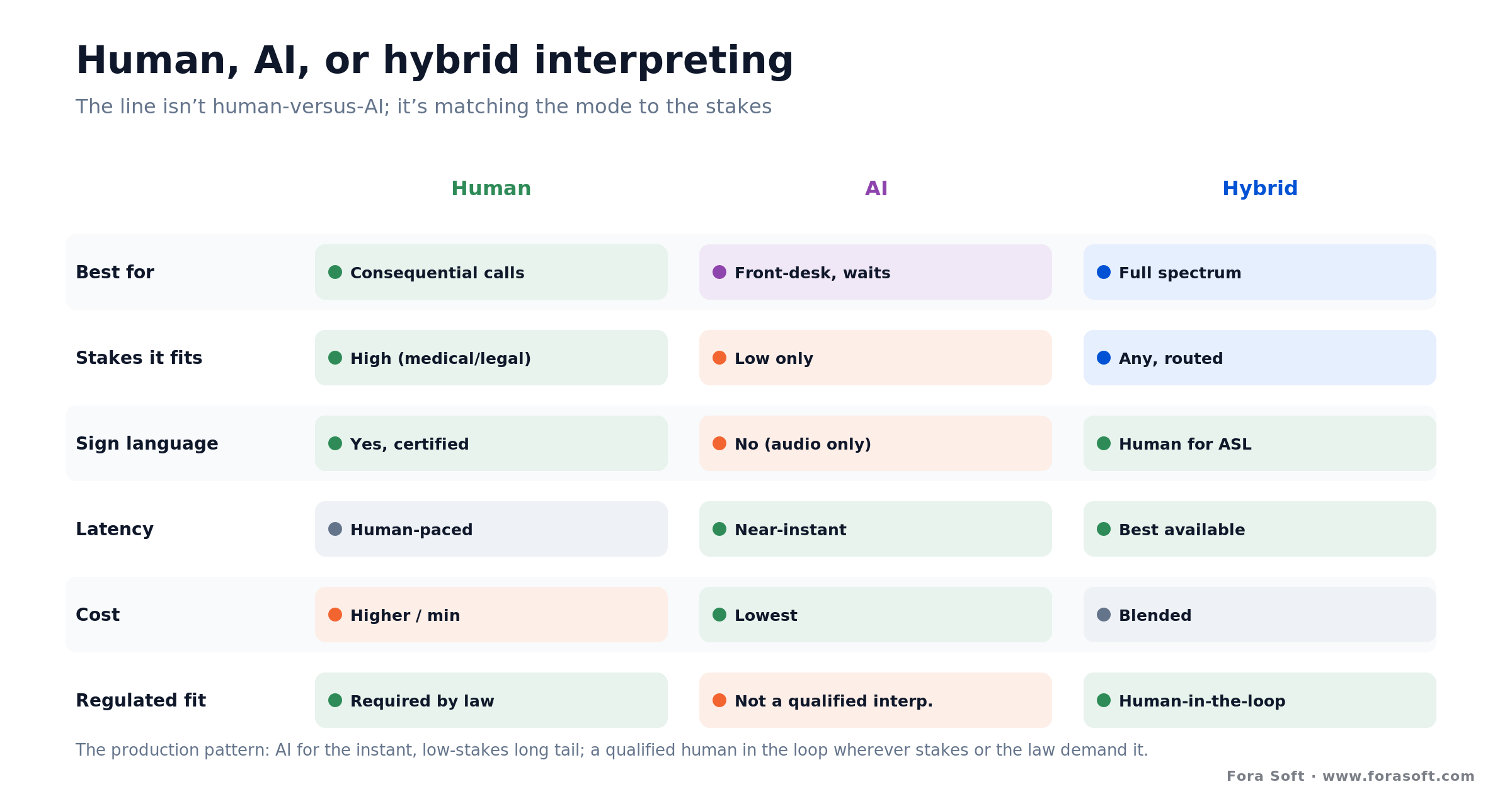
Figure 3. Where each mode fits. The line isn’t human-versus-AI; it’s matching the mode to the stakes.
Human interpreters are non-negotiable for consequential settings. A misinterpreted dosage or a misread legal question isn’t an edge case you patch later, and, as covered above, healthcare and courts legally require a qualified human. Sign language reinforces this: ASL is visual and spatial, not audio, so speech-to-speech AI doesn’t address it at all. For these, the human is the product and AI is, at most, a support tool for the interpreter.
AI interpreting earns its place in lower-stakes, high-volume spoken-language moments: front-desk questions, wayfinding, filling the wait while a human connects, or webinars and events where a good-enough live translation beats none. On TransLinguist we ship AI speech-to-speech in 16+ languages alongside the human interpreters precisely for these cases, and on Rafiky a machine-translation voice-over keeps a session going when a live interpreter briefly drops.
Reach for a hybrid model when: you want AI to cover the instant, low-stakes long tail and a human to take over the moment stakes rise. The design pattern that works is human-in-the-loop by default in regulated settings, with AI as fallback and triage, never AI silently standing in for a qualified interpreter where the law names one.
If your product leans heavily on the AI lane, our writeups on building an AI interpretation platform and the underlying real-time speech translation for live video go deeper on the mechanics than we can here.
The build-vs-buy market: services, platforms, custom
“VRI companies” is a category that hides three very different things: providers who sell you the interpreting service, software vendors who sell interpreter management platforms, and building it yourself. Knowing which one you actually need is the whole game, so here they are side by side.
| Option | What you get | Pricing shape | Where it wins | Where it breaks |
|---|---|---|---|---|
| Service provider (LanguageLine, Sorenson, AMN) | Interpreters on demand, their app | Per minute (~$1.95–$3.49) | You just need interpreters, fast, compliant | No control of software, data, or margin |
| Interpreter management platform (Boostlingo) | Scheduling, routing, VRI+OPI software | Subscription + usage | You’re an LSP running your own interpreters | Their workflow, roadmap, and branding |
| Generic video SDK + your own glue | Video calls; you build routing/ops | Per-minute media + your dev cost | Fast start on the video layer only | You still build the 90% that’s hard |
| Custom platform | The whole system, owned by you | One-time build + hosting | Interpreting is your product; you own data and margin | Upfront cost and time; you carry maintenance |
Boostlingo is worth a specific note because it consolidated the tooling market, having acquired Interpreter Intelligence and the remote-simultaneous vendor VoiceBoxer, so an LSP shopping for a platform is often really shopping for Boostlingo. That’s a good thing when their model fits you and a reason to build when it doesn’t. Our read: buy the service if you consume interpreting, license a platform if you’re a standard LSP, and build when your economics, workflow, or product ambitions don’t fit either box.
When building a VRI platform wins
Most organizations should not build. If you consume interpreting, buy the service; if you’re a conventional LSP, license a platform. Building earns its cost in a narrower set of cases, and being honest about which one you’re in saves a lot of money. Four decision rules:
Reach for buying the service when: you’re an end user, a hospital, court, or company, who needs interpreters, not software. Pay per minute, stay compliant immediately, and put zero engineers on it. For a single consuming organization this is the right trade almost every time.
Reach for licensing a platform when: you’re a language service provider with your own interpreters and standard workflows. An interpreter management system gives you scheduling, routing, and video without a build, and you customize at the edges instead of owning the core.
Reach for a hybrid build when: you want a proven video and media core but the routing, interpreter marketplace, billing, and compliance logic have to be yours. Reuse the commodity plumbing (an SFU, transcription, telephony) and build the parts that are your differentiator. This is often the fastest path to a defensible platform.
Reach for a full custom build when: interpreting is the product you sell, you run a large interpreter marketplace whose economics no tool fits, you need interpreting embedded inside your own application, or per-minute and per-seat fees at your scale have passed what a one-time build plus hosting would cost over two or three years.
The build case is strongest for platforms, not consumers. If you’re selling interpreting access, running a marketplace, or embedding language access into a healthcare or legal product, owning the routing engine and the interpreter relationship beats renting them. That’s the same logic that led our clients to build TransLinguist and Rafiky rather than resell someone else’s stack.
What a custom VRI platform costs to build
A custom VRI platform is a one-time build plus ongoing run cost, weighed against recurring fees that never stop. We’ll give ranges rather than a single number, because scope genuinely drives the figure, how many languages and modalities, which compliance regimes, whether you run your own interpreter marketplace, and quoting a precise price sight-unseen would be dishonest.
The build side. A focused VRI core, request app, routing engine with no-answer fallthrough, a WebRTC session layer on a media server, interpreter accounts and availability, per-minute billing, and an audit log, is a mid-six-figure build in our experience, because the hard components (media servers, telephony, transcription) are proven pieces we assemble rather than invent. Adding a full interpreter marketplace, sign-language modality, deep compliance for a regime like Section 1557, or embedding into an existing product each adds a meaningful increment on top. The cost lives in routing, credentialing, and compliance, not in the video call itself.
The run side. Ongoing cost is dominated by real-time media (SFU compute and egress, which scale with concurrent minutes), plus optional AI (speech-to-text and translation), telephony for the OPI lane, and normal maintenance. Interpreter payouts are usually a pass-through you bill against, not a platform cost. Once the pipeline exists, the marginal cost of the ten-thousandth session is close to the first.
Reach for a build when: recurring platform and per-minute fees at your volume are heading past what a one-time build plus hosting would cost over two or three years, or when interpreting is the product you sell and the margin belongs to you. Below that line, buying or licensing wins on speed and simplicity every time.
Want the build-vs-buy math for your case?
Send us your languages, volume, and where the calls happen (healthcare, courts, your own app). We’ll model buy, license, and build side by side — with a realistic budget and no sales theater.
On-demand VRI vs staff interpreters: the math
Whether you’re building a platform or just choosing how to source interpreting, the same cost question decides the model: pay per minute on demand, or carry dedicated interpreters. The answer turns on how many minutes of each language you actually use.
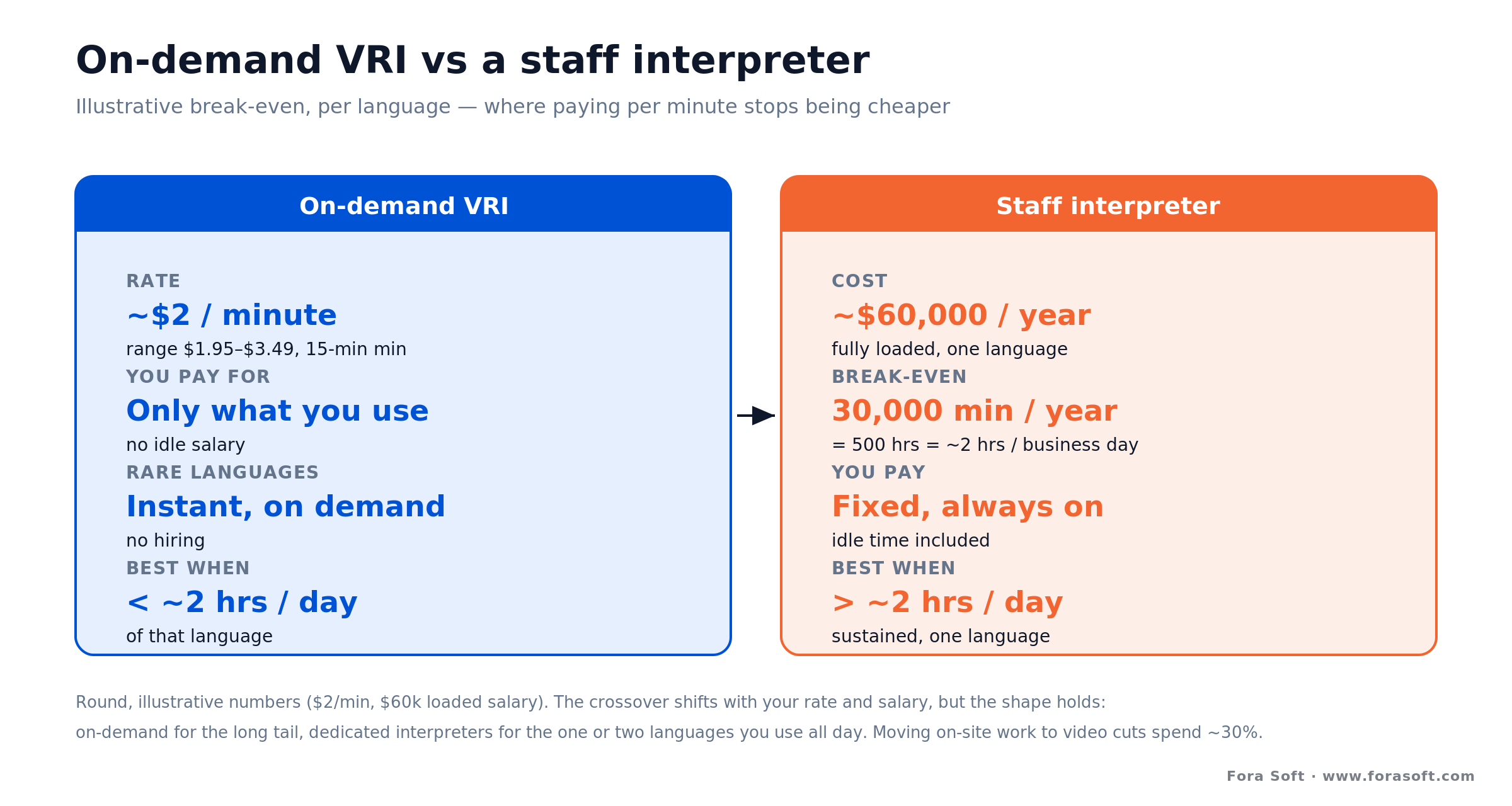
Figure 4. Illustrative break-even between on-demand VRI and a salaried interpreter, per language. The crossover moves with your rate and salary, but the shape holds.
Here’s the arithmetic, with round, illustrative numbers. On-demand VRI runs roughly $1.95 to $3.49 a minute, often with a 15-minute minimum; call it $2 a minute. A full-time staff interpreter, fully loaded with benefits, might cost $60,000 a year for one language. Divide: $60,000 at $2 a minute is 30,000 minutes, or about 500 hours of interpreting a year, which is roughly two hours every business day in that one language.
So the rule of thumb is clean. If you need less than about two hours a day of a given language, on-demand VRI is cheaper and infinitely more flexible, no idle salary, no coverage gaps, instant access to rare languages. If you consistently need more than that in one language, a dedicated interpreter (staffed or on a block contract) starts to win on cost for that language, while you still use on-demand VRI for the long tail of everything else. Most organizations land on exactly that mix.
This is also why switching routine on-site interpreting to video typically cuts spend by around 30%: VRI removes travel, mileage, and the two-hour on-site minimums that on-site interpreters bill. The savings are real, but they’re a reason to adopt VRI, not automatically a reason to build the platform yourself, which is a separate decision driven by the earlier sections.
Mini-case: three interpreting platforms we built
TransLinguist — the marketplace platform. We built a video interpreting platform that runs 75+ languages and a marketplace of 30,000+ certified interpreters, at roughly $4.2M in annual revenue. Its biggest validation is regulatory: it won the UK’s NHS national framework for language services, the contract vehicle hospitals, councils, schools, and police forces buy through, which is about as demanding a compliance and reliability bar as this field has. On top of human interpreting it ships AI speech-to-speech in 16+ languages, captions in 22, and a sign-language interface. The engineering underneath is the stack this guide describes: a MediaSoup media server for WebRTC, a routing layer over a message queue, transcription from multiple speech engines, and integrations into Zoom, Teams, and Google Meet.
Rafiky — the rescue and scale story. Rafiky is a simultaneous-interpretation platform, 200+ languages, 6,000+ interpreters, 30,000+ events, ISO 27001 certified, that we took over when its core real-time flows were unreliable. We stabilized the media pipeline and extended it for high-load multilingual events scaling to thousands of participants, and added a machine-translation voice-over that keeps a session running when a live interpreter briefly drops. It’s the clearest example of a point we make often: on these platforms, the real-time reliability engineering is the hard part, and it’s where a specialist team pays for itself.
Hospital phone interpreter — routing without the video. Not every interpreting need is video. We built an over-the-phone interpreting system where a clinician picks up any hospital landline, chooses a language from an IVR menu, and is connected to a live interpreter in seconds, no app, no training. The interesting engineering is the same routing and queue logic a VRI platform needs, distribution by language, priority, and availability, running on a telephony stack (SIP and FreeSWITCH) instead of WebRTC. The lesson across all three: the video is interchangeable plumbing; the routing, credentialing, and reliability are the product. Want that rigor on your platform? That’s a good 30-minute call.
A VRI decision framework in five questions
1. Do you consume interpreting, or sell it? If you need interpreters for your own operations, buy the service. If interpreting access is what you sell, or you run the interpreter pool, you’re a platform, and building or licensing is on the table.
2. What’s your compliance floor? Healthcare (Section 1557, HIPAA), Deaf access (ADA video standards), and courts each pull the architecture a different way. The more regimes you stack on one platform, the more a purpose-built system earns its keep over a generic one.
3. Do you need sign language? ASL and other signed languages raise the video-quality bar and require credentialed interpreters that speech AI can’t substitute. If sign language is core, weight everything toward video quality, framerate, and RID-style credentialing.
4. What’s your volume, per language? Run the two-hours-a-day test from the cost section for each major language. It tells you where on-demand wins and where dedicated interpreters do, and whether your total volume justifies owning the platform at all.
5. Does interpreting need to live inside your own product? If language access has to be embedded in your app, your data, and your brand, rather than a third-party tool your users also have to touch, that pushes hard toward a custom or hybrid build.
Five pitfalls when building a VRI platform
1. Treating video as the hard part. Teams spend their first month perfecting the call and discover routing, presence, and no-answer handling are where the real work is. Budget your engineering for the matching engine, not the WebRTC connection.
2. Ignoring the video-quality standard. A generic SDK that degrades to a frozen image passes a consumer QA and fails 28 CFR 36.303(f). Design for guaranteed frame rate and sharpness, especially for sign language, and be able to prove it.
3. Skipping interpreter credentialing. “Qualified interpreter” is a legal term under Section 1557. If your platform can’t track credentials and route only qualified interpreters into regulated calls, and log it, you’ve built a compliance liability.
4. Underbuilding for the long tail. Spanish always connects; the platform’s reputation is made on the rare language at 3 a.m. Build graceful fallthrough, honest wait estimates, and audio fallback before you launch, not after the first stranded call.
5. Forgetting the operations layer. Billing, payouts, quality monitoring, and audit aren’t v2 features; they’re what makes the thing a business a buyer will trust. Ship them with the first version, not later.
When NOT to build a VRI platform
Don’t build if you consume interpreting rather than sell it. A hospital, court, or company that just needs interpreters should contract a service like LanguageLine or a Boostlingo-powered provider and be compliant this week. Paying a software team to rebuild what a mature provider already does well would be a poor trade, and we’d say so on the first call.
Don’t build if you’re a conventional language service provider whose workflow an interpreter management platform already fits. Licensing Boostlingo or a similar system, and customizing at the edges, gets you running far faster than a ground-up build, and you keep your engineering budget for the parts that actually differentiate you.
Do revisit the decision as you grow. The buy-versus-build line moves when interpreting becomes something you sell, when per-minute fees compound past a build’s cost, or when a product you ship needs language access as a native feature. For neighboring build decisions, our guides to enterprise language interpretation software and AI translation companies are good next reads, and our AI integration services show where we’d start.
FAQ
What is video remote interpreting (VRI)?
Video remote interpreting is a service that connects people who don’t share a language to a qualified interpreter over live video, on demand or by appointment. It’s used in hospitals, courts, banks, and businesses when an in-person interpreter isn’t available fast enough. Video (rather than phone) matters because sign language is entirely visual and spoken-language interpreting also relies on facial expression and gesture.
How does video remote interpreting work?
A user requests an interpreter from an app or device and picks a language. A routing engine finds an interpreter who is qualified for that language and setting and available right now, rings them (falling through to the next on no-answer), and connects everyone to a live video session, usually through a media server so quality and recording are controlled. When the call ends, the platform logs it, bills per minute, and files the record for compliance.
What’s the difference between VRI and VRS?
VRI (video remote interpreting) is a fee-based service used when parties are together or in a video meeting, and it’s the provider’s responsibility to supply it. VRS (video relay service) is a free, US federally funded telecom service, paid through the FCC’s relay fund, that lets a Deaf person make a phone call to someone in another location; the FCC prohibits using VRS when both parties are in the same room. In short: VRS is for phone calls between separated people; VRI is for shared or scheduled situations.
How much does video remote interpreting cost?
On-demand VRI typically runs about $1.95 to $3.49 per minute, often with a 15-minute minimum, with rates depending on language and volume. Switching routine on-site interpreting to video usually cuts spend by around 30% by removing travel, mileage, and on-site minimums. Building a custom platform is a separate cost: typically a mid-six-figure one-time build plus hosting, which only pays off at high volume or when interpreting is the product you sell.
Does a VRI platform have to be ADA and Section 1557 compliant?
If it serves US public accommodations or healthcare, yes. The ADA (28 CFR 36.303(f)) sets four video-quality standards: real-time full-motion video with no lag, a sharp image showing hands and face, clear audio, and trained users. Section 1557’s 2024 rule requires a qualified interpreter, free language assistance, and bans low-quality VRI and unqualified interpreters. Practically, the platform must guarantee video quality, track interpreter credentials, and keep an audit trail proving both.
Is video remote interpreting used mainly in healthcare?
Healthcare is the biggest driver, hospitals and clinics are legally required to provide language access, but VRI is also heavily used in courts and legal settings, financial services, insurance, government, education, and any business serving multilingual or Deaf customers. The wider language-services market is around $73B in 2026 (Nimdzi), with interpreting its fastest-growing segment and video remote interpreting growing at roughly 8% a year as more settings prioritize seeing the participants, not just hearing them.
Can AI replace human interpreters in a VRI platform?
Not for consequential settings. Healthcare and courts legally require a qualified human interpreter, and sign language is visual, so speech-to-speech AI doesn’t address it. AI does add real value for low-stakes, high-volume spoken-language moments, front-desk questions, wait-time coverage, events, and as a fallback when a human briefly drops. The production pattern that works is hybrid: AI for the low-stakes long tail, human-in-the-loop wherever stakes or the law demand it.
Should we build our own VRI platform or buy one?
Buy the service if you consume interpreting; license an interpreter management platform if you’re a standard language service provider; build a custom platform when interpreting is the product you sell, you run a large interpreter marketplace no tool fits, you need it embedded in your own app, or per-minute and per-seat fees at your scale have passed a one-time build’s cost over two or three years. When in doubt, model buy, license, and build side by side before committing.
What to read next
Software
Enterprise Language Interpretation Software
The broader interpretation-software category around VRI: features, integrations, and buying criteria.
AI
Building an AI Interpretation Platform
The AI lane in depth: speech-to-speech, when it fits, and where humans stay non-negotiable.
Benchmarks
Real-Time Speech Translation Benchmarks
How the speech-translation engines behind AI interpreting actually compare on latency and accuracy.
Tools
Real-Time Meeting Translation Tools
The meeting-translation adjacent to VRI: three solutions compared for live multilingual calls.
Ready to build language access that holds up?
Video remote interpreting looks like a video call and is really a routing, credentialing, and compliance system with a video call attached. The platform’s job is to put a qualified interpreter on a legally clean video feed in seconds, prove it happened, and bill for it, across every language, including the rare one at 3 a.m. Get the matching engine, the 36.303(f) video bar, and the “qualified interpreter” standard right, and the rest follows.
Buy the service if you consume interpreting; license a platform if you’re a standard LSP; build when interpreting is your product or the fees have outgrown a build. If you’re not sure which side of that line you’re on, we’ve built enough of these to tell you straight. Explore our language interpretation development work to see where we’d begin.
The handbook · 7 volumes
Fora Soft Video Engineering Handbook
Video quality as a legal requirement and AI or hybrid interpreting are the two threads this guide ends on, and our seven-volume handbook covers both. Volume 7 explains live translation and captions under a real-time budget and EU AI Act rules; Volume 3 covers WebRTC and QoE, and Volume 4 covers voice processing and accessibility. Written by Nikolay Sapunov, CEO at Fora Soft.
Browse the handbook on Amazon →7 volumes · 9,000+ pages · Kindle & paperback
Let’s make your interpreting platform real
Whether you’re choosing a VRI provider or building a platform of your own, we’ll give you an honest read in 30 minutes — buy, license, or build, with the routing, video-quality, and cost math to back it.