
Key takeaways
• Voice biometrics verifies a person by the sound of their voice, not by what they know. A speaker-verification engine turns a voice sample into a numeric voiceprint and compares it to an enrolled one, a 1:1 match that answers “is this the claimed person?” in about a second.
• Accuracy is a trade-off, not a number. Every system slides between a false-acceptance rate and a false-rejection rate; the equal-error rate (EER) is where they meet. Vendor “99.9%” claims describe a lab operating point, not your call center at 3pm.
• AI voice cloning broke standalone voice login. In 2023 a reporter cloned his own voice with a free tool and walked into his bank account. Treat voice as one factor, add liveness and anti-spoofing, and follow the NIST rule that a biometric is never the whole password.
• Voiceprints are regulated personal data. Under GDPR they are special-category data; Illinois BIPA carries $1,000–$5,000 statutory damages per violation. Consent, retention, and deletion are engineering requirements, not legal footnotes.
• Build vs buy turns on volume, data residency, and control. A managed API ships this week; an on-prem or custom build wins when you handle regulated audio, need on-device matching, or run enough verifications that per-call fees stop making sense.
Why Fora Soft wrote this guide
Most articles about voice biometrics are written by the companies selling it. Search the term and you get definition pages and product tours, not a straight answer on whether to build it, buy it, or leave it alone. We wrote this because we build the voice and telephony systems where speaker verification actually lives, and we keep getting the same question from founders and heads of engineering: “can we just log people in with their voice?” The honest answer has a lot of “it depends” in it, and the cost of guessing wrong is a fraud loss or a class action.
Fora Soft has built video, real-time, and AI software since 2005, with 250+ projects with a 50+ person in-house team. On Nucleus, an on-prem communication platform for the Canadian telecom Fibernetics, our voice pipeline carries 600M+ AI phone-call minutes a month across SIP and WebRTC, under SOC 2, HIPAA, and GDPR. On BlaBlaPlay, an anonymous voice social app, we run audio machine learning on-device with CoreML. That is the exact plumbing a voiceprint rides on: capture, voice activity detection, an embedding model, and a decision that has to be fast and defensible. The same pipeline runs our AI call agent development work for inbound and outbound phone lines.
So this is a builder’s guide, not a brochure. We will show you how speaker verification works, what the accuracy numbers really mean, why AI clones changed the threat model, what it costs against a plain SMS code, and when we would tell you not to bother. Where we have shipped something relevant, we will say so; where we would want a specialist in the room, we will say that too.
Weighing voice biometrics for your product?
Bring your use case, your risk level, and your call volume. We’ll tell you honestly whether to buy a speaker-verification API, run one on-prem, or skip it, what it costs, and where the compliance lines sit.
What voice biometrics actually is
Voice biometrics is the practice of confirming who someone is from the physical characteristics of their voice. A verification engine listens to a sample, turns it into a compact numeric signature called a voiceprint, and compares that signature to one you captured earlier. If they are close enough, the person is accepted. It is the audio cousin of a fingerprint or face match.
Two words get mixed up constantly, so let’s pin them down. Speaker verification is a 1:1 check. The person claims an identity (a customer ID, an account) and the system confirms yes or no. Speaker identification is a 1:N search that decides who, out of many enrolled voices, this is. Authentication is almost always verification: the account is already named, and voice is the proof. Identification is a fraud-and-forensics tool, used to spot a known bad actor calling back under a new name.
One more distinction, because people conflate it with dictation. Speech recognition answers “what did they say?” Speaker verification answers “who said it?” They use different models and solve different problems. You can run both at once, transcribing the words and verifying the speaker, but a great transcription engine tells you nothing about identity. If your calls happen in noise, our field notes on speech recognition accuracy in noisy environments apply to the capture side of verification too.
How speaker verification works, end to end
Every voice-biometrics system runs two flows: enrollment once, and verification every time after. In enrollment, you capture clean speech, strip the silence, and feed it to a neural network that outputs a fixed-length vector, the voiceprint. Modern engines use deep speaker embeddings (the x-vector and ECAPA-TDNN family) that map any voice to a few hundred numbers describing its vocal-tract fingerprint. You store that vector, not the audio.
Verification repeats the front end (capture, voice activity detection, embedding), then scores the new vector against the enrolled one with a distance measure (cosine similarity or PLDA). The score crosses a threshold you set, and the system returns accept or reject. Here’s the part vendor diagrams skip: a spoofing check should sit between the match and the decision, asking “is this a live human or a recording, a synthetic clone, or a converted voice?” before anything is approved. We will come back to why that box is the whole ballgame.
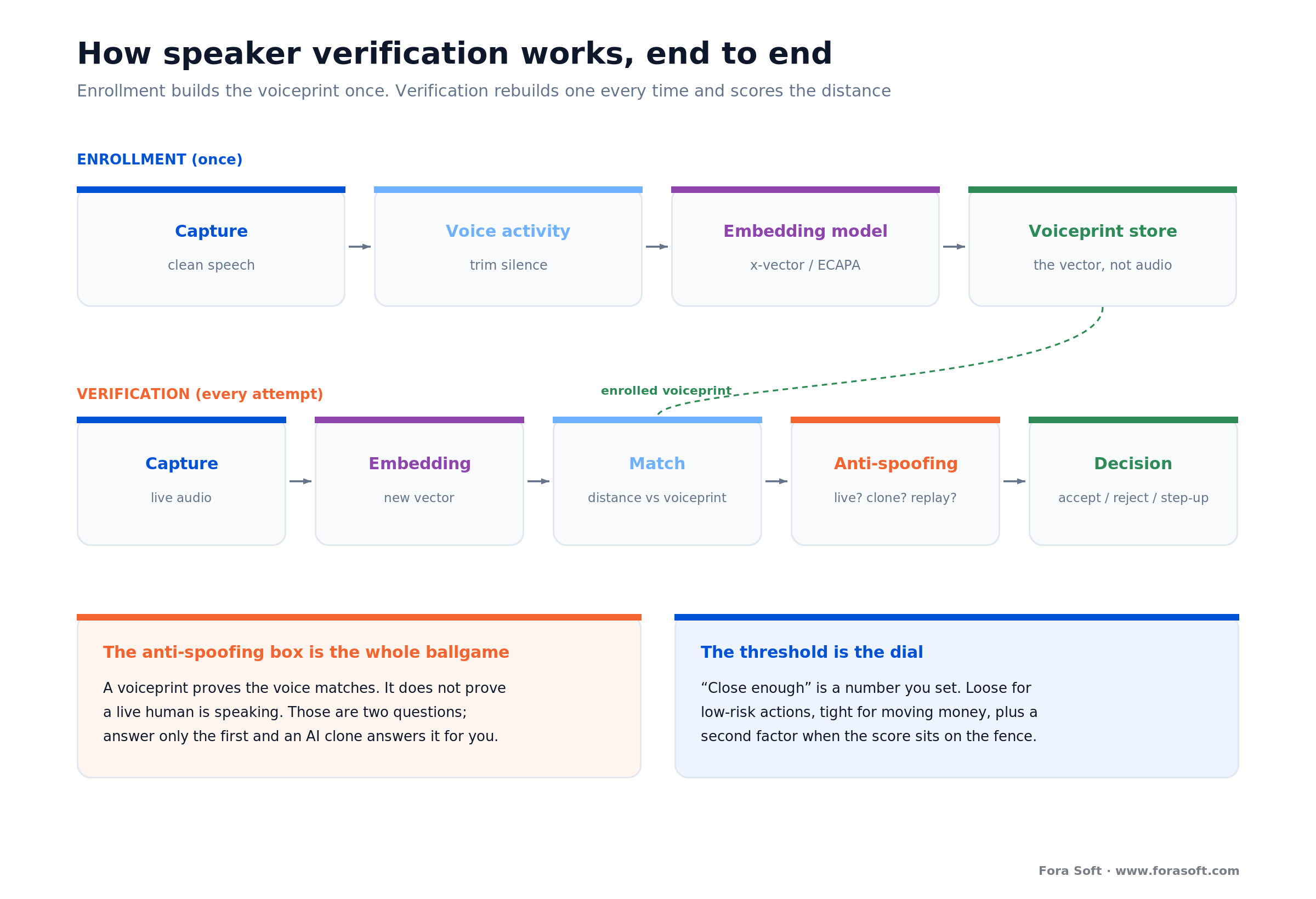
Figure 1. The two flows of speaker verification. Enrollment builds the voiceprint once; verification rebuilds one on every attempt and scores the distance. The anti-spoofing check between match and decision is where systems live or die.
A useful mental model: the embedding is a dictionary definition of your voice, and verification is checking how far a new definition sits from the stored one. Distance small enough, you’re in. The threshold is the dial that decides how forgiving “close enough” is, and it is the single most important tuning decision you will make.
Text-dependent, text-independent, and passive
There are two ways to ask for the voice, and the choice shapes the whole product. Text-dependent verification uses a fixed passphrase, the classic “my voice is my password.” The user enrolls by repeating it, and every login says the same words. It is fast, needs only a couple of seconds of audio, and tends to score more accurately because the content is constant. The catch: a fixed phrase is easy to record and replay, so it leans hard on liveness checks.
Text-independent verification works on any speech. It doesn’t care what you say, which lets it verify you in the background of a normal conversation, the pattern call centers want. That’s passive voice biometrics: the customer explains their problem to an agent or a bot, and within ten to fifteen seconds of natural speech the system has quietly confirmed the account, no passphrase, no “please repeat after me.” It needs more audio and more compute, and it demands upfront consent because you’re building a voiceprint from ordinary talk.
Reach for text-dependent when: you control a mobile app or IVR, want the fastest possible check, and can pair the passphrase with a strong liveness or challenge-response step. Reach for passive text-independent when the win is removing friction from a live agent call and you can collect explicit consent and 10–15 seconds of speech.
Accuracy: FAR, FRR, and the EER trade-off
There is no single accuracy number for a voice system. There is a curve, and where you sit on it is a business decision. Two error rates matter. The false acceptance rate (FAR) is how often an impostor gets in. The false rejection rate (FRR) is how often a real user is turned away. Tighten the threshold and FAR drops while FRR rises; loosen it and the reverse happens. You cannot minimize both at once.
The equal error rate (EER) is the operating point where FAR equals FRR, and it’s the fair way to compare two engines. Vendors quoting FAR near 0.01% and FRR of 1–3% are describing clean, matched conditions (biometricupdate, 2021). Your numbers will be worse, because the real world adds background noise, phone codecs, colds and tiredness, and the slow drift of a voice aging over years. Test on your own audio, in your own channel, before you trust anyone’s datasheet.
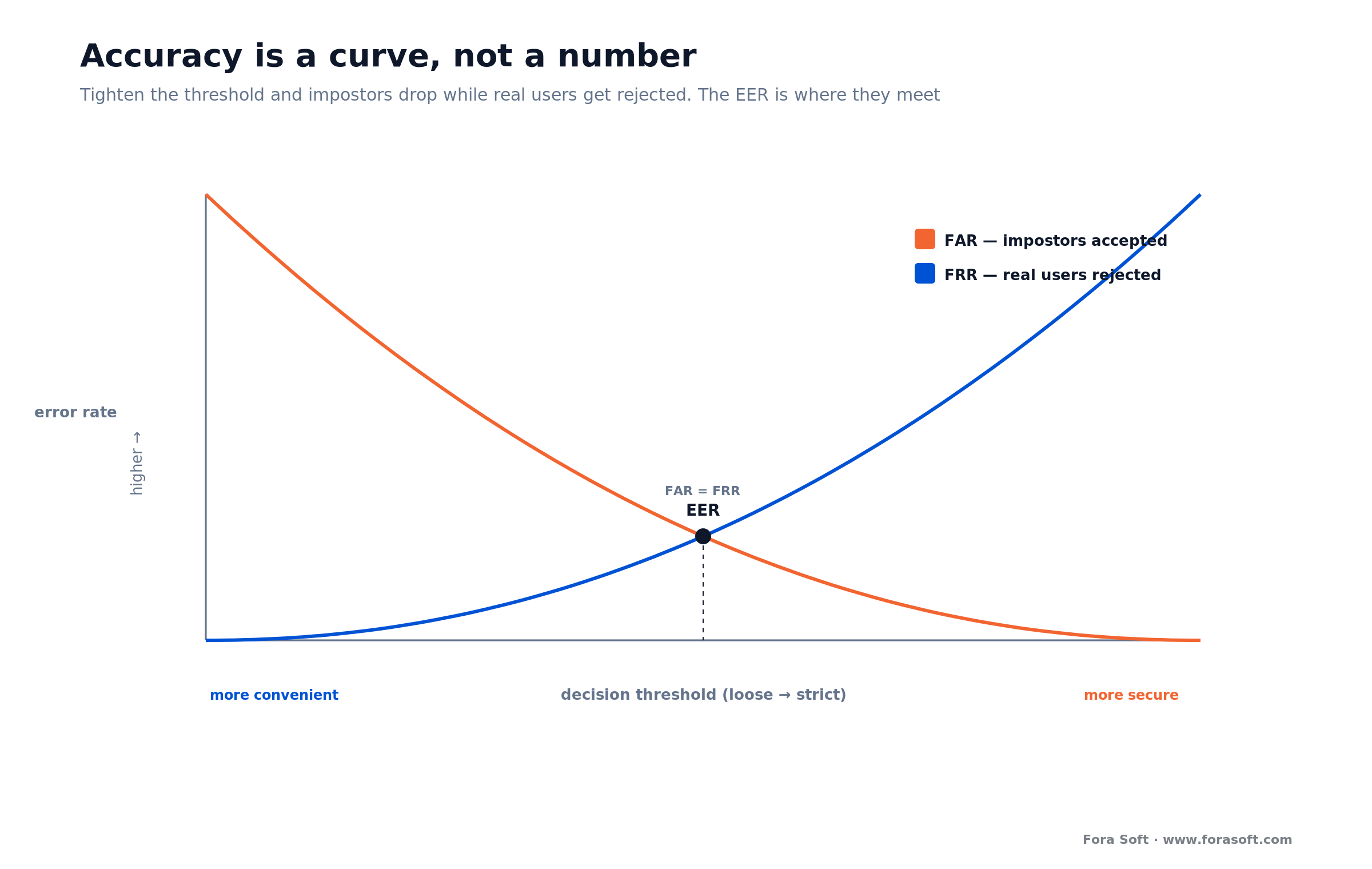
Figure 2. The security-versus-convenience dial. Moving the threshold trades false accepts for false rejects; the EER is where they meet. High-value transactions push the dial toward security and add a second factor.
Here’s how we’d use it in practice. Set a looser threshold for low-risk actions like checking a balance, and a much tighter one for moving money — then require a second factor when the voice score is only borderline. That tiered approach beats picking one threshold and living with it, and it’s the difference between a system users tolerate and one they curse.
The deepfake problem voice vendors gloss over
Can voice biometrics stop AI-cloned calls? Only if you build for it — and plain voice matching, on its own, no longer can. In February 2023 a VICE reporter cloned his own voice with a free ElevenLabs account, using about five minutes of audio, and after a little tuning walked straight through Lloyds Bank’s Voice ID into his account (biometricupdate, 2023). That wasn’t a lab stunt; it was a consumer tool against a production bank. The uncomfortable truth is that your voice is not a secret. It’s on your voicemail, your webinars, your social videos — minutes of training data anyone can scrape.
Three attack shapes matter. Replay plays a recording of the real person. Synthetic speech uses text-to-speech to generate the target’s voice saying anything. Voice conversion takes an attacker’s live speech and morphs its timbre toward the target in real time, the hardest to catch because it’s interactive. The losses are real: a Hong Kong finance worker wired $25M in 2024 after a deepfake video call impersonating his CFO, and a UAE bank lost $35M to a cloned-voice instruction back in 2020.
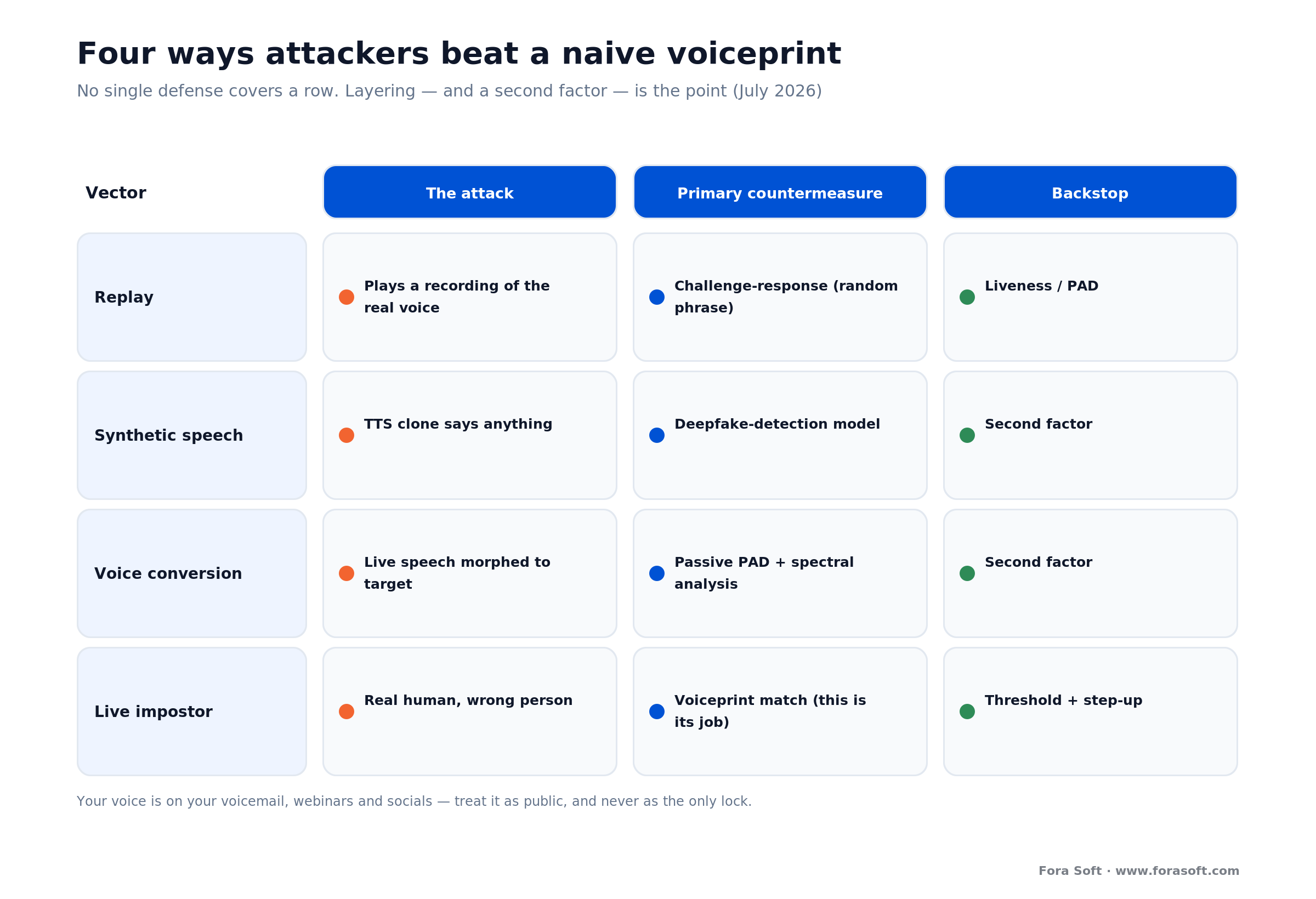
Figure 3. The four ways attackers beat a naive voiceprint, and the countermeasure each one calls for. No single defense covers the row; layering is the point.
The rule we live by: a voiceprint proves the voice matches; it does not prove a live human is speaking. Those are two different questions, and if your design answers only the first, an AI clone answers it for you. The attack side of this, how good cloning has gotten, is covered in our piece on voice cloning and synthesis.
Worried your voice login is one clone away from a breach?
We’ll review your authentication flow, stress-test it against replay and synthetic-voice attacks, and lay out a layered fix with a second factor and anti-spoofing built in.
Anti-spoofing: liveness, PAD, and challenge-response
If a voiceprint answers “does this match?”, anti-spoofing answers “is this real?” The formal name is presentation attack detection (PAD), and there is an international standard for testing it: ISO/IEC 30107-3:2023. It defines how to measure a system’s resistance to spoofs with two rates: APCER (how often an attack slips through) and BPCER (how often a genuine user is wrongly flagged as an attack). When a vendor claims “liveness,” ask which of those numbers they publish and under whose test.
Three defenses do the heavy lifting. Passive PAD analyzes the signal for the artifacts recordings and synthesis leave behind: missing room acoustics, compression traces, unnatural spectral patterns. Challenge-response asks the caller to say a random phrase or digits the attacker couldn’t have pre-recorded, which kills simple replay outright. Deepfake detection is a dedicated model trained to separate human speech from generated speech; the academic benchmark for this is the ASVspoof challenge, whose fifth edition ran in 2024. Vendors sell products here too. Pindrop’s Pulse Inspect (2024) advertises 99% deepfake detection on digital audio, which is a marketing operating point, not a guarantee for your traffic.
The honest caveat: this is an arms race. Every improvement in detection is met by better synthesis, and a model that scores well on last year’s attacks can miss this year’s. That’s an argument for a defense you can retrain and update, and against treating anti-spoofing as a box you tick once and forget.
Voice is a factor, not a password
Should you let people log in with voice alone? No, and the standards agree. The US digital-identity guidance, NIST SP 800-63B, is blunt: a biometric is not recognized as an authenticator by itself, and may be used only as part of multi-factor authentication, bound to a physical authenticator you hold. Voice is an inherence factor (something you are), and it belongs next to something you have (a registered device) or something you know (a PIN), never standing alone.
In practice this makes voice biometrics a superb friction remover rather than a lone gatekeeper. Two patterns work. Use voice as a fast step-up check: the customer is already on a known device, and voice confirms them before a sensitive action. Or use it to shrink the call-center script: passive verification replaces three security questions, then anything high-risk still triggers a second factor. Either way the voice score is one input to a risk decision, not the decision.
Design rule: pair the voice check with a possession factor (the enrolled phone or app) and reserve a hard second challenge for money movement and profile changes. This is also how voice biometrics stays inside PSD2 strong-customer-authentication rules, where inherence is explicitly one of three factors and never sufficient by itself.
Build, buy, or wire up an API
There are three honest paths, and the first firm “yes” usually settles which. Start with your volume, your data-residency rules, and how much custom logic you need.
1. Buy a managed API. Providers expose enroll and verify endpoints; you send audio, they return a score. Live this week, least operational burden, and someone else keeps the anti-spoofing models current. The limits: recurring per-verification fees, your customers’ voice data leaves your walls, and you inherit the vendor’s roadmap and their end-of-life decisions.
Reach for a managed API when: you’re validating the idea, volume is modest, cloud storage of voice data is acceptable under your regulator, and speed to launch beats long-term unit economics.
2. Self-host a licensed engine. Vendors like Phonexia license an on-prem engine you run inside your own network. Voice data never leaves, latency is yours to control, and you can meet strict residency rules. You take on the ops (scaling, updates, monitoring) and you still pay license fees, but the compliance story is far cleaner.
Reach for self-hosting when: you handle regulated audio (banking, health), your regulator wants data kept in-country, and you have the platform team to run a service properly.
3. Build custom on open models. Open speaker-embedding models (the ECAPA-TDNN family, packaged in toolkits like SpeechBrain) let you build a verification service you own end to end, including on-device matching where the voiceprint never touches a server. It’s the most work and demands real audio-ML skill, but it wins on margin at scale, on white-labeling, and on privacy designs a vendor can’t offer.
Reach for a custom build when: you run high volume, need on-device or fully private matching, want to white-label the capability, or the recurring API bill has crossed the cost of owning the stack.
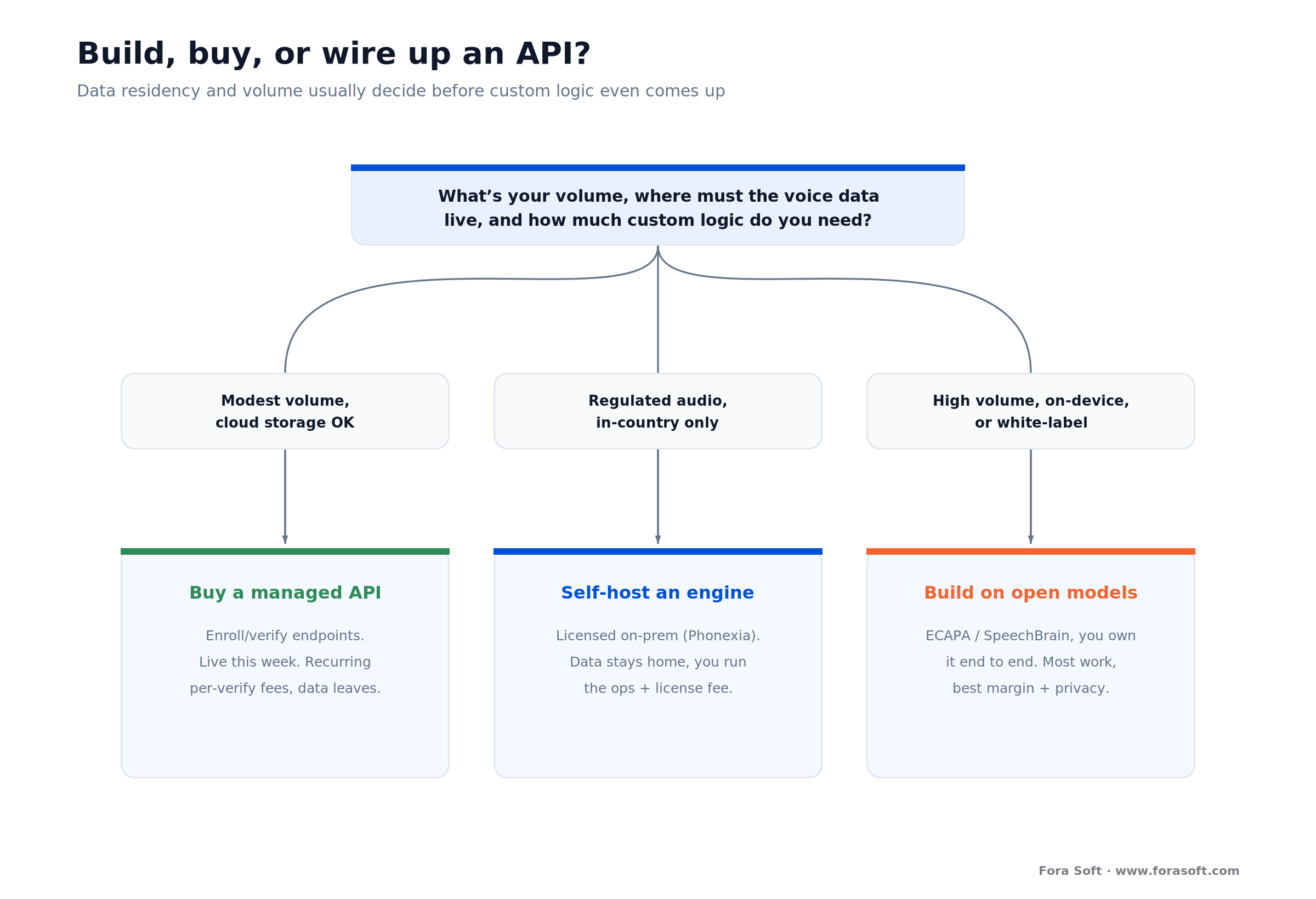
Figure 4. Three paths, one first question. Data residency and volume usually decide before custom logic even enters the conversation.
Compliance: GDPR, BIPA, and PSD2
A voiceprint is regulated personal data, and the rules bite harder than teams expect. This is a plain-English summary, not legal advice (every deployment needs its own counsel), but three regimes set the shape of the build.
GDPR. Under Article 9, biometric data used to identify a person is special-category data. You need an explicit legal basis (usually explicit consent), a clear purpose, secure storage, and a working deletion path — the right to erasure applies to voiceprints. Design the “delete my voiceprint” flow on day one, not after the first request.
Illinois BIPA. The strictest US rule. Before you capture a voiceprint you must get written consent and publish a retention-and-destruction schedule. It carries a private right of action with statutory damages of $1,000 for negligent and $5,000 for intentional violations, per violation — the reason biometric class actions are a genuine financial risk, not a theoretical one.
PSD2 in the EU. For payments, voice counts as the inherence factor in strong customer authentication and must be combined with an independent factor. It shapes exactly where in the flow voice is allowed to stand and where a second factor is mandatory. This is the ongoing-authentication cousin of onboarding identity checks; we split those intents deliberately in our guide to video KYC solution development — KYC proves who you are at sign-up, voice biometrics re-confirms it later.
What voice biometrics really costs
The cheapest way to understand the economics is to compare it to the thing it usually replaces: the SMS one-time code. SMS looks cheap per message but never stops costing, because every verification sends a new billable text.
Here’s the worked math. A managed verification product such as Twilio Verify runs about $0.05 per successful US verification (Twilio pricing, 2026). At 100,000 verifications a month that’s roughly $5,000 every month, forever — $60,000 a year that scales linearly with your users. Raw A2P SMS is cheaper per message (around $0.011 in the US after carrier fees) but adds campaign registration and grows the same way.
| Approach | Cost shape | 100K/month | Scales with |
|---|---|---|---|
| SMS OTP (managed Verify) | Per message, recurring | ≈ $5,000/mo | Every verification |
| Voice API (managed) | Per verification, recurring | Quote-based, per-call | Every verification |
| Self-hosted engine | License + your infra | Fixed-ish + fraction/verify | Infra, not per-call |
| Custom on open models | Build once + compute | Mostly fixed | Near-zero per verify |
The point isn’t that voice biometrics is free — enrollment, anti-spoofing, and the second factor all cost something. It’s that a 1:1 embedding comparison is a fraction of a cent of compute, so once you own the stack the marginal cost per login trends toward zero while SMS keeps billing. That crossover — where a build pays back the recurring API or SMS bill — is the number to model before you commit. We keep these estimates conservative; if we’re unsure of a figure, we don’t publish it.
Want the crossover math for your volume?
Tell us your monthly verification count and risk profile. We’ll model API-vs-build economics and hand you a break-even you can take to your CFO.
The voice biometrics companies, compared
The vendor field splits into authentication engines and deepfake-defense specialists, and most enterprise pricing is quote-only, so treat the numbers you’re quoted as your own benchmark. One planning note that catches banks off guard: Nuance Gatekeeper, long the default in the enterprise, has been reported to be winding down orderability under Microsoft, with on-prem support phasing out. If you’re standing on it, factor a migration into your roadmap.
| Vendor | Focus | Where it wins | Where it breaks |
|---|---|---|---|
| Pindrop | Anti-fraud + auth | Deepfake detection, call-center fraud | Enterprise pricing, cloud-first |
| Phonexia | On-prem engine | Data stays in your network | You run the ops |
| ID R&D (Mitek) | Voice + liveness SDK | Strong passive anti-spoofing | Embed + integrate yourself |
| Nuance Gatekeeper | Enterprise incumbent | Deep bank deployments | Reported wind-down; lock-in |
| Open models (SpeechBrain) | Build-your-own | You own it; on-device possible | Needs audio-ML expertise |
Our take: if the job is call-center fraud defense, a specialist like Pindrop earns its keep. If it’s data-residency-bound authentication, an on-prem engine or a custom build is the cleaner answer. And if you want privacy that no vendor can offer, matching that happens on the user’s device so the voiceprint never leaves it, that’s a build.
What we have shipped in production voice
We want to be straight about scope: we haven’t deployed a bank-grade speaker-verification product, and we’d bring an anti-spoofing specialist into the room for one. What we have done is build and run the exact infrastructure a voiceprint rides on, at scale, under compliance.
On Nucleus, the on-prem communication platform we build for the Canadian telecom Fibernetics, our voice stack handles 600M+ AI phone-call minutes a month across SIP and WebRTC for 5,000+ businesses, under SOC 2, HIPAA, and GDPR. That is the environment where a call-center voice-verification layer lives: real-time capture, low-latency processing, and a security bar that regulators check. Adding passive verification to a flow like that is an integration problem we understand from the inside.
On BlaBlaPlay, an anonymous voice social app, we run audio machine learning on-device with CoreML: a custom neural network that analyzes voice notes and flags content, plus Whisper transcription, all processed on the phone. That’s the same shape as on-device voiceprint matching: run the model where the audio is, keep the sensitive data off the server. It’s the kind of work we do under AI integration. If you want a similar assessment of where voice biometrics fits your stack, book a 30-minute call and we’ll walk your flow with you.
A decision framework in five questions
Before you scope anything, answer these five. They decide the shape of the project faster than any feature list.
1. What’s the risk of the action? Checking a balance and wiring money are not the same decision. High-value actions need a tighter threshold and a mandatory second factor; low-risk ones can lean on voice for convenience.
2. Where must the voice data live? If your regulator wants audio kept in-country or off third-party clouds, a managed API is out and you’re looking at on-prem or a custom build.
3. How many verifications per month? Model the recurring API or SMS bill against the cost of owning the stack. High volume tips the math toward building.
4. Passphrase or passive? An app or IVR can ask for a phrase; a live-agent call center wins most from passive verification in the background. That choice drives your consent flow and your compute budget.
5. Who owns the anti-spoofing? If you can’t retrain a deepfake defense as attacks evolve, buy from a vendor who does. If you need that capability in-house and private, that’s a signal to build with a partner who has run audio ML in production — which is where a conversation with us pays for itself.
Five pitfalls that sink voice-auth projects
1. Treating voice as the whole login. The single most common and most dangerous mistake. A voiceprint alone is a username-grade secret, not a password. Pair it with a second factor or you’ve built the system the VICE reporter walked through.
2. Shipping without anti-spoofing. Matching resistance to clones is not a later phase. Replay and synthetic-voice attacks are cheap and available now; if PAD and challenge-response aren’t in the first release, don’t launch to high-value flows.
3. Tuning the threshold on lab audio. Numbers from a clean dataset collapse on real phone lines with noise and codecs. Calibrate FAR and FRR on your own channel, with your own users, and re-check after launch.
4. Ignoring the consent and deletion path. Under GDPR and BIPA, missing consent or a missing deletion flow is a legal exposure with per-violation damages. Build enrollment consent and “forget my voiceprint” before you build the fun parts.
5. Locking into a vendor you can’t leave. The Nuance Gatekeeper wind-down is the cautionary tale. Ask where the voiceprints are stored, whether you can export them, and what happens if the product is discontinued — before you enroll your first million users.
The KPIs that tell you it is working
Security KPIs. Track the false acceptance rate on your real traffic, the attack presentation classification error rate (APCER) from your PAD tests, and confirmed fraud that got through. These are the numbers that keep you out of the news; if FAR or APCER drifts up, the model or threshold needs work.
Accuracy and experience KPIs. Watch the false rejection rate and the enrollment completion rate. A high FRR means real users are being turned away — the fastest way to make people hate a login. Enrollment drop-off tells you whether the onboarding ask is too heavy.
Business KPIs. Measure average handle time in the call center (passive verification should cut it by removing security questions), cost per verification against your old SMS bill, and containment — how many calls are authenticated without a human. These translate the tech into the numbers a CFO signs off on.
When not to use voice biometrics
Sometimes the right answer is don’t. If you’re a low-risk consumer app where a password reset by email is fine, voice biometrics adds cost, consent overhead, and a regulated data store you didn’t need. A passkey or a plain authenticator app is cheaper and stronger.
Don’t use voice as a standalone gate for high-value actions, full stop — that’s the pattern clones defeat. And be careful with populations where voices vary or degrade: illness, aging, and speech differences push up false rejections, so if accessibility and inclusion matter for your users, voice-only will frustrate exactly the people you most want to serve. Keep an alternative path.
The strongest case for voice biometrics is narrow and real: a call center drowning in security questions, or a step-up check on a known device where speed matters. Outside that, question whether the friction it removes is worth the machinery it adds.
FAQ
What is voice biometrics in simple terms?
Voice biometrics confirms who someone is from the physical sound of their voice. The system turns a voice sample into a numeric voiceprint and compares it to one captured at enrollment. If they match closely enough, the person is accepted — the audio equivalent of a fingerprint check.
How does voice biometrics work?
A neural network converts speech into a fixed-length embedding (the voiceprint). At verification, the system builds a new embedding from the live audio and measures its distance to the stored one. If the score crosses a set threshold and an anti-spoofing check confirms a live human, the person is verified.
How accurate and secure is voice biometrics?
Accuracy is a trade-off between false acceptances and false rejections, summarized by the equal error rate. Vendors quote very low error under lab conditions, but noise, phone codecs, and aging voices push real numbers higher. On security, voice alone is no longer safe against AI clones — it must be one factor among two or more, with anti-spoofing.
Can voice biometrics help prevent deepfake calls?
Only when it’s built to. A plain voiceprint match can be fooled by a good clone, as a 2023 bank bypass showed. What stops deepfakes is a layered defense: presentation attack detection, challenge-response with random phrases, a dedicated deepfake-detection model, and a second authentication factor for anything high-value.
What is the difference between text-dependent and passive voice biometrics?
Text-dependent verification uses a fixed passphrase said the same way every time — fast and accurate but easy to record. Passive (text-independent) verification works on any speech, confirming the speaker in the background of a natural conversation, which is what call centers prefer. Passive needs more audio, more compute, and explicit consent.
Is voice biometrics legal, and what about GDPR and BIPA?
It’s legal with the right safeguards. A voiceprint is special-category data under GDPR, needing explicit consent, secure storage, and a deletion path. Illinois BIPA requires written consent and a published retention schedule, with statutory damages of $1,000–$5,000 per violation. Treat consent and retention as build requirements, and get your own legal review.
How much does a voice biometrics system cost?
Managed APIs charge per verification, which at 100,000 checks a month runs into the low thousands monthly and scales with users. Self-hosted engines add a license plus your infrastructure. A custom build costs more upfront but drops the marginal cost per login toward zero, which is why high volume favors building. Model the crossover before you commit.
Is there a voice biometrics API we can just plug in?
Yes — several vendors expose enroll and verify endpoints, and that’s the fastest way to launch. The trade-offs are recurring per-verification fees, your users’ voice data leaving your infrastructure, and dependence on the vendor’s roadmap. For regulated audio or on-device matching, a self-hosted engine or a custom build on open speaker-embedding models is the better fit.
What to read next
Identity, at onboarding
Video KYC Solution Development: A Build Guide
Prove who a user is at sign-up; voice biometrics re-confirms it later.
The attack surface
Voice Cloning and Synthesis: How It Works
Understand how good clones have gotten — the threat this article defends against.
The voice stack
AI Call Assistants: An API and Build Guide
The telephony and voice pipeline a verification layer plugs into.
The capture problem
Speech Recognition Accuracy in Noisy Environments
Noise wrecks recognition and verification alike — how we handle the audio front end.
Ready to design voice authentication that survives clones?
Voice biometrics is a strong friction remover and a weak lone gatekeeper. It verifies a person from a voiceprint in about a second, but accuracy is a threshold you tune on your own audio, AI cloning means it must never stand alone, and a voiceprint is regulated data with real consent and deletion duties. Build for layers (voice plus a second factor plus anti-spoofing) and it earns its place.
The build-vs-buy call comes down to volume, data residency, and control: a managed API to validate fast, an on-prem engine when audio must stay home, a custom build when you own the scale or need on-device privacy. We’ve run the voice infrastructure underneath all three, and we’ll tell you honestly which one fits — including when the answer is to skip it.
The handbook · 7 volumes
Fora Soft Video Engineering Handbook
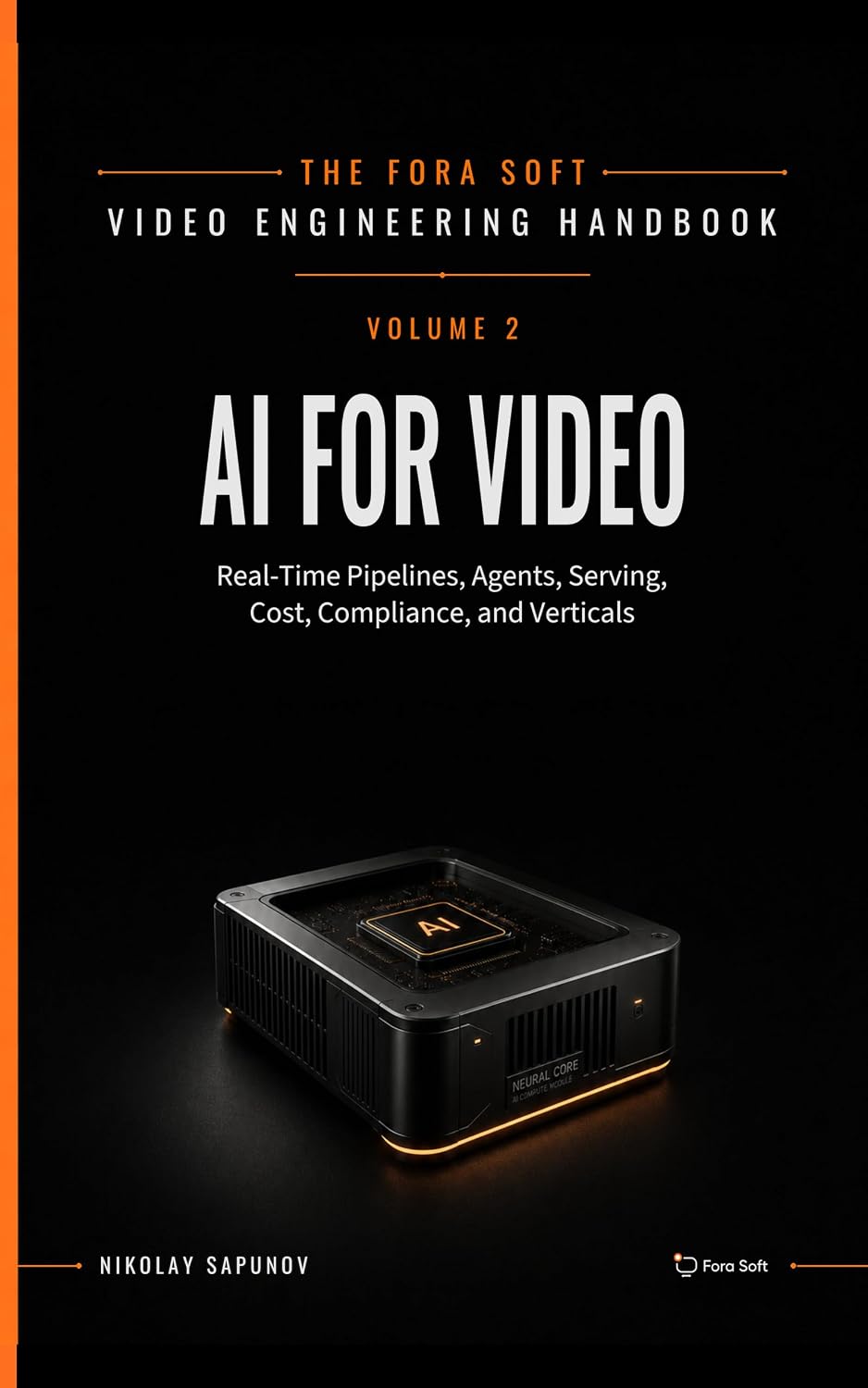
Speaker verification sits on top of audio capture and speech models, and AI voice clones have changed the threat model for both. Our seven-volume Fora Soft Video Engineering Handbook covers that stack. Start with Volume 6 on speech recognition, diarization and model deployment, then Volume 7 for biometric regulation and real-time agents, and Volume 4 for the voice processing that cleans audio before scoring. Written by Nikolay Sapunov, CEO at Fora Soft.
Browse the handbook on Amazon →7 volumes · 9,000+ pages · Kindle & paperback
Let’s scope your voice authentication
Thirty minutes, your use case, a straight recommendation: buy, self-host, or build — with the cost, the compliance path, and the anti-spoofing plan spelled out.