


Why This Matters
If you build or buy video software — conferencing, surveillance, OTT, e-learning, telemedicine — the words "generative," "agent," and "agentic" now appear in every vendor deck, usually as if they mean the same thing. They do not, and the gap between them decides cost, risk, and what you can actually promise a customer. This article is for product managers, founders, and operations leads who need to tell the three apart well enough to scope a project, question a vendor, and talk to their own engineers. By the end you will be able to draw the agent loop on a whiteboard and say exactly where it belongs in a video pipeline — and, just as important, where it does not.
Start With The Three Words, Defined Plainly
The fastest way to get lost in this topic is to treat "generative AI," "AI agent," and "agentic AI" as synonyms. They sit at three different levels. One is a capability, one is a unit, and one is a pattern of behavior. Define each in plain terms before the term itself appears, and the confusion clears.
The content-making capability, called generative AI, is software that produces new output — text, an image, audio, a summary, a block of code — from patterns it learned during training. You give it a prompt; it gives you a result. It is reactive: it waits to be asked, answers, and then stops. A model that writes a meeting summary from a transcript is generative AI. So is one that draws a thumbnail or drafts a reply. The job begins and ends with a single response.
The single working unit, called an AI agent, is a program that uses a generative model as its brain but adds three things the model alone does not have: a goal, the ability to call tools, and the freedom to decide its own next step. An agent does not just answer — it acts. It can search a database, call an API, open a web page, run a script, and then look at what came back and decide what to do next. IBM frames an AI agent as a system that autonomously performs tasks by designing its own workflow with the tools available to it. The key word is autonomously: the agent, not a fixed script, chooses the order of operations.
The broader behavior, called agentic AI, is the property of working toward a goal with limited supervision — perceiving a situation, reasoning about it, breaking it into steps, taking action, and adjusting based on results. A single capable agent can be agentic. More often, agentic AI describes a system of several agents that coordinate, hand work to each other, and keep shared memory — what the field calls orchestration. NVIDIA and IBM describe this as the shift from one model answering one question to multiple agents reasoning, planning, and working together across software.
Here is the relationship in one line. Generative AI is the engine. An AI agent is one car built around that engine. Agentic AI is the traffic system that lets one or many cars get somewhere on their own. You can have the engine without a car, and a car without a coordinated traffic system — but you cannot have agentic AI without the engine underneath.
 Figure 1. The three terms sit at three levels: generative AI is the capability, an AI agent is the unit built around it, and agentic AI is the coordinated pattern.
Generative AI vs Agentic AI: The One Difference That Matters
Strip away the marketing and a single distinction separates the two: a loop.
Generative AI is a straight line. Prompt goes in, output comes out, the interaction is over. If the output is wrong, the model does not know — it has no way to check its own work against the real world, because it never touches the real world. It only produces text or pixels.
Agentic AI is a circle. The system takes an action, watches what happens, and feeds that result back into its next decision. Because it can observe consequences, it can correct course. Ask generative AI to "find the moment the delivery van arrives in this 8-hour parking-lot recording" and it will guess from whatever you paste into the prompt. Ask an agentic system the same thing and it will run a detector across the footage, get back a list of candidate timestamps, watch those segments, discard the false hits, and return the one clip that actually shows a van — because each step's result shaped the next step.
A worked comparison makes the cost of that loop concrete. Suppose a generative summary of a one-hour meeting costs one model call. An agent that produces the same summary but also verifies the action items against the calendar, checks each owner exists in your directory, and files the notes to the right project might make eight to twelve model calls plus six tool calls. If a single model call costs $0.01, the generative path costs about $0.01 and the agentic path costs roughly $0.10 to $0.20 — ten to twenty times more — for a result that is also slower. That premium buys reliability and autonomy. It is only worth paying when the task genuinely needs them. Anthropic's own engineering guidance is blunt about this: find the simplest solution that works, and only add agentic complexity when a simpler approach falls short.
| Dimension | Generative AI | Agentic AI |
|---|---|---|
| Shape of work | One prompt → one output | Loop: observe → reason → act → repeat |
| Posture | Reactive — waits to be asked | Proactive — pursues a goal |
| Touches the real world? | No — produces content only | Yes — calls tools, APIs, databases |
| Can it correct itself? | No — cannot see its own errors | Yes — observes results, adjusts |
| Supervision | Human reviews every output | Limited; human sets goal and guardrails |
| Cost per task | Low (one call) | 5–20× higher (many calls + tools) |
| Best for | Drafting, captioning, summarizing | Multi-step investigation, automation |
The table also answers the most-searched question on this topic — agentic AI vs generative AI — without forcing a winner. They are not competitors. Agentic AI uses generative AI as one of its parts. The right question is never "which is better," but "does this task need a single answer, or a loop?"
AI Agents vs Agentic AI: Unit vs Pattern
The second confusion is subtler, because the two terms are genuinely close. The cleanest way to hold them apart: an AI agent is a thing you can point at; agentic AI is a way of behaving.
A 2025 academic taxonomy from researchers surveying the field draws the line at coordination. An AI agent is a modular, single-entity system — one LLM, a set of tools, a task. Agentic AI, in their framing, is marked by multi-agent collaboration, dynamic task decomposition, persistent memory across steps, and orchestrated autonomy. In plainer words: one agent doing a job is an AI agent. Several agents splitting a job, passing results to each other, and keeping a shared notebook of what they have learned is agentic AI.
This matters for buying decisions because vendors blur it on purpose. "We have AI agents" can mean one helpful assistant or a coordinated fleet, and those are very different products to operate. A useful test when a vendor says "agentic": ask how many agents, and who orchestrates them? If the answer is "one agent that uses tools," you are buying a capable assistant — valuable, but simpler to reason about. If the answer is "a planner agent that delegates to a vision agent and a report agent," you are buying a multi-agent system, which is more powerful and meaningfully harder to test, secure, and keep within budget.
A common mistake follows directly from this. Adding more agents does not automatically make a system smarter. A pile of agents with no coordination is just more moving parts, more cost, and more places to fail. Agentic behavior comes from planning and orchestration, not from agent count. The teams that succeed start with the smallest design that works — often a single agent — and add agents only when one agent provably cannot hold the whole task.
The Agent Loop: The Engine Under The Hood
Everything agentic runs on one mechanism. It has a name from research and a shape simple enough to draw from memory. It is the agent loop, and the canonical version comes from a 2022 paper by Yao and colleagues at Princeton and Google called ReAct — short for "Reasoning and Acting." The paper's insight was that a language model does much better when it interleaves thinking out loud with taking actions, rather than doing only one or the other.
The loop has four steps. Define each before naming it, the same way you would explain it to someone who has never seen it.
First, the system takes in the current situation — what just happened, what a tool returned, what the user asked. This intake step is called perceive (or observe). For a video agent, perceiving might mean reading the latest detection results or a transcript chunk.
Second, the system thinks: it decides what the situation means and what to do next. This planning step is called reason. The model writes a short internal note — "no van in the last hour of footage, widen the search window" — that guides its next move. These notes are the "reasoning traces" the ReAct paper showed were so valuable.
Third, the system does something in the outside world — runs a detector, queries a database, calls an API, posts a message. This step is called act. Acting is what separates an agent from a chatbot; it is the only step that changes anything beyond the model's own text.
Fourth, the system looks at the result of its action and feeds it back to the top of the loop. This step is called observe. The observation becomes the next perception, and the cycle turns again.
The loop repeats until one of two things happens: the goal is met, or a stop condition fires — a step limit, a budget cap, a timeout, or a rule that says "ask a human now." That stop condition is not optional housekeeping. It is the brake pedal, and a loop without one can spin forever and spend without limit.
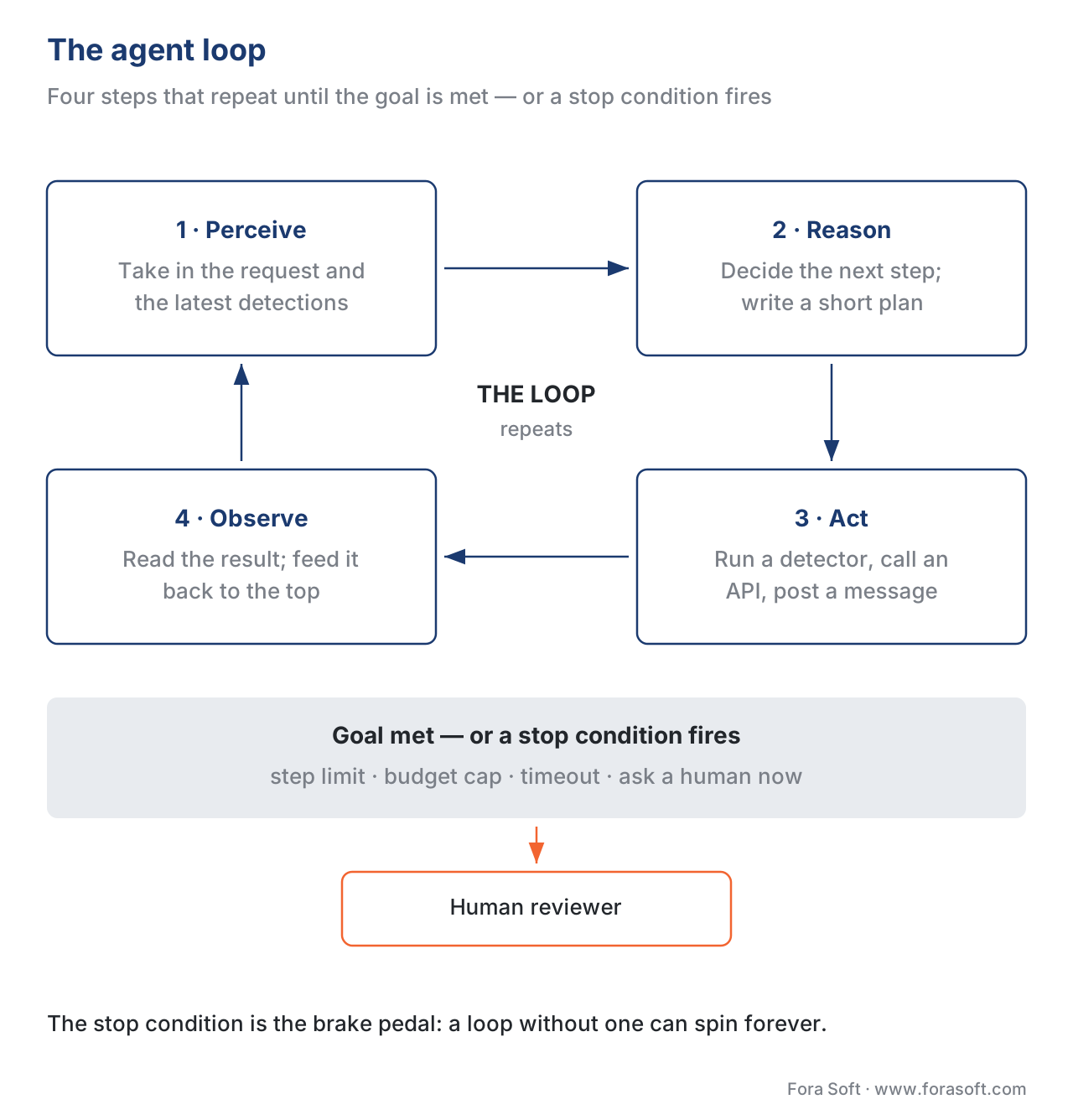 Figure 2. The agent loop: perceive, reason, act, observe — repeating until the goal is met or a stop condition hands control back to a human.
To see the loop carry real weight, follow a surveillance example one turn at a time. The goal: "tell me if anyone entered the loading bay after 22:00 last night." The agent perceives the request and the available cameras. It reasons that it should run a person detector on the loading-bay camera between 22:00 and 06:00. It acts by calling that detector. It observes three candidate clips come back. It loops: it reasons that two clips are a passing cat and a shadow, acts by watching the third more closely with a vision model, observes a person at 23:14, and — goal met — acts one last time by drafting a one-line incident note with the timestamp and a link to the clip. No human wrote that sequence of steps. The agent chose them, because each observation reshaped the next decision. That is the whole idea.
Why The Loop Is A Natural Fit For Video
Video is the rare domain where the agent loop earns its cost almost every time, for one reason: video is enormous and mostly empty. A single 24-hour camera produces 86,400 seconds of footage in which the interesting moment might last four seconds. A week of recorded meetings is dozens of hours in which the decision you need lives in two sentences. Generative AI cannot help you here on its own — you cannot paste a week of video into a prompt. You need a system that can go look, narrow, look again, and bring back only what matters. That is a loop.
This is also why the most valuable video AI features in 2026 are agentic rather than generative. Surveillance vendors now describe natural-language forensic search that turns investigations "from days to seconds" by letting an operator ask a question in plain language and having the system query footage across thousands of cameras and return the relevant clips — with teams reportedly resolving a large share of alerts in under a minute. None of that is a single model call. It is an agent loop running detection, filtering, and verification against a camera fleet.
Four agent patterns recur across the video products we and others build, and each maps to a later lesson in this series. The first is the investigator: an agent that searches an archive against a question and returns evidence — the surveillance case above. The second is the meeting copilot: an agent that joins a live call, tracks the conversation, and acts during or after it, from pulling up a relevant document to filing follow-ups. The third is the async reviewer: an agent that processes a backlog of recorded video overnight — tagging, moderating, or quality-checking — and flags only the exceptions for a human. The fourth is the real-time responder: an agent inside a live pipeline that watches the stream and triggers an action, such as alerting on a safety event. Each is the same loop with a different goal and a different set of tools.
 Figure 3. Four recurring agent patterns in video products — all the same loop, differing by goal, tools, and whether they run over an archive, a live call, a backlog, or a real-time stream.
When NOT To Build An Agent
The most expensive mistake in this space is reaching for an agent when a simpler tool would do. An agent loop is powerful precisely because it is open-ended — and open-ended systems are slower, costlier, and harder to predict than fixed ones. Three rules keep you honest.
If the steps never change, do not build an agent — build a workflow. Anthropic draws this line cleanly: a workflow is a system where the models and tools are orchestrated through code paths you wrote in advance, while an agent is a system where the model decides the path itself. "Transcribe every uploaded video, then translate the captions, then publish" is a fixed sequence. You know every step ahead of time, so write them as code. You will get a faster, cheaper, more testable result than any agent, and you keep full control. Reach for an agent only when you genuinely cannot map the decision tree in advance — when the next step truly depends on what the last step found.
If one model call answers the question, do not loop. A thumbnail, a caption, a summary of a clip you already have in hand — these are generative tasks. Wrapping them in an agent adds cost and latency for nothing.
If the cost of a wrong autonomous action is high and there is no human checkpoint, do not let the agent act unsupervised. In regulated settings — a telemedicine note, a flagged surveillance event, anything that touches a person's rights — the durable pattern is the agent assembles evidence and structures the work, and a human makes the final call. That is not a limitation to engineer around; in 2026 it is increasingly the law.
The Governance The Loop Forces
A system that can act on its own raises a question a chatbot never did: what happens when it acts wrongly? Regulators have noticed. The EU AI Act (Regulation (EU) 2024/1689) requires, in Article 50, that people be told when they are interacting with an AI system — which a calendar-joining meeting agent or a customer-facing video assistant must honor. Analysts are blunt about the risk curve, too: Gartner expects that by the end of 2026, legal claims tied to insufficient AI guardrails will run into the thousands, and it projects that more than 40% of agentic AI projects will be canceled by the end of 2027, largely over cost, unclear value, and weak risk controls. The lesson is not "avoid agents." It is "give every loop a budget cap, a step limit, an audit trail, and a human exit before you ship it." Lesson 7.7 in this series covers that discipline in full.
Free download: Agentic AI for Video — Decision Cheat SheetOne page with the three definitions, the four-step loop and its stop condition, the build-vs-skip call, and the four video agent patterns.Where Fora Soft Fits In
We build video products — conferencing, streaming, OTT, surveillance, e-learning, telemedicine, AR/VR — and across all of them the same shift is underway: from generative features that produce a single output to agentic features that run a loop over the customer's footage and calls. In conferencing, that looks like a meeting copilot that does more than transcribe. In surveillance, it looks like an investigator agent that searches an archive on a plain-language question. In OTT and e-learning, it looks like async reviewers that process a content backlog and surface only the exceptions. Our role is to put the loop where it pays for itself and to keep it out of places where a fixed workflow or a single model call is the honest, cheaper answer. Where the loop earns its place, our AI video agent development team builds it on real-time computer vision, and where one model call is enough, our generative AI development services ship it inside the product you already run.

The book
AI for Video: A Complete Guide to Intelligence in Video Products
This article draws the loop; volume 7 builds it. It takes the agent primitives apart one at a time — tool use, memory, planning, frameworks, orchestration — and then covers what a loop needs once it runs in production: serving on vLLM, Triton and TensorRT, the cost per stream-hour, and the EU AI Act duties that land on a system allowed to act. Written by Nikolay Sapunov, CEO at Fora Soft.
Not sure whether your video feature needs an agent or a fixed workflow?
Describe the task and we will tell you which of the three it is — one model call, a workflow you can write in code, or a loop that earns the 5–20× it costs. 250+ video products shipped since 2005.
See our case studies
Case study
Mindbox
The investigator pattern in production: Smart Forensic Search over recorded footage, 99.5% face recognition and ANPR on 500,000+ vehicles a day, across 50+ deployments.
Case study
TransLinguist
AI inside the live call — speech-to-speech translation and live captions on a platform covering 62+ languages and a marketplace of 8,000+ professional interpreters.
Case study
VocalViews
The backlog an async reviewer is built for: recorded video interviews with automatic transcription and live interpretation, across 800,000+ verified panelists in 7 countries.
What to read next
Frameworks
LangGraph vs CrewAI vs AutoGen — Agent Framework Decision
Once you know you need a loop, this is how you pick the runtime that will run it.
Surveillance
The Video Investigator Agent — A Surveillance Use Case
The first pattern in full: index the footage cheaply at ingest, read only the candidate clips.
Conferencing
The Meeting Copilot Agent — A Conferencing Use Case
The same loop inside a live call, and why the agent proposes while a person decides.
Async review
The Async Video Review Agent — An Archive Pattern
The overnight pattern: work through a backlog and hand a human only the exceptions.
References
- IBM — "What is Agentic AI?" — https://www.ibm.com/think/topics/agentic-ai — tier 4. Definition of agentic AI as goal-directed systems with limited supervision; multi-agent collaboration, task decomposition, persistent memory, orchestration.
- IBM — "What Are AI Agents?" — https://www.ibm.com/think/topics/ai-agents — tier 4. AI agent defined as a system that autonomously performs tasks by designing its own workflow with available tools.
- IBM — "Agentic AI vs. Generative AI" — https://www.ibm.com/think/topics/agentic-ai-vs-generative-ai — tier 4. Side-by-side of the reactive (generative) vs proactive (agentic) distinction.
- Yao et al. — "ReAct: Synergizing Reasoning and Acting in Language Models," arXiv:2210.03629 (Princeton University & Google, 2022) — tier 5 (primary algorithmic source). The canonical agent loop: interleaved reasoning traces and actions; evaluated on HotPotQA, Fever, ALFWorld, WebShop. This is the source of truth for the perceive–reason–act–observe cycle.
- Anthropic — "Building Effective Agents" (December 2024) — https://www.anthropic.com/research/building-effective-agents — tier 3. Workflow (predefined code paths) vs agent (model directs its own process) distinction; guidance to use the simplest solution and add agentic complexity only when needed.
- Sapkota et al. — "AI Agents vs. Agentic AI: A Conceptual Taxonomy, Applications and Challenges," arXiv:2505.10468 (2025) — tier 5. Academic taxonomy separating single-entity AI agents from multi-agent, orchestrated agentic AI.
- MIT Sloan — "Agentic AI, explained" — https://mitsloan.mit.edu/ideas-made-to-matter/agentic-ai-explained — tier 5. Plain-language framing of agentic autonomy for a non-technical audience.
- NVIDIA / IBM — "NVIDIA and IBM push AI agents into the enterprise fast lane" — https://www.ibm.com/think/news/nvidia-ibm-push-ai-agents-enterprise-fast-lane — tier 4. Multi-agent orchestration as the enterprise pattern; AI-Q / AgentIQ blueprints for agents that reason, plan, and work together.
- European Union — Regulation (EU) 2024/1689 (AI Act), Article 50 (transparency obligations) — https://eur-lex.europa.eu/eli/reg/2024/1689/oj — tier 1 (official regulation). Requirement to disclose when a person is interacting with an AI system; binding on customer-facing and meeting-joining video agents.
- Gartner — "Gartner Predicts 40% of Enterprise Apps Will Feature Task-Specific AI Agents by 2026" (press release, 26 Aug 2025) — https://www.gartner.com/en/newsroom/press-releases/2025-08-26-gartner-predicts-40-percent-of-enterprise-apps-will-feature-task-specific-ai-agents-by-2026 — tier 6. Adoption trajectory: <5% (2025) → 40% (2026).
- Gartner — "Over 40% of Agentic AI Projects Will Be Canceled by End of 2027" (press release, 25 Jun 2025) — https://www.gartner.com/en/newsroom/press-releases/2025-06-25-gartner-predicts-over-40-percent-of-agentic-ai-projects-will-be-canceled-by-end-of-2027 — tier 6. Cancellation drivers: cost, unclear value, inadequate risk controls.
- Ambient.ai — "Agentic AI Security and the Scale Problem in Enterprise Physical Security" — https://www.ambient.ai/blog/agentic-ai-security — tier 7 (vendor, used as use-case evidence only). Natural-language forensic search across camera fleets; investigation time compressed from days to seconds.
