


Updated October 2026: new AC-4 vs E-AC-3 section and how AC-4 is decoded and played; current ATSC spec (A/342-2:2026-04), NextGen TV reach (76% of the US, July 2026) and Peacock's January 2026 AC-4 commitment.
The short answer: Dolby AC-4 (Audio Coding 4) is Dolby's fourth-generation audio codec, standardized by ETSI as TS 103 190 in 2014, that delivers Dolby Digital Plus quality at about half the bitrate and carries loudness control, viewer-adjustable dialogue, audio description and video-frame-aligned audio inside the stream. In 2026 it is the audio of NextGen TV (ATSC 3.0) in the United States and is adopted by DVB in Europe, while most streaming services still ship Dolby Digital Plus.
Why this matters
If you build an OTT service, an Internet-TV product, or any app that delivers audio to modern televisions, AC-4 is the codec that the next decade of broadcast is built on, and you need to know where it fits before you plan a delivery pipeline. This article is written for a product manager, founder, or operations lead with no audio background: by the end you will understand what AC-4 is, the four features that make it different from older Dolby codecs, why it saves so much bandwidth, where it is actually deployed in 2026, and why streaming has been slow to adopt it. Every technical number traces back to the controlling standard — ETSI TS 103 190 and ATSC A/342 Part 2 — or to Dolby's own published figures.
The codec built to replace the Dolby Digital family
For twenty-five years, Dolby's broadcast audio came from one family: AC-3 (Dolby Digital) and its successor E-AC-3 (Dolby Digital Plus), covered in AC-3 and E-AC-3 explained. Both work, both are everywhere, and both were designed in an era when audio was a fixed mix of channels poured into a fixed number of speakers. The world changed: viewers now watch on phones, tablets, soundbars, and home cinemas, often in noisy rooms, and increasingly expect to personalize what they hear. The old codecs were never built for that.
Dolby started designing AC-4 in late 2011 as a clean-sheet replacement. The European Telecommunications Standards Institute — the standards body known as ETSI — published it as ETSI TS 103 190 in April 2014 (ETSI press release, 29 April 2014). The name follows the family line: AC-3 was "Audio Coding 3", so AC-4 is the fourth generation. Like its predecessors, AC-4 is built on a mathematical tool called the Modified Discrete Cosine Transform, or MDCT, which turns a slice of sound into frequency ingredients and spends bits only where the ear will notice — the same family of math behind MP3 and AAC, explained in how audio compression works. AC-4 uses an improved version of that transform plus newer coding tools.
The one fact to hold onto for the rest of this article: AC-4 is not a small upgrade to Dolby Digital Plus — it is a different codec with features baked into the stream that the older codecs handle clumsily or not at all.
 Figure 1. Three generations of Dolby broadcast audio. AC-3 owns the legacy era, DD+ owns streaming Atmos, and AC-4 is built for the NextGen-TV broadcast era.
Half the bits, the same sound
The headline number is efficiency. Dolby states that AC-4 delivers the same perceived quality at about a 50% lower data rate than Dolby Digital Plus (Dolby, AC-4: Audio Delivery for Next-Generation Entertainment Services, 2015). That is a large jump, and it comes from newer coding tools — among them Advanced Spectral Extension, which rebuilds high frequencies cheaply, and two channel-coding tools the codec switches between depending on the data rate: Advanced Joint Channel Coding for low bitrates and Advanced Coupling for high bitrates (Dolby AC-4 white paper, 2021).
What does "half the bits" mean in real numbers? When AC-4 was tested for ATSC 3.0, the data rates needed to reach the required quality score were 96 kbit/s for stereo, 192 kbit/s for 5.1 surround, and 288 kbit/s for 7.1.4 immersive audio (Dolby, 2015). Compare that to the Dolby Digital Plus rates a streaming service like Netflix uses — up to 640 kbit/s for 5.1 and up to 768 kbit/s for Atmos, figures from the AC-3 and E-AC-3 article — but those are ceilings, not quality-matched rates. The fair comparison is like for like: at equal quality, AC-4 needs about half the bitrate of DD+, so 5.1 that takes 384 kbit/s in DD+ fits in about 192 kbit/s in AC-4.
To make the bandwidth saving concrete, take one hour of 5.1 audio at those two illustrative rates. The arithmetic for the data volume is:
data = bitrate × duration
data (DD+ at 384 kbit/s) = 384,000 bits/s × 3,600 s = 1.3824 × 10^9 bits ≈ 173 MB
data (AC-4 at 192 kbit/s) = 192,000 bits/s × 3,600 s = 6.912 × 10^8 bits ≈ 86 MB
So the same hour of 5.1 surround drops from roughly 173 MB to 86 MB — about half. On a broadcast channel where every bit of bandwidth is shared between the picture and the sound, those reclaimed bits go straight back to a sharper 4K image. That is why a broadcast standards body cares about audio efficiency far more than a streaming service that can simply send a few more megabytes.
The four features built into the bitstream
Efficiency gets AC-4 in the door; its built-in features are why broadcasters chose it. ETSI lists four headline benefits, and each one is a real capability carried inside the audio stream, not an add-on (ETSI press release, 29 April 2014).
Intelligent loudness. Every audio program has to hit a loudness target so the volume does not jump when a viewer switches channels or an ad starts — the rules behind regimes like the United States CALM Act, explained in loudness normalization: EBU R128, BS.1770, ATSC A/85. AC-4 carries loudness metadata and an automated management system that holds the target across the whole chain, so the same stream plays at a consistent level whether it lands on a home cinema or a phone speaker.
Advanced dialogue enhancement. This is the feature viewers feel first. AC-4 can carry the dialogue in a way that lets the decoder raise or lower the speech level relative to the music and effects, on the viewer's command. Someone hard of hearing, or watching with the volume low, can turn dialogue up without making the explosions louder too. Older codecs mostly bake dialogue and effects into the same channels; they can carry a separate dialogue or description service, but the viewer cannot rebalance speech against the main mix with the same control.
Advanced accessibility. Broadcasters must deliver secondary audio — most importantly an audio-description track that narrates the action for blind and partially sighted viewers, covered in multi-language and descriptive audio. AC-4 can add that description as a small object that the decoder mixes in on demand, rather than shipping a whole second 5.1 program. The result is full accessibility without doubling the bitrate.
A/V frame alignment. AC-4 can be configured so that its audio frame boundaries line up exactly with the video frame boundaries. Because the audio and video frames share an edge, a broadcaster can cut, splice, or switch the stream at a video frame where the encoder placed an independently decodable audio frame (an AC-4 I-frame) — to insert an ad or join a network feed — without decoding and re-encoding the audio. That keeps audio and video locked in sync through every step of the broadcast chain, a problem explored in depth in PTS, DTS and elementary stream timestamps.
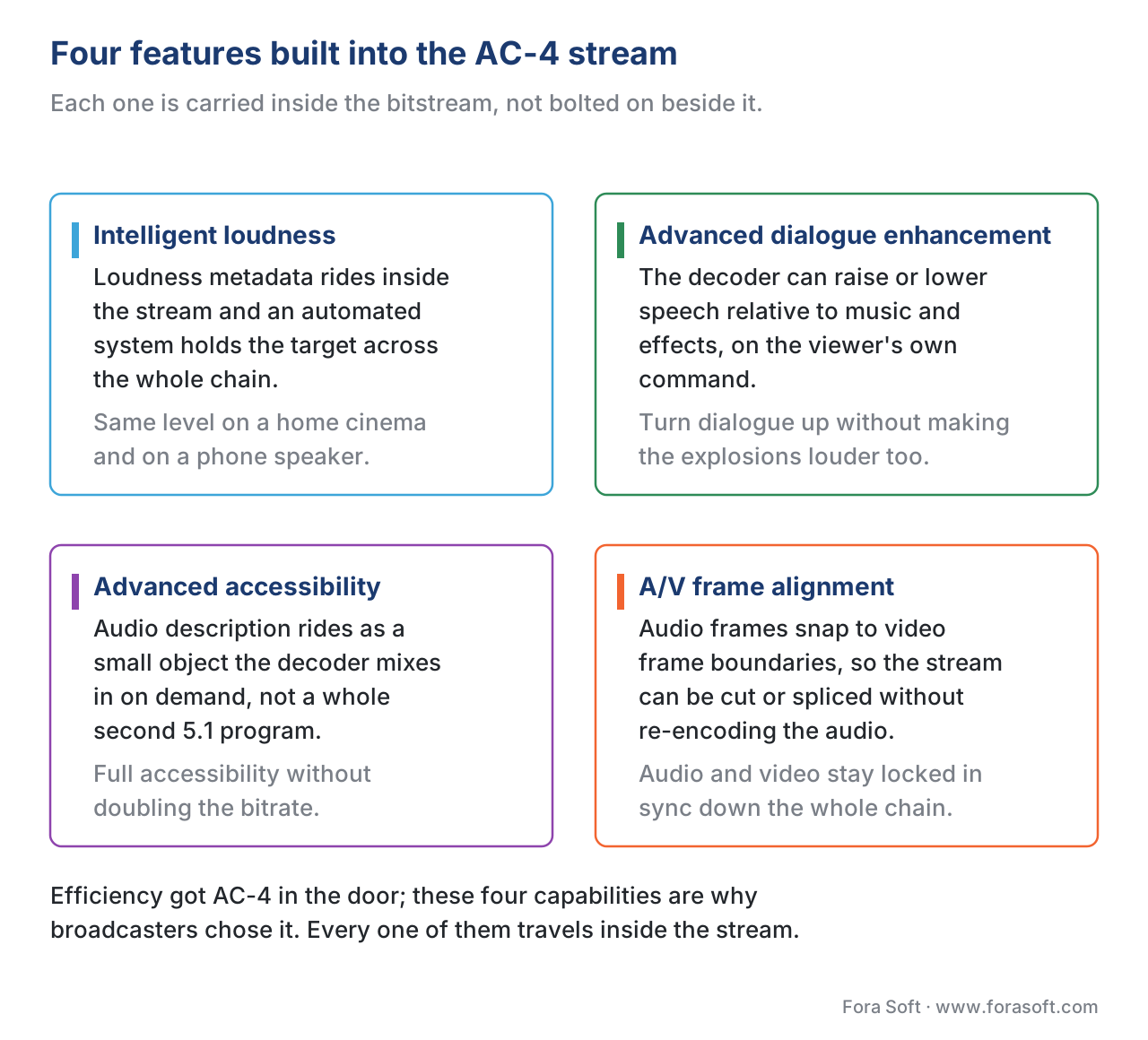 Figure 2. The four capabilities AC-4 carries inside the stream. Each one solves a problem that AC-3 and E-AC-3 handle clumsily or not at all.
Channels, objects, and the layered decoder
AC-4 carries two kinds of sound at once. It always carries a core of up to 5.1 channels — front left, center, right, two surrounds, and the bass channel — and every AC-4 decoder is required to play that core (Dolby AC-4 white paper, 2021). On top of the core, AC-4 can carry side signals: extra channels that extend the mix to a 7.1.4 immersive layout, plus audio objects — individual sounds tagged with a position in 3-D space, the same object-based idea behind Dolby Atmos covered in AC-3 and E-AC-3 explained.
The clever part is the layered decoder design. A cheap television only needs to decode the 5.1 core and ignore everything else, so it stays inexpensive. A premium AV receiver decodes the core plus the side signals and objects, and renders the full immersive scene. One stream serves both, which is how AC-4 can ship to a whole market of devices at different price points without sending different files.
Here is the comparison with the older Dolby codecs as a table you can paste into a planning document.
| Property | AC-3 (Dolby Digital) | E-AC-3 (Dolby Digital Plus) | AC-4 |
|---|---|---|---|
| Year standardized | 1995 (ATSC A/52; in cinemas from 1992) | 2005 (ATSC A/52B) | 2014 (ETSI TS 103 190) |
| Core / max channels | 5.1 | up to 15.1 | 5.1 core, side signals to 7.1.4 |
| Object audio | No | Via JOC (on DD+) | Native |
| Relative efficiency | Baseline | Better than AC-3 | ~50% less data than DD+ |
| Dialogue enhancement | No | Limited | Yes, viewer-adjustable |
| A/V frame alignment | No | No | Yes |
| Primary home | DVD, ATSC 1.0 | Streaming, DVB broadcast | ATSC 3.0, DVB broadcast |
Table 1. AC-3 vs E-AC-3 vs AC-4. Channel and object figures from the Dolby AC-4 white paper (2021); efficiency figure from Dolby (2015); standardization dates from ETSI and ATSC.
AC-4 vs E-AC-3 (Dolby Digital Plus): which one should you ship?
For streaming in 2026, ship E-AC-3 (Dolby Digital Plus) and treat AC-4 as an optional extra rendition (a second version of the audio track that capable players can pick); for NextGen TV broadcast in the United States, AC-4 is the format the receivers expect. E-AC-3 is the safer choice because it is what Dolby-licensed TVs, streaming sticks, soundbars and phones already decode, and it already carries Dolby Atmos. AC-4 wins on bandwidth and on built-in personalization, but only on hardware built roughly since 2017.
- Bitrate: AC-4 reaches DD+ quality at about half the data rate, so 5.1 that needs 384 kbit/s in DD+ fits in about 192 kbit/s in AC-4 (Dolby, 2015).
- Device reach: E-AC-3 is near-universal on Dolby-licensed devices; AC-4 is limited to newer TVs and set-top boxes, mostly NextGen TV models. The Consumer Technology Association expects about 19.3 million ATSC 3.0-capable TVs to have shipped in the US by the end of 2026, around 11% of 2026 TV shipments (CTA via TV Tech, September 2026).
- Atmos: both carry it. E-AC-3 uses Joint Object Coding on top of the channel mix; AC-4 carries objects natively.
- Dialogue and accessibility: AC-4 lets the viewer turn speech up or down and mixes audio description in as a small object; E-AC-3 handles this less flexibly, typically with an extra associated or complete mix.
- Software decoding: E-AC-3 decodes in FFmpeg and most players; AC-4 does not have an open-source decoder in mainline FFmpeg (next section).
Search engines sometimes surface "E-AC-4" or "EAC4": there is no such codec. The Dolby line runs AC-3 (Dolby Digital), E-AC-3 (Dolby Digital Plus), then AC-4.
Where AC-4 actually lives in 2026
AC-4 is a broadcast-first codec, and that is where it is deployed. Its biggest home is ATSC 3.0, the new over-the-air television standard branded "NextGen TV" in the United States. ATSC 3.0 specifies AC-4 as one of its two audio systems in a document called ATSC A/342 Part 2, the AC-4 System — the current revision is A/342-2:2026-04, approved on 14 April 2026 (ATSC A/342-2). The other ATSC 3.0 audio system is MPEG-H 3D Audio, and the split matters: the United States uses AC-4, while South Korea, which launched 4K ATSC 3.0 broadcasts in 2017, uses MPEG-H, and Brazil chose MPEG-H as the mandatory audio for its next-generation DTV+ service (Fraunhofer IIS, MPEG-H adoption). In the United States, 76% of the country was within reach of a NextGen TV signal as of July 2026, across more than 75 markets (ATSC via TV Tech, September 2026). In October 2025 the FCC proposed dropping the rule that forces stations to keep simulcasting the old ATSC 1.0 signal (FCC Further Notice of Proposed Rulemaking, Federal Register, 20 November 2025), which would speed the move to AC-4 receivers. In Europe, the DVB broadcast project and the Nordic NorDig specification have also adopted AC-4 (ETSI, 2014; Dolby, 2021).
Streaming is the gap. As of 2026, most streaming services still send Dolby Digital Plus, including the "Dolby Atmos" titles on Netflix, Disney+, and Apple TV+. The reason is inertia, not quality: the encoding pipelines, the device decoders, and the player apps already speak DD+ end to end, and DD+ with Joint Object Coding already carries Atmos to that hardware. Switching to AC-4 means re-tooling the whole chain for a bandwidth saving that streaming, unlike broadcast, does not desperately need. That picture is starting to shift — on 5 January 2026 NBCUniversal and Dolby announced that Peacock will be the first streamer to commit to AC-4 and Dolby Vision 2, with the launch expected later in 2026 (Dolby / NBCUniversal press release, January 2026) — but for the rest of the streaming world, the AAC family, Opus, and DD+ remain the workhorses.
A note on licensing, because it shapes adoption: AC-4 is patented and needs a Dolby license, but Dolby charges for only one of its technologies per device, so a TV that already licenses Dolby Digital Plus pays nothing extra to add AC-4 (Dolby, 2018). That removes a cost barrier for hardware makers and is one reason AC-4 decoding spread quickly across new smart TVs.
Common mistake: assuming AC-4 plays everywhere AC-3 does
The most common planning error is treating AC-4 as a drop-in replacement that "every Dolby device" can decode. It cannot. AC-3 is near-universal because it has been shipping in consumer gear for about thirty years; AC-4 only exists in hardware built since roughly 2017. A set-top box, soundbar, or TV from before then will not decode AC-4 at all. If your delivery has to reach a mixed fleet of old and new devices, you cannot ship AC-4 alone — you must either fall back to AC-3 or DD+ for the older hardware, or detect device capability and serve the right format. Shipping an AC-4-only stream to a general audience today guarantees silent playback on a large slice of devices.
How is AC-4 decoded and played?
AC-4 is decoded by a licensed Dolby decoder built into the device, usually the TV or set-top-box chipset; there is no free, open-source AC-4 decoder in mainline FFmpeg as of version 8.1 (March 2026). FFmpeg can read a raw .ac4 stream and copy it into an MP4 or MPEG-TS container without touching the audio, but it cannot turn AC-4 into sound; the community decoder exists only in a fork and has not been submitted for review (FFmpeg ticket #8349, July 2025). Players built on FFmpeg inherit the same gap.
What this means for your product: an AC-4 stream plays where the platform exposes a Dolby AC-4 decoder, which in practice means NextGen TV sets and recent smart-TV and set-top platforms, and on Android it plays only when the device ships that decoder. For desktop or Linux pipelines, Dolby-certified commercial decoders exist, such as Fluendo's AC-4 plugin for GStreamer. For quality checks during development, test on the real target TVs rather than on a laptop, and keep an E-AC-3 or AAC rendition so any player that cannot decode AC-4 still has sound.
Free download: Dolby AC-4 — cheat sheetOne page: the AC-3 versus E-AC-3 versus AC-4 comparison, the four features built into the stream, the ATSC 3.0 test bitrates (96, 192 and 288 kbit/s), deployment status in 2026, and the “AC-4 does not play everywhere AC-3 does” pitfall.Where Fora Soft fits in
We build OTT and Internet-TV products, video-streaming and conferencing platforms, telemedicine systems, and surveillance and AR/VR software, and the question of which audio codec to ship comes up on most of those projects. When a client's product has to reach NextGen TV broadcast or the newest smart TVs, AC-4 enters the conversation, and the engineering work is practical: deciding when a codec earns its place in the delivery ladder, keeping a sensible fallback to AC-3 or DD+ for older hardware, and preserving the loudness and accessibility metadata that AC-4 carries through every transcode and repackage step. We have made those trade-offs across streaming and broadcast builds since 2005. Our OTT and Internet TV developers handle the codec ladder and device fallbacks, and our audio processing engineers keep loudness and accessibility metadata intact through each transcode.
The book
Audio for Video: A Complete Guide to Sound in Video Products: From PCM and Codecs to Loudness, Accessibility, and Real-Time Voice Processing
We wrote a seven-volume series that takes the video stack apart from the pixel to production, so that someone who works through it can design and build a system like the one this article describes. Volume 4 is the one that sits under this page: 1,229 pages on codecs and on the two AC-4 features you will actually have to operate — the loudness chapters that explain what a loudness target is actually measured against and what breaks when that metadata is stripped somewhere in the chain, and the accessibility chapters on audio description as a deliverable rather than a checkbox. Volume 5 picks up where the core-plus-objects section here stops, on object-based audio, Atmos and the metrics used to judge it. Written by Nikolay Sapunov, CEO at Fora Soft.
Which audio codec should your 2026 delivery actually ship?
Tell us which devices you have to reach — NextGen TV sets, older set-top boxes, phones, the web — and we will come back with the renditions to package, whether AC-4 earns a place in the ladder or DD+ and AAC still carry it, what the fallback for pre-2017 hardware looks like, and how to keep loudness and accessibility metadata intact through transcode and repackage. 250+ video products shipped since 2005.
See our case studies
Case study
WorldCast Live
Concert streaming at 0.4–0.5 s latency to 10,000 simultaneous viewers on a 1.5 Gbit/s feed — the case where bandwidth is shared between picture and sound, and halving the audio bitrate buys a sharper image rather than a smaller bill.
Case study
Mindbox
An RTSP to FFmpeg to HLS pipeline running across 50+ deployments — the transcode-and-repackage chain where a codec's loudness and accessibility metadata either survives every hop or quietly disappears before playback.
Case study
Speed.Space
Remote production used on Netflix, Electronic Arts and HBO shoots, recording at 1080p and 8 Mbit/s with codec and bitrate exposed as controls — the master side, decided before anyone picks the delivery codec the fleet has to decode.
What to read next
Codecs
AC-3 (Dolby Digital) and E-AC-3 (Dolby Digital Plus)
The two codecs AC-4 was designed to replace, and the fallback you still ship.
Loudness
Loudness normalization: EBU R128, BS.1770, ATSC A/85
The rules the intelligent-loudness metadata has to satisfy, and who enforces them.
Accessibility
Captions, audio description and the accessibility stack
What the audio-description object carries, and what else a regulator expects beside it.
Immersive
Channel-based vs object-based vs scene-based audio
The three ways to describe a mix, behind the 5.1 core and side signals here.
References
- ETSI TS 103 190-1 V1.4.1 (2025-07), Digital Audio Compression (AC-4) Standard; Part 1: Channel based coding. The controlling specification for AC-4's channel-based coding; current version checked October 2026. https://www.etsi.org/deliver/etsi_TS/103100_103199/10319001/01.04.01_60/ts_10319001v010401p.pdf
- ETSI TS 103 190-2 V1.3.1 (2025-07), Digital Audio Compression (AC-4) Standard; Part 2: Immersive and personalized audio. The controlling specification for AC-4's immersive and personalized features (objects, dialogue enhancement). Current revision read for this article. https://www.etsi.org/deliver/etsi_ts/103100_103199/10319002/01.03.01_60/ts_10319002v010301p.pdf
- ETSI, ETSI releases AC-4, the new generation audio codec standard (press release, 29 April 2014). First-party source for AC-4's standardization as TS 103 190 and the four headline benefits: intelligent loudness, advanced dialogue enhancement, advanced accessibility, A/V frame alignment, plus bandwidth efficiency. https://www.etsi.org/newsroom/news/783-2014-04-etsi-releases-ac-4-the-new-generation-audio-codec-standard/
- ATSC A/342-2:2026-04 (approved 14 April 2026; earlier revisions 2017, 2021, 2022, 2023, 2024 and July 2025), ATSC Standard: A/342 Part 2, AC-4 System. The North American broadcast specification defining AC-4 as an ATSC 3.0 audio system. Source for the ATSC 3.0 deployment context. https://www.atsc.org/atsc-documents/a342-part-2-ac-4-system/
- Dolby Laboratories, Dolby AC-4: Audio Delivery for Next-Generation Entertainment Services (June 2015). First-party source for the ~50% bitrate reduction over Dolby Digital Plus, the ATSC 3.0 test bitrates (96 kbit/s stereo, 192 kbit/s 5.1, 288 kbit/s 7.1.4), and the DVB MUSHRA score of 90 at 192 kbit/s for 5.1. https://web.archive.org/web/20190530051301/https://www.dolby.com/us/en/technologies/ac-4/Next-Generation-Entertainment-Services.pdf
- Dolby Laboratories, Dolby AC-4: Audio delivery for next-generation entertainment services (white paper, February 2021). First-party technical detail on the AC-4 decoder, the 5.1 core / side-signal structure, object support, and coding tools (Advanced Spectral Extension, Advanced Coupling, Advanced Joint Channel Coding, Advanced Joint Object Coding). https://professional.dolby.com/siteassets/technologies/dolby_atmos_ac-4_whitepaper.pdf
- Dolby Laboratories (Giles Baker), Setting the record straight on Dolby AC-4 and MPEG-H (11 April 2018). First-party source for AC-4 licensing — the one-technology-per-device royalty rule that makes AC-4 free on devices already licensing Dolby Digital Plus. https://web.archive.org/web/20180914203227/https://hub.dolby.com/setting-record-straight-dolby-ac4-mpegh/
- ITU-R BS.1196-7 (January 2019), Audio coding for digital broadcasting. The ITU-R recommendation cataloguing broadcast audio coding systems, including AC-4; cited for the higher bitrate (up to ~1536 kbit/s) used for 22.2-channel audio. https://www.itu.int/dms_pubrec/itu-r/rec/bs/R-REC-BS.1196-7-201901-S!!PDF-E.pdf
- Dolby Laboratories and NBCUniversal, NBCUniversal's Peacock to Be First Streamer to Integrate Dolby's Full Suite of Premium Picture and Sound Innovations (press release, 5 January 2026). Source for Peacock's commitment to AC-4 and Dolby Vision 2, with launch expected later in 2026. https://www.nbcuniversal.com/article/nbcuniversals-peacock-be-first-streamer-integrate-dolbys-full-suite-premium-picture-and-sound
- TV Tech, ATSC 3.0 Deployments: Where and When Will NextGen TV be Available? (updated 15 September 2026). Source for 75+ NextGen TV markets, 76% of the US within reach of a signal as of July 2026 (ATSC), and the CTA estimate of 19.3 million ATSC 3.0 TVs shipped by the end of 2026. https://www.tvtechnology.com/news/atsc-30-deployments-where-and-when-will-nextgen-tv-be-available
- Federal Communications Commission, Authorizing Permissive Use of the "Next Generation" Broadcast Television Standard, Further Notice of Proposed Rulemaking (Federal Register, 20 November 2025). Source for the proposal to end mandatory ATSC 1.0 simulcasting. https://www.federalregister.gov/documents/2025/11/20/2025-20437/authorizing-permissive-use-of-the-next-generation-broadcast-television-standard
- Fraunhofer IIS, MPEG-H Audio adoption (checked October 2026). Source for MPEG-H as the ATSC 3.0 audio system in South Korea since 2017 and the mandatory audio of Brazil's DTV+. https://mpegh.com/adoption/
- FFmpeg, Ticket #8349: Dolby AC-4 Support (latest status July 2025) and FFmpeg 8.1 source (libavformat/ac4dec.c, raw AC-4 demuxer only; release March 2026). Source for the absence of an AC-4 decoder in mainline FFmpeg. https://trac.ffmpeg.org/ticket/8349
- Fluendo, AC-4 Decoder (product page, checked October 2026). Example of a Dolby-certified commercial AC-4 software decoder for GStreamer. https://fluendo.com/products/ac4-decoder/
