


Updated October 2026: Apple’s current HLS bitrate rules for AC-3 and E-AC-3, the AC-3 vs E-AC-3 same-bitrate question, how to build an AC-3 fallback from a DD+ source, and the 2025–2026 shifts (AC-4 on Peacock, Eclipsa Audio).
AC-3 vs E-AC-3: the short answer
AC-3 (Dolby Digital) is the original 5.1 surround codec from 1991, capped at 5.1 channels and 640 kbit/s. E-AC-3 (Dolby Digital Plus, also written EAC3, E-AC3 or DD+) is its 2004 successor: it runs from 32 kbit/s to 6.144 Mbit/s, carries up to 15.1 channels and, with Joint Object Coding (JOC), carries Dolby Atmos. E-AC-3 is more efficient, so it sounds as good at a lower bitrate: Apple’s HLS authoring specification (revised June 2025) recommends 384 kbit/s for 5.1 Dolby Digital but only 192 kbit/s for 5.1 Dolby Digital Plus. AC-3 wins on reach: almost every TV, soundbar and AV receiver made in the last 25 years decodes it, which is why Apple requires an AC-3 rendition alongside DD+ whenever some target devices cannot play DD+.
- Pick E-AC-3 for streaming to modern TVs, soundbars, streaming sticks and phones, and for anything with Dolby Atmos.
- Keep an AC-3 track as the fallback for older receivers, DVD-era hardware and S/PDIF links.
- A typical 2026 streaming set: AAC stereo for every device, DD+ 5.1 at 192–640 kbit/s, an optional DD+ JOC Atmos track at 448–768 kbit/s, and AC-3 5.1 at 384–640 kbit/s as the fallback.
- “EAC3 5.1” simply means a six-channel (5.1) mix encoded as Dolby Digital Plus; “E-AC-3 JOC” or “EAC3 Atmos” means the same stream with Atmos object data riding on top.
Why this matters
If you run an OTT service, an Internet-TV app, or any product that streams to TVs and soundbars, you cannot avoid the Dolby Digital family — it is the audio format the hardware in the room actually understands. This article is written for a product manager, founder, or operations lead with no audio background: by the end you will understand what AC-3 and E-AC-3 are, how DD+ carries Dolby Atmos without breaking older devices, which one to pick and at what bitrate in 2026, and the common mistakes that corrupt a Dolby stream in a delivery pipeline. Every number traces back to the controlling standard — ETSI TS 102 366 and ATSC A/52 — or to the platform's own published figures, not a secondhand blog.
The codec that put surround sound in the living room
Before 1991, multichannel sound was an analog trick. Cinemas painted optical stripes on the edge of film; the format that mattered was a matrix that folded four channels into two and unfolded them at the projector. There was no clean way to store five separate, full-quality channels and a deep bass channel on consumer media, because the bits did not fit.
Dolby Laboratories solved the storage problem in 1991 with a codec called AC-3 — "Audio Coding 3", the third in a line of Dolby coding systems — and marketed it as Dolby Digital. AC-3 was the first widely deployed audio codec built on a mathematical tool called the Modified Discrete Cosine Transform, or MDCT, which converts a slice of sound into a set of frequency ingredients and then spends bits only where the ear will notice (the same family of math later used by MP3 and AAC, covered in how audio compression works). That efficiency is what let five full channels plus bass fit on a DVD and inside a broadcast signal.
The thing to hold onto for the rest of this article: AC-3 is the original 5.1 surround codec, and E-AC-3 is the same idea, extended. Everything else is detail layered on those two facts.
 Figure 1. Thirty-five years of one codec family. AC-3 owns the disc-and-broadcast era; E-AC-3 with Joint Object Coding owns the streaming-Atmos era.
AC-3 in plain terms: five channels, one bass channel, 640 kbit/s
A surround mix is usually described as 5.1. The five is five full-range speakers — front left, front center, front right, surround left, surround right. The ".1" is one extra channel that carries only the deep bass, called the Low-Frequency Effects channel, or LFE; it feeds the subwoofer. So "5.1" means six channels of audio, five of them full-range and one of them bass-only.
AC-3 packs that 5.1 mix into a stream with a hard ceiling on its data rate. The standard allows a maximum coded bit rate of 640 kbit/s (ATSC A/52:2012, §5.3.2). It supports three sampling rates — 32, 44.1, and 48 kHz — and in practice almost all video uses 48 kHz, the rate the rest of the video world settled on, explained in sample rate: 44.1, 48, 96 kHz.
AC-3 chops sound into fixed blocks. Each AC-3 frame holds 1,536 samples per channel. At 48,000 samples per second, the arithmetic for one frame's duration is:
frame duration = samples per frame ÷ sample rate
frame duration = 1,536 ÷ 48,000
frame duration = 0.032 seconds = 32 milliseconds
So an AC-3 frame is 32 milliseconds of sound. That number matters when you sync audio to video or worry about latency — a topic frames, packets, granules covers for codecs in general.
For two decades that was enough. AC-3 became the mandatory surround codec for the DVD, for the ATSC digital-television system used across North America, and for cable and satellite. If a device made in the last twenty-five years can decode any surround format at all, it can almost certainly decode AC-3. That ubiquity is AC-3's lasting value: it is the format you fall back to when you do not know what the device supports.
E-AC-3 (Dolby Digital Plus): the same idea, with room to grow
By the early 2000s, AC-3's ceilings were a problem. The 640 kbit/s cap limited quality at the top end, and 5.1 was no longer the most channels anyone wanted. Dolby's answer, introduced in 2004 and known as E-AC-3 (Enhanced AC-3) or Dolby Digital Plus (DD+), kept the AC-3 core and pushed every limit outward.
Three changes matter to a product team. First, the data-rate range widened enormously: DD+ runs from 32 kbit/s all the way to 6.144 Mbit/s (ETSI TS 102 366 V1.4.1, Annex E). The low end means DD+ can be efficient at modest bitrates where AC-3 would sound strained; the high end means it has headroom AC-3 never had. Second, the channel count grew from AC-3's 5.1 ceiling to as many as 15 full-range channels plus LFE — written 15.1. Third, DD+ added substreams, a way to pack several audio programs — a main mix, a foreign-language dub, a director's commentary, a described-video track for blind viewers — into one stream, which connects to multi-language audio.
Under the hood, DD+ adds coding tools that AC-3 lacks: the Adaptive Hybrid Transform for steady tones, Spectral Extension to rebuild high frequencies cheaply, Enhanced Coupling to preserve stereo phase, and transient pre-noise processing to clean up sharp sounds. You do not need to track these by name. The takeaway is that DD+ squeezes more quality out of each bit than AC-3, which is exactly why broadcasters and streamers adopted it as a higher-efficiency replacement.
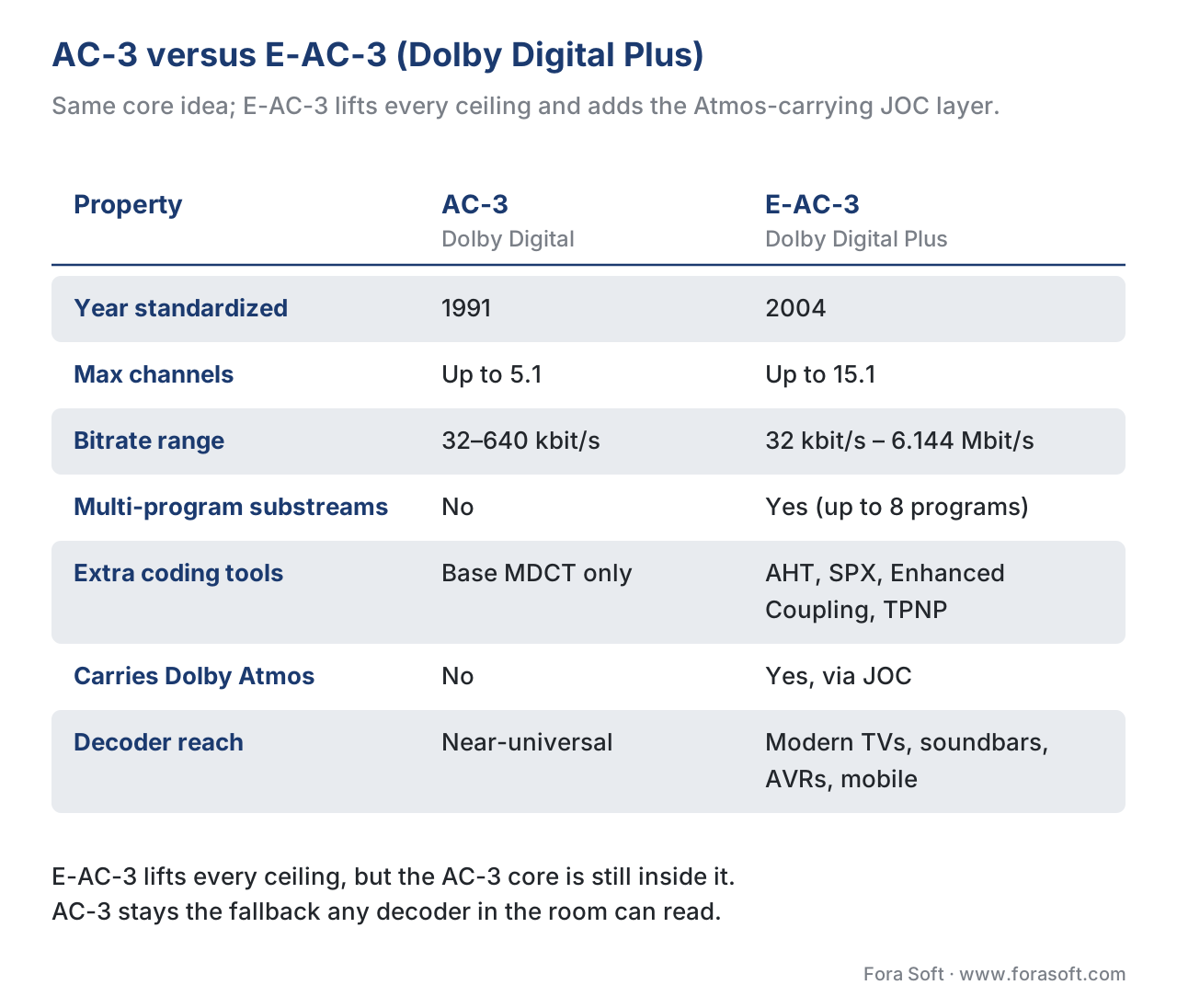 Figure 2. What E-AC-3 adds to AC-3: more channels, a far wider bitrate range, multi-program substreams, extra coding tools, and the Atmos-carrying JOC layer.
Here is the same comparison as a table you can paste into a planning doc.
| Property | AC-3 (Dolby Digital) | E-AC-3 (Dolby Digital Plus) |
|---|---|---|
| Year introduced | 1991 | 2004 |
| Max channels | 5.1 | 15.1 |
| Bitrate range | 32–640 kbit/s | 32 kbit/s – 6.144 Mbit/s |
| Sample rates | 32 / 44.1 / 48 kHz | 32 / 44.1 / 48 kHz |
| Frame size (common) | 1,536 samples (32 ms at 48 kHz) | 256 / 512 / 768 / 1,536 samples |
| Multi-program substreams | No | Yes (up to 8 programs) |
| Carries Dolby Atmos | No | Yes, via JOC |
| Decoder reach | Near-universal | Modern TVs, soundbars, AVRs, mobile |
Table 1. AC-3 versus E-AC-3 at a glance. Channel, bitrate, and substream figures from ETSI TS 102 366 V1.4.1 and ATSC A/52:2012.
How DD+ carries Dolby Atmos without breaking old devices
Dolby Atmos is object-based audio. Instead of mixing sounds permanently into fixed channels — "put the helicopter in the rear-left speaker" — an Atmos mix stores each sound as an object with a position in 3-D space, plus a set of bed channels for the ambient layer. The decoder in the room then renders those objects to whatever speakers are actually present, whether that is a 5.1 living room or a 7.1.4 home cinema.
The problem: an object scene is a different kind of data from a channel mix, and the millions of DD+ decoders already in TVs and soundbars only know how to read channels. Shipping a brand-new format would have stranded that hardware.
Dolby's solution is Joint Object Coding, or JOC. Think of JOC as a recipe card tucked inside an ordinary meal. The DD+ stream still carries a normal 5.1 mix — the meal — that any existing decoder can play. Riding alongside it as side data is the JOC payload: a compact set of instructions plus per-object metadata that an Atmos-capable decoder uses to reconstruct the object scene from that 5.1 downmix (ETSI TS 103 420 V1.2.1, 2018).
The result is one stream that does two jobs. An old 5.1 decoder reads only the channel bed and ignores the JOC side data, so it plays correct surround sound. An Atmos decoder reads both and rebuilds the immersive mix. This is why streaming services can label a title "Dolby Atmos" while sending a single DD+ stream that still works on a decade-old soundbar. The marketing name for this combination is Dolby Digital Plus with Dolby Atmos, sometimes written "DD+ JOC" or "E-AC-3 JOC". In an HLS playlist the two are told apart by the codec string: plain DD+ is signalled as ec-3 and DD+ with Atmos as ec+3 (Apple HLS authoring specification, 2025). How Atmos itself is mixed and mastered for film, broadcast and music is covered in Dolby Atmos across film, broadcast and streaming.
 Figure 3. One stream, two outcomes. The 5.1 bed plays everywhere; the JOC side data lets an Atmos decoder rebuild the object scene. Old hardware never sees the difference.
What bitrates the platforms actually use in 2026
Two public sources anchor the numbers: Apple’s HLS authoring specification, which every iPhone, iPad and Apple TV app is built against, and Netflix, which published its delivery bitrates.
| Channels | Codec | Apple HLS recommendation (kbit/s) |
|---|---|---|
| 2.0 stereo | Dolby Digital Plus (E-AC-3) | 96–160 |
| 5.1 surround | Dolby Digital (AC-3) | 384 |
| 5.1 surround | Dolby Digital Plus (E-AC-3) | 192 |
| 7.1 surround | Dolby Digital Plus (E-AC-3) | 384 |
Table 2. Apple HLS authoring specification for Apple devices, bitrate recommendations, revision of 26 June 2025. AC-3 has no 7.1 row because AC-3 stops at 5.1.
Apple’s rules add three requirements that shape any delivery pipeline: if you ship DD+ to devices that cannot decode it, you must also ship AC-3; Dolby loudness should be carried in the dialnorm field when the fMP4 file has no loudness box; and on tvOS, Dolby Atmos content should be offered at a single bitrate rather than as a ladder (a service can still pick different Atmos rates for different platforms).
Netflix sits at the high end. In May 2019 it began streaming 5.1 audio adaptively from 192 kbit/s up to 640 kbit/s, calling 640 kbit/s perceptually transparent, meaning a listener cannot reliably tell it from the studio master, and Dolby Atmos from 448 kbit/s up to 768 kbit/s (Netflix, “Bringing Studio Quality Sound to Netflix”, 2019). A device on a fast connection gets the higher rate and a constrained one gets a lower rate, the same way video adapts in audio adaptive bitrate ladders.
To make the storage side concrete, take a 90-minute feature with a 5.1 DD+ track at 640 kbit/s:
size = bitrate × duration
size = 640,000 bits/s × (90 × 60) seconds
size = 640,000 × 5,400 = 3.456 × 10^9 bits
size = 3.456 × 10^9 ÷ 8 ÷ 1,000,000 ≈ 432 megabytes
So one high-quality 5.1 audio track for a feature is roughly 432 MB — small next to the video, but it multiplies fast once you add an Atmos rendition and several language tracks, the math worked out in multi-language audio storage and CDN cost.
As of 2026, DD+ with JOC is the standard way to stream Dolby Atmos to living-room hardware: in Apple’s specification it is the only Dolby format listed for audio that mixes channels and objects. Plain AC-3 remains the safe surround fallback. Two shifts are worth tracking. Dolby’s next-generation codec, AC-4, already used in ATSC 3.0 broadcast and covered in AC-4 explained, is moving into streaming: in January 2026 Peacock announced it would become the first streamer to support AC-4, with launch expected later in 2026 (NBCUniversal and Dolby press release, 5 January 2026). And Samsung and Google launched Eclipsa Audio, a royalty-free immersive format built on the Alliance for Open Media’s IAMF, on Samsung’s 2025 TVs, with YouTube accepting Eclipsa uploads from 2025 (Google Open Source Blog, January 2025). Neither changes today’s practical answer: for streaming surround and Atmos to TVs and soundbars, the workhorse is still DD+, with AC-3 as the fallback.
AC-3 640 vs E-AC-3 640: which sounds better at the same bitrate?
At 640 kbit/s for 5.1, both are at or near transparency, so pick by device support, not by ear. E-AC-3’s extra coding tools matter most at lower bitrates; that is why Apple asks for 384 kbit/s with AC-3 but 192 kbit/s with E-AC-3 for the same 5.1 mix. At 640 kbit/s, Netflix already calls DD+ perceptually transparent, and AC-3 is at its own maximum. So a 640 kbit/s AC-3 track is the better choice when the playback chain includes an older receiver or an S/PDIF optical link, and a DD+ track is the better choice when you want headroom, 7.1 or Atmos. Encoder quality matters too: a commercial Dolby encoder and the open-source FFmpeg encoders do not produce identical results at the same bitrate.
AAC vs AC-3 vs E-AC-3: which one does a streaming product need?
Most streaming products ship AAC as the universal stereo track and add Dolby renditions for surround. AAC plays in every browser and phone; AC-3 and E-AC-3 play on the living-room hardware that drives speakers. The AAC family article covers the AAC side member by member.
| Question | AAC (AAC-LC / HE-AAC) | AC-3 (Dolby Digital) | E-AC-3 (Dolby Digital Plus) |
|---|---|---|---|
| Best at | Stereo everywhere, low bitrates | 5.1 to any legacy device | 5.1, 7.1 and Atmos to modern devices |
| 5.1 bitrate (Apple HLS, 2025) | 320 kbit/s | 384 kbit/s | 192 kbit/s |
| Dolby Atmos | No | No | Yes, with JOC |
| Loudness metadata | prog_ref_level or MPEG-D DRC | dialnorm | dialnorm |
Table 3. AAC, AC-3 and E-AC-3 side by side. Bitrates and loudness fields from Apple’s HLS authoring specification (2025).
HE-AAC versus Dolby Digital Plus is a different contest: HE-AAC is built for very low stereo bitrates, roughly below 64 kbit/s, while DD+ is built for multichannel and Atmos. They rarely compete for the same track.
Reading a file label: “E-AC-3 48.0 kHz 6 channels 640 kb/s”
Media players and tools such as MediaInfo describe a Dolby track in one line. “E-AC-3” is the codec (Dolby Digital Plus). “48.0 kHz” is the sample rate. “6 channels” is a 5.1 layout: five full-range channels plus LFE. “640 kb/s” is the bitrate, Netflix’s top 5.1 rate. If the label adds “JOC” or “Atmos”, the stream also carries object data for an Atmos decoder. “AC-3 … 6 channels 448 kb/s” is a plain Dolby Digital 5.1 track with no Atmos layer.
How to build an AC-3 fallback from a DD+ source
A catalogue mastered in DD+ often needs an AC-3 rendition for older devices, and the common mistake is to treat that as a fresh encode with default metadata. The correct path is decode, re-encode and carry the metadata across: dialnorm, dynamic-range profiles and downmix settings should follow the source. In AWS Elemental MediaConvert and MediaLive this is the metadataControl setting on the AC-3 output: set to FOLLOW_INPUT, the encoder takes its metadata from the DD or DD+ decoder that supplied the audio, and falls back to the static settings only when the source was not Dolby (AWS MediaConvert API reference, Ac3Settings). Whatever your encoder calls the option (it is often searched for as “use DD+ metadata to generate AC3”), the principle is the same: the AC-3 fallback inherits the DD+ metadata instead of inventing its own. Keep the AC-3 5.1 output between 384 kbit/s, the default, and 640 kbit/s, the ceiling.
The loudness metadata you must not strip: dialnorm
Every Dolby Digital stream carries a small but critical piece of metadata called dialnorm — short for "dialogue normalization". It is a single number that tells the decoder how loud the dialogue in this program is, on a perceptual loudness scale, so the decoder can adjust playback to a consistent reference level. It is the mechanism that stops the audio jumping in volume when a viewer changes channels or moves from a show to an ad, and it underpins loudness-compliance regimes such as the CALM Act, detailed in loudness normalization: EBU R128, BS.1770, ATSC A/85.
DD+ also defines decoder operating modes that apply different amounts of dynamic-range compression for different rooms: a Line mode at a −31 LKFS reference for home cinema, an RF mode at −20 LKFS for TV speakers, and a Portable mode at −11 LKFS for phones and headphones (LKFS is the loudness unit ATSC uses; it is the same scale as LUFS used in streaming). The point for a product team is simpler than the numbers: this metadata is part of the bitstream, and if your pipeline mangles it, loudness goes wrong.
Common mistake: treating a Dolby stream as if it were PCM
The single most common way teams corrupt Dolby audio is to let a tool treat the compressed bitstream as ordinary uncompressed audio — called PCM, the raw sample format. Much consumer and even professional gear does not recognize a Dolby bitstream as an encoded format and will pass it over S/PDIF or HDMI, or store it in a WAV file, as though it were PCM. That is fine if the bytes are passed through untouched. But any operation that is harmless to real PCM — a volume change, a sample-rate conversion, a "normalize" pass — will scramble the Dolby bitstream and destroy it. The fix is discipline in the pipeline: carry Dolby streams as opaque, never apply gain or resampling to them, and only ever decode them with a real Dolby decoder. A second frequent error is stripping dialnorm or substream metadata during repackaging, which silently breaks loudness and secondary-language tracks.
Frequently asked questions
What is the difference between AC3 and EAC3?
AC3 (Dolby Digital) is the original 5.1 codec, capped at 5.1 channels and 640 kbit/s. EAC3 (Dolby Digital Plus) is its successor, running from 32 kbit/s to 6.144 Mbit/s with up to 15.1 channels and Dolby Atmos support through JOC.
Is E-AC-3 better than AC-3?
E-AC-3 is more efficient, so it sounds as good at roughly half the bitrate: Apple recommends 192 kbit/s for 5.1 DD+ against 384 kbit/s for 5.1 AC-3. AC-3 is more compatible, so keep it as the fallback for older receivers and optical links.
What is E-AC-3 audio?
E-AC-3 (Enhanced AC-3) is Dolby Digital Plus, the surround and immersive audio codec used by most streaming services for 5.1, 7.1 and Dolby Atmos. It is defined in Annex E of ETSI TS 102 366.
What is E-AC-3 JOC?
E-AC-3 JOC is Dolby Digital Plus with Joint Object Coding: a normal 5.1 DD+ stream plus side data that lets an Atmos decoder rebuild the full Dolby Atmos object mix. A decoder without Atmos simply plays the 5.1 bed.
Is EAC3 the same as Dolby Atmos?
No. EAC3 is a codec; Dolby Atmos is an immersive audio format. Streaming services usually deliver Atmos inside an EAC3 stream using JOC, so an “EAC3 Atmos” track is EAC3 carrying Atmos data.
What does EAC3 5.1 mean?
EAC3 5.1 is a six-channel surround mix (left, center, right, two surrounds and an LFE bass channel) encoded as Dolby Digital Plus. On streaming services it is typically delivered at 192 to 640 kbit/s.
Can AC-3 carry Dolby Atmos?
No. AC-3 has no object or JOC layer and stops at 5.1 channels. Atmos in a stream needs E-AC-3 with JOC, AC-4, or a lossless disc format such as Dolby TrueHD.
Free download: Dolby Digital Family — cheat sheetOne page: the AC-3 versus E-AC-3 comparison, how DD+ carries Dolby Atmos via JOC, the 2026 platform bitrates (Netflix 5.1 and Atmos), and the “a Dolby stream is not PCM” pitfall.Where Fora Soft fits in
We build OTT and Internet-TV products, video-conferencing and e-learning platforms, telemedicine systems, and surveillance and AR/VR software, and audio delivery to living-room devices is a recurring part of that work. When a client's catalogue has to reach smart TVs, soundbars, and set-top boxes, AC-3 and E-AC-3 are usually the formats those devices decode, so the engineering questions are practical: which renditions to package, how to keep dialnorm and substream metadata intact through transcode and repackage, and when an Atmos rendition earns its extra storage and CDN cost. We have handled those trade-offs across streaming and conferencing builds since 2005. If your catalogue needs Dolby renditions for living-room devices, our Internet TV and OTT development team packages and tests them across Smart TV and set-top boxes, and our audio transcoding developers keep dialnorm and Atmos metadata intact through the pipeline.
The book
Audio for Video: A Complete Guide to Sound in Video Products: From PCM and Codecs to Loudness, Accessibility, and Real-Time Voice Processing
We wrote a seven-volume series that takes the video stack apart from the pixel to production, so that someone who works through it can design and build a system like the one this article describes. Volume 4 is the one that sits under this page: 1,229 pages on the material of sound and the codecs that carry it, with the loudness chapters that explain what dialnorm is actually normalizing and why stripping it breaks a catalogue. Volume 5 picks up where the JOC section here stops, on object-based audio, Atmos and the quality metrics used to judge it. Written by Nikolay Sapunov, CEO at Fora Soft.
Will your catalogue still sound right on a soundbar?
Tell us which devices you have to reach and what your masters look like, and we will come back with the renditions to package, where AC-3 has to stay as the fallback, whether an Atmos rendition earns its storage and CDN cost, and how to keep dialnorm and substream metadata intact through transcode and repackage. 250+ video products shipped since 2005.
See our case studies
Case study
WorldCast Live
Concert streaming at 0.4–0.5 s latency to 10,000 simultaneous viewers, carrying five audio channels at 1.5 Gb/s — the case where the audience hears more than stereo and the channel count is the engineering problem.
Case study
Speed.Space
Remote production used on Netflix, Electronic Arts and HBO shoots, recording at 1080p and 8 Mbit/s with resolution, fps, codec and bitrate exposed as controls — the master side, before anything is encoded down to a delivery format.
Case study
Mindbox
An RTSP to FFmpeg to HLS pipeline running across 50+ deployments — the kind of transcode-and-repackage chain where an encoded audio stream has to survive as opaque bytes rather than be treated as PCM.
What to read next
Fundamentals
Channels and channel layouts: mono, stereo, 5.1, 7.1, 7.1.4
What 5.1 and 7.1.4 actually name, before any codec touches them.
Codecs
The AAC family: AAC-LC, HE-AAC v1 and v2, xHE-AAC
The other codec family your player will be offered, member by member.
Packaging
Audio in HLS, DASH and CMAF
How a player chooses between the DD+ rendition and the AAC one.
Loudness
Loudness normalization: EBU R128, BS.1770, ATSC A/85
The scale dialnorm is measured on, and the rules it has to satisfy.
References
- ETSI TS 102 366 V1.4.1 (2017-09), Digital Audio Compression (AC-3, Enhanced AC-3) Standard. The controlling specification: the main body defines AC-3; Annex E defines E-AC-3, including the 6.144 Mbit/s ceiling, 15.1 channel support, and substream structure. https://www.etsi.org/deliver/etsi_ts/102300_102399/102366/01.04.01_60/ts_102366v010401p.pdf
- ATSC A/52:2012 (17 December 2012), Digital Audio Compression (AC-3, E-AC-3) Standard. The North American broadcast specification; source for the AC-3 640 kbit/s maximum and the 1,536-sample frame. https://www.atsc.org/wp-content/uploads/2015/03/A52-201212-17.pdf
- ETSI TS 103 420 V1.2.1 (2018-10), Backwards-compatible object audio carriage using Enhanced AC-3. The standard behind DD+ JOC: how object audio rides in an E-AC-3 stream so that a legacy decoder plays the channel bed and an object-capable decoder reconstructs the full scene. https://www.etsi.org/deliver/etsi_TS/103400_103499/103420/01.02.01_60/ts_103420v010201p.pdf
- Dolby Professional, Dolby Digital Plus technology page (accessed 2026-06-05). Vendor overview of DD+ deployment in streaming and broadcast. https://professional.dolby.com/technologies/dolby-digital-plus/
- Netflix Technology Blog, Bringing Studio Quality Sound to Netflix (1 May 2019). Source for Netflix's adaptive 5.1 range (192–640 kbit/s, perceptually transparent at 640) and Atmos range (448–768 kbit/s). Used for platform bitrate figures; where it discussed perceptual transparency, cross-checked against the codec ceilings in ETSI TS 102 366. https://about.netflix.com/en/news/bringing-studio-quality-sound-to-netflix
- Andersen, R. L., et al. (2004), Introduction to Dolby Digital Plus, an Enhancement to the Dolby Digital Coding System, Journal of the Audio Engineering Society / AES Convention Paper. The original technical paper introducing E-AC-3's coding tools (AHT, SPX, ECPL, TPNP). https://web.archive.org/web/20161119192949/https://www.dolby.com/us/en/technologies/aes-convention-paper-intro-to-dolby-digital-plus.pdf
- Library of Congress, AC-3 Compressed Audio (Dolby Digital), Revision A — Sustainability of Digital Formats (accessed 2026-06-05). Independent archival summary of the AC-3 format and its history. https://www.loc.gov/preservation/digital/formats/fdd/fdd000209.shtml
- ETSI TS 101 154, Specification for the use of Video and Audio Coding in Broadcasting Applications based on the MPEG-2 Transport Stream. The DVB carriage specification for E-AC-3, referenced for how DD+ rides in broadcast transport streams. https://www.etsi.org/standards
- IEC 61937-3, Interfaces for non-linear PCM encoded audio bitstreams — Part 3: Non-linear PCM bitstreams according to the AC-3 and enhanced AC-3 formats. The interface standard governing carriage of AC-3 / E-AC-3 over S/PDIF and HDMI; cited for the PCM-passthrough pitfall. https://webstore.iec.ch/
- Apple Developer, HTTP Live Streaming (HLS) authoring specification for Apple devices (revision 2025-06-26; accessed 2026-10-09). Source for AC-3 / E-AC-3 bitrate recommendations, the AC-3 fallback requirement, dialnorm loudness signalling, the
ec-3/ec+3codec values and the tvOS single-bitrate Atmos rule. https://developer.apple.com/documentation/http-live-streaming/hls-authoring-specification-for-apple-devices - AWS, MediaConvert API reference: Ac3Settings (accessed 2026-10-09). Source for
metadataControlFOLLOW_INPUT and the AC-3 3/2+LFE bitrate range (384 kbit/s default, 640 kbit/s maximum). https://docs.aws.amazon.com/AWSJavaSDK/latest/javadoc/com/amazonaws/services/mediaconvert/model/Ac3Settings.html - NBCUniversal and Dolby, Peacock to Be First Streamer to Integrate Dolby’s Full Suite of Premium Picture and Sound Innovations (5 January 2026). Source for Peacock’s planned Dolby AC-4 support. https://s27.q4cdn.com/365963565/files/doc_news/NBCUniversals-Peacock-to-Be-First-Streamer-to-Integrate-Dolbys-Full-Suite-of-Premium-Picture-and-Sound-Innovations-2026.pdf
- Google Open Source Blog, Introducing Eclipsa Audio: immersive audio for everyone (15 January 2025). Source for Eclipsa Audio, its IAMF basis, Samsung 2025 TVs and YouTube uploads. https://opensource.googleblog.com/2025/01/introducing-eclipsa-audio-immersive-audio-for-everyone.html
