


Updated October 2026: IAMF 2.0 (August 2026) adds objects to the open Eclipsa Audio format, Brazil’s DTV+ went on air with mandatory MPEG-H (June 2026), plus Apple’s ASAF/APAC and how object audio reaches cinema amplifiers.
Object-based vs channel-based vs scene-based audio: the short answer
Object-based audio stores each sound as a separate audio object plus metadata (its 3D position, size and level over time), and a renderer on the playback device decides which speakers or headphone channels play it. Channel-based audio stores one finished feed per speaker of a fixed layout such as stereo, 5.1 or 7.1.4. Scene-based audio (ambisonics) stores the whole sound field around one listening point as 4, 9, 16 or more mathematical components that can be decoded to any layout and rotated with the listener’s head.
In practice, almost every modern format is a hybrid: Dolby Atmos mixes a channel bed with up to 118 objects, MPEG-H 3D Audio and AOMedia’s IAMF 2.0 (August 2026) carry all three types, and Apple’s ASAF combines objects with higher-order ambisonics. The rule of thumb for 2026: object-based for streaming, OTT and broadcast premium tiers, scene-based wherever the listener turns their head (VR, AR, 360° video), channel-based as the fallback that plays everywhere.
Why this matters
If you build or buy a product that plays video — streaming, conferencing, OTT, e-learning, telemedicine, surveillance, or VR — someone will eventually ask whether you support "spatial audio," "Dolby Atmos," or "ambisonics." Those three words map onto the three approaches in this article, and confusing them leads to expensive mistakes: shipping a 5.1 pipeline when the client needed object-based delivery, or storing flat stereo when a VR headset needed a rotatable sound field. This article gives a product person the full mental model — what each approach stores, what it costs, where it wins, and how the modern standards (Dolby Atmos, MPEG-H, ambisonics) fit together — so you can scope an audio feature and talk to engineers without guessing. It assumes zero audio background; every term is defined before it is used.
The one question that splits all spatial audio
Every immersive-audio format ever built answers the same question in one of three ways. The question is: what exactly do we write into the file?
You can write down the speakers — "play this signal out of the left-rear speaker." You can write down the sounds and their positions — "the helicopter is up and to the right; figure out which speakers to use." Or you can write down the whole sound field as a stack of mathematical layers and decode it later for any speaker set. That is the entire taxonomy: channel-based, object-based, and scene-based. Everything else — Atmos, DTS:X, MPEG-H, ambisonics, Apple Spatial Audio — is a product built from one or more of these three ideas.
This three-way split is not marketing language. It is written into the international standard that broadcasters and tool-makers use to label audio, Recommendation ITU-R BS.2076, known as the Audio Definition Model or ADM. The ADM is a formal vocabulary — think of it as the grammar that lets a file say "I am this type of audio." Its current edition, BS.2076-3, was published in February 2025. The ADM actually names five types (it adds matrix and binaural as special cases we will cover briefly), but the three that matter for almost every product decision are channel, object, and scene.
 Figure 1. The three philosophies of spatial audio, by what they actually write into the file.
What is channel-based audio? Name the speakers
Channel-based audio is the kind humanity has used since the first wax cylinder. A channel is one stream of audio meant to be played, without modification, out of one speaker in a known position. Stereo is two channels: left and right. "5.1" is six channels. The EBU's ADM guidelines call this type DirectSpeakers precisely to stress what it is — a signal that goes direct to a speaker, no thinking required.
Let us define "5.1" properly, because the notation confuses almost everyone. The first number counts the full-range, ear-level speakers; the second counts a special bass-only channel.
5.1 = five full-range channels (Left, Centre, Right, Left Surround, Right Surround), each carrying roughly 20 Hz to 20,000 Hz, plus one Low-Frequency Effects channel — the "LFE" — that carries only deep bass, about 20–120 Hz. The ".1" means that bass channel uses roughly a tenth of a normal channel's bandwidth. It is the channel your subwoofer plays. It is "point one" because it is a partial channel, not because there is exactly one of it.
A useful analogy: a channel-based mix is a set of pre-addressed envelopes. The studio writes "left-rear speaker" on an envelope and seals the sound inside. As long as your room has a left-rear speaker in the right place, the letter is delivered perfectly.
The strength is obvious — it is dead simple and needs no computing power at playback. The weakness is just as obvious: the mix only sounds right in a room that matches the studio's speaker map. If the studio mixed for five speakers and you have two, something has to fold the five down to two. That folding is called a downmix, and it always loses information. Move a speaker, or remove one, and the spatial picture distorts.
There is a second, subtler weakness that matters for streaming. Each speaker layout is a different file. If you want to serve stereo, 5.1, and 7.1.4 (a layout with overhead speakers — more on the third number shortly), you store and stream three separate audio renditions. We will put numbers on that storage cost later in the article.
How far channel-based goes
Channel-based audio does not stop at 5.1. Layouts climb as rooms add speakers:
- 7.1 adds two more surround channels for eight ear-level-plus-LFE feeds.
- 7.1.4 keeps the seven ear-level channels and one LFE, then adds four overhead channels. That third number — the ".4" — counts ceiling speakers. So "7.1.4" is twelve speakers: seven around you, one subwoofer, four above you.
- 22.2, NHK's broadcast layout, uses twenty-four speakers in three vertical layers.
Notice the pattern. As soon as audio went up — adding height — the channel approach started to strain. Twenty-four pre-addressed envelopes is a lot of envelopes, and almost no living room has the speakers to open them. This strain is exactly what pushed the industry toward the second approach.
What is channel-based immersive audio?
Channel-based immersive audio is a fixed speaker layout that adds a height layer, such as 7.1.4, 9.1.6, Auro-3D 13.1 or NHK 22.2, with one pre-mixed feed per speaker. It gives you sound from above without a renderer, but the mix only sounds as intended in a room with exactly that layout, and every other layout needs its own downmix or its own deliverable. Dolby Atmos beds are channel-based immersive audio; the objects on top are what make Atmos object-based.
What is object-based audio? Name the sounds, not the speakers
Object-based audio is a way of storing sound in which every important sound is kept as its own audio object with position metadata, and the mix is built for your actual speakers only at playback, by a renderer. It flips the question. Instead of writing "play this out of the left-rear speaker," it writes "here is the sound of a helicopter, and here is its position — up, behind you, drifting left." The file stores the sound (called an audio object) plus metadata: data about the sound, in this case its three-dimensional position over time. A separate piece of software at the playback end, called the renderer, reads the position and figures out which of your speakers should play how much of that sound to put it in the right place.
The analogy: object-based audio is a GPS address, not a sealed envelope. The studio writes "this sound lives at these coordinates." Your renderer is the local driver who knows your neighbourhood — your exact speakers — and delivers the sound to the right spot regardless of how your room is laid out. One address works for every neighbourhood.
This is the central advantage, and it is worth stating plainly: one object-based master plays correctly on headphones, a soundbar, a 5.1 system, or a 64-speaker cinema, with no separate mix for each. The renderer adapts. Channel-based audio needs a new file per layout; object-based audio needs one file plus a renderer.
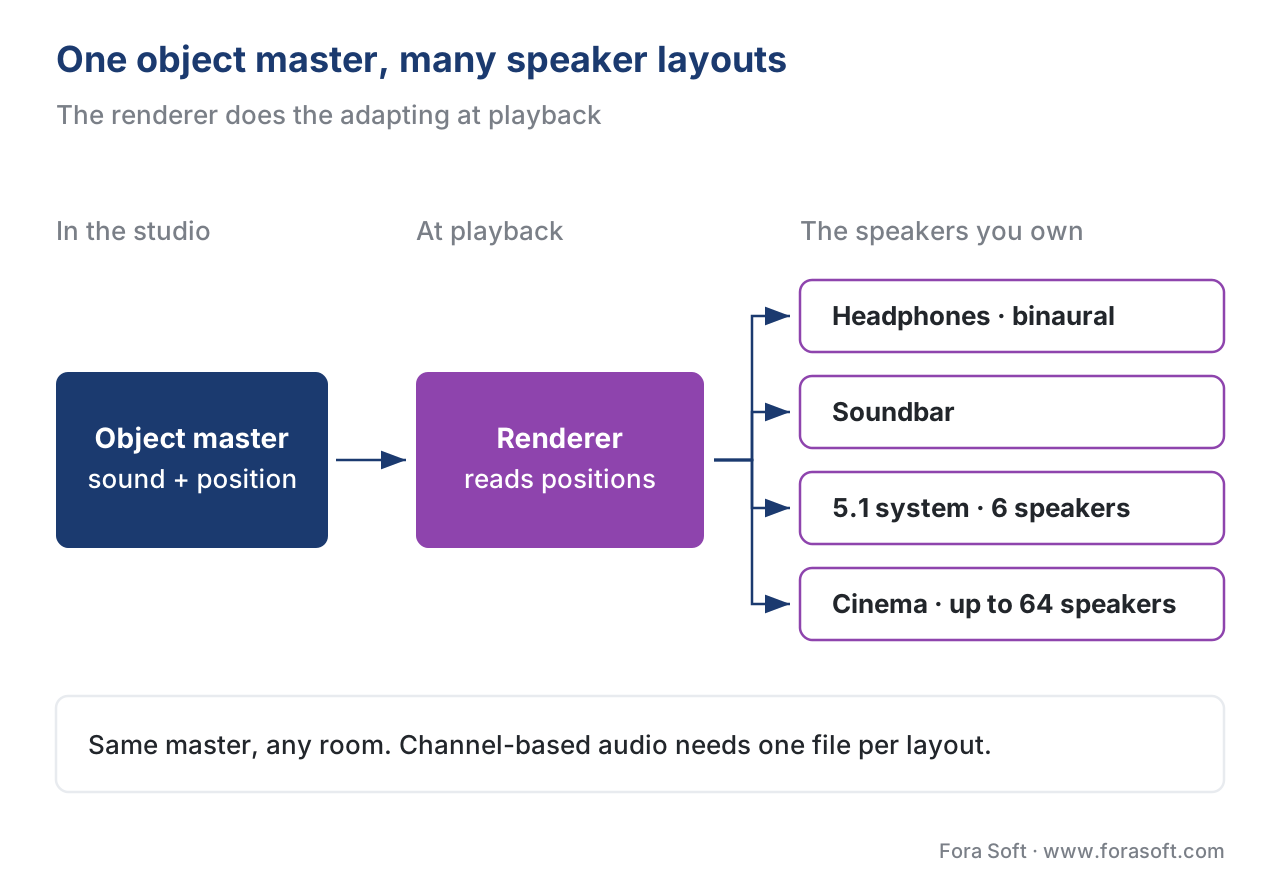 Figure 2. One object master, many speaker layouts — the renderer does the adapting.
Dolby Atmos is object-based (with a channel-based bed)
The most famous object-based system is Dolby Atmos. Atmos is not pure objects, though — it is a hybrid, and understanding the hybrid is the key to understanding modern immersive audio.
An Atmos mix has two parts. The first is a bed: a set of ordinary channel-based audio (often a 7.1.2 layout — seven ear-level, one LFE, two overhead) used for ambience, music, and anything that does not need to move precisely. The second is a set of objects: individual sounds with positional metadata that the renderer places dynamically. A door slam, a passing car, a line of dialogue — these become objects.
The Dolby Atmos Renderer, the software studios use, accepts up to 128 inputs total, where each channel of a bed counts as one input and each object counts as one input. In a cinema, the bed typically eats 9.1 of those (often described as 7.1.2), leaving up to 118 objects to roam freely. During playback, each cinema's own Atmos system renders those objects in real time against the known positions of that cinema's speakers — which is why the same Atmos master sounds correct in a room with 12 speakers and a room with 64.
The home-delivery trick: spatial coding
Shipping 128 separate channels of audio to a living room is not practical — it would be a huge bitrate. So for home delivery, Atmos uses spatial coding: an algorithm groups the 128 beds and objects into roughly 12 to 16 perceptually distinct "clusters," then carries those clusters plus metadata inside a normal codec. In the Dolby Digital Plus path (technically E-AC-3 with "Joint Object Coding," or JOC), this is how a streaming service squeezes Atmos into a bitrate a home internet connection can handle, while staying backward-compatible — a device that does not understand Atmos still decodes the underlying 5.1.
This is the trick worth remembering for any streaming product: object audio is captured with up to 128 elements in the studio, then intelligently reduced to ~12–16 clusters for delivery. You are not streaming 128 channels.
A worked number, to make the bandwidth concrete. A naive "stream every object separately" approach at, say, 48 kHz and 24 bits per sample, uncompressed, costs per object:
48,000 samples/s × 24 bits/sample = 1,152,000 bits/s = 1.152 Mbps per object
128 objects × 1.152 Mbps        = 147.5 Mbps
147 Mbps for audio alone is absurd for home streaming. Spatial coding down to ~16 clusters carried in E-AC-3 brings practical Atmos delivery to a few hundred kbps — a roughly 100-to-1 reduction. That is the difference between "studio format" and "delivery format," and it is why you should never assume the studio object count equals the streamed channel count.
How object-based cinema audio travels from the server to the amplifiers
In a cinema, object audio is never mixed down before the show: the DCP carries the bed and the objects as one immersive audio track, the media server streams that bitstream in sync with the picture to the cinema processor, and the processor renders it live to the room’s speaker feeds. The interoperable bitstream is SMPTE ST 2098-2 Immersive Audio Bitstream (IAB), packaged in the DCP as an Immersive Audio track file under SMPTE ST 429-18. The industry delivery profile, SMPTE RDD 57:2021 (IAB Application Profile 1), caps a composition at 10 bed channels and 118 objects, no more than 128 elements rendered at once, at 48 kHz. On the output side, a processor such as Dolby’s CP950A renders up to 64 speaker feeds and hands them to the amplifiers over networked audio (AES67 or BLU Link). DTS:X screens play IAB too: GDC Technology’s servers were certified to output DTS:X for IAB in 2022.
DTS:X — the other object system
Dolby's main rival, DTS:X, is also object-based and also layout-flexible: it does not lock the mix to a fixed speaker count and lets the decoder adapt to the room. For a product decision, treat DTS:X and Atmos as the same category (object-based, renderer-driven, immersive) competing on ecosystem and licensing rather than on the underlying philosophy.
Object-based mixing: the workflow in five steps
Object-based mixing means routing each sound either to the channel bed or to an object, then writing its position as metadata instead of baking the pan into the audio. A typical 2026 workflow looks like this:
- Mix in a DAW with native immersive support, such as Pro Tools, Logic Pro, Nuendo or DaVinci Resolve (Fairlight).
- Send ambience and music to the bed (for example 7.1.2) and send sounds that must move or stay pin-sharp, such as dialogue, effects and fly-overs, to objects.
- Pan each object in 3D; the DAW records position, size and level as metadata over time.
- Monitor through the renderer on speakers and in binaural for headphones, because most viewers will hear the mix on earbuds.
- Export a master with ADM metadata (ITU-R BS.2076), usually an ADM BWF file, and encode it into the delivery formats: DD+ JOC or AC-4 for streaming, MPEG-H for broadcast, IAB for cinema.
What is scene-based audio? Name the whole sound field
The third approach does not name speakers or sounds. It captures the entire sound field at a point in space as a set of mathematical layers, then reconstructs it for any speaker layout — or, crucially, rotates it when the listener turns their head.
This is ambisonics. Here is the plain-language version before any math. Imagine standing at one spot and asking, "from every direction around me, how much sound is arriving and from where?" Ambisonics answers that question with a stack of channels that, taken together, describe the sound arriving from all directions at once. It is not tied to speakers at all; it is a description of the sound at your head.
The lowest, simplest version is First Order Ambisonics (FOA), and it uses exactly four channels, conventionally called W, X, Y, and Z. W is the omnidirectional channel — the total sound pressure, "how much sound overall." X, Y, and Z capture how that sound is distributed along the three axes: front-back, left-right, and up-down. Four numbers, and you have a crude but complete 360° description of the sound field.
To sharpen the picture, you add more layers. This is Higher Order Ambisonics (HOA). The relationship between the order and the channel count is a clean formula, and showing it once makes the whole idea click:
channels = (order + 1)²
order 1 (FOA): (1 + 1)² = 2² = 4 channels
order 2:       (2 + 1)² = 3² = 9 channels
order 3:       (3 + 1)² = 4² = 16 channels
order 7:       (7 + 1)² = 8² = 64 channels
Higher order means finer spatial resolution — sounds localise more precisely — at the cost of more channels to store and transmit. Third order (16 channels) is a common sweet spot for high-quality VR; first order (4 channels) is what most consumer 360° video uses.
The analogy: ambisonics is a panoramic photo of sound. A first-order capture is a low-resolution panorama — you can tell roughly where things are. A third-order capture is a higher-resolution panorama — sharper edges, clearer positions. And like a panorama, you can pan and rotate the whole image after the fact. That last property is the magic.
 Figure 3. Scene-based audio: more order means more channels and sharper spatial resolution. The whole field rotates with the listener's head.
Why VR and 360° video want scene-based audio
When you turn your head in a VR headset, the entire sound field should rotate with you — the sound that was in front is now to your side. With channel-based audio that is hard; with object-based audio it is possible but you must re-render every object. With scene-based audio it is a single, cheap mathematical rotation applied to the whole field at once. Rotate the four (or sixteen) ambisonic channels with one matrix operation and the world turns correctly. That is why head-tracked VR audio is almost always scene-based at its core.
YouTube's spatial-audio support for 360° and VR video is the mainstream example. YouTube accepts First Order Ambisonics in AmbiX (ACN order, SN3D normalisation) as a 4-channel track ordered W, Y, Z, X at 48 kHz, as PCM in MOV, AAC at 256 kbps or more, or Opus at 512 kbps or more (YouTube Help, checked October 2026), or FOA plus a "head-locked" stereo pair (a 6-channel track, W, Y, Z, X, L, R, at a minimum 768 kbps) for narration or music that should not rotate with the head. When a viewer drags the 360° view, YouTube rotates the ambisonic field in real time.
A note on exchange formats: ACN and SN3D
If your engineers work with ambisonics, two acronyms will come up. ACN (Ambisonic Channel Number) defines the order the channels are stored in — instead of the historical W, X, Y, Z names, each component gets a number. SN3D (Schmidt Semi-Normalisation) defines how the channels are scaled relative to each other; its practical benefit is that no component ever exceeds the level of the omnidirectional W channel, which helps prevent clipping. The widely used open exchange format AmbiX — introduced in 2011 by researchers at IEM Graz — combines ACN ordering with SN3D normalisation and stores the channels as plain PCM inside a WAV/CAF file. You do not need the math to make a product call, but knowing "we use AmbiX, ACN/SN3D" tells you a team is working in scene-based audio.
The two ADM special cases: matrix and binaural
Two more ADM types round out the picture; both are best understood as derivatives of the main three.
Matrix-based audio combines channels with simple arithmetic to make other channels. The classic example is Mid/Side encoding used in FM radio: the "Mid" channel is left-plus-right, the "Side" channel is left-minus-right. If the weak Side signal is lost, you still recover mono from Mid. The Lt/Rt downmix that folds 5.1 into two channels is also matrix-based. Think of matrix as a reversible folding trick layered on top of channel-based audio.
Binaural audio is the two-channel signal designed specifically for headphones, engineered so your two ears perceive full 3D placement. It is usually the output of a renderer rather than a production format: a renderer takes object-based or scene-based audio and produces a binaural pair using a model of how your head and ears colour sound from each direction (a "head-related transfer function," covered in our ambisonics and HRTF article). Apple Spatial Audio is the consumer face of this — an Atmos (object-based) master rendered to head-tracked binaural for AirPods.
Putting the three side by side
Here is the comparison a product person actually needs. The lightly tinted cells mark where each approach is the natural winner.
| Criterion | Channel-based | Object-based | Scene-based |
|---|---|---|---|
| What the file stores | Speaker feeds | Sounds + position metadata | Sound-field layers (W, X, Y, Z…) |
| Tied to a speaker layout? | Yes — one file per layout | No — renderer adapts | No — decode to any layout |
| Playback compute cost | Lowest (none) | Medium (renderer) | Medium (decoder/rotation) |
| Head rotation (VR) | Hard | Possible, re-render each object | One cheap rotation of the field |
| Precise moving sounds | Limited | Excellent | Good, improves with order |
| Diffuse ambience / "being there" | Good | OK | Excellent |
| Typical channel count | 2 to 24 | 1 bed + up to ~128 objects (studio) | 4 (FOA) to 16+ (HOA) |
| Flagship products | Stereo, 5.1, 7.1, 22.2 | Dolby Atmos, DTS:X | Ambisonics, YouTube/VR audio |
| Standard anchors | ITU-R BS.775 | ETSI/Dolby; MPEG-H objects | ITU-R BS.2076 (HOA) |
Table 1. The three approaches compared on the axes that drive a buy/build decision.
A common mistake worth flagging directly:
Pitfall — "Atmos is just more channels." It is not. Atmos is object-based: it stores sounds and positions, then renders to your speakers at playback. Treating it as "7.1.4 channels" and storing twelve fixed feeds throws away the adaptivity that is the entire point — and it will sound wrong on any layout that is not exactly 7.1.4. If a vendor describes Atmos as a fixed channel count, they have misunderstood the format.
MPEG-H: the standard that does all three at once
If the three approaches feel like rivals, MPEG-H 3D Audio is the standard that refuses to choose. Specified as ISO/IEC 23008-3 (MPEG-H Part 3), it carries channel-based, object-based, and scene-based (HOA) audio in a single bitstream, and lets a content creator mix them — a channel bed, plus moving objects, plus an ambisonic ambience layer, all together. It supports up to 64 loudspeaker output channels and 128 codec core channels.
The practical payoff for viewers is interactivity: because objects carry metadata, an MPEG-H decoder can let the user turn up the dialogue, choose a different commentary language, or adjust the balance — all from the same broadcast stream. That is why broadcasters adopted it. MPEG-H is the sole audio system of South Korea's UHD ATSC 3.0 ("Next Gen TV") service. In the United States, ATSC 3.0's audio standard (A/342) permits both MPEG-H and Dolby's AC-4, and US deployments have largely used AC-4. Brazil's next-generation system, branded DTV+ / "TV 3.0," was adopted in August 2025, builds on ATSC 3.0 technology and went on air commercially in June 2026: Globo started 24/7 DTV+ transmission in Rio de Janeiro, São Paulo and Brasília ahead of the 2026 football World Cup, with 15 state capitals planned by 2030, and the standard makes MPEG-H Audio support over HDMI mandatory in every DTV+ receiver (Fraunhofer IIS, June 2026). So the same three-way taxonomy underpins the broadcast standards now rolling out worldwide.
What changed in 2025–2026: IAMF 2.0, Eclipsa Audio and Apple ASAF
The newest formats do not pick one approach: they carry objects, ambisonics and channels in one stream, and the open-source side of the market now has a full object-based stack. Three developments matter for a product decision made today.
- IAMF 2.0 adds objects (August 2026). The Alliance for Open Media’s Immersive Audio Model and Formats, the royalty-free container behind Google and Samsung’s Eclipsa Audio, reached version 2.0.0 as a final deliverable on 24 August 2026; the specification now covers channel-based, scene-based and object-based audio. In July 2026 AOMedia also published Open Audio Renderer (OAR) v1, a reference renderer for speakers and binaural headphones.
- Eclipsa Audio is on real screens. YouTube was the first streaming service to support it; Samsung TVs and soundbars from the 2025 line-up and Galaxy phones and tablets play it, and in July 2026 Samsung TV Plus began streaming Eclipsa Audio programmes in South Korea (SamMobile, 10 July 2026).
- Apple ASAF and APAC (WWDC, June 2025). Apple Spatial Audio Format combines objects, higher-order ambisonics and channels with time-varying metadata, rendered on the device for head-tracked headphones. Apple says most Apple Immersive Video content uses fifth-order ambisonics, which is (5 + 1)² = 36 channels; fifth order plus 15 objects is 51 signals, about 81 Mbps as 32-bit PCM, which the Apple Positional Audio Codec carries at about 1 Mbps and can push down to 64 kbps. APAC runs on every Apple platform except watchOS.
The standards that define object-based media, and where each stands in October 2026:
| Standard | What it defines | Audio types | Status, October 2026 |
|---|---|---|---|
| ITU-R BS.2076 (ADM) | Metadata vocabulary for production and exchange | Channel, object, scene, matrix, binaural | Edition BS.2076-3, February 2025, in force |
| SMPTE ST 2098-2 (IAB) | Cinema immersive audio bitstream in the DCP | Bed + objects | 2022 edition; RDD 57 profile: 10 bed channels + 118 objects |
| ISO/IEC 23008-3 (MPEG-H 3D Audio) | Broadcast and streaming codec | Channel, object, HOA | ATSC 3.0 in South Korea; mandatory in Brazil’s DTV+ (on air June 2026) |
| ETSI TS 103 190 (Dolby AC-4) | Broadcast and streaming codec | Channel, object | Main audio codec of US ATSC 3.0 deployments |
| AOMedia IAMF | Royalty-free immersive audio format (Eclipsa Audio) | Channel, scene, object (v2.0) | v2.0.0 final deliverable, 24 August 2026 |
| Apple ASAF + APAC | Proprietary format and codec for Apple devices | Object, HOA, channel | Shipping since 2025 on all Apple platforms except watchOS |
Table 2. Object-based media standards and their status in October 2026.
How to choose, in one paragraph
For most streaming and OTT products today, the spine is object-based: author in Dolby Atmos (or MPEG-H where broadcast requires it, IAMF/Eclipsa Audio if you need a royalty-free path to YouTube and Samsung devices), deliver via spatial coding so the bitrate stays sane, and let devices render down to whatever the viewer owns. Keep a channel-based stereo and 5.1 fallback for older devices — that is just good hygiene. Reach for scene-based ambisonics specifically when head tracking is in play: VR, AR, and 360° video, where the field must rotate with the viewer. Pure channel-based audio is now mostly a fallback and a capture format, not the thing you build your premium tier around.
 Figure 4. A four-question decision path for picking an audio approach in 2026.
Frequently asked questions
What is object-based audio?
Object-based audio stores each sound as a separate object with metadata about its position, size and level, and a renderer builds the final mix for the listener’s actual speakers or headphones at playback. One master therefore plays correctly on earbuds, a soundbar or a 64-speaker cinema.
What is the difference between channel-based and object-based audio?
Channel-based audio is mixed to a fixed speaker layout, so the file says “play this from the left-rear speaker” and needs a separate version for every other layout. Object-based audio says “this sound is here” and lets the renderer pick the speakers, so one file adapts to any room.
What is channel-based immersive audio?
It is a fixed layout with height speakers, such as 7.1.4, 9.1.6, Auro-3D 13.1 or 22.2, with one pre-mixed feed per speaker. It needs no renderer but only sounds as intended on that exact layout.
Is Dolby Atmos object-based?
Yes, Dolby Atmos is a hybrid: a channel-based bed (often 7.1.2) plus up to 118 objects, 128 inputs in total, rendered to the playback system. For home streaming it is spatially coded into about 12–16 clusters inside Dolby Digital Plus (JOC) or AC-4.
What is scene-based audio?
Scene-based audio, or ambisonics, records the full sound field around one point as (order + 1)² channels: 4 for first order, 16 for third order, 36 for fifth order. Because the whole field can be rotated with one matrix operation, it is the standard choice for head-tracked VR and 360° video.
How is object-based cinema audio encoded and transported to the amplifiers?
The bed and objects travel in the DCP as an SMPTE ST 2098-2 Immersive Audio Bitstream track (packaged per SMPTE ST 429-18); the media server streams it with the picture to the cinema processor, which renders it live to up to 64 speaker feeds and sends them to the amplifiers over networked audio such as AES67.
Is Samsung Object Tracking Sound the same as Dolby Atmos?
No. Object Tracking Sound is a TV speaker feature that moves sound to follow on-screen action; Dolby Atmos is a content format that carries objects and metadata. A TV can decode an Atmos track and play it through its own speaker system, so the two are not competing formats.
Which standards define object-based media?
The core ones are ITU-R BS.2076 (Audio Definition Model) for metadata, SMPTE ST 2098-2 (IAB) for cinema, ISO/IEC 23008-3 (MPEG-H) and ETSI TS 103 190 (AC-4) for broadcast and streaming, and AOMedia IAMF 2.0 as the royalty-free option; Table 2 above lists their status.
Free download: Channel vs Object vs Scene: Decision Cheat SheetOne page: what each of the three audio approaches stores, where each wins, the 5.1 / 7.1.4 / FOA / HOA notation decoded, and a four-question path to pick an approach in 2026.Where Fora Soft fits in
Fora Soft has built video products since 2005 across streaming, OTT/Internet TV, video conferencing, e-learning, telemedicine, surveillance, and AR/VR — and audio is the part of every one of those pipelines that users notice first when it breaks. As an OTT and IPTV platform development team, we wire up object-based delivery (Atmos via E-AC-3 JOC, or MPEG-H for broadcast targets) with channel-based stereo and 5.1 fallbacks so a title plays correctly from a phone to a home cinema. In AR/VR and 360° projects we work in scene-based ambisonics so the sound field tracks the headset. The point of knowing all three approaches is not academic: it is how you scope an audio feature that ships on the devices your users actually have. Our video and audio processing development covers the encoding, mixing and fallback renditions, and our AR and VR app development team handles ambisonic sound fields for headsets such as Meta Quest and Vision Pro.
The book
Audio for Video: A Complete Guide to Sound in Video Products: From Jitter Buffers and Lip Sync to Atmos, Quality Metrics, and Neural Codecs
Volume 5 of the handbook picks up where this article stops: how beds, objects and ambisonic layers are actually rendered to speakers and to head-tracked headphones, where DD+ JOC, AC-4 and MPEG-H differ once you have to ship them, and how to keep spatial audio in sync with the picture after it crosses the network. It also covers the listening tests and quality metrics (MUSHRA, POLQA, ViSQOL) you need to prove a spatial encode still sounds right. Written by Nikolay Sapunov, CEO at Fora Soft.
Not sure whether your product needs channel, object or scene-based audio?
Tell us which devices your viewers use and whether any of them wear a headset, and we will tell you which approach to author in, which codec carries it to each device, and what a stereo and 5.1 fallback adds to your storage and CDN bill. 250+ video products shipped since 2005.
See our case studies
Case study
WorldCastLive
Concert streaming with five audio channels at 1.5 Gb/s, 0.4–0.5 s latency and 10,000 simultaneous viewers — channel-based multichannel audio delivered live, at scale.
Case study
Drundoo
Bulgarian internet TV with 60 live channels plus movies, series, sport and concerts on demand — the OTT catalog where a premium audio track and a stereo fallback have to play on every device.
Case study
Tyxit
Remote jamming for musicians at under 30 ms with a proprietary codec, played live between the Montreux Jazz Festival and Jazz à Vienne stages — when latency is the budget, plain channels win.
What to read next
Fundamentals
Channels and channel layouts: mono, stereo, 5.1, 7.1, 7.1.4
The channel-based side in depth: what each number in 5.1 and 7.1.4 counts.
Immersive audio
MPEG-H 3D Audio: the ISO immersive standard
The one standard that carries channels, objects and HOA in a single bitstream.
Immersive audio
Ambisonics, HRTF and binaural rendering
How a scene-based field becomes head-tracked sound in a pair of headphones.
Streaming delivery
Atmos and immersive audio in streaming
How Netflix, Apple and Tidal ship object audio at 768 kbps and signal it in HLS.
References
- Recommendation ITU-R BS.2076-3 (02/2025), "Audio Definition Model." The controlling standard that formally defines channel-based, object-based, scene-based (HOA), matrix, and binaural audio types. Tier 1 (official standard). https://www.itu.int/dms_pubrec/itu-r/rec/bs/R-REC-BS.2076-3-202502-I!!PDF-E.pdf
- EBU ADM Guidelines, "Types of Audio." Open, plain-language companion to ITU-R BS.2076; source for the five-type model, the DirectSpeakers naming, and the HOA component-count examples (FOA = 4 components; 3rd order = 16). Tier 3 (standards-body educational). https://adm.ebu.io/background/audio_types.html
- ISO/IEC 23008-3 (MPEG-H Part 3), "3D Audio." Defines MPEG-H 3D Audio carrying channel, object, and HOA elements in one bitstream; up to 64 loudspeaker channels and 128 codec core channels. Tier 1 (official standard); catalogue/abstract read, full normative text paywalled. https://www.iso.org/standard/83525.html
- Recommendation ITU-R BS.775 (5.1 reference layout). The 3/2 loudspeaker arrangement underlying channel-based 5.1. Tier 1. https://www.itu.int/rec/R-REC-BS.775
- ATSC A/342, "Next Generation Audio" (ATSC 3.0). Specifies that ATSC 3.0 audio may use AC-4 or MPEG-H 3D Audio. Tier 1. https://www.atsc.org/atsc-documents/type/3-0-standards/
- Dolby, "Dolby Atmos Renderer" product documentation. Source for the 128-input renderer limit (beds + objects) and the bed/object hybrid model. Tier 3 (first-party vendor). https://professional.dolby.com/product/dolby-atmos-content-creation/dolby-atmos-renderer/
- Wikipedia, "Dolby Atmos." Used only for orientation on the spatial-coding cluster count (~12–16 elements) and the E-AC-3 JOC home-delivery path; the underlying claims trace to Dolby documentation. Tier 6 (navigational). https://en.wikipedia.org/wiki/Dolby_Atmos
- Google / YouTube Help, "Use spatial audio in 360-degree and VR videos." First-party source for YouTube's First Order Ambisonics support (4-channel W,Y,Z,X at 48 kHz; FOA + head-locked stereo 6-channel, min 768 kbps). Tier 3 (first-party platform docs). https://support.google.com/youtube/answer/6395969
- M. Kratschmer et al., "AmbiX — A Suggested Ambisonics Format" (Ambisonics Symposium 2011, IEM Graz). Source for the AmbiX exchange format using ACN ordering and SN3D normalisation. Tier 5 (peer-reviewed). https://ambisonics.iem.at/proceedings-of-the-ambisonics-symposium-2011/ambix-a-suggested-ambisonics-format
- SMPTE ST 2098-2:2022, "Immersive Audio Bitstream Specification." The interoperable cinema bitstream for beds and objects. Tier 1 (official standard). https://pub.smpte.org/latest/st2098-2/st2098-2-2022.pdf
- SMPTE RDD 57:2021, "IAB Application Profile 1." Source for the 10 bed channels, 118 objects, 128 rendered elements and 48 kHz limits, and for ST 429-18 packaging. Tier 1 (SMPTE registered disclosure, ISDCF/EDCF). https://pub.smpte.org/doc/rdd57/20210225-pub/rdd57-2021.pdf
- SMPTE ST 429-18, "D-Cinema Packaging — Immersive Audio Track File." How IAB is carried inside a DCP. Tier 1. https://pub.smpte.org/latest/st429-18/index.html
- AOMedia, "Immersive Audio Model and Formats" v2.0.0 (final deliverable, 24 August 2026). Source for IAMF supporting channel-based, scene-based and object-based audio. Tier 1 (specification). https://aomediacodec.github.io/iamf/
- Apple, "Apple Spatial Audio Format and Apple Positional Audio Codec" (Meet with Apple, 2025). Source for ASAF (objects, HOA, channels), fifth-order ambisonics in Apple Immersive Video, the 51-signal / 81 Mbps / 1 Mbps / 64 kbps figures and platform support. Tier 3 (first-party vendor). https://developer.apple.com/videos/play/meet-with-apple/223/
- Fraunhofer IIS, "DTV+ Goes Live in Brazil with MPEG-H Audio at the Core" (16 June 2026). Source for the Globo launch, the three launch cities, the 2030 coverage target and the mandatory MPEG-H over HDMI rule. Tier 3 (codec developer). https://mpegh.com/?p=11667
- SamMobile, "Samsung TV Plus gets Eclipsa Audio" (10 July 2026). Source for Eclipsa Audio device support and the Samsung TV Plus launch in South Korea. Tier 4 (trade press). https://www.sammobile.com/news/samsung-tv-plus-eclipsa-audio-launch/
Note on source hierarchy (per our research standard): where a vendor description and the standard disagree, the article follows the standard. The three-type taxonomy here is taken from ITU-R BS.2076, not from any single vendor's framing; Atmos and DTS:X are then described as products built within that taxonomy.
