


This is engineering guidance, not legal advice. Confirm specifics with qualified counsel.
Why This Matters
If you run certification, licensing, hiring tests, or graded online courses, someone has told you that you "need proctoring" — and someone else has warned you it will get you sued. Both can be right, and this article is the vendor-neutral, privacy-honest map that lets you decide for yourself: what each proctoring approach actually catches, what it costs per exam, what data it collects, and which laws that data triggers. It is written for the product manager, L&D director, or founder building a credential — not for a lawyer or a computer-vision engineer, though both should find it accurate. We have built assessment, video, and identity features across e-learning and other regulated verticals, and the most expensive mistakes we see are not technical; they are deploying invasive proctoring no one weighed the privacy cost of, and trusting an automated flag as if it were a verdict. By the end you will be able to scope a proctored-assessment subsystem and weigh its privacy cost out loud.
What "Online Proctoring" Actually Means
Start with the word. A proctor — also called an invigilator — is the person who traditionally walks the rows of an exam hall, checks IDs at the door, and makes sure no one is reading from their sleeve. Online proctoring is the software-and-services attempt to recreate that supervision when the test-taker is at home and the proctor, if there is one at all, is somewhere else. It usually combines four data streams: the webcam (the test-taker's face and room), the microphone (voices, a second person, a phone), the screen (what is on it, and whether they switched away from the exam), and the browser or a lockdown app (which keys and tabs are allowed).
The plain analogy: a proctor in a hall watches one room full of people with their own eyes; online proctoring wires a camera and a microphone to every test-taker's desk and then decides — with a human, a recording, or an algorithm — who to look at more closely. Everything that follows is a consequence of that one shift, from a shared physical space to thousands of private homes piped through software.
Two things are worth separating immediately, because vendors blur them. Identity verification answers "is this the right person?" — usually an ID-document check and a face match at the start. Proctoring answers "did they behave during the test?" — the ongoing monitoring. They are different jobs with different data and different risks; this article is about the second, and identity verification has its own article. Proctoring is also not the whole anti-cheating story — browser lockdown, plagiarism detection, and cheat-resistant question design carry more of the load than the camera does, and they get their own treatment too.
The Three Approaches, and What Separates Them
Almost every proctoring product is one of three approaches, or a blend. The differences are not cosmetic — they change what you catch, what you pay, and how much of a test-taker's life you record.
The first is live proctoring (also "live online proctoring" or "remote live"). A real human watches in real time over the webcam, usually monitoring several test-takers at once on a dashboard, and can step in mid-exam — pause it, ask the test-taker to show the room, or stop the session. It is the closest digital cousin to the exam hall. Because a person is present, ambiguous moments get judged in context as they happen, and the deterrent is strong: people behave differently when they know someone is watching live.
The second is record-and-review (sometimes "record-and-review proctoring" or "asynchronous proctoring"). The software records the webcam, microphone, and screen during the exam, and a human reviews the footage afterward — either the whole thing, or just the moments the software flagged. No one watches live, so it scales better than live proctoring and lets you run exams at any hour. The catch is that you cannot intervene during the exam; you can only decide afterward what to do about what you find.
The third is automated proctoring (also "AI proctoring," "auto-proctoring," or "fully automated"). Software monitors the session and flags suspicious moments — a second face, the test-taker looking away repeatedly, a new voice, a switched tab — and produces a report, with no human watching at all unless someone later reviews the flags. This is the cheapest and most scalable approach, which is why it dominates high-volume hiring and large course exams. It is also where the privacy and fairness problems concentrate, because an algorithm with no context decides what counts as "suspicious."
A useful way to hold the three together: live proctoring spends a human's attention during the exam, record-and-review spends it after, and automated proctoring tries not to spend it at all. The table below lays out the trade-off.
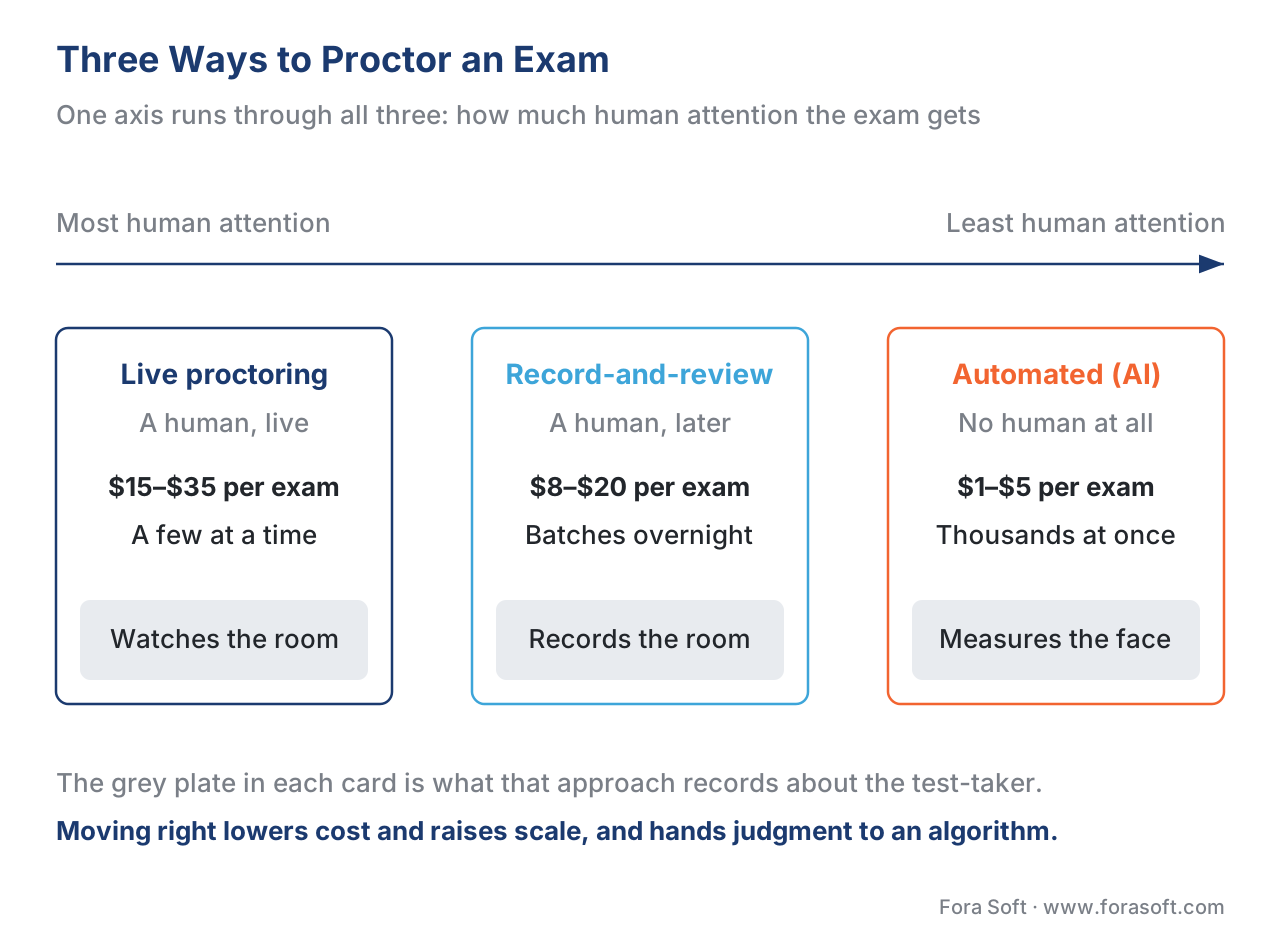 Figure 1. The three online proctoring approaches as a spectrum from most human attention to least. Moving right lowers cost and raises scale, but moves judgment from a present human to an algorithm — and concentrates the privacy and fairness risk.
| Criterion | Live proctoring | Record-and-review | Automated (AI) |
|---|---|---|---|
| Human present | Yes, in real time | Yes, afterward | No (optional flag review) |
| Can intervene mid-exam | Yes | No | No |
| Typical cost per exam | ~$15–$35 | ~$8–$20 | ~$1–$5 |
| Scales to thousands at once | Hard (1 proctor : few test-takers) | Better | Easily |
| Deterrence strength | Highest | Medium | Medium (people fear the recording) |
| Context for ambiguous moments | Best (judged live) | Good (reviewer sees footage) | Worst (algorithm, no context) |
| Main privacy concern | Live human sees the home | Stored recording of the home | Biometric analysis + opaque flags |
| Integration into your LMS | LTI 1.3 launch + result | LTI 1.3 launch + async result | LTI 1.3 launch + flag report |
Costs above are 2026 market ranges and vary widely by volume, exam length, and region; treat them as order-of-magnitude, not quotes. Notice the last row: whichever approach you pick, the clean way to wire it into your learning platform is the same standard launch-and-return mechanism, LTI 1.3, so the proctoring tool opens from inside your LMS and sends the result back. Proctoring choice and integration choice are separate decisions.
How Automated Proctoring Actually Works
Because automated proctoring is where most of the money and most of the controversy sit, it is worth opening the box. The software does not "detect cheating." It detects signals — measurable events — and then applies rules or a model to decide which signals look suspicious. Knowing the signals tells you exactly what the tool can and cannot see.
The most common signals are: face presence and count (is exactly one face visible, or zero, or two?); gaze and head pose (is the test-taker looking at the screen, or repeatedly off to the side?); audio events (a second voice, a sustained conversation, a phone notification); identity drift (does the face still match the person who logged in?); screen and window activity (did they switch tabs, open another app, copy text?); and environment changes (someone walking into frame, the lighting changing). Each signal is just a number or an event; the product turns a stack of them into a "flag" and often a "risk score."
The pipeline is straightforward to picture. The test-taker's camera, microphone, and screen feed a capture layer; that feed runs through detection models (face detection, gaze estimation, speech detection); the detections become time-stamped events; a rules-or-model layer scores them; and the result is a report a human can open later. The figure below traces that path.
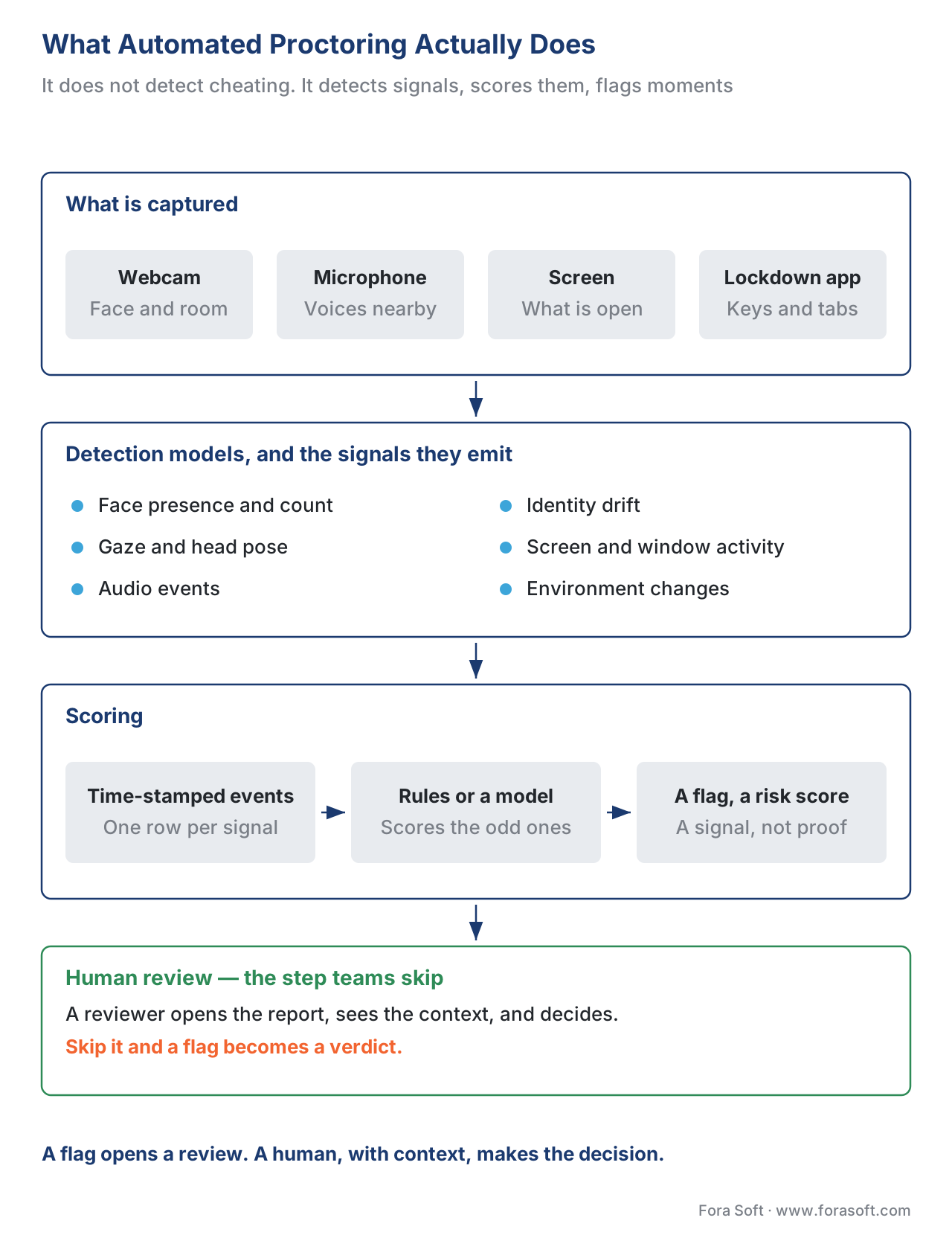 Figure 2. The automated-proctoring pipeline. Raw capture becomes detected signals, signals become scored flags, and a human reviews the flags — the human review step is the one teams most often skip, and the one that turns a flag into a fair decision.
Two precise points matter here, because popular write-ups get them wrong. First, a flag is not a finding. "Looked away 14 times" is an observation, not proof of cheating; people look away to think. Treating the score as a verdict is the central design error in this field. Second, some products advertise "emotion detection" or "stress detection" — inferring a mental state from a face. That capability is not just unreliable; in the European Union it is now prohibited in education, a point we return to under the law.
A Worked Example: Cost and False Positives
Numbers make the trade-off concrete. Imagine a certification body running 10,000 proctored exams a month, each 60 minutes.
Take cost first. Walk the three approaches at mid-range market rates:
Live proctoring at ~$25/exam:        10,000 × $25 = $250,000 / month
Record-and-review at ~$12/exam:      10,000 × $12 = $120,000 / month
Automated at ~$3/exam:               10,000 × $3  =  $30,000 / month
The spread is roughly 8×, top to bottom. That gap is exactly why high-volume programs drift toward automation — and why the privacy and fairness costs of automation get waved through. Now look at the other side of the ledger, the false alarms.
Suppose the automated system flags sessions as "suspicious" with a false-positive rate of 6% — within the 5–8% range researchers and vendors report for legitimate test-takers wrongly flagged. On 10,000 exams:
False positives per month: 10,000 × 6% = 600 sessions wrongly flagged
Six hundred honest people a month land in a review queue — or worse, get accused — for looking away, having a sibling walk past, or sitting in a dim room. If each flagged session needs a 10-minute human review to be fair, that is:
600 reviews × 10 min = 6,000 min = 100 staff-hours / month
So "fully automated" is not free of humans after all; doing it fairly re-introduces about 100 hours of review labor a month that the $30,000 price tag hid. The lesson is not "automation is bad." It is that the honest comparison is cost plus fair review plus the cost of getting it wrong, and the cheapest sticker price carries the largest hidden review-and-harm bill.
What Each Approach Catches — and Misses
Be precise about capability, because overconfidence here is how programs both miss cheating and punish the innocent.
Proctoring is good at catching the clumsy and the casual: a second person in the room, an obvious phone, a test-taker reading from off-screen, someone leaving and returning. Live proctoring catches these best because a human notices context immediately; record-and-review catches them on playback; automation catches the ones that match its signals.
Proctoring is weak against the prepared and the technical. The 2022 USENIX study "Watching the Watchers" reverse-engineered four major proctoring suites used for U.S. law and licensing exams and found their anti-cheating measures could be "trivially bypassed" — a virtual machine, a second device out of frame, a hidden earpiece, or a confederate feeding answers defeats camera-and-screen monitoring. The uncomfortable truth: the people most likely to cheat successfully are the ones proctoring is least able to stop, while the people most likely to be falsely flagged are ordinary test-takers with messy rooms, dark skin, disabilities, or caregiving duties. That asymmetry is the strongest argument for leaning on cheat-resistant assessment design rather than the camera.
The Privacy Cost Is Real — and Specific
Here is the part competitors gloss over. Proctoring does not just "use a webcam." It collects a webcam recording of someone's home, a microphone recording of their household, a capture of their screen, and — for automated tools — a biometric analysis of their face. Each of those is sensitive, and several are regulated as a distinct, high-risk class of data. Walk the specifics.
Biometric data and Illinois law (BIPA). The Illinois Biometric Information Privacy Act treats a faceprint — a measurement of facial geometry used to identify a person — as protected biometric data that you may not collect without informed, written consent, and for which individuals can sue. This is not theoretical. Online-proctoring vendors have faced repeated BIPA class actions over student face scans; Respondus settled one such case for $6.25 million, and ProctorU and others have been sued on the same theory. If your automated proctoring computes a faceprint and any test-taker is in Illinois (or one of the growing list of states with biometric statutes), this law is live for you, not your vendor only.
Special-category data under GDPR. For test-takers in the European Union or the United Kingdom, the General Data Protection Regulation (Regulation (EU) 2016/679) classifies biometric data processed to uniquely identify a person as "special category" data under Article 9 — the most protected tier. Processing it needs both a lawful basis under Article 6 and a specific Article 9 condition, most commonly the test-taker's explicit consent. Consent for proctoring is legally fragile, because consent must be freely given, and a student who must accept proctoring or fail the exam is arguably not free to refuse. You also need a written data-processing agreement with the proctoring vendor under Article 28, with retention limited to what the purpose requires.
Student records under FERPA. In the United States, the Family Educational Rights and Privacy Act (20 U.S.C. § 1232g; 34 CFR Part 99) governs how an institution may disclose education records — including proctoring recordings tied to a student — to third parties such as a proctoring vendor. The vendor typically has to fit the "school official" exception, under the institution's control and barred from re-using the data.
The home is constitutionally protected (in the U.S.). In Ogletree v. Cleveland State University (N.D. Ohio, 2022), a federal court held that scanning a student's bedroom before a remote exam — a "room scan" — was an unreasonable search under the Fourth Amendment. The court found the student's privacy interest in his home outweighed the university's interest in the scan. The ruling was fact-specific and applies to public institutions, but it put the routine "show me your room" step on notice everywhere.
The figure below traces where proctoring data actually goes, and the legal gate it must clear at each hop.
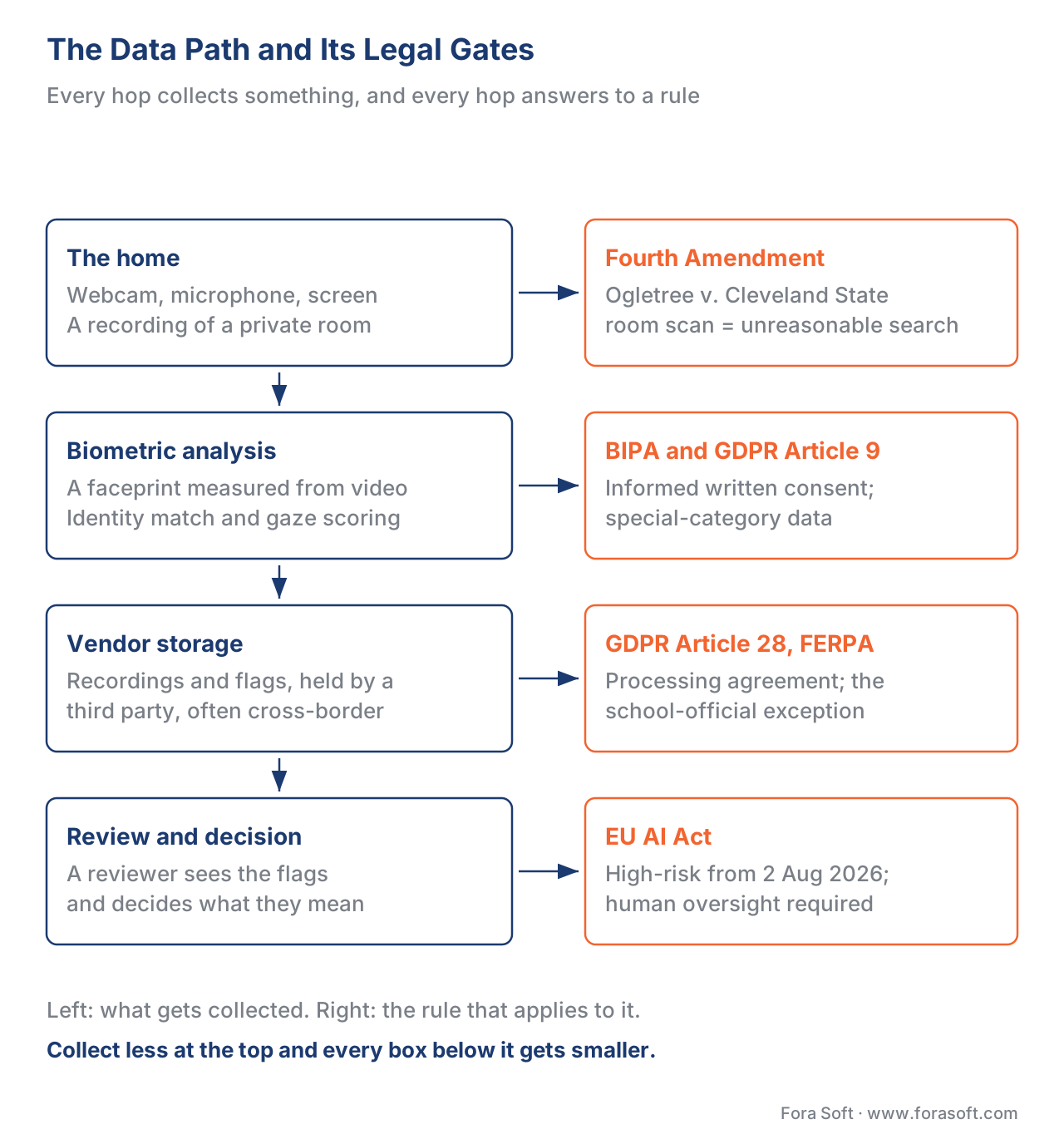 Figure 3. The proctoring data path and its legal gates. Biometric analysis triggers BIPA and GDPR Article 9; cross-border vendor storage triggers a data-processing agreement; the room scan touches Fourth Amendment protection of the home. Minimizing what you collect shrinks every box downstream.
Fairness: the Bias That Has Produced Litigation
Privacy is one half of the honest treatment; fairness is the other. Automated proctoring leans on facial detection and recognition, and those systems do not perform equally across people.
The same 2022 USENIX study evaluated the facial-recognition classifier used by Examplify — the legal-exam proctoring suite with the largest market share — and tested whether faces with certain skin tones were more readily flagged. Independent researchers and journalists have reported that some proctoring face-detection systems fail to detect darker-skinned faces a large fraction of the time, which means the software repeatedly tells those test-takers to "fix their lighting," flags them for being "absent," or fails to verify them at all. A camera that cannot see you reliably is not a neutral tool.
The harm is not limited to skin tone. Proctoring penalizes the neurodivergent test-taker who looks away or talks to themselves to concentrate, the disabled test-taker who uses assistive technology or cannot sit still, the caregiver whose child enters the room, and the low-income test-taker on a slow connection or a cheap webcam in a shared space. Where proctoring must not disadvantage a disabled learner, accessibility law and the WCAG 2.1 AA expectations of the rest of your platform pull in the opposite direction from blunt surveillance. Designing the assessment so flags are reviewed by a human who can see context — and so a flag never auto-fails anyone — is the minimum fairness bar.
The Legal Landscape, in One Pass
You do not need to be a lawyer to keep the map in your head; you need to know which rules exist so you can ask the right questions. (Reminder: this is engineering guidance, not legal advice.)
The EU AI Act (Regulation (EU) 2024/1689) is now the sharpest constraint. Its Annex III classifies AI systems "intended to be used for monitoring and detecting prohibited behaviour of students during tests" as high-risk — that is exactly automated proctoring — and the high-risk obligations for education systems apply from 2 August 2026. High-risk status brings real duties: risk management, data governance, technical documentation, logged decisions you can reconstruct, human oversight by design, and accuracy and robustness testing. Separately, the Act prohibits AI that infers emotions in education, in force since 2 February 2025 — so any proctoring feature marketed as "stress detection" or "emotion analysis" is not merely risky in the EU, it is banned.
In the United States, the active fronts are biometric law (Illinois BIPA and a growing set of state statutes, with settlements already paid), FERPA for student-record disclosure, the Fourth Amendment for public institutions (the room-scan ruling), and disability law (the Americans with Disabilities Act) where proctoring disadvantages disabled test-takers. In the EU and UK, GDPR special-category rules, the fragility of consent, and data-minimization and retention limits govern. Across all of them, one engineering principle does the most legal work: collect the least data that achieves the integrity goal, keep it the shortest time, and never let an algorithm make the final call.
Common mistake: treating an automated proctoring flag as proof and auto-failing or auto-accusing the test-taker. It is the single most damaging error in this field — it punishes false positives (an estimated 5–8% of honest sessions), it is indefensible when the flag came from a biased detector, and under the EU AI Act's human-oversight duty for high-risk systems it is non-compliant. A flag opens a review; a human, with context and a right of appeal, makes the decision.
Build vs Buy: When Proctoring Is Worth It, and How to Get It
Lead with the business question, not the technology. Proctoring is worth its cost and risk only when the stakes justify it: a licensing or certification exam, a regulated compliance test, a credential an employer will trust. For a formative quiz inside a course, or low-stakes practice, proctoring is usually all cost and no benefit — the cheating it stops is not worth catching, and the trust it burns is real.
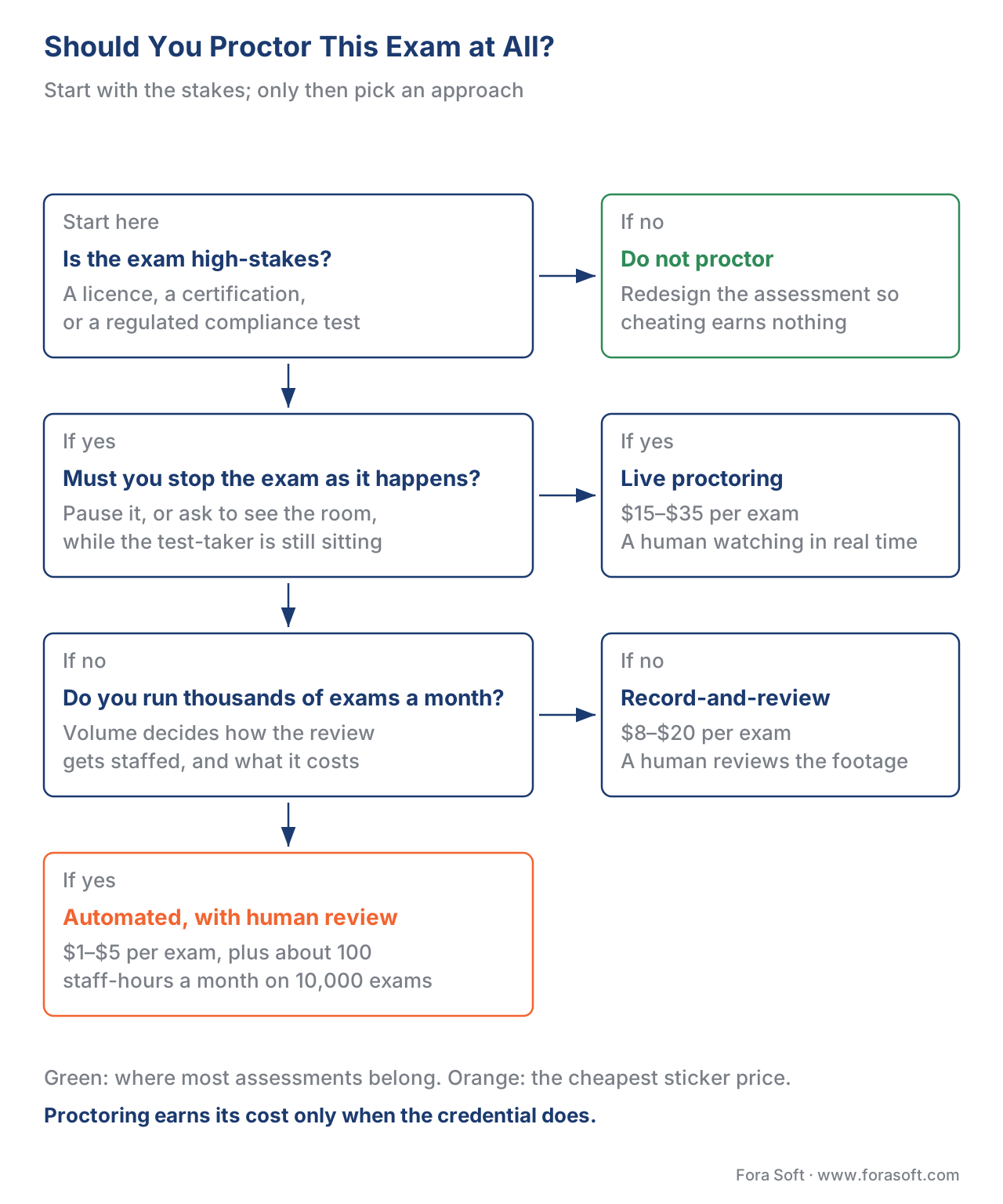 Figure 4. A one-pass decision tree. Start with the stakes; if proctoring is justified, choose by whether you need real-time intervention and by volume. Most low-stakes assessments should not be proctored at all.
When you do need it, the build-vs-buy reality is clear: buy the proctoring capability, do not build it. A credible proctoring stack is years of computer-vision work, a 24/7 live-proctor workforce, and an evolving compliance burden across dozens of jurisdictions — almost no learning product should build that. The right architecture is to integrate a specialist proctoring vendor into your platform through LTI 1.3, keep the test-taker's experience inside your product, and own the two things that are actually yours to get right: the policy (what you collect, how long you keep it, who reviews flags, how a test-taker appeals) and the integration (clean launch, reliable result return, no orphaned biometric data). The full annotated blueprint for that subsystem — lockdown client, identity service, capture, scoring, and the LMS bridge — is the proctoring and assessment reference design.
Free download: Online Proctoring Selection & Privacy ChecklistA one-page gate to run before you deploy proctoring: confirm the exam is high-stakes enough, pick the lightest defensible approach, clear consent and biometric law (BIPA, GDPR Article 9), test fairness across skin tones, accommodate disabled test-takers, keep a human on every flag, sign the processing agreement, and set retention.Where Fora Soft Fits In
Fora Soft builds video, real-time, and assessment features for regulated products across e-learning, telemedicine, and other verticals where what you record and how you store it carries legal weight. In proctoring specifically, the value we add is rarely the camera — it is the engineering judgment to integrate a specialist proctoring vendor cleanly through standard launch-and-return, to design the data flow so biometric and recording data is minimized, encrypted, and retention-limited, and to keep a human in the decision loop so a flag never becomes an automatic verdict. We help teams weigh the build-vs-buy trade-off honestly: when proctoring earns its place, when assessment redesign is the better control, and how to wire the chosen tool into a learning platform without inheriting its privacy liabilities.
The handbook
Fora Soft Video Engineering Handbook
We wrote a seven-volume series that takes the whole video stack apart across 9,000+ pages — encoding, delivery, audio and AI — so a subsystem that watches people in their homes is something you can design deliberately instead of buying blind. Volume 7 sits closest to this article: real-time AI pipelines, biometrics, and the compliance layer, including the EU AI Act duties that land on high-risk education systems in August 2026. Volume 6 is where the detection itself is explained — face detection, gaze and head pose, speech and speaker separation, and what each model does and does not see — and volume 3 covers the players, DRM and delivery economics behind every recorded session a reviewer later opens. Written by Nikolay Sapunov, CEO at Fora Soft.
Do your exams actually need proctoring, and which kind?
Tell us what the credential is worth, how many exams a month you run, and where your test-takers sit — and we will come back with the lightest approach that holds up, the LTI 1.3 integration into your platform, the retention and consent design around biometric data, and what each part costs to build. 250+ video products shipped since 2005.
See our case studies
Case study
BrainCert
A virtual-classroom LMS with 100K+ customers and 500M+ real-time classroom minutes, carrying proctored exams, SCORM and xAPI, and its own QuantumKey content protection, under SOC 2 Type II, ISO/IEC 27001, HIPAA and GDPR. That is this article in production: the proctoring sits inside the learning platform, and the compliance work is a standing cost, not a launch task.
Case study
VALT
A recording and observation platform for medical education, simulation labs and law-enforcement interviews — 770+ organizations, 50,000+ users, HIPAA and GDPR compliant, built and maintained by us for 10+ years. It is record-and-review done carefully: encrypted streams, per-role permissions, scheduled capture, and a reviewer who jumps to the moment rather than trusting a score.
Case study
ALDA
An AI course generator built with 70+ U.S. college educators at institutions serving 500,000+ students a year, now owned by 1EdTech — the body that publishes LTI 1.3. It generates personalized assessments, which is the control this article argues carries more weight than the camera, wired to the standard we recommend for launching any proctoring tool.
What to read next
Integrity
Anti-Cheating: Detection, Deterrence, and Assessment Design
The controls that stop the prepared cheater the camera cannot see.
Privacy
Proctoring Data, Privacy, and the Legal Landscape
The deep dive on BIPA, GDPR, consent, retention, and bias litigation.
Reference design
Proctoring and Assessment Reference Design
The annotated blueprint: lockdown client, identity, capture, scoring, LMS bridge.
Standards
LTI Explained: Launching Tools Inside Any LMS
How the proctoring tool opens from your LMS and sends the result back.
References
- EU Artificial Intelligence Act — Annex III, point 3(d): High-Risk AI Systems (education, monitoring and detecting prohibited behaviour of students during tests). European Union, Regulation (EU) 2024/1689, Official Journal version 13 June 2024. Tier 1. https://artificialintelligenceact.eu/annex/3/
- EU Artificial Intelligence Act — Article 5, Prohibited AI Practices (emotion inference in education prohibited from 2 February 2025). European Union, Regulation (EU) 2024/1689. Tier 1. https://artificialintelligenceact.eu/article/5/
- General Data Protection Regulation (GDPR), Article 9 — Processing of special categories of personal data (biometric data for unique identification). European Union, Regulation (EU) 2016/679. Tier 1. https://gdpr-info.eu/art-9-gdpr/
- General Data Protection Regulation (GDPR), Article 28 — Processor (data processing agreement). European Union, Regulation (EU) 2016/679. Tier 1. https://gdpr-info.eu/art-28-gdpr/
- Family Educational Rights and Privacy Act (FERPA), 20 U.S.C. § 1232g; 34 CFR Part 99. U.S. Department of Education. Tier 1. https://www.ecfr.gov/current/title-34/subtitle-A/part-99
- Illinois Biometric Information Privacy Act (BIPA), 740 ILCS 14. Illinois General Assembly. Tier 1. https://www.ilga.gov/legislation/ilcs/ilcs3.asp?ActID=3004
- Burgess, Ginsberg, Felten, Cohney — "Watching the Watchers: Bias and Vulnerability in Remote Proctoring Software." 31st USENIX Security Symposium (USENIX Security '22), pp. 571–588, 2022. Tier 5 (peer-reviewed). https://www.usenix.org/conference/usenixsecurity22/presentation/burgess
- Ogletree v. Cleveland State University, No. 1:21-cv-00500 (N.D. Ohio, Aug. 22, 2022) — room-scan ruling. Reporting and ruling summary, NPR. Tier 5/6. https://www.npr.org/2022/08/25/1119337956/test-proctoring-room-scans-unconstitutional-cleveland-state-university
- "Class action alleges Bradley University's use of Respondus proctoring tool violated Illinois students' privacy" / Respondus $6.25M BIPA settlement. ClassAction.org and Biometric Update reporting. Tier 6. https://www.classaction.org/news/class-action-alleges-bradley-universitys-use-of-respondus-proctoring-tool-violated-illinois-students-privacy
- ICO — "How do we process biometric data lawfully?" (UK GDPR biometric guidance). UK Information Commissioner's Office. Tier 2. https://ico.org.uk/for-organisations/uk-gdpr-guidance-and-resources/lawful-basis/biometric-data-guidance-biometric-recognition/how-do-we-process-biometric-data-lawfully/
Per the editorial conflict rule, where vendor marketing claims of "100% cheating detection" conflicted with the USENIX security analysis, this article follows the peer-reviewed finding (anti-cheating measures are trivially bypassable) and treats vendor claims as marketing, not evidence.
