


Why this matters
If you are a founder, product lead, or first-time streaming CTO, accessibility is the part of the legal shell that quietly turned from "nice to have" into "enforceable in your two largest markets" within the last year. Get the scope wrong and you can draw an FCC complaint, an ADA lawsuit, or — new since June 2025 — European Accessibility Act enforcement that can pull your service from the EU market. Under-build it and you wall off a large, loyal, and growing slice of your audience, because captions and described audio are used by far more people than the law has in mind. This article separates the obligations cleanly: the two content tracks (captions and audio description), the one interface standard (WCAG), and the map of which law applies where and how hard it bites. It is the accessibility specialization of Block 8, sitting beside ratings, parental controls, and age gates (the audience dimension), content windowing (the time dimension), and multi-territory licensing and geo-blocking (the place dimension). For the file formats and audio-mixing internals behind the tracks, it links to the Audio for Video section rather than repeating them. This is engineering guidance, not legal advice; confirm your specific obligations with qualified counsel for each market.
The one idea: two layers and one map
Most teams hear "accessibility" and picture a single checkbox — "add captions." It is two layers and a map, and the build only goes smoothly once you separate them.
The first layer is the content: extra tracks that travel with the video so a viewer who cannot hear or cannot see still gets the program. The two that matter are captions (a text version of the audio, including who is speaking and what non-speech sounds occur) and audio description (a spoken narration of the important visual action, inserted in the gaps between dialogue). These are things you add to the title itself.
The second layer is the experience: the sign-up flow, the catalog, the search box, the settings screen, and the player controls. A blind viewer reaches these through a screen reader; a viewer with limited motor control reaches them through a keyboard or a TV remote. This layer is measured against a single international standard, the Web Content Accessibility Guidelines, usually shortened to WCAG. The content can be perfectly captioned and still fail the law if a blind user cannot operate the play button.
The third piece is the map: which country's law applies to you, and how high it sets the bar for each layer. The same platform faces the US CVAA and ADA, the EU's European Accessibility Act, the UK's Equality Act, and more — each with a different scope and different teeth.
A useful analogy is a public building. The content tracks are the ramps and the braille signage — features you add to the structure so everyone can use it. The interface standard is the building code the whole structure must pass. And the law is the inspector who shows up to check — a different inspector, with different powers, in each country. A real platform needs all three, and they are built and owned by different parts of the system.
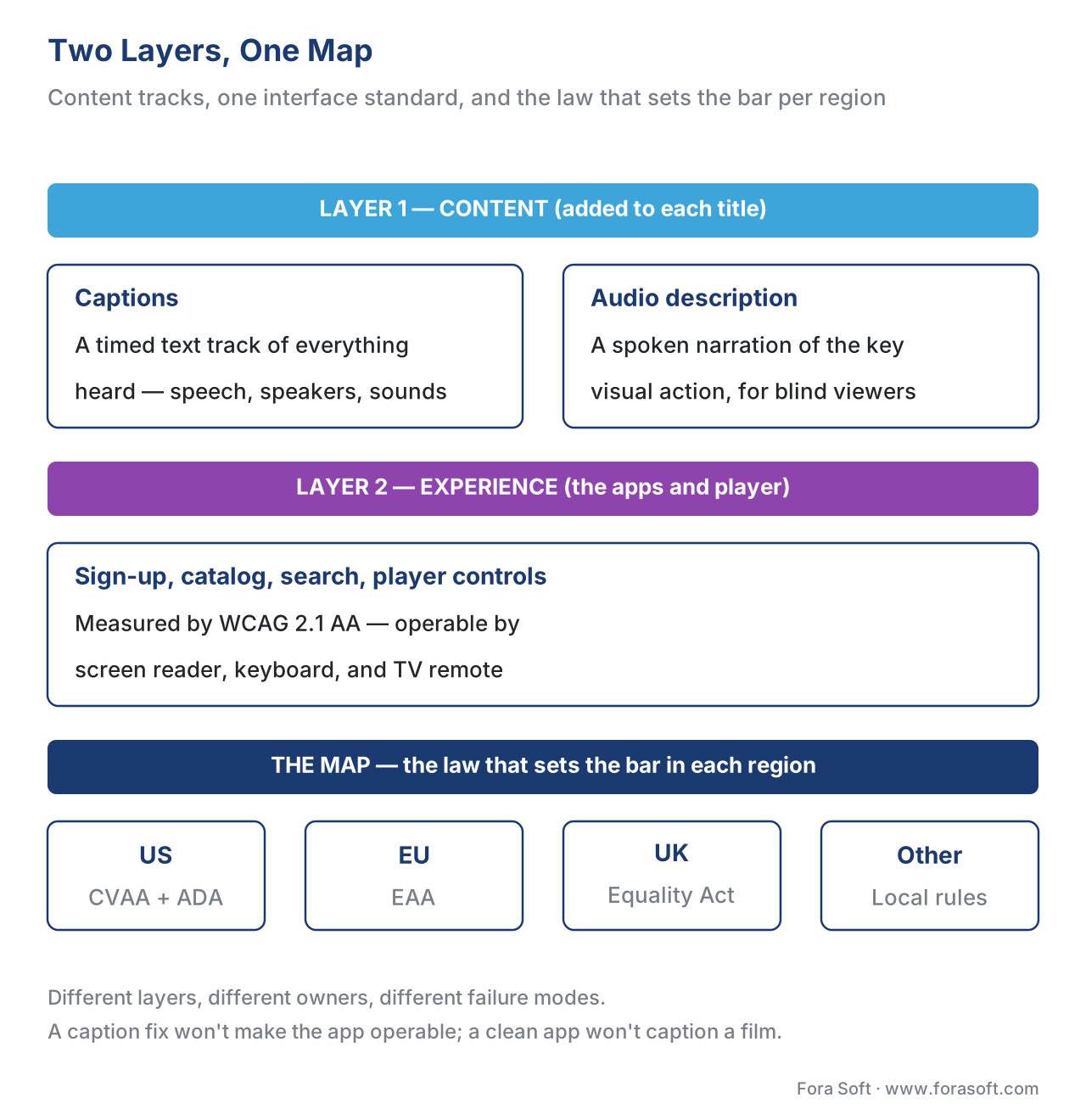 Figure 1. The two layers and the map. Captions and audio description live on the content; WCAG governs the apps and player; and a different law sets the bar in each region. Different layers, different owners, different failure modes.
Hold onto that separation. The sections below are each one of the three: the content tracks (captions, then audio description), the interface standard (WCAG), and the regional map (the laws, side by side).
Layer one, part one: captions, the content track for viewers who cannot hear
Start with the most familiar track. Captions are a timed text version of a program's audio — not only the dialogue, but speaker labels and non-speech sounds ("[door slams]", "[ominous music]") — designed for someone who cannot hear the soundtrack. They differ from subtitles, which translate or transcribe dialogue only and assume the viewer can hear everything else. "Closed" captions are the kind the viewer can switch on and off, which is what every streaming platform ships. The file formats that carry them (WebVTT, IMSC, the legacy CEA-608/708) and how they ride alongside the video in the manifest are covered in audio, subtitles, and accessibility tracks in the ladder and, for the rendering internals, in the Audio for Video section's captions and subtitle formats; this article is about the law that requires them.
In the United States, the controlling law is the Twenty-First Century Communications and Video Accessibility Act of 2010 — the CVAA — which the Federal Communications Commission implements in 47 CFR Part 79. The rule for internet video is 47 CFR § 79.4, and its scope contains the single most misunderstood fact in this whole topic. The rule requires captions on full-length internet video only if that programming was shown on US television with captions. It explicitly defines "video programming" as content "provided by, or generally considered comparable to programming provided by, a television broadcast station," and it excludes consumer-generated media. The phase-in dates were: 30 September 2012 for prerecorded programming not edited for internet, 30 March 2013 for live and near-live programming, and 30 September 2013 for prerecorded programming edited for internet.
Read that scope carefully, because it is where most platforms misjudge their exposure. The FCC's internet-captioning rule does not reach internet-original content. A streaming-only original — the kind a subscription service commissions and never airs on broadcast TV — falls outside § 79.4 entirely. That does not make it caption-free in practice (the ADA and the EU's law, both below, close the gap), but it means a founder cannot reason "we follow the FCC rule" and assume their originals are covered. The FCC rule covers TV-derived content; the broader obligation to caption everything comes from elsewhere.
When the FCC rule does apply, "captions exist" is not the whole bar. The same Part 79 sets quality standards — written for TV in § 79.1 and carried over by reference — on four axes: accuracy (the captions match the spoken words, in order, correctly spelled and punctuated), synchronicity (they appear and leave in step with the speech), completeness (they run start to finish), and placement (they do not block faces, on-screen text, or other essential visuals). For delivery, the rule names a safe-harbor format — SMPTE Timed Text, SMPTE ST 2052-1:2010 — that a programmer can use to satisfy its obligation to hand captions to the distributor at TV quality. One more practical detail: § 79.4 creates no private right of action, so enforcement runs through FCC complaints rather than lawsuits — a different risk profile from the ADA.
Common mistake: assuming the FCC caption rule covers your streaming originals. Teams routinely read "47 CFR 79.4 requires captions on internet video" and conclude their whole catalog is in scope. The rule covers full-length programming that aired on US TV with captions — not streaming-only originals, not user-generated clips. Originals still need captions, but the obligation comes from the ADA in the US and the European Accessibility Act in the EU. Scope your captioning to all of it, and reason about which law drives each part.
Layer one, part two: audio description, the content track for viewers who cannot see
The second content track is the one teams forget. Audio description — also called video description or described video — is a separate narration track in which a voice describes the key visual action during the natural pauses in dialogue: "She slips the note into his coat pocket and turns away." It lets a blind or low-vision viewer follow a program that would otherwise be a confusing wash of music and sound effects. Technically it is just another audio rendition riding in the same package as the main mix and the alternate-language tracks, signaled in the manifest so a player can offer it; the mixing and loudness internals live in the Audio for Video section, and how it sits in the encode is covered in audio, subtitles, and accessibility tracks in the ladder.
In the US, audio description is governed by 47 CFR § 79.3, again under the CVAA. The FCC has been steadily widening its reach. The requirement phases in by television market — formally, Designated Market Areas, or DMAs — at a pace of ten markets per year: it reached DMAs 101–110 on 1 January 2025, extends to DMAs 111–120 on 1 January 2026, and is scheduled to cover all 210 US markets by 1 January 2035. In the markets it covers, the local ABC, CBS, Fox, and NBC affiliates among the top 120 DMAs must carry 87.5 hours of audio-described programming per calendar quarter (roughly seven hours a week), of which 50 hours must be prime-time or children's programming. These are broadcast obligations, but they set the supply of described masters that flow downstream into streaming catalogs — and the EU rules below put the obligation directly on the streaming service.
The takeaway for a platform builder: audio description is not optional polish. It is a legally recognized accessibility track on the same footing as captions, and in the EU it is squarely your responsibility. Budget for it in the encoding ladder and in content acquisition, not as an afterthought.
Layer two: the interface standard — WCAG 2.1 AA
Captions and audio description make the content accessible. They do nothing for the app. A blind viewer still has to create an account, find a title, and press play — all through a screen reader. That second layer is measured by one standard, and you should know it by name.
The Web Content Accessibility Guidelines (WCAG) are the international standard for digital accessibility, published by the World Wide Web Consortium (W3C). They are organized under four principles — content must be perceivable, operable, understandable, and robust (a useful mnemonic: POUR) — and each principle breaks down into testable success criteria at three conformance levels: A (the minimum), AA (the level nearly every law adopts), and AAA (aspirational). When a regulator or a court says "accessible," they almost always mean WCAG level AA.
Versions matter, because the law pins to specific ones. WCAG 2.0 was published in 2008; WCAG 2.1 on 5 June 2018, adding 17 success criteria mostly for mobile and low-vision users; and WCAG 2.2 on 5 October 2023, adding 9 more (including a minimum touch-target size of 24×24 pixels and a rule that keyboard focus must not be hidden behind overlays) and retiring one criterion, 4.1.1 Parsing. The versions are backward-compatible — meeting 2.2 AA automatically means you meet 2.1 AA — and WCAG 2.2 has since been adopted as an international standard, ISO/IEC 40500:2025. Today most accessibility law still references 2.1 AA; the EU's harmonized standard is expected to move to 2.2 in a forthcoming revision. Build to 2.2 AA and you are covered either way.
A streaming product does not live or die on all fifty-plus AA criteria equally. A handful decide whether your platform is usable, and they map directly onto the player and the app. The table below is the one a product team should pin above the desk.
| WCAG success criterion | Level | What it means for a streaming app | Supported when… |
|---|---|---|---|
| 1.2.2 Captions (Prerecorded) | A | On-demand titles carry synchronized captions | The player renders the caption track for every VOD title |
| 1.2.4 Captions (Live) | AA | Live streams carry real-time captions | Live events ship live captions, not "captions coming later" |
| 1.2.5 Audio Description (Prerecorded) | AA | On-demand titles offer a described-audio track | The ladder includes an audio-description rendition |
| 1.4.3 Contrast (Minimum) | AA | Text and controls are readable | UI text meets a 4.5:1 contrast ratio (3:1 for large text) |
| 2.1.1 Keyboard | A | Everything works without a mouse | Every control is reachable by keyboard — and by a TV remote |
| 2.4.7 Focus Visible | AA | The user can see where they are | The focused control has a visible highlight on every screen |
| 2.5.8 Target Size (Minimum) | AA (2.2) | Controls are big enough to hit | Tap targets are at least 24×24 px |
The non-obvious insight is hidden in criterion 2.1.1. A smart-TV, Roku, or Apple TV app is navigated with a directional pad on a remote, and to the operating system that D-pad is a keyboard — up, down, left, right, select. The very same WCAG keyboard and visible-focus criteria that make a website usable without a mouse are what make your living-room app usable with a remote at all. Teams that treat "keyboard accessibility" as a web-only concern discover their TV apps fail both the remote and the law for the same reason. Get focus order and focus visibility right once, in a shared design system, and you fix the screen reader, the keyboard, and the remote together. The screens this must hold up on are catalogued in the OTT client matrix.
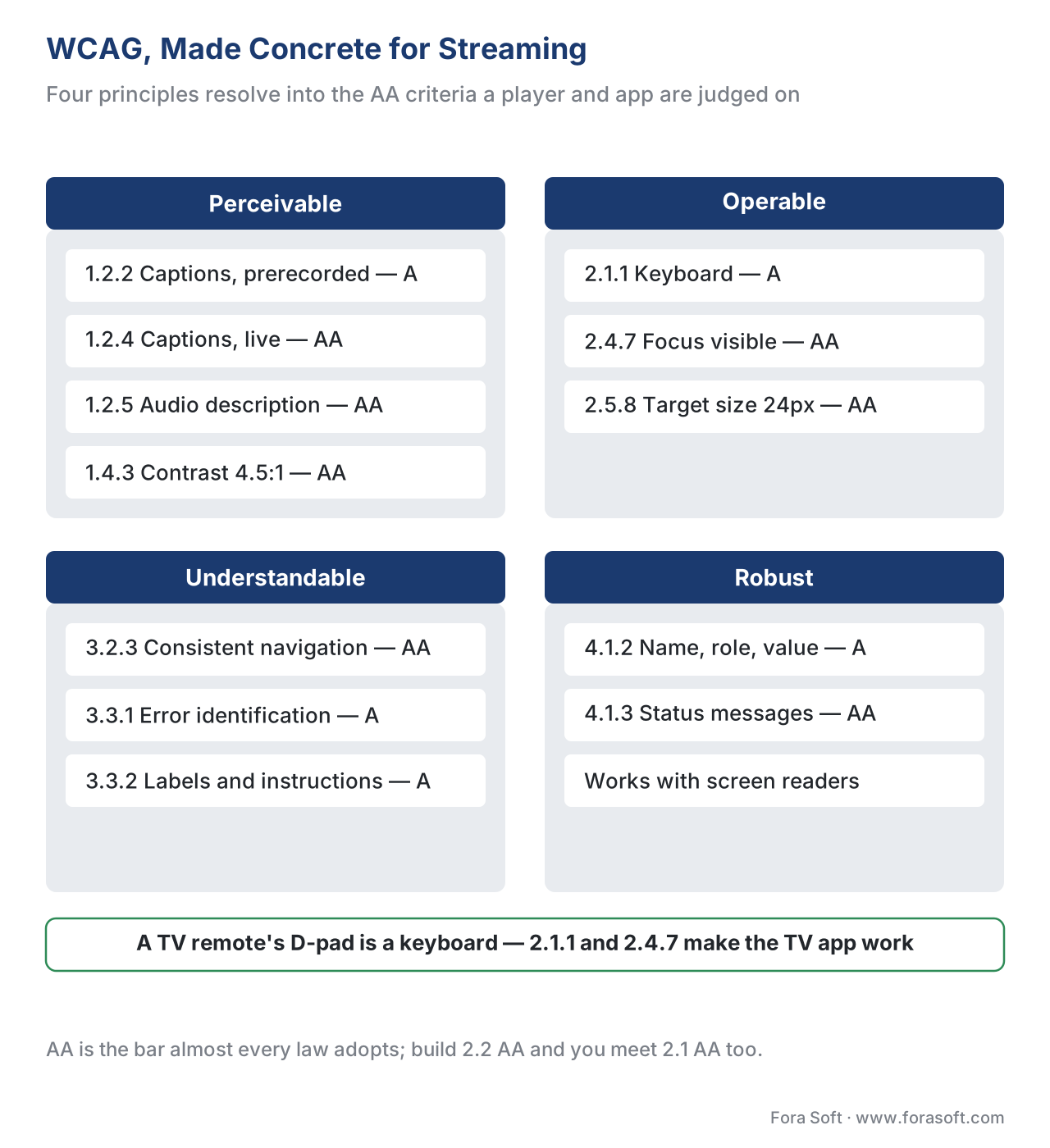 Figure 2. WCAG, made concrete for streaming. The four principles (perceivable, operable, understandable, robust) resolve into the handful of AA success criteria a player and app are actually judged on — captions, audio description, contrast, keyboard, and visible focus, the last of which is also what makes a TV remote work.
The map: the law, region by region
Now stack the layers onto the map. The same two layers — content tracks and the WCAG interface — recur in every market; what changes is the scope and the enforcement.
United States — two regimes, not one. The first is the CVAA, enforced by the FCC through Part 79: captions on TV-derived internet video (§ 79.4), audio description (§ 79.3), and accessible device user interfaces and program guides (§§ 79.107 and 79.108, which require that menus and the closed-caption toggle be reachable by blind and low-vision users). In July 2024 the FCC went further, requiring that closed-caption display settings be readily accessible. The second regime is the Americans with Disabilities Act (ADA), Title III, which bans discrimination by "places of public accommodation." In NAD v. Netflix (2012), a federal court rejected Netflix's argument that a streaming-only service is not a "place," and Netflix settled with a consent decree to caption 100% of its streaming library and pay legal fees — the first time the ADA was applied to an online-only video service. The Department of Justice has not issued a technical web standard for private businesses under Title III, so courts and settlements generally treat WCAG 2.x AA as the practical benchmark. (For government services, Section 508 of the Rehabilitation Act already requires WCAG 2.0 AA, and a 2024 ADA Title II rule sets WCAG 2.1 AA for state and local government — useful signals of where the bar sits.) The net effect: the FCC tells you to caption TV-derived content; the ADA effectively tells you to caption and make accessible everything.
European Union — the new and sharpest obligation. The European Accessibility Act (EAA), Directive (EU) 2019/882, became applicable on 28 June 2025, and it is the change that should be on a product roadmap right now. It covers, among other things, "access to audiovisual media services and related consumer equipment" and "e-commerce" — which is to say, both your streaming apps and the sign-up and payment flows that sell access to them. A service in scope must make its website and mobile apps accessible, make the electronic program guide accessible, transmit captions, audio description, spoken subtitles, and sign-language tracks in high quality and properly synchronized, give users control over how those features display, and indicate which programs carry which accessibility features. Compliance is measured against the harmonized European standard EN 301 549, which currently incorporates WCAG 2.1 AA in full. The EAA grants a five-year transition (its Article 32) for content published before 28 June 2025, and exempts service microenterprises, but new content and new services are in scope now. Enforcement is by national market-surveillance authorities, who can require corrective action and, ultimately, order a non-compliant service withdrawn from the market — a far blunter instrument than a fine. The EAA sits on top of the older Audiovisual Media Services Directive (AVMSD), whose Article 7 already required media services to be made "continuously and progressively more accessible" to people with disabilities.
United Kingdom and beyond. The UK's Equality Act 2010 imposes a duty to make reasonable adjustments for disabled users, and on-demand program services carry accessibility duties overseen by the regulator. Canada (the Accessible Canada Act), Australia, and others run parallel regimes. The pattern repeats: captions and audio description on the content, WCAG AA on the interface, a local enforcer with local teeth.
| Region | Captions required | Audio description | Interface standard | Enforcement / teeth |
|---|---|---|---|---|
| US — CVAA (FCC, Part 79) | Yes, for TV-derived internet video (§ 79.4) | Yes, phasing in by market (§ 79.3) | Device UI & guides (§§ 79.107–79.108) | FCC complaints; no private lawsuits |
| US — ADA Title III | Effectively yes, across streaming (case law) | Pushed by case law | WCAG 2.x AA (de facto benchmark) | Private lawsuits; consent decrees |
| EU — European Accessibility Act | Yes, since 28 June 2025 | Yes, on the service | EN 301 549 → WCAG 2.1 AA | Market surveillance; can pull from market |
| UK — Equality Act + on-demand rules | Yes | Yes | WCAG AA in practice | Regulator + reasonable-adjustment claims |
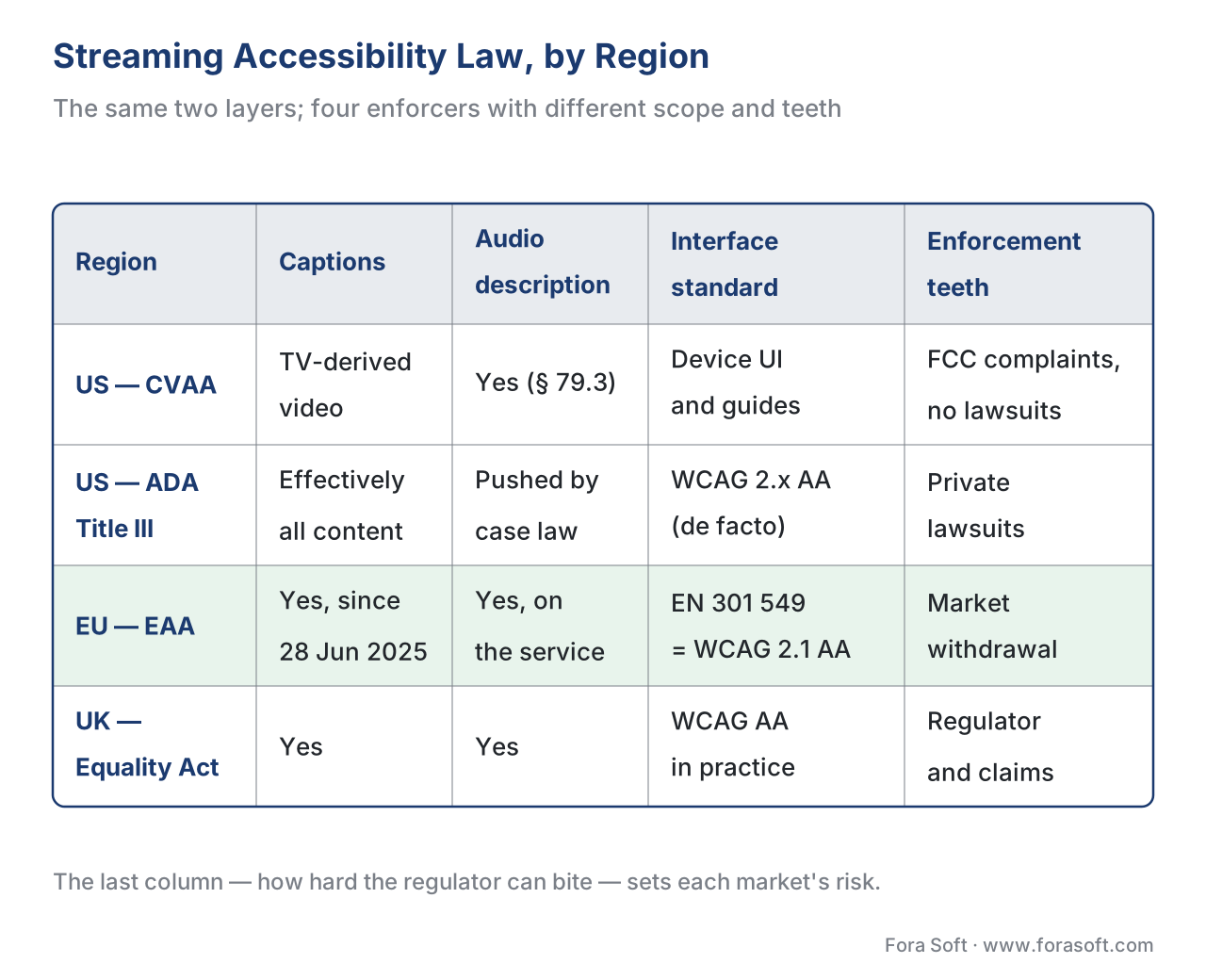 Figure 3. The same two layers, four enforcers. Captions and audio description recur in every market; the interface bar is WCAG AA almost everywhere; what differs is scope and how hard the regulator can bite — from an FCC complaint to an EU market withdrawal.
Accessibility is a reach win, not just a cost
Founders often file accessibility under compliance cost. The data says it is closer to a growth lever, because the people who use these features vastly outnumber the people the law was written for.
Captions are the clearest case. Surveys put US subtitle usage around 70% of viewers at least some of the time, and roughly 80% of people who turn captions on are not deaf or hard of hearing — they use them in noisy rooms, in quiet ones, with unfamiliar accents, or because they simply retain more. The generational skew is stark: about 63% of adults under 30 prefer watching with subtitles, against roughly 30% of those 65 and older. And the engagement effect is measurable — one industry study found viewers up to 80% more likely to finish a video when subtitles are available. Globally, the World Health Organization estimates about 1.3 billion people — roughly 16% of the world — live with a significant disability, including over 400 million with disabling hearing loss and more than 2 billion with some vision impairment.
Put a number on it for your own platform. Suppose you run a service heading toward 5 million monthly active users, and assume conservatively that 15% of your addressable audience either requires or strongly prefers captions or audio description to keep watching:
addressable users who rely on accessibility features
   = 5,000,000 MAU × 15%
   = 750,000 viewers

retention value if shipping these features protects even
half of that group from churning away
   = 750,000 × 50%
   = 375,000 viewers retained
Those 375,000 viewers are not a rounding error — they are a mid-size competitor's entire user base. The arithmetic is deliberately rough, but the direction is not: the same caption and audio-description tracks that satisfy the FCC and the EAA are watched by a large, sticky, growing share of everyone, and the same WCAG-clean interface that a screen-reader user needs is faster and clearer for every user. Accessibility done well pays for itself in reach and retention before you ever count the avoided legal risk.
Build it once: the accessibility architecture
The good news is that nothing here demands a parallel "accessibility system." It demands two disciplines wired into the platform you are already building.
On the content side, captions and audio description are tracks, and tracks belong in the pipeline. Author or acquire them once, encode the audio-description rendition into the encoding ladder alongside the language mixes, and signal every track in the manifest when you package to CMAF, HLS, and DASH so that every client — web, mobile, and TV — can discover and render them without custom code. Run the FCC quality bar (accuracy, synchronicity, completeness, placement) as a QC gate, the same way you gate video quality. The rendering details belong to the player and to the Audio for Video section; your job at the platform level is to make sure the track exists, is correct, and is advertised.
On the interface side, accessibility is a property of one shared design system, not a per-app scramble. Define focus order, visible focus, contrast, and target sizes once, and let web, iOS, Android, and the TV platforms inherit them — remembering that the TV remote is a keyboard, so the keyboard rules are doing double duty. Test with the real assistive technology: VoiceOver and TalkBack, the platform accessibility inspectors, and an actual remote with the screen reader on. WCAG conformance is verified, not assumed.
Then there is the piece the EAA makes explicit and most teams miss: you must indicate which titles have which accessibility features. That turns accessibility into first-class catalog metadata — a per-title set of flags ("captions: en, es; audio description: en") that the same systems behind discovery metadata and ratings-as-metadata already know how to store, surface, and filter. A viewer who needs audio description should be able to find the titles that have it, and the law in the EU now requires you to tell them.
Common mistake: accessibility as a final QA pass. The most expensive way to do this is to build the platform, then "add accessibility" near launch. Captions and audio description become a frantic backfill, and WCAG failures are baked into a design system that is costly to change. Treat the tracks as pipeline stages and WCAG as a design-system rule from day one, and the marginal cost of each new title and each new screen stays near zero.
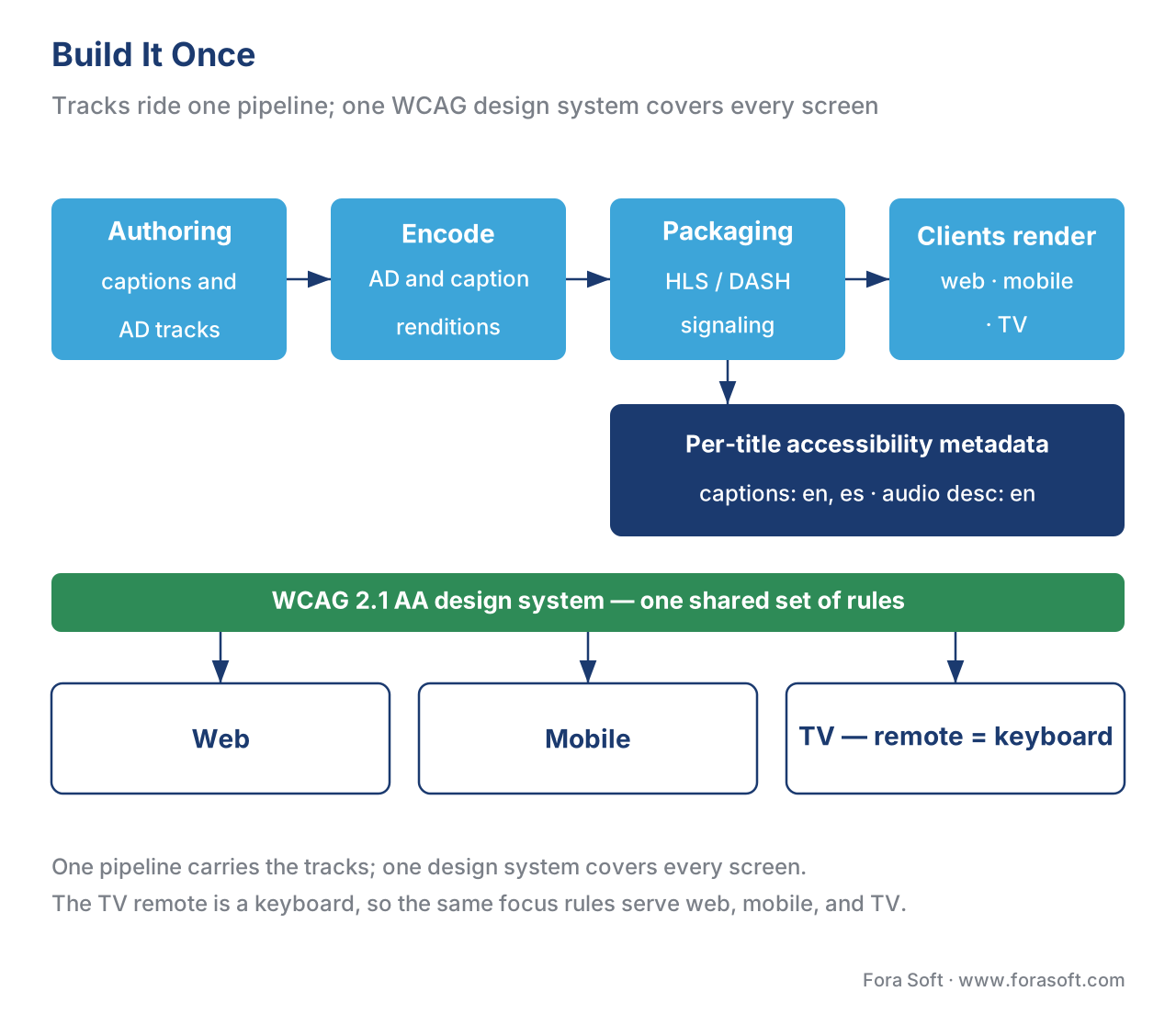 Figure 4. Build it once. Caption and audio-description tracks enter the pipeline at authoring, ride the package and manifest to every client, and surface as per-title metadata; the apps pass a WCAG AA gate shared across web, mobile, and TV. One pipeline, one design system, every market satisfied.
Where Fora Soft fits in
Accessibility at streaming scale is a correctness-and-coverage problem before it is a feature: a catalog of tens of thousands of titles, each needing caption and audio-description tracks authored, quality-checked, signaled in the manifest, and rendered identically across web, mobile, and a fleet of TV platforms — plus sign-up, catalog, search, and player UIs that pass WCAG AA on every screen, including the one driven by a remote. Fora Soft has built video streaming and OTT/Internet TV platforms since 2005 — 625+ projects for 400+ clients over 20+ years — and the same accessibility discipline runs through our e-learning and telemedicine work, where captioned, navigable, screen-reader-friendly video is a baseline expectation. We wire caption and audio-description tracks into the encoding ladder and manifest, build design systems that hold WCAG AA across the client matrix, and model accessibility features as catalog metadata so users can find what they can use. We are vendor-neutral about captioning and audio-description providers; we integrate the ones a given market and budget call for. This is engineering guidance, not legal advice — confirm your caption, audio-description, and WCAG obligations for each territory with qualified counsel.

The handbook
Fora Soft Video Engineering Handbook
We wrote a seven-volume series that covers the whole video stack from the pixel to production — encoding, delivery, sound, and AI. Volume 4 covers the audio side these accessibility tracks live on, including caption and subtitle formats and how a described-audio track is authored and mixed; volume 3 covers the players, subtitles, and quality-of-experience behind a WCAG-clean playback experience; and volume 2 covers the packaging and manifest signaling that advertises every caption and audio-description track to each client. Work through them and you can build the accessible, multi-platform pipeline this article describes. Written by Nikolay Sapunov, CEO at Fora Soft.
Not sure your platform would pass an accessibility audit?
Tell us your target markets and your client mix — web, mobile, and which TV platforms — and we will map your caption, audio-description, and WCAG 2.1 AA obligations to a build plan that ships them once, across every screen. 250+ video products shipped since 2005.
See our case studies
Case study
TransLinguist
Closed captioning in 22 languages, automatic subtitles, session transcription and a sign-language interpretation UI — accessibility tracks as first-class product features. It won the NHS national framework across the UK, exactly where the Equality Act bites.
Case study
Tabsera
A multilingual K-12 learning platform across web and iOS in English, French, Arabic and Turkish — the client matrix and multi-language track discipline this article asks for, where navigable, captioned video is the baseline, not an add-on.
Case study
Smart IPTV for set-top boxes
A white-label IPTV app on set-top boxes, driven entirely by a standard TV remote, with a full electronic program guide and video on demand — the living-room client where the “remote is a keyboard” focus and visible-focus rules decide whether the app is usable at all.
What to read next
Tracks
Audio, Subtitle & Accessibility Tracks in OTT Streaming
How caption and audio-description tracks ride the encode and the manifest, one layer down from the law.
Clients
The OTT Client Matrix: Web, Mobile, Smart TV, Devices
The screens your WCAG AA conformance has to hold up on — including the one driven by a remote.
Packaging
CMAF Packaging: Serve HLS and DASH From One Master
Where every caption and audio-description track gets signaled so each client can discover it.
Metadata
Content Metadata: the Fuel for Streaming Discovery
The backbone that lets you tell viewers which titles carry which accessibility features — now an EU requirement.
References
- Twenty-First Century Communications and Video Accessibility Act of 2010 (CVAA), Public Law 111-260 — the US statute directing the FCC to require accessibility of communications and video programming, including captioning of internet-delivered video and accessible user interfaces. Tier 1 (US statute). https://www.fcc.gov/cvaa
- 47 CFR § 79.4 — Closed captioning of video programming delivered using Internet protocol — requires captions on nonexempt full-length IP-delivered programming that aired on US television with captions; defines "video programming" as TV-comparable content excluding consumer-generated media; phase-in dates 30 Sep 2012 / 30 Mar 2013 / 30 Sep 2013; SMPTE ST 2052-1:2010 safe-harbor format; no private right of action. Read directly. Tier 1 (US regulation). https://www.ecfr.gov/current/title-47/chapter-I/subchapter-C/part-79/subpart-A/section-79.4
- 47 CFR § 79.1 — Closed captioning of televised video programming (quality standards) — sets the four caption quality axes (accuracy, synchronicity, completeness, placement) referenced by the IP-captioning rule. Tier 1 (US regulation). https://www.ecfr.gov/current/title-47/chapter-I/subchapter-C/part-79/subpart-A/section-79.1
- 47 CFR § 79.3 — Audio description of video programming — the FCC video/audio-description rule; phased expansion by Designated Market Area (DMAs 111–120 from 1 Jan 2026; all 210 by 2035); 87.5 hours/quarter for top-120 ABC/CBS/Fox/NBC affiliates. Tier 1 (US regulation). https://www.fcc.gov/consumers/guides/audio-description
- 47 CFR §§ 79.107 and 79.108 — Accessible user interfaces, video programming guides and menus — require digital apparatus interfaces and navigation-device guides/menus to be accessible to blind and low-vision users and to make closed-caption activation reachable. Tier 1 (US regulation). https://www.law.cornell.edu/cfr/text/47/79.107
- W3C Web Content Accessibility Guidelines (WCAG) 2.1 (5 June 2018) and 2.2 (5 October 2023) — the international interface standard; four principles (POUR), levels A/AA/AAA; 2.1 adds 17 success criteria, 2.2 adds 9 and retires 4.1.1; backward-compatible; WCAG 2.2 = ISO/IEC 40500:2025; EN 301 549 currently references WCAG 2.1. Read directly. Tier 1 (W3C Recommendation). https://www.w3.org/WAI/standards-guidelines/wcag/
- European Accessibility Act — Directive (EU) 2019/882 — applicable from 28 June 2025; covers access to audiovisual media services and related equipment and e-commerce; requires accessible apps/EPGs, transmitted accessibility components, user control, and indication of which programs have which features; five-year content transition (Art. 32); microenterprise service exemption; market-surveillance enforcement. Read directly (EC overview). Tier 1 (EU law). https://commission.europa.eu/strategy-and-policy/policies/justice-and-fundamental-rights/disability/european-accessibility-act-eaa_en
- EN 301 549 — Accessibility requirements for ICT products and services (v3.2.1) — the EU harmonized standard used to demonstrate EAA conformance; Chapter 9 incorporates WCAG 2.1 AA in full; a forthcoming revision (under Standardisation Request M/587) is to incorporate WCAG 2.2. Tier 2 (issuing-body standard). https://www.etsi.org/deliver/etsi_en/301500_301599/301549/
- Americans with Disabilities Act, Title III (42 U.S.C. §§ 12181–12189), and NAD v. Netflix (D. Mass., 2012 consent decree) — Title III bars discrimination by places of public accommodation; the Netflix case applied it to an online-only streaming service, with a decree to caption 100% of the streaming library. Tier 1 (US statute) + Tier 5 (litigation). https://www.ada.gov/
- Audiovisual Media Services Directive (Directive 2010/13/EU as amended by Directive (EU) 2018/1808), Article 7 — requires media services under EU jurisdiction to be made continuously and progressively more accessible to persons with disabilities through proportionate measures. Tier 1 (EU law). https://eur-lex.europa.eu/eli/dir/2018/1808/oj
- Section 508 of the Rehabilitation Act (29 U.S.C. § 794d) and the Revised 508 Standards — federal ICT accessibility benchmark incorporating WCAG 2.0 AA; cited here as a US government signal of the WCAG-AA bar. Tier 1 (US law). https://www.section508.gov/
- Subtitle and caption usage statistics (YouGov; industry surveys; WHO disability estimates) — ~70% of US viewers use subtitles at least sometimes; ~80% of caption users are not hard of hearing; ~63% of under-30s prefer subtitles; WHO estimates ~1.3 billion people live with significant disability. Tier 5 (surveys/institutional). https://www.who.int/news-room/fact-sheets/detail/disability-and-health
Per the section's source hierarchy, where popular "streaming accessibility" how-tos blur the FCC caption rule, the ADA, and the EAA into one duty, this article follows the controlling law and standards directly — the FCC's 47 CFR Part 79 (read from the eCFR), W3C WCAG (read from the W3C), and the European Accessibility Act (read from the European Commission) — and separates the two content tracks, the WCAG interface standard, and the regional map. Dated, fast-moving items (the EAA's June 2025 applicability, the FCC's annual audio-description DMA expansion, and the EN 301 549 move to WCAG 2.2) are flagged for re-verification, not presented as fixed.
