


Why this matters
If you are a founder, product lead, or first-time streaming CTO, windowing is where a content deal becomes a database problem. Miss a window's end date and you stream a title past your license — a breach a studio can see in its own reporting and act on. Miss a window's start date and you have spent marketing money on a premiere the catalog will not show. This article explains, in plain language, what windowing is, the order the windows usually run in, how availability arrives as structured data you can automate, and how a platform enforces a window across a whole catalog without a human in the loop. It is the time specialization of content licensing and rights for OTT — read that first if "exclusive versus non-exclusive, territory, term" is new — and the sibling of multi-territory licensing and geo-blocking, which handles place while this one handles time.
The one idea: availability is a function of time
Most teams model a catalog as a list of titles and assume the list is the same today as it was yesterday. The time dimension breaks that assumption. What a viewer may watch depends on when they ask, because the right to stream a given title was licensed to you for a defined term — a start, a length, and an end — not forever.
So the core change in thinking is small to say and large to build. Availability is not a property of a title; it is a function that takes a title, a location, a business model, and a moment in time, and returns yes or no. The film Example Feature is not "available" in the abstract. It is available on your subscription tier in Brazil from 1 March, unavailable there before that date, and dark again after 31 August when the window closes. Your platform's job is to compute that function correctly, fast, on every catalog screen and every play request, with no human pressing a button at midnight.
Multi-territory licensing and geo-blocking taught the same lesson for place: availability is a function of location. Windowing adds the clock. Put them together and the availability function a real platform computes is available = f(title, territory, business model, time) — four inputs, one yes-or-no, on every request. Everything below is either how that timing is described as data, or how you turn it into a correct, automatic yes-or-no.
Windowing: releasing one title across channels, in sequence
Start with the word. A film or show is not sold to the public once; it is released down a staircase of channels, each one opening after the last, each one a separate deal. The practice of timing those releases so they do not all happen at once — and so each channel gets an exclusive stretch before the next opens — is called windowing. A window is one step on the staircase: a span of time during which a title is offered through a particular channel and business model.
The classic order, top to bottom, is a move from "pay the most, wait the least" to "pay nothing, wait the longest." It runs: cinema (theatrical); then premium home rental, called premium video on demand (PVOD) or transactional video on demand (TVOD), where you pay once per view; then electronic sell-through (EST), where you buy a permanent digital copy; then subscription streaming, called subscription video on demand (SVOD), the tier people mean by "it's on Netflix now"; then free, ad-supported viewing — advertising video on demand (AVOD) and the channel-style free ad-supported streaming TV (FAST); and finally traditional broadcast. Each step trades exclusivity for reach.
A useful analogy: windowing is a hardcover-then-paperback release for video. The hardcover comes out first at the highest price for the most eager buyers; the cheaper paperback follows months later for everyone else; the library copy comes last. Nobody prints them all on the same day, because each format would eat the others' sales. Video windows protect revenue the same way — by making the eager pay first and the patient wait.
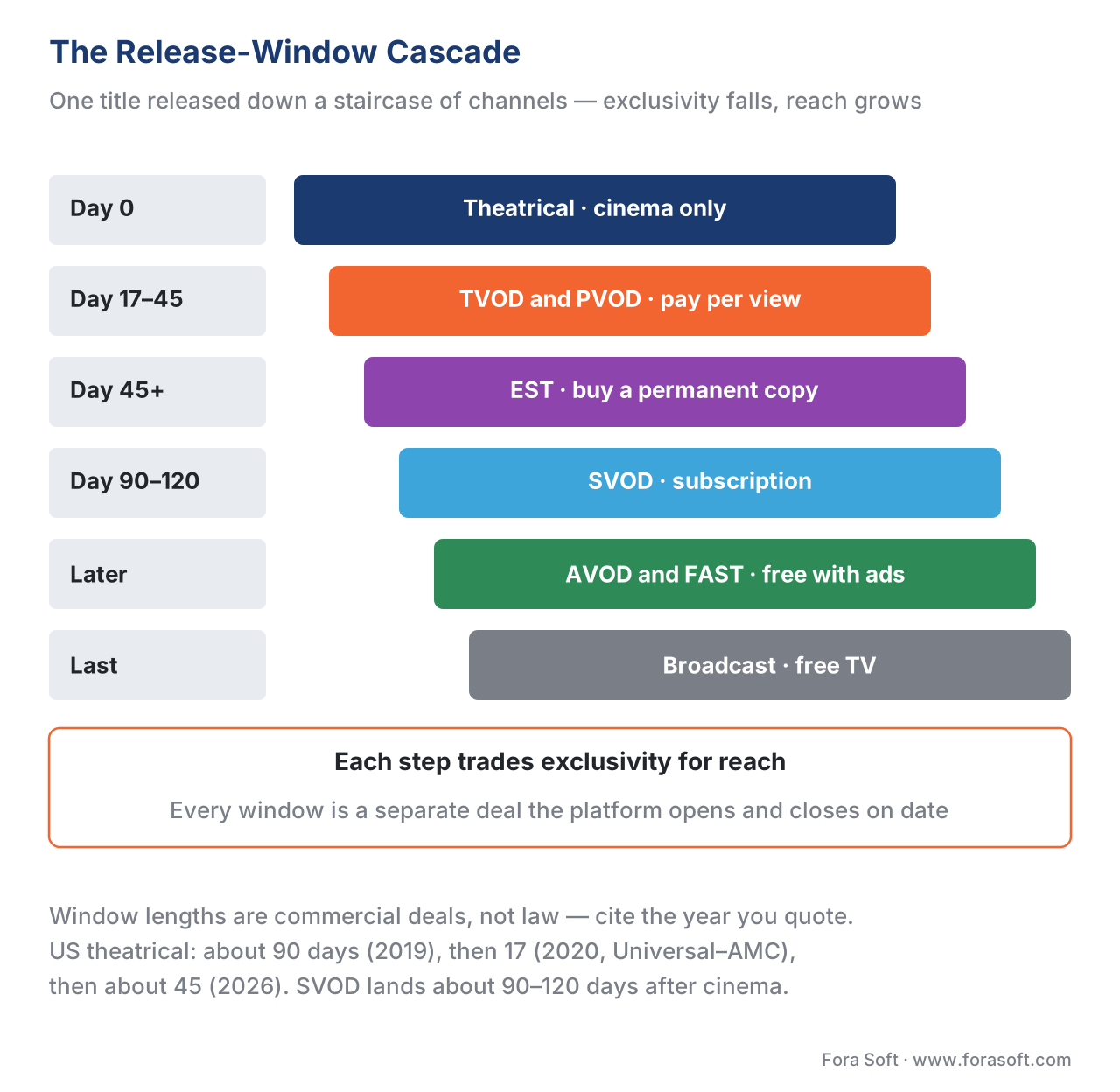 Figure 1. The window cascade. One title is released down a staircase of channels over time. Each window is a separate, time-boxed deal; the platform must open and close each one on the right date.
The windows have been moving — cite the year, always
Window lengths are not fixed law; they are commercial deals that shift, and any number you quote ages quickly. Cite the year.
The reference point is the old theatrical window: for decades, a film played only in cinemas for roughly three months before any home release. In the United States that exclusive run averaged about two months and three weeks (around 90 days) in 2019. Then it collapsed. In 2020, Universal and the cinema chain AMC struck a deal to cut the exclusive theatrical window to as few as 17 days — three weekends — before a title could move to premium home rental, with the studio sharing the rental revenue; bigger films, those opening above about $50 million, kept a longer window of roughly 31 days.
The pendulum has since swung back toward longer windows, which is exactly why you date the claim. In 2025, Disney's average gap from cinema to premium home rental ran about 57 days, and its films did not reach its subscription services for at least three months. Universal has signalled a move away from its 17-day minimum toward a 45-day window from 2027. The current working norm in 2026 is roughly 45 days from cinema to paid rental, and about 90 to 120 days to subscription — but treat those as this year's numbers, not constants.
The lesson for a builder is not the specific day counts; it is that windows are configuration, not code. If a window length is hard-coded anywhere in your platform, every studio renegotiation becomes an engineering ticket. Window dates belong in data, per title, per territory, per business model — which is exactly what the rest of this article is about.
The vocabulary, in plain language
A handful of terms recur in every windowing conversation. Define them once and the rest is easy.
An avail (short for availability) is the record that says a specific title may be offered, in a specific place, under a specific business model, between two dates. It is the atomic unit of windowing — the thing your platform actually ingests and enforces.
A window's start date (often called the avail start or street date) is the first moment the title may appear and play. Its end date (the avail end) is the moment it must go dark. The span between them is the window.
An embargo or holdback is a contractual "not yet": a period during which you hold a title back from a channel even though you possess the files. A studio might give you a film for subscription but embargo it from your free, ad-supported tier until a later date.
A pre-order or pre-sell window is the opposite — a stretch before the start date when you may show the title's page and take a reservation or a purchase, while playback stays locked until the street date. And dark is the plain word for a title that exists in your system but is not currently available to anyone, because its window has not opened or has already closed.
Avails: the machine-readable availability contract
Here is the engineering core. A studio licensing a thousand titles to your platform cannot send a thousand emails, and you cannot type a thousand windows by hand without error. The industry solved this with a standard file format for communicating availability from the content owner to the platform: the EMA Avails specification.
The format was defined by the Entertainment Merchants Association together with MovieLabs (a studio-funded technology lab), and MovieLabs maintains it today. Its own definition is the clearest one-liner in the field: an avail is "information about the time, location and business rules relating to offering an asset." That is windowing, geo-rights, and the business model captured in one record — time, place, and terms together.
Avails come in two encodings. One is a spreadsheet (Excel), which a rights manager can read and edit by hand; the current published Excel template is version 1.9, from December 2019. The other is XML, the machine-to-machine form a platform ingests automatically; the current XML specification is version 2.25, dated 5 December 2025 (reference TR-META-AVAIL), and MovieLabs publishes a validator and an open-source library to convert between the two. The direction of travel is clear: spreadsheets for humans now, XML for systems as the supply chain automates.
What is in one avail record? The fields map almost one-to-one onto our availability function. There is the content identifier (which title, exactly); the territory (which country or region); the license type — the business model, such as SVOD, AVOD, TVOD, or EST; the start and end dates; the price tier for transactional titles; and language, format, and rating data. Read that list again: title, territory, model, start, end. An avail is f(title, territory, business model, time) written down as a contract your platform can parse.
<!-- One Avail (illustrative, simplified from EMA Avails XML v2.25) -->
<Avail>
  <ALID>urn:eidr:10.5240:7791-8534-2C23-9030-8610-5</ALID>
  <Transaction>
    <LicenseType>SVOD</LicenseType>
    <Territory><country>BR</country></Territory>
    <Start>2026-03-01T00:00:00-03:00</Start>   <!-- window opens (local time) -->
    <End>2026-08-31T23:59:59-03:00</End>        <!-- window closes -->
  </Transaction>
</Avail>
EIDR: the stable name a window hangs on
A window is only as reliable as the title it points to. If your catalog calls a film one thing, the studio's avail calls it another, and your reporting calls it a third, windows attach to the wrong rows and titles go dark by accident. The fix is a single, global, permanent identifier every party agrees on.
That identifier is EIDR — the Entertainment Identifier Registry — a centrally registered, globally unique ID for films and television, defined as a formal internet name in IETF RFC 7972 (September 2016). An EIDR ID is a special kind of Digital Object Identifier (the same DOI system that gives academic papers permanent links), built on ISO 26324; it looks like 10.5240/7791-8534-2C23-9030-8610-5, and the standard guarantees it is unique and never reassigned. Because it resolves to a metadata record, anyone can look up exactly which edit of which title an ID means.
The payoff is what the industry calls the EIDR round trip: the same ID rides in the avail that opens a window, in the playback system that serves it, and in the report that pays the studio for it. One name, end to end — so a window opens on the right title, plays the right file, and bills against the right contract. This stable-identifier discipline is the same backbone behind royalties, reporting, and rights compliance.
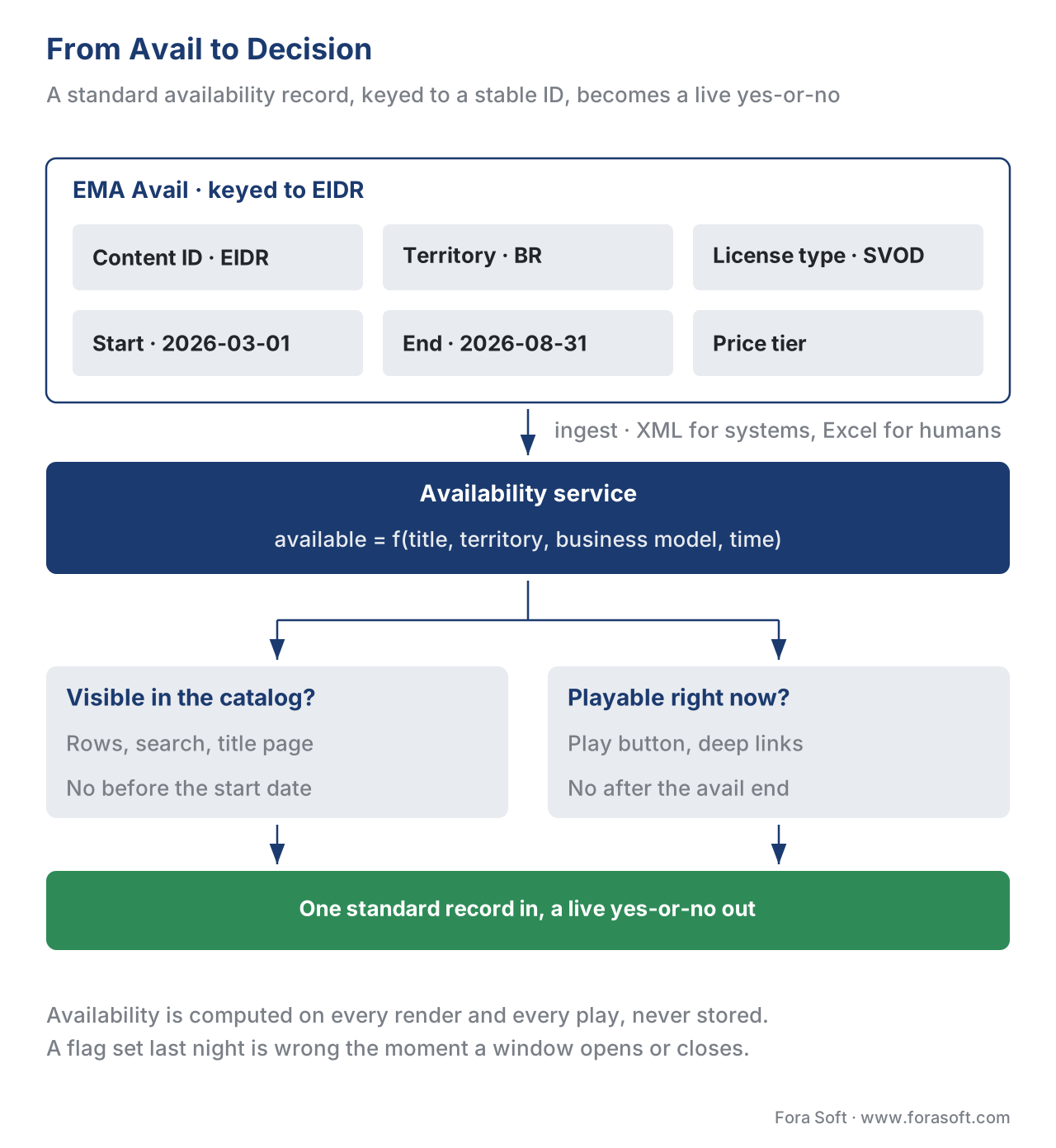 Figure 2. From contract to decision. A standard avail record, keyed to an EIDR identifier, is ingested as data; the availability service reads it on every request and returns visible/playable or dark.
How a platform enforces a window automatically
Ingesting avails is half the job. The other half is acting on them — turning a pile of start and end dates into the right behaviour on every screen, every second, forever, without anyone watching the clock. Three principles make that work.
First, one availability service, read on every request. The same service that already answers "is this allowed in this territory?" and "is this in this viewer's tier?" also answers "is this inside its window right now?" It takes the title, the territory, the business model, and the current time, reads the avail, and returns a yes-or-no. Availability is computed, never stored as a static flag, because a flag set last night is wrong the moment a window opens or closes. This is the same service that drives subscription billing and entitlement.
Second, scheduled publish and unpublish jobs. Windows have known dates, so the platform schedules the transitions in advance: a job to make a title appear at its start, a job to take it dark at its end. The catalog does not wait for someone to remember; the calendar does the work. Pre-orders flip to playable at the street date; expiring titles disappear at the avail end — automatically.
Third — the one that bites teams hardest — get time zones right. "Available 1 March" is not a moment; it is a moment somewhere. Here is the math, out loud. Suppose a window must end at midnight local time on 31 December across, say, 30 territories. If you run a single unpublish job at midnight in your server's own zone (UTC), then for viewers in Hawaii (UTC−10) you cut the title off 10 hours early — angry, paying customers — and for viewers in Japan (UTC+9) you keep streaming it for 9 hours after the license ended — a breach. One naive job, two failures at once. The fix is to store each window's start and end as a precise instant with its time zone, and schedule the transition per territory, not per server.
These three give you the rule that mirrors geo-enforcement: enforce in two places, because hiding the title is not enough. The catalog layer stops an expired title from appearing; the playback layer stops it from playing even via a saved deep link, a stale recommendation row, or a bookmarked URL. A title removed from the home screen but still streamable from an old link is a window that has not actually closed.
Common mistake: the manual takedown. A surprising number of platforms still "remember" to pull expiring titles by hand, or rely on a nightly batch that runs in one time zone. Both leak. Manual takedowns get forgotten over holidays; single-zone batches breach in every territory east of the server. The window is a contract with a clock — automate the clock, per territory, in both the catalog and the player.
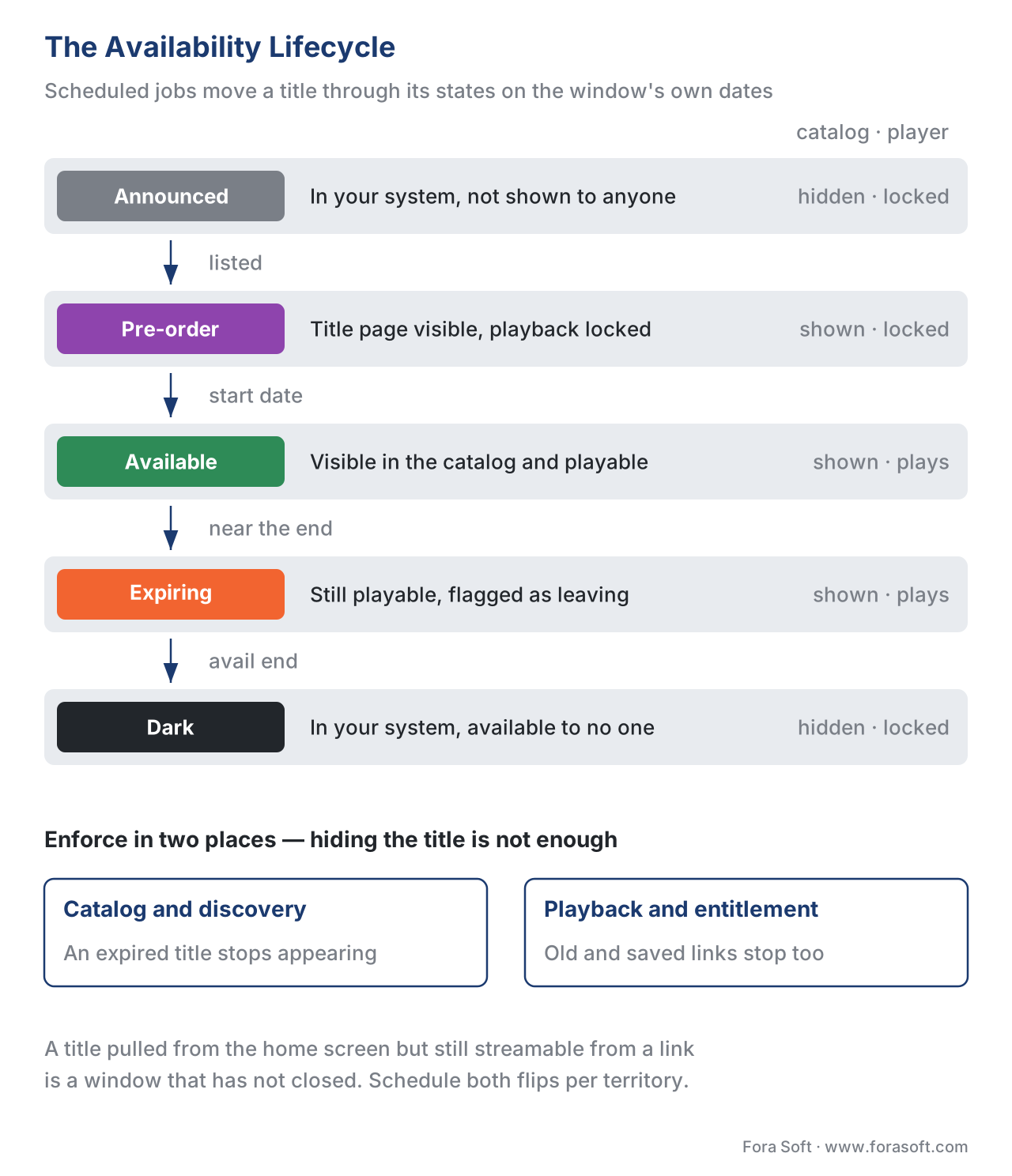 Figure 3. The availability lifecycle. Scheduled jobs move a title through its states on the window's dates; enforcement happens in two places so an expired title neither shows nor plays.
Where windowing meets the business model
The business model decides the shape of the window, so the two cannot be designed apart. (If SVOD, AVOD, TVOD, and EST are new, read SVOD, AVOD, TVOD, and hybrid business models first.)
Subscription (SVOD) and ad-supported (AVOD/FAST) windows are time-boxed access: the title is in the catalog for the window and gone after, like a library loan. Transactional rental (TVOD) is a short access window per purchase. The interesting exception is electronic sell-through (EST) — buying a permanent copy. When a viewer buys a title, that purchase generally survives the catalog window: the storefront may stop selling new copies when the avail ends, but buyers keep access to what they already own. Your entitlement model has to distinguish "the catalog window closed" from "this person owns this title," or you will either wrongly revoke purchases or wrongly keep selling. Transactional flows are covered in TVOD and transactional flows: rent, buy, PPV.
The table below shows how the window behaves per model — including the column that trips teams up most, whether access survives the window's end.
| Business model | Window position | Has an end date? | Catalog rotates? | Buyer keeps access after end? |
|---|---|---|---|---|
| Theatrical | First (cinema only) | Yes — opens home release | n/a | n/a |
| TVOD / PVOD (rent) | Early, post-cinema | Per rental (e.g. 48h) | Yes | No — rental expires |
| EST (buy) | Early, post-cinema | Storefront stops selling | Sales window only | Yes — purchase persists |
| SVOD (subscription) | Mid (Pay-1) | Yes — title goes dark | Yes | No — access ends with window |
| AVOD / FAST (free, ads) | Late | Yes — license-bound | Yes — frequent refresh | No |
FAST — the free, channel-style tier — deserves a note because its windows churn fastest. A FAST channel needs a large, constantly refreshed library; industry guidance suggests on the order of 200 hours of programming a year with a 25–30% annual refresh, which means licensing windows open and close on that tier continuously. Do the arithmetic: a 200-hour channel refreshing 30% a year rotates about 60 hours of content in and out every year — dozens of windows opening and closing on one channel alone. A platform that cannot automate window transitions cannot run FAST at all.
Free download: Content Windowing & Availability Readiness ChecklistOne page for the time dimension of rights: avails as data (EMA Avails and EIDR), the window cascade and the clock, automatic per-territory enforcement in catalog and player, and the business-model edge cases — including the EST purchase that survives the window.Where Fora Soft fits in
Windowing is a scale problem before it is a legal one: a catalog of a few hundred titles can almost be managed by hand, but a catalog of tens of thousands across dozens of territories and several business models has millions of date-bound availability decisions to make correctly, every day, in the right time zones. Fora Soft has built video streaming and OTT/Internet TV platforms since 2005 — 625+ projects for 400+ clients over 20+ years — and that work centres on exactly this kind of rights-aware catalog engineering: ingesting standard avails, computing availability as a function of title, territory, model, and time, and enforcing windows in both the catalog and the player. We are vendor-neutral; we translate a studio's deal terms into an availability service that scales, rather than selling a particular rights-management product. This is engineering guidance, not legal advice — confirm window and territory terms with the rights holder and qualified counsel.

The handbook
Fora Soft Video Engineering Handbook
We wrote a seven-volume handbook, 9,000+ pages, that works through the whole video stack from the pixel to production — encoding, delivery, audio and AI — so the availability rules in this article sit on machinery you can follow all the way down. Volume 3 is closest to this chapter: DRM and key delivery, the player that has to be told no, and the delivery economics behind a catalog whose windows open and close across dozens of territories. Volume 2 covers the packaging and delivery your scheduled jobs switch on and off on the avail dates, and volume 1 explains what actually gets encoded for every title and version you hold a window on. Written by Nikolay Sapunov, CEO at Fora Soft.
Who closes your windows at midnight — a scheduled job, or someone who has to remember?
Send us your catalog size, the territories you sell in and where your avails come from, and we will put the window dates in data instead of code, schedule the publish and unpublish per territory rather than per server, and enforce the answer in both the catalog and the player — so a title appears on its street date and goes dark at its avail end with nobody watching the clock. 250+ video products shipped since 2005.
See our case studies
Case study
Smart IPTV for Android Set-Top Boxes
A white-label operator app on Android set-top boxes — live channels, scheduled programs and on-demand video through the Stalker and Ministra middleware — where what a subscriber may open at any moment is the operator’s entitlement, not a setting in the app.
Case study
Worldcast Live
HD concert streaming at 1.5 Gbit/s with 0.4–0.5 s latency for 10,000 simultaneous viewers, sold as pay-per-view tickets: every show is a window that opens and closes on a single night.
Case study
Sprii
A Danish live shopping platform with 72,000+ live events hosted and 88,600 campaigns run in 2024 across Europe — every event is its own time-boxed window, and the same catalog behaves differently in each country.
What to read next
Rights
Content licensing and rights for OTT
The five dimensions a license is carved along — a window is the term dimension.
Geography
Multi-territory licensing and geo-blocking
The place dimension to this article’s time: availability by country.
Transactional
Pay-per-view streaming and TVOD: rent, buy, PPV
Where an EST purchase outlives the catalog window that sold it.
Business model
SVOD vs AVOD vs TVOD: OTT business models explained
The model decides the shape of the window, so the two are designed together.
References
- EMA Content Availability Metadata (Avails and Title List),
TR-META-AVAIL, Version 2.25 (5 December 2025) — MovieLabs / Entertainment Merchants Association. Defines the standard format (XML and Excel) for communicating availability — time, location, and business rules for offering a title — from content owners to platforms; XML schemaavails-v2.25.xsd. Tier 1 (standards-body specification). https://www.movielabs.com/md/avails/ - EMA Avails, Excel template, Version 1.9 (17 December 2019) — MovieLabs / EMA. The human-editable spreadsheet encoding of an avail, still in wide use alongside the XML form. Tier 1. https://www.movielabs.com/md/avails/
- IETF RFC 7972 — Entertainment Identifier Registry (EIDR) URN Namespace Definition (September 2016) — defines EIDR as a formal URN; an EIDR ID is a DOI Name (ISO 26324), globally unique, never reassigned, e.g.
10.5240/7791-8534-2C23-9030-8610-5. The stable identifier a window attaches to. Tier 1 (IETF). https://datatracker.ietf.org/doc/rfc7972/ - SMPTE RP 2079 — DOI Name and Entertainment ID Registry (EIDR) Identifier Representations (2014) — specifies the EIDR suffix syntax and the Mod 37,36 check character (cited normatively by RFC 7972). Tier 1 (SMPTE). https://datatracker.ietf.org/doc/rfc7972/
- MovieLabs — "A Short Guide to Identifiers for the Digital Supply Chain" (13 December 2017) — explains how EIDR ContentIDs and ALIDs ride from the publishing of an avail through to financial reporting (the EIDR "round trip"). Tier 2 (issuing-body guidance). https://www.movielabs.com/md/avails/
- OTT.X Avails Metadata Workgroup — the cross-industry group (platforms, content providers, service providers) that maintains the EMA Avails specification and publishes implementation guidance. Tier 2. https://www.ottx.org/committees-councils/avails-workgroup/
- Screen Daily / The Hollywood Reporter — Universal–AMC theatrical-window agreement (2020) — the deal collapsing the exclusive theatrical window to a minimum of 17 days (≈31 days for films opening above ~$50M) with PVOD revenue sharing; pre-2020 US average ≈ 90 days. Tier 5 (industry trade press), dated. https://www.screendaily.com/news/universal-amc-theatres-agree-to-collapse-theatrical-window-share-pvod-revenue/5151932.article
- SymphonyAI / nScreenMedia — 2025–2026 windowing trends — the swing back to longer windows (Disney ≈57-day average to PVOD in 2025; Universal moving toward a 45-day window from 2027; SVOD ≈90–120 days), used as dated current-state context. Tier 5 (analyst/industry), re-verify each cycle. https://www.symphonyai.com/resources/blog/media/studios-movie-transactional-revenue/
- Vitrina / FilmTrack — FAST channel licensing and automated window enforcement — "clean avails," the territory/window/exclusivity levers, automatic availability-and-expiry without manual intervention, and the ~200 hrs/year with 25–30% refresh guideline. Tier 5 (industry). https://vitrina.ai/blog/free-ad-supported-streaming-tv-content-licensing
Per the section's source hierarchy, where popular articles framed avails loosely, this article follows the EMA Avails specification and RFC 7972 directly. Window day-counts are dated commercial deals (tier 5), explicitly flagged for re-verification — they are not standards.
