


Why this matters
If you license content rather than own it — and almost every streaming platform does — your obligation to the content owner does not end when you ingest the file. You owe them money tied to how the title performed, and you owe them a defensible, auditable account of that performance, usually every month. A founder who treats royalty reporting as a spreadsheet someone fills in by hand at quarter-end is carrying two hidden liabilities: underpayment that surfaces in an audit with interest and penalties, and a reporting failure that can put the whole content deal in breach. This article maps the four kinds of money a streaming platform owes — for the video, for the music, for the performers, and for the sound recordings — then shows the one pipeline that meters, calculates, reports, and audits all of them from the viewing events you are already capturing. It is the capstone of Block 8's legal shell, building directly on content licensing and rights for OTT and reusing the metering you set up in the personalization data pipeline and player QoE instrumentation. This is engineering guidance, not legal or accounting advice; confirm your specific royalty and reporting obligations with qualified counsel and your finance team.
The one idea: the platform is the meter, and the meter must be auditable
Most teams picture royalties as a finance problem — a number someone negotiates and accounting pays. For a streaming platform it is an engineering problem first, because the number is computed from data only your platform has: who watched what, for how long, in which country, on which plan. You are the meter. And a meter nobody can check is worthless to the people being paid from it, so the second half of the idea is just as important — the meter has to be auditable, down to the individual play, years after the fact.
Start with what "royalty" actually means here. A royalty is a payment you make to a rights holder for the right to use their work, usually scaled to how much that work earned or was used. When you license a film, you are not buying it; you are renting the right to stream it under specific terms — a territory, a time window, a set of devices — and paying for that right either as a flat fee, a share of the revenue the title generates, or a per-view amount, often with a guaranteed minimum on top. The contract that grants the right also dictates what you must report and when.
A useful analogy is a commercial tenant paying percentage rent. A shop in a mall often pays a base rent plus a percentage of its sales above a threshold; to make that work, the landlord requires the shop to report sales on a regular schedule, and reserves the right to send an auditor to check the books. A streaming platform is the shop, the rights holders are the landlords, the "sales" are views and the revenue they drive, and the lease is the content license. The reporting cadence and the audit clause are not optional extras — they are how the landlord trusts the percentage.
The reason this is hard is that a single title is not one tenant with one landlord. It is a stack of overlapping rights, each owned by different people, each with its own payment rule and its own report.
The four kinds of money one title owes
Picture a single licensed movie playing on your platform. Behind that one play sit at least four separate payment obligations, and a real platform has to honor all of them.
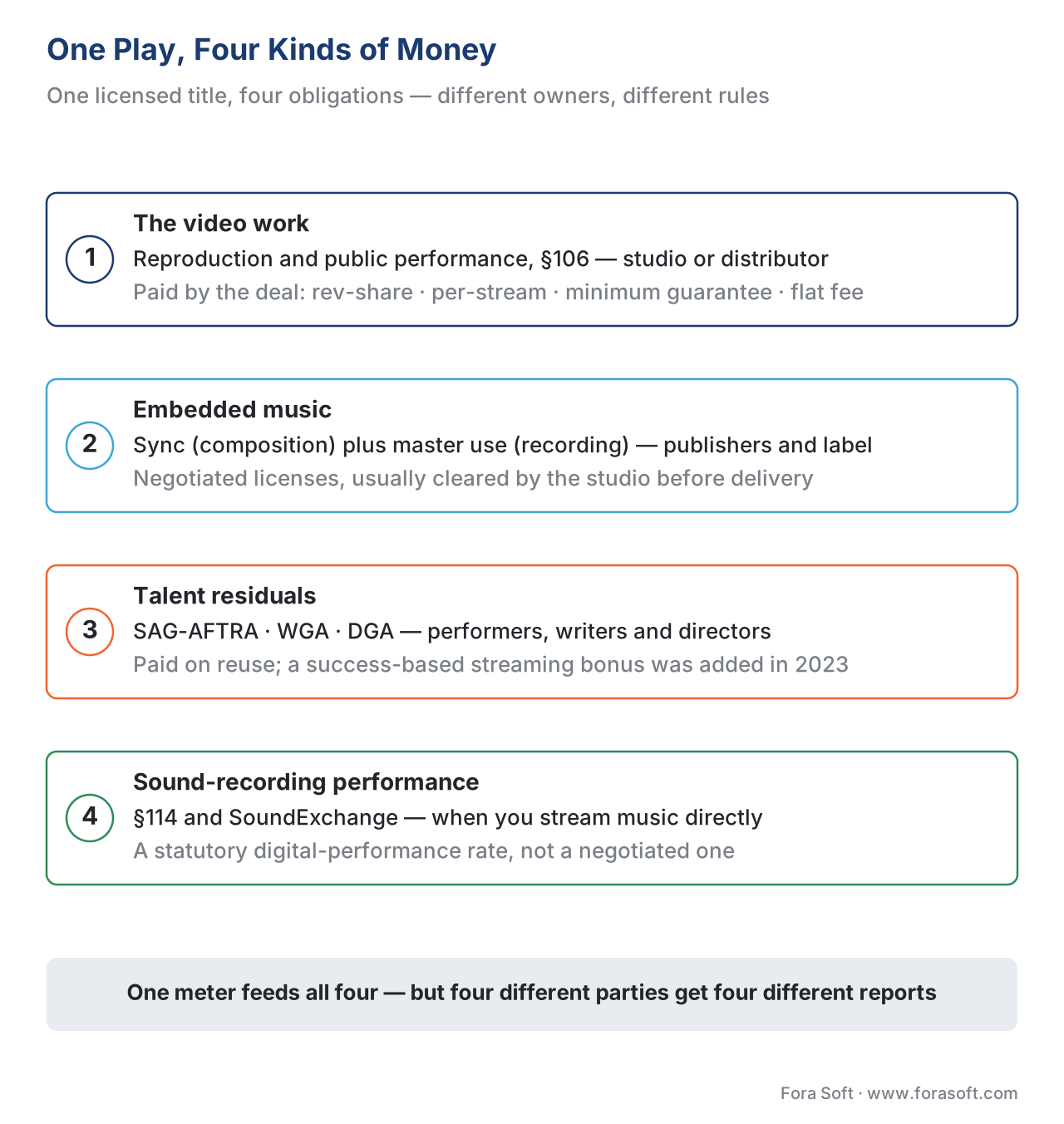 Figure 1. One play, a stack of rights. Each layer is owned by different parties and paid under a different rule.
The video itself. The studio, distributor, or independent producer that owns the film licensed it to you. Under US copyright law the owner holds exclusive rights to reproduce and publicly perform the work (17 U.S.C. § 106), and your license is permission to exercise some of those rights within limits. You pay them under the deal you struck — a revenue share, a per-stream or per-minute-watched rate, a flat fee, or a minimum guarantee that your royalties pay down. This is the largest line item and the one most platforms model well.
The music embedded in the video. Almost every film and show contains music, and music carries two separate copyrights that must both be cleared: the composition (the song as written — melody and lyrics, owned by songwriters and publishers) and the sound recording (the specific recorded performance, called the master, owned by a label or artist). Putting a recording into a video requires a sync license for the composition and a master use license for the recording, and these are negotiated, not statutory — there is no government rate card for putting a song in a movie. Most of the time the studio cleared this music before licensing the title to you, but if your platform commissions originals, produces user content with music, or runs music-driven channels, the obligation can land on you.
The performers, writers, and directors — residuals. In film and television, the unions and guilds (in the US, SAG-AFTRA for performers, the Writers Guild for writers, the Directors Guild for directors) negotiate residuals: ongoing payments to talent each time a title is reused, including when it streams. These are owed by the production or distributor under the guild agreements, and as of the 2023 contracts they include a success-based streaming bonus tied to viewership — more on that below. If you are a pure licensee streaming third-party catalog, residuals usually flow through the studio; if you produce or co-produce, they can be your direct obligation.
The sound recording, when you stream music directly. If your platform streams music itself — a music-video service, a concert platform, an audio tier — a separate regime applies to the public performance of the sound recording over a digital service. In the US that performance royalty is collected by SoundExchange under the statutory license of 17 U.S.C. § 114, distinct from the composition royalties above.
The practical takeaway: before you can compute a single royalty, your catalog metadata has to know which of these layers each title carries, who owns each layer, and under which deal each is paid. That rights metadata — not the video file — is the asset that makes royalty reporting possible. We covered building it in content licensing and rights for OTT; here it becomes the lookup table for every payment.
How royalties are actually calculated: four models
Content deals settle into a handful of payment shapes. You will usually run several at once, because different rights holders insist on different models. Here are the four that cover almost everything, with the engineering implication of each.
| Royalty model | How it's metered | Who carries the risk | Reporting need | Typical use |
|---|---|---|---|---|
| Revenue share | % of revenue the title drives | Shared — both rise and fall together | Revenue allocation per title | AVOD, TVOD, catalog deals |
| Per-stream / per-minute | Count of qualifying plays or minutes watched | Platform (you pay per use regardless of revenue) | Accurate play/minute metering | SVOD catalog, music |
| Minimum guarantee + recoupment | MG paid upfront, then royalties recoup against it | Platform pays MG even if title underperforms | Running recoupment ledger | Premium / exclusive titles |
| Flat license fee | Fixed sum for a term | Platform (sunk cost) | Light — proof of license window | Small libraries, fixed-term buys |
The "Who carries the risk" column is the one to read before you sign — it tells you whether a flop costs you money.
Revenue share pays the rights holder a percentage of the money the title generates. It sounds simple until you ask: how much revenue did one title generate on an all-you-can-watch subscription where the viewer paid one flat fee for the whole catalog? There is no per-title price, so platforms allocate subscription (and ad) revenue across titles by a usage key — most commonly each title's share of total watch time in the period. This revenue-pool allocation is the single most consequential calculation in SVOD royalties, and it is pure engineering: sum the qualifying minutes per title, divide by total qualifying minutes, multiply by the distributable revenue pool.
Per-stream or per-minute pays a fixed rate for each qualifying play or each minute watched. Music streaming leans this way; some video catalog deals do too. The risk shifts to you — you owe the rate whether or not the viewer's subscription covered it — so the definition of a "qualifying" play matters enormously. Did a 12-second sample count? Did an autoplay preview? The deal defines the threshold, and your metering has to enforce exactly that definition, not a looser one.
Minimum guarantee with recoupment is the premium-content shape. The rights holder demands a guaranteed sum upfront — the minimum guarantee, or MG — that is non-refundable, and your ongoing royalties recoup against it: you do not pay additional royalties until the rights holder's earned share exceeds the MG you already paid. Engineering-wise this is a running ledger per deal: accrue earned royalties each period, net them against the outstanding MG balance, and only cut a fresh payment once the balance is cleared. Getting the recoupment math wrong is the most common royalty dispute.
Flat license fee is a fixed payment for a fixed term — the lightest to administer, because the money is decided in advance. Your only real obligation is proving you stayed inside the licensed window and territory, which ties back to content windowing and availability.
A worked allocation
Make the revenue-share allocation concrete. Suppose in one month your SVOD service collected $1,000,000 in subscription revenue, and after your contractual platform margin you have a $500,000 distributable pool to split across licensed titles by watch time. Total qualifying watch time that month was 10,000,000 minutes. One licensed film accumulated 250,000 minutes.
That film's share of watch time is 250,000 ÷ 10,000,000 = 2.5%. Its allocated revenue is 2.5% × $500,000 = $12,500. If the deal pays the rights holder a 60% revenue share, the royalty owed for that title this month is 60% × $12,500 = $7,500. Now multiply that arithmetic across a catalog of tens of thousands of titles, every month, per territory, and you see why this is a pipeline and not a spreadsheet.
Usage reporting: what you send, and the standard for sending it
Calculating the royalty is half the obligation. The other half is reporting the usage that justifies it, in a form the rights holder can ingest and check. Two things drive the format: industry standards and the law.
On the industry side, the music business solved the "every service invents its own report" problem with a standard from DDEX (Digital Data Exchange), the standards body for music supply-chain messaging. Its Digital Sales Reporting Message Suite (DSR) is the agreed format in which a digital service reports sales and usage to the rights owners it pays. A DSR file is, in essence, a large flat file (commonly CSV or TSV, sometimes XML) that lists, line by line, every monetizable event in the reporting period: the identifier of the recording or work that was used (for sound recordings, the ISRC; for works, the ISWC), the country where the use happened, the user tier (free, premium, student, family), and the number of streams or other usages, often with the revenue and the allocated royalty. The DSR record type for streaming services and webcasts (the SU02-family records in the current DSR generation) exists precisely so a platform and a label or publisher can exchange usage without bespoke engineering on both sides. If you stream music in any form, building your reporting to emit valid DSR is the difference between a deal that runs on autopilot and one that drowns in reconciliation emails.
On the legal side, US law makes one report mandatory and prescriptive. When a streaming service uses the blanket mechanical license for musical compositions — the license created by the Music Modernization Act of 2018 and administered by the Mechanical Licensing Collective (MLC) since the license availability date of January 1, 2021 — it must deliver to the MLC a monthly report of usage, plus an annual report, under 17 U.S.C. § 115(d)(4)(A). The statute and the Copyright Office's regulations (37 CFR Part 210, Subpart B) require that report to be in a machine-readable format compatible with the MLC's systems. This is not a format you get to invent; the report is the legal precondition for the license that lets you reproduce the composition when you stream the track. Miss it, and you lose the safe harbor the blanket license provides.
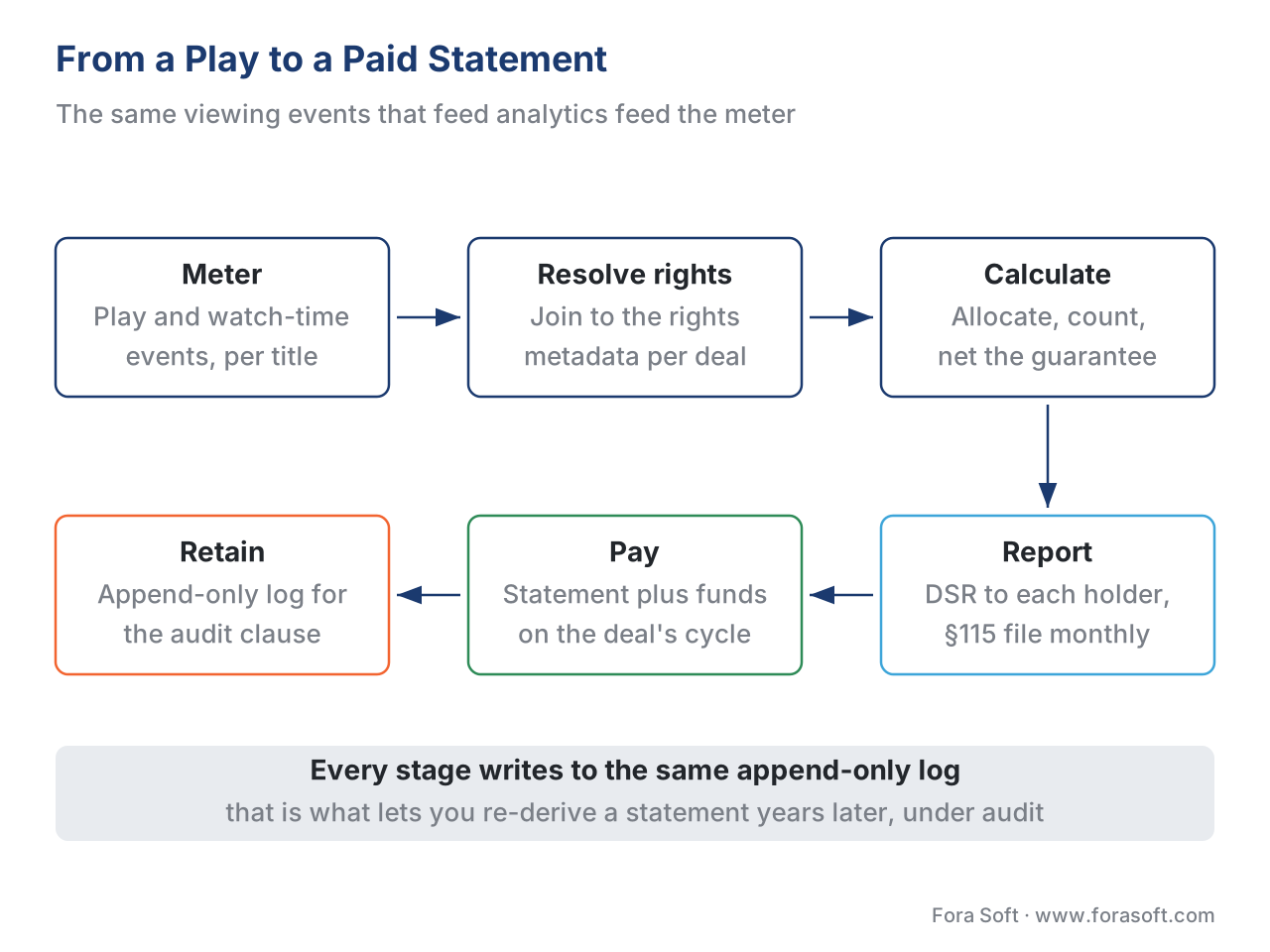 Figure 2. The usage-to-royalty pipeline. The same play events that feed analytics feed the meter; every stage writes to the audit log.
The architecture that satisfies both is a single pipeline. The play and watch-time events your platform already emits for analytics become the meter. A rights-resolution step joins each event to the rights metadata for that title — who owns each layer, under which deal. A calculation step applies the deal terms (allocate the revenue pool, count qualifying streams, net against any MG). A reporting step formats the result per recipient — a DSR flat file for a label, a § 115 machine-readable report for the MLC, a custom statement for a studio. A payment step issues the statement and the funds. And every stage writes to an append-only audit log, because of the obligation that comes next.
The audit trail rights holders require
Here is the clause that turns reporting from a feature into an architecture decision: almost every serious content license includes a right to audit. The rights holder reserves the right to send an auditor to inspect the books and the underlying data that produced your royalty statements — typically once a year, with a look-back window of two to three years, and a common term that if the audit finds you underpaid by more than 5–10%, you pay for the audit (and the shortfall, often with interest). Music licensing deals carry the same audit-clause pattern.
Think about what that clause demands of your systems. Two or three years after a given month, you must be able to reconstruct, for a specific title in a specific territory, exactly how you arrived at the royalty you paid: how many qualifying plays and minutes you counted, what revenue you allocated to the title and by what key, what deal terms you applied, what MG balance you netted against, and what you ultimately reported and paid. If your metering pipeline overwrote its inputs, recomputed totals in place, or kept only summary numbers, you cannot answer — and an auditor's job is to assume the gap favors the platform.
The engineering answer is an immutable, event-sourced royalty ledger: store the raw qualifying events (or a faithful, dated rollup of them), the version of the rights metadata and deal terms in force at the time, the allocation inputs and the computed outputs, and the report you sent — all append-only, all timestamped, none overwritten. When the deal terms change, you write a new version rather than editing the old; when you correct an error, you write a compensating entry rather than mutating history. This is the same discipline a bank's general ledger uses, for the same reason: someone will check it later, and "trust me" is not an answer. It also pairs naturally with the privacy boundary from privacy and viewing data — the royalty ledger needs the title and the count, rarely the identity of the individual viewer, so report on aggregates and keep personal data out of the statements you hand to rights holders.
The new wrinkle: success-based streaming residuals
For platforms that produce or co-produce content, 2023 changed the residual math in a way that is squarely an engineering problem. After the writers' and actors' strikes, the new US guild agreements added a success-based streaming residual — a bonus paid to talent when a streaming title performs well, on top of the existing fixed residual.
The trigger is defined in viewership terms. Under the 2023 SAG-AFTRA deal, a title qualifies for the bonus when, in its first 90 days of release, it draws domestic views equal to at least 20% of the streaming service's domestic subscribers. And the contract had to define a "view" precisely for this to be enforceable, so it did: a view is the title's total viewing time divided by its runtime — effectively the number of complete watches the total minutes add up to. A qualifying title triggers a bonus to principal performers (the SAG-AFTRA structure routes a portion to a distribution fund), and the guild estimated the new bonus at roughly $40 million per year across the industry. The Directors Guild and Writers Guild negotiated parallel viewership-based structures.
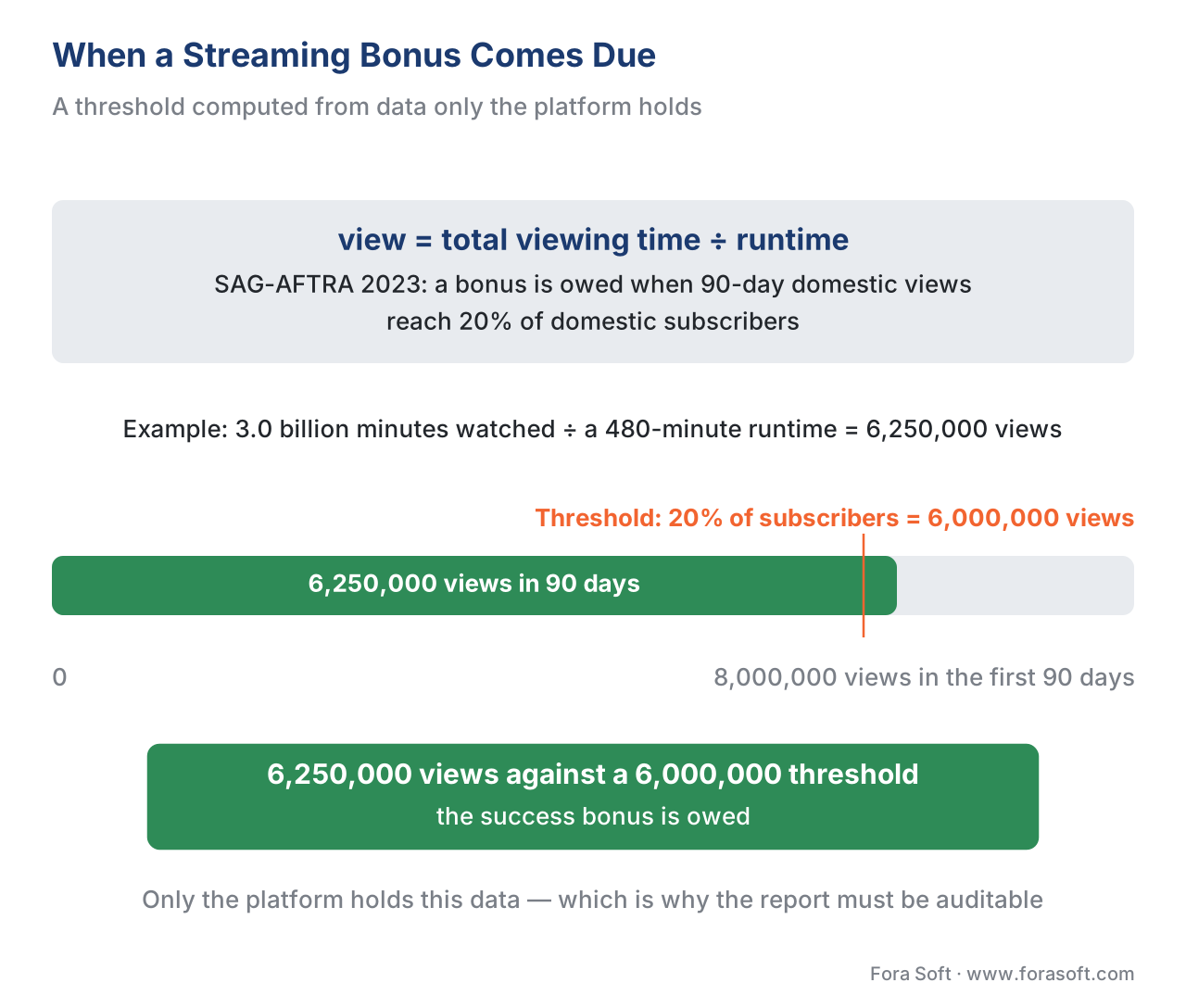 Figure 3. The success-based residual threshold. The platform's own watch-time data is the input that decides whether the bonus is owed.
The reason this matters to your platform is that the threshold is computed entirely from data only you hold: total viewing time, runtime, the 90-day window, and your domestic subscriber count. If you produce content, your metering pipeline is now the system that determines whether a guild bonus is owed and to whom. That is a reporting and calculation obligation you build, test, and audit like any other — except the recipients are unions with their own audit rights, and the figures (the subscriber count especially) are commercially sensitive. Note too that the precise definitions and thresholds come from the guild agreements and are periodically renegotiated, so treat the 20%/90-day rule as current to the 2023 contracts and re-verify against the agreement in force when you build.
A worked residual check
Concretely: say your service has 30,000,000 domestic subscribers, so the bonus threshold for any title is 20% × 30,000,000 = 6,000,000 qualifying views in the first 90 days. A new original series has a total runtime of 8 hours (480 minutes) across its season. In its first 90 days it accumulated 3,000,000,000 minutes of domestic viewing time. Views = 3,000,000,000 ÷ 480 = 6,250,000. That clears 6,000,000, so the title qualifies and the success bonus is triggered. Move the watch time down to 2.8 billion minutes and views fall to about 5.83 million — below the line, no bonus. The difference between owing and not owing turns on numbers your pipeline computes, which is exactly why the metering has to be defensible.
A common mistake: metering that the deal doesn't recognize
The most expensive royalty error is not bad arithmetic — it is metering a different event than the contract defines. A platform that counts "plays" for its own dashboards as any video-start, including autoplay previews and a viewer scrubbing back to rewatch, will happily feed those same inflated counts into a per-stream royalty and overpay; or, counting a stricter internal metric, will undercount a revenue-share watch-time pool and underpay into an audit finding. The contract's definition of a qualifying stream, a counted minute, and a billable view almost never matches your analytics defaults. Build the royalty meter as its own pass with the contract's definitions encoded explicitly — qualifying duration thresholds, what counts as a unique view, how trailers and previews are excluded — and reconcile it against, but never conflate it with, your product analytics. The two answer different questions and must be allowed to disagree.
Free download: Rights, Reporting & Royalty Compliance ChecklistThe four royalty layers on one page, the metering definitions to take from the contract instead of your analytics defaults, the §115 machine-readable monthly report of usage and the DDEX DSR file, minimum-guarantee recoupment, and the audit-trail fields a rights holder will ask for — in a form you can hand to a vendor before you sign.Where Fora Soft fits in
Royalty and rights compliance is where a streaming platform's revenue scale meets its legal obligations, and both have to hold at volume — millions of plays a day turning into auditable, per-title, per-territory statements every month without manual reconciliation. Fora Soft has built video streaming and OTT/Internet TV platforms since 2005, across 625+ projects for 400+ clients, including the metering, entitlement, and reporting layers that licensed catalogs require. We design the royalty pipeline as part of the platform — the same viewing events feeding analytics, the rights metadata feeding entitlement and payment, and an append-only ledger built to survive a rights holder's audit — so reporting is a query, not a quarterly fire drill. We are vendor-neutral: we implement the DSR and § 115 reporting your deals and the law require, on the data architecture that fits your scale.
The handbook
Fora Soft Video Engineering Handbook
We wrote a seven-volume handbook, 9,000+ pages, that takes the video stack from a single pixel to production — encoding, delivery, audio and AI — and someone who works through it can design and build the platform that has to produce these statements. Volume 3 is the one to open next to this article: it covers the delivery economics, the DRM and entitlement machinery, and the player telemetry that the same viewing events feed. Volume 2 covers the ingest and packaging those events are generated by, and volume 1 covers the encoding ladder that decides what a title costs to carry while it earns. Written by Nikolay Sapunov, CEO at Fora Soft.
Could your platform produce a statement a rights holder would accept?
Tell us what your catalogue is licensed for, how your deals define a qualifying stream, and who you report to, and we will say what the metering, rights-resolution and reporting layers take to build, and what an append-only royalty ledger costs to run at your volume. 250+ video products shipped since 2005.
See our case studies
Case study
Franchise Record Pool
A DJ platform founded by Funkmaster Flex carrying 720,000+ licensed tracks from Sony Music, Universal and Virgin Records, with a Tracker system that reports plays back to the labels in real time — usage reporting built as a product feature, not a monthly export.
Case study
Drundoo
A Bulgarian internet TV service carrying 60 licensed live channels on every subscription plan alongside movies, series, sport and catch-up — one licensed catalogue where every play has to be attributable to the deal that allowed it.
Case study
Perspire.tv
A live and on-demand fitness platform where trainers keep 80% of revenue through a Coins economy, with per-video and per-session pricing and Stripe payouts — the same rev-share arithmetic a royalty model runs on, metered per play.
What to read next
Licensing
Content Licensing & Rights for OTT
The rights metadata every royalty calculation has to join against.
Windowing
Content Windowing and Availability for OTT Platforms
Proving you stayed inside the licensed term and territory.
Privacy
VPPA, GDPR, CCPA: Streaming Viewing-Data Privacy
Keeping personal data out of the statements you send.
Monetization
OTT Monetization: SVOD, AVOD, TVOD & Hybrid Explained
The revenue a rev-share percentage is taken out of.
References
- 17 U.S.C. § 115 — Compulsory license for making and distributing phonorecords; blanket license for digital uses. Legal Information Institute (Cornell), reading the current statutory text. Tier 1. Establishes the § 115 blanket mechanical license, digital phonorecord deliveries (DPDs), and the monthly/annual report-of-usage obligation to the MLC under § 115(d)(4)(A). https://www.law.cornell.edu/uscode/text/17/115 (accessed 2026-06-19).
- 17 U.S.C. § 106 — Exclusive rights in copyrighted works. Legal Information Institute (Cornell). Tier 1. The reproduction and public-performance rights that a content license grants permission to exercise. https://www.law.cornell.edu/uscode/text/17/106 (accessed 2026-06-19).
- 37 CFR Part 210, Subpart B — Blanket Compulsory License for Digital Uses, Mechanical Licensing Collective, and Digital Licensee Coordinator. eCFR (US Copyright Office regulations). Tier 1. Specifies the monthly report of usage, its machine-readable format requirement, and the recordkeeping rules implementing § 115. https://www.ecfr.gov/current/title-37/chapter-II/subchapter-A/part-210/subpart-B (accessed 2026-06-19).
- Orrin G. Hatch–Bob Goodlatte Music Modernization Act — Frequently Asked Questions. U.S. Copyright Office. Tier 1 (issuing body). Title I creates the § 115 blanket license, the MLC and DLC, the January 1, 2021 license availability date, and the willing-buyer/willing-seller rate standard. https://www.copyright.gov/music-modernization/faq.html (accessed 2026-06-19).
- 17 U.S.C. § 114 — Scope of exclusive rights in sound recordings. Legal Information Institute (Cornell). Tier 1. The statutory digital-performance license for sound recordings, collected by SoundExchange — relevant when a platform streams music directly. https://www.law.cornell.edu/uscode/text/17/114 (accessed 2026-06-19).
- Digital Sales Reporting Message Suite (DSR). DDEX (Digital Data Exchange) Knowledge Base. Tier 2 (industry standards body). The standardized flat-file format for reporting sales and usage from a digital service to rights owners; the SU02-family records cover streaming services and webcasts (ISRC/ISWC, territory, user tier, stream counts). https://kb.ddex.net/implementing-each-standard/digital-sales-reporting-message-suite-(dsr)/ (accessed 2026-06-19).
- Music Licensing: The ASCAP and BMI Consent Decrees. Congressional Research Service (Congress.gov), IF11463. Tier 2. How performing-rights organizations license public performance of compositions and how the consent decrees and rate courts work. https://www.congress.gov/crs-product/IF11463 (accessed 2026-06-19).
- SAG-AFTRA 2023 TV/Theatrical contract — streaming residuals and the success-based bonus. SAG-AFTRA member summary (Streaming Residuals 2023). Tier 3 (first-party, the guild). Defines the viewership threshold (20% of domestic subscribers within 90 days), the "view" definition (total viewing time ÷ runtime), and the ~$40M/year estimate. https://www.sagaftra.org/sites/default/files/sa_documents/StreamingResiduals23_F.pdf (accessed 2026-06-19).
- "New WGA & SAG-AFTRA Residuals Model Explained." Deadline, November 2023. Tier 5 (trade reporting). Corroborates the success-based streaming-bonus mechanics and the parallel WGA/DGA structures. https://deadline.com/2023/11/streaming-model-explained-sag-aftra-wga-residuals-deal-1235642995/ (accessed 2026-06-19).
- "Royalty with Minimum Guarantee" / "Sales- or Usage-Based Royalties." PwC Viewpoint and Deloitte DART (ASC 606 revenue-recognition guidance). Tier 5 (professional accounting guidance). The minimum-guarantee-plus-recoupment model and the accounting treatment of usage-based royalties. https://viewpoint.pwc.com/dt/us/en/fasb_financial_accou/trg_revenue/trg_revenue_US/salesbased_or_usageb_US.html (accessed 2026-06-19).
Spec/standard precedence note (per §4.3.2): where popular "how streaming royalties work" explainers blur the composition and the sound recording, or treat all music royalties as paid through one collective, this article follows the controlling US statutes (§§ 106, 114, 115) and the DDEX DSR standard directly, and separates the mechanical (MLC/§115), performance-of-composition (PRO/ASCAP-BMI), and performance-of-recording (SoundExchange/§114) flows. Litigation- and contract-dependent items (the 2023 guild thresholds, audit-clause percentages) are flagged for re-verification against the agreement in force.
