


Why this matters
Everything else in discovery — the recommendation rows, search, personalized merchandising, and the experiments that tune them — is only as good as the data pipeline feeding it, so this is the foundation the rest of the block stands on. Get it right and a viewer's choice in the last hour can reshape the home screen by tonight; get it wrong and the smartest model serves stale or inconsistent signals and the recommendations rot. This article is for the founder, product manager, or streaming CTO who has to decide how much data infrastructure to build, whether features should update in seconds or overnight, and — critically — where the legal line sits around what you know about your viewers. You will not write the stream-processing code, but you do have to set the architecture and the privacy boundary, and understand why the cheapest-looking shortcut so often turns into the most expensive bug or the most expensive lawsuit.
What the personalization pipeline actually is
Start with the plainest version. The personalization data pipeline is the chain of systems that takes raw viewer behavior — what people watched, when they stopped, what they searched, what they scrolled past — and turns it into the tidy, current numbers that recommendation and search models read to decide what to show each person next. It is the bridge between the messy stream of things viewers do and the clean inputs an algorithm needs.
A useful analogy is a restaurant kitchen. The dining room (your apps) generates a constant stream of orders and reactions; the kitchen (the pipeline) receives them, preps ingredients into a standard form, keeps the most-used ingredients ready on the line, and makes sure the dish a cook plated in the test kitchen tastes the same as the one sent to the table. The recommendation model is the chef at the pass — and how that model ranks titles is a craft of its own — but the chef is only as good as the kitchen behind them. Most of the work, and most of the failure modes, live in the kitchen.
Four jobs make up that kitchen, and the rest of this article is one section each: collect the events from every device; move and process them through a log into real-time and batch computation; store the results in a feature store that guarantees a model sees the same data in training and in production; and protect the viewing data behind a privacy boundary the law takes seriously. Each one is a place where streaming platforms either build a durable advantage or quietly break the product.
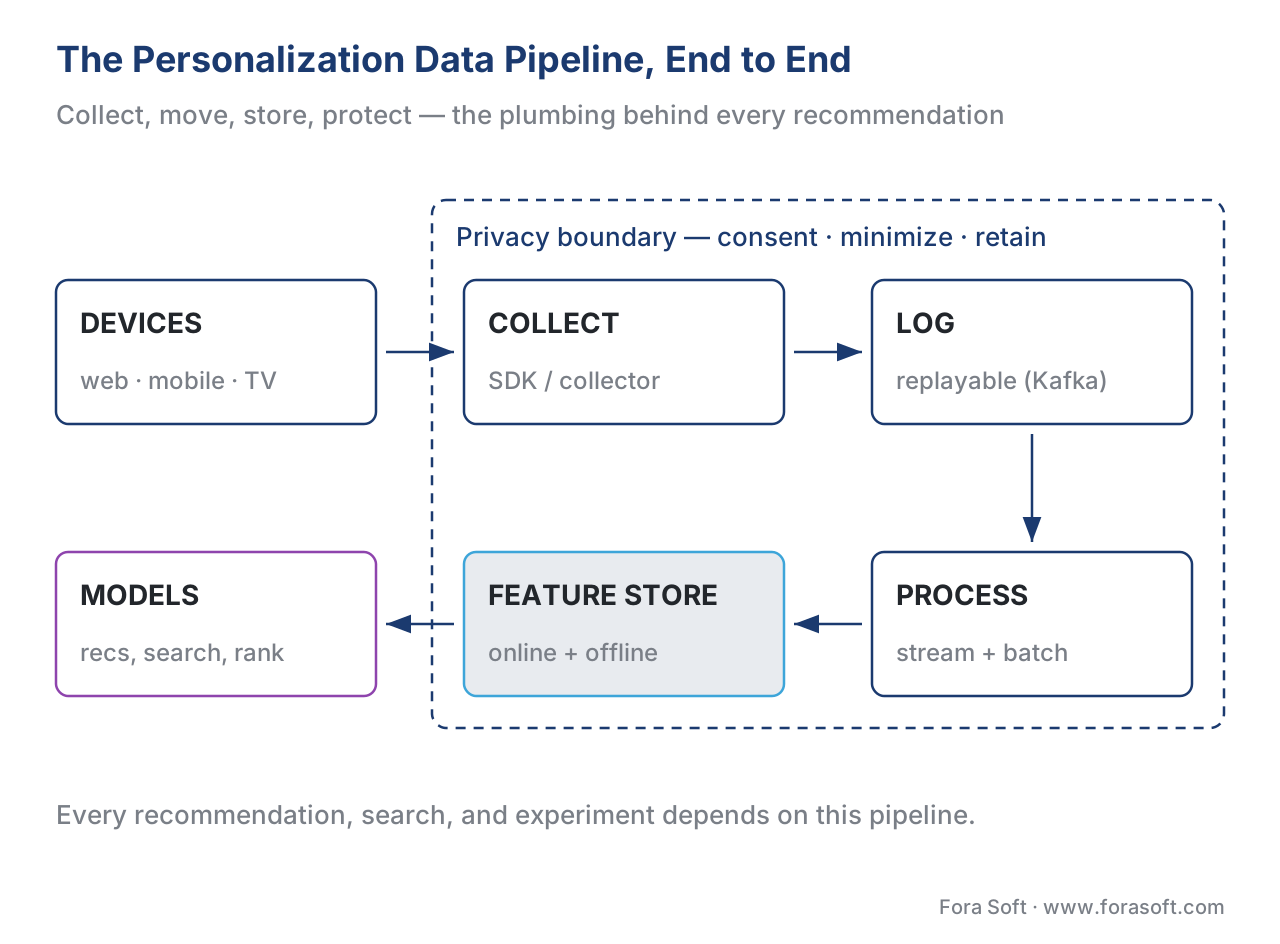 Figure 1. The personalization data pipeline end to end. Events from every screen are collected, moved through a replayable log, processed in two speeds (real-time stream and scheduled batch), and written to a feature store that serves the recommendation, search, and ranking models. The dashed boundary marks the viewing-data zone where consent, minimization, and retention rules apply.
Step one: collecting the events
Everything begins with an event — a small, timestamped record that says "this viewer did this thing at this moment." Events are the raw material of personalization; with no events, the smartest model is blind. They fall into three families, and keeping them straight helps you reason about what the pipeline carries.
The first family is playback events: the things that happen inside the player. A play start fires when a title begins; pause, resume, and seek (jumping to a different point) fire as the viewer controls it; a complete fires at the end. Crucially, the player also emits a heartbeat — a small "still watching, at this position" ping sent every few seconds — because without it you cannot tell a thirty-second sample from a full episode. Watch time, the metric that decides almost everything, is reconstructed from these heartbeats.
The second family is navigation events, sometimes called clickstream: what the viewer does outside the player. An impression records that a title was shown in a row (it appeared on screen); a click records that the viewer opened its detail page; scrolls, row views, and hovers record browsing. Impressions matter as much as clicks, because a recommendation system has to learn from what it showed and the viewer ignored, not only from what they picked.
The third family is search events: the query typed, the results shown, and which result was chosen — the raw material for search and content discovery. Layered on top of all three is content metadata — the genre, cast, and tags that turn a bare title_id into something a model can generalize from, the subject of metadata as the fuel for discovery.
These events do not arrive one at a time from one place. A single "press play" sets off events from several services at once — the playback service, the recommendation service that served the row, the quality-monitoring service, and the CDN-routing service each emit their own (Netflix Technology Blog, 2018). Multiply that across every screen and the volume is large, which is the next thing to make concrete.
The arithmetic of event volume
Numbers anchor the architecture, so walk through one. Suppose your platform has one million viewers watching at the same time at peak. The player sends a heartbeat every 10 seconds, which is 6 heartbeats per minute, and during active browsing each viewer generates roughly 4 more navigation events per minute. Call it 10 events per minute per viewer. Then:
events/second = 1,000,000 viewers × 10 events/min ÷ 60 s
              = 10,000,000 ÷ 60
              ≈ 167,000 events per second
So a one-million-concurrent service is producing on the order of 167,000 events every second at that moment — and that is the steady rate, before any premiere spike. Over a full day, even at a lower average concurrency, that is billions of events. For scale context, Netflix's data pipeline reports peaks around 12.5 million events per second and on the order of two trillion events per day across all its services (Netflix Technology Blog, 2018). If each raw event is roughly one kilobyte, a billion events is about a terabyte of raw data — so storage and processing cost, not cleverness, is the first real constraint. This is the same scale-first reality that governs scaling and concurrency for OTT: you design the pipeline for the peak, then make the steady state cheap.
| Event family | What it captures | Concrete examples | What it feeds |
|---|---|---|---|
| Playback | What happens inside the player | play start, pause, resume, seek, complete, heartbeat | Watch time, completion, "continue watching" |
| Navigation (clickstream) | Browsing outside the player | impression, click, scroll, row view, hover | What was shown vs chosen; ranking signals |
| Search | Intent typed by the viewer | query, results shown, result chosen | Search relevance, demand signals |
Table 1. The three families of event a personalization pipeline collects. Playback events (especially the heartbeat) reconstruct watch time; navigation events capture what was shown and ignored, not just what was clicked; search events capture stated intent. A model that learns only from clicks and never from impressions cannot tell a good recommendation from a lucky position.
Step two: moving and processing the events — the two clocks
Once collected, events have to travel from millions of devices to the systems that compute features, and the design choice that organizes everything is the log. A log here is an append-only, replayable record of every event in the order it happened — think of it as a tape you can always rewind. Apache Kafka is the most common implementation. Producers (the apps and services) write events to the log; consumers (the processing jobs) read from it at their own pace. The log decouples the people making events from the people using them, and because it is replayable, you can reprocess history by reading it again from the start (Kleppmann, 2017).
From the log, processing happens on two clocks, and understanding the difference is the heart of pipeline design.
The fast clock is stream processing: jobs that read events the instant they land and update a number within seconds. "How many episodes has this viewer finished in the last hour?" is a streaming feature — it has to be current to be useful. Apache Flink is a common engine here. A typical streaming job filters out noise, then enriches each event — a raw play_start carries only user_id, title_id, and a timestamp, so the job joins it against reference data to attach the genre, the viewer's country, and the content rating before anything downstream uses it (Netflix Technology Blog, 2018).
The slow clock is batch processing: jobs that run on a schedule — every few hours, or nightly — over huge historical datasets. "This viewer's favorite genres over the last 90 days" is a batch feature; it changes slowly, so recomputing it once a day is fine and far cheaper than touching it on every event. Apache Spark is a common engine here.
How you combine the two clocks has a name. The Lambda architecture runs both layers in parallel — a batch layer for accurate, complete history and a fast "speed" layer for the last few minutes — and merges their outputs at read time (Marz & Warren, 2015). It is fault-tolerant but carries a hidden tax: you maintain the same logic twice, once in the batch system and once in the streaming system, and keeping two codebases producing identical results is exactly as painful as it sounds. That pain is why Jay Kreps, a creator of Kafka, proposed the Kappa architecture in 2014: drop the separate batch layer, keep a single streaming layer over a replayable log, and when you need to recompute history, just replay the log through the same code (Kreps, 2014). One code path, one source of truth, reprocessing by rewinding the tape.
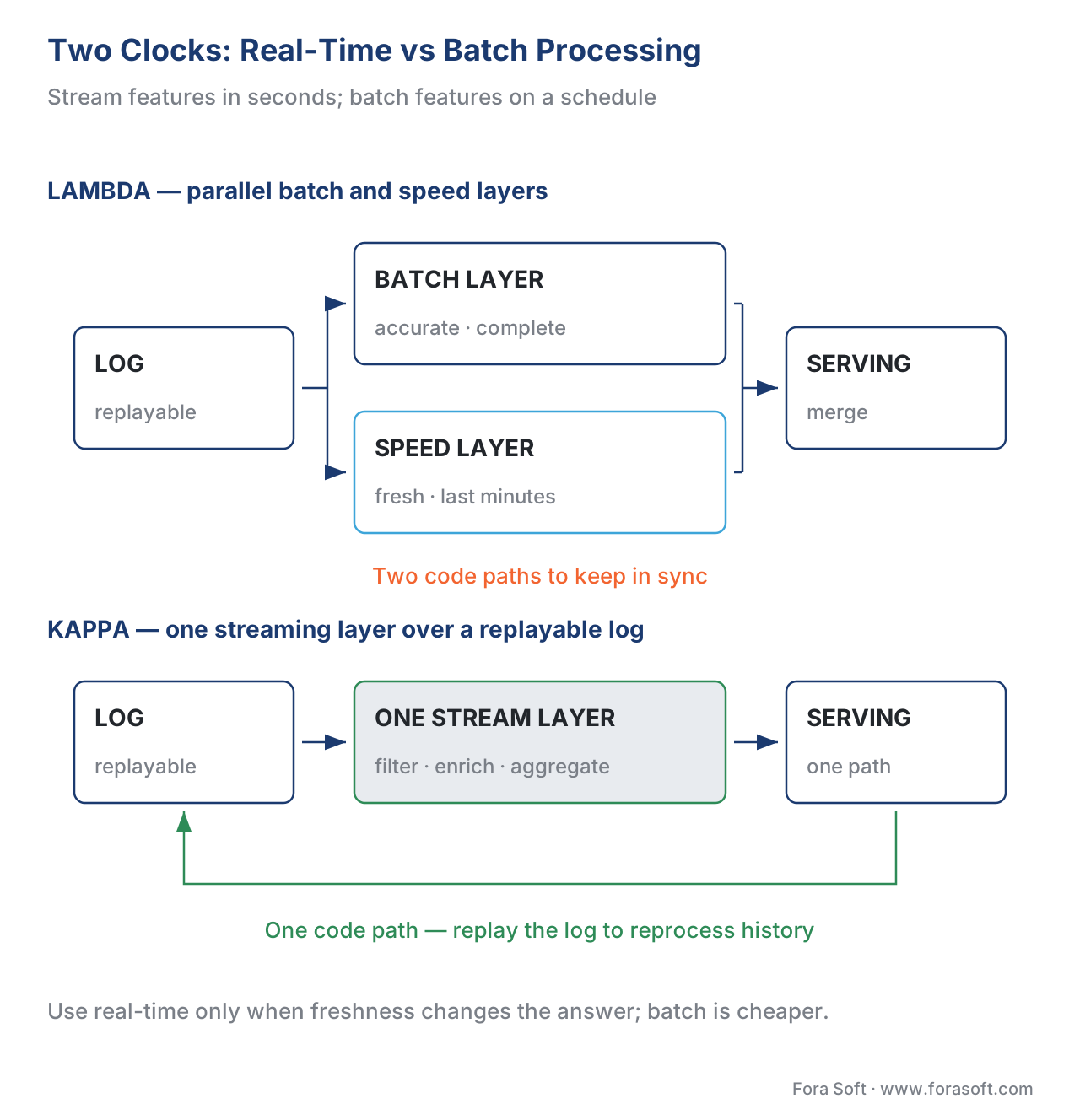 Figure 2. The two clocks of a personalization pipeline. Streaming features must be fresh in seconds (episodes finished this hour); batch features change slowly and recompute cheaply on a schedule (favorite genres over 90 days). The Lambda architecture maintains separate batch and speed layers and merges them; the Kappa architecture keeps a single streaming layer and reprocesses by replaying the log — one code path instead of two.
The practical guidance is simple. Use a streaming feature when freshness changes the answer — the last few titles watched, what is trending right now, "continue watching." Use a batch feature when the signal is slow and the volume is huge — long-run taste, lifetime watch hours, content embeddings. Most real platforms run both, and the architecture question is whether you can collapse them onto one code path (Kappa) or truly need two (Lambda). The trap is reaching for real-time everywhere: streaming infrastructure is more expensive and harder to operate, and most personalization signals do not actually need to be seconds-fresh.
| Dimension | Real-time (streaming) features | Batch features |
|---|---|---|
| Freshness | Seconds | Hours to a day |
| Typical engine | Stream processor (e.g. Flink) | Batch engine (e.g. Spark) |
| Cost & operational load | Higher — always-on, harder to run | Lower — scheduled, simpler |
| Use it for | "Watched in the last hour", trending now, continue-watching | 90-day taste, lifetime hours, slow embeddings |
| Failure if misused | Stale signal kills "what's hot" | Wasted spend chasing freshness nobody needs |
Table 2. When to use a real-time feature versus a batch feature. The deciding question is whether freshness changes the recommendation. Defaulting to real-time everywhere is the common and costly mistake; defaulting to batch where the signal is truly time-sensitive makes "trending now" lie.
Step three: the feature store — and the bug that pays for it
Now the most important and least understood part. A feature is a single number a model reads — "episodes finished this week", "share of comedy in the last 30 days." A feature store is the system that computes, stores, and serves those features, and it solves a specific, expensive problem that the rest of this section explains. The concept was named and popularized by Uber's Michelangelo platform in 2017, which built a central store so teams could "create and manage canonical features" and reuse them across models instead of rebuilding the same logic over and over (Uber Engineering, 2017).
The problem the feature store exists to kill is training-serving skew: the gap between the features a model learned from during training and the features it actually receives when it is live (Zinkevich, Google "Rules of Machine Learning"). A model is trained on historical data assembled one way — say, in a batch job over a data warehouse — and then served live by a different code path that recomputes those same features under a latency budget. If the two code paths compute "average watch time this week" even slightly differently — a different rounding, a different time window, a different handling of missing data — the model sees one thing in the lab and another in the wild, and its recommendations quietly degrade. The damage is hard to spot precisely because each piece looks correct in isolation; nothing crashes, the numbers just drift apart.
The structural fix is the feature store's reason for being: define each feature once, and serve that one definition to both training and production. A feature store does this with two synchronized halves. The offline store holds the long history and answers training-time questions over huge datasets. The online store holds the current value of each feature and answers it in a few milliseconds at serving time — Uber reported serving online features with 95th-percentile latency under about 10 milliseconds, fast enough to sit inside a live recommendation request (Uber Engineering, 2017). Because both halves are fed from the same definition, the model gets consistent numbers on both clocks. A complementary defense, recommended in Google's engineering rules, is to log the exact features used at serving time and train the next model on those logs — if you train on what you actually served, the two cannot drift apart (Zinkevich, Google "Rules of Machine Learning").
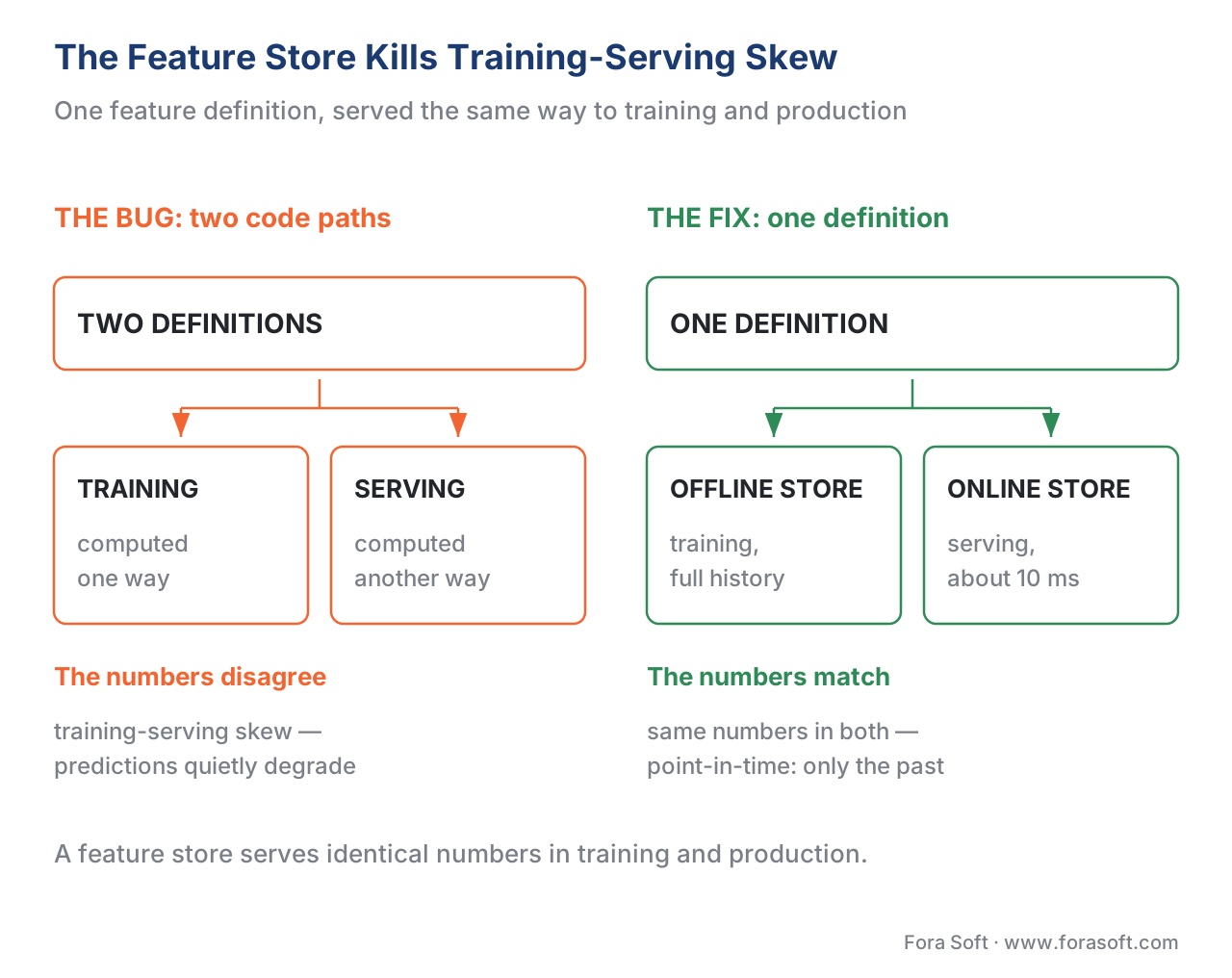 Figure 3. Why a feature store exists. Two separate code paths for training and serving drift apart and cause training-serving skew (left, the bug). One shared feature definition feeding a synchronized offline store (training, full history) and online store (serving, milliseconds) keeps them consistent (right, the fix). Point-in-time joins ensure training rows only ever see data that existed before the moment being predicted.
There is a second, subtler trap the feature store guards against: point-in-time correctness, also called avoiding data leakage. When you build a training example for "will this viewer churn", you join each viewer's label (did they cancel) to their features (their behavior). If you accidentally attach feature values from after the moment you are pretending to predict, the model learns from the future — information it will never have in real life. The result is a model that looks brilliant in testing and fails in production; a classic symptom is an offline accuracy score of 0.95 collapsing to 0.78 once live (Huyen, 2022). A feature store with time-travel joins assembles each training row using only the feature values that existed before that row's timestamp, which is tedious to do by hand and easy to get wrong — another reason the major streaming and tech platforms built feature stores rather than rederive the join every time (Huyen, 2022).
Step four: the privacy boundary on viewing data
The pipeline now knows, for every viewer, exactly what they watched and when. That is precisely the information several laws treat as sensitive, and the privacy boundary is the part of the architecture that decides what data flows where, to whom, and for how long. Treating it as an afterthought is how a personalization win becomes a class-action lawsuit.
The streaming-specific law to know is the United States Video Privacy Protection Act (VPPA), codified at 18 U.S.C. § 2710. It was passed in 1988 after a newspaper published a Supreme Court nominee's video-rental history, and its core rule is blunt: a "video tape service provider" may not knowingly disclose personally identifiable information — defined in the statute as information identifying a person "as having requested or obtained specific video materials or services" — without the viewer's informed, written consent (18 U.S.C. § 2710(a)(3), (b)). The teeth are in the damages: a court may award liquidated damages of $2,500 per affected person (§ 2710(c)(2)), which in a class action across millions of viewers is enormous. Although written for video stores, the statute's language has been applied to modern streaming, and the recent wave of lawsuits targets exactly one pattern — sending viewing events to third-party advertising and analytics tags — which is why it sits at the center of this article's pitfall.
Two more obligations from the same statute shape the pipeline directly. Consent under the VPPA must be specific and separate — not buried in a general terms-of-service click — and may be granted in advance for up to two years with a clear way to withdraw it (§ 2710(b)(2)(B)). And the statute requires providers to destroy personally identifiable information "as soon as practicable, but no later than one year" after it is no longer needed for its purpose (§ 2710(e)) — a hard retention limit your pipeline's storage policy must actually enforce, not just promise.
Beyond the VPPA, two broad regimes apply because viewing data tied to an account or device is personal data. The EU's General Data Protection Regulation (GDPR, Regulation (EU) 2016/679) requires a lawful basis to process it (Article 6) and sets principles your architecture must embody: purpose limitation (use it only for what you told the viewer), data minimization (collect only what you need), and storage limitation (keep it only as long as necessary) — Article 5(1)(b), (c), (e). California's Consumer Privacy Act (CCPA), as amended by the CPRA (Cal. Civ. Code § 1798.100 et seq.), gives viewers rights to know, delete, and opt out of the "sale" or "sharing" of their data, and treats precise data about a consumer as sensitive. The privacy work covered end to end in privacy and viewing data: VPPA, GDPR, CCPA is the legal companion to this engineering article; here the point is that the pipeline is where these rules are enforced or violated.
In practice the boundary is built from four controls. Pseudonymization replaces the real identity with an opaque key inside the pipeline, so the analytics systems work on viewer_8f3c1 rather than a name and email. Data minimization means not collecting fields you have no use for. Retention limits delete raw events on a clock that satisfies the one-year VPPA rule and GDPR's storage limitation. And consent state travels with the data, so a viewer who never agreed to ad targeting never has their viewing history flow to an ad partner. The boundary is not a single wall; it is a set of rules attached to the data as it moves.
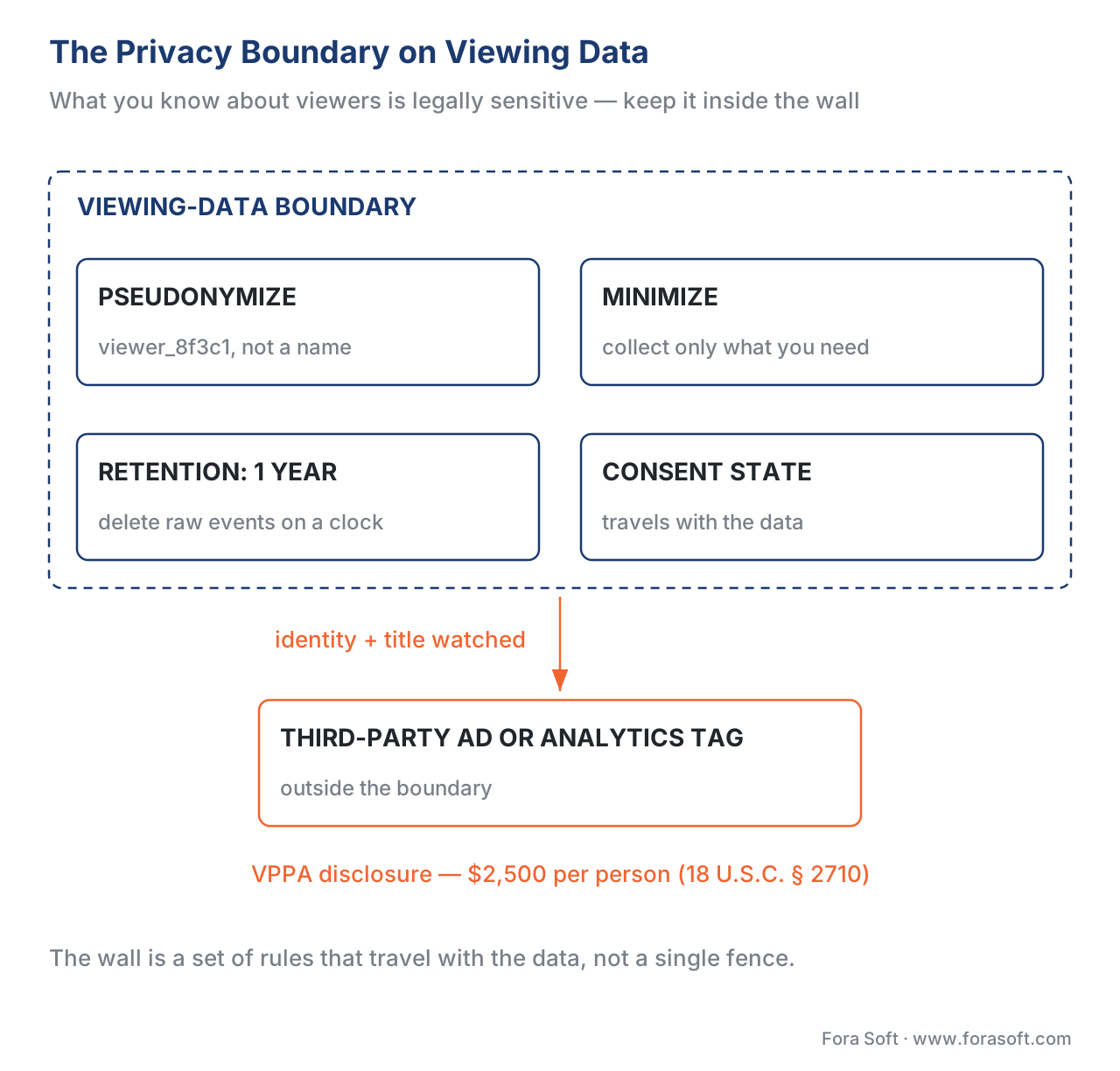 Figure 4. The privacy boundary on viewing data. Inside the boundary, viewing events are pseudonymized, minimized, retention-limited, and gated by consent state. The red path — piping a viewer's identity plus the specific title they watched to a third-party advertising or analytics tag — is the exact pattern that triggers Video Privacy Protection Act liability of $2,500 per person (18 U.S.C. § 2710).
| Regime | What it governs | Key obligation for the pipeline | The control it forces |
|---|---|---|---|
| VPPA (18 U.S.C. § 2710) | Disclosing who watched what | No disclosure of viewing PII without specific written consent; destroy ≤ 1 year after need ends | Block third-party tags; consent gating; retention clock |
| GDPR (EU 2016/679) | Any personal data of EU viewers | Lawful basis; purpose limitation, minimization, storage limitation (Art. 5–6) | Minimize fields; delete on schedule; document purpose |
| CCPA / CPRA (Cal.) | Personal data of California consumers | Rights to know, delete, opt out of sale/sharing | Honor delete/opt-out; segregate "shared" data |
Table 3. The three privacy regimes most relevant to a personalization pipeline and the control each forces into the architecture. The VPPA is the streaming-specific one — its per-person liquidated damages make the third-party-tag leak the highest-risk single mistake in the whole pipeline.
A common mistake: the convenient third-party tag
The pitfall that turns a personalization pipeline into a lawsuit is also the one that looks most harmless. A team wants better analytics or ad attribution, so they drop a third-party tag — an advertising pixel or an analytics SDK — into the app and let it observe viewing events. It is one line of integration code and it "just works." The problem is that this is precisely the act the VPPA forbids: a provider disclosing, to an outside party, information that identifies a specific person as having watched specific content (18 U.S.C. § 2710(b)). The wave of VPPA class actions over the last several years has targeted exactly this pattern, and the statute's $2,500-per-person floor means even a modest user base implies very large exposure.
The engineering fix is the privacy boundary above: viewing events never leave the boundary attached to an identity unless consent specifically allows it, third-party tags are kept away from the viewing stream, and what you do share is pseudonymized and minimized. The second, quieter version of "the convenient shortcut" is on the modeling side — computing a feature one way for training and another for serving because it was faster to write a second query than to share one definition. Both mistakes come from the same instinct: treating the pipeline as glue code rather than as the product. On a streaming platform, the data pipeline is the personalization product.
Free download: Personalization Data Pipeline Readiness ChecklistOne page to check your own pipeline against: the three event families and the heartbeat, choosing real-time against batch on purpose, a feature store that serves the same numbers in training and production, point-in-time correctness, and the viewing-data boundary the VPPA, GDPR and CCPA draw.Where Fora Soft fits in
A personalization pipeline is a scale-and-correctness problem before it is a machine-learning problem: the model is a small part, and the durable advantage is the kitchen behind it — event collection that does not lose data at peak, a feature store that serves identical numbers in training and production, and a privacy boundary that holds. Across 625+ shipped projects for 400+ clients since 2005 in video streaming, OTT/Internet TV, e-learning, and telemedicine, the pattern we build is the full pipeline: event collection across web, mobile, and TV; a replayable log feeding both stream and batch processing; a feature store that eliminates training-serving skew and enforces point-in-time correctness; and a privacy boundary engineered around the VPPA, GDPR, and CCPA from the first event, not bolted on after launch. Our approach is scalability-first and vendor-neutral: we start from your peak event volume and which signals truly need to be seconds-fresh, decide where a hosted feature-store and streaming service is enough and where a custom pipeline earns its cost, and wire the output straight into the recommendation, search, and experimentation systems so what a viewer does in the last hour can reshape what they see tonight — safely.



The handbook
Fora Soft Video Engineering Handbook
We wrote a seven-volume handbook that takes the whole video stack apart, from the pixel to production, and an engineer who works through it can design and build the platform a pipeline like this one feeds. Volume 7 sits closest to this page — real-time pipelines, model serving inside a latency budget, what that costs to run and the compliance boundary around the data it reads — and volume 6 covers the models waiting on the other end of the feature store: recommendation, search and speech. Volume 3 goes back to where your playback events are born, from player QoE instrumentation to the economics of delivery. Written by Nikolay Sapunov, CEO at Fora Soft.
How fresh do your personalization features actually need to be?
Send us your peak concurrency, the signals you want personalized and where viewing data is allowed to travel, and we will come back with the shape of the pipeline — what has to run streaming, what can run overnight, and where the feature store and the privacy boundary sit — 250+ video products shipped since 2005.
See our case studies
Case study
WorldCast Live
HD concert streaming at 1.5 Gb/s to 10,000 simultaneous viewers at 0.4–0.5 s latency, with dynamic quality adjustment — the peak-concurrency case this article sizes, where heartbeats alone arrive by the hundred thousand per second.
Case study
TradeCaster
A live trading platform for 46,000+ users that auto-scales through market-hour spikes and ranks streamers on trade history and P&L — signals worth nothing unless they are seconds fresh, which is exactly when a streaming feature earns its cost.
Case study
VocalViews
A video research marketplace with 1M+ participants and 800K+ verified panelists across 7 countries, with KYC verification and automatic payouts — identity, consent and recorded video kept inside a boundary rather than handed to whatever tag is convenient.
What to read next
Discovery
Video Recommendation System: How It Works
The model waiting at the other end of the feature store, and how it turns your features into a row on the home screen.
Merchandising
Personalized Merchandising: Rows, Artwork & Ordering
Where these features surface: which rows a viewer sees, in what order, and with which artwork.
Experimentation
A/B Testing and Experimentation for Streaming
How to prove a fresher feature or a new model actually moved watch time, instead of assuming it did.
Privacy law
VPPA, GDPR, CCPA: Streaming Viewing-Data Privacy
Step four of this article taken end to end: what the three regimes demand of viewing data, and what that costs to get wrong.
References
- Video Privacy Protection Act — 18 U.S. Code § 2710, "Wrongful disclosure of video tape rental or sale records." Enacted Pub. L. 100–618, Nov. 5, 1988; amended Pub. L. 112–258, Jan. 10, 2013. Tier 1 (primary legal source — U.S. statute). Source of: the definition of personally identifiable information as identifying a person "as having requested or obtained specific video materials or services" (§ 2710(a)(3)); the prohibition on knowing disclosure without consent (§ 2710(b)(1)); the informed-written-consent requirement, distinct and separate, up to two years with withdrawal (§ 2710(b)(2)(B)); the $2,500 liquidated-damages floor (§ 2710(c)(2)(A)); the destroy-within-one-year retention rule (§ 2710(e)). Cornell Legal Information Institute. https://www.law.cornell.edu/uscode/text/18/2710 — accessed 2026-06-18.
- Regulation (EU) 2016/679 (General Data Protection Regulation, GDPR). Official Journal of the European Union, 2016. Tier 1 (primary legal source — EU regulation). Source of: the definition of personal data (Art. 4(1)); the processing principles of purpose limitation, data minimization, and storage limitation (Art. 5(1)(b), (c), (e)); the requirement of a lawful basis for processing (Art. 6). https://eur-lex.europa.eu/eli/reg/2016/679/oj — accessed 2026-06-18.
- California Consumer Privacy Act of 2018 (CCPA), as amended by the California Privacy Rights Act (CPRA) — Cal. Civ. Code § 1798.100 et seq. Tier 1 (primary legal source — state statute). Source of: California consumers' rights to know, delete, and opt out of the "sale" or "sharing" of personal information, and the CPRA's category of sensitive personal information. California Legislative Information. https://leginfo.legislature.ca.gov/faces/codes_displayText.xhtml?division=3.&part=4.&lawCode=CIV&title=1.81.5 — accessed 2026-06-18.
- Meet Michelangelo: Uber's Machine Learning Platform. Del Balso, M. & Hermann, J. Uber Engineering Blog, September 5, 2017. Tier 3 (first-party engineering — the source that named and popularized the feature store). Source of: the feature store concept (a central store of canonical, shareable features); the split between offline and online feature pipelines; applying the same feature definition (DSL) at training and prediction time to guarantee consistency; ~10,000 features in the store; 95th-percentile online serving latency under ~10 ms; the highest-traffic models serving 250,000+ predictions per second. https://www.uber.com/blog/michelangelo-machine-learning-platform/ — accessed 2026-06-18.
- Rules of Machine Learning: Best Practices for ML Engineering. Zinkevich, M. Google for Developers. Tier 2 (authoritative first-party engineering guide). Source of: the definition of training-serving skew (a difference between performance in training and in serving caused by divergent data handling); Rule #29 — log the set of features used at serving time and pipe them to training; Rules #31–#32 on the causes of skew. https://developers.google.com/machine-learning/guides/rules-of-ml — accessed 2026-06-18.
- Questioning the Lambda Architecture. Kreps, J. (co-creator of Apache Kafka). O'Reilly Radar, July 2, 2014. Tier 2 (authoritative engineering essay). Source of: the cost of maintaining the same logic in two systems under Lambda; the Kappa architecture — a single streaming layer over a replayable log, reprocessing history by replaying the log. https://www.oreilly.com/radar/questioning-the-lambda-architecture/ — accessed 2026-06-18.
- Big Data: Principles and Best Practices of Scalable Real-Time Data Systems. Marz, N. & Warren, J. Manning Publications, 2015. ISBN 978-1-617290-34-3. Tier 2 (authoritative practitioner text). Source of: the Lambda architecture — a batch layer for accurate complete history, a speed layer for recent data, and a serving layer that merges them. https://www.manning.com/books/big-data — accessed 2026-06-18.
- Keystone Real-time Stream Processing Platform. Netflix Technology Blog, 2018 (with the 2016 "Keystone streaming data pipeline @ scale" talk). Tier 3 (first-party engineering — orientation for scale and "what ships"). Source of: the pipeline scale (~2 trillion events/day, peak ~12.5 million events/second); Kafka as the messaging/log layer and Flink for stream processing; per-event enrichment (a raw play_start carrying only user_id/title_id/timestamp enriched with genre, country, rating); multiple services emitting events on a single "press play." https://netflixtechblog.com/keystone-real-time-stream-processing-platform-a3ee651812a — accessed 2026-06-18.
- Designing Machine Learning Systems. Huyen, C. O'Reilly Media, 2022. ISBN 978-1-098-10796-3. Tier 2 (authoritative practitioner text). Source of: the distinction between batch (static) and streaming (dynamic) features; the feature store's role; point-in-time correctness and data leakage (joining post-prediction data inflates offline metrics — the offline-0.95/online-0.78 failure pattern); the stream-batch consistency problem. https://www.oreilly.com/library/view/designing-machine-learning/9781098107956/ — accessed 2026-06-18.
- Designing Data-Intensive Applications. Kleppmann, M. O'Reilly Media, 2017. ISBN 978-1-449-37332-0. Tier 2 (authoritative practitioner text). Source of: the append-only, replayable log as the backbone of event delivery; the producer/consumer decoupling it provides; stream processing and reprocessing by replay; change data capture. https://www.oreilly.com/library/view/designing-data-intensive-applications/9781491903063/ — accessed 2026-06-18.
Where popular explanations blurred the line, primary and authoritative sources were followed. The legal claims (VPPA, GDPR, CCPA) are cited to the statutes and regulation themselves (refs 1–3, all tier 1), not to law-firm summaries; the per-person $2,500 figure, the one-year destruction rule, and the consent form are quoted to the section of 18 U.S.C. § 2710. The feature-store and training-serving-skew claims are cited to the originating engineering sources (Uber Michelangelo, Google's Rules of ML) and an authoritative ML-systems text (Huyen 2022); the architecture claims to their originators (Marz & Warren for Lambda, Kreps for Kappa). This is a data-engineering and legal topic rather than a delivery/encryption/DRM specification, so the ≥3-primary-source bar is met with the three primary legal sources plus authoritative engineering literature — consistent with the section's treatment of other Block 7 product topics.
