


Why this matters
If you are a founder, product lead, or first-time streaming CTO, the licensing layer is the part of the build most likely to be discovered too late — usually the week a studio's lawyer asks how your platform guarantees a title goes dark at midnight on its expiry date in France but stays live in Brazil. Content rights decide what your catalog can even contain, and the shape of those rights decides what you have to build: a system that knows, for every title, where it may play, when, on what device, in what language, and to whom. This article explains how content rights actually work — in plain language, grounded in the copyright law underneath them — and then shows the concrete bridge from a signed contract to the availability and entitlement services that enforce it. It is the anchor of our licensing-and-law block: read it first, because windowing, multi-territory rights, and royalty reporting are all specializations of the one idea below.
The one idea: your platform is downstream of a contract
Most explanations of streaming treat the catalog as a product decision — pick the titles, upload the files, build the rows. That framing hides the most important constraint in the whole business. You do not decide what is in your catalog; your licenses do. Every title carries an invisible rulebook negotiated long before it reached your ingest pipeline, and the platform's job is to enforce that rulebook on autopilot across thousands of titles, dozens of territories, and every device class.
Think of it the way a bar thinks about its liquor licence. The bar owns the building, the taps, and the glasses — that is the chassis, the same one we mapped in how an OTT platform works. But what it may pour, to whom, and until what hour is set by a licence it did not write and can lose. A streaming platform is the same: you own the pipeline, but a stack of contracts governs what flows through it. Build as if the catalog is a free choice and you will ship a platform that cannot answer the questions a rights owner will absolutely ask.
So read everything below not as "legal background" but as "the specification your catalog database and your entitlement service must implement." The contract is the source of truth; your platform is the runtime that obeys it.
What a "right" actually is, in plain language
To license content you first have to know what is being licensed. The thing a studio or producer owns is copyright, and copyright is not one indivisible thing — it is a bundle of separate rights that can be split apart and handed out independently.
US law spells this out. Under the Copyright Act, the owner of a work has a set of exclusive rights — to reproduce it, to make new works based on it, to distribute copies, and, the one that matters most for streaming, to perform the work publicly (17 U.S.C. § 106). The law's own legislative history calls these the "bundle of rights," and says each one "may be subdivided indefinitely and … may be owned and enforced separately." That single sentence is the legal engine of the entire licensing business: because the bundle can be sliced, a rights holder can sell the cinema right to one company, the US streaming right to another, and the German streaming right to a third, all for the same film.
Now, why does streaming touch the public-performance right at all, when one person is watching alone on a phone? Because of how the law defines the words. To "transmit" a performance is to communicate it "by any device or process whereby images or sounds are received beyond the place from which they are sent," and a performance is "public" even when people receive it "in separate places and at … different times" (17 U.S.C. § 101). In the words of the statute's own drafters, "a cable television system is performing when it retransmits [a] broadcast to its subscribers." On-demand streaming is the modern version of exactly that act: you are publicly performing the work, by transmission, to each viewer. That is the right you must license. (Streaming can also implicate the reproduction right, because caches and downloads make copies — which is why offline rights are negotiated separately, as covered in license policy: rentals, offline, output.)
Internationally the same idea has a cleaner name. The WIPO Copyright Treaty of 1996, Article 8, gives authors the right to authorize "any communication to the public of their works … including the making available to the public of their works in such a way that members of the public may access these works from a place and at a time individually chosen by them." That "making available" phrase was written for the internet: on-demand streaming is its textbook case, and it is the basis on which rights holders license — and withhold — the streaming right country by country. The treaty also clarifies that merely "providing physical facilities" (the pipes) is not itself the communication — so your CDN provider is not the licensee; you are.
The practical upshot for a builder: a content license is a written permission to exercise a named slice of someone's public-performance/making-available right, under conditions. Everything else in this article is about what those conditions are and how your platform enforces them.
The five dimensions every content license carves
A license is not "yes you can stream this." It is "yes, within these limits," and the limits fall along five axes. Memorize these five, because together they are the data model for a title's rights.
1. Exclusivity — are you the only one who can show it? An exclusive license means the rights holder cannot grant the same right to anyone else in your scope; a non-exclusive license means several platforms can carry the same title at once. Exclusivity is the single biggest price lever in content: industry practice puts exclusive deals at roughly three to ten times the cost of non-exclusive rights for the same title, because you are paying not just to show it but to deny it to competitors. Exclusivity is also scoped — a deal can be "exclusive in the US, non-exclusive elsewhere," which your metadata must represent per territory, not as one global flag.
2. Territory — where may it play? Rights are sold country by country, or region by region, because the underlying rights were often pre-sold that way decades ago. The same film can be licensed to you for Brazil and to a competitor for Portugal. Your platform must therefore make availability a function of location, which is why the territory dimension wires directly into geo-enforcement — the subject of multi-territory licensing and geo-blocking.
3. Term and window — when may it play? Every license has a start date and an end date — the term — and within the wider release sequence the title occupies a window (more on windows below). Modern catalog deals are short: where studios once sold long or perpetual rights, platforms now commonly license for 3 to 12 months at a time, while the big worldwide-exclusive originals deals can run around seven years. Short terms mean titles are constantly arriving and expiring, and the platform has to switch them on and off automatically on the contract dates — never by hand.
4. Platform and media — on what may it play, and how? A license names the media and devices it covers: internet streaming, yes, but is it ad-supported (AVOD), subscription (SVOD), or transactional (TVOD)? Mobile only, or connected-TV too? Streaming only, or also download-to-own? These map straight onto the business models we separated in SVOD, AVOD, TVOD, and hybrid — a title licensed for subscription is not automatically cleared to run in your ad-supported tier, and treating the two as the same is a breach.
5. Language — in which versions? Dubs, subtitles, and original-language tracks are themselves rights. You may hold the right to stream a film with English subtitles but not its French dub, or to carry the original audio but not a locally produced dubbing. For a global catalog this dimension multiplies fast and is easy to under-model.
Two cross-cutting clauses ride on top of these five and are worth naming because they routinely surprise teams. A holdback forbids you from showing a title during some period even though you "have" the right — for example, a title you have licensed for SVOD may be held back until 90 days after its transactional window closes. And a most-favored-nation (MFN) clause ties your terms to the best terms the rights holder gives anyone else, which can silently change what you owe. Neither is a separate axis; both are conditions that modify the five above, and both must live in your rights data, not in someone's memory.
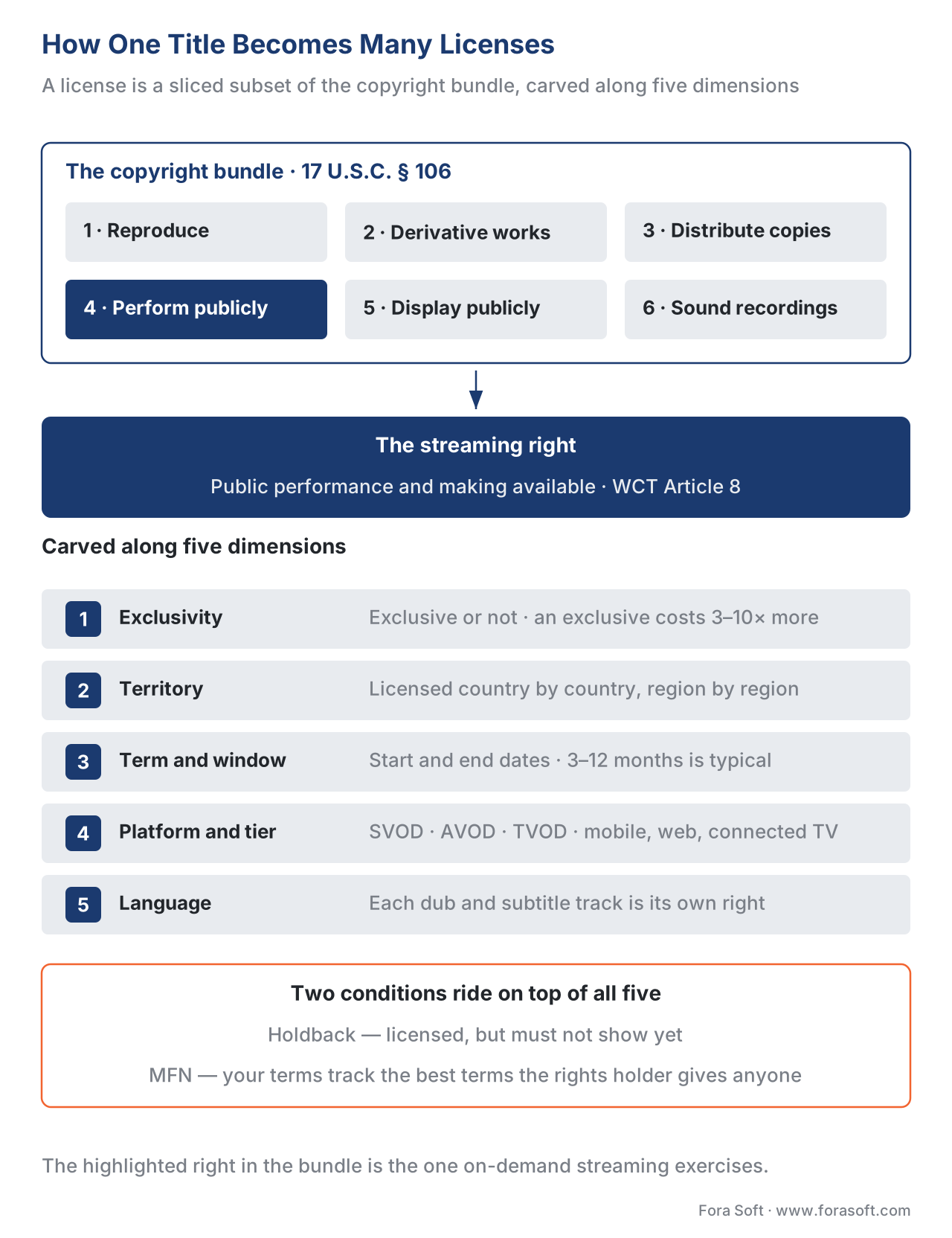 Figure 1. A license is a sliced subset of the copyright bundle. The same title can be sold many times by cutting along different combinations of the five dimensions.
Owning versus licensing a catalog
There are only two ways a title can be in your catalog: you own it (you made it or bought the copyright — an "original") or you license it (you rented a slice of someone else's rights for a term). The choice shapes both your economics and your architecture, and almost every real platform runs a blend.
Licensing is how you fill a catalog quickly and cheaply at first. You pay a fee for a term, the title appears, and viewers have something to watch on launch day. The catch is everything that follows from "for a term": the title expires, the licensor controls it (they can decline to renew, raise the price, or pull it for their own service), and you are one of several carriers if the deal is non-exclusive, so the title is not a differentiator. Licensed content is an operating expense that recurs forever — when the term ends, you have nothing to show for the money unless you pay again.
Owning is the opposite trade. An original costs far more up front and carries production risk (it might flop), but once made it is a permanent library asset: no expiry, full control of every window and territory, and the freedom to license it out to others as a revenue line. This is the structural reason the largest streamers shifted so hard toward originals — licensed content is rented and controlled by the landlord, while an original is owned outright and never expires. It is also why content budgets are enormous: global streaming-only content spend is estimated at roughly $101 billion in 2026, with Netflix guiding about $20 billion for the year and Disney around $24 billion across its direct-to-consumer and broader content slate (analyst and company figures, 2026; treat as orientation).
For a new platform the lesson is not "own everything" — you cannot afford to — but to be deliberate: license to fill the catalog, own (or commission) the few titles that are your identity, and build the rights system to handle both from day one. The table below is the trade in one view.
| Dimension | Licensed content | Owned content (original) |
|---|---|---|
| Upfront cost | Lower (fee for a term) | High (full production/acquisition) |
| Ongoing cost | Recurs every renewal, forever | None after production |
| Who controls it | The licensor (can pull/raise/refuse renewal) | You |
| Term | Fixed, expires (often 3–12 months) | Perpetual |
| Exclusive to you? | Only if you paid for exclusivity | Always |
| Can you license it out? | No | Yes — a revenue line |
| Catalog risk | Title can vanish at term end | You bear production/flop risk |
| Differentiates your platform? | Weakly (others may carry it) | Strongly |
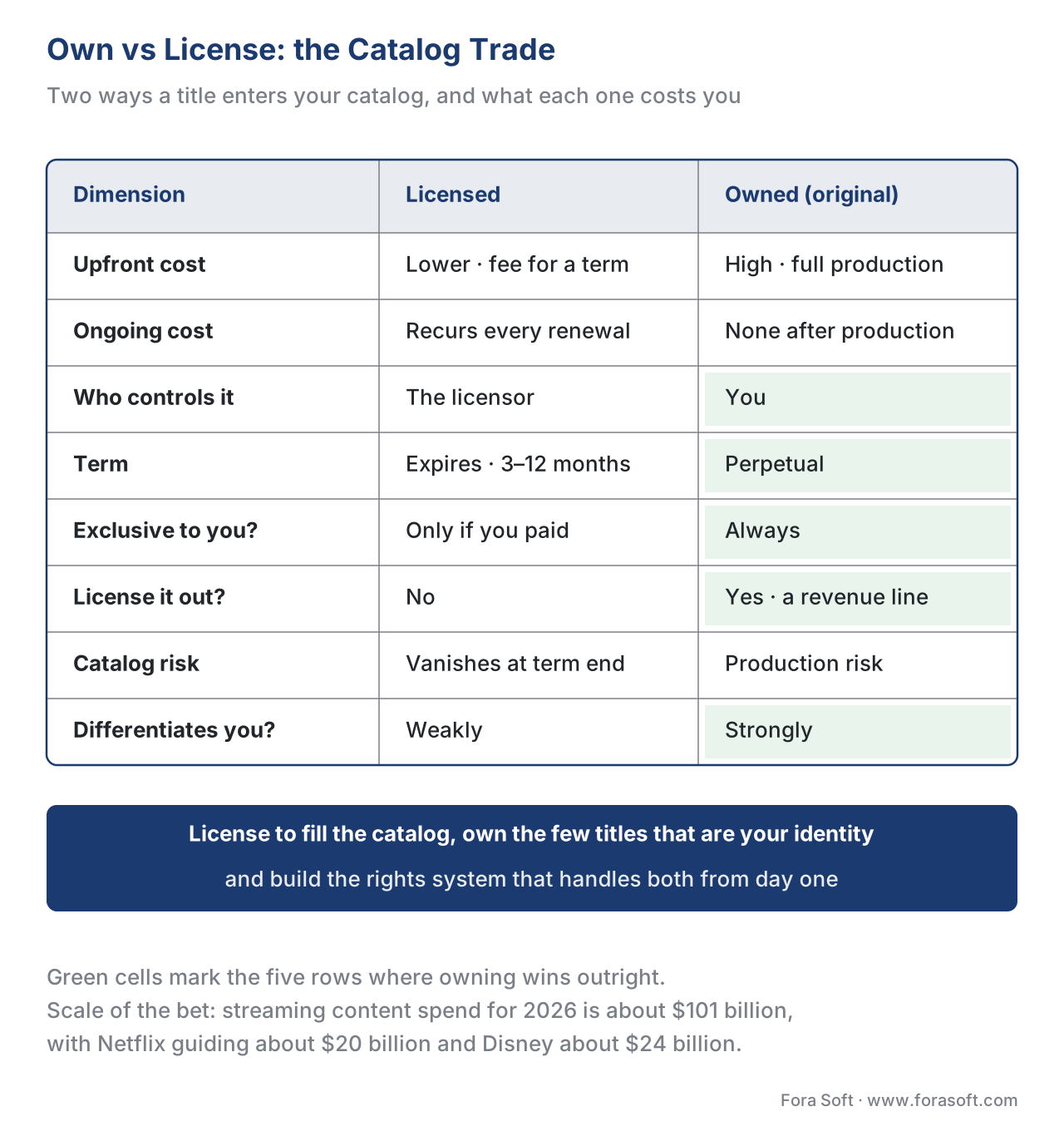 Figure 2. The own-versus-license trade in one view. Owning costs more up front but yields a permanent, controlled, exclusive asset; licensing is cheap to start but rented and expiring.
From contract to catalog: how rights become metadata
Here is the engineering heart of the article. A signed contract is a PDF in a lawyer's drive; your platform cannot read a PDF on every play. So the terms have to be turned into structured rights metadata — machine-readable records that say, for each title, exactly what the five dimensions and their conditions allow. The industry has a standard name and a standard format for the most important of these records.
The identifier comes first. Before you can attach rights to a title you need to be certain which title you mean — across your competitor's catalog, the studio's delivery, and three localized versions. The industry standard for this is the Entertainment Identifier Registry (EIDR), a universal ID for movies, episodes, edits, and even encodings, with its identifier format defined as an IETF standard (RFC 7972). EIDR is deliberately not a rights system — it does not say who may show what — but it is the hook every rights record, avail, and royalty report hangs off, so that "this title" means the same thing in every system. Get the identifier wrong and every downstream rights decision is attached to the wrong content.
Then come the avails. When a content provider tells a platform what it may carry, it sends a structured availability record the industry calls an avail (short for "availability"). The standardized format is EMA Avails, a schema first released in 2013 and maintained today as part of the MovieLabs Digital Distribution Framework (MDDF), alongside the Common Metadata and Media Entertainment Core specifications (the framework's specs were refreshed in the December 2025 MDDF update). An avail is, in MovieLabs' own words, the communication "about when video titles will be available online and in which territories," plus the language, run-time, format, license type, and pricing — exactly our five dimensions, expressed as data a machine can ingest. Avails moved the industry off emailed spreadsheets and onto an XML schema precisely so platforms could automate scheduling and, just as importantly, timely takedown when a window closes.
So the pipeline is: contract → avails (keyed by EIDR) → your rights database → your availability and entitlement services → the player. Each hop turns legal language into something more executable, until the final hop is a yes/no the player can act on in milliseconds. Build this pipeline well and a new studio deal is a data import; build it badly and every deal is a manual project.
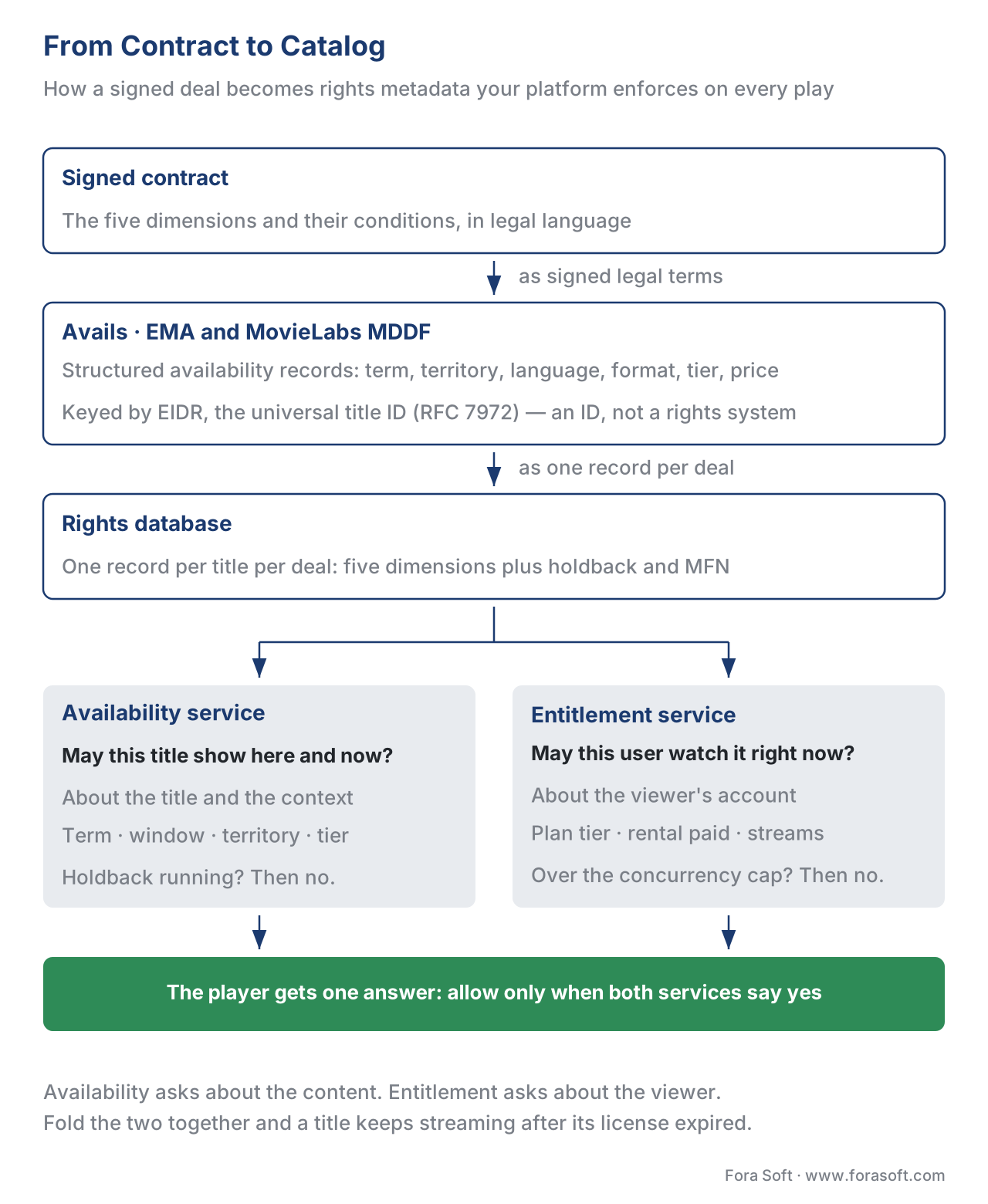 Figure 3. The rights pipeline. A contract becomes EIDR-keyed avails, which populate a rights database that an availability service and an entitlement service read on every catalog render and every play.
Two services, two different questions
Teams new to this conflate two systems that answer two genuinely different questions. Keeping them separate is the cleanest architectural decision in the whole rights layer.
The availability service answers a question about the title and the context: "May this title be shown here and now, to anyone at all?" It reads the rights metadata and resolves the five dimensions for the current request — is today inside the term and window, is the viewer's territory licensed, is this device class and this business tier (AVOD vs SVOD) covered, is there an active holdback? If any answer is no, the title should not even appear in the catalog for that request. Availability is about the content's rights.
The entitlement service answers a question about the specific viewer: "Is this particular user allowed to watch this title right now?" Is their subscription active, have they paid for this rental, are they within their concurrent-stream limit, does their plan tier include this title? Entitlement is about the user's account, and we cover it in depth in subscription billing and entitlement.
A play only proceeds when both say yes: the content must be licensable to that request (availability) and the user must be cleared to watch it (entitlement). The classic, expensive bug is folding rights into entitlement — checking "does the user's plan include this?" but not "is this title still licensed in this country today?" That gap is how a title keeps streaming three days after its license expired, which is a breach a rights holder can detect and act on. Separate the two services and each stays simple and correct.
Worked example: enforcing a window across a catalog
Numbers make the stakes concrete. Suppose you license a film for SVOD in Brazil, non-exclusive, for a 12-month term starting 2026-07-01, with a 90-day holdback at the front because the title is still in its transactional window elsewhere. Walk the dates the way your availability service must:
Term start:            2026-07-01
Holdback (90 days):    2026-07-01  →  2026-09-28  (licensed, but MUST NOT show)
Available to stream:   2026-09-29
Term end:              2027-06-30  (last day it may stream)
Goes dark:             2027-07-01  (00:00, Brazil time)
Three facts an engineer must take from this. First, "licensed" and "showable" are not the same — for the first 90 days you hold the right but a holdback forbids display, so a naive "do we have the rights?" check would wrongly publish it. Second, time zones are part of the rule — "goes dark 2027-07-01" means midnight in São Paulo, not on your servers, and getting the zone wrong streams the title into breach for hours. Third, this is one title in one country; a catalog of 5,000 titles across 30 territories is 150,000 such windows, each with its own clock. No team enforces that by hand — it is exactly why the avails-to-availability pipeline above exists, and why the takedown side of it matters as much as the publish side.
The same arithmetic, run forward across a title's whole life, produces the release window sequence — the ordered set of exclusive periods a title moves through. A typical theatrical film descends a staircase: cinema first, then premium transactional (PVOD/TVOD) rental and purchase, then a first subscription window (often called "pay-1"), then ad-supported and FAST, and eventually free or linear TV. Each step is a separately licensed window with its own start and end, and your platform usually owns only one or two steps of that staircase for any given title. Windowing has its own article — content windowing and availability — but the point here is that a window is just the term-and-window dimension drawn on a timeline.
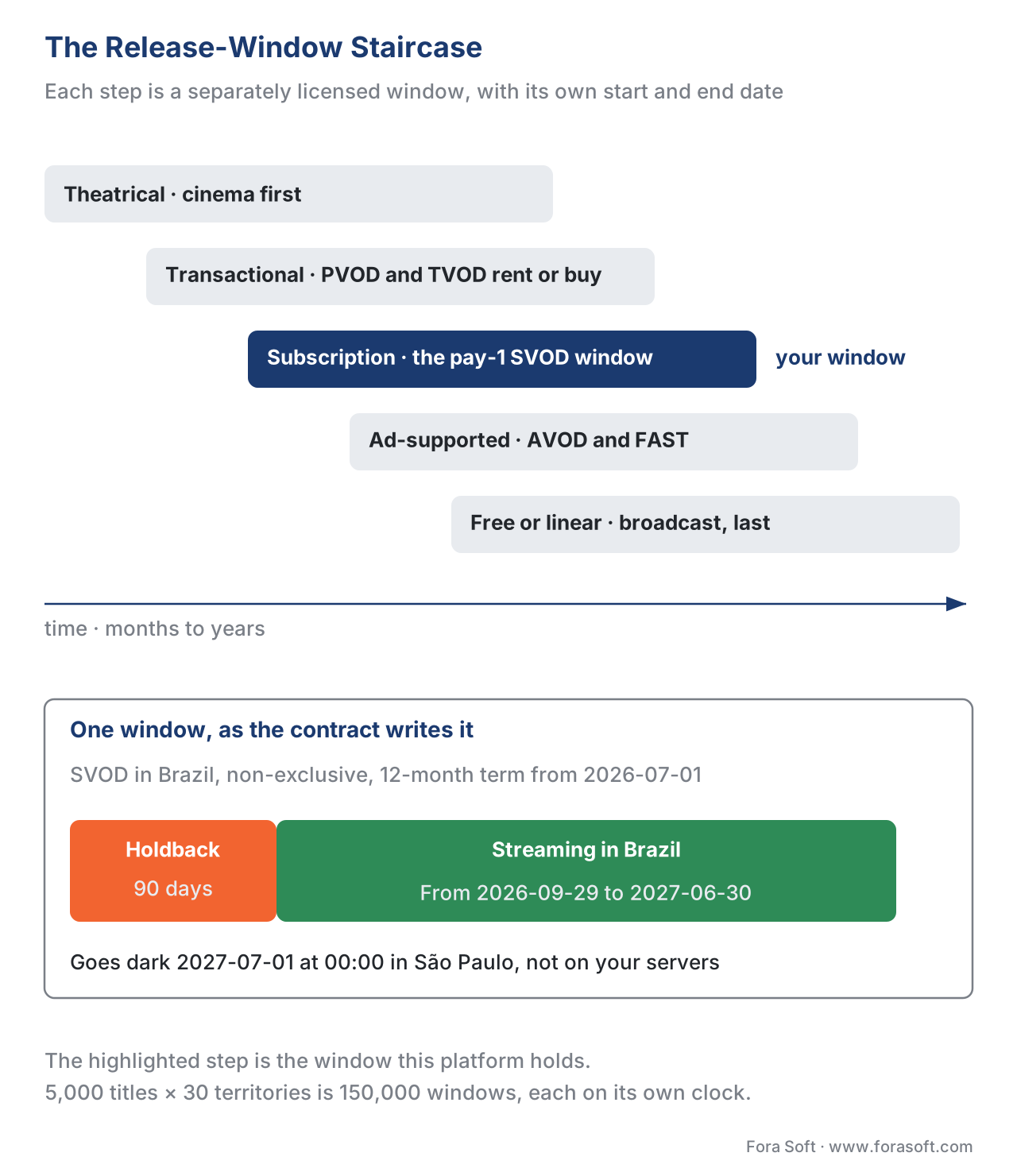 Figure 4. The release-window staircase. Each step is a separately licensed window with its own start and end date; a platform typically holds one or two steps per title and must switch availability on the contract dates.
The trap inside the title: music and underlying rights
A subtle, costly mistake is assuming that licensing "the film" licenses everything in the film. It does not. A movie or show is a stack of separately owned works, and the most common landmine is music. Using a song in audiovisual content touches two distinct rights that come from two different owners: the synchronization (sync) right in the musical composition — permission to set the song in time with the picture — and the master right in the specific sound recording used. Hold one without the other and you cannot legally stream the scene.
This is why a title that was cleared for one territory or one term can suddenly be unstreamable in another: the music was licensed only for the original scope. It is also why catalogs sometimes carry a title with a song replaced — the original music's rights lapsed or never extended to streaming. For a platform builder the practical defense is to treat underlying rights (music, archival footage, talent likeness) as part of a title's rights metadata, not as someone else's problem, and to surface any music-rights limitation in the same availability check as everything else. The reporting and payment side of music rights — performance royalties to organizations such as ASCAP, BMI, SESAC, and GMR, and recording royalties via SoundExchange for the relevant digital uses — is the domain of royalties, reporting, and rights compliance.
A common mistake: the catalog as a flat list
The single most expensive architectural error in this topic is modeling the catalog as a flat list of titles with a country tag — "here are our 5,000 titles, and here are the countries we operate in." It feels sufficient on launch day with 200 owned titles and one territory. It collapses the moment real licensed content arrives, because it cannot express "available in Brazil from 29 Sep 2026 to 30 Jun 2027, SVOD tier only, original audio and Portuguese subtitles but not the dub, held back for the first 90 days, non-exclusive." A country tag has nowhere to put a date, a window, a tier restriction, a language limit, or a holdback.
The fix is not heroic, but it must be early: make rights a first-class entity in the data model from the start. Every title links to one or more rights records, each carrying the five dimensions plus the holdback/MFN conditions, each keyed to a stable identifier like EIDR, each ingested from avails rather than typed in by hand. The availability service reads those records; the entitlement service reads the user's account; a play needs both. Retrofitting this onto a flat catalog after the first big studio deal is a rebuild of the most central table in the system — far more expensive than designing it in. As with the business model in SVOD, AVOD, TVOD, and hybrid, the cheap moment to get rights right is before you pour the foundations.
Free download: Content Rights Readiness ChecklistOne page of the rights questions to answer for every title before it goes live: the five license dimensions, own versus license, the contract-to-metadata pipeline, and the availability and entitlement gate that has to agree before a play starts.Where Fora Soft fits in
The reason we treat the rights layer as architecture, not paperwork, is that it sets the hardest scaling and correctness constraints on the whole platform: an availability service consulted on every catalog render and every play, across every territory, that must be both fast and never wrong. Since 2005, Fora Soft has shipped 625+ video projects for 400+ clients across video streaming, OTT/Internet TV, live conferencing, e-learning, surveillance, and telemedicine — including platforms whose catalogs blend owned and licensed content under exactly the kind of windowed, territory-bound, multi-tier rights this article describes. When a media company arrives with a slate of studio deals, our first engineering job is the one mapped here: turn contract terms into rights metadata and a rights-aware availability service, so the catalog enforces every license automatically as the platform scales, instead of relying on a spreadsheet and good intentions.
The handbook
Fora Soft Video Engineering Handbook
We wrote a seven-volume handbook, 9,000+ pages, that works through the whole video stack from the pixel to production — encoding, delivery, audio and AI — so the rights layer in this article sits on machinery you can follow all the way down. Volume 3 sits closest to this chapter: DRM and key delivery, the player that asks for a license, and the delivery economics that decide what a windowed, multi-territory catalog costs to run. Volume 2 covers the packaging and delivery your availability service switches on and off on the contract dates, and volume 1 explains what actually gets encoded for every title and version you hold rights to. Written by Nikolay Sapunov, CEO at Fora Soft.
Can your platform prove a title goes dark on its expiry date in every territory?
Send us your catalog size, the territories you sell in and the deals you have signed, and we will map the five dimensions into a rights model, split availability from entitlement, and wire the avails feed that switches titles on and off on the contract dates — so 150,000 windows enforce themselves instead of living in a spreadsheet. 250+ video products shipped since 2005.
See our case studies
Case study
Franchise Record Pool
A DJ platform whose library is 720,000+ licensed tracks from Sony Music, Universal, Virgin and other labels, with per-play tracking reported back to the rights holders — a catalog where the rights records, not the files, are the hard part.
Case study
Smart IPTV for Android Set-Top Boxes
A white-label operator app on Android set-top boxes — live channels, EPG and VOD served through the Stalker and Ministra middleware — where what a subscriber may open is decided by the operator’s entitlement, not by the app.
Case study
Worldcast Live
HD concert streaming at 1.5 Gbit/s with 0.4–0.5 s latency for 10,000 simultaneous viewers, sold as pay-per-view tickets — a window that opens and closes on one night, per event and per territory.
What to read next
Windowing
Content windowing and availability for OTT platforms
The term-and-window dimension drawn across a title’s whole life.
Entitlement
Subscription billing and entitlement
The per-user service that has to agree before availability means a play.
Compliance
Royalties, reporting and rights compliance
What you owe, and what you must report, once the title is streaming.
Business model
SVOD vs AVOD vs TVOD: OTT business models explained
The platform-and-tier dimension, priced — a title cleared for one tier is not cleared for the next.
References
- 17 U.S.C. § 106 — Exclusive rights in copyrighted works (United States Code). Tier 1. Establishes the copyright "bundle of rights," including the public-performance right (§106(4)) that streaming exercises; the legislative history confirms each right "may be subdivided indefinitely and … owned and enforced separately." https://www.law.cornell.edu/uscode/text/17/106
- 17 U.S.C. § 101 — Definitions ("transmit", "perform", "publicly") (United States Code). Tier 1. Defines transmission and public performance so that on-demand streaming to viewers in separate places and at different times is a public performance by transmission. https://www.law.cornell.edu/uscode/text/17/101
- WIPO Copyright Treaty (1996), Article 8 — Right of Communication to the Public (WIPO). Tier 1. The international "making available" right covering on-demand interactive streaming, and the basis for territory-by-territory licensing; also clarifies that providing physical facilities is not itself communication. https://www.wipo.int/wipolex/en/text/295166
- EIDR — Entertainment Identifier Registry; URN namespace (IETF RFC 7972). Tier 1. The universal content-identifier standard that rights records, avails, and royalty reports key to; explicitly not a rights-management system itself. https://datatracker.ietf.org/doc/rfc7972/
- EMA Avails / MovieLabs Digital Distribution Framework (MDDF) (MovieLabs / Entertainment Merchants Association). Tier 2. The standardized content-availability metadata schema (XML) communicating term, territory, language, format, license type, and pricing; refreshed in the December 2025 MDDF update. https://www.movielabs.com/md/avails/
- MovieLabs Common Metadata & Media Entertainment Core (MEC) (MovieLabs). Tier 2. The metadata foundations EMA Avails builds on for title and version identification across the digital supply chain. https://www.movielabs.com/md/md/
- Specification for Enhanced Content Protection (ECP) (MovieLabs). Tier 2. The studio-driven protection profile that premium licenses commonly require, linking the rights layer to the DRM tier. https://movielabs.com/md/ecp/
- Music licenses and royalties — sync, master, performance (Copyright Alliance). Tier 5. Explains the distinct synchronization and master rights (and performance royalties) that ride inside audiovisual titles and must be cleared separately. https://copyrightalliance.org/music-licenses-and-royalties/
- Streaming content spend 2026 (Netflix ~$20B; Disney ~$24B DTC/slate; ~$101B streaming-only total) (analyst/company aggregation, 2026). Tier 5. Orientation figures for the owned-vs-licensed economics; figures diverge by methodology. https://www.statista.com/statistics/964789/netflix-content-spend-worldwide/
- OTT content-licensing practice — exclusivity premium, term lengths, windows (industry guides, 2025–2026). Tier 7. Orientation for market practice (exclusive ≈ 3–10× non-exclusive; 3–12-month terms; ~7-year worldwide-exclusive originals); used only for orientation, not as a legal source. https://vitrina.ai/blog/licensing-models-ott-platforms/
Per the conflict hierarchy, the statutory and treaty texts (refs 1–3) control over the market-practice guides (ref 10); where a popular guide implied "licensing the film licenses the music," the article follows copyright's bundle/sync-vs-master framing and flags the distinction.
