


Why this matters
If you are a founder, product manager, or first-time streaming CTO, you will be asked "how will it make money?" long before you write a line of code — and the answer changes what you build, not just what you charge. Pick subscription and you owe your users a billing system, an entitlement service, and a DRM tier strong enough to license premium content; pick advertising and you owe them an ad-decision server, server-side ad insertion, and a viewing-data privacy posture that can survive a class action. Choosing the wrong model first, or pretending you can decide later, is how teams build an SVOD platform and then spend a second project bolting on an ad stack that should have shaped the foundation. This article maps each model to the systems it demands so you can scope the right platform once. It follows the vocabulary article — there we separated how video is delivered from who controls the clock; here we answer who pays, and what that costs you to build.
The one idea: the model is an architecture decision
Most explanations of streaming business models stop at the revenue definition — subscription versus ads versus rentals — as if the only difference were the line item on an invoice. That framing is why so many platforms are mis-scoped. The revenue model is the least interesting part of the difference. What matters to a build is that each model conscripts a different set of systems, and those systems are the most expensive, highest-risk parts of an OTT platform: the money-handling layer, the content-protection layer, and the data-privacy layer.
Think of the platform you saw in the end-to-end map — ingest, encode, package, protect, deliver, play — as a chassis. Every streaming service shares that chassis. The business model is the engine you drop into it, and each engine bolts to different mounting points. Subscription bolts to a billing engine and an entitlement service. Advertising bolts to an ad-decision server and a consent manager. Transactions bolt to a payment processor and a refund workflow. Choose the engine first, because you cannot re-drill the mounting points cheaply once the chassis is welded.
So read the four models below not as "ways to charge" but as "things you are now obligated to build." That reframing is the whole point of this article.
The four shapes, in plain language
Before the architecture, the definitions — each in one breath, with the everyday analogy that anchors it.
SVOD — Subscription Video on Demand. The viewer pays a recurring fee (monthly or yearly) for unlimited access to a library. It is the gym membership model: one price, walk in as often as you like, the door checks your card. Netflix's flagship plan, Disney+, and Max are SVOD. The viewer is the customer, and the recurring relationship is the asset you protect.
AVOD — Advertising-based Video on Demand. The content is free to watch; advertisers pay to interrupt it. It is commercial radio: you tune in for nothing, and the ads between songs fund the station. Tubi, the free tier of YouTube, and Pluto TV's on-demand library are AVOD. Here the advertiser is the paying customer and the viewer is the audience you sell access to.
TVOD — Transactional Video on Demand. The viewer pays per title, either to rent for a window or to buy permanently. It is the cinema box office or the old video-rental store: money changes hands for one specific film, one specific time. Apple TV rentals, premium new-release purchases, and pay-per-view (PPV) events are TVOD. Each transaction is a discrete sale tied to a single piece of content.
FAST — Free Ad-Supported Streaming Television. Free, ad-funded, but delivered as linear channels you tune into rather than an on-demand library you browse. It is broadcast TV reborn on the internet: a grid of channels, a schedule, ad breaks, no bill. The Roku Channel, Samsung TV Plus, and Pluto TV's live channels are FAST. We covered FAST's timing nature in the vocabulary article; here it matters as a monetization shape — AVOD economics on a linear schedule.
And then the one that describes most real platforms:
Hybrid. Two or more of the above in one product. The dominant pattern in 2026 is SVOD + AVOD: a paid ad-free tier and a cheaper (or free) ad-supported tier side by side. Netflix, Disney+, Max, and Prime Video all run an ad tier beside their flagship plan, and that ad tier is the volume-growth engine for most of them. Hybrid is not a fence-sit; it is a deliberate choice to capture both the viewer who pays to skip ads and the viewer who watches ads to pay nothing — at the cost of building both engines.
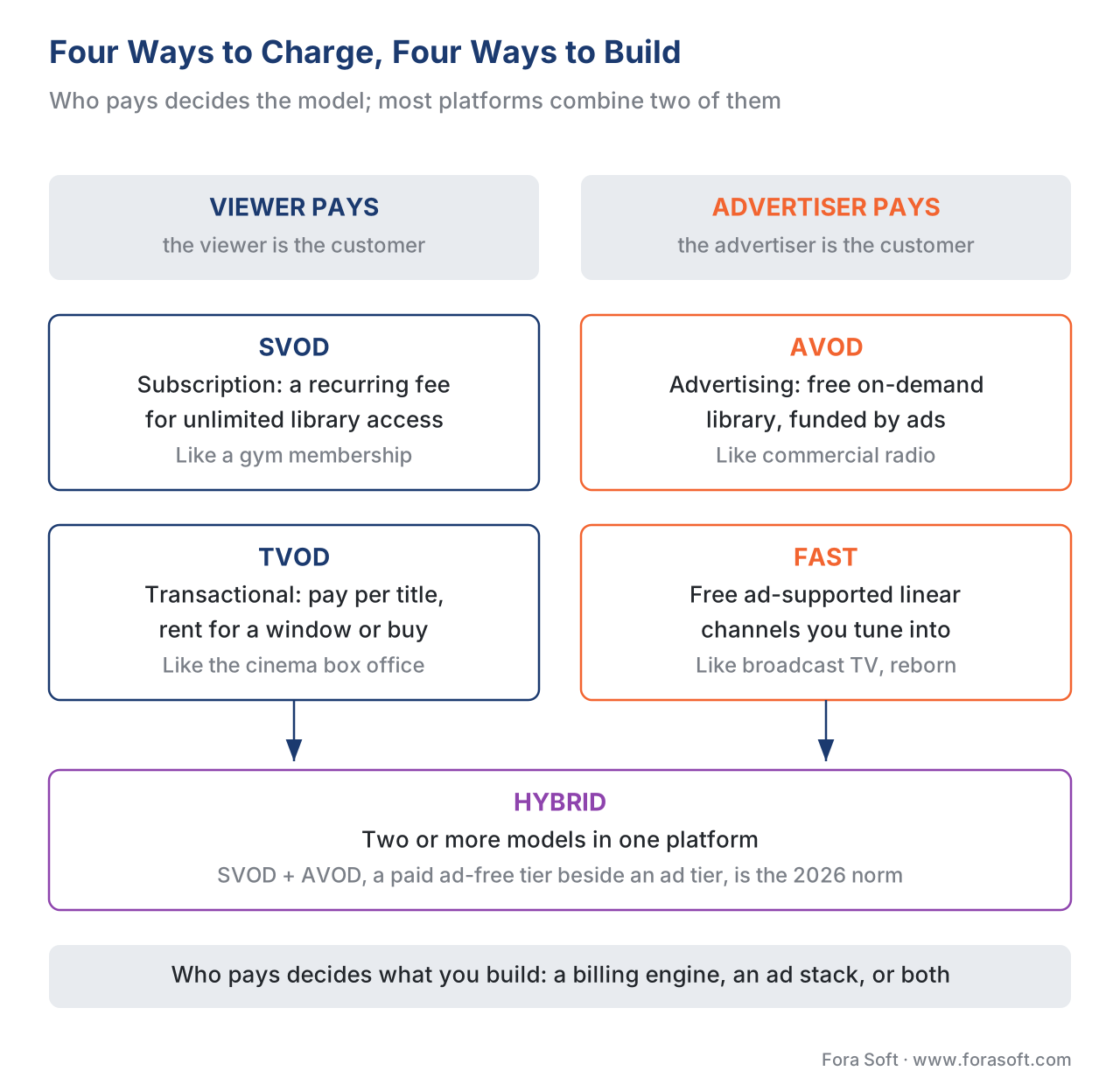 Figure 1. The four models on two axes — who pays (viewer vs advertiser) and how often (recurring, per-title, or continuous free) — with hybrid as the overlap most platforms occupy.
The market in 2026: where the money and growth actually are
Before scoping, know the shape of the money — because it tells you which engine is worth building well. The figures below are 2026 analyst estimates and vary by methodology; treat them as orientation, not precision.
Global SVOD revenue sits around $95–105 billion in 2026, still the largest pool, but maturing — growth has slowed to roughly 6–9% a year as the subscription market saturates in wealthy regions. AVOD is smaller at roughly $30–35 billion, but growing far faster — 15–20% a year — pulled up by connected-TV ad inventory. FAST has carved out a $12–18 billion ad-supported niche of its own and is the fastest-growing format by percentage. TVOD is a mature, steady $6–8 billion — small, but high-margin and uncomplicated.
The single most important market fact for an architect is what it implies: the growth is in advertising. The clearest evidence is the SVOD giants themselves adding ad tiers. Netflix's ad-supported tier passed 250 million global monthly active viewers by May 2026 (up from about 94 million a year earlier), roughly 45% of US Netflix sign-ups now choose the ad tier, and Netflix expects around $3 billion in ad revenue in 2026, double its 2025 figure (Netflix investor materials, 2026). When the company that defined pure subscription builds an ad stack, the lesson for a new platform is plain: design as if you will need both engines, even if you launch with one.
SVOD: what subscription forces into the build
Choose subscription and you have signed up to build a recurring-revenue machine, and the hard part is not the paywall the user sees — it is the entitlement service behind it.
The entitlement service is the real product. Entitlement is the system that answers one question on every single play: is this viewer allowed to watch this title right now? It must know the viewer's plan, whether their payment is current, how many simultaneous streams they are allowed, and which regions and titles their plan covers. This sounds simple until you add free trials, plan upgrades and downgrades mid-cycle, proration, family profiles, and the dunning process (the automated retry-and-remind flow when a card is declined). Entitlement is consulted on every play, so it must be fast and never wrong — a false "no" locks out a paying customer, and a false "yes" gives away content you are obligated to protect. We cover this engine in depth in subscription billing and entitlement; the architectural point here is that SVOD's center of gravity is a stateful, always-consulted service that AVOD and TVOD need in far lighter form.
Premium content demands premium protection. Subscription platforms compete on catalog, and a good catalog means licensed studio content — which comes with contractual protection requirements. To license HD and 4K/HDR titles from major studios, you generally must encrypt with multi-DRM and meet a hardware security level: Google Widevine L1 (keys and decryption handled inside a hardware-isolated Trusted Execution Environment) and Apple FairPlay, frequently with forensic watermarking on the highest tiers, broadly along the lines of the MovieLabs Enhanced Content Protection specification. Widevine L3 — software-only protection — is typically capped to standard definition and will not unlock a 4K license. This is a real cost and a real constraint: your DRM tier is dictated by your content deals, and premium SVOD sits at the demanding end. The mechanics live in our DRM block, starting with why DRM exists and the three DRM systems.
The app-store tax is an architecture decision, not an afterthought. If viewers subscribe inside your iOS or Android app, the platform store takes a cut of that subscription. Apple charges 30% in the first year of a subscription and 15% from the second year onward, with a 15% rate for developers under \$1 million in revenue via the Small Business Program; Google Play charges 15% on subscriptions (Apple and Google developer policies, 2026). That cut comes straight off your highest-value revenue, which is why SVOD platforms architect deliberately around where the subscription is sold — a web sign-up flow outside the app keeps the full dollar, while in-app convenience costs you the commission. You cannot retrofit this cleanly; the billing routing and the account-linking flow have to be designed in from the start. The arithmetic below shows why it is worth the design effort.
Churn is the metric the whole architecture serves. Because the revenue recurs, the thing that kills an SVOD platform is churn — the rate at which subscribers cancel. Every system above ultimately exists to reduce it: fast entitlement so playback never fails, dunning so an expired card does not become a cancellation, and the recommendation layer (covered in why discovery decides retention) so viewers keep finding the next thing to watch. SVOD analytics are churn analytics, detailed in churn, retention, and subscription analytics.
What SVOD does not need, notably, is an ad stack. No ad-decision server, no SCTE-35 ad markers, no VAST tags, no per-impression measurement. That entire subsystem — which is the heart of the next model — is absent from a pure subscription build. That asymmetry is exactly why the model must be chosen first.
AVOD: what advertising forces into the build
Choose advertising and you have signed up to build an ad-delivery and measurement machine — and to take on a data-privacy liability that subscription platforms largely avoid. The viewer pays nothing, so everything that earns money lives in the ad path.
The ad stack is a platform inside the platform. To monetize a free stream you need several systems that SVOD never touches. First, ad signaling: the stream must carry frame-accurate markers that say "an ad break goes here," the industry standard for which is SCTE-35 (ANSI/SCTE 35). Second, an ad-decision server that, when a break arrives, decides which ad to play for this viewer, using the VAST and VMAP response formats from the IAB Tech Lab. Third, an insertion mechanism — and here you face the defining AVOD architecture choice between client-side ad insertion (CSAI), where the player fetches and plays ads itself, and server-side ad insertion (SSAI), where ads are stitched directly into the video stream at the server so they arrive as one seamless feed. SSAI is the modern default because it survives ad-blockers and avoids the buffering glitches of client-side ad loading. These choices get their own articles — SSAI vs CSAI, SCTE-35 and ad signaling, and ad serving, VAST/VMAP, and the ad stack — but the scoping fact is blunt: AVOD adds an entire revenue subsystem that SVOD does not have.
Privacy is now a first-class engineering concern, not a legal footnote. AVOD earns more when ads are targeted, and targeting means processing data about what each viewer watches. In the United States that runs straight into the Video Privacy Protection Act (VPPA, 18 U.S.C. § 2710) — a 1988 law, written for video-rental records, that has become the single most active basis for streaming privacy class actions. Plaintiffs allege that sharing a viewer's watch history with ad and analytics third parties (through tracking pixels and SDKs) without informed consent violates the statute, and over 200 VPPA suits were filed in 2025 alone; the scope question reached the US Supreme Court in Salazar v. Paramount Global (Privacy World, 2025). Layer on GDPR in Europe and CCPA/CPRA in California, and the consequence for your build is concrete: an AVOD platform needs a consent-management layer, careful control over what viewing data leaves the platform, and an auditable record of permission — none of which a pure subscription service must carry to the same degree. We treat this in privacy and viewing data: VPPA, GDPR, CCPA.
A registration wall instead of a paywall. AVOD usually wants the viewer's identity for frequency capping and targeting without charging them, so the gate in front of content is a registration wall (give us an email) rather than a paywall (give us a card). That is a different access-control pattern, covered in paywalls, registration walls, and access control.
Lighter DRM, heavier scale. AVOD catalogs often skew toward owned or lower-tier licensed content, so the protection bar can be lower — sometimes software-level DRM or robust token authentication is enough where premium SVOD would demand hardware L1. But AVOD lives or dies on scale: revenue is roughly impressions × fill rate × CPM, so free platforms chase large audiences, and large free audiences put real pressure on the CDN egress bill without the cushion of a guaranteed subscription. The protection tier may relax; the delivery-cost discipline does not.
TVOD: what transactions force into the build
Choose pay-per-title and you have signed up to build a storefront and a cashier, and the architecture concentrates around handling money for discrete sales rather than recurring relationships or ad impressions.
Payments and the PCI boundary. Every TVOD action is a real-money transaction — a rental or a purchase — so you integrate a payment processor and live with the PCI DSS (Payment Card Industry Data Security Standard) obligations that come with handling card data. The discipline is to keep card data inside the processor's vault and never let it touch your own systems, shrinking your compliance boundary. Pay-per-view (PPV) live events add a sharp twist: a one-time event sells a spike of transactions in the minutes before kickoff, so the purchase-and-entitlement path has to survive a thundering herd the way the live delivery pipeline does.
Transactional entitlement and rental windows. TVOD entitlement is per title and time-boxed, not plan-wide. A rental typically grants, say, 48 hours of access from first play; a purchase grants indefinite access — but "indefinite" is still bounded by the underlying license you hold from the rights owner. The entitlement service therefore tracks individual title grants with their own clocks, a different data model from SVOD's plan-level grants. Refunds, failed payments, and chargebacks each need an explicit reversal path, because a transaction can be undone in a way a streamed ad impression cannot. The details live in TVOD and transactional flows: rent, buy, PPV.
Windowing makes content appear and disappear on a schedule. TVOD usually sits at the front of the release window — the ordered sequence in which a title becomes available across channels (cinema → TVOD → SVOD → AVOD). A new release might be rent-only for its first weeks, then move to subscription. Your platform has to switch a title's availability automatically as windows open and close, which is a rights-and-scheduling system explained in content windowing and availability.
TVOD is, in pure form, the simplest model to operate at small scale — no recurring billing to reconcile, no ad stack to fill — which is why it is often a platform's first or supplementary revenue line rather than its whole identity.
FAST: AVOD economics on a linear chassis
FAST reuses AVOD's entire ad stack — SCTE-35, ad-decision server, SSAI — and adds the one thing on-demand AVOD does not need: a linear playout system. A playout scheduler stitches pre-recorded files into a continuous, never-ending channel with a program guide, as if it were a broadcast network. Because the audience of a channel converges on the same moment, FAST also inherits the concurrency and ad-density challenges of scheduled viewing. We covered the linear mechanics and the SCTE 301 channel-assembly standard in the vocabulary article; as a monetization choice, FAST is best understood as "AVOD, but you also operate channels." For a media owner with a deep back catalog, that is an attractive way to turn a dormant library into ad-earning inventory without asking anyone to subscribe.
Hybrid: why most real platforms build two engines
Here is the reality the four clean definitions hide: most successful platforms in 2026 are hybrids, and the dominant shape is SVOD plus an AVOD tier. The logic is simple. A pure subscription price excludes everyone unwilling to pay it; a pure ad model leaves money on the table from viewers who would happily pay to remove ads. Running both tiers captures both populations — the ad-free subscriber and the ad-tolerant free (or cheap) viewer — and lets the platform move users between them rather than losing them at the door.
Netflix is the worked example. It launched as the archetype of pure SVOD, resisted advertising for years, and now runs a hybrid: a flagship ad-free plan alongside an ad tier that reached 250M+ monthly active viewers by mid-2026 and is its fastest-growing segment (Netflix investor materials, 2026). The ad tier does not replace subscription revenue; it stacks a second revenue stream — ad dollars — on top of a lower subscription price, and the net revenue per ad-tier user approaches that of a standard subscriber as the ad business matures.
The architectural cost of hybrid is the headline of this whole article: you build both engines. Hybrid SVOD + AVOD means a billing-and-entitlement system and a full ad stack, a premium DRM tier and a consent-management layer, churn analytics and impression measurement. This is precisely why a "simple streaming app" so often balloons in scope — the moment someone says "and a free ad-supported tier," the build roughly doubles in monetization surface area. The mitigation is not to avoid hybrid (the market rewards it) but to design for it from day one, so the second engine is a planned mounting point rather than a retrofit. The strategic version of this decision is the capstone article pricing, packaging, and the monetization decision.
 Figure 2. The same chassis, different engines. Each model marks which platform subsystems it makes mandatory; hybrid (right column) inherits the union of SVOD and AVOD.
The models against the architecture, in one table
| Requirement it forces | SVOD | AVOD | TVOD | FAST | Hybrid (SVOD+AVOD) |
|---|---|---|---|---|---|
| Recurring billing engine | Required | — | — | — | Required |
| Entitlement service | Plan-level, heavy | Light (free/registered) | Per-title, time-boxed | Light | Plan-level, heavy |
| Payment processor + PCI scope | For sign-up | — | Core | — | For sign-up |
| Ad stack (SCTE-35, VAST, SSAI) | — | Core | — | Core | Required |
| Linear playout scheduler | — | — | — | Required | If FAST tier added |
| DRM tier (typical) | Hardware L1 + FairPlay | Often software L3 / token | Hardware for new releases | Software / token | Hardware (premium tier) |
| Privacy / consent layer (VPPA, GDPR) | Baseline | Heightened | Baseline | Heightened | Heightened |
| Primary success metric | Churn rate | Fill rate × CPM | Transactions, refunds | Fill rate × CPM | Both |
| Relative build complexity | High | High | Medium | High | Highest |
"Required" cells are lightly the gating systems — leave one out and that revenue model does not function. The table is the reason the model is chosen before the architecture, not after.
Worked example: the app-store tax, and the AVOD break-even
Two pieces of arithmetic make the stakes concrete. Both are the kind of number a founder should see before committing to a model.
The app-store tax on SVOD. Suppose your subscription is \$12.00 per month and you have 100,000 subscribers, all paying through Apple in their first year. Gross monthly revenue is:
100,000 subscribers × $12.00 = $1,200,000 / month gross
Apple's first-year commission is 30%, so the platform keeps:
$1,200,000 × (1 − 0.30) = $1,200,000 × 0.70 = $840,000 / month net
That is \$360,000 a month — \$4.32 million a year — handed to the store, purely as a function of where the subscription was sold. Now route even half of those sign-ups through a web flow outside the app, where you keep the full dollar (minus a ~3% payment-processing fee):
50,000 web subs × $12.00 × 0.97 = $582,000 net
50,000 in-app subs × $12.00 × 0.70 = $420,000 net
Total = $1,002,000 / month  →  +$162,000/month vs all-in-app
The web-billing architecture pays for itself many times over — but only if it was designed in from the start. That is why "where is the subscription sold" is an architecture question, decided in Block 1, not a growth-hack discovered in year two.
The AVOD break-even against a subscriber. How many ad-supported viewers does it take to equal one subscriber? Say a subscriber yields \$12/month. An AVOD viewer's revenue is roughly ad impressions × CPM. If a viewer watches 20 hours a month, sees about 10 ad minutes per hour at, say, \$20 CPM (cost per thousand impressions) with ~2 ad impressions per minute:
20 hours × 10 ad-min/hr × 2 impressions/min = 400 impressions/month
400 impressions × ($20 / 1,000) = $8.00 / month per heavy viewer
So a heavy free viewer earns about two-thirds of a subscriber — but a light viewer who watches 2 hours a month earns barely \$0.80. The lesson the arithmetic teaches the architect: AVOD revenue is brutally sensitive to watch time, so the discovery and retention systems that keep free viewers watching are not a nicety — they are the revenue engine. This is why pure-AVOD platforms invest so heavily in the recommendation layer covered in Block 7.
A common mistake: deciding the model after the build
The most expensive error in this whole topic is treating the business model as a late, reversible, UI-level decision — "we'll launch subscription and add ads later if we need to." The trap is that later means a second platform project. An SVOD-first team optimizes for a small, high-value audience: a heavy entitlement service, premium DRM, modest delivery scale. Then the business asks for a free ad tier, and the team discovers it now needs an ad-decision server, SCTE-35 signaling, SSAI, a consent-management layer for VPPA exposure, and a delivery tier sized for a much larger free audience — none of which the original architecture anticipated. The retrofit costs more than building hybrid-ready from the start would have. The fix is cheap and entirely about sequencing: decide your one-to-three-year monetization shape during architecture, design the mounting points for the engines you will plausibly need, and only then build. Getting the model right on paper costs a week; getting it wrong in code costs a quarter.
Free download: OTT Business-Model Architecture ChecklistOne-page map of the platform systems each monetization model (SVOD, AVOD, TVOD, FAST, hybrid) forces into the build — billing, ad stack, payment/PCI, DRM tier, and privacy layer.Where Fora Soft fits in
The reason we lead our streaming engagements with the monetization question is that it determines the scale and the risk surface of everything downstream — the billing engine, the DRM tier, the ad stack, the privacy posture. Since 2005, Fora Soft has shipped 625+ video projects for 400+ clients across video streaming, OTT/Internet TV, live conferencing, e-learning, surveillance, and telemedicine, including platforms that run subscription, ad-supported, transactional, and hybrid models — sometimes all four inside one product. When a media company arrives with "we want to charge for video," our first job is the one this article does: turn the revenue model into a concrete list of systems to build and protect, so the platform is scoped for the right scale and the right obligations from day one rather than rebuilt after launch.
The handbook
Fora Soft Video Engineering Handbook
We wrote a seven-volume handbook, 9,000+ pages, that takes the video stack from a single pixel to production — encoding, delivery, audio and AI — and someone who works through it can design and build an OTT platform for any of the four models. Start with volume 3: players, DRM tiers and the economics of streaming, where subscription, ad and transaction revenue meet delivery cost. Volume 2 covers the HLS and MPEG-DASH path that SSAI stitches ads into, and volume 1 covers the encoding ladder that sets what a premium tier can promise. Written by Nikolay Sapunov, CEO at Fora Soft.
SVOD, AVOD, TVOD or a hybrid: which engines does your platform actually need?
Tell us how you plan to charge — subscription, ads, rentals, or a mix — and which devices you need to reach, and we will turn it into the list of systems to build: billing and entitlement, the ad stack, payment and PCI scope, the DRM tier and the privacy layer, with the app-store cut worked into the numbers. 250+ video products shipped since 2005.
See our case studies
Case study
Drundoo
A Bulgarian internet TV platform with live channels, catch-up TV and a video-on-demand library of movies, series, sports and concerts, sold on subscription plans with 60 channels included whatever the plan — SVOD with plan-level entitlement over live and VOD.
Case study
Vodeo
An iOS movie-rental app for Janson Media Group with 100K+ users: no subscription, viewers buy in-app tickets and spend them to rent single films or episodes, with AirPlay and Chromecast to the TV — TVOD with per-title rental access sold inside the app.
Case study
Perspire.tv
A live and on-demand fitness streaming platform where viewers buy Coins and spend them on trainer channel subscriptions, video rentals and live sessions, with Stripe payouts and trainers keeping 80% — a hybrid that runs subscription and transaction engines side by side.
What to read next
Monetization
OTT Monetization: SVOD, AVOD, TVOD & Hybrid Explained
How each revenue model wires into the platform, system by system.
Billing
Subscription Billing and Entitlement: the SVOD Engine
The billing engine and entitlement check the SVOD column requires.
Advertising
SSAI vs CSAI: Server-Side vs Client-Side Ad Insertion
The core of the ad stack every AVOD and FAST service runs.
Pricing
Streaming Monetization Models: the Pricing Decision
Choosing and combining models for a specific catalog and audience.
References
- 18 U.S.C. § 2710 — Video Privacy Protection Act (VPPA) (United States Code). Tier 1. The statute governing disclosure of a consumer's video-viewing records; the controlling law behind AVOD/streaming viewing-data class actions. https://www.law.cornell.edu/uscode/text/18/2710
- ANSI/SCTE 35 — Digital Program Insertion Cueing Message (SCTE). Tier 1. The ad-signaling standard (
splice_insert,time_signal) that marks ad breaks for AVOD and FAST insertion. https://account.scte.org/standards/library/catalog/scte-35-1-digital-program-insertion-cueing-message-part-1-legacy-splice-based-and-time-based-signaling/ - VAST 4.x / VMAP — Digital Video Ad Serving Templates (IAB Tech Lab). Tier 1. The ad-response and ad-break-timing formats the ad-decision server returns to an AVOD/FAST player or SSAI stitcher. https://iabtechlab.com/standards/vast/
- ISO/IEC 23001-7 — Common Encryption (CENC) (ISO/IEC). Tier 1. The encryption foundation for the multi-DRM tier SVOD/premium content requires; defines the
cenc/cbcsschemes. https://www.iso.org/standard/84637.html - MovieLabs Specification for Enhanced Content Protection (ECP) (MovieLabs). Tier 2. The studio-driven content-protection profile (hardware DRM, forensic watermarking) that premium SVOD/TVOD licensing is benchmarked against. https://movielabs.com/md/ecp/
- Google Widevine — DRM security levels (L1/L2/L3) (Google). Tier 3. The hardware (L1, TEE) vs software (L3) distinction that gates 4K/HDR studio licensing for subscription catalogs. https://developers.google.com/widevine/drm/overview
- Apple — Schedule 2, in-app purchase and subscription commission (Apple Developer Program, 2026). Tier 3. The 30% first-year / 15% subsequent-year subscription commission and the Small Business Program 15% rate. https://developer.apple.com/app-store/small-business-program/
- Google Play — service fees for subscriptions and in-app purchases (Google Play Console Help, 2026). Tier 3. The 15% subscription service fee and the announced reductions effective from mid-2026. https://support.google.com/googleplay/android-developer/answer/112622
- 2025 Video Privacy Protection Act Litigation Year in Review (Privacy World / Squire Patton Boggs, 2025). Tier 5. 200+ VPPA suits filed in 2025; Salazar v. Paramount Global reaching the US Supreme Court. https://www.privacyworld.blog/2025/12/2025-video-privacy-protection-act-litigation-year-in-review/
- Netflix Q1 2026 shareholder materials — ad-tier reach and ad-revenue guidance (Netflix, Inc., SEC Form 8-K, 2026). Tier 5. Ad-tier MAU growth and ~$3B 2026 ad-revenue expectation, evidencing the SVOD→hybrid shift. https://www.sec.gov/Archives/edgar/data/1065280/000106528026000137/ex991_q126.htm
- Streaming business-model market estimates 2026 (SVOD/AVOD/TVOD/FAST revenue pools) (industry analyst aggregation, 2026). Tier 5. Orientation figures for SVOD ($95–105B), AVOD ($30–35B), FAST ($12–18B), TVOD ($6–8B). https://www.emarketer.com/
