


Why this matters
If you are a founder, product manager, or first-time streaming CTO, the paywall is the feature everyone has an opinion about and almost nobody budgets correctly. The design team argues about the upgrade screen; meanwhile the part that actually protects revenue — the server that says yes or no on every play, the token that expires in ninety seconds, the geo-check that keeps you inside your content licenses, the stream counter that stops one password from becoming ten — gets built last, or not at all. Get it wrong in the permissive direction and you give your catalog away for free; get it wrong in the strict direction and you lock out paying customers and manufacture cancellations. This is the access gate in front of the subscription billing and entitlement engine, and it is where monetization meets enforcement.
The one idea: the paywall is a screen, access control is a system
It is worth saying plainly because so many teams miss it. The paywall — the screen that shows plans, collects a card, or asks for an email — is a user-interface element. Access control is the system that decides whether a viewer is allowed to watch, and then makes that decision true all the way down to the video bytes. The paywall is the sign on the door; access control is the lock, the bouncer, and the fact that the windows are barred too.
Here is the distinction that organizes everything else. Hiding the "Play" button when someone has not paid is a paywall. Making sure that even a viewer who finds the raw video URL, shares a login, or travels outside your licensed territory still cannot watch is access control. The first is a few hours of front-end work. The second is the entitlement service, the signed tokens, the tokenized delivery URLs, and the digital rights management (DRM) license working together. The rest of this article is mostly about the second thing, because the first thing is the part you already know how to build.
One scalability note up front, because it shapes the design. The access decision runs on every single play, which on a platform with a million viewers is tens of thousands of decisions a second at peak. That is why access control is built as a fast, stateless-at-the-edge check backed by a small authoritative service — not as a database query that joins five tables every time someone hits play.
The three paywall shapes, and what each one costs you
Before the enforcement stack, the product decision: what does a visitor get for free, and what triggers the ask? There are three canonical shapes, and they map directly onto the business models that decide a platform's architecture.
A hard paywall blocks everything until the viewer subscribes or buys. Nothing plays without payment. This is the model for premium, exclusive, must-have catalogs — live sports, first-run films, professional training — where the content is the reason people show up. It maximizes revenue per user and minimizes free-loading, at the cost of the hardest possible first impression: a stranger must pay before they have watched a second.
A metered paywall (also called a soft paywall) lets a visitor watch a set number of items — three videos a month, say — then asks them to pay. Borrowed from news publishing, it trades a little free consumption for the chance to build a habit before charging. It earns reach and search visibility (the free items are indexable and shareable) while still converting the engaged.
A freemium paywall keeps part of the catalog permanently free — often ad-supported — and reserves a premium tier behind the wall. The free tier is the marketing; the paid tier and the ads are the revenue. This is the default of the modern ad-supported world and pairs naturally with a registration wall, discussed next.
The choice is not cosmetic — it moves money. Industry app-economy data for 2026 puts hard-gated apps at a roughly 12.1% median download-to-paid rate by day 35, versus about 2.2% for freemium — a 5.5× gap — and roughly 2× the first-year value per paying user ($49.30 vs $24.24 median) (Airbridge, 2026 — analyst benchmark, methodology-dependent). Yet freemium dominates by sheer volume; the overwhelming majority of app-store apps use some free tier, because reach and category dynamics matter as much as per-user yield. The lesson is not "hard paywalls win"; it is that the shape is a deliberate trade between yield per user and total reach, and you should pick it on purpose.
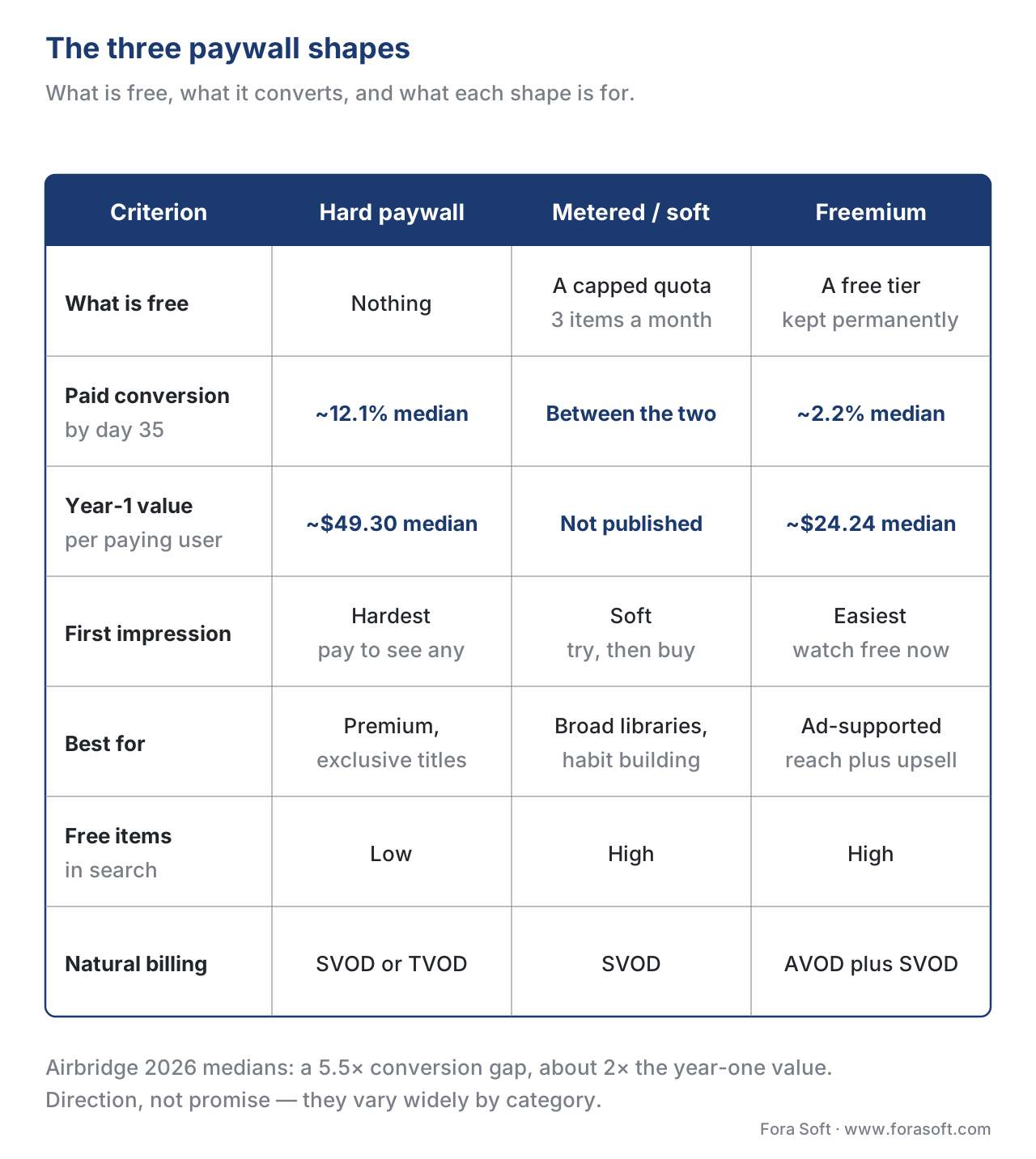 Figure 1. The three paywall shapes. Hard maximizes revenue per user and minimizes free-loading; metered trades a free quota for habit and reach; freemium keeps a free tier as marketing for the paid one.
| Criterion | Hard paywall | Metered / soft paywall | Freemium |
|---|---|---|---|
| What's free | Nothing | A capped quota (e.g. 3/month) | A permanent free tier |
| Best for | Premium / exclusive catalogs | Habit-building, broad libraries | Ad-supported reach + upsell |
| Convert rate (D35, 2026 benchmark) | ~12.1% median | Between the two | ~2.2% median |
| Y1 value per payer (2026 benchmark) | ~$49.30 median | — | ~$24.24 median |
| First impression | Hardest (pay to see anything) | Soft (try before you buy) | Easiest (watch free now) |
| Natural billing model | SVOD / TVOD | SVOD | AVOD + SVOD upsell |
| SEO / shareability of free content | Low | High (free items indexable) | High (free tier indexable) |
Table 1. The three paywall shapes as a trade-off. The "convert rate" and "value per payer" cells are 2026 app-economy medians (Airbridge) and vary widely by category — treat them as direction, not promises.
Registration walls: the email is the price
A registration wall asks for something other than money — usually an email address and an account — before unlocking content. On an ad-supported (AVOD) service the viewer pays with their identity and attention rather than a card. This is not a minor variant; it is a deliberate strategy that has spread fast as third-party tracking cookies have decayed.
The reason is first-party data — information a viewer gives you directly, which you own, versus third-party data brokered from elsewhere. A logged-in audience can be measured, segmented, and offered to advertisers as addressable inventory, which is worth far more than anonymous impressions. The ad-supported audience is now enormous: eMarketer estimates roughly 209 million US AVOD viewers in 2026, heading toward 216 million by 2027 (eMarketer, 2026). Major publishers and broadcasters have rolled out registration walls explicitly to convert anonymous traffic into known, addressable accounts.
But a registration wall on a video service collects exactly the data a 1988 US statute was written to protect, and that is a trap teams walk into constantly. The Video Privacy Protection Act (VPPA, 18 U.S.C. § 2710) bars a "video tape service provider" from knowingly disclosing personally identifiable viewing information without the viewer's informed, written consent, and sets statutory damages at a minimum of $2,500 per violation (18 U.S.C. § 2710). The modern danger is mundane: drop a Meta or Google advertising pixel on a page where a logged-in viewer watches a video, and you may be "disclosing" their identity tied to their viewing to a third party. VPPA suits surged through 2024 and 2025 on exactly this pattern, and the US Supreme Court granted review in Salazar v. Paramount Global in January 2026 on who even counts as a protected "consumer" (WilmerHale VPPA review, 2025; Salazar v. Paramount, cert. granted Jan 2026 — live, re-verify). The engineering takeaways are concrete: capture separate, explicit consent for sharing viewing data (a cookie banner is not enough), keep video-viewing events out of analytics pixels you do not control, and treat the consent record as auditable data. The broader privacy stack — VPPA, GDPR, and CCPA together — is covered in privacy and viewing data.
How the gate actually enforces: the access-control stack
Now the part that separates a real platform from a demo. When a viewer presses play, the decision has to be made and enforced across four layers, each one closing a hole the previous one leaves open. Think of it as defense in depth: any single layer can be bypassed by a determined user, so you stack them.
Layer 1 — the entitlement check. The player asks your backend a single question: may this account watch this title, right now? The entitlement service answers from the subscription's current state, the title's licensing rules, the viewer's region, and the account's active-stream count. This is the brain. Everything below it is muscle that carries out the decision.
Layer 2 — a short-lived signed playback token. If entitlement says yes, the backend issues a signed token — almost always a JSON Web Token (JWT, IETF RFC 7519), a compact string with three parts (a header, a set of claims, and a cryptographic signature) that any service can verify without calling back to the database. The claims carry the user ID, the asset ID, the allowed region, and — critically — an expiry timestamp. The token says, in effect, "the bearer of this is allowed to watch asset X for the next few minutes, and here is a signature proving I issued it" (RFC 7519). Because it is signed, it cannot be forged; because it expires, a leaked token is worthless almost immediately.
Layer 3 — a signed (tokenized) delivery URL. The token gets exchanged for time-limited URLs that point at the actual video segments on the content delivery network (CDN) — the global network of caches that serves the bytes. A signed URL carries a cryptographic signature and a short expiry in its query string, so the CDN edge will only serve the segment to a request that presents a valid, unexpired signature. Current practice keeps these segment URLs alive for only 60–300 seconds (vendor CDN guidance, 2026), which is why a URL copied out of a browser's network tab is dead before it can be shared. This is the layer that stops the "just grab the .m3u8 link" attack.
Layer 4 — the DRM license. For premium content, the segments themselves are encrypted, and the player must fetch a DRM license — the cryptographic key plus a usage policy — from a license server before it can decrypt and play. DRM is the only layer that protects the decrypted video on the device; the gate, the token, and the signed URL all protect access to the file, but DRM protects the content after it arrives. (DRM is its own deep topic; start with why DRM exists and what it protects and multi-DRM across every device.)
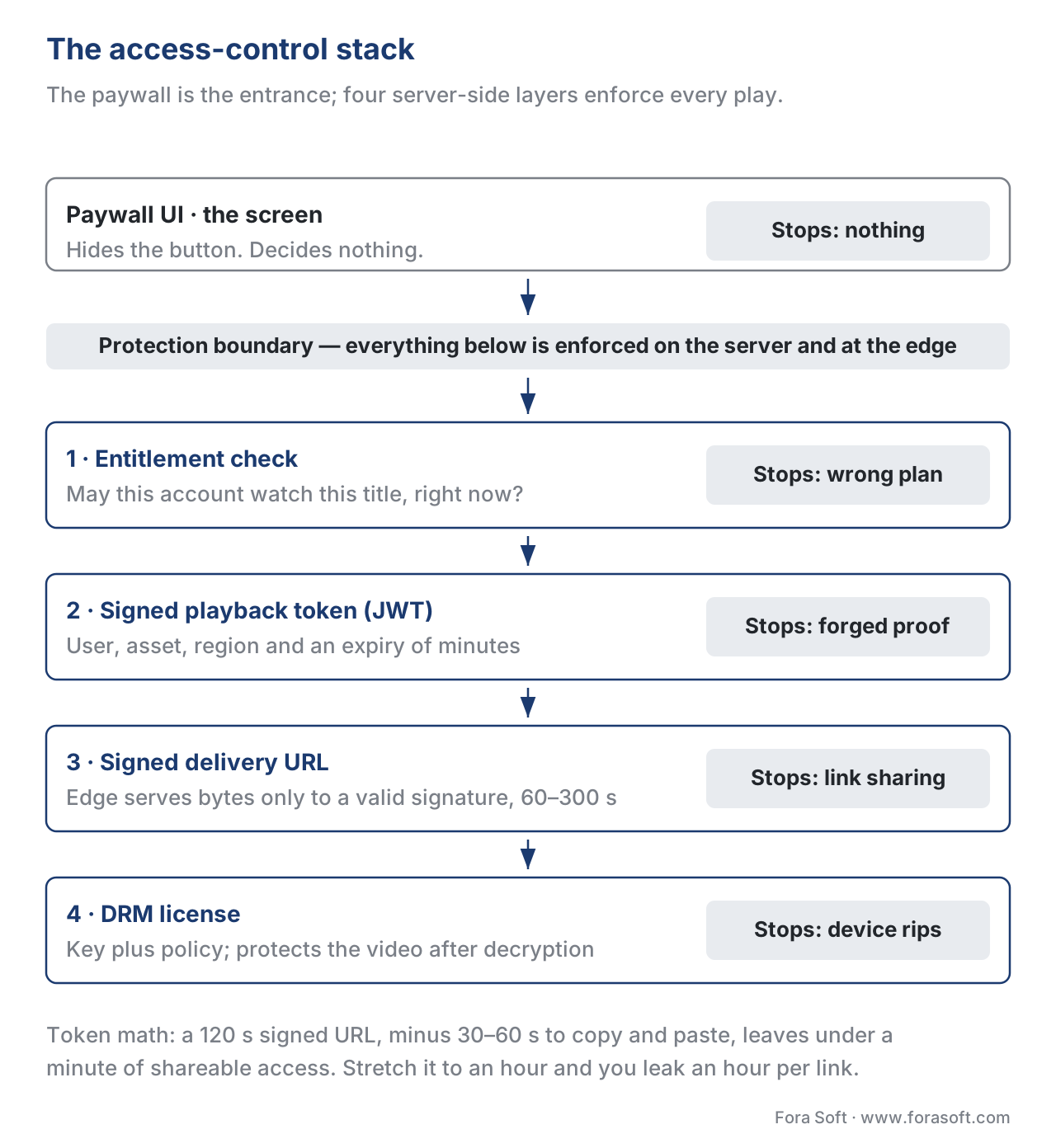 Figure 2. The access-control stack. The paywall UI is the entrance; entitlement decides, a signed token proves the decision, a signed URL gates the bytes, and DRM protects the decrypted video. Each layer closes a hole the one above it leaves open.
Put the token math out loud, because the short lifetimes are the whole point. Suppose a segment URL is signed to live for 120 seconds and the playlist refreshes every few seconds:
token lifetime          = 120 seconds
time to copy + paste     ≈ 30–60 seconds (best case for an attacker)
shareable viewing window = 120 − 60 ≈ 60 seconds, then dead
A stolen URL buys an attacker under a minute, after which the edge refuses it and the player has to present a fresh, freshly-signed one that the attacker never receives — because they were never entitled. Stretch the lifetime to an hour "for convenience" and you hand out an hour of free, shareable access per leak. Short tokens are not paranoia; they are the design.
Geo-gating: showing the right content in the right country
Content licenses are almost always territorial — you may stream a film in the US but not in Germany — so the access gate must also check where the viewer is. This is geo-gating (or geo-blocking): allowing or denying playback based on the viewer's country, usually inferred from their IP address, sometimes confirmed by billing country or GPS.
The mechanism is a geo-IP lookup at the entitlement layer, with the resolved country folded into the playback token's claims so the CDN can enforce it at the edge too. The honest engineering caveat: IP geolocation is good, not perfect, and a virtual private network (VPN) — software that routes a viewer's traffic through another country to disguise their location — defeats simple geo-IP. Serious platforms add VPN/proxy detection (commercial IP-intelligence feeds that flag known datacenter and VPN ranges) when a content owner's license demands strict enforcement. The deeper treatment of multi-territory rights lives in multi-territory licensing and geo-blocking.
There is a legal wrinkle that surprises teams expanding into Europe. Under the EU Cross-Border Portability Regulation ((EU) 2017/1128), in force since 1 April 2018, a provider of a paid online content service must let subscribers access the same content they pay for at home when they are temporarily in another EU member state — you may not geo-block your own paying subscriber for taking their account on a trip inside the EU (Regulation (EU) 2017/1128). So your geo-gate needs two distinct concepts: where the device is right now (for licensing) and where the subscriber resides (their home market), because EU portability keys off residence, not current location. Free, no-payment services are outside the mandatory scope but may opt in.
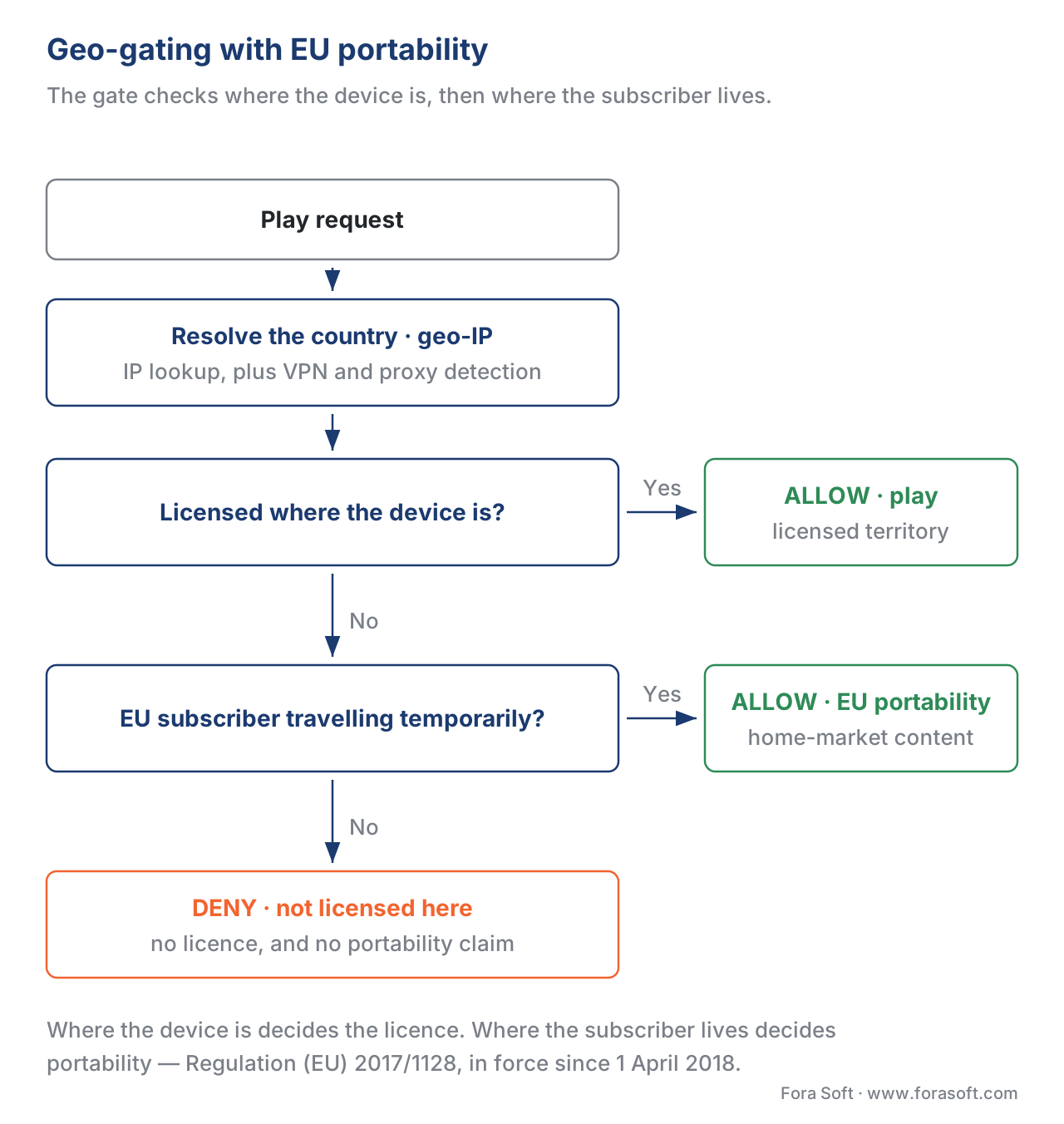 Figure 3. Geo-gating. The gate resolves the viewer's country, checks the title's territorial license, and applies the EU portability exception for a subscriber temporarily abroad — distinguishing where the device is from where the subscriber lives.
Concurrent-stream limits: one password should not become ten
The last access dimension is how many screens at once. A concurrent-stream limit caps the number of simultaneous plays on one account — commonly tied to the plan tier. The published limits are familiar: Netflix grants one, two, or four simultaneous streams across its plan tiers, and Max grants two on its ad and ad-free plans and four on its top tier (service plan pages, 2026 — vendor policy, re-check). The business reason is large: US streaming providers lost an estimated $2.3 billion to password sharing in 2022, Netflix alone accounting for roughly $791 million (industry estimates, 2022) — which is why password-sharing enforcement became an industry-wide project.
The enforcement mechanism is a heartbeat: while a stream plays, the player periodically pings a concurrency service (every 30–60 seconds), which counts the account's active sessions. When a new play would exceed the cap, the service either refuses it or signals the oldest session to stop, and the viewer sees "too many streams" (W3C Encrypted Media Extensions describes the related license-renewal mechanism browsers use for this kind of periodic re-authorization). Two engineering details decide whether this works. First, sessions must time out — a player that crashes without saying goodbye would otherwise hold a slot forever, so a missed heartbeat after a grace window frees the slot. Second, the count must be authoritative and fast, typically an in-memory store keyed by account, because it is consulted on every play and every heartbeat across the whole base.
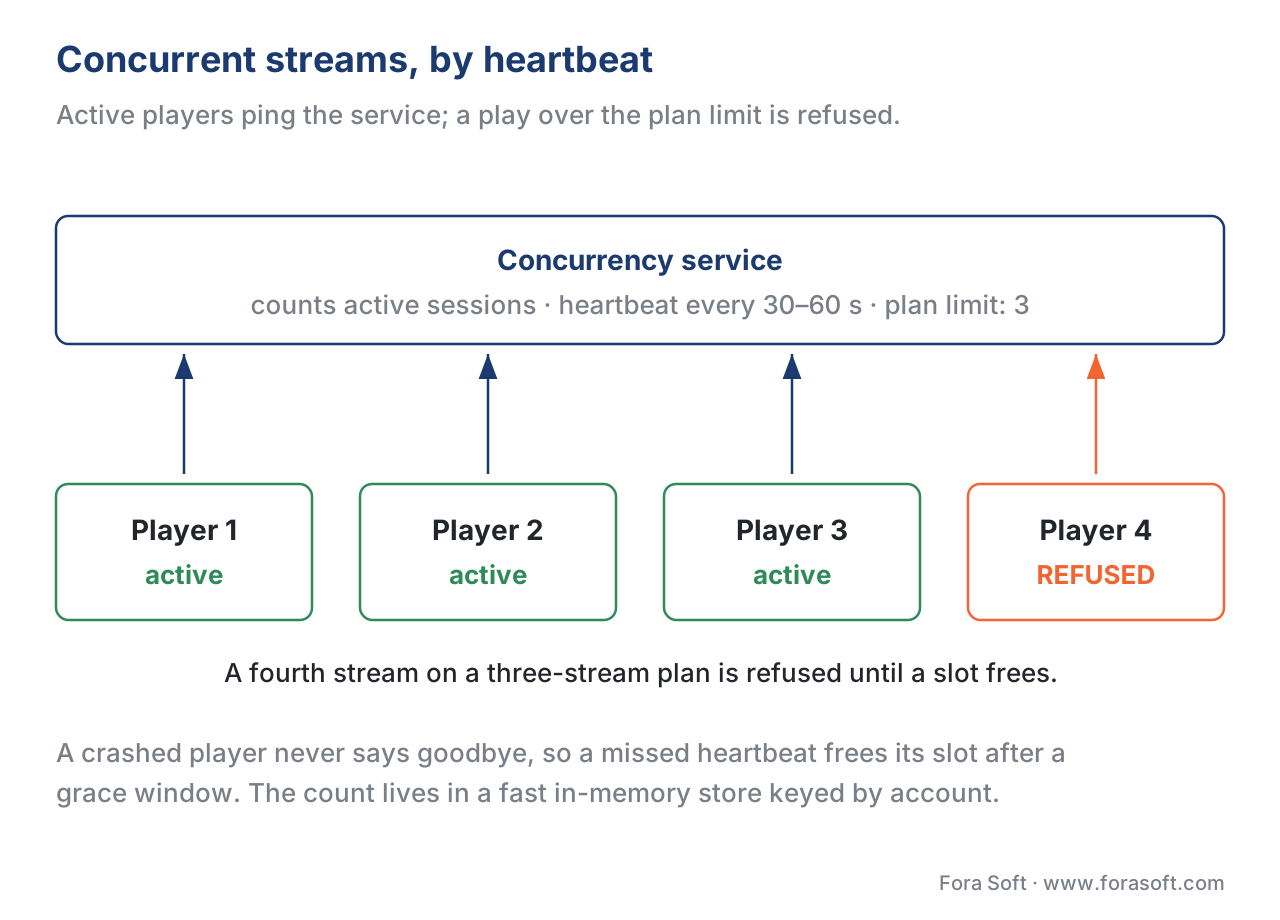 Figure 4. Concurrent-stream limiting by heartbeat. Active players ping the concurrency service on a timer; a fourth play on a three-stream plan is refused, and a crashed player's slot is reclaimed when its heartbeat times out.
A common mistake: enforcing the gate in the client
The single most expensive access-control error is to enforce the decision in the app instead of on the server. A team hides the play button behind an if (user.isSubscribed) check in the front-end, ships, and feels done. Then reality arrives. The mobile app's check can be patched on a jailbroken device; the web app's check is one line edited in the browser console; and none of it touches the video files, which sit on a CDN behind URLs that — without signing — anyone who finds them can fetch. The catalog is effectively public; the paywall is a curtain, not a wall.
The fix is the rule that governs every layer above: the client may decide what to show, but only the server may decide what to serve. The app can hide the play button for a better experience, but the entitlement check, the signed token, the signed URL, and the DRM license must all be enforced server-side and at the edge, where the user cannot reach them. A useful test: imagine the most hostile user has your raw segment URLs, a patched app, and a VPN. If your revenue still holds, the gate is real. If it does not, you built a paywall screen and called it access control.
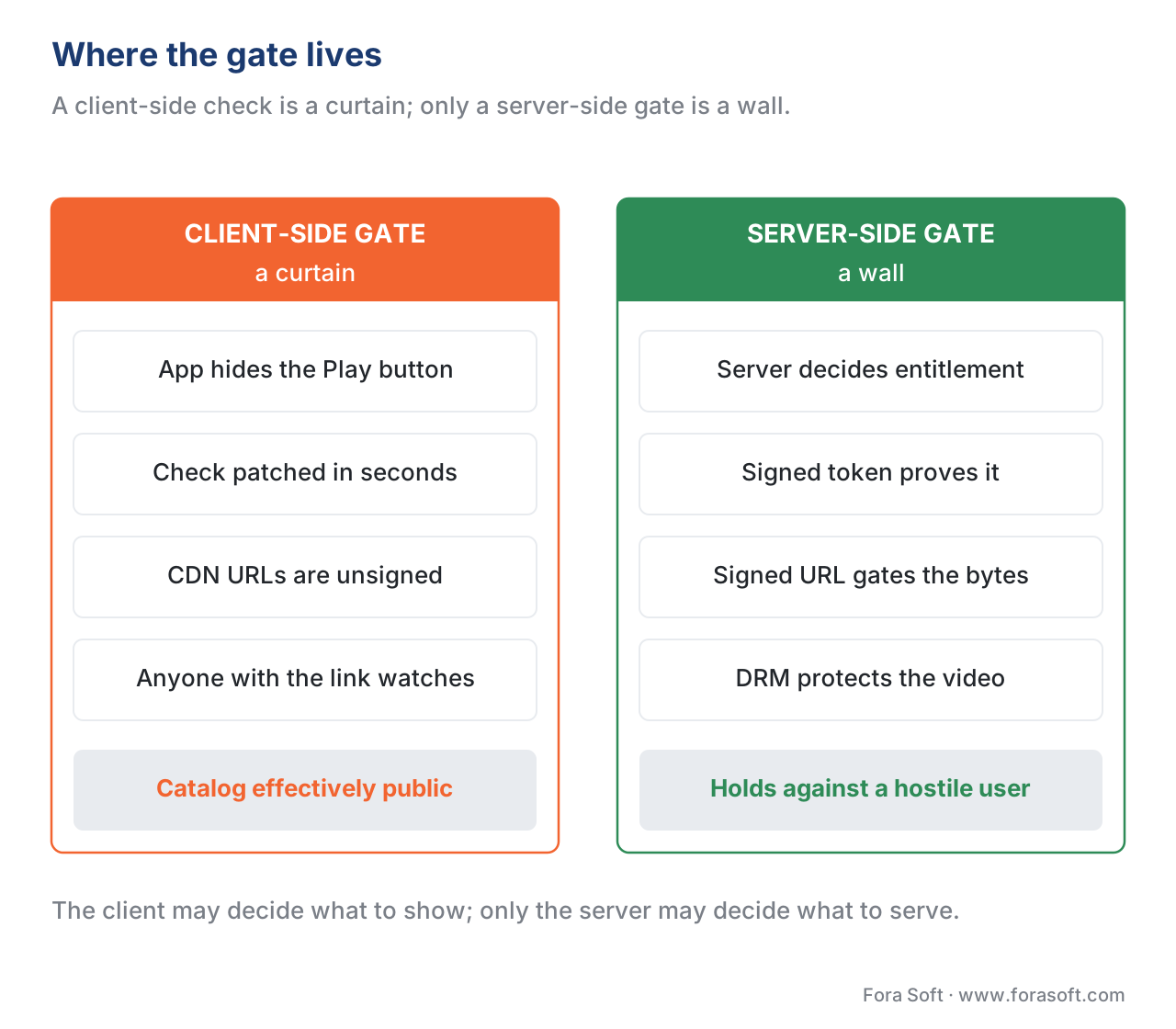 Figure 5. The same gate, in two places. A client-side check hides the button but serves the catalog from unsigned URLs to anyone; only a server-side gate, enforced at the edge, holds against a hostile user.
Where Fora Soft fits in
Access control is where a streaming platform's revenue is either protected or quietly leaked, and the failures are invisible until they compound: a catalog served from unsigned URLs, a registration wall that pipes viewing data into an ad pixel and into a VPPA suit, a geo-gate that breaks EU portability for paying travelers, a concurrency limit that holds slots forever after a crash. Fora Soft has built video streaming and OTT/Internet-TV platforms since 2005, across 625+ shipped projects for 400+ clients, which means we have wired entitlement services that answer correctly under peak concurrency, issued short-lived signed tokens and tokenized CDN URLs that survive a hostile user with the raw links, and built geo-gating and concurrent-stream enforcement that respects both content licenses and the law. Our stance is scalability-first and vendor-neutral: we start from the scale you must serve and the catalog you must protect, then build the access gate — hard, metered, freemium, or registration-walled — that your model and your licenses actually require.



The handbook
Fora Soft Video Engineering Handbook
We wrote a seven-volume handbook that takes the whole video stack apart, from the pixel to the delivery invoice, and an engineer who works through it can design and build the platform your gate protects. Volume 3 sits closest to this article: CDNs and signed delivery, players, DRM and the economics of streaming — the layers that turn an entitlement decision into bytes a stranger cannot fetch. Volume 2 covers the transport and the manifests those signed URLs point at, and volume 1 covers the encoding ladder behind every rendition you are gating. Written by Nikolay Sapunov, CEO at Fora Soft.
Not sure your paywall is more than a curtain?
Send us your player, your CDN setup and your plan tiers, and we will tell you which of the four layers is missing and what it would take to close it — 250+ video products shipped since 2005.
See our case studies
Case study
TradeCaster
A hard paywall with a trial in front of live trading streams: 46,000+ users on $99–$119/mo plans after a 7-day trial, with entitlement checked on the server for every play.
Case study
Franchise Record Pool
A $19.99/mo subscription over 720,000+ licensed tracks from Sony Music, Universal and Virgin — the case where the gate has to satisfy rights holders, not just the billing system.
Case study
Speed.Space
Role-based access decided server-side — Production Crew, Talent, Representatives — on 1080p/8 Mbps sessions used for Netflix, Electronic Arts and HBO productions.
What to read next
Monetization
Subscription Billing and Entitlement: the SVOD Engine
The service that answers layer 1, and how a plan change or a failed payment reaches it.
Delivery
CDN Cache Keys and Tokenized URLs Explained
Layer 3 in detail: what belongs in the cache key, and why the token must stay out of it.
Rights
Multi-Territory Licensing & Geo-Blocking for OTT
Where the territorial rules your geo-gate enforces come from, market by market.
Privacy
VPPA, GDPR, CCPA: Streaming Viewing-Data Privacy
What your registration wall may collect, and the consent record that keeps it lawful.
References
- JSON Web Token (JWT) — IETF RFC 7519. Internet Engineering Task Force, 2015. Tier 1. Defines the signed, claims-bearing token used for short-lived playback authorization (header, claims including expiry, signature). https://www.rfc-editor.org/rfc/rfc7519 — accessed 2026-06-17.
- Video Privacy Protection Act, 18 U.S.C. § 2710. United States Code. Tier 1. Bars knowing disclosure of personally identifiable viewing information without informed, written consent; statutory damages of $2,500 minimum per violation. https://www.law.cornell.edu/uscode/text/18/2710 — accessed 2026-06-17.
- Regulation (EU) 2017/1128 on cross-border portability of online content services. European Parliament and Council, in force 1 April 2018. Tier 1. Requires paid online content services to let subscribers access home-market content while temporarily in another EU member state. https://eur-lex.europa.eu/eli/reg/2017/1128/oj — accessed 2026-06-17.
- W3C Encrypted Media Extensions (EME) — Recommendation. World Wide Web Consortium, 2017. Tier 1. The browser API for DRM key exchange and the license-renewal mechanism used for periodic re-authorization (the basis for heartbeat-style concurrency checks). https://www.w3.org/TR/encrypted-media/ — accessed 2026-06-17.
- HTTP Live Streaming — IETF RFC 8216. Internet Engineering Task Force, 2017. Tier 1. The HLS playlist/segment model whose segment URLs are gated by short-lived signed URLs in this article. https://www.rfc-editor.org/rfc/rfc8216 — accessed 2026-06-17.
- General Data Protection Regulation (EU) 2016/679 (GDPR), Art. 6–7. European Parliament and Council. Tier 1. The lawful-basis and consent requirements that govern a registration wall's data collection in the EU. https://eur-lex.europa.eu/eli/reg/2016/679/oj — accessed 2026-06-17.
- Signed URLs and token authentication for secure video playback. Mux engineering documentation, 2026. Tier 4 (first-party vendor). Practice for time-limited signed delivery URLs, including the 60–300-second segment-URL lifetime guidance. https://www.mux.com/articles/securing-video-playback-with-signed-urls — accessed 2026-06-17. Vendor doc — re-check.
- Hard paywall vs freemium: 2026 app-economy analysis. Airbridge, 2026. Tier 5. Median download-to-paid (~12.1% hard vs ~2.2% freemium, D35) and first-year value per payer (~$49.30 vs ~$24.24); methodology-dependent benchmarks. https://www.airbridge.io/en/blog/hard-paywall-vs-freemium-2026 — accessed 2026-06-17. Estimates vary by category.
- AVOD audience size, 2026. eMarketer. Tier 5. ~209 million US ad-supported VOD viewers in 2026, ~216 million projected by 2027 — the addressable audience a registration wall converts to known accounts. https://www.emarketer.com/topics/category/avod — accessed 2026-06-17.
- Concurrent stream limiting (CSL): mechanism and per-service limits. VdoCipher / DoveRunner engineering references and service plan pages, 2026. Tier 4. Heartbeat-based concurrency enforcement; Netflix 1/2/4 and Max 2/2/4 stream limits by tier. https://www.vdocipher.com/blog/concurrent-stream-limit/ — accessed 2026-06-17. Vendor/plan policy — re-verify limits.
- 2025 Year in Review: VPPA litigation trends; Salazar v. Paramount Global cert. granted. WilmerHale Privacy & Cybersecurity blog, 2026. Tier 5. The 2024–2025 surge of pixel-based VPPA suits and the Supreme Court's January 2026 grant of review on the "consumer" definition. https://www.wilmerhale.com/en/insights/blogs/wilmerhale-privacy-and-cybersecurity-law/20260123-2025-year-in-review-video-privacy-protection-act-litigation-trends — accessed 2026-06-17.
- US password-sharing revenue loss, 2022. Industry estimates (Parks Associates / press coverage). Tier 5. ~$2.3 billion lost to US password sharing in 2022, ~$791 million attributed to Netflix — the driver of concurrency enforcement. https://www.pcworld.com/article/3071674/are-you-sharing-streaming-passwords-read-this-first.html — accessed 2026-06-17. Older figure — historical reference.
Where sources disagreed, the official standard or statute was followed. RFC 7519 (JWT), 18 U.S.C. § 2710 (VPPA), Regulation (EU) 2017/1128, W3C EME, RFC 8216, and GDPR are cited from the issuing bodies. Signed-URL lifetimes, per-service concurrency limits, and store/vendor behaviors are cited from first-party vendor docs and dated, because they change. Paywall-conversion, AVOD-audience, and password-sharing figures are analyst benchmarks cited as ranges, never as universal numbers; the 2022 password-sharing loss is labelled historical.
