


Why this matters
If you run a subscription streaming service, or you are about to build one, churn is the single number that decides whether the business compounds or slowly bleeds. Acquisition gets the budget and the dashboards on launch day, but a service that adds 100,000 subscribers a month and loses 95,000 is not growing — it is running on a treadmill that gets faster as it gets bigger. For a founder, product manager, or first-time streaming CTO, the hard part is not collecting the data; it is knowing which number is lying to you, which losses are recoverable, and which product levers actually move retention. This is the analytics layer that sits on top of your subscription billing and entitlement engine and turns raw payment and viewing events into the decisions that keep the revenue you already won.
The one idea: retention is the growth engine, not a back-office metric
Start with the picture, because it reframes everything. Imagine your subscriber base as a bucket. Acquisition pours new subscribers in at the top. Churn is the set of holes in the bottom. You can pour faster — spend more on marketing — but if the holes are wide, you are buying water that runs straight out. Net growth is simply what pours in minus what leaks out, and past a certain size the leak dominates, because churn is a percentage of a base that keeps growing while acquisition is a roughly fixed monthly effort.
Here is why this matters in money rather than metaphor. Suppose a service has one million subscribers paying $10 a month. At 5% monthly churn, it loses 50,000 subscribers every month — $500,000 in monthly recurring revenue, or $6 million a year walking out the door. Cut churn to 4% and you keep 10,000 of those subscribers each month; over a year that one point is worth roughly $1.2 million in retained revenue before you count the marketing you did not have to spend to replace them. One point of churn, on a base this size, is a seven-figure line item. That is why retention is not a back-office report; it is the growth engine.
The rest of this article is about measuring that leak honestly, separating the holes you can plug cheaply from the ones you cannot, and reading the early-warning signs before a subscriber reaches for the cancel button.
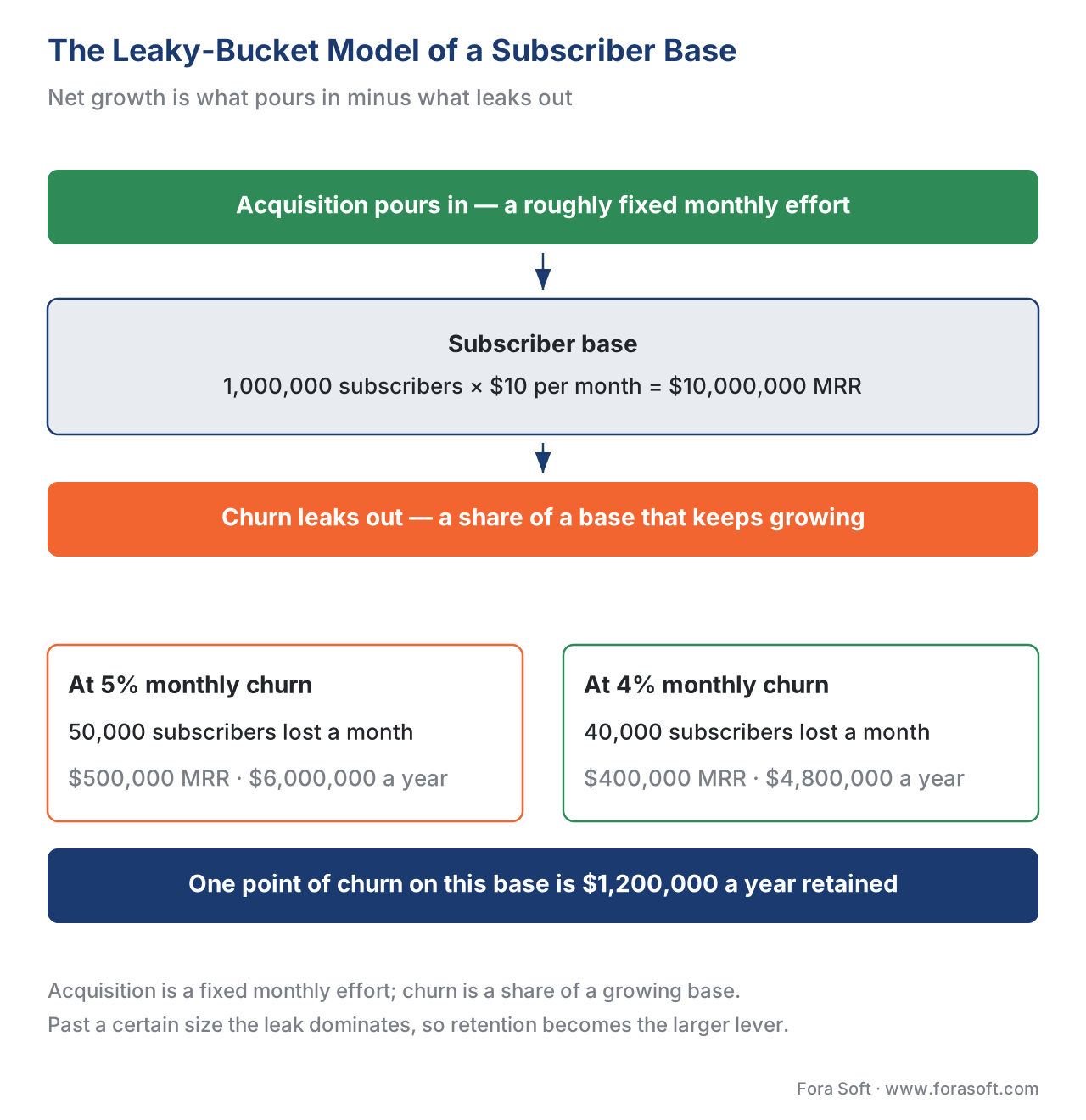 Figure 1. The leaky-bucket model. Net subscriber growth equals acquisition minus churn; past a certain scale, churn on a large base outweighs a roughly fixed monthly acquisition effort, so retention becomes the dominant lever.
What churn actually is — and the counting pitfalls
Churn rate is the share of subscribers who leave in a period, usually a month. The basic formula is simple, but the details decide whether the number means anything:
monthly churn rate = subscribers lost during the month
                     ----------------------------------
                     subscribers at the start of the month
Plug in numbers the first time so the definition is concrete. Start a month with 200,000 subscribers; lose 9,000 by month-end; churn = 9,000 ÷ 200,000 = 4.5%. The mirror image is retention rate = 1 − churn = 95.5%: the share who stayed. Both describe the same event from opposite sides.
Three counting pitfalls trip up almost every new team, and each one changes the number materially.
First, logo churn versus revenue churn. Logo (or subscriber) churn counts people who left. Revenue churn counts the money that left. They diverge whenever your subscribers pay different amounts. Lose 5% of subscribers but mostly cheap ad-tier accounts, and your revenue churn is lower than 5%; lose a smaller number of premium annual plans and your revenue churn is higher. A subscription business should watch both, because logo churn tells you about product-market fit and revenue churn tells you about the bank balance.
Second, gross versus net churn. Gross churn counts only what you lost. Net churn subtracts what you regained from the same base — upgrades, win-backs, and reactivations. A service with strong upgrades can post a net revenue churn near zero or even negative (the survivors expand faster than the leavers shrink the base), while its gross churn is a healthy-looking but incomplete story. Report gross churn to understand the leak; report net to understand the trajectory.
Third, the denominator and the window. A monthly churn rate and an annual one are not interchangeable, and you cannot simply multiply by twelve, because churn compounds. Retaining 95.5% each month leaves 0.955¹² ≈ 57.6% after a year — meaning roughly 42% annual churn, not 54%. Always state the window, and convert with the compounding formula, never with multiplication.
| Metric | What it counts | When it lies if used alone |
|---|---|---|
| Logo (subscriber) churn | People who cancelled | Hides that you lost high-value vs low-value accounts |
| Revenue churn | Recurring revenue lost | Hides whether you lost many small or few large accounts |
| Gross churn | Only losses | Ignores upgrades, win-backs, reactivations |
| Net churn | Losses minus regains | Can look healthy while the leak is still large |
| Monthly vs annual | Loss over the stated window | Cannot be multiplied — churn compounds, not adds |
Table 1. Five ways a single churn number misleads. A subscription operator reports the pair (logo and revenue, gross and net) and always states the window.
Voluntary versus involuntary churn: the split that decides your playbook
This is the most important distinction in the whole topic, and the one most often skipped. Not everyone who churns decided to leave.
Voluntary churn is an active choice: the subscriber opens settings and cancels, because the price went up, they finished the show they came for, or they are juggling too many subscriptions. Involuntary churn is an accident of plumbing: the recurring charge failed — an expired card, an insufficient balance, a bank decline, a card reissued with a new number — and the subscription lapsed without anyone choosing to leave. The subscriber may not even know they are gone until they try to watch.
The reason this split matters is that the two have completely different cures, and involuntary churn is far larger than most teams assume. Industry analyses put involuntary churn at roughly 20–40% of total churn for subscription businesses, with failed payments leaking on the order of 9% of monthly recurring revenue when nothing is done to recover them (subscription-billing vendor analyses, 2026 — benchmark, varies by mix). That is the cheapest churn you will ever fix, because the subscriber still wants the product — you simply failed to collect. Voluntary churn, by contrast, requires changing the product, the price, or the content slate. You attack the two with different tools, so you must measure them separately before you do anything else.
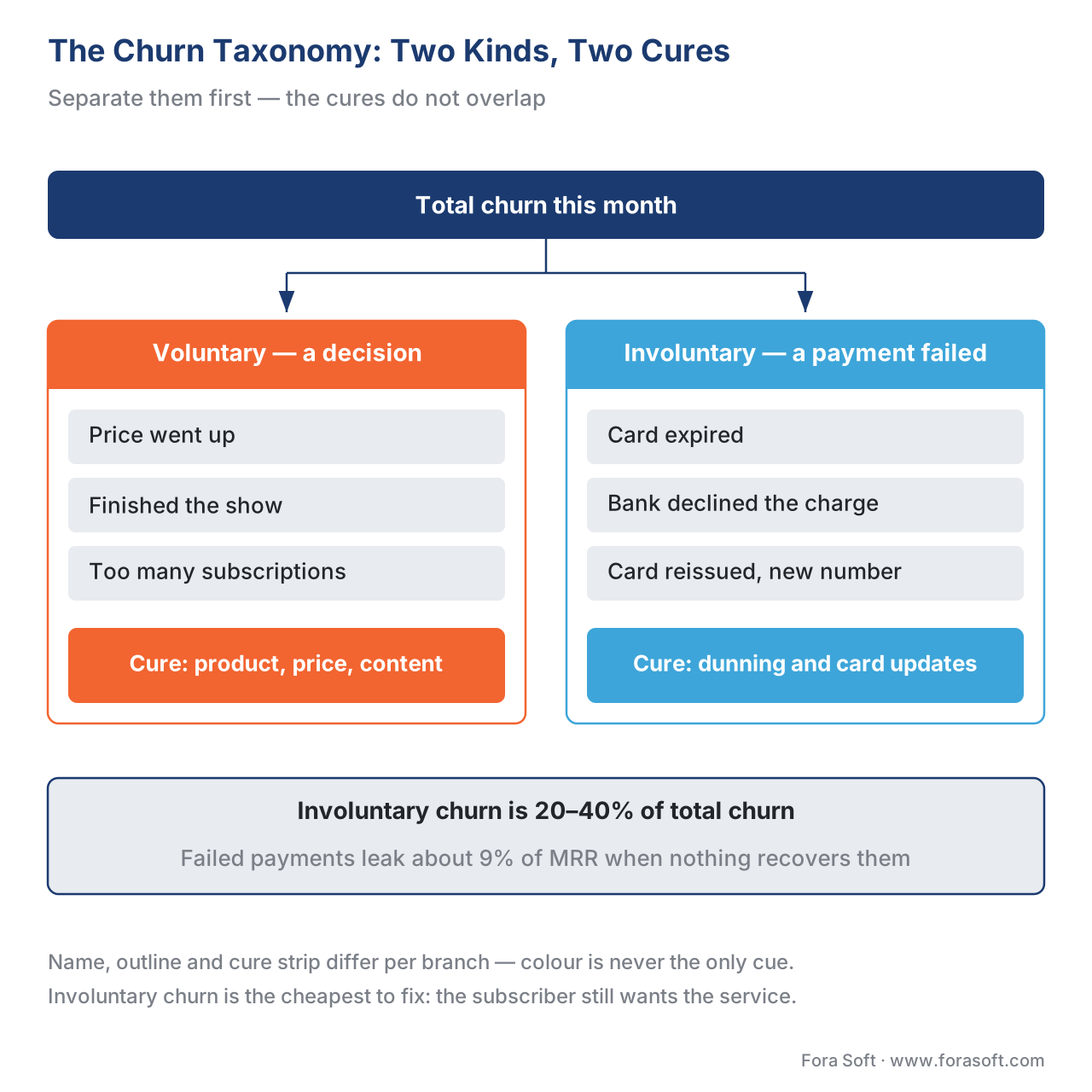 Figure 2. The churn taxonomy. Voluntary churn is a decision you fight with product, price, and content; involuntary churn is a payment failure you fight with dunning. Separating them is the first analytics task, because the cures do not overlap.
Dunning: recovering the churn nobody chose
Dunning is the process of recovering a failed recurring payment — the automated retries and customer messages that try to collect the charge before the subscription lapses. Done well, dunning recovers a large share of involuntary churn: vendor benchmarks commonly cite 50–80% of failed payments recovered through a layered approach (Recurly, ProsperStack, and other billing-vendor analyses, 2026 — re-verify, methodology-dependent). Because that recovered revenue would otherwise be lost from subscribers who never wanted to leave, dunning is usually the highest-return retention work a streaming team can do.
A modern dunning stack layers several mechanisms, each catching failures the others miss:
- Smart retries. Rather than retrying a declined card immediately and identically, the billing system retries at times and in ways most likely to succeed — after payday, after a few days, sometimes routed through a different acquirer. Naive fixed-interval retries recover far less than ones timed to the decline reason.
- Card-network account updater. Visa, Mastercard, American Express, and Discover each run a service that pushes a subscriber's new card number to merchants when a card is reissued, expires, or is upgraded — without asking the subscriber to type anything. These services are reported to cut "hard" declines by roughly 30–50% by fixing the most common cause of failure: stale card details (card-network and billing-vendor documentation, 2026).
- Network tokens. Instead of storing a raw card number, the merchant stores a network-issued token that the network keeps mapped to the live card, so a reissue updates transparently. This both lifts authorization rates and reduces the stale-credential failures that drive involuntary churn.
- Dunning communications. When the automated layers cannot fix it, a sequence of emails and in-app prompts asks the subscriber to update their card — framed as "we could not process your payment", not "you have been cancelled".
There is a European wrinkle worth knowing, because it shapes how recurring charges are authenticated. Under the EU's second Payment Services Directive — PSD2, Directive (EU) 2015/2366 — and its technical standard on Strong Customer Authentication (SCA), Commission Delegated Regulation (EU) 2018/389 (in effect since 14 September 2019), many online payments must be authenticated with two factors. Recurring subscription charges are handled as merchant-initiated transactions (MIT): the first payment is strongly authenticated and sets up a mandate, and subsequent fixed recurring charges are exempt from per-transaction SCA (Commission Delegated Regulation (EU) 2018/389). The engineering consequence is concrete: capture and store the mandate correctly on the first charge, and flag recurring attempts as MIT, or your retries in Europe will be declined for the wrong reason and inflate your involuntary churn.
Walk the recovery math out loud, because it shows why dunning is worth building before any clever retention campaign. Take the million-subscriber, $10 service again, at 4.5% monthly churn — 45,000 lost subscribers a month. Suppose 30% of that churn is involuntary: 13,500 subscribers, $135,000 of monthly recurring revenue, lost to failed payments. Recover 60% of it with a layered dunning stack and you save 8,100 subscribers and $81,000 a month — roughly $972,000 a year — from people who never wanted to leave. No content deal or price test returns that fast.
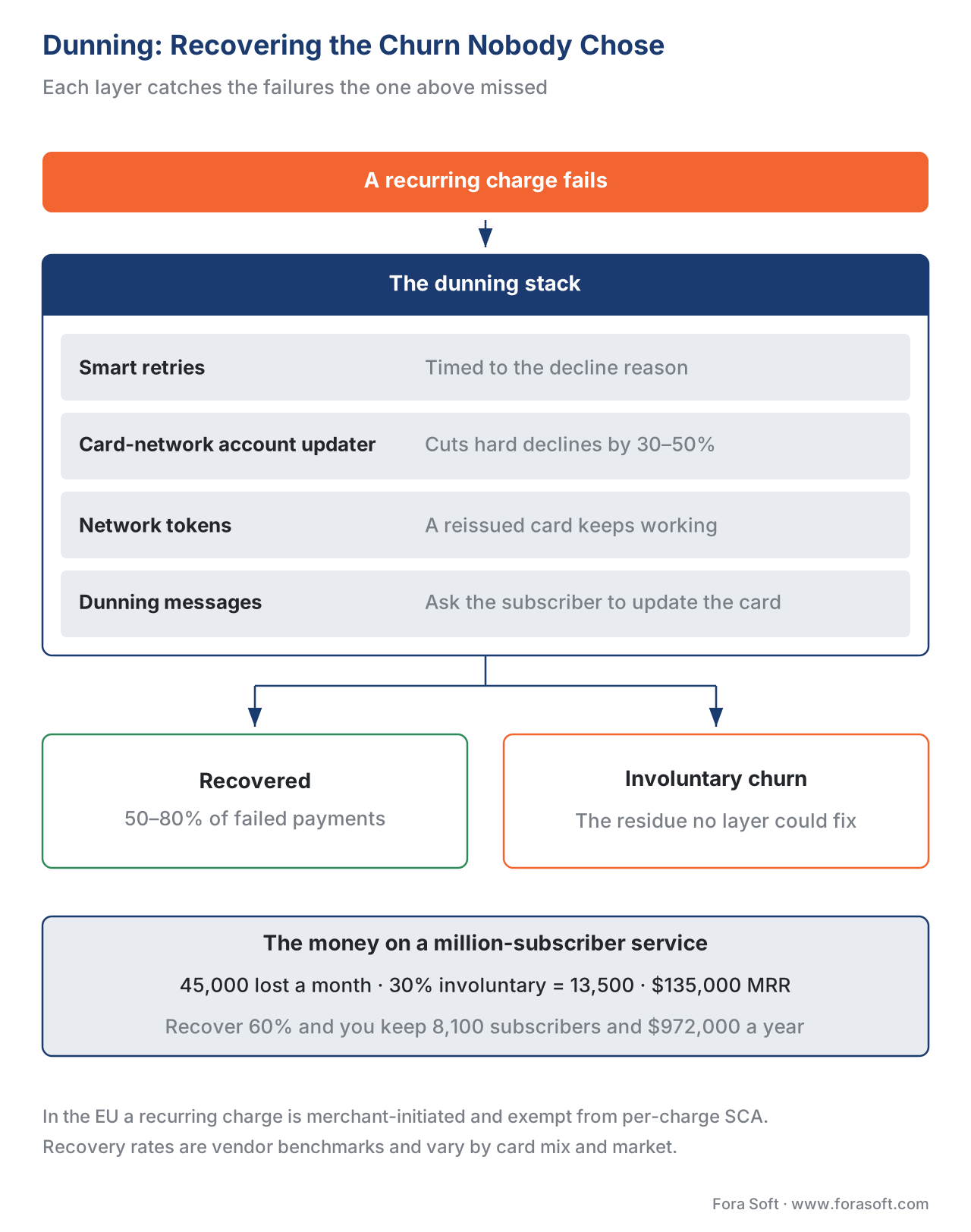 Figure 3. The dunning recovery flow. A failed recurring charge passes through smart retries, the card-network account updater, network tokens, and dunning messages; each layer recovers a slice, and only the residue becomes involuntary churn.
Cohorts and retention curves: the truth a monthly percentage hides
A single monthly churn number is an average, and averages hide the most important fact about subscription retention: churn is not constant over a subscriber's life. New subscribers leave far faster than long-tenured ones. To see this, you stop looking at the whole base at once and start looking at cohorts — groups of subscribers who joined in the same period — and you track each cohort's survival month by month.
The tool that makes this rigorous is the retention curve, often built with the Kaplan–Meier estimator, a method from survival analysis (Kaplan & Meier, 1958) that calculates the probability a subscriber is still active after n months without throwing away the subscribers who simply have not been around long enough to observe — a problem statisticians call censoring. The shape of the curve tells the story a percentage cannot. It usually drops steeply in the first one to three months — the people who signed up for one show, or on a free trial they forgot to cancel — then flattens into a long, durable tail of loyal subscribers whose monthly churn is a fraction of the headline rate.
That shape carries two product lessons. First, the early cliff is where the biggest, cheapest retention wins live: onboarding, getting a new subscriber to a second and third session quickly, and surfacing a reason to come back next week. Second, the flat tail is your real, durable base, and its slope — not the blended average — is what you should forecast lifetime value from. A service obsessed with the headline monthly number will misjudge both.
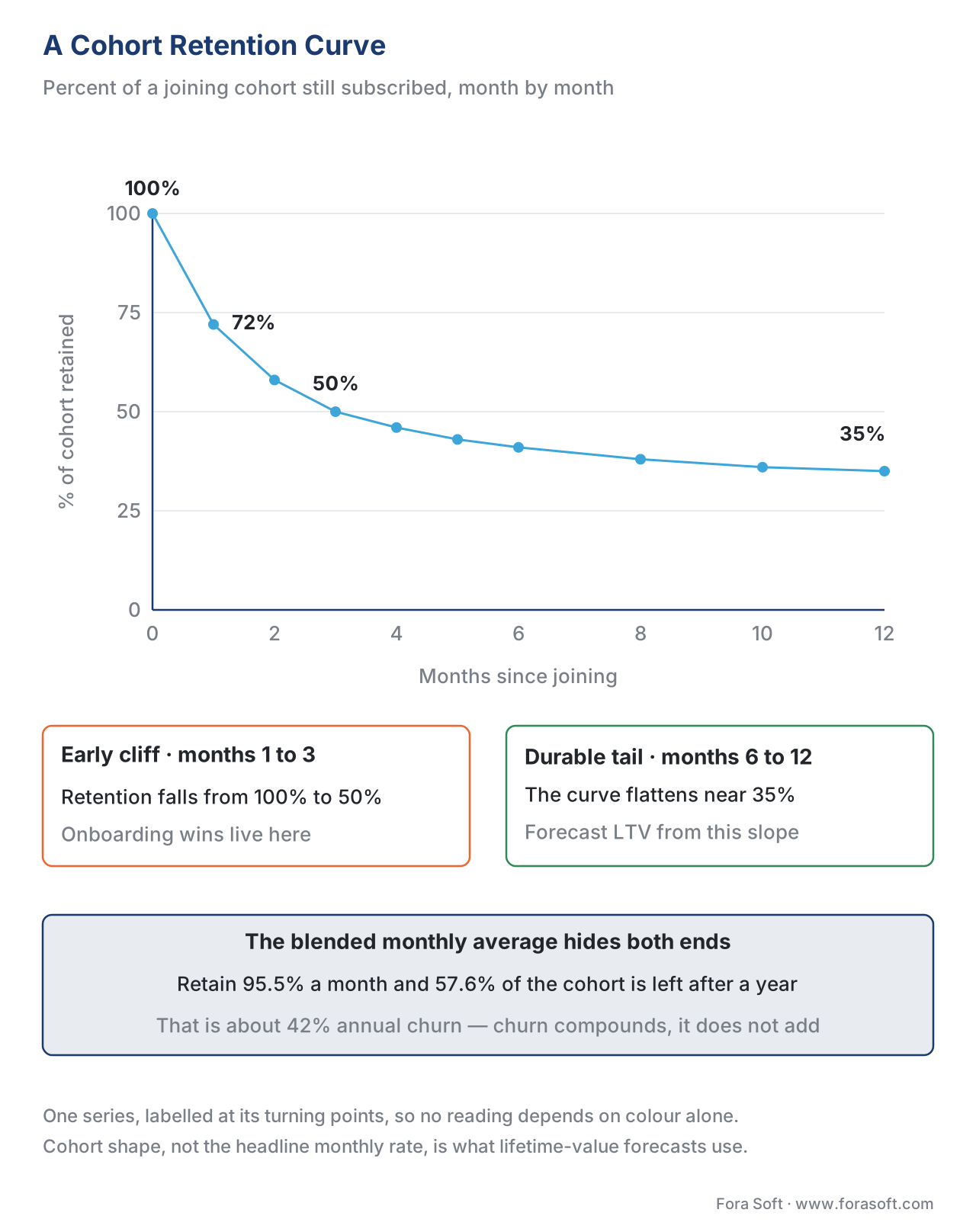 Figure 4. A cohort retention (survival) curve. The steep early drop is where onboarding wins live; the flat tail is the durable base whose slope, not the blended average, should drive lifetime-value forecasts.
Cohorts also expose which subscribers and which months are the problem. A cohort that joined for a single tent-pole release will show a sharp drop the month after it ends; a cohort acquired through a discount promotion will often churn harder when the promo price expires. Compare cohorts by acquisition source, plan, and content, and the curve stops being a chart and becomes a list of things to fix. This cohort view is the bridge into the broader retention and engagement analytics practice in Block 9.
Engagement is the leading indicator of retention
Churn and retention are lagging indicators — by the time a subscriber cancels, the decision was made weeks earlier. The leading indicator, the thing that predicts next month's churn before it happens, is engagement: how often a subscriber watches, how much, and how recently. A subscriber who watched three nights last week is overwhelmingly likely to pay next month; one who has not opened the app in three weeks is already most of the way out the door, whatever their billing status says.
This is why discovery and engagement are retention features, not just growth features. On a large catalog, what a viewer watches is mostly what the platform surfaces, so the discovery layer that drives retention — recommendations, the right artwork, a reason to return — is directly a churn-reduction system. And because a frustrating playback experience drives people away, the platform's quality of experience, especially startup time and rebuffering, is itself a retention input: viewers who hit spinners watch less, and viewers who watch less churn more.
The market data backs the engagement thesis directly. Deloitte's 2026 Digital Media Trends survey found US streaming cancellation running near 40% of subscribers cancelling at least one service over six months, with a large "churn and return" pattern — about 24% of consumers cancel and then resubscribe to the same service within six months, rising to roughly 40% among Gen Z (Deloitte, 2026). The same survey found 61% of consumers would cancel a favourite service over a $5 price rise, a direct read on price sensitivity. The operational takeaway: a base that disengages before it cancels can be re-engaged before it cancels, but only if you are watching engagement, not just billing.
The metrics dashboard a SVOD operator lives in
Pull it together into the handful of numbers a subscription-video operator checks constantly. Each answers a different question, and they are only useful as a set.
- Churn rate (logo and revenue, gross and net). The leak, measured both by people and by money, both before and after regains.
- Retention rate and the retention curve. The mirror of churn, plus the cohort shape that shows when people leave.
- Average revenue per user (ARPU). Total recurring revenue ÷ active subscribers. The lever that, with churn, sets the value of each subscriber.
- Monthly recurring revenue (MRR). The predictable revenue base; its month-over-month change decomposes into new, expansion, contraction, and churned MRR.
- Customer lifetime value (LTV). The total revenue you expect from a subscriber before they churn — the number that tells you how much you can afford to spend acquiring one.
LTV is where churn turns into a planning number, so show the math. The simplest form ties LTV directly to churn:
average lifetime (months) = 1 ÷ monthly churn rate
LTV (gross)               = ARPU × average lifetime
At 4% monthly churn, the average subscriber lifetime is 1 ÷ 0.04 = 25 months. At an ARPU of $10, gross LTV ≈ $10 × 25 = $250. Drop churn to 3% and lifetime jumps to 33 months and LTV to $330 — a 32% increase in the value of every subscriber from a single point of churn. This is the same lever as before, now expressed as the ceiling on what you can spend to acquire a subscriber. A healthy subscription business keeps LTV comfortably above customer acquisition cost (CAC) — a common rule of thumb is an LTV:CAC ratio of at least 3:1 — and churn sits inside both halves of that ratio, because lower churn raises LTV and disengaged subscribers raise the cost of replacing them.
A note on revenue, because finance will ask. Subscription revenue is recognised over the service period, not when the card is charged — money collected for a month not yet delivered sits as deferred revenue until earned, under the revenue-recognition standards ASC 606 (US GAAP) and IFRS 15 (FASB/IASB, effective 2018). Churn and dunning therefore move both the cash you collect and the revenue you can recognise, which is why the subscription dashboard and the finance ledger have to agree on definitions.
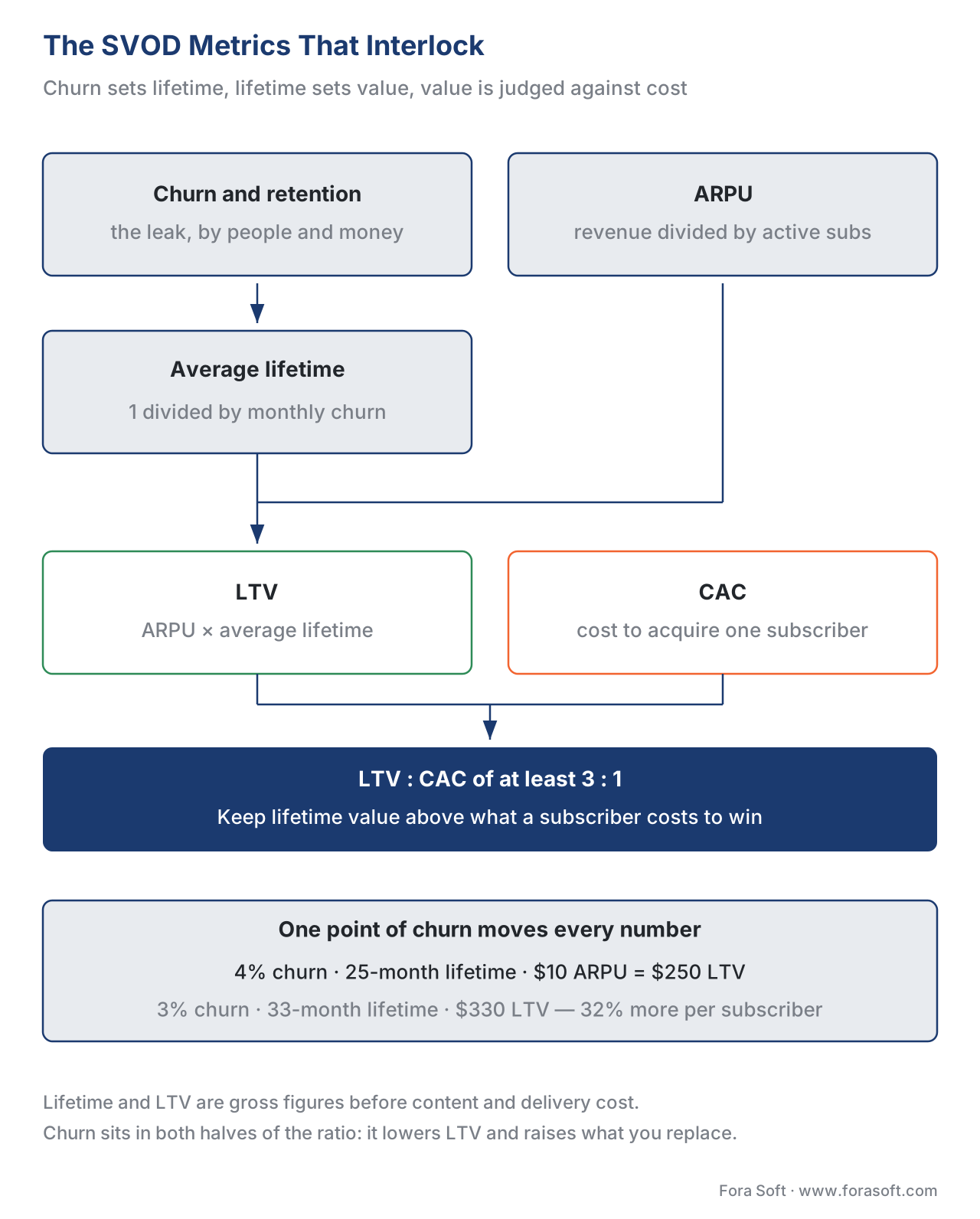 Figure 5. The SVOD metrics that interlock. Churn and retention set average lifetime; lifetime times ARPU gives LTV; LTV against acquisition cost (the LTV:CAC ratio) tells you whether the business compounds.
A common mistake: chasing acquisition while ignoring involuntary churn
The most expensive analytics error in streaming is to pour budget into acquisition while treating churn as one undifferentiated number — and, inside that, to ignore involuntary churn entirely. A team celebrates record sign-ups, watches the blended monthly churn tick along at "industry average", and never notices that a third of those losses are failed payments from subscribers who still want the service. They are, in effect, paying full acquisition cost to replace subscribers they could have kept for the price of a smarter card retry.
The fix is the order of operations this article lays out. Split voluntary from involuntary churn first, because the cures do not overlap. Build the dunning stack — smart retries, account updater, network tokens, MIT-compliant recurring charges in Europe — before any clever win-back campaign, because it returns the fastest and serves subscribers who never decided to leave. Then look at cohorts and the retention curve, not the blended average, to find where voluntary churn actually happens, and treat engagement as the leading indicator you act on before the cancel button is pressed. Acquisition fills the bucket; this is how you stop it leaking.
Free download: Churn-Analysis Worksheet — One-Page ReferenceThe churn and retention formulas (logo and revenue, gross and net, monthly to annual), the voluntary and involuntary split, the dunning recovery playbook, the cohort retention method, and the LTV-from-churn calculation, on a single sheet.Where Fora Soft fits in
A streaming platform's revenue is won at acquisition and kept — or lost — in the retention systems most teams build last. The failures are quiet and compounding: involuntary churn nobody is recovering, a blended churn number hiding a brutal first-month cliff, engagement data that never reaches the team deciding what to recommend. Fora Soft has built video streaming and OTT/Internet-TV platforms since 2005, across 625+ shipped projects for 400+ clients, which means we have wired the billing and entitlement engines that emit clean churn and payment events, built dunning and account-updater flows that recover failed payments at scale, and connected viewing data to the recommendation and analytics layers that turn engagement into retention. Our stance is scalability-first and vendor-neutral: we start from the size of the base you must keep and the recurring revenue you must protect, then build the churn analytics, dunning, and engagement plumbing your subscription model actually requires.



The handbook
Fora Soft Video Engineering Handbook
We wrote a seven-volume handbook, 9,000+ pages, that works through the whole video stack from the pixel to production — encoding, delivery, audio and AI — so the subscription business this article measures sits on ground you can follow all the way down. Volume 3 carries this chapter further into players, QoE monitoring and the delivery economics behind every retention number you forecast from; volume 6 covers the recommendation and search layer that turns engagement into the leading indicator this article asks you to watch; volume 2 works through the transport and packaging that decide whether a session starts fast enough for the viewer to come back next week. Written by Nikolay Sapunov, CEO at Fora Soft.
Do you know how much of your churn is just a failed card?
Send us your billing setup and a month of churn events and we will tell you what share of it is involuntary, what a layered dunning stack would recover, and where your cohort curve actually breaks — then build the payment and analytics plumbing that keeps the revenue you already won. 250+ video products shipped since 2005.
See our case studies
Case study
TradeCaster
A live streaming platform for stock traders, 46,000+ users on $99–$119 monthly subscriptions behind a 7-day free trial — the shape of base where the trial-to-paid step and the first three months decide the whole cohort curve.
Case study
Franchise Record Pool
A DJ platform on a $19.99 monthly subscription carrying 720,000+ licensed tracks across web, desktop, iOS and Android — recurring charges at a scale where every reissued card is a churn event nobody chose.
Case study
TapeReal
A creator video platform with 52,000+ members, paywalled posts and a Creator Pro+ membership — paywall and engagement analytics in one product, which is where next month's churn shows up first.
What to read next
Monetization
Subscription billing and entitlement: the SVOD engine
The engine that emits the payment and churn events this article counts.
Analytics
Retention and engagement analytics
The cohort practice opened here, worked through end to end.
Discovery
Why discovery decides retention
The lever behind engagement, the leading indicator of next month's churn.
Quality
QoE: startup time and rebuffering
Why a spinner is a retention problem, measured in seconds.
References
- Strong Customer Authentication RTS — Commission Delegated Regulation (EU) 2018/389. European Commission, in effect 14 September 2019. Tier 1. Defines the SCA requirements and the merchant-initiated-transaction / recurring-payment exemptions that govern how recurring subscription charges are authenticated in the EU. https://eur-lex.europa.eu/eli/reg_del/2018/389/oj — accessed 2026-06-17.
- Payment Services Directive 2 (PSD2) — Directive (EU) 2015/2366. European Parliament and Council. Tier 1. The directive that mandates Strong Customer Authentication for electronic payments, the legal basis for the recurring-payment handling described here. https://eur-lex.europa.eu/eli/dir/2015/2366/oj — accessed 2026-06-17.
- Revenue from Contracts with Customers — FASB ASC 606 / IFRS 15. Financial Accounting Standards Board / International Accounting Standards Board, effective 2018. Tier 1. The five-step revenue-recognition standard requiring subscription revenue to be recognised over the service period, with amounts collected in advance held as deferred revenue. https://www.fasb.org/page/PageContent?pageId=/standards/implementing/revenue-recognition.html — accessed 2026-06-17.
- Nonparametric Estimation from Incomplete Observations. Kaplan, E. L. & Meier, P., Journal of the American Statistical Association, 53(282), 1958. Tier 1. The Kaplan–Meier estimator — the survival-analysis method used to build subscriber retention curves that correctly handle censored (not-yet-observed) tenures. https://www.jstor.org/stable/2281868 — accessed 2026-06-17.
- Antenna Q1'26 State of Subscriptions: Premium SVOD 2025 Year in Review. Antenna, 2026. Tier 5. Weighted-average monthly Premium SVOD churn near 4.6%, churn stabilization across 2024–2025, and per-category figures (Specialty 6.6%, Sports 5.1%, vMVPD 4.5%; Netflix consistently under 2%). https://www.antenna.live/insights/antenna-q126-state-of-subscriptions-report-premium-svod-2025-year-in-review — accessed 2026-06-17. Analyst data — methodology-dependent.
- 2026 Digital Media Trends. Deloitte Insights, 2026. Tier 5. ~40% of US subscribers cancelled at least one service over six months; ~24% "churn and return" (≈40% among Gen Z); 61% would cancel over a $5 price rise; 68% of SVOD households have an ad-supported tier. https://www.deloitte.com/us/en/insights/industry/technology/digital-media-trends-consumption-habits-survey.html — accessed 2026-06-17. Survey data.
- Churn management: voluntary and involuntary churn, and dunning recovery. Recurly, 2026. Tier 4 (first-party vendor). Practice for smart retries, account updater, and network tokens; layered recovery of 50–60%+ of failed recurring payments. https://www.recurly.com/product/churn-management/ — accessed 2026-06-17. Vendor doc — re-verify recovery figures.
- Subscription dunning: recovering failed payments. ProsperStack, 2026. Tier 4 (first-party vendor). Involuntary churn as ~20–40% of total churn and ~9% of MRR leakage; dunning recovering 50–80% of failed payments. https://prosperstack.com/blog/subscription-dunning/ — accessed 2026-06-17. Vendor doc — benchmark, varies by mix.
- Card-network account updater services (Visa Account Updater / Mastercard Automatic Billing Updater). Card-network and billing-vendor documentation, 2026. Tier 4. Automatic push of reissued/updated card credentials to merchants, reported to cut hard declines by ~30–50%. https://www.cleeng.com/involuntary-churn — accessed 2026-06-17. Vendor doc — re-verify.
- Predicting subscriber lifetime value using survival analysis. DS Analytics, 2026. Tier 5. Worked application of survival curves and cohort retention to subscriber LTV prediction. https://dsanalytics.co.uk/thoughts/predicting-subscriber-lifetime-value — accessed 2026-06-17. Institutional/analytical reference.
Where sources disagreed, the official standard or statute was followed. Commission Delegated Regulation (EU) 2018/389 (SCA RTS), Directive (EU) 2015/2366 (PSD2), ASC 606 / IFRS 15, and Kaplan & Meier (1958) are cited from the issuing bodies and primary literature. Churn benchmarks, dunning-recovery rates, and account-updater impact are analyst and first-party vendor figures, cited as ranges and dated, never as universal numbers, because they vary by service mix and method.
