


Why this matters
If you run or are planning an over-the-top (OTT) platform — a service that streams video over the internet rather than through a cable box — the cost of winning a subscriber is paid once, but the revenue arrives only as long as they stay. Deloitte's 2026 Digital Media Trends survey found that 41% of US consumers had cancelled at least one paid streaming service in the prior six months, and a growing group cancel and re-subscribe within the same window. That makes retention, not acquisition, the number that compounds. This article is for the non-technical operator — the founder, product lead, or streaming executive — who has to read the retention dashboard, decide where to intervene, and brief the data and growth teams, without becoming an analyst. It is the companion to the OTT analytics map, which laid out the whole measurement landscape; this article goes deep on the audience and engagement half of it.
The one idea: engagement leads, retention lags
Start with the rule that organizes everything else. Retention is a result you can only confirm after the fact — you know someone stayed in May once June arrives and they are still paying. Engagement is the behaviour happening right now that causes that result. So the entire discipline is about watching engagement closely enough to predict retention while you can still change it.
Think of it like a doctor watching blood pressure rather than waiting for the heart attack. Cancellation is the heart attack: by the time it shows up on the revenue chart, the decision was made weeks ago. The early signs — a viewer who used to watch four nights a week and now watches one, who started three shows and finished none, who has not opened the app since the season finale — are the rising blood pressure. A platform that only tracks churn is reading the obituary; a platform that tracks engagement is reading the warning signs.
Everything below is built on that split. Engagement metrics are the leading indicators you act on. Retention and churn are the lagging results you report. Keep the two roles distinct and the dashboard stops being a wall of numbers and becomes a sequence of decisions.
Engagement: the metrics that predict whether someone stays
Engagement is how much, how often, and how completely people watch. A handful of metrics carry almost all the predictive weight, and each has a counting pitfall worth knowing before you quote it.
Watch time is the total time viewers actually spent watching — the fundamental engagement number, because more watching is the clearest sign someone is getting value. The pitfall is defining it honestly. The streaming-industry standard for this, the Consumer Technology Association's CTA-2066 (Streaming Quality of Experience Events, Properties and Metrics, 2020), names the precise metric Play Time — the time the video was genuinely playing, not the time the tab was open, not the time a trailer auto-played to a viewer who walked away. Map every screen — web, mobile, smart TV — to the same CTA-2066 definitions, or a "watch-time up 10%" headline may just mean autoplay fired more often.
Completion rate is the share of a title that viewers finish, and it predicts retention better than raw view counts because finishing something is the strongest signal of satisfaction. The relationship is measurable: analysis of streaming KPIs has found that platforms exceeding roughly 65% completion see materially higher retention than those below it. A million plays that all stop at minute three is a worse sign than a hundred thousand plays that run to the credits.
Session frequency and time-to-second-session are the sharpest early-warning signals of all. How many days a week a viewer opens the app, and — critically — how soon a brand-new viewer returns for a second session, are leading indicators of churn that let you intervene before the cancellation decision is made. A subscriber who has not come back within their first week is already drifting.
Stickiness (the DAU/MAU ratio) compresses habit into one number: daily active users divided by monthly active users, expressed as a percentage. It answers "of the people who use us in a month, what share use us on any given day?" Streaming apps typically land between 20% and 40%. The math is plain: 400,000 daily actives over 1,600,000 monthly actives is 400,000 ÷ 1,600,000 = 25% stickiness, meaning the average subscriber shows up about one day in four. Higher stickiness usually predicts better retention — but it is not a guarantee, because a viewer can watch daily and still cancel at renewal if the price stops feeling worth it.
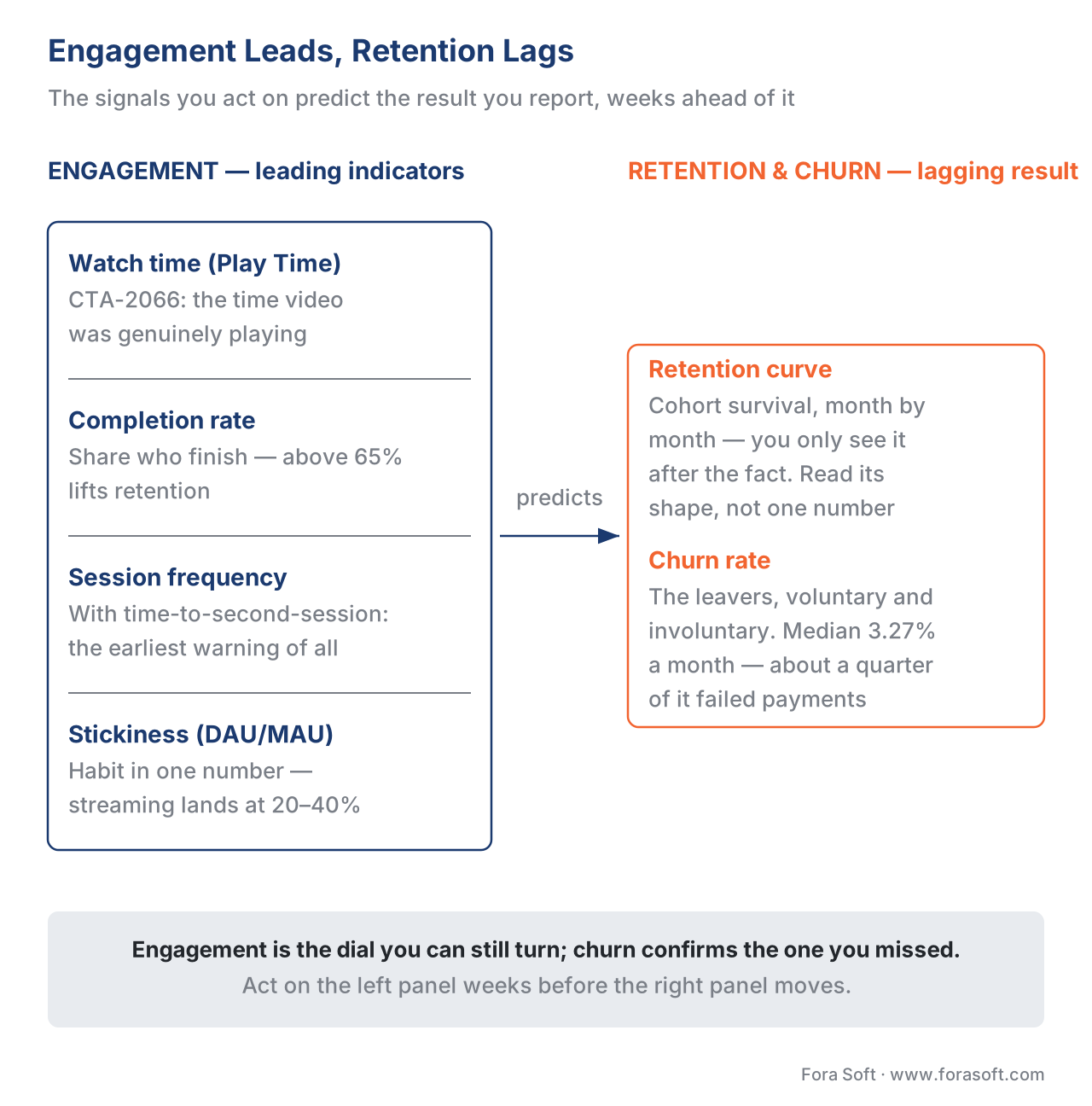 Figure 1. Engagement leads, retention lags. Watch time, completion, session frequency, and stickiness are the signals you act on; retention and churn are the results you report.
Cohort retention analysis: how to read the chart
A single blended churn number hides the most important question: is retention getting better or worse over time? Cohort analysis answers it. A cohort is a group of viewers who share a starting event — almost always the month they signed up. You then track each cohort's survival across the months that follow, so the January joiners and the February joiners are measured on their own clocks rather than blended together.
Read as a grid, it forms a triangle. Each row is one signup month; each column is "months since joining." The cell shows the share of that cohort still active. A healthy platform shows the numbers across each row flattening into a plateau — the curve drops fast at first, then levels off as the committed core remains.
 Figure 2. The cohort retention triangle. Each row is a signup month; each column is months since joining. A healthy curve drops, then flattens — the plateau is your committed core.
Here is the arithmetic on one cohort. Say 10,000 viewers join in January. By month one, 7,000 are still active — that is 7,000 ÷ 10,000 = 70% month-1 retention. By month three, 5,200 remain (52%); by month six, 4,500 remain (45%). The fact that the curve is flattening — losing 7 points between months one and three but only another 7 across the next three months — is the good news: you are reaching the loyal core. The slope of that flattening, compared month-over-month between cohorts, tells you whether a product change actually helped. If your March cohort's month-1 retention is 74% against January's 70%, something you shipped in between is working.
Two refinements matter. First, watch the shape, not just the endpoint: a curve that flattens high is a durable business; one that keeps sliding toward zero has no floor. Second, watch for the "smile" — when later columns tick back up because lapsed viewers return for a new season or a tentpole release. Those returning viewers are the "churn and return" behaviour Deloitte flagged, and a smile in the curve is a signal to time your big releases and win-back offers to that rhythm.
Churn: the number, and the half you can win back for free
Churn is the mirror of retention — the share of subscribers who leave in a period — and it splits into two kinds that demand completely different responses.
Voluntary churn is the viewer choosing to cancel. It is driven by the behavioural signals above: falling watch time, finished content with nothing new to start, a price that outran the perceived value. You fight it with the product — better recommendations, fresh content, the right plan — and you predict it with engagement data.
Involuntary churn is the subscriber who did not choose to leave: their card expired, the payment failed, the renewal silently bounced. This is the half operators routinely overlook, and it is close to free money. Industry data for 2026 puts median monthly subscription churn around 3.27%, split into roughly 2.41% voluntary and 0.86% involuntary — so involuntary churn is on the order of a quarter to a third of the total, and most of it is recoverable through dunning (the automated sequence of payment retries, card-updater services, and reminder emails that recovers a failed charge before the subscriber is ever cut off).
Walk the math. A service with 1,000,000 subscribers losing 0.86% to involuntary churn each month is losing 8,600 paying subscribers monthly to nothing but failed payments. At $10 a month that is $86,000 in monthly recurring revenue walking out the door for a billing reason, not a satisfaction reason. Recover even 60% of it with a competent dunning sequence and you have saved roughly 5,160 subscribers and about $51,600 a month — without producing a single new show. This is why mature platforms model voluntary and involuntary churn separately: they have different signatures and different fixes, and blending them hides the cheapest retention win on the board.
Common mistake: the vanity-metric trap. The three classic errors compound each other. Reporting one blended churn number hides the recoverable involuntary half. Celebrating total plays or registered users — numbers that only ever go up — tells you nothing about whether anyone is staying. And letting autoplay or background tabs inflate watch time lets a falling business look healthy. The discipline is to define each metric precisely (CTA-2066 helps), separate the churn types, and always prefer a rate or a cohort over a cumulative total.
The quality link: bad QoE is a silent retention tax
Retention is not only about content and price. The measured quality of playback — how fast video starts, how often it freezes — directly changes how much people watch and whether they come back. This is the one place where the engineering metrics from your quality-of-experience (QoE) stack and the business metrics on your retention dashboard are the same conversation.
The foundational evidence is a large Akamai study of 23 million video views from 6.7 million viewers (Krishnan and Sitaraman, Video Stream Quality Impacts Viewer Behavior, 2012), and its numbers still anchor the field. Viewers begin abandoning a video once startup takes longer than about two seconds, and each additional second of startup delay raises the abandonment rate by roughly 5.8%. A viewer who suffers rebuffering equal to just 1% of the video's duration watches about 5% less of it. And a viewer who hits a playback failure is 2.32% less likely to return to the same service within a week. That last number is the bridge from QoE to retention: a quality failure is not just a bad session, it is a small, measurable subtraction from the odds that the viewer ever comes back.
The operational takeaway is to put a QoE dimension on your retention cohorts. Slice next-week return rates by whether the viewer's first session rebuffered, and the silent retention tax becomes visible and fundable. The mechanics of measuring QoE itself — startup time, rebuffering ratio, the player beacons — live in their own articles; see the QoE quartet for the definitions and the QoE measurement stack for the tooling, and the deeper player-event mechanics in Video Streaming's QoE metrics. The point for this article is simpler: quality is a retention input, so it belongs on the retention dashboard.
The feedback loop: from watch data to decisions
Engagement and retention data are not a report you file; they are fuel for two engines that, in turn, improve retention. This is the loop that separates a platform that measures from one that learns.
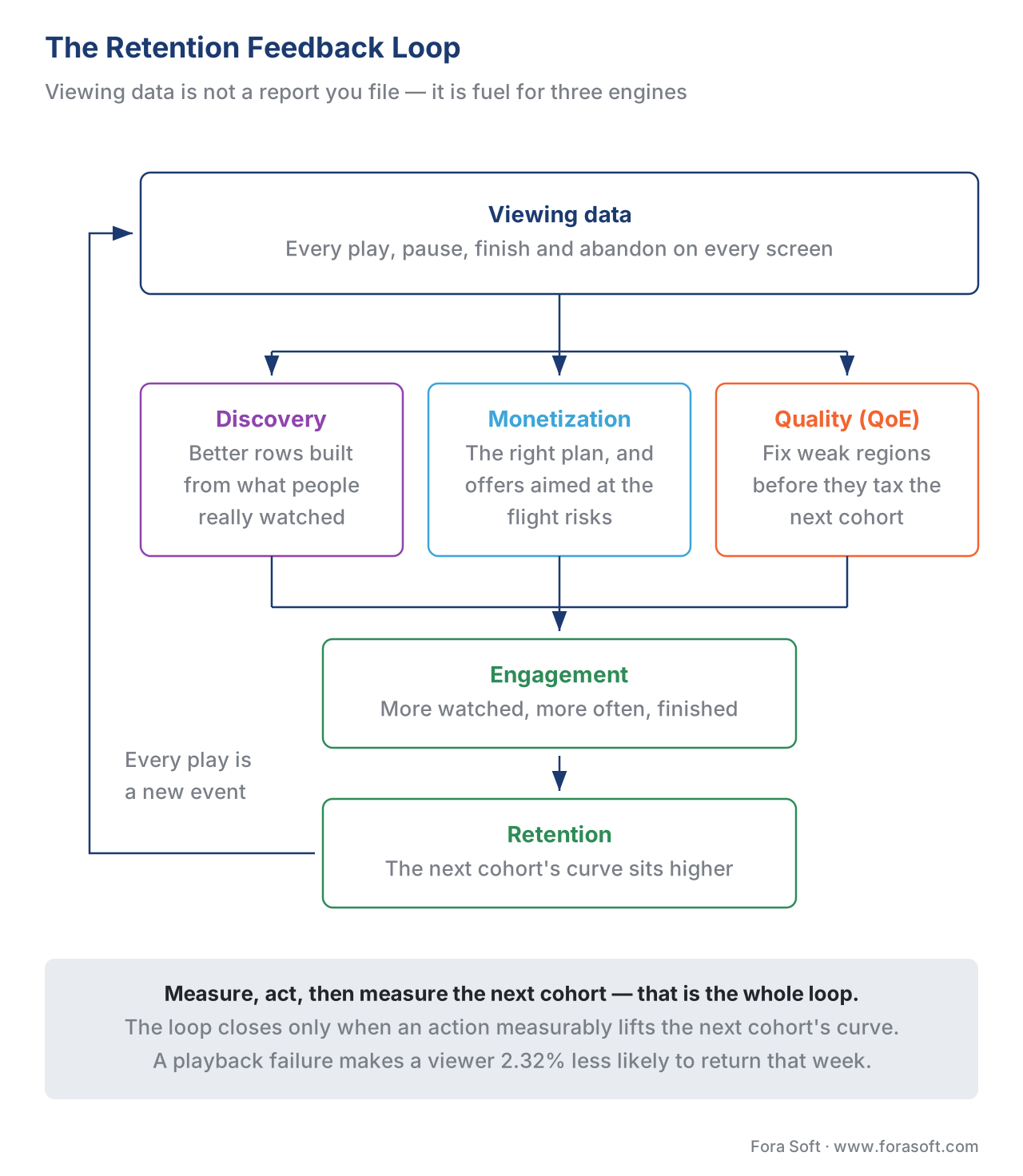 Figure 3. The retention feedback loop. Viewing data feeds recommendations, monetization, and quality decisions, each of which lifts engagement and closes the loop on retention.
The first engine is discovery. Every play, pause, finish, and abandon is training data for the recommendation system that decides what each viewer sees next, and better discovery is one of the most direct levers on engagement and therefore retention. The model internals live elsewhere — see recommendation systems for video and, for the algorithms, the AI section's recommendation models — but the data that powers them is exactly the engagement data on your dashboard.
The second engine is monetization. Engagement segments tell you who to nudge toward an annual plan, who is a flight risk worth a retention offer, and when a serial churner's favourite franchise is about to drop. This is where retention analytics meets the churn-and-retention playbook in subscription churn analytics and pricing and packaging. The loop closes when an action — a better row of recommendations, a timely win-back email, a quality fix in a weak region — measurably lifts the next cohort's curve.
Privacy: analysing viewing data is regulated
The moment you analyse what specific people watched, you are handling some of the most protected data there is, and two regimes govern it. In the United States, the Video Privacy Protection Act (VPPA, 18 U.S.C. § 2710) prohibits a video service from disclosing personally identifiable viewing information to a third party without the consumer's informed, written, separately-obtained, revocable consent — and "third party" has been read to include advertising and analytics providers, which is why dropping a careless tracking pixel on a watch page has driven a wave of litigation. The scope is live law: the US Supreme Court agreed in 2026 to resolve who counts as a protected "consumer," so the boundaries may shift. In the European Union, the General Data Protection Regulation (GDPR, Regulation (EU) 2016/679) treats viewing behaviour as personal data and requires a lawful basis — typically consent — before you process it for analytics. The practical rule: separate the analytics that improve the product (governed, consented, often pseudonymised) from any sharing with outside ad or analytics partners (consent-gated and logged), and treat your viewing-data pipeline as a compliance surface, not just an engineering one. The full treatment is in privacy and viewing data.
Free download: Retention & Engagement Analytics Starter KitThe four leading engagement metrics and the counting trap in each, how to read a cohort curve by its shape, the voluntary-versus-involuntary churn split with the dunning arithmetic worked through, and the QoE numbers that move retention — on one page you can take into a data review.Where Fora Soft fits in
Retention analytics only earns its keep at scale, where a fraction of a percent of monthly churn is thousands of subscribers and a regional quality problem is invisible without the right slicing. Fora Soft has built video streaming, OTT/Internet TV, e-learning, and telemedicine platforms since 2005 — 625+ shipped projects for 400+ clients over 20+ years — so we treat the engagement-to-retention loop as platform plumbing: player beacons that feed honest CTA-2066 metrics, cohort and QoE-sliced dashboards, and the data pipeline that routes viewing signals into recommendations and billing without breaking VPPA or GDPR. We are vendor-neutral; we wire the analytics layer to the platform, not to a particular tool. The job is to make the warning signs visible early enough to act on.



The handbook
Fora Soft Video Engineering Handbook
We wrote a seven-volume handbook, 9,000+ pages, that takes the video stack from a single pixel to production — encoding, delivery, audio and AI — and someone who works through it can design and build the platform this dashboard is measuring. Volume 3 is the one to open next to this article: it covers the player beacons and QoE metrics behind the startup-time and rebuffering numbers that quietly tax retention, and the delivery economics that decide what a saved subscriber is worth. Volume 6 covers the recommendation and search models your engagement data trains, and volume 7 takes them into production — serving, cost per stream-hour, and the privacy and compliance surface that viewing data drags behind it. Written by Nikolay Sapunov, CEO at Fora Soft.
Can your dashboard tell you who is about to cancel?
Tell us what your players already log, how you define watch time, and whether you split voluntary churn from failed payments, and we will say what to instrument, what to slice the cohorts by, and which number belongs in front of the board. 250+ video products shipped since 2005.
See our case studies
Case study
Perspire.tv
A live and on-demand fitness platform where trainers keep 80% of revenue and viewers buy Coins rather than one flat plan — session frequency and repeat bookings are the business model, not a slide in the deck.
Case study
Sprii
A Danish live shopping platform with €365M+ in cumulative sales and 72,000+ live events, where viewers stay 20 minutes against 54 seconds on a static page — watch time read as the leading indicator, per event.
Case study
Worldcastlive
HD concert streaming at 0.4–0.5s latency for 10,000 simultaneous viewers at 1.5 Gb/s, with quality stepped down automatically on weak connections — the QoE side of the retention equation, engineered.
What to read next
Analytics map
OTT Analytics: Audience, Engagement & Quality Metrics
The whole measurement landscape, of which this article is one half.
Churn
Streaming Churn and Retention: the SVOD Analytics Guide
The subscription side: win-back offers, pricing, and the dunning sequence.
QoE tooling
The QoE Measurement Stack: Mux, Conviva & Telemetry
Where the startup-time and rebuffering numbers on your cohorts come from.
Data pipeline
The Personalization Data Pipeline
How a play event becomes a feature the discovery engine can actually use.
References
- Krishnan, S. S. and Sitaraman, R. K. Video Stream Quality Impacts Viewer Behavior: Inferring Causality Using Quasi-Experimental Designs. ACM Internet Measurement Conference (IMC) 2012 — abandonment after ~2s startup, +5.8% per added second, 1% rebuffering → ~5% less watched, failure → 2.32% less likely to revisit in a week; 23M views / 6.7M viewers. Tier 5 (foundational academic). https://dl.acm.org/doi/10.1145/2398776.2398799
- Consumer Technology Association. CTA-2066: Streaming Quality of Experience Events, Properties and Metrics, 2020 — defines Play Time (watch time) and the common QoE/engagement metric terminology used across players and analytics vendors. Tier 1 (standard). https://shop.cta.tech/products/cta-2066
- United States Code. Video Privacy Protection Act, 18 U.S.C. § 2710 — consent requirements for disclosing personally identifiable viewing information to third parties including analytics/ad providers. Tier 1 (statute). https://www.law.cornell.edu/uscode/text/18/2710
- European Union. General Data Protection Regulation, Regulation (EU) 2016/679 — viewing behaviour as personal data; lawful basis/consent required for analytics processing. Tier 1 (regulation). https://eur-lex.europa.eu/eli/reg/2016/679/oj
- Deloitte. 2026 Digital Media Trends — 41% of US consumers cancelled at least one paid SVOD in the prior six months; "churn and return" behaviour; average of four services per household. Tier 5 (analyst/institutional). https://www2.deloitte.com/us/en/insights/industry/technology/digital-media-trends-consumption-habits-survey.html
- Eightx. DTC Subscription Churn Index 2026 — median monthly churn ~3.27% (≈2.41% voluntary, ≈0.86% involuntary); involuntary churn 30–40% of total and largely recoverable via dunning. Tier 5 (industry analysis). https://eightx.co/blog/dtc-subscription-churn-index-2026
- Countly. 7 Streaming KPIs That Predict Subscriber Retention — completion-rate threshold (~65%) and higher retention; time-to-second-session and session frequency as leading churn indicators. Tier 6 (industry/educational). https://countly.com/blog/7-streaming-kpis-that-predict-long-term-subscriber-value-for-audio-and-video-platforms
- Ropes & Gray LLP. Supreme Court to Consider the Video Privacy Protection Act (February 2026) — the 2026 case resolving the scope of "consumer" under the VPPA. Tier 5 (legal analysis). https://www.ropesgray.com/en/insights/alerts/2026/02/supreme-court-to-consider-the-video-privacy-protection-act
- Mux. Track the success of your videos with new Engagement Metrics — first-party definitions of watch-time/engagement metrics in a managed analytics platform. Tier 3 (first-party platform). https://www.mux.com/blog/track-the-success-of-your-videos-with-new-engagement-metrics
