


Why this matters
If you run or are planning an OTT platform, analytics is not a data-science side project — it is the instrument panel you fly the business on. A founder who cannot answer "how many people are watching right now, how much of each title they finish, and whether the video is playing cleanly" is making product, content, and infrastructure decisions on guesses. The trouble is that streaming throws dozens of metrics at you, most dashboards mix them together, and many of the headline numbers (raw "plays", average watch time) lie in ways that flatter the platform. This article gives you the map a non-technical operator needs: the three metric families, how they connect to revenue, and how to read them without being fooled. It is the anchor of the analytics block, and it links out to the deeper articles on each family — viewership metrics, quality of experience, and retention analytics — so you can go as deep as you need on any one of them.
The one idea: analytics is the operator's instrument panel
A pilot does not stare at one dial. The instrument panel groups readings by what they tell you — altitude and heading say where you are, airspeed and fuel say how you are doing, engine temperature and oil pressure say whether the machine is healthy — and the pilot reads all three groups together because any one alone can mislead. An OTT analytics map is the same idea. You are not chasing a single "north-star metric"; you are reading three groups of dials that answer three different questions, and the skill is knowing which group answers which question and how they affect each other.
So before any specific number, fix the three questions in your head. Who is watching, and how many? That is the audience family. What are they watching, and for how long? That is the engagement family. How well did the video actually play? That is the quality family. Every metric a streaming platform produces drops into one of those three buckets, and the reason the map matters is that the buckets are causally linked — bad quality quietly poisons engagement, weak engagement shows up as churn, and churn is the number your revenue cannot survive. Read them in isolation and you will treat symptoms; read them as a map and you can trace a revenue problem back to its cause.
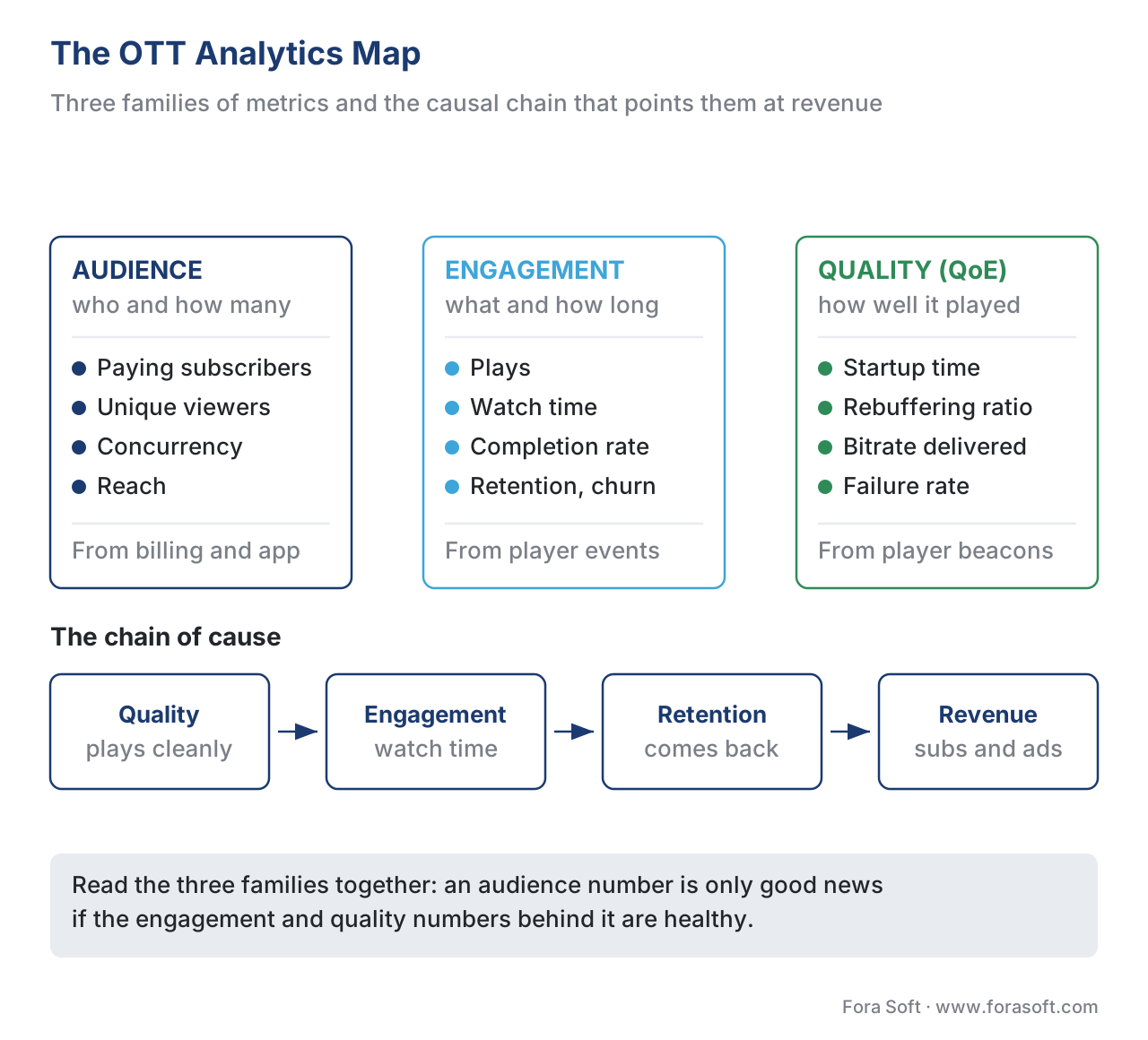 Figure 1. The three families and the direction of cause. Quality feeds engagement, engagement feeds audience retention, and retention is what revenue is built on.
Family one: audience — who is here, and how many
The audience family answers the headcount questions. These are the numbers a board asks about first, because they size the business.
The base layer is registered and subscribed accounts — how many people have signed up, and (for a subscription service) how many are paying. But an account is not a viewer. One household subscription can be three people on four devices, so platforms also track unique viewers (distinct people or profiles who actually watched in a period) and, for advertising, reach (how many unique viewers an ad or a title touched). The gap between accounts and active unique viewers is itself a health signal: a platform with a million subscribers but two hundred thousand monthly active viewers has a retention problem hiding behind a healthy-looking subscriber count.
The metric that is unique to streaming — and the one that most stresses the architecture — is concurrency: how many people are watching at the same instant. Concurrency is what your delivery, your transcoding, and your content-delivery network are sized against, and for a live event it can spike to many multiples of the average. We treat the engineering of that spike in depth in scaling and concurrency for OTT; here the point is simpler — concurrency is an audience metric that doubles as a capacity-planning metric, and it is the one that breaks platforms that only watch daily totals.
The honest-counting trap in this family is treating accounts as viewers. Define your unique-viewer and concurrency metrics precisely — per profile, in a stated time window, de-duplicated across devices — before you quote them to anyone, because the naive version always over-counts.
Family two: engagement — what they watch, and for how long
If the audience family sizes the room, the engagement family tells you whether anyone is actually enjoying the show. This is the family most tied to whether a viewer comes back, and it is built from a small number of carefully defined events.
The atom of engagement is the play: a single instance of a viewer starting a piece of content. It sounds trivial to count, and it is the single most abused metric in streaming, because "a play" is a defined event, not a guess. Does a two-second autoplay preview in a browse row count as a play? Does the player counting a re-buffer recovery as a fresh play count it twice? Different definitions can change a "plays" number by a wide margin, which is why the industry leans on a qualifying threshold — a common convention is to count a play only after a minimum continuous watch time. We pull this metric apart, including the autoplay and bot pitfalls, in viewership metrics.
From plays you build the metrics that actually predict loyalty. Watch time (total minutes viewed) is the raw fuel of the business — it drives ad inventory in advertising models and is the usage key that allocates revenue to titles. Completion rate (what fraction of a title viewers finish) tells you whether the content delivers on its promise. Session length and sessions per user tell you whether the platform is a habit or an occasional visit. And the engagement family rolls up into the two numbers that summarize loyalty: retention (the share of users who keep coming back over time) and its mirror image churn (the share who leave). Churn as a revenue metric is the heart of the subscription business, and we treat it as such in churn, retention, and subscription analytics; the engagement curves that predict churn are the subject of retention and engagement analytics.
The honest-counting trap here is the average. "Average watch time was 28 minutes" can describe a healthy platform or one where a tiny core of superfans masks a wall of viewers who quit in the first minute. Engagement metrics must be read as distributions and cohorts, not single averages, or they will tell you a comforting story that is not true.
Family three: quality — how well it actually played
The third family is the one founders most often overlook and engineers most often obsess over, and it is the one this section treats as the operator's lever. Quality of experience (QoE) is the umbrella term for how well the video played from the viewer's seat — not whether the content was good, but whether the technology delivered it cleanly. It exists as a named, standardized family precisely because every analytics vendor used to define these metrics slightly differently; the Consumer Technology Association's CTA-2066 standard ("Streaming Quality of Experience Events, Properties and Metrics", 2020) was written to give the industry one terminology and one agreed way to compute each metric, so that two platforms reporting "rebuffering ratio" mean the same thing.
Four QoE metrics — often called the QoE quartet — carry most of the weight, and you should be able to name them.
| QoE metric | Plain-language meaning | What it maps to | Operator target (typical) |
|---|---|---|---|
| Video startup time | How long from pressing play to first frame | Abandonment before the video even begins | Under ~2 seconds |
| Rebuffering ratio | Share of viewing time spent frozen, buffering | Viewers watching less and leaving | Under ~1%, best-in-class ≤0.5% |
| Average bitrate / video quality | How sharp the picture the player actually delivered was | Perceived quality, satisfaction | As high as the network sustains |
| Playback failure rate | Share of attempts that error out and never play | Outright lost views and lost trust | As close to 0% as possible |
Targets are common operator conventions, not standards; the exact definitions live in CTA-2066 and the Video Streaming section linked below.
These four are the operator's view. The formal, player-algorithm definitions — exactly how a player computes startup time, how adaptive bitrate selection works under the hood — belong to the streaming-engineering layer, and we deliberately do not re-derive them here; read video QoE metrics in the Video Streaming section for the definitions, and player QoE instrumentation for how the player emits them. What matters on the analytics map is that the quality family is measurable from the player and directly tied to revenue — which is the link the next section proves.
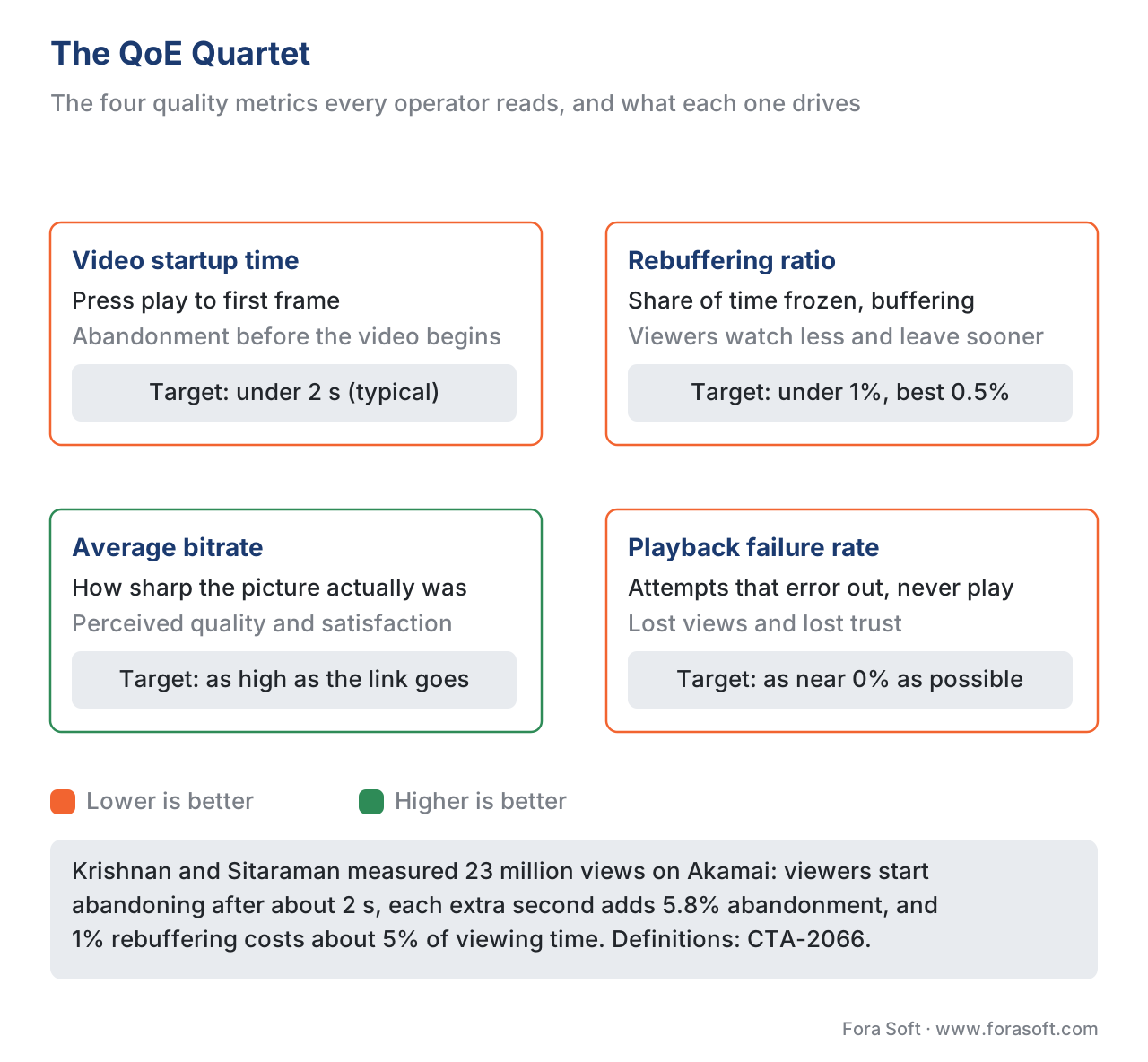 Figure 2. The four quality metrics every operator reads, and the viewer behavior each one drives.
The thing the map is really about: how the three families connect to revenue
Here is why grouping the metrics matters more than any single number. The three families are not parallel report cards — they are a causal chain, and the chain points at revenue.
Quality affects engagement. This is not a hunch; it is one of the most-cited results in streaming research. In 2012, Krishnan and Sitaraman analyzed 23 million video views from 6.7 million unique viewers on Akamai's network and established a causal link — not just a correlation — between stream quality and viewer behavior. Their headline findings still anchor the field: viewers begin to abandon a video once startup takes more than about two seconds, and each additional second of startup delay increases the abandonment rate by 5.8 percent. They also found that a viewer who suffers rebuffering equal to just 1% of the video's duration watches about 5% less of it, and that a viewer who hit a failure was measurably less likely to return to the same site within a week. The IETF's own guidance for streaming operators, RFC 9317 ("Operational Considerations for Streaming Media", 2022), frames startup time, playback stability, and the avoidance of stalls as the core quality concerns precisely because they govern the experience.
Engagement affects retention. A viewer who finishes titles, returns across sessions, and builds a habit is a viewer who renews a subscription or sees more ads. A viewer whose sessions get shorter is sending you a churn warning weeks before they cancel.
Retention affects revenue. In a subscription (SVOD) model, retention is the revenue line — lost subscribers are lost recurring income. In an advertising (AVOD) model, engagement is the inventory — fewer minutes watched means fewer ads served. Either way, the money sits at the end of the chain, and the chain starts with quality.
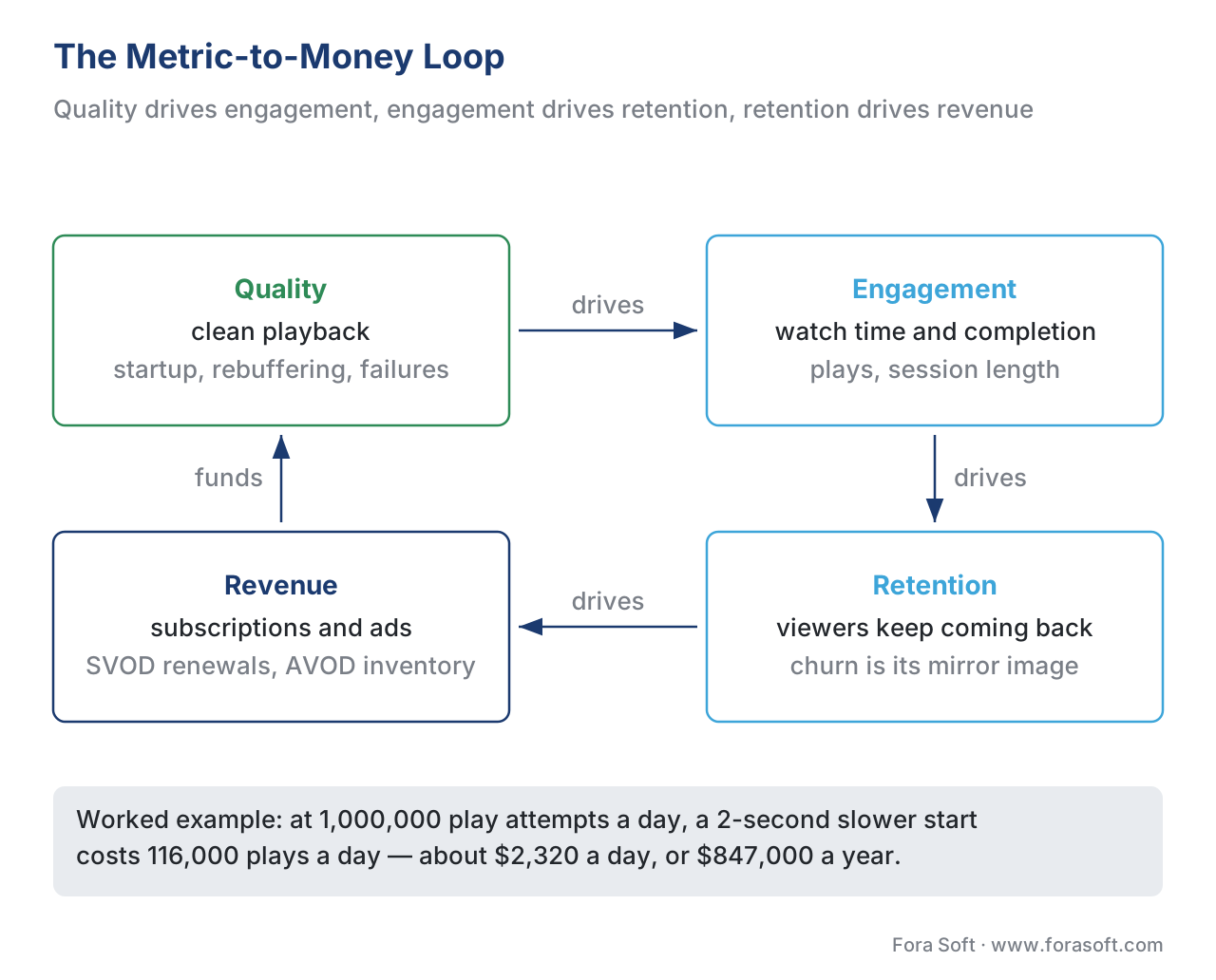 Figure 3. The loop closes: revenue funds the infrastructure that keeps quality high, which is why analytics is a business instrument, not a reporting chore.
A worked example: the cost of a slow start
Make the chain concrete with arithmetic, because that is what turns a quality metric into a budget line.
Suppose your platform serves 1,000,000 play attempts a day. An infrastructure change — a cheaper but slower content-delivery configuration — pushes your median video startup time from 2 seconds to 4 seconds: two extra seconds.
Using the Akamai finding of 5.8% additional abandonment per extra second, two seconds means roughly 2 × 5.8% = 11.6% more of those attempts abandoned before the video starts.
11.6% of 1,000,000 = 116,000 lost plays per day.
Now attach money. Say each successful play is, conservatively, worth $0.02 to you (one pre-roll ad impression net of costs, or the watch-time value of one retained session). Then 116,000 × $0.02 = $2,320 lost per day, or about $847,000 a year — purely from a two-second-slower start, before a single subscriber churns. Run the same arithmetic with your real numbers and the quality family stops being an engineering vanity metric and becomes a line your CFO cares about. This "cost of a slow start" calculation is the strongest argument the analytics map gives you, and we extend it in the QoE article.
Where the numbers come from: the data layer under the map
A map is only as good as the instruments feeding it, so it helps to know where each family's numbers originate.
Audience and engagement metrics come from two places: your application and billing systems (who signed up, who is paying, who pressed play) and your player events (when a play started, how long it ran, where it stopped). Quality metrics come almost entirely from the player itself, which is the only component that knows what the viewer actually saw — when the first frame appeared, how long it stalled, what bitrate it settled on. The player emits these as small telemetry messages, called beacons, that flow to your analytics system; building them is the subject of player QoE instrumentation.
Two standards are worth knowing by name because they are making this data layer interoperable. CTA-2066 (above) standardizes what the metrics mean. CTA-5004, the Common Media Client Data (CMCD) specification, standardizes how a player attaches playback information — session ID, the content's bitrate, whether it is about to stall — to each request it makes to the content-delivery network, so that the network and the analytics layer can be correlated instead of guessing. Its companion CTA-5006 (Common Media Server Data, CMSD) lets the servers reply with their own data. Together they mean your delivery logs and your player metrics can finally be stitched into one session view — the foundation of the measurement stack we cover in the QoE measurement stack.
The map and its three families, then, are not abstract — each family has a concrete source, and the standards above are why an operator can read them consistently rather than trusting a single vendor's private definitions.
A common mistake: steering by vanity metrics
The most expensive analytics error is not a missing dashboard — it is steering by the wrong family. A platform that celebrates "ten million plays this month" while ignoring rebuffering ratio and completion rate is reading the audience dial while the engine-temperature dial is in the red. Raw plays inflate easily (autoplay, re-counts, bots), feel great in a board deck, and tell you almost nothing about whether viewers are happy or will return. The discipline the map enforces is to always read the three families together: an audience number is only good news if the engagement and quality numbers behind it are healthy. When a headline metric improves, ask which family it belongs to and what the other two families say — if plays are up but completion is down and rebuffering is up, you are buying a spike you will pay for in churn.
Free download: OTT Analytics Map & Honest-Counting ChecklistOne page with the three metric families, the QoE quartet and its targets, where each number comes from, and the counting traps — the play definition, averages that hide the tail, accounts quoted as viewers.Where Fora Soft fits in
Analytics on a streaming platform has to hold at scale — millions of play events and quality beacons a day, turning into honest, real-time dials an operator can actually steer by, not a warehouse of numbers nobody trusts. Fora Soft has built video streaming and OTT/Internet TV platforms since 2005, across 625+ projects for 400+ clients, including the player instrumentation, event pipelines, and dashboards that make the three families legible. We design the analytics layer as part of the platform — player beacons emitting standardized QoE events, an event pipeline that defines a "play" and a "unique viewer" precisely, and dashboards that show the audience, engagement, and quality families side by side so the causal chain to revenue is visible. We are vendor-neutral: we will build on a measurement platform like Mux or Conviva, or on open telemetry, whichever fits your scale and budget.

The handbook
Fora Soft Video Engineering Handbook
We wrote a seven-volume handbook that takes the whole video stack apart, from the pixel to the bill at the end of the month, and someone who works through it can design and build the platform these dials are measuring. Volume 3 sits closest to this article — players, CDNs, DRM and the economics of delivery, which is where startup time and rebuffering are actually produced and paid for; volume 2 covers the transport and the HLS and DASH manifests that the CMCD fields ride on; volume 1 explains the encoding ladder behind the bitrate your player reports as delivered. Written by Nikolay Sapunov, CEO at Fora Soft.
Do your dashboards tell you why a number moved?
Tell us what your player emits and where those events land, and we will tell you which of the three families you are flying blind on and what it takes to close the gap. 250+ video products shipped since 2005.
See our case studies
Case study
Worldcastlive
HD concert streaming at 0.4–0.5 s latency and 1.5 Gb/s for 10,000 simultaneous viewers — concurrency is the audience number your delivery is sized against, not a daily total.
Case study
Sprii
72,000+ live shopping events, where viewers stay about 20 minutes against 54 seconds on a static product page — the engagement gap only shows up if you read the distribution.
Case study
TradeCaster
46,000+ traders on $99–$119/mo subscriptions, auto-scaling through the spike at market open — retention is the revenue line, and the quality that protects it is sized in advance.
What to read next
Quality
Quality of experience: startup time and rebuffering
The quality family in depth, with the cost-of-a-slow-start arithmetic run out in full.
Data layer
The QoE measurement stack
Where player beacons land, and what Mux, Conviva and open telemetry each give you.
Engagement
Retention and engagement analytics
Turning the engagement family into cohorts and product decisions instead of one average.
Decisions
From metrics to decisions
Reading all three families together on one page, and acting on what they say.
References
- RFC 9317 — Operational Considerations for Streaming Media. J. Holland, A. Begen, S. Dawkins. IETF (Media Operations WG), Informational, October 2022. Tier 1 (standards body). Frames the operational quality-of-experience concerns for streaming — startup time, playback-quality stability, and stall avoidance — and references CTA-2066 and CTA-5004 as the metric and telemetry standards. §4.4, §5.6.1–5.6.2. https://www.rfc-editor.org/info/rfc9317 (accessed 2026-06-19).
- CTA-2066 — Streaming Quality of Experience Events, Properties and Metrics. Consumer Technology Association, March 2020. Tier 1 (standards body). Defines a common set of player events, properties, and QoE metrics (including video startup time, rebuffering, and how each should be computed) so reporting is consistent across players and analytics vendors. https://shop.cta.tech/products/cta-2066 (accessed 2026-06-19).
- CTA-5004 — Common Media Client Data (CMCD). Consumer Technology Association, 2020. Tier 1 (standards body). Standardizes the playback metadata a media client attaches to each CDN request (session ID, bitrate, buffer state), enabling correlation of client experience with delivery for QoS/QoE monitoring. https://cdn.cta.tech/cta/media/media/resources/standards/pdfs/cta-5004-final.pdf (accessed 2026-06-19).
- CTA-5006 — Common Media Server Data (CMSD). Consumer Technology Association, November 2022. Tier 1 (standards body). The server-side companion to CMCD: a standard way for every media server and intermediary to communicate data with each response to improve delivery efficiency and QoE. https://cdn.cta.tech/cta/media/media/resources/standards/pdfs/cta-5006-final.pdf (accessed 2026-06-19).
- Video Stream Quality Impacts Viewer Behavior: Inferring Causality Using Quasi-Experimental Designs. S. S. Krishnan and R. K. Sitaraman. ACM Internet Measurement Conference (IMC '12), 2012. Tier 5 (peer-reviewed academic, foundational). 23M views / 6.7M unique viewers on Akamai; establishes causality: abandonment begins after ~2s startup, +5.8% abandonment per added second, 1% rebuffering → ~5% less viewing, failures reduce return visits. https://people.cs.umass.edu/~ramesh/Site/HOME_files/imc208-krishnan.pdf (accessed 2026-06-19).
- Quality of Experience (QoE) in Video Streaming. Mux. Tier 3 (first-party analytics vendor). Operator-facing definitions and benchmarks for the QoE metrics — video startup time, rebuffering, playback failures — and their correlation with abandonment. https://www.mux.com/articles/qoe (accessed 2026-06-19).
- What is QoE (Quality of Experience). Mux Video Glossary. Tier 3 (first-party). Concise definition of QoE as user-perceived performance and the metrics that compose it. https://www.mux.com/video-glossary/qoe-quality-of-experience (accessed 2026-06-19).
- OTT Platform Analytics: KPIs Every Streaming Operator Must Track. MwareTV. Tier 5 (industry/operator guidance). Orientation on the operator KPI set across audience, engagement, technical quality, and monetization; used for current-practice framing, not for metric definitions. https://mwaretv.com/en/blog/ott-platform-analytics-guide (accessed 2026-06-19).
- Guide to Video Analytics for OTT Platforms — Key Metrics in 2026. FastPix. Tier 5 (industry). Current (2026) operator-metric orientation: time-to-first-frame, completion rate, concurrency, and the audience/engagement/quality split. https://www.fastpix.io/blog/guide-to-video-analytics-for-ott-platform-key-metrics (accessed 2026-06-19).
Spec/standard precedence note (per §4.3.2): where popular OTT-analytics listicles present a flat list of "top KPIs" with vendor-specific definitions, this article follows the controlling standards — CTA-2066 for the QoE metric definitions and CTA-5004/5006 for the telemetry data layer — and the peer-reviewed Krishnan–Sitaraman study for the quality→behavior causality, organizing the metrics into the three-family causal map rather than a flat list. Operator "target" thresholds (≈2s startup, ≤1% rebuffering) are common conventions, not standardized limits, and are flagged as such.
