


Why this matters
If you operate or are planning an over-the-top (OTT) platform — one that delivers video over the internet rather than through a cable box — you cannot improve a viewer experience you are not measuring, and you cannot measure it from your servers alone. The numbers that decide whether viewers stay (how fast video starts, how often it freezes) live on the viewer's device, so the measurement stack is the plumbing that brings those numbers back to you and turns them into action. This article is for the non-technical operator — the founder, product manager, or streaming executive — who has to choose and budget that stack, talk to the vendors, and read the dashboard, without becoming a data engineer. It is the practical follow-on to the QoE quartet: that article defined the metrics; this one is about the machinery that produces them.
The one idea: you can only fix what you measure at the player
Start with the rule that organizes everything else. The metrics that describe a viewer's experience — startup time, rebuffering, the bitrate they actually received, whether playback failed — can only be measured honestly at the player, because that is the one place that sees what the human saw. Your content-delivery network (the network of cache servers that pushes video close to viewers, called a CDN) can report perfect health while a viewer on weak home Wi-Fi watches a spinning loader. The internet standard that frames this whole area, the Internet Engineering Task Force's RFC 9317 (Operational Considerations for Streaming Media, October 2022), says it plainly: a CDN "produces millions of log lines per second" but "has no concept of a 'session'" and "cannot tell ... whether any of the clients have stalled and are rebuffering."
So a QoE measurement stack exists to do three jobs in order: collect the truth from the player, aggregate it into metrics you can read, and act on it before viewers leave. Everything below — the vendors, the open standards, the data model — is a different way of doing those same three jobs. Keep the three jobs in mind and the market stops looking like an alphabet soup of products.
What the measurement stack actually does, stage by stage
A QoE stack is a short pipeline. Picture it left to right, the same way you would picture the streaming pipeline itself.
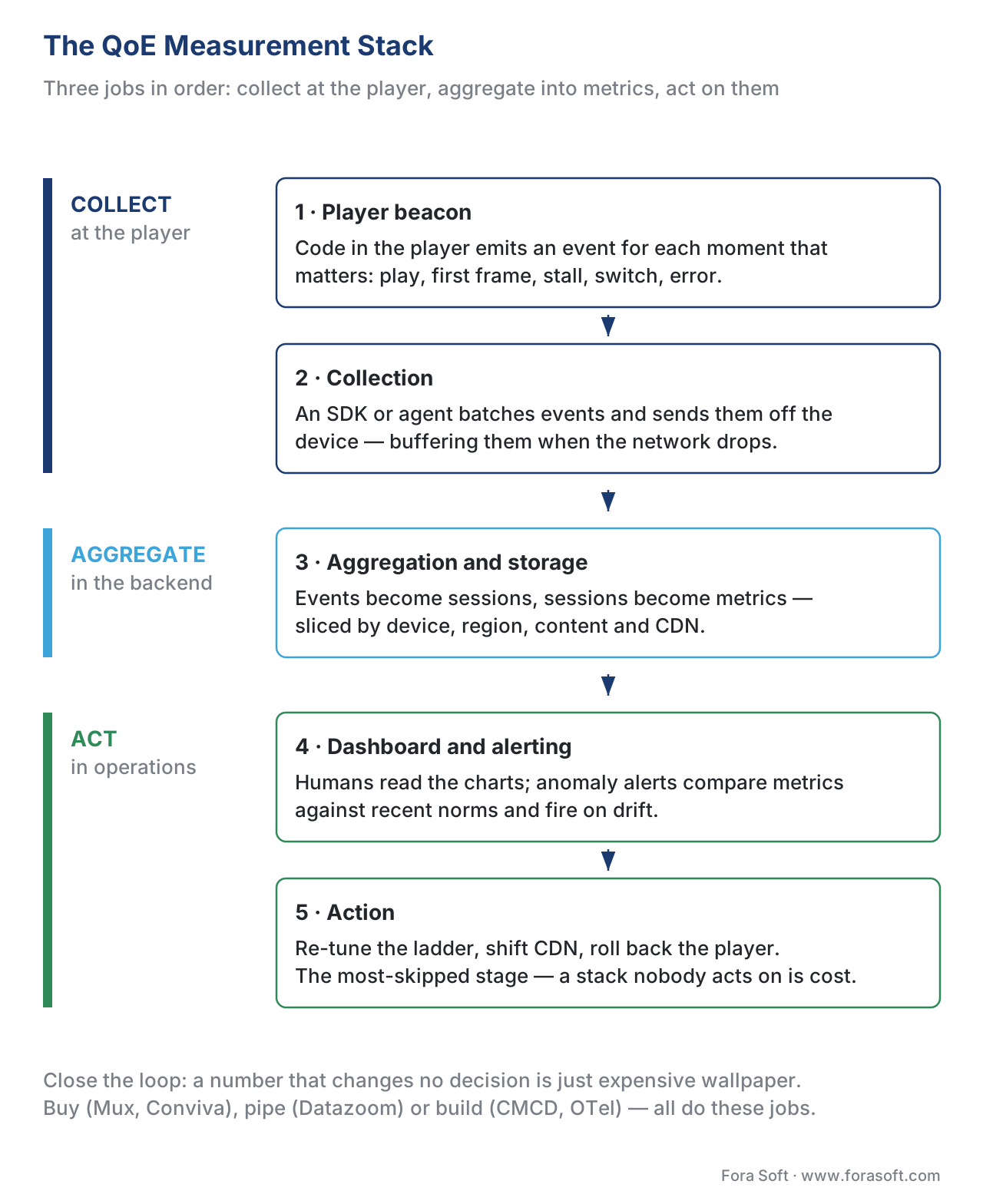 Figure 1. The measurement stack does three jobs — collect at the player, aggregate into metrics, act on them — and the loop only closes when a number changes a decision.
The first stage is the player beacon: a small piece of code inside the video player that emits an event every time something meaningful happens — play requested, first frame shown, stall started, stall ended, bitrate switched, error thrown. These events are the raw material; nothing downstream can be more accurate than they are. The discipline of placing these beacons correctly on each device is its own subject — see player QoE instrumentation — but for the operator the point is simple: the beacon is where measurement begins, and a missing or wrong beacon is a number you will never be able to trust.
The second stage is collection: an SDK (a software development kit — the vendor's library you drop into your app) or a lightweight agent batches those events and sends them off the device to an ingest endpoint. Good collection is resilient — it buffers events when the network drops and survives the app being backgrounded — because the moments you most want to measure (a bad network) are exactly when the data is hardest to send.
The third stage is aggregation and storage: the raw events are stitched into sessions (one viewer watching one thing), then rolled up into the metrics you actually read — average startup time, rebuffering ratio, failure rate — sliced by device, region, content, and CDN. This is where a million scattered events become a single readable number, and, as we will see, it is where most of the honest-measurement decisions get made.
The fourth stage is presentation and alerting: dashboards for humans, and automated alerts that fire when a metric drifts from its norm. The best modern systems add anomaly detection so a person does not have to stare at a chart; Conviva's Video AI Alerts, for example, "continually compare Quality of Experience (QoE) and engagement metrics against recent norms and instantly detect anomalies," then surface the likely root cause.
The fifth and most-skipped stage is action: the number has to change a decision — re-tune the encoding ladder, shift traffic to a healthier CDN, or roll back a player release — or the whole stack is just expensive wallpaper. A measurement stack that nobody acts on is the most common waste in streaming operations.
The real decision: buy, pipe, or build
There is no universally right stack; there is the stack that fits your scale and your team. Three shapes dominate, and the choice between them is the central decision of this article.
 Figure 2. Build-vs-buy for the telemetry layer is driven by scale and team size, not by a feature list. Most platforms should buy until the in-house math clearly wins.
The first shape is buy a managed QoE platform — Mux Data or Conviva. You install their SDK, and they handle collection, aggregation, dashboards, and alerting. You get a working QoE practice in days, not quarters, and you never run the ingest infrastructure. The trade-off is a per-view or per-stream fee and that your data lives in their system.
The second shape is pipe your data through a vendor-neutral collector — Datazoom is the clearest example. Instead of one product that both collects and analyzes, Datazoom collects standardized player events and routes them to whatever systems you choose — your own data warehouse, a product-analytics tool, or an observability backend. As Datazoom describes it, the platform "captures, standardizes, enriches, and delivers data from across components of the video streaming workflow in real-time," standardizing every event "into easy-to-parse JSON." The appeal is data ownership and freedom from lock-in; the cost is that you still need somewhere to send the data and someone to build the analysis on top.
The third shape is build an open stack yourself from streaming standards and open-source tooling — covered in its own section below. Maximum control and no per-view fee, but you are now operating a real-time data system, which is a product in itself.
The honest rule of thumb in 2026: a managed platform is the right answer for almost everyone below roughly one billion viewing minutes a year, and an in-house build only pays off above that — and only after a clean total-cost-of-ownership analysis that counts the engineers, not just the cloud bill. Shipping a minimum viable product with a small team? Buy. The product truth is in your catalogue and your app, not in your telemetry pipeline.
The buy options compared: Mux Data, Conviva, Datazoom
These three platforms are not the same kind of thing, which is exactly the point. The table below compares them on the axes that decide a real choice, including a capability column for the questions operators actually ask.
| Capability | Mux Data | Conviva | Datazoom |
|---|---|---|---|
| What it is | Managed QoE analytics, developer-first | Enterprise QoE + engagement, real-time | Vendor-neutral data collection & routing |
| QoE dashboards built in? | Yes | Yes | No — you build them downstream |
| Single composite score? | Yes — Overall Viewer Experience (0–100) | Yes — Streaming Performance Index | No — you define your own |
| Real-time anomaly alerting? | Yes | Yes — Video AI Alerts with root cause | Via the backend you route to |
| You own / can export raw data? | Limited | Limited | Yes — that is the product |
| Best-fit scale | Startups to mid-size; fast time-to-value | Large broadcasters, premium live | Teams wanting their own data lake / multi-tool |
| Typical pricing shape (2026) | Per 1,000 views (≈ $0.50–0.60) | Enterprise contract, sensor-based | Platform fee + volume |
Vendor capabilities and prices change — this table is dated June 2026 and must be re-verified before a buying decision. NPAW (Youbora) is a fourth comparable QoE platform worth a quote. Metric terminology across all of them should map to CTA-2066 so your numbers stay portable.
A few specifics that matter for the decision. Mux Data rolls the whole experience into a single 0–100 number it calls the Overall Viewer Experience score, built from four components — playback success, startup time, playback smoothness, and video quality — so an executive can track one dial while engineers drill into the parts. It is sold per view (additional views start around $0.50–0.60 per thousand in 2026) and is designed to be dropped onto any player, not just Mux's own. Conviva is the enterprise incumbent for premium and live streaming; its sensors feed a real-time picture, its Streaming Performance Index is the composite, and its Video AI Alerts diagnose the likely root cause of an anomaly rather than just flagging it. Datazoom is the odd one out by design: it does not try to be your dashboard, it tries to be your pipe, collecting events in sub-second real time and delivering clean JSON to the systems you already run. If your strategy is to own your data and analyze it alongside billing and product analytics, Datazoom (or a similar collector) fits where a closed platform would fight you.
The open-telemetry route: standards plus open-source tooling
The third shape — build it yourself — has become far more credible because the streaming industry has standardized the hard parts. "Open telemetry" here means two things working together: the open standards that define how the player, the CDN, and your tools exchange QoE data, and the open-source observability tools that store and display it.
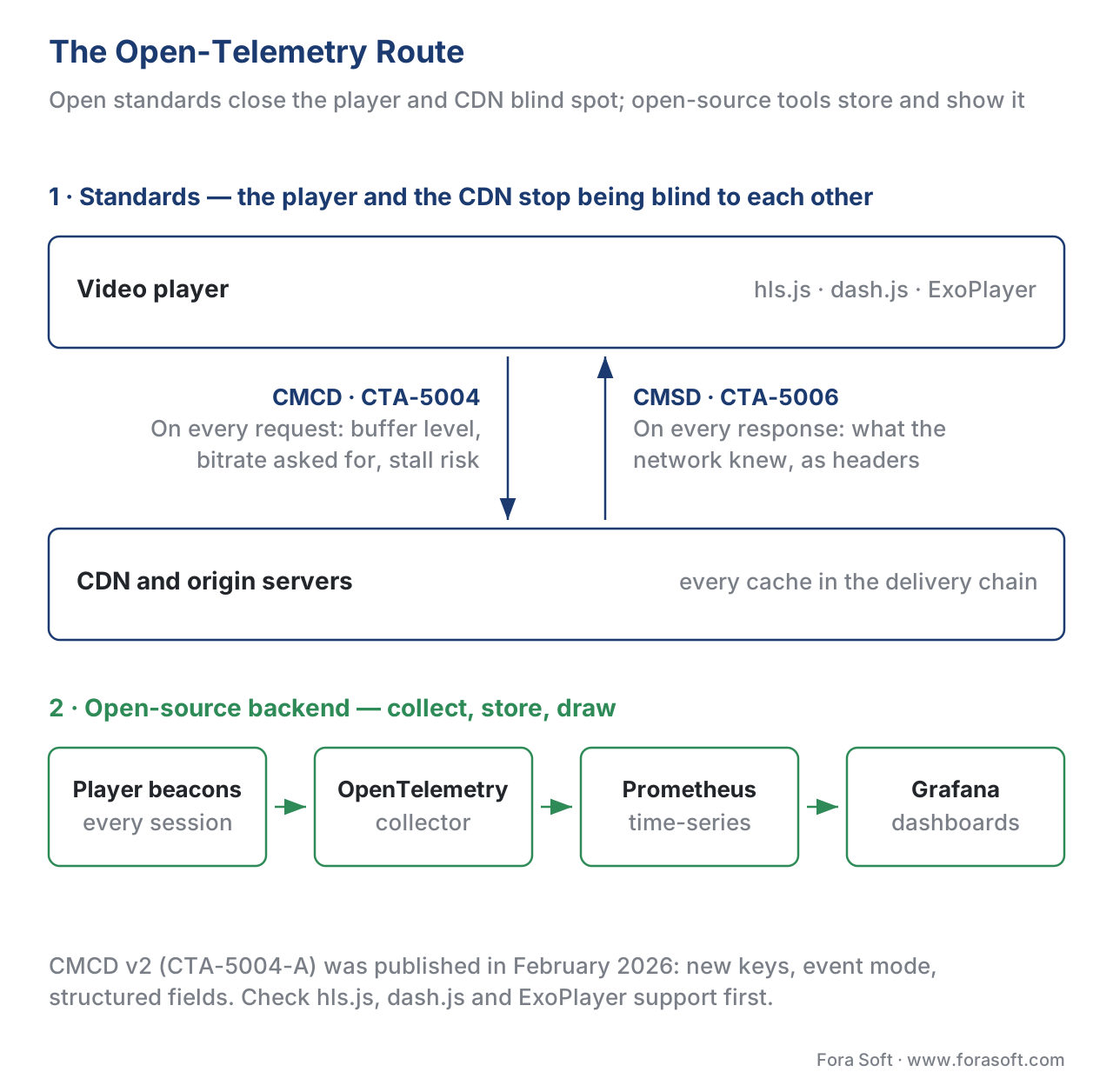 Figure 3. The open route. CMCD and CMSD close the player↔CDN blind spot; OpenTelemetry, Prometheus, and Grafana store and show the metrics — no per-view fee, but you operate it.
Two standards close the gap RFC 9317 described, where the CDN could not see the viewer's experience. The first is Common Media Client Data (CMCD), defined in the Consumer Technology Association's CTA-5004 (September 2020). CMCD lets the player attach what it is experiencing — its buffer level, the bitrate it is requesting, whether it is at risk of stalling — to every request it sends the CDN, using standardized short keys grouped into four families (request, object, status, and session data). The second is Common Media Server Data (CMSD), defined in CTA-5006 (November 2022), the mirror image: it lets every server in the delivery chain attach data to its responses — sent as CMSD-Static and CMSD-Dynamic headers — so the player and the analytics layer can see what the network knew. Together they turn an opaque CDN into a participant in your measurement.
CMCD is a moving target worth a calendar reminder: a version 2 of the spec, designated CTA-5004-A, was published in February 2026, adding new keys, an event-reporting mode, and structured field encoding, with player libraries (hls.js, dash.js, ExoPlayer) adding support through 2026. Treat the version like any dated vendor capability — cite it and re-check it before you rely on a specific key.
On top of the standards sit the open-source tools. OpenTelemetry is the widely adopted open framework for collecting metrics, traces, and logs and forwarding them to a backend; Prometheus stores time-series metrics; Grafana draws the dashboards. The streaming-specific glue — parsing CMCD, normalizing player events — is increasingly available off the shelf through the Streaming Video Technology Alliance's open Common Media Library. The result is a QoE stack you own end to end, with no per-view fee. The catch is the one named above: you are now running a real-time data system, with the on-call rotation, scaling, and maintenance that implies. The open route is cheapest in dollars per view and most expensive in engineering attention — which is why it belongs at large scale, not at launch.
The data model behind a QoE dashboard
Whichever shape you choose, the dashboard is built on the same three-layer data model, and understanding it is what lets you read a number correctly instead of being misled by it.
The bottom layer is the event: a single timestamped fact from the player — "stall started at 00:42," "switched to 1080p," "error 3-12." Events are precise but unreadable in bulk; a popular title can emit billions a day.
The middle layer is the session (also called a view): all the events from one viewer watching one piece of content, stitched together. The session is where a metric becomes meaningful — this view's startup time was 1.4 seconds, it rebuffered twice for a total of 6 seconds, it ended in success. Defining the session boundaries correctly (when does a view start, when does a pause become a new view) is the single most consequential modeling choice, because every metric above it inherits those boundaries.
The top layer is the aggregate: sessions rolled up across a population and a time window, sliced by dimensions — device, operating system, app version, geography, CDN, content, and player version. The aggregate is what you put on a chart. The two rules that keep an aggregate honest are: read percentiles, not just averages (a 1.8-second average startup time can hide smart-TV viewers in one region waiting eight seconds — watch the 95th percentile), and always keep the dimensions so you can break a bad number down to the device, region, or CDN causing it. A composite score such as Mux's Overall Viewer Experience or Conviva's Streaming Performance Index sits one level above the aggregate, useful as a single dial only as long as you can decompose it back into the underlying metrics.
The math: what the stack costs, and where build overtakes buy
Show the arithmetic, because this is the decision that has a budget attached. Suppose your platform serves 50 million views a month. On a managed platform billed at, say, $0.50 per 1,000 views:
monthly cost = 50,000,000 views ÷ 1,000 × $0.50 = $25,000
annual cost  = $25,000 × 12 = $300,000
Now weigh the build alternative. An in-house open stack has no per-view fee, but it needs people and infrastructure. A conservative estimate for a real-time data pipeline:
two data engineers (loaded)   ≈ $400,000 / year
cloud + storage + on-call     ≈  $80,000 / year
in-house total                ≈ $480,000 / year
At 50 million views a month, buying ($300k) beats building ($480k) comfortably — and the managed platform ships in days. The lines cross only when per-view fees grow faster than a fixed team's cost. At, say, 300 million views a month, the managed bill becomes $1.8M a year while the team cost barely moves — and now building, or piping raw data into systems you own, starts to win. That crossover, roughly the billion-minutes-a-year mark, is the whole build-vs-buy story in one calculation. Run it with your real numbers before you commit either way; this links directly to the broader OTT cost model.
Common mistakes that make a QoE stack lie
QoE measurement fails in predictable ways, and each one hides a real problem behind a healthy-looking number.
The most common is trusting averages and platform-wide rollups. An average smooths the failures into invisibility; the viewers leaving are in the tail and in the segments. Read the 95th percentile and break every metric down by device, region, content, and CDN, or the dashboard will reassure you while you lose viewers.
The second is inconsistent definitions across platforms and screens — your web player counts startup time from a different moment than your TV app, so the numbers cannot be compared. This is exactly the interoperability problem CTA-2066 (Streaming Quality of Experience Events, Properties and Metrics, March 2020) was written to fix: it defines common terminology and "how each metric should be computed for consistent reporting." Map every screen to the same standard or you are adding apples to oranges.
The third is measuring quality of service instead of quality of experience — watching the CDN's 99.99% availability dashboard and concluding viewers are happy. As established, the network can be healthy while the last hop into the home fails. Measure at the player.
The fourth is buying a platform and never closing the loop to action. A QoE stack that produces beautiful dashboards nobody acts on is pure cost. Wire at least one alert to a real runbook — shift CDN, roll back the player, re-tune the ladder — before you call the stack finished. Delivery-side alerting deserves its own design; see delivery observability.
Free download: QoE Measurement Stack Decision ChecklistOne page with the five stages, the buy-pipe-build decision and the cost arithmetic that decides it, so you can price your own stack before you call a vendor.Where Fora Soft fits in
Fora Soft has built video streaming and OTT/Internet TV software since 2005, with 625+ shipped projects for 400+ clients, and the measurement stack is where streaming scale turns into an operational discipline rather than a vendor logo. When a platform has to prove QoE across phones, smart TVs, and set-top boxes — and across regions with very different networks — the work is instrumenting consistent player beacons on every screen, mapping them to a common standard (CTA-2066, CMCD/CMSD) so the numbers stay portable, and choosing the buy-pipe-build shape that matches the client's real scale and team. We are vendor-neutral about the analytics layer: we have integrated managed platforms for fast time-to-value and assembled open stacks where data ownership and volume justified it. That is the same streaming, encoding, and delivery experience we apply across video conferencing, e-learning, telemedicine, and surveillance, where a frozen frame is never acceptable.

The handbook
Fora Soft Video Engineering Handbook
We wrote a seven-volume handbook, 9,000+ pages, that takes the video stack from a single pixel to production — encoding, delivery, audio and AI. Volume 3 is the one to open next to this article: it covers ABR, CDNs, players, QoE monitoring and the economics that make the buy-pipe-build arithmetic real. Volume 2 explains the transport and packaging your beacons are reporting on, and volume 1 covers the encoding ladder you re-tune once the numbers tell you to. Written by Nikolay Sapunov, CEO at Fora Soft.
Not sure whether to buy, pipe, or build your QoE stack?
Tell us your monthly views, your screens and your team size, and we will run the same arithmetic with your numbers and say which shape fits — we are vendor-neutral about the analytics layer. 250+ video products shipped since 2005.
See our case studies
Case study
WorldCastLive
Sub-second latency (0.4–0.5 s) for 10,000 simultaneous viewers at 1.5 Gb/s, with quality stepped down per viewer on a weak connection — the difference only the player can see.
Case study
Sprii
72,000+ live events and 12.3 million products sold in 2024 across iOS, Android, web and OBS — four ways to start a stream that all have to count startup the same way.
Case study
TradeCaster
46,000+ traders on $99–119/month subscriptions, auto-scaling through market-hour spikes — where a stall is not a chart, it is a cancelled plan.
What to read next
QoE metrics
Video QoE: Startup Time and Rebuffering Explained
The four numbers this stack exists to produce, and what each one costs you.
Instrumentation
Player QoE Instrumentation: Startup, Stalls, Beacons
How the beacons in stage one get placed correctly on every screen.
Analytics
OTT Analytics: Audience, Engagement & Quality Metrics
Where quality sits among the three metric families, and how they chain.
Operations
Delivery Observability: Who Is Buffering and Where
The delivery-side half of alerting, once the player data is flowing.
References
- Operational Considerations for Streaming Media (RFC 9317). Internet Engineering Task Force (IETF), October 2022. Tier 1 (IETF standards-track informational RFC). §5.6 establishes CTA-2066 and CTA-5004 (CMCD) and the CDN's session blind spot — "produces millions of log lines per second," "has no concept of a 'session'," "cannot tell ... whether any of the clients have stalled and are rebuffering" — the operational case for measuring at the player. https://www.rfc-editor.org/rfc/rfc9317.html (accessed 2026-06-19).
- CTA-2066: Streaming Quality of Experience Events, Properties and Metrics. Consumer Technology Association (CTA WAVE), March 2020. Tier 1 (industry standard). Defines common media-player events, properties, and QoE metrics and "how each metric should be computed for consistent reporting" across players and analytics vendors — the standard that makes a startup-time number from one screen comparable to another. https://shop.cta.tech/products/streaming-quality-of-experience-events-properties-and-metrics (accessed 2026-06-19).
- CTA-5004: Web Application Video Ecosystem — Common Media Client Data (CMCD). Consumer Technology Association (CTA WAVE), September 2020; version 2 (CTA-5004-A) published February 2026. Tier 1 (industry standard). Standardizes how the player sends media data (buffer level, requested bitrate, stall risk) to the CDN via four key families; v2 adds new keys, an event-reporting mode, and structured field encoding. https://cdn.cta.tech/cta/media/media/resources/standards/pdfs/cta-5004-final.pdf (accessed 2026-06-19).
- CTA-5006: Web Application Video Ecosystem — Common Media Server Data (CMSD). Consumer Technology Association (CTA WAVE), November 2022. Tier 1 (industry standard). Defines how every media server (intermediate and origin) attaches data to each object response — sent as
CMSD-Static/CMSD-Dynamicheaders — so the player and analytics layer can see what the network knew; the server-side mirror of CMCD. https://cdn.cta.tech/cta/media/media/resources/standards/pdfs/cta-5006-final.pdf (accessed 2026-06-19). - ITU-T Recommendation P.1203 — Parametric bitstream-based quality assessment of adaptive audiovisual streaming. International Telecommunication Union (ITU-T), 2017. Tier 1 (international standard). The first standardized model that turns session parameters (video quality, audio quality, quality switches, initial loading delay, stalling) into a Mean Opinion Score (1–5) — the open, standardized alternative to a vendor composite score. https://www.itu.int/rec/T-REC-P.1203 (accessed 2026-06-19).
- Understand Mux Data metric definitions / Overall Viewer Experience. Mux. Tier 3 (first-party analytics vendor). Defines the Overall Viewer Experience score (0–100) built from playback success, startup time, playback smoothness, and video quality, plus player-side metric definitions and the per-view pricing model. https://www.mux.com/docs/guides/understand-metric-definitions (accessed 2026-06-19).
- Conviva — Video AI Alerts and VSI sensors. Conviva. Tier 3 (first-party analytics vendor). Describes sensor-based collection, the Streaming Performance Index composite, and Video AI Alerts that "continually compare Quality of Experience (QoE) and engagement metrics against recent norms and instantly detect anomalies" with root-cause diagnosis. https://www.conviva.com/newsroom/conviva-introduces-video-ai-alerts-artificial-intelligence-purpose-built-streaming-video-delivery/ (accessed 2026-06-19).
- Datazoom — the video data platform. Datazoom. Tier 3 (first-party platform). Describes the vendor-neutral model — Collectors, Data Pipes, Connectors — that "captures, standardizes, enriches, and delivers data from across components of the video streaming workflow in real-time," standardizing events into JSON for routing to systems the operator owns. https://www.datazoom.io/ (accessed 2026-06-19).
- OpenTelemetry with Prometheus and Grafana. Grafana Labs / OpenTelemetry documentation. Tier 6 (educational / open-source documentation). Orientation for the open observability backend (collect → store time-series → dashboard) that an in-house QoE stack assembles beneath the streaming standards. https://grafana.com/docs/opentelemetry/ (accessed 2026-06-19).
Spec/standard precedence note (per §4.3.2): where vendor marketing implies its composite score is "the" QoE number, this article follows the controlling measurement standard (CTA-2066) for metric terminology and computation and ITU-T P.1203 for the open perceptual-score model, treating each vendor composite (Mux Overall Viewer Experience, Conviva SPI) as a useful but proprietary roll-up that must decompose back into the standard metrics. The player↔CDN data flow is grounded in RFC 9317 and the CTA-5004/5006 standards rather than vendor blogs; the CMCDv2 (CTA-5004-A) February 2026 date is a dated capability flagged for re-check.
