


Why this matters
If you are a founder, product manager, or streaming CTO, per-title encoding is the single highest-leverage change you can make to your unit economics without touching the product your viewers see. Delivery — the bytes a content delivery network sends to viewers — is the largest recurring line on a streaming bill, and per-title encoding cuts that line by a fifth to a half on most catalogs while holding picture quality constant. This article gives you the mental model and the arithmetic to decide whether it is worth it for your catalog, how much it will save, and where the trade-off tips against you. By the end you will be able to challenge an encoder vendor's savings claim, size the payback for your own audience, and tell the difference between a real quality-preserving optimization and a vendor quietly shipping a worse picture at a lower bitrate.
Start with the waste a fixed ladder creates
A quick recap, because the savings only make sense against the baseline. A streaming platform makes several quality versions of every title — different resolution-and-bitrate pairs called renditions — and stacks them into an encoding ladder (also called a bitrate ladder) so a player can switch between them as the viewer's network speeds up or slows down — a technique called adaptive bitrate streaming. We covered how a ladder is built, rung by rung, in the encoding ladder explained; the one fact to carry here is that the bitrate of each rung is what a content delivery network bills you to deliver.
Most platforms build one fixed ladder — the same rungs at the same bitrates — and apply it to every title in the catalog. It is simple, and it is wrong for almost every individual title, because content is not equally hard to compress. A fast, grainy action film genuinely needs a high bitrate to look clean: there is a lot of motion and fine detail to carry. A flat cartoon, a slide-based lecture, or a static talking head looks identical at half that bitrate, because there is far less visual information in the frame. A fixed ladder serves both the same way. It overspends on the easy content — and you pay that overspend on every view, every month, forever.
The waste hides because the picture looks fine. Nobody complains that the cartoon streamed at 6,000 kbps; it looked great. They just looked great at three times the bitrate they needed, and you paid a content delivery network for the difference times every viewer who watched. Per-title encoding is the discipline of finding and removing that invisible overspend.
What per-title encoding actually is
Here is the idea in one sentence: instead of guessing one ladder for the whole catalog, analyze each title and build the cheapest ladder that still looks as good as the fixed one for that specific content. Simple content gets a lower, shorter ladder; complex content gets the bitrate it actually needs. Netflix introduced the approach publicly in December 2015 with a blunt assertion — there is no one-size-fits-all ladder, and each title deserves its own.
To find the right ladder, you need a way to measure "looks as good," and that is the piece that makes the whole thing possible. The measure is a perceptual quality metric — a score that predicts how good a video looks to a human eye, not just how many bits it carries. The dominant one is VMAF (Video Multi-Method Assessment Fusion), an open-source metric Netflix developed and released that scores a video from 0 to 100 by modeling the human visual system and fusing several quality signals. A useful anchor: a change of about 6 VMAF points is roughly one "just-noticeable difference" — the smallest quality change a viewer would actually perceive. VMAF turns the vague idea of "good enough" into a number you can target, which is what lets a machine decide, safely, that a cartoon at 2,000 kbps is indistinguishable from the same cartoon at 6,000 kbps.
With a quality metric in hand, the original Netflix method is a brute-force search. Encode the title many times — across a finite set of resolutions and many bitrates, with the encoder's quality settings stepped about one just-noticeable difference apart — and for each encode, measure both the bitrate and the VMAF score. Plot every result as a point on a quality-versus-bitrate chart. The points trace out curves, one per resolution, and the upper-left boundary of all of them — the line that gives the best quality available at each bitrate — is a shape engineers call the convex hull. The title's ideal ladder is the set of rungs sitting on that hull. Anything below the hull is a rung that spends bits without buying quality; per-title encoding simply refuses to build those rungs.
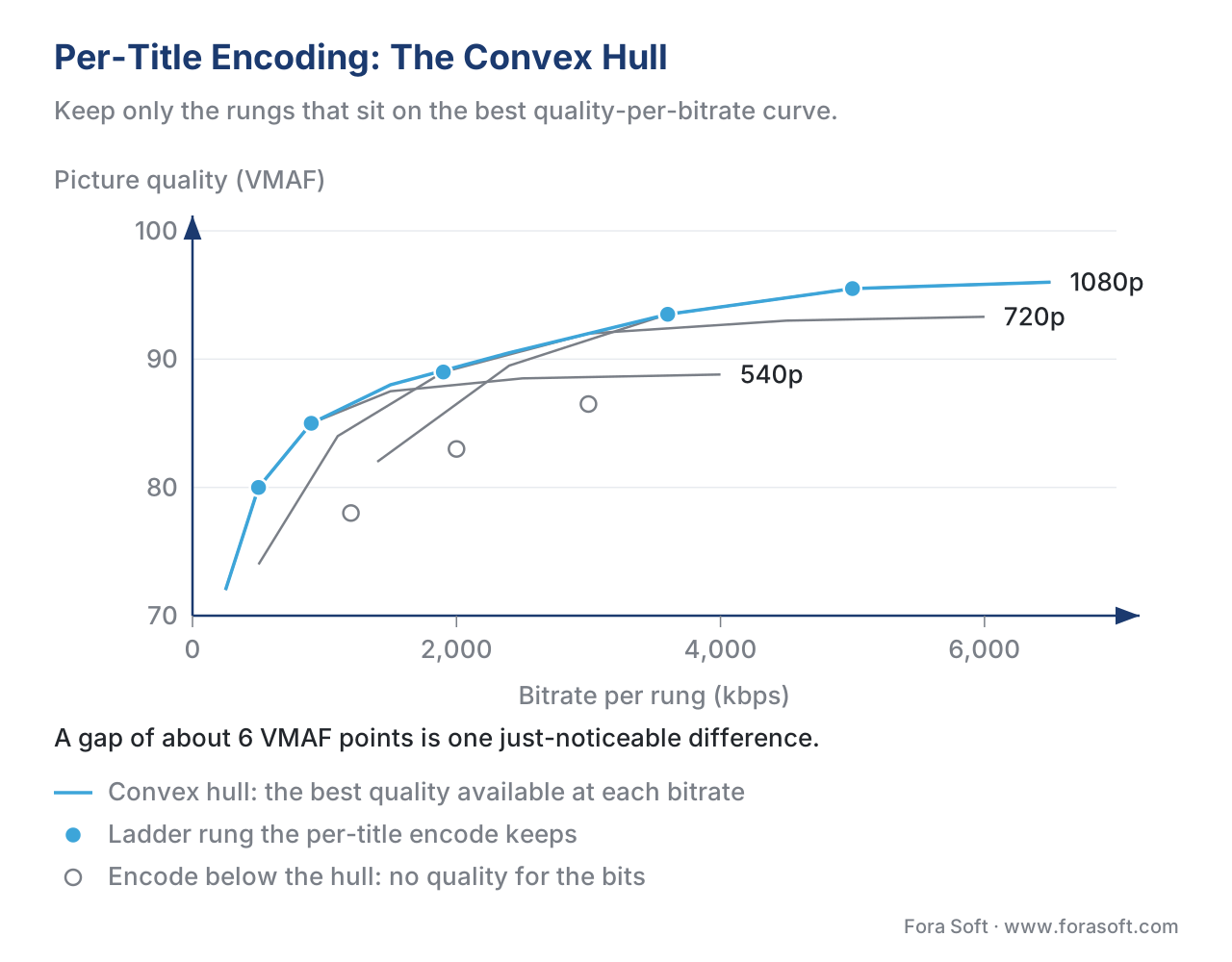 Figure 1. Each resolution has its own quality-versus-bitrate curve. The convex hull is the best-quality boundary across all of them; the per-title ladder picks the rungs that sit on it and skips the wasteful ones underneath.
The plain-language version: stop paying 1080p prices to deliver a cartoon that looks perfect at a third of the bitrate. Modern encoders spare you the literal hundreds of test encodes — vendors like Bitmovin run a fast complexity analysis that predicts the hull, and AWS Elemental MediaConvert's Automated ABR analyzes each input and picks the rendition count and resolutions for you, defaulting to a cap of fifteen rungs and dropping any that add bitrate without adding quality. The principle is identical; only the cost of finding the hull has come down.
Per-title, per-shot, context-aware: a ladder of granularity
"Per-title" is the first rung of a taller ladder of optimization, and each step up tunes the encode more finely — for more savings and more compute. It helps to see the three levels as a progression.
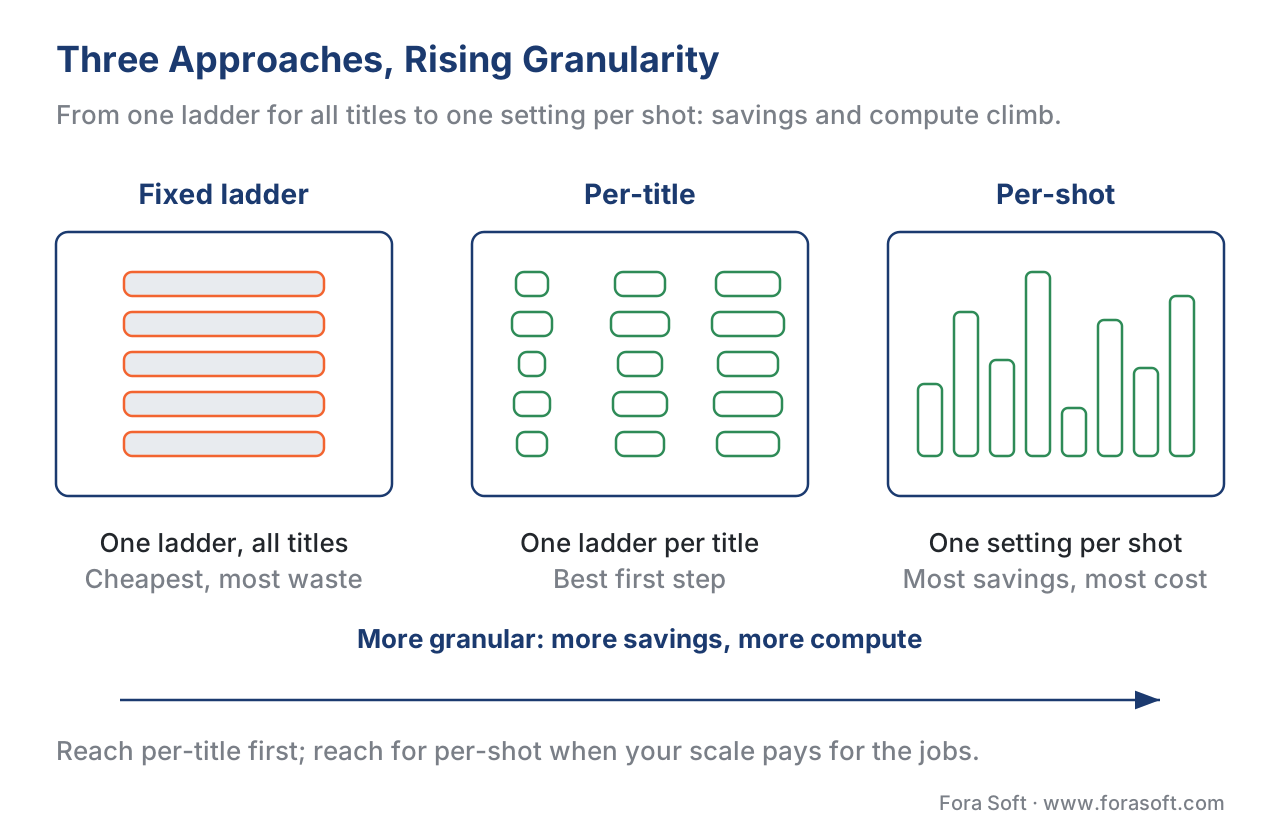 Figure 2. As optimization gets more granular — from one ladder for everything, to one ladder per title, to one setting per shot — both the savings and the compute cost climb. The right level depends on your catalog and your scale.
The first level is the fixed ladder: one ladder, every title, no analysis. Cheapest to run, most wasteful to deliver.
The second level is per-title encoding: one analysis per title, producing one custom ladder for that whole title. This is the level most platforms should reach first, because it captures the largest share of the savings for a modest, one-time analysis cost.
The third level is per-shot, or context-aware, encoding: optimize inside the title. A two-hour film is not uniformly complex — a dark, still dialogue scene needs far fewer bits than the car chase that follows. Per-shot encoding cuts the title into its individual shots and picks the best resolution and quality setting for each one. Netflix shipped exactly this in 2018 as its Dynamic Optimizer, choosing per-shot settings to maximize VMAF at a given bitrate, and reported about a 30% average bitrate reduction versus the best whole-title fixed-quality encode. The cost is granularity: where a one-hour episode used to be encoded as roughly twenty multi-minute chunks, shot-based encoding of the same episode means processing on the order of 900 short shots — far more encoding jobs, far more orchestration.
"Context-aware" is the umbrella term for this family, and the context can extend past the content itself. Some systems fold in the device (a phone screen cannot show the detail a 65-inch TV can, so it can accept a lower rung — the renditions-per-device decision) and the network (a viewer on a steady connection needs fewer safety rungs than one on a flaky mobile signal). Vendors implement pieces of this differently. AWS's quality-defined variable bitrate mode (QVBR) allocates bits by scene complexity within a single encode and reports 25–40% smaller files than a fixed constant-bitrate encode at equal quality. Harmonic's content-aware encoding (EyeQ) adapts bitrate to the content perceptually and reports up to 50% bandwidth and storage reduction, including a live trial that took a 65 Mbps feed down to a 27 Mbps average. The labels differ; the principle is constant — spend bits where the eye will notice, save them where it will not.
How much it actually saves
Savings claims in this field are real but vendor-reported, so treat them as well-evidenced ranges, not guarantees, and always tied to a quality metric. The honest summary across the public evidence: per-title encoding cuts delivery and storage costs by roughly 20% to 50% on a typical mixed catalog, and far more on individual easy-to-compress titles. The table below collects the named, dated figures and — per our rule for any vendor comparison — marks where each technique is actually available.
| Approach | Granularity | Reported saving (source, date) | Extra compute | Available in |
|---|---|---|---|---|
| Fixed ladder | One ladder for all titles | baseline (0%) | none | every encoder |
| Per-title encoding | One ladder per title | ~20–50% delivery; up to ~80% storage on easy titles (Bitmovin, 2023) | analysis pass (one-time) | Netflix (in-house); Bitmovin Per-Title; AWS Automated ABR |
| Per-shot / Dynamic Optimizer | One setting per shot | ~30% avg vs best whole-title encode (Netflix, 2018) | high — ~900 vs ~20 jobs per episode | Netflix (in-house); partial in QVBR / EyeQ |
| QVBR (scene-complexity) | Bits by scene within one encode | 25–40% vs CBR (AWS, 2026) | low — single- or multi-pass | AWS MediaConvert |
| Content-aware (EyeQ) | Per-frame, perceptual | up to ~50% bandwidth/storage (Harmonic, 2020) | medium | Harmonic software/appliances |
Table 1. Optimization techniques, their reported savings, and where they run. Figures are vendor-reported and dated; re-verify against the current source before quoting. The savings depend heavily on content mix — a catalog of cartoons and lectures saves far more than one of grain-heavy thrillers.
The single most striking measured example comes from Bitmovin. On one customer's ultra-high-definition content, a per-title ladder hit a VMAF score of 94.9 at just 1.9 Mbps for the 4K top rendition, against the customer's fixed ladder that used 15 Mbps for an effectively identical score. That is the same picture at roughly an eighth of the bytes — an 87% cut on the delivery cost of the top rendition. Walk the per-view consequence out loud, because that is where it becomes money:
fixed top rendition:    15 Mbit/s × (44.65 min × 60 s) ÷ 8 ≈ 5,023 MB ≈ 5.0 GB per view
per-title top rendition: 1.9 Mbit/s × (44.65 min × 60 s) ÷ 8 ≈   622 MB ≈ 0.62 GB per view
saved per full view of the top rendition ≈ 4.4 GB
At a representative content-delivery rate of about $0.04–$0.08 per gigabyte, that one optimization saves roughly 18 to 35 cents on every single full view of the top rendition — before counting the storage saved and the buffering avoided. A second Bitmovin example is gentler but more typical: on medium-complexity 1080p content, per-title encoding with a more efficient codec held 1080p quality at 2 Mbps where the customer's fixed H.264 ladder needed over 6.5 Mbps — about a 70% bandwidth cut on the top rung. (Pairing per-title with a more efficient codec compounds the savings; we keep the codec decision itself in codec strategy for OTT, and the codec mechanics live in the Video Encoding section.)
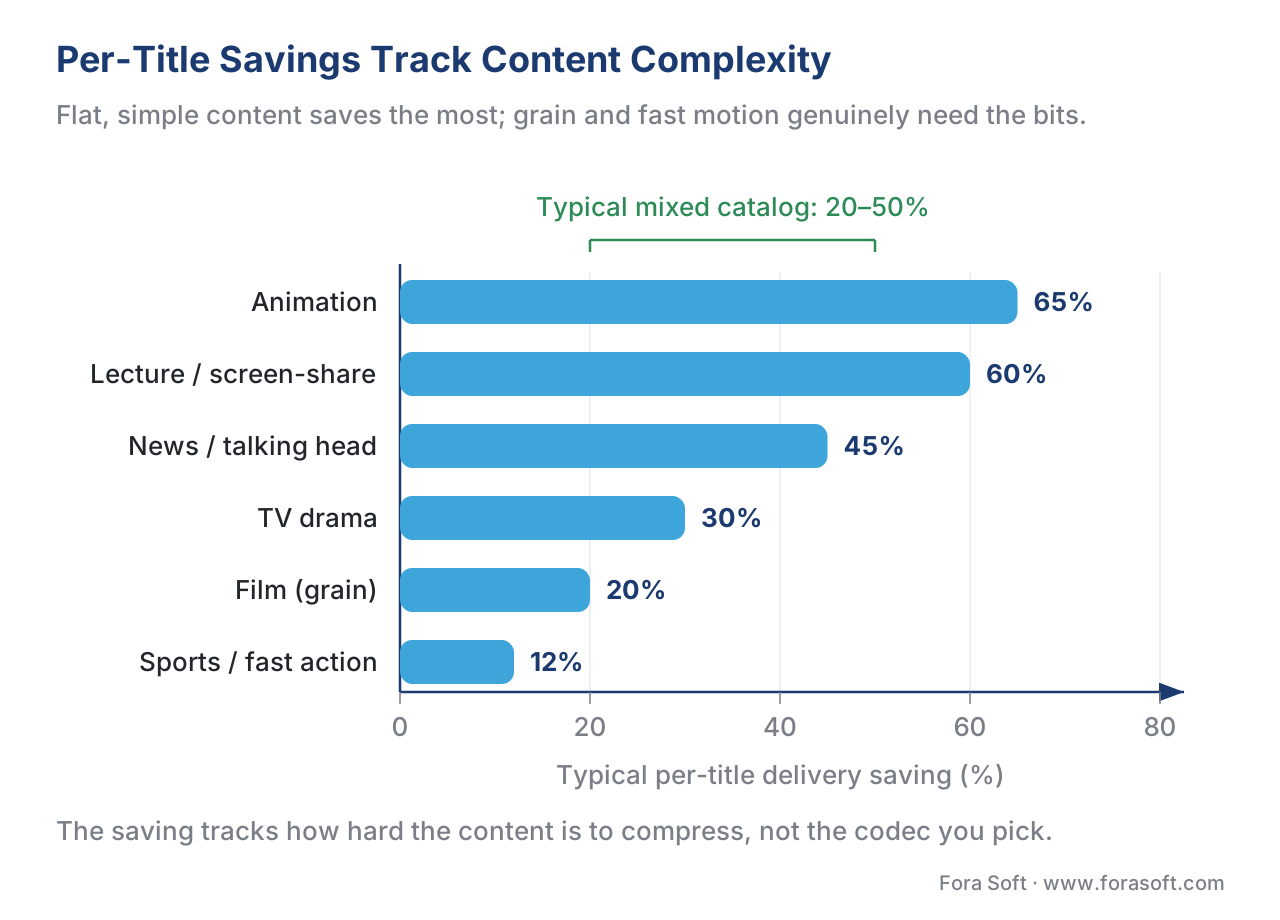 Figure 3. Per-title savings track content complexity. Flat animation, screen-share lectures, and news desks save the most; sports, film grain, and fast action save the least because they genuinely need the bits.
The economics: one-time compute against recurring egress
The deepest reason per-title encoding is almost always worth it is not the size of the savings — it is their shape. The cost it adds and the cost it removes live on opposite sides of a fence that matters enormously.
The extra compute is a one-time cost. You analyze and encode a title once. Whether that title is then watched zero times or ten million times, you pay the encoding bill exactly once. The egress it saves is a recurring cost. Every view sends bytes through a content delivery network, and per-title encoding shaves bytes off every one of those views, this month and every month the title stays in the catalog. One-time spend buys forever-savings. That asymmetry is the whole argument, and it is worth seeing in numbers.
Take the representative seven-rung H.264 ladder from the previous article — its rung bitrates sum to 17,475 kbps, and it stores a two-hour film in about 15.7 GB. Now price the one-time encode. Cloud encoders bill per minute of output, scaled by a multiplier for resolution and effort; AWS Elemental MediaConvert, for example, charges its professional tier from $0.0120 per "normalized minute" at low volume, where a high-definition rung counts as 2× and a standard-definition rung as 1×. Our seven rungs (three HD, four SD) sum to a 10× multiplier:
encode cost (fixed ladder, one-time):
  120 min of film × 10 (summed rung multipliers) = 1,200 normalized minutes
  1,200 × $0.0120                                = $14.40 to encode the whole ladder, once
Per-title encoding adds an analysis step and often a higher-effort, multi-pass encode. Be pessimistic and assume it doubles the one-time encode bill, to about $29 — an extra $14.40 paid once. Now the recurring side. Suppose the fixed ladder's average delivered rung is 3.0 Mbps, and per-title tuning pulls that average down to 2.0 Mbps for the same perceived quality (a one-third cut, conservative against the 20–50% range):
egress per 2-hour view, fixed ladder:    3.0 Mbit/s × 7,200 s ÷ 8 = 2,700 MB = 2.70 GB
egress per 2-hour view, per-title ladder: 2.0 Mbit/s × 7,200 s ÷ 8 = 1,800 MB = 1.80 GB
saved per view: 0.90 GB  ×  $0.06/GB  ≈  $0.054  (about 5.4 cents)
Put the one-time cost over the per-view saving to find the break-even:
break-even views = extra one-time compute ÷ saving per view
                 = $14.40 ÷ $0.054 per view  ≈  267 views
After roughly 270 views, the per-title encode has paid for itself. Every view beyond that saves about 5.4 cents that flows to your margin, plus a smaller recurring storage saving (the per-title ladder here stores the film in about 7.3 GB instead of 15.7 GB — about 54% less — saving roughly $0.19 a month at standard cloud storage rates). For any title that earns more than a few hundred lifetime views, per-title encoding is not a close call; it is found money. The full delivery-cost model, including how egress is tiered and discounted at scale, lives in CDN cost engineering, and the whole-platform economics in the OTT cost model.
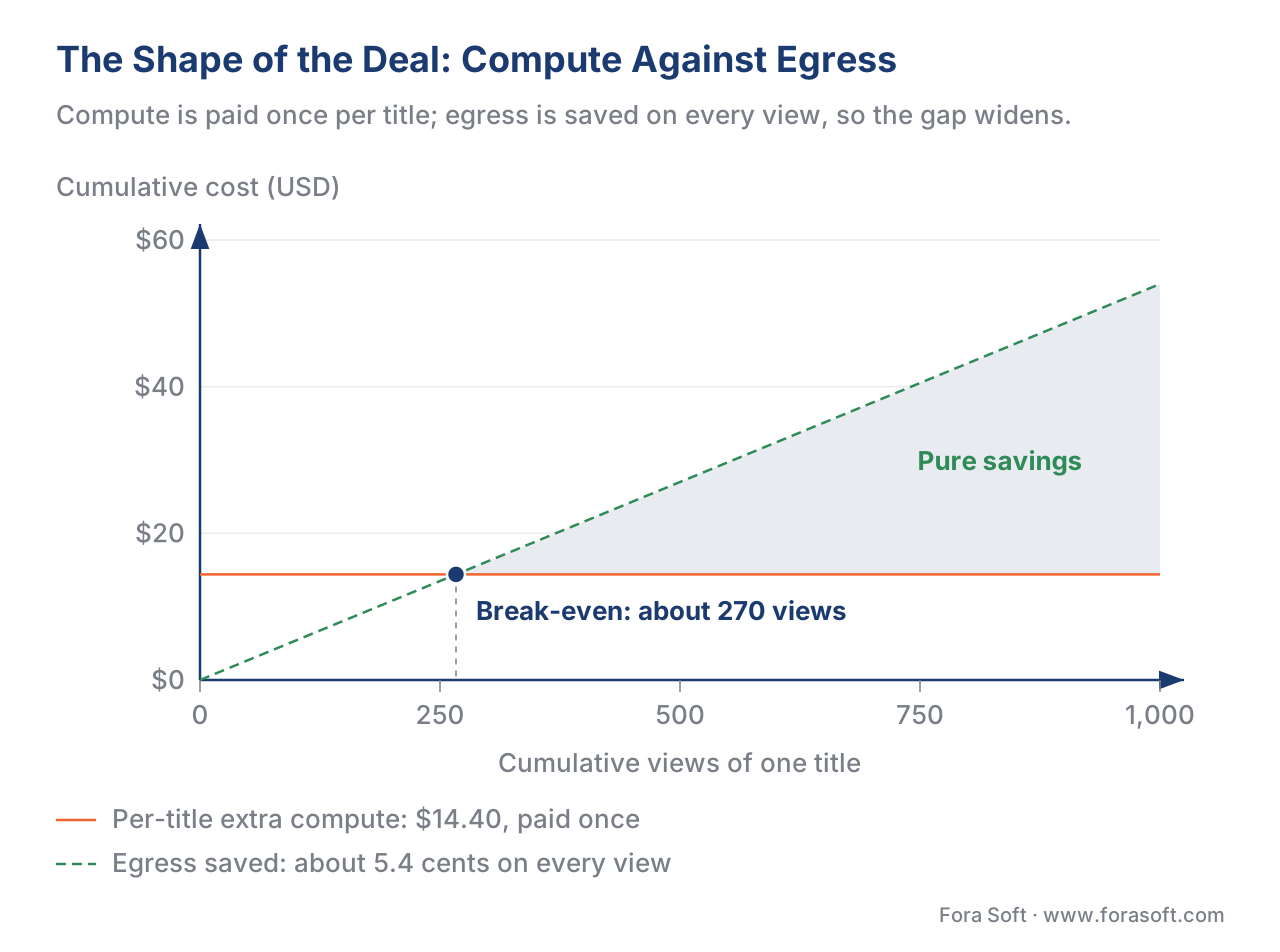 Figure 4. The shape of the deal. The per-title compute is a flat one-time cost; the egress it saves grows with every view. Past the crossover near 270 views, the gap is pure margin — and it widens forever.
Scale that single-title arithmetic to a catalog and the numbers stop being abstract. A 1,000-title library averaging 5,000 views per title a year, with these inputs, saves on the order of $270,000 in delivery a year against a one-time extra compute bill near $14,000 — a net first-year saving past $250,000, and more every year after, because the compute is never paid again. The savings calculator below lets you replace every input with your own.
We have packaged this exact calculation into a spreadsheet so you can run it on your own catalog and CDN rate before committing to a per-title pipeline.
When the trade-off tips the other way
The asymmetry above is so favorable that the failure cases are narrow — but they exist, and knowing them keeps you from over-engineering.
The first is the deep long tail. If a large slice of your catalog earns only a handful of views each — niche archive titles, expired-rights leftovers, user uploads nobody watches — then some titles never cross the few-hundred-view break-even, and the analysis compute on them is spent without payback. The fix is not to skip per-title; it is to apply it lazily. Encode the long tail with a cheap fixed ladder, and trigger per-title (or a re-encode to a better codec) only when a title's view count crosses a threshold. Popularity is the signal that a title deserves the optimization.
The second is per-shot at small scale. Per-shot encoding multiplies your encoding jobs by one to two orders of magnitude — recall the jump from roughly twenty chunks to nine hundred shots for a single episode. At Netflix's catalog and concurrency, that compute is repaid thousands of times over. At a few thousand titles and a modest audience, the orchestration complexity and compute can outrun the marginal savings over plain per-title. Reach per-title first; reach for per-shot only when your scale justifies the machinery.
A common mistake: "savings" that are just a worse picture
The most damaging error in this area is trusting a bitrate cut without a quality metric behind it. Anyone can "save 40%" by simply lowering every rung's bitrate — and ship a blockier, smearier picture that drives viewers away. That is not per-title encoding; it is degradation with a press release. The entire method depends on holding a measured quality target — a VMAF score, or an equivalent perceptual metric — constant while the bitrate falls. If a vendor quotes you a savings percentage, the first question is always: at what VMAF, measured how, against what baseline? A 50% saving at an unchanged VMAF of 94 is real. A 50% saving with no quality number attached is a warning.
Two related traps. First, do not confuse per-title with a codec switch. Per-title and a more efficient codec are different levers that compound; a vendor demo that swaps both at once can credit the codec's gains to per-title. Ask to see per-title savings at a fixed codec, then the codec's savings separately. Second, respect your product promises. If your premium tier markets 4K, the convex hull for a simple title may say the 4K rung is wasteful — but dropping it can breach what you sold and what a content owner's contract requires. Keep the top rung you promised even when the math alone would cut it; per-title optimizes the rungs you keep, it does not overrule your product.
Free download: Per-Title Encoding Savings CalculatorA live-formula spreadsheet that runs this article's arithmetic on your own catalog: storage, CDN egress, the one-time compute, the break-even in views and the whole-catalog annual saving. Edit the shaded input cells and every result recomputes.Where Fora Soft fits in
Per-title and context-aware encoding pay off only when they are wired into the pipeline correctly and run reliably across a catalog of thousands of titles as the audience grows from a thousand viewers to a million — which is an engineering problem, not a setting. Fora Soft has built video streaming, OTT/Internet TV, e-learning, telemedicine, and video surveillance software since 2005, across 625+ shipped projects for 400+ clients, and that work centers on exactly this kind of scale-and-cost engineering: standing up a complexity-analysis and per-title stage, choosing where per-shot is worth the compute and where it is not, gating optimization on popularity so the long tail stays cheap, and tying the whole thing to VMAF so quality is provable rather than promised. When a media company needs its delivery bill to fall without its picture quality falling with it, that encoding-economics engineering is the capability we bring.
The handbook
Fora Soft Video Engineering Handbook
We wrote a seven-volume handbook that takes the whole video stack apart, from the pixel to the delivery invoice, and an engineer who works through it can design and build the pipeline this article costs out. Volume 1 sits closest to this page: rate control, the encoder settings a per-title ladder actually moves, and VMAF as a target you hold constant while the bitrate falls. Volume 3 then follows those bytes to the CDN and the bill — ABR, caching, players and the economics of delivery — while volume 2 covers the transport and the manifests that carry the ladder you just tuned. Written by Nikolay Sapunov, CEO at Fora Soft.
What would per-title encoding actually save on your catalog?
Send us your catalog size, your average delivered rung and your CDN rate, and we will come back with the break-even in views and the first-year saving on your own numbers — 250+ video products shipped since 2005.
See our case studies
Case study
WorldCast Live
HD concert streaming at 1.5 Gb/s to 10,000 simultaneous viewers at 0.4–0.5 s latency, with dynamic quality adjustment — the scale where every kbps on a rung is multiplied by the whole audience.
Case study
Speed.Space
Recording at 1080p / 8 Mbps — over 5× a standard conference call — for Netflix, Electronic Arts and HBO productions, with resolution, fps, codec and bitrate exposed as per-project settings rather than one fixed preset.
Case study
Sprii
An RTMP, WebRTC and FFmpeg pipeline behind 72,000+ live shopping events and 12.3 million products sold in 2024 — a catalog big enough that a lower average rung compounds across every replay.
What to read next
Encoding
Encoding Ladder Explained: Renditions & Bitrates
The fixed ladder this article tunes: how rungs, resolutions and bitrates get chosen in the first place.
Delivery cost
CDN Cost Engineering: Egress, Commits & 95th Percentile
Where the bytes you saved turn into money: egress tiers, commit discounts and how the bill is measured.
Economics
OTT Platform Cost Model: Build & Run Costs
The whole build-and-run bill, with encoding and delivery sized against each other in real proportions.
Pipeline
Encoding QC and the Mezzanine Workflow for OTT
Where the complexity analysis runs, and the quality control that catches a per-title ladder gone wrong.
References
- RFC 8216 — HTTP Live Streaming (HLS) — IETF. The master playlist and
EXT-X-STREAM-INFtag (§4.3.4.2) that defines each ladder rung; a per-title ladder is the same structure with a different, content-tuned set of rungs. Tier 1 (official standard). https://www.rfc-editor.org/rfc/rfc8216 (accessed 2026-06-16) - ISO/IEC 23009-1 — Dynamic Adaptive Streaming over HTTP (MPEG-DASH) — ISO/IEC. The MPD
AdaptationSet/Representationmodel that expresses the per-title ladder in DASH. Tier 1. https://www.iso.org/standard/83314.html (accessed 2026-06-16) - ISO/IEC 23000-19 — Common Media Application Format (CMAF) — ISO/IEC. One set of fragmented-MP4 segments serving both HLS and DASH, so a tuned ladder is built once and packaged for everyone. Tier 1. https://www.iso.org/standard/85623.html (accessed 2026-06-16)
- Per-Title Encode Optimization — Netflix Technology Blog (2015). The foundational case that each title deserves its own ladder; the brute-force, convex-hull method of choosing rungs by plotting quality against bitrate. Tier 4 (first-party engineering). https://netflixtechblog.com/per-title-encode-optimization-7e99442b62a2 (accessed 2026-06-16)
- Optimized Shot-Based Encodes / Dynamic Optimizer — Netflix Technology Blog (2018). Per-shot optimization maximizing VMAF at a bitrate; ~30% average bitrate reduction versus the best whole-title fixed-quality encode; the ~900-shots-per-episode granularity jump. Tier 4. https://netflixtechblog.com/optimized-shot-based-encodes-now-streaming-4b9464204830 (accessed 2026-06-16)
- Toward a Practical Perceptual Video Quality Metric (VMAF) — Netflix Technology Blog /
github.com/Netflix/vmaf. VMAF's 0–100 perceptual scale, human-visual-system modeling, and the ~6-points-per-just-noticeable-difference anchor that makes quality-constrained optimization possible. Tier 4 (first-party / open source). https://netflixtechblog.com/toward-a-practical-perceptual-video-quality-metric-653f208b9652 (accessed 2026-06-16) - Game-Changing Savings with Per-Title Encoding — Bitmovin (2023, updated 2026). The 4K 1.9 Mbps-vs-15 Mbps (VMAF 94.9) and 1080p 2 Mbps-vs-6.5 Mbps examples; 20–50% delivery and up to ~80% storage savings; complexity-analysis approach to the convex hull. Tier 4 (vendor engineering). https://bitmovin.com/blog/per-title-encoding-savings/ (accessed 2026-06-16)
- AWS Elemental MediaConvert — Pricing — Amazon Web Services. Per-normalized-minute professional-tier transcode pricing (from $0.0120/min) and the resolution/effort multipliers used in the worked compute example; storage and CDN egress billed separately. Tier 4 (vendor pricing). https://aws.amazon.com/mediaconvert/pricing/ (accessed 2026-06-16)
- Automated ABR & QVBR — AWS Elemental MediaConvert documentation — Amazon Web Services. Automated ABR auto-selects rendition count (default cap 15) and resolutions and drops renditions that add bitrate without quality; QVBR reports 25–40% smaller files than CBR at equal quality. Tier 4. https://docs.aws.amazon.com/mediaconvert/latest/ug/auto-abr.html (accessed 2026-06-16)
- EyeQ Content-Aware Encoding — Harmonic. Perceptual, content-aware bitrate reduction reporting up to ~50% bandwidth and storage savings at equal quality; the 65→27 Mbps live-trial figure. Tier 4 (vendor engineering). https://www.harmonicinc.com/video-appliances-software/technologies/eyeq-content-aware-encoding/ (accessed 2026-06-16)
Source note (per §4.3.2): the ladder structure a per-title pipeline produces traces to tier-1 standards (refs 1–3). The per-title and per-shot methods and their savings are first-party engineering and vendor-reported (refs 4–10) and are labelled as such in-text, with quality always tied to a measured VMAF target. Vendor savings figures are dated and flagged for re-verification; no lower-tier source overrode a standard.
