


Why this matters
If you run a streaming product, the codec decision quietly sets two of your biggest numbers at once: how many people can watch (reach) and how much you pay to deliver every stream (the egress bill). Pick a codec too aggressively and the newest phones look great while a third of your audience sees an error screen; pick too conservatively and you pay to ship 40% more bytes than you need to, every month, forever. This article is written for the founder, product manager, or streaming CTO who has to make that call and defend it — not for the engineer tuning the encoder. We keep the internal mechanics of each codec at arm's length (those live in our Video Encoding section) and focus on the only question that touches your business: which codecs belong in your catalog, for which devices, at what cost. By the end you will be able to read a codec proposal and ask the four questions that matter — what does it reach, what does it save, what does it cost to license, and what does it cost to encode.
A codec is a product decision, not a technical one
Start with what a codec actually is. The video coming out of a camera or an editing suite is enormous — far too large to send over the internet in real time. A codec (coder-decoder) is the agreed method for compressing that video down to a streamable size and decompressing it again on the viewer's device. H.264, HEVC, AV1, and VVC are four such methods, each newer and more efficient than the last. How they achieve compression — the block transforms, motion prediction, and entropy coding inside them — is a fascinating engineering subject, and it is covered in depth in our Video Encoding section. For building an OTT platform, none of that matters directly. What matters is the trade-off each codec forces on your product.
That trade-off has four levers, and every codec choice moves all four at once.
The first lever is reach — the share of your audience whose devices can decode the codec and play the video. A codec the device cannot decode is not a slower stream; it is a blank screen. Reach is the lever you can never sacrifice, because a viewer who cannot play anything churns immediately.
The second lever is efficiency — how few bytes the codec needs to hit a given picture quality. Efficiency is usually quoted as bitrate savings against H.264: a codec that delivers the same quality at half the bitrate is "50% more efficient." Because a content delivery network bills you for the bytes you send to viewers — a recurring cost called egress — efficiency is the lever that bends your monthly delivery bill. Lead with this one: at scale, the codec that halves your bitrate halves the line item that decides your margin.
The third lever is licensing — whether the codec is free to use or carries patent royalties, and how much legal certainty comes with the answer. This lever is invisible until a patent pool sends an invoice, and it has sunk more than one codec's adoption.
The fourth lever is encode cost — the compute you burn to compress each title. A more efficient codec is almost always harder to encode, so the egress you save on delivery is partly paid back in the transcoding farm. For a large catalog or a live stream, that cost is real and has to be weighed.
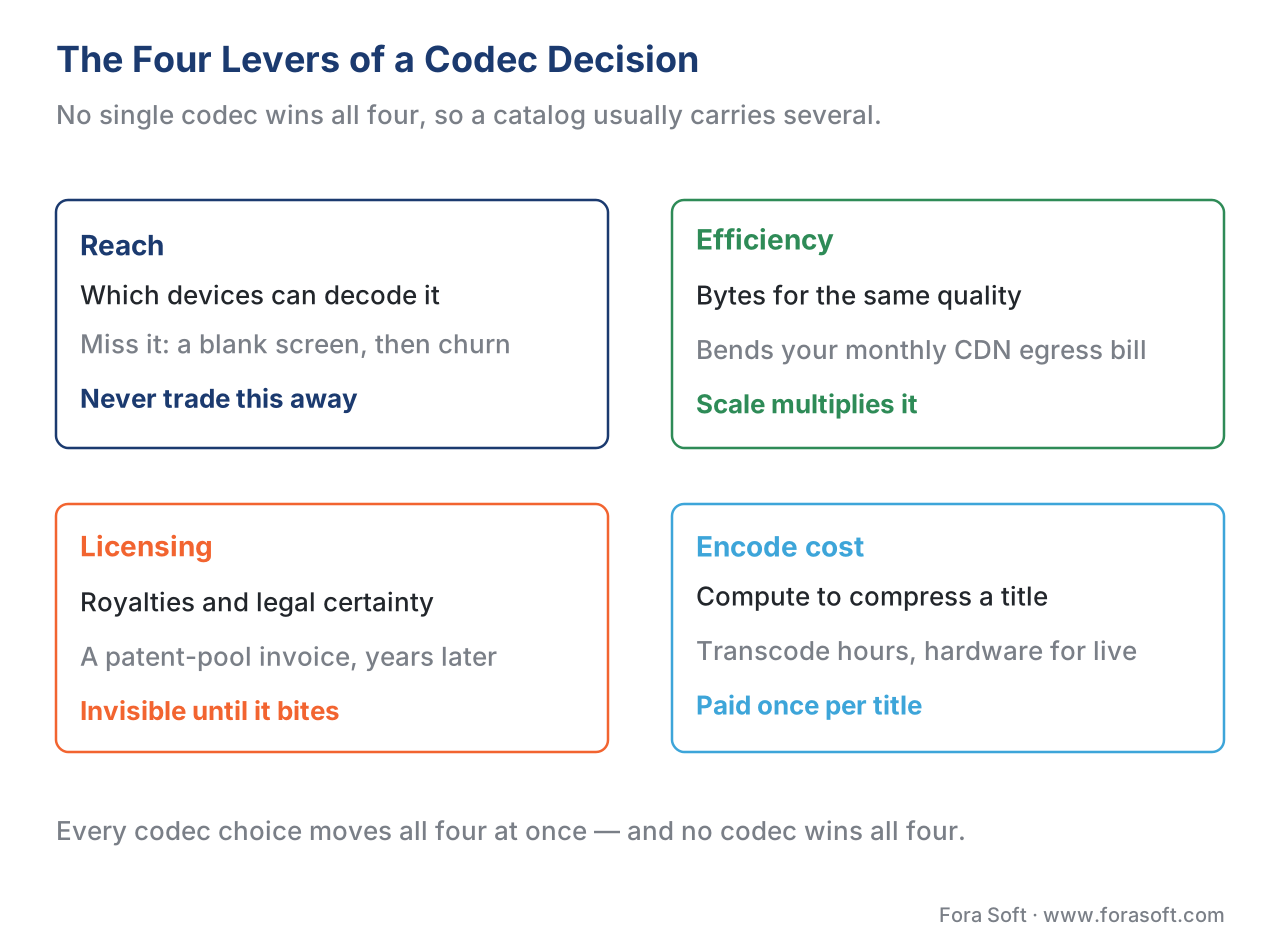 Figure 1. Every codec choice moves four levers at once. No codec wins all four, which is why a catalog usually carries more than one.
H.264 (AVC): the reach floor you cannot skip
H.264, also called AVC (Advanced Video Coding), is the codec that plays on essentially everything. Finalized in 2003, it has hardware decoding in every smartphone, tablet, laptop, smart TV, set-top box, and game console made in the last fifteen years. That universal reach is its entire value proposition, and it is the reason H.264 is still the floor of almost every catalog in 2026.
The cost of that reach is efficiency: H.264 is the least efficient of the four codecs here, and it is the baseline everything else is measured against. It is also not free — H.264 is licensed through the patent pool now run by Via LA (formerly MPEG LA). For years that licensing was a settled, modest cost, but in 2025 the pool announced steep increases to its streaming-distribution fees, with reports of caps rising from $100,000 to as high as $4.5 million for the largest distributors. The encoding side, by contrast, is cheap and instant: H.264 encodes faster than any newer codec and runs on hardware everywhere, which is why it remains the default for live streaming where there is no time to spend on heavier compression.
The product takeaway is simple. You keep H.264 in the catalog not because it is good at saving bytes — it is the worst of the four at that — but because it is the only codec you can be certain every viewer can play. It is your insurance rung. The strategy question is never "H.264 or something newer?" It is "H.264 plus what?"
HEVC (H.265): more efficiency, more licensing pain
HEVC, or High Efficiency Video Coding (H.265), arrived in 2013 as the successor to H.264. It delivers roughly 50% bitrate savings at equal quality — the same picture for about half the bytes — and it was the first codec to make 4K and HDR streaming practical. On the device side it has strong reach in exactly the places H.264 dominates the living room: every Apple device since 2015, almost all smart TVs and set-top boxes, and most recent Android phones decode HEVC in hardware. Its weak spot is the open web — HEVC playback in desktop browsers has always been patchy, with Safari supporting it and Chrome and Firefox historically not.
HEVC's real problem is the third lever: licensing. Where H.264 has one pool, HEVC is fragmented across several. The largest is the HEVC Advance pool run by Access Advance, which lists over 29,000 patents; a second pool was run by Via LA until December 2025, when Access Advance acquired it and renamed it the VCL Advance program; and on top of both pools sit patent holders who license individually and are in no pool at all. For a platform operator, the encouraging news is that since 2018 the device-focused HEVC pools have not charged a royalty on streaming content itself — the royalties fall on device makers, not on the titles you distribute. The discouraging news is that in 2025 new content-distribution pools (Avanci Video and an Access Advance video-distribution pool) began seeking exactly those content royalties from streaming services for HEVC and other codecs, and HEVC device rates were scheduled to rise in 2026. The map keeps changing, and the uncertainty is the cost.
The product takeaway: HEVC buys you a real efficiency gain and excellent living-room reach, especially for 4K and HDR, but you adopt it knowing the licensing picture is fragmented and moving. For many platforms, HEVC's natural role in 2026 is the premium 4K/HDR tier on Apple and smart-TV devices — and increasingly, the question is whether AV1 should take that role instead.
AV1: royalty-free efficiency that finally has the hardware
AV1 is the codec that changed the strategy. Released in 2018 by the Alliance for Open Media (AOMedia) — a consortium that includes Google, Netflix, Amazon, Microsoft, Meta, and Apple — AV1 was built to do two things HEVC could not: be meaningfully more efficient, and be royalty-free. On efficiency it delivers roughly 30% bitrate savings over HEVC, which is around 50% over H.264 — the same quality for half the bytes or better. On licensing, AOMedia publishes AV1 under a royalty-free patent license, and its members cross-license their own patents into it.
For years AV1 had one fatal weakness for streaming: almost nothing could decode it in hardware, so playback fell back to software, which drained batteries and overheated phones. That weakness is gone. As of 2026, AV1 hardware decoding ships on the iPhone 15 Pro family and all iPhone 16 and 17 models, on Macs with M3 silicon and newer, on Android flagships built around recent Qualcomm Snapdragon and MediaTek Dimensity chips, and on the large majority of smart TVs and streaming devices sold since 2022 — Samsung, LG, Sony, and Hisense TVs, Chromecast with Google TV, the 2022-and-later Amazon Fire TV Stick 4K, and Roku Ultra. Netflix reported that 88% of large-screen devices submitted for its certification over 2021–2025 support AV1. The proof is in deployment: AV1 now powers about 30% of all Netflix streaming and more than 75% of YouTube's, with Meta serving over 70% of its video in AV1.
AV1's licensing carries one asterisk worth stating plainly. Although AOMedia offers it royalty-free, two patent administrators — Sisvel and, through litigation, parties such as InterDigital — claim that some patents practiced by AV1 sit outside AOMedia's license and are owed royalties. No broad AV1 streaming royalty has successfully been collected, and AOMedia members operate as though the codec is free, but a cautious operator should know the claim exists rather than be surprised by it.
The remaining real cost is the fourth lever: encoding. AV1 is heavier to encode than HEVC, historically several times slower. The gap has narrowed sharply — the SVT-AV1 encoder at its middle speed presets now encodes at roughly HEVC-software speeds while keeping most of AV1's compression advantage — but live AV1 still effectively requires hardware encoders, and a large VOD library costs more compute to convert. That cost is one-time per title and is repaid by lower egress on every view thereafter, which is why high-volume services adopt AV1 first.
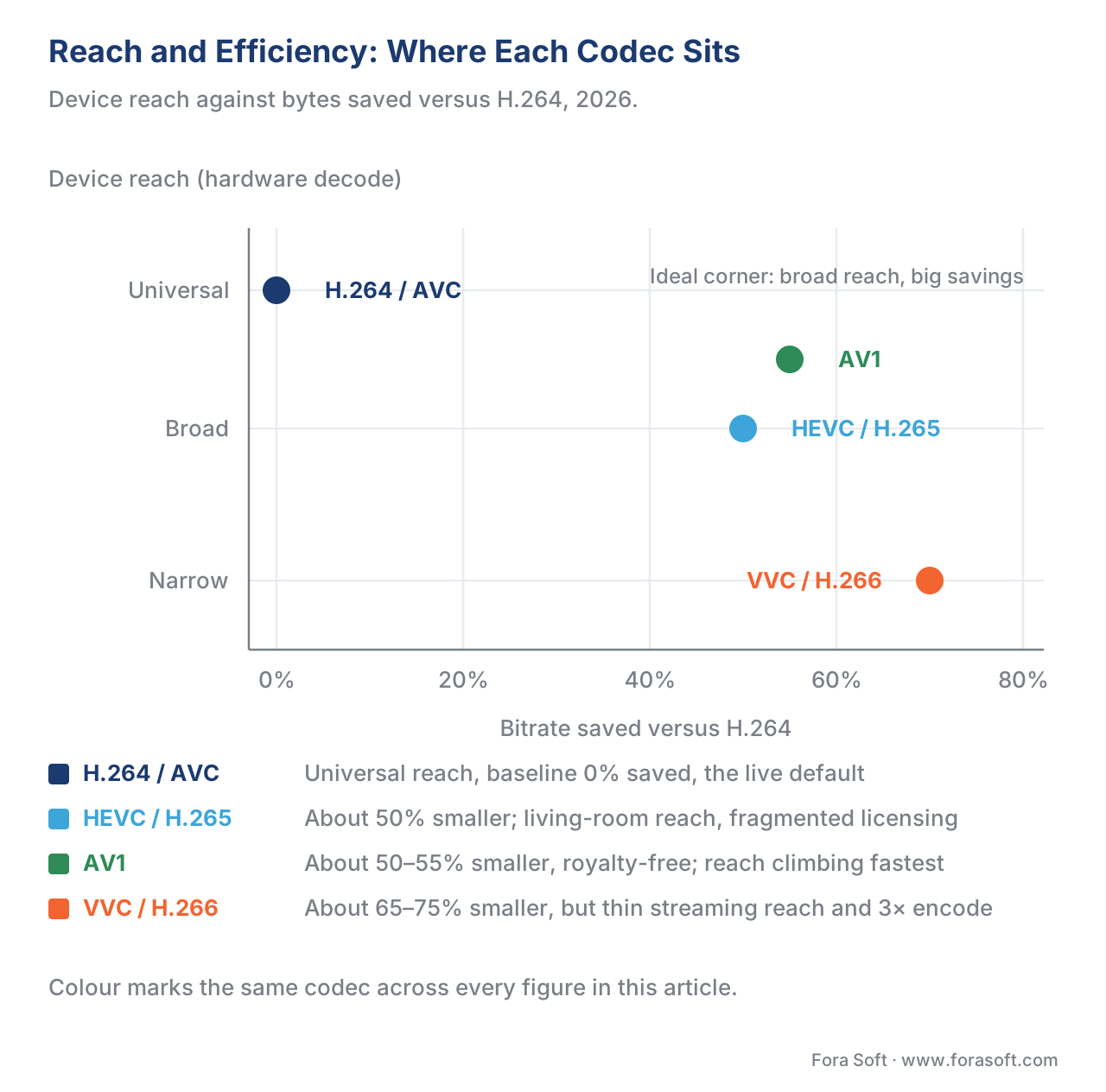 Figure 2. The four codecs plotted by reach (how many devices play it) against efficiency (bytes saved). H.264 anchors the high-reach corner; AV1 is the one climbing fastest toward both.
VVC (H.266): technically best, commercially stalled
VVC, or Versatile Video Coding (H.266), finalized in 2020, is the most efficient codec in this article. In lab comparisons it delivers roughly 40–50% savings over HEVC, beating even AV1 by a meaningful margin — at 8K resolution, studies put VVC near 78% savings over H.264 against AV1's 63%. If efficiency were the only lever, VVC would already be everywhere.
It is not, for two reasons that map directly onto the other three levers. First, encode cost: VVC is dramatically heavier to encode than AV1 — independent comparisons put its encoding time at around three times AV1's — which makes large-catalog and live use expensive. Second, and more decisively, licensing and reach are both weak. VVC's patents are split across the Access Advance VVC pool (4,500+ patents) and the former Via LA pool, with a long list of essential patent holders — Apple, Google, Samsung, Qualcomm, Microsoft, and others — still licensing outside any pool as of early 2026. That fragmentation is the same problem that slowed HEVC, and it has kept VVC out of the browser and out of mainstream streaming entirely: four years after finalization there are no major streaming-publisher deployments. Where VVC is gaining ground is broadcast and television — Brazil's TV 3.0 standard launched over-the-air 4K with VVC in August 2025, ATSC 3.0 added VVC in July 2025, and Android 17 added native VVC decoding on capable hardware.
The product takeaway is the cleanest in this article: for an OTT streaming platform in 2026, VVC is a watch item, not a deployment. The efficiency is real, but the licensing fog, thin device reach in the streaming world, and steep encode cost mean it earns no place in a streaming catalog yet. We make the same case in more depth in our dedicated breakdown, H.266 / VVC: technically excellent, market-weak. Revisit the decision when browser support and a clear license arrive.
The four codecs side by side
The table below puts the four levers in one view. The "plays on" column is the coverage view that keeps you from adopting a codec your audience cannot decode — read it before the efficiency column, because reach is the lever you cannot trade away.
| Codec | Efficiency vs H.264 | Plays on (hardware decode, 2026) | Licensing | Encode cost | Natural OTT role |
|---|---|---|---|---|---|
| H.264 / AVC | Baseline (0%) | Everything — universal | Single pool (Via LA); 2025 streaming-fee hikes | Lowest, real-time | Universal floor; live default |
| HEVC / H.265 | ~50% smaller | Apple, most TVs/STBs, recent Android; weak in browsers | Fragmented (Access Advance + VCL Advance + outsiders); no content royalty since 2018 | Moderate | Premium 4K/HDR tier on living-room devices |
| AV1 | ~50–55% smaller | iPhone 15 Pro+/16/17, M3+ Macs, Android flagships, most 2022+ TVs & sticks | Royalty-free (AOMedia); minor unresolved third-party claims | Higher; live needs HW encoders | Efficiency tier; default for high-volume VOD |
| VVC / H.266 | ~65–75% smaller | Broadcast/TV, some Android 17 devices; not in browsers | Fragmented, many holders outside pools | Highest (~3× AV1) | Watch item — not for streaming yet |
Table 1. The four-lever view. Efficiency figures are approximate ranges from published comparisons and vary by content and quality metric; treat them as planning estimates, not guarantees. Verify licensing terms and device coverage live — both change.
The table collapses into a simple gate you can apply to each catalog tier: keep the H.264 floor, add AV1 where the device decodes it, fall back to HEVC for older living-room and 4K-HDR devices, and park VVC.
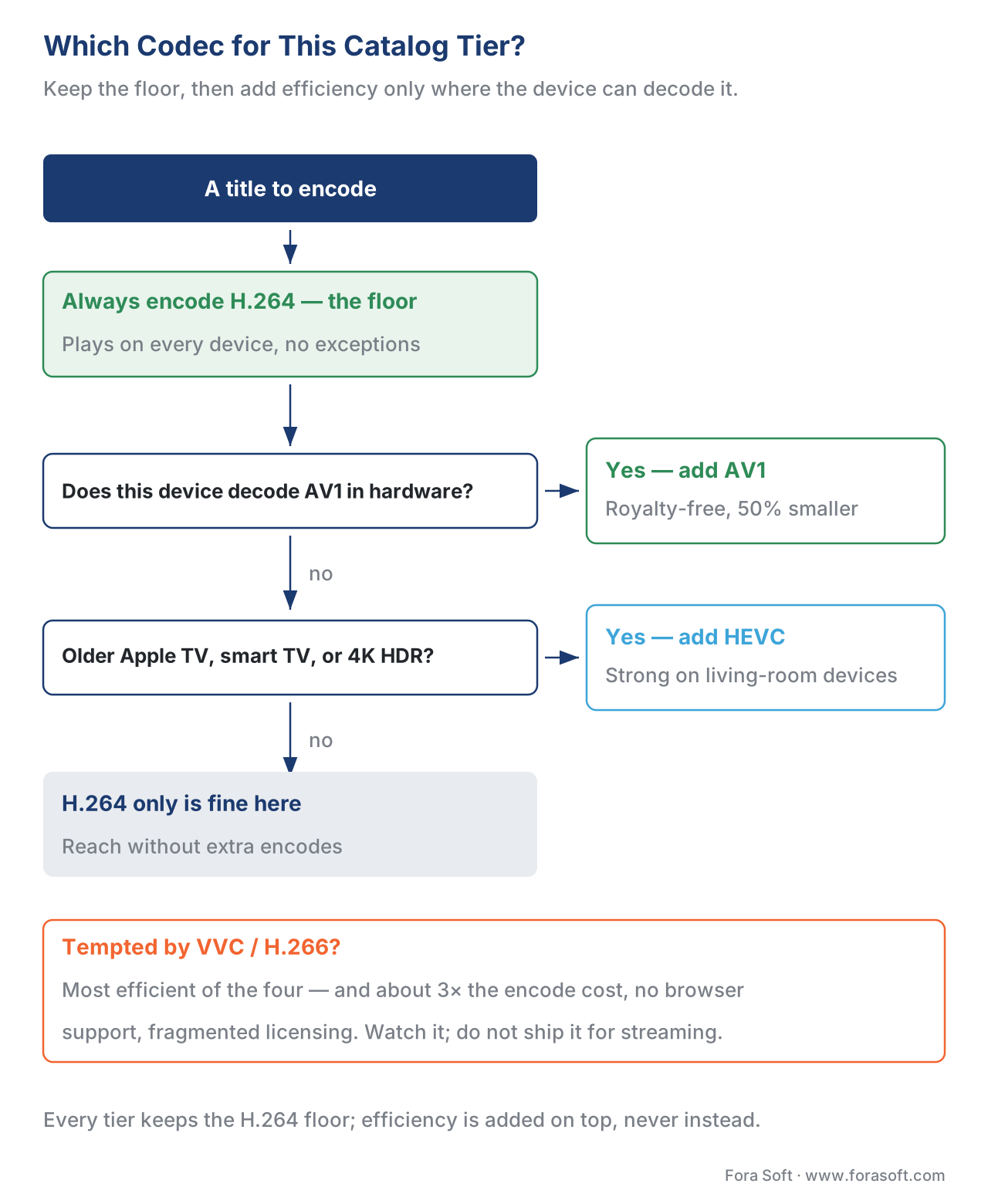 Figure 4. One gate per tier. The floor is unconditional; everything above it is "the best codec this device can actually decode."
The strategy almost every platform actually runs: a mixed-codec catalog
Here is the conclusion the four levers force: you do not pick one codec, you carry a small set, and you let each viewer's device pull the best codec it can decode. This is the mixed-codec catalog, and it is how Netflix, YouTube, and every serious streaming service operate.
The pattern is a floor plus an efficiency layer. The floor is H.264, encoded for every title, guaranteeing that any device on earth can play something. The efficiency layer is AV1 (and/or HEVC) encoded for the same titles, served only to the devices that can decode it. When a player loads a stream, it announces which codecs it supports, and the platform hands back the most efficient one on the list — AV1 to a 2024 smart TV, HEVC to an older Apple TV, plain H.264 to a decade-old tablet. The viewer never sees this negotiation; they just get a stream that plays. The same single set of segments can be packaged to serve multiple codecs and both major streaming formats, the "encode once, serve everyone" idea covered in packaging: CMAF, HLS, and DASH from one mezzanine.
The cost of this strategy is that each codec multiplies your encoding ladder. Add AV1 to an H.264 catalog and you encode and store every title twice — more compute in the transcoding farm and more storage. The economics only work because storage is cheap and the egress savings on every delivered AV1 stream dwarf the one-time encode-and-store cost. That trade-off — extra encode and storage now, against lower delivery forever — is the same calculation behind per-title encoding, worked through in per-title and context-aware encoding: the economics, and it lives inside the full picture in the OTT cost model.
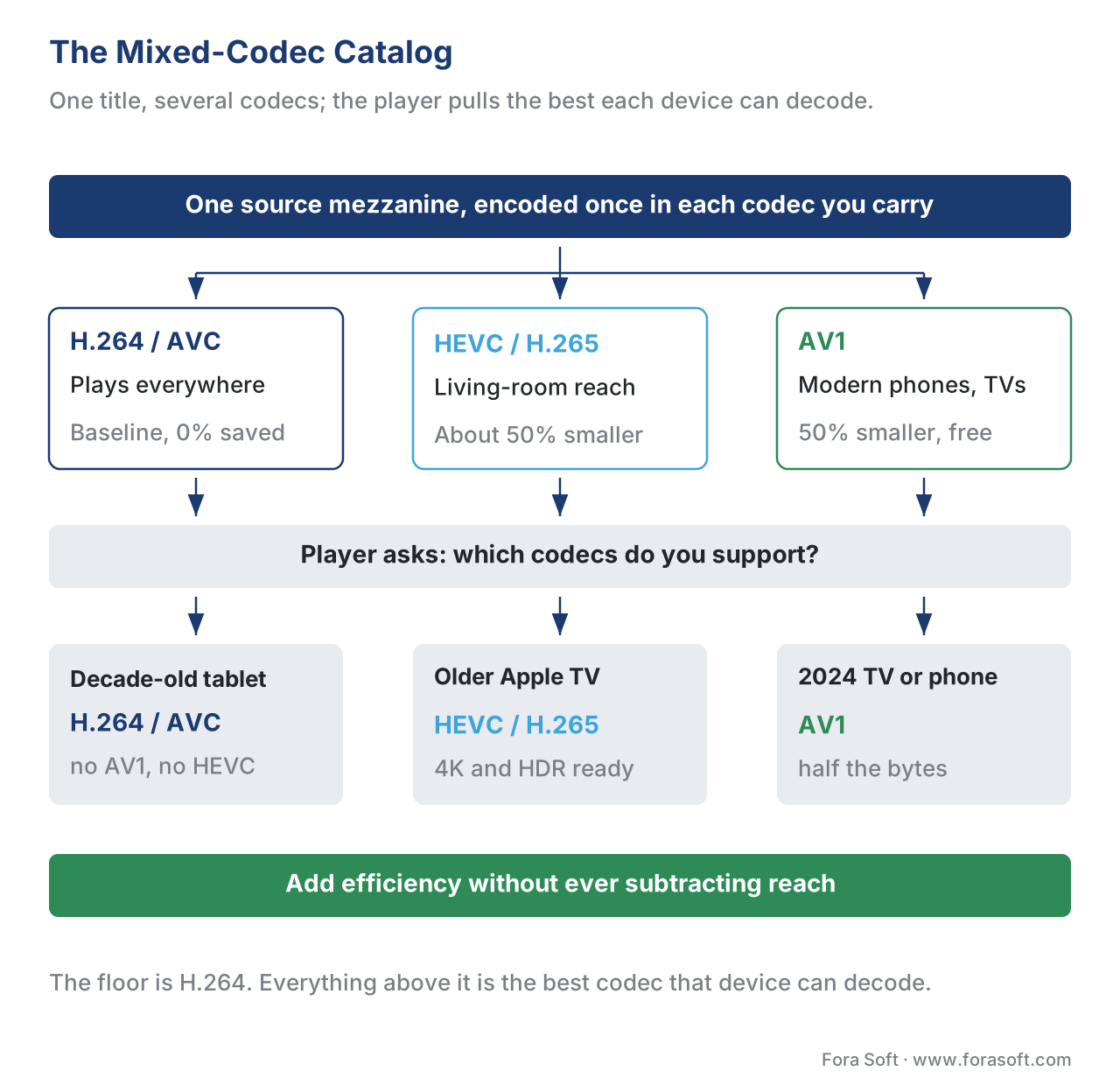 Figure 3. The floor-plus-efficiency pattern. H.264 reaches every device; AV1 and HEVC serve the devices that can decode them. The player asks for the best it supports.
A worked example: what an efficiency tier saves
Put numbers on it, because the efficiency lever is the one that pays for the whole exercise. Imagine a service whose viewers stream 10 million hours a month. On an H.264-only catalog, suppose the average delivered rung runs at 3 Mbps. The monthly egress is the bytes those hours add up to:
hours per month     = 10,000,000 hr
average bitrate     = 3 Mbit/s
data per hour       = 3 Mbit/s × 3,600 s ÷ 8 = 1,350 MB ≈ 1.35 GB
monthly egress      = 10,000,000 hr × 1.35 GB = 13,500,000 GB ≈ 13.5 PB
at $0.04 per GB     = 13,500,000 × $0.04      = $540,000 / month
Now add an AV1 efficiency tier. Suppose 60% of those viewing hours happen on AV1-capable devices — a realistic share in 2026 given the device numbers above — and AV1 cuts the bitrate for equal quality by 40%. Those hours now stream at 1.8 Mbps instead of 3 Mbps; the other 40% stay on H.264 at 3 Mbps:
AV1 hours (60%)     = 6,000,000 hr × (1.35 GB × 0.6 bitrate) = 6,000,000 × 0.81 GB = 4,860,000 GB
H.264 hours (40%)   = 4,000,000 hr × 1.35 GB                 = 5,400,000 GB
new monthly egress  = 10,260,000 GB
at $0.04 per GB     = $410,400 / month
That is about $130,000 a month saved — roughly a 24% cut in the delivery bill — for the one-time cost of encoding and storing an AV1 copy of the catalog. As more of the audience's devices gain AV1 hardware decode each year, the saving grows on its own. That is the entire commercial case for a codec strategy: efficiency, multiplied by scale, paid once and saved forever.
A common mistake: betting the catalog on a single codec
The most expensive codec mistake is treating the decision as "which one codec?" instead of "which set?" It shows up in two opposite directions.
The first is over-conservatism: shipping H.264 only, because it is safe and universal, and paying 40–50% more egress than necessary on every modern device that could have taken AV1. At small scale this is invisible; at a million viewers it is a six-figure annual leak, exactly the one the worked example above closes.
The second is over-aggression: chasing the newest codec for everyone and cutting off the audience that cannot decode it. Encoding a catalog AV1-only in 2026 still strands the large installed base of older phones, budget Android devices, and pre-2022 TVs that have no AV1 hardware — and forcing those devices into battery-draining software decode is its own failure. The newest-is-best instinct is even more dangerous with VVC, where adopting it for streaming today means paying triple the encode cost to reach almost no one through an unresolved licensing fog.
The fix for both is the mixed-codec catalog: an H.264 floor you never remove, plus the most efficient codec each device can actually decode, with the player choosing. You add efficiency without ever subtracting reach. A related trap is forgetting that every codec multiplies your storage and transcode footprint, so adding codecs without a per-title or device-aware plan can erase the egress savings in encode-and-store cost — match the codec set to the devices and content you actually have, the theme of renditions per device.
Free download: OTT Codec Strategy WorksheetOne page for choosing your codec set before you commit a transcode pipeline: weigh the four levers, set an H.264 floor, decide the AV1 or HEVC efficiency tier per device class, park VVC as a watch item, and run the egress-savings sanity check.Where Fora Soft fits in
The codec decision is where reach and delivery cost are set together, and getting it right at scale — across a catalog of thousands of titles, a dozen device classes, and an audience that grows from a thousand viewers to a million — is the kind of engineering Fora Soft has done since 2005, across 625+ shipped projects for 400+ clients in video streaming, OTT/Internet TV, e-learning, telemedicine, and video surveillance. That work is precisely this: building the mixed-codec pipeline that adds an AV1 efficiency tier without dropping a single legacy device, wiring codec negotiation into the player and packager, and sizing the transcode-and-storage cost against the egress it saves. When a media company needs a streaming platform whose delivery bill survives a real audience and whose reach never strands a viewer, that codec-and-delivery engineering is the capability we bring.


The handbook
Fora Soft Video Engineering Handbook
We wrote a seven-volume handbook, 9,000+ pages, that works through the whole video stack from the pixel to production — encoding, delivery, audio and AI — so the codec call in this article rests on ground you can follow all the way down. Volume 1 carries this chapter furthest: how H.264, HEVC, AV1 and VVC actually compress, what those bitrate-saving percentages are measured against, and the quality metrics that decide whether “same quality” is true. Volume 3 prices the result in CDN egress, ABR ladders and the players that pick a rung, and volume 2 covers the HLS and DASH packaging that carries every codec you add. Written by Nikolay Sapunov, CEO at Fora Soft.
Which codecs belong in your catalog, and what would the second one save you?
Send us your device mix, your catalog size and your monthly viewing hours, and we will tell you which codecs earn a place, what an AV1 or HEVC tier takes off your egress bill at your scale, and what the extra encode and storage cost against it — then build the mixed-codec pipeline and the player negotiation that serves it. 250+ video products shipped since 2005.
See our case studies
Case study
Worldcast Live
HD concert streaming at 1.5 Gbit/s with 0.4–0.5 s latency for 10,000 simultaneous viewers — the scale at which one efficiency tier stops being a rounding error and starts deciding the delivery bill.
Case study
Smart IPTV for Android Set-Top Boxes
A white-label operator app on Android set-top boxes — live channels, EPG and VOD driven by a remote over the Stalker/Ministra API — the living-room hardware that is exactly why an H.264 floor stays in the catalog.
Case study
Speed.Space
A remote production platform recording at 1080p and 8 Mbit/s for Netflix, Electronic Arts and HBO shoots, where creators set resolution, frame rate, codec and bitrate per stream — the codec decision exposed as a product control.
What to read next
Encoding
The encoding ladder explained: renditions, resolutions, bitrates
Every codec you add multiplies this ladder — here is what a rung costs.
Economics
Per-title and context-aware encoding: the economics
The other way to cut bytes without ever touching reach.
Packaging
Packaging: CMAF, HLS and DASH from one mezzanine
Encode once, serve every player — what makes a mixed catalog cheap.
Transcode cost
Transcoding farm cost: cloud vs on-prem vs GPU
What the fourth lever actually costs when you add an AV1 tier.
References
- RFC 6386 / AOMedia AV1 Bitstream & Decoding Process Specification — Alliance for Open Media. The royalty-free AV1 specification and its licensing framework; the consortium membership (Google, Netflix, Amazon, Microsoft, Meta, Apple) that publishes it. Tier 1 (specification / standards body). https://aomedia.org/av1/specification/ (accessed 2026-06-16)
- ISO/IEC 23008-2 — High Efficiency Video Coding (HEVC/H.265) — ISO/IEC (and ITU-T H.265). The HEVC standard defining the ~50%-over-H.264 efficiency target. Tier 1. https://www.iso.org/standard/85457.html (accessed 2026-06-16)
- ISO/IEC 23090-3 — Versatile Video Coding (VVC/H.266) — ISO/IEC (and ITU-T H.266). The VVC standard. Tier 1. https://www.iso.org/standard/73022.html (accessed 2026-06-16)
- ITU-T H.264 — Advanced Video Coding (AVC) — ITU-T. The H.264/AVC standard, the universal reach baseline. Tier 1. https://www.itu.int/rec/T-REC-H.264 (accessed 2026-06-16)
- AV1 — Now Powering 30% of Netflix Streaming — Netflix Technology Blog (Dec 2025). AV1 at ~30% of Netflix streaming; 85% HDR-catalog AV1-HDR10+ coverage; 88% of certified large-screen devices (2021–2025) support AV1. Tier 4 (first-party engineering). https://netflixtechblog.com/av1-now-powering-30-of-netflix-streaming-02f592242d80 (accessed 2026-06-16)
- Access Advance Announces HEVC Advance and VVC Advance Pricing through 2030 — Access Advance (Jul 2025). HEVC Advance (29,000+ patents) and VVC Advance (4,500+ patents) pool scope and 2026 rate changes; no content royalty on streaming distribution in the device pools. Tier 4 (licensing administrator). https://accessadvance.com/2025/07/21/access-advance-announces-hevc-advance-and-vvc-advance-pricing-through-2030/ (accessed 2026-06-16)
- Performance Comparison of VVC, AV1, HEVC, and AVC for High Resolutions — MDPI Electronics 13(5):953 (2024). Peer-reviewed BD-rate comparison: ~78% (VVC), ~63% (AV1), ~53% (HEVC) savings over H.264 at 8K; ~25–29% VVC-over-AV1; encode/decode time multiples. Tier 5 (peer-reviewed). https://www.mdpi.com/2079-9292/13/5/953 (accessed 2026-06-16)
- The State of Streaming Codecs 2026 — Streaming Media (2026). Industry survey of codec adoption, AV1 device share, VVC's broadcast-but-not-streaming status (Brazil TV 3.0, ATSC 3.0, Android 17), and the licensing landscape. Tier 5 (institutional/analyst). https://www.streamingmedia.com/Articles/Editorial/Featured-Articles/The-State-of-Streaming-Codecs-2026-173838.aspx (accessed 2026-06-16)
- SVT-AV1 encoder performance vs x265 — Streaming/encoder community benchmarks (2025). SVT-AV1 at mid presets approaches HEVC-software encode speed; libaom 5–10× slower than HEVC; AV1 ~55% bitrate vs x265 ~67% at equal VMAF. Tier 6 (educational/benchmark). https://gitlab.com/AOMediaCodec/SVT-AV1 (accessed 2026-06-16)
- Sisvel AV1 Patent Pool; InterDigital AV1 litigation — Streaming Media / ip fray (2024–2025). The third-party royalty claims that qualify AV1's "royalty-free" status. Tier 6 (trade press). https://www.streamingmedia.com/Articles/ReadArticle.aspx?ArticleID=139636 (accessed 2026-06-16)
Source note (per §4.3.2): codec efficiency and reach claims trace to the standards (refs 1–4, tier 1) and a peer-reviewed BD-rate comparison (ref 7); adoption figures are first-party (ref 5, Netflix) and institutional (ref 8). Licensing facts trace to the pool administrator's own announcements (ref 6) with the contested AV1 claims labelled and sourced (ref 10). Efficiency percentages are content- and metric-dependent ranges, flagged as planning estimates in-text; no lower-tier source overrode a standard.
