


Why this matters
If you operate or are planning an OTT platform, viewership metrics are the numbers you will quote to your board, your advertisers, and your content partners — and the numbers they will hold you to. The danger is that the headline figures are trivially easy to inflate and just as easy to misread: a platform can honestly report "ten million plays a month" while a large share of those plays are two-second autoplay previews nobody chose to watch. This article is for the non-technical operator who needs to define a play, a unique viewer, a completion rate, and a concurrency number that survive scrutiny, and who needs to know which of these metrics sizes the engineering bill. It sits under the OTT analytics map, which frames the three metric families; here we go deep on the audience and engagement numbers inside the first two families.
The one idea: every viewership number is a definition you choose
Start with the habit that prevents most analytics mistakes. A viewership metric is not a measurement you read off a sensor like a thermometer reading temperature. It is the result of a counting rule you decided on, and the rule is where the truth lives. Two platforms can both report "views" and mean completely different things, because one counts a view the instant a player is told to start and the other counts it only after thirty seconds of real watching. Neither is wrong; they are answering different questions. The error is quoting the number without stating the rule.
So for every metric below, the discipline is the same: define the event first, then count it, then report the definition alongside the number. The rest of this article is the set of definitions worth standardizing on, and the traps that appear when you skip the definition step.
The atom: what counts as a "play" (a view)?
The smallest unit of viewership is a single instance of a viewer starting a piece of content. Different teams call it a play or a view; they mean the same atom. Everything else — watch time, completion, even some audience numbers — is built by aggregating plays, so if the play is defined loosely, every number above it inherits the looseness.
The first decision is when the play is counted. The cleanest engineering definition comes from the analytics vendors that instrument the player directly. Mux, for example, defines a view as "an attempt (successful or not) to play a video," created the moment a viewer clicks play or playback is started programmatically — so a play that loads and then fails still counts as one view, because the intent to watch is what is being measured. That same view is then tracked until playback is explicitly ended or until sixty minutes after it stops, and a pause-and-resume within that window stays a single view rather than splitting into two. This is a sensible default, but notice it is still a choice: the sixty-minute resume window is a rule, and a different rule would produce different numbers from the identical viewer behavior.
The advertising world draws the line differently and more strictly, because money changes hands on it. The Interactive Advertising Bureau's Digital Video Impression Measurement Guidelines (IAB, v1.1) require that a video ad impression be counted client-initiated and only when the ad begins to render — when the first frame actually begins to paint on the viewer's screen — explicitly not when the buffer is merely initiated. The guidelines reject server-initiated counting because it sits furthest from the viewer actually seeing anything. The lesson for a platform operator is that "the video started loading" and "the viewer saw the first frame" are two different events, and a credible play definition counts the second, not the first.
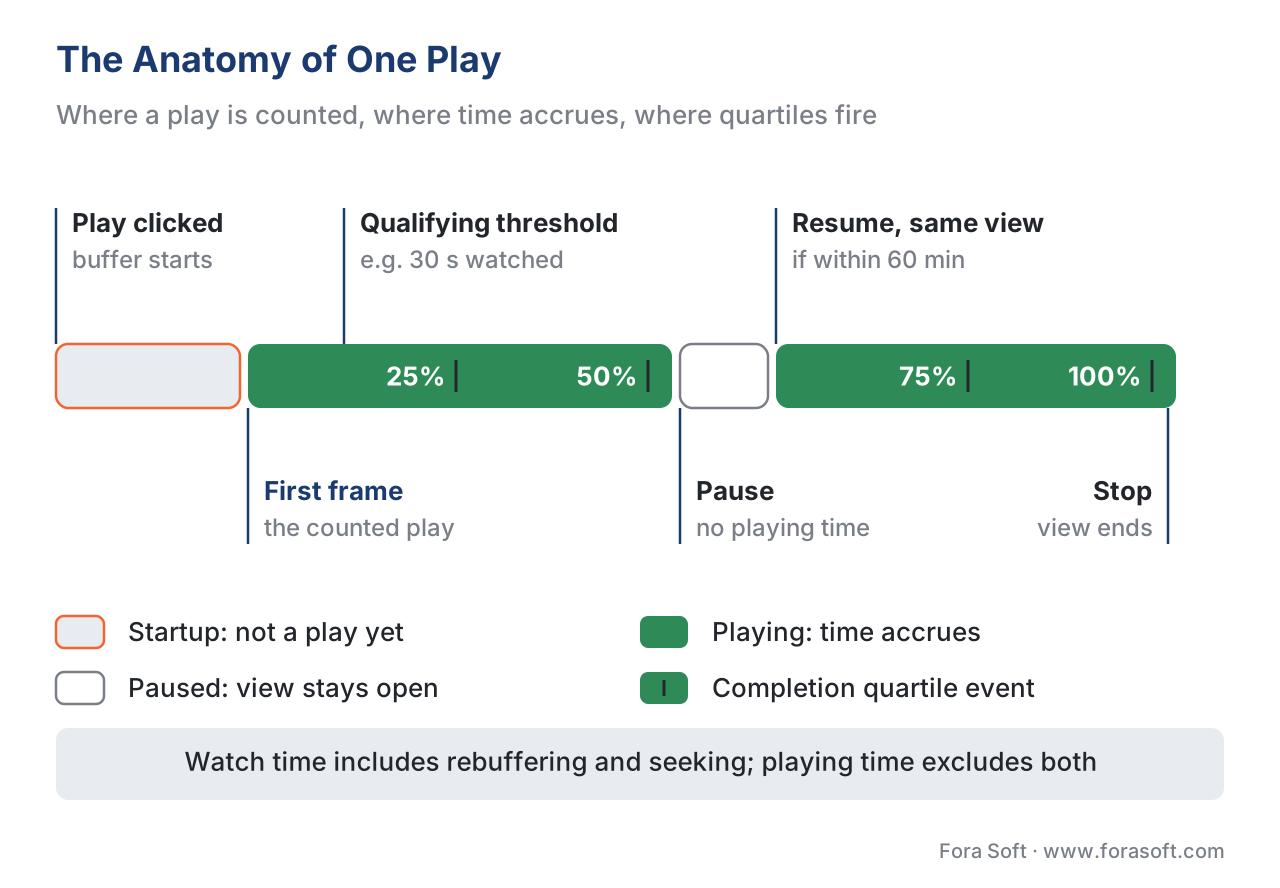 Figure 1. The anatomy of one play. The counted-play marker sits at the first frame, not at the buffer start; watch time accrues only while bytes are actually playing; completion fires at the 25/50/75/100% quartiles.
The qualifying threshold, and the "30-second rule"
Because the bare "press play" event is so easy to trigger by accident — an autoplay preview, a misclick, a page that starts video on load — most serious platforms add a qualifying threshold: a play only counts once a minimum amount of real watching has happened. The thresholds chosen across the industry vary wildly, which is the clearest possible proof that "a view" is a definition and not a fact:
| Platform / standard | What triggers a counted view | Counts a muted autoplay preview? |
|---|---|---|
| YouTube (standard video) | ~30 seconds of intentional watching — the "30-second rule" | No |
| YouTube Shorts (since 2025) | Every time the Short starts playing | Yes |
| Facebook / Instagram feed video | 3 continuous seconds | Often yes |
| Instagram Reels | The instant playback starts | Yes |
| LinkedIn video | 2 continuous seconds | Partly |
| IAB video ad impression | First frame begins to render (client-initiated) | Counts render, not intent |
| MRC viewable video impression | ≥ 50% of pixels in view for ≥ 2 continuous seconds | Only if on-screen |
Conventions current to 2026; platform rules change — date any figure you quote. The "supported?" question here is "does this rule count an autoplay preview as a view?" — the answer reveals how inflated the number can get.
The "30-second rule" — the convention that a standard YouTube view requires roughly thirty seconds of watching — is the most famous qualifying threshold, and it is a useful mental anchor even though your own platform will pick its own number. The point is not to copy thirty seconds; it is to have a threshold and publish it. A play counted at the first frame and a play counted after thirty seconds describe very different levels of real engagement.
The common mistake: letting autoplay inflate "plays"
Here is the most expensive viewership error, and it is almost always honest rather than dishonest. Suppose your home screen shows twenty autoplaying preview tiles per visit, and you get 100,000 visits a day. If your "plays" counter fires on every preview that starts, that is 20 × 100,000 = 2,000,000 "plays" a day before anyone has chosen to watch anything. If the number of plays where a viewer actually selected a title and watched past a real threshold is, say, 300,000, then your headline "plays" figure overstates genuine viewing by nearly 6.7×. Report the inflated number to an advertiser or a content partner and you have a credibility problem the first time they audit it. The fix is not to stop autoplay; it is to count qualified plays separately from preview starts and never blur the two.
Watch time is not "how much of the video was watched"
The next metric up is watch time: the total amount of time viewers spent watching. It is the raw fuel of the business — it drives advertising inventory in ad-supported models and it is the usage key many platforms use to allocate revenue to individual titles. But it carries a subtlety that trips up almost everyone the first time.
Watch time measures elapsed playback time, not video duration consumed. The cleanest illustration comes again from Mux's definitions: if a viewer watches a two-minute video at 2× speed, the watch time is one minute, because watch time counts how much wall-clock time elapsed during playback, not how much of the content's runtime was covered. Conversely, watch time as some vendors define it includes the seconds spent rebuffering, seeking, and starting up — time the viewer spent waiting, not enjoying. Mux draws this distinction explicitly: watch time includes rebuffering and seeking, while playing time is the stricter metric that counts only the time content was actually playing, excluding rebuffering, seeking, and pauses. A worked example from their documentation: 90 seconds of play, 4 seconds of rebuffering, 2 seconds of seeking, then 60 more seconds of play totals 156 seconds of watch time (90 + 4 + 2 + 60), even though less of that was clean playback.
For an operator this matters in two ways. First, when you quote "average watch time," say whether it includes buffering — the two definitions can differ by several percent on a poorly performing platform, and the difference is precisely the QoE problem you would otherwise hide. Second, watch time and completion are different questions: a long watch time on a short video can mean the viewer rewatched it; a short watch time on a long film can still be a happy viewer who finished a clip. Keep the time metric and the progress metric separate.
Completion rate: did they reach the end?
Completion rate answers the progress question directly: what fraction of a piece of content did viewers actually finish? It is the clearest signal of whether the content delivered on its promise — a trailer that loses 80% of viewers in the first ten seconds and a documentary that 70% of starters watch to the credits are telling you very different things about your catalogue.
The industry already has a precise, standardized way to measure progress, and it comes from the advertising stack: the IAB's Video Ad Serving Template (VAST) defines quartile tracking events that fire as playback crosses fixed progress milestones — start, firstQuartile (25% viewed), midpoint (50%), thirdQuartile (75%), and complete (100%). These events were designed so an ad server could verify how far an ad was watched, but the same quartile model is the right mental tool for content completion too: instead of a single "completion rate," track the share of viewers who survive to each quartile, because the shape of that drop-off curve tells you where your content loses people. A title where most of the loss happens between start and firstQuartile has an opening problem; one where viewers stream out at thirdQuartile may simply be too long.
The trap with completion rate is the same one that haunts watch time and every average: a single average completion number hides the distribution. "Average completion 55%" can describe a healthy title where most viewers finish and a few sample-and-leave, or a broken one where half the audience quits in the first minute and a loyal remainder finishes — two completely different content problems with the same headline number. Read completion as a quartile curve and as cohorts, never as one mean.
Concurrency: the audience metric that sizes the engineering
The most important viewership metric you will never see on a daily-totals dashboard is concurrency — the number of viewers watching at the same instant. Daily plays and monthly unique viewers describe the size of your audience over time; concurrency describes the load on your system right now, and it is the number every piece of your delivery infrastructure is sized against. It is also the metric that most distinguishes streaming from almost any other web product, because a live event can push concurrency to many multiples of the daily average in a matter of minutes.
This is where viewership analytics meets the infrastructure bill, so walk the arithmetic out loud. Suppose a live sports final on your platform peaks at 200,000 concurrent viewers, and your adaptive encoding delivers an average of 5 megabits per second (Mbps) per viewer at that moment. The aggregate bandwidth you must be able to push at the peak is:
200,000 viewers × 5 Mbps = 1,000,000 Mbps = 1,000 gigabits per second (Gbps) ≈ 1 terabit per second (Tbps).
That one-terabit-per-second figure — the peak concurrency × per-viewer bitrate — is what you provision content-delivery capacity for, not the comfortable daily average. A platform that planned around "two million plays today" and ignored the 200,000-at-once spike will fail at exactly the moment the most people are watching. We treat the engineering of that spike — multi-CDN capacity, origin protection, and graceful degradation — in depth in scaling and concurrency for OTT; for analytics, the point is that concurrency is an audience metric that doubles as your single most important capacity-planning number, and peak concurrency, not average, is the one to watch.
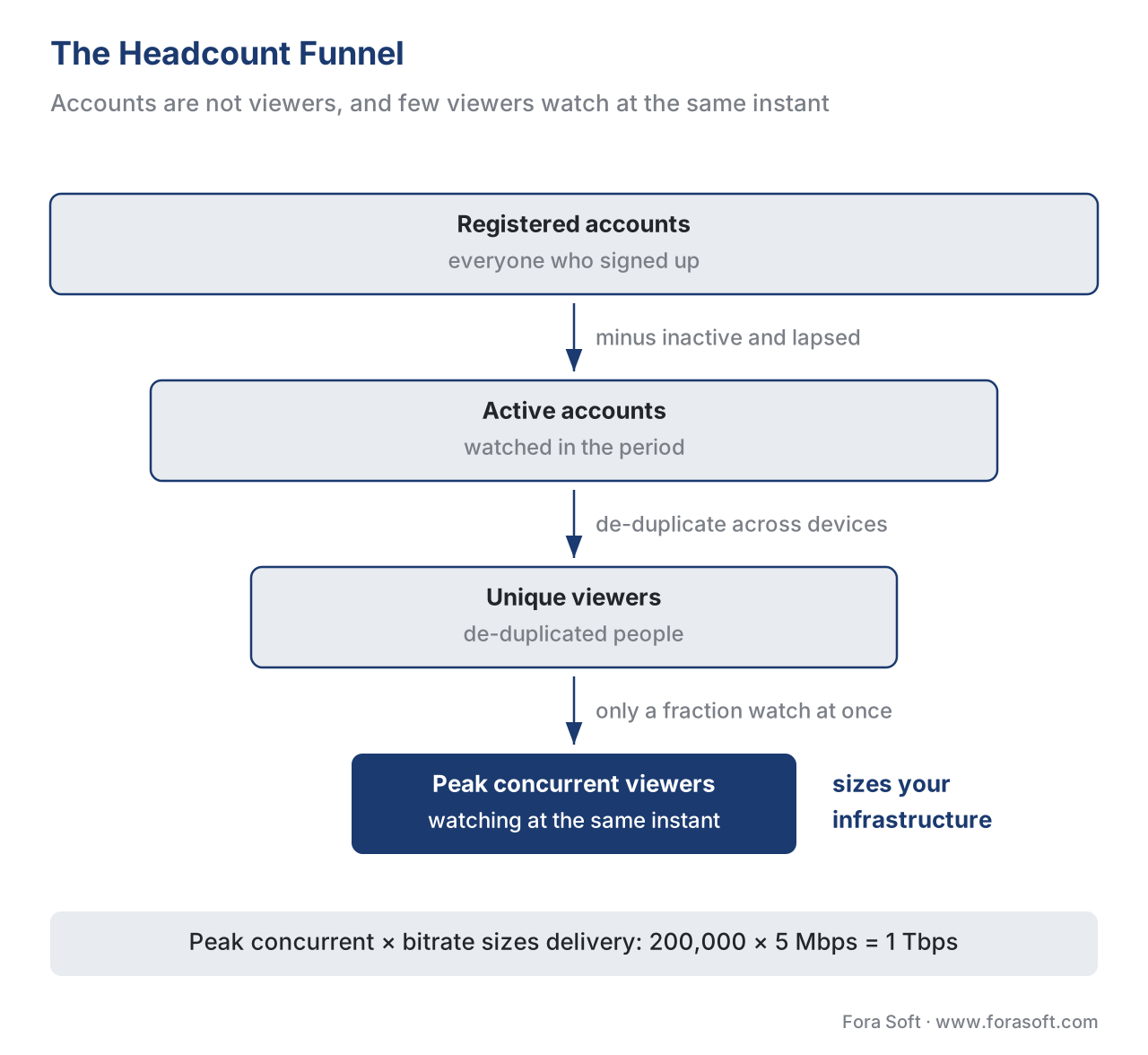 Figure 2. The headcount funnel. Accounts are not active viewers, active viewers are not unique de-duplicated people, and only a fraction of those are ever watching at the same instant — yet that smallest number sizes your infrastructure.
Unique viewers: stop counting accounts as people
Audience size sounds like the easiest number of all — until you ask units. The base layer is registered or subscribed accounts: how many people signed up. But an account is not a viewer. One household subscription can be three people on four devices, and a platform that reports "one million subscribers" as if it were one million viewers is over-counting in one direction while a platform that reports "four million active devices" as if they were four million people is over-counting in the other.
The honest audience metric is unique viewers: distinct people or profiles who actually watched in a defined period, de-duplicated across devices. Mux's definition is again a clean reference — unique viewers are counted by a stable Viewer ID, and a single viewer is counted once even when watching from multiple screens at the same time. The gap between accounts and active unique viewers is itself a health signal: a platform with a million subscribers but two hundred thousand monthly unique viewers has a retention problem hiding behind a healthy subscriber count, the kind of problem retention and engagement analytics exists to surface.
For advertising-supported models there is a fourth headcount metric, reach — the number of unique viewers an ad or a title actually touched — and here the measurement standards get strict because cross-media comparisons depend on them. The Media Rating Council's Cross-Media Audience Measurement Standards require, for deduplicated cross-media reach, a viewability threshold of 100% of pixels on screen for at least two continuous seconds applied to both the digital and the linear-TV components, so that a "reach" number means the same thing whether it came from a connected TV app or a broadcast feed. You do not need to implement that standard to run a subscription service, but if you sell advertising against your reach, your buyers will measure you against it.
Keeping the numbers honest: bots and invalid traffic
One more counting trap deserves its own name, because it can quietly corrupt every metric above: invalid traffic — plays, views, and impressions generated by something other than a real human choosing to watch. The advertising industry has formalized this. The Media Rating Council's Invalid Traffic (IVT) Detection and Filtration Guidelines split it into two tiers: General Invalid Traffic (GIVT), the routine, list-identifiable kind such as known bots, spiders, crawlers, and data-center traffic; and Sophisticated Invalid Traffic (SIVT), the harder kind that needs advanced analytics to catch — hijacked devices, falsified measurements, and malware-driven views. A platform that does not filter at least GIVT out of its viewership numbers is reporting a mix of humans and machines and calling it an audience. You do not need MRC accreditation to start; you do need to know that some fraction of raw plays is never a person, and to filter the obvious bots before you quote a number to anyone who matters.
Where the numbers come from
Viewership metrics are assembled from two sources, and knowing which is which keeps you honest about their reliability. Audience and engagement signals — who signed up, who is paying, who pressed play, and for how long — come from your application and billing systems combined with player events: small messages the player emits when a play starts, progresses through its quartiles, pauses, resumes, and stops. Concurrency is computed by counting the player heartbeats that are active in the same moment. Building that instrumentation cleanly — so a "play" fires once and means the same thing on web, mobile, and TV — is the subject of player QoE instrumentation, and the VAST quartile events above are emitted by the same player layer when ads are involved, which is covered in ad serving, VAST/VMAP, and the ad stack. The reliability rule is simple: a metric is only as trustworthy as the single, consistent event that feeds it.
Free download: Viewership Metrics Definition & Honest-Counting ChecklistPlays, watch time, completion, concurrency, unique viewers and reach: the honest definition of each, the counting trap it carries, and the peak-concurrency arithmetic that sizes delivery, on one page.Where Fora Soft fits in
The viewership layer has to be correct and hold at the scale of a live premiere — millions of play events a day and hundreds of thousands of concurrent heartbeats during a spike, turned into numbers an operator can defend to an advertiser. Fora Soft has built video streaming and OTT/Internet TV platforms since 2005, across 625+ projects for 400+ clients, including the player instrumentation and event pipelines that define a "play," a "unique viewer," and a concurrency number once and apply them consistently across web, mobile, and smart-TV clients. We design the metric definitions with you — the qualifying threshold, the resume window, the quartile model, the bot filter — so the numbers are honest before they reach a dashboard, and we size the delivery against peak concurrency rather than comfortable averages. We are vendor-neutral: we will instrument on a measurement platform like Mux or Conviva, or on open telemetry, whichever fits your scale and budget.


The handbook
Fora Soft Video Engineering Handbook
We wrote a seven-volume handbook, 9,000+ pages, that takes the video stack from a single pixel to production, and someone who works through it can design and build the player events, QoE beacons and delivery capacity behind the numbers in this article. Start with volume 3: players and their telemetry, ABR, CDNs and the economics of serving a peak audience. Volume 2 covers the HLS and DASH segments whose playback those events measure, and volume 1 the encoding ladder that sets the per-viewer bitrate you multiply by peak concurrency. Written by Nikolay Sapunov, CEO at Fora Soft.
Would your play, viewer and concurrency numbers survive an advertiser audit?
Tell us how your players count plays today and what your biggest live event peaked at, and we will set the qualifying threshold, resume window, quartile events and bot filter, then size delivery against peak concurrency. 250+ video products shipped since 2005.
See our case studies
Case study
Worldcast Live
A live concert platform serving 10,000 concurrent viewers at 0.4–0.5 s latency — the peak-concurrency number that decided its delivery design.
Case study
Sprii
A Danish live-shopping platform with 72K+ live events, where viewers watch for 20 minutes against 54 seconds on static pages — watch time as the metric that sells the product.
Case study
Drundoo
A Bulgarian internet-TV platform with 60 live channels, catch-up and a VOD library — one audience watching live and on demand across the devices it already owns.
What to read next
Analytics
OTT Analytics: Audience, Engagement & Quality Metrics
The three metric families this article's numbers belong to.
Architecture
OTT Platform Scaling: 1,000 to 1,000,000 Viewers
Engineering the peak-concurrency spike you just sized.
Analytics
The QoE Measurement Stack: Mux, Conviva & Telemetry
Where the play, watch-time and concurrency events get collected.
Analytics
Retention and Engagement Analytics for OTT
Turning unique viewers and watch time into retention signals.
References
- Digital Video Impression Measurement Guidelines (v1.1). Interactive Advertising Bureau (IAB) / Media Rating Council. Tier 1 (industry standard). Requires client-initiated counting and that a video ad impression be counted only when the ad begins to render (first frame paints), not when the buffer is initiated; rejects server-initiated counting. https://www.iab.com/wp-content/uploads/2016/12/Digital-Video-Impression-Measurement-Guidelines_1.1.pdf (accessed 2026-06-19).
- MRC Cross-Media Audience Measurement Standards (Phase I, Video). Media Rating Council, September 2019. Tier 1 (standards body). Defines deduplicated cross-media reach and the viewability qualification threshold of 100% of pixels on screen for ≥ 2 continuous seconds applied to both digital and linear components. https://mediaratingcouncil.org/sites/default/files/Standards/MRC%20Cross-Media%20Audience%20Measurement%20Standards%20(Phase%20I%20Video)%20Final.pdf (accessed 2026-06-19).
- Digital Video Ad Serving Template (VAST) — quartile tracking events. IAB Tech Lab, VAST 4.x. Tier 1 (industry standard). Defines the linear-video progress tracking events
start,firstQuartile(25%),midpoint(50%),thirdQuartile(75%), andcomplete(100%) — the standardized model for measuring how far playback progressed. https://iabtechlab.com/standards/vast/ (accessed 2026-06-19). - MRC Invalid Traffic (IVT) Detection and Filtration Guidelines (Addendum). Media Rating Council / IAB. Tier 1 (standards body). Defines General Invalid Traffic (GIVT — bots, spiders, crawlers, non-browser agents, data-center traffic) and Sophisticated Invalid Traffic (SIVT — hijacked devices, falsified measurement, malware) and the accreditation framework for filtering them. https://www.iab.com/guidelines/mrc-invalid-traffic-ivt-detection-and-filtration-guidelines-addendum/ (accessed 2026-06-19).
- CTA-2066 — Streaming Quality of Experience Events, Properties and Metrics. Consumer Technology Association, March 2020. Tier 1 (standards body). Standardizes the player events and engagement/QoE metrics — including how playback and viewing events are computed — so viewership and quality reporting is consistent across players and analytics vendors. https://shop.cta.tech/products/cta-2066 (accessed 2026-06-19).
- Understand Mux Data metric definitions. Mux. Tier 3 (first-party analytics vendor). Operator-facing definitions: a "View" is an attempt (successful or not) to play, created on play/programmatic start, tracked until end or 60 minutes after stop, with pause-resume inside the window staying one view; Watch Time = elapsed playback time including rebuffering/seeking/startup; Playing Time excludes them; the 2×-speed and 156-second worked examples. https://www.mux.com/docs/guides/understand-metric-definitions (accessed 2026-06-19).
- Understand Monitoring Metrics and Dimensions / Live Streaming Analytics. Mux. Tier 3 (first-party). Definitions of Unique Viewers (distinct Viewer IDs, counted once across simultaneous screens) and Concurrent Viewers (number watching at the same instant; peak concurrency for live). https://www.mux.com/docs/guides/monitoring-metrics (accessed 2026-06-19).
- What's A Video View? On Facebook, Only 3 Seconds Vs. 30 At YouTube. MarTech / The Video Company. Tier 5 (trade press). Orientation source for the per-platform view-counting thresholds (YouTube ~30 s, Facebook/Instagram 3 s, LinkedIn 2 s, Shorts/Reels instant). Used for current-practice framing, not for standard definitions. https://martech.org/whats-a-video-view-on-facebook-only-3-seconds-vs-30-at-youtube/ (accessed 2026-06-19).
- Guide to Video Analytics for OTT Platforms — Key Metrics in 2026. FastPix. Tier 5 (industry). Current (2026) operator-metric orientation: time-to-first-frame, completion rate, concurrency, and the audience/engagement split. https://www.fastpix.io/blog/guide-to-video-analytics-for-ott-platform-key-metrics (accessed 2026-06-19).
Spec/standard precedence note (per §4.3.2): where popular "video KPI" listicles present a single flat "views" or "completion rate" number with no counting rule, this article follows the controlling measurement standards — the IAB Digital Video Impression Guidelines (begin-to-render, client-initiated), VAST 4.x quartile events for progress, the MRC Cross-Media standard for deduplicated reach, and the MRC IVT guidelines for bot filtration — and uses Mux's first-party engineering definitions for the player-side view/watch-time/concurrency terms. Per-platform thresholds (30 s, 3 s, 2 s) are vendor conventions, not standards, and are dated and flagged as such.
