


Why this matters
If you are about to build a streaming platform, the monetization model is the most expensive decision you will make, because it silently dictates the rest of the build. A subscription service needs a billing-and-entitlement engine; an ad-supported one needs an ad-decision and stitching stack; a transactional one needs a payment and rights-window system; and a hybrid needs most of them at once. Pick the wrong model for your catalog and audience and you do not just lose revenue — you build the wrong software and pay to rebuild it. This article is for the founder, product manager, or first-time streaming CTO who has to choose the model, defend it to investors and content owners, and brief the engineers who will implement it. It sits on top of the OTT monetization map, which explains how each model wires into the platform; here the job is to help you choose.
The one idea: the monetization model is an architecture decision
Start with the costly misconception, because it shapes everything that follows. Most teams treat monetization as a late decision — build the platform, then "figure out pricing." That is backwards. The way you intend to make money decides which systems you must build, and those systems take months and define your cost base.
Think of it like deciding whether to open a cinema, a rental shop, or a billboard company before you pour the foundation. A cinema (subscription) needs turnstiles and season passes — billing and entitlement. A rental shop (transactional) needs a till and a returns desk — payments and rental windows. A billboard company (advertising) needs an ad-sales team and a system to swap the posters per viewer — an ad server and stitching. You would never build the building first and pick the business second, yet that is the default mistake in streaming.
So the order is: choose the monetization model first, then design packaging (the tiers you offer), then set pricing (the numbers). The rest of this article walks each layer, grounds it in current numbers, and ends with the constraints — the app-store tax and subscription law — that change the math after you think you are done.
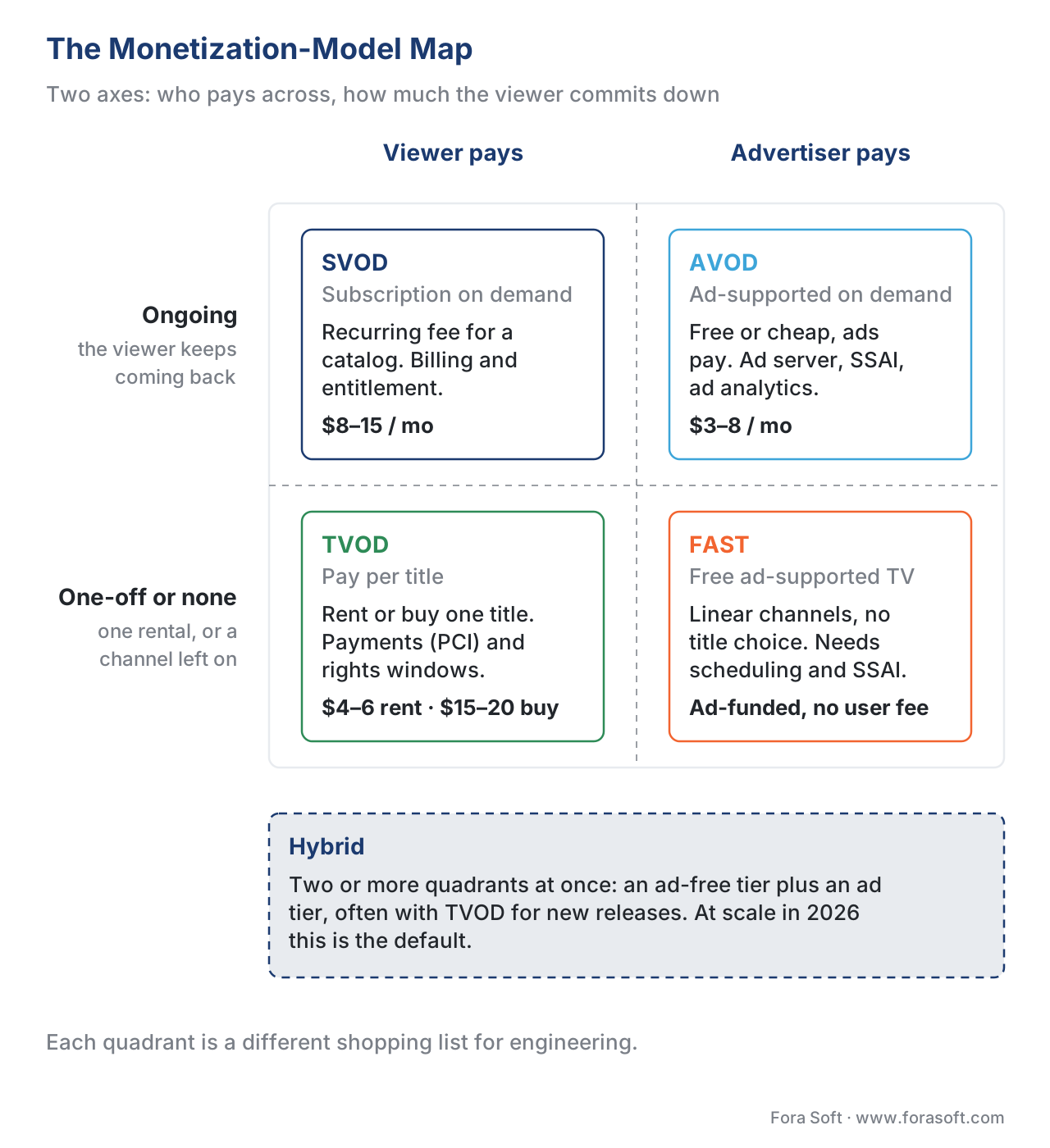 Figure 1. The monetization-model map. The four base models differ on who pays (viewer vs advertiser) and on viewer commitment (one-off vs recurring vs none); most 2026 platforms run a hybrid that occupies more than one quadrant.
The five models, and what each one demands from the platform
Before you can choose, you need the models clear and distinct. Streaming people blur them constantly, and each carries different billing, ad, rights, and analytics requirements. Here they are in plain language, with the engineering each forces on you.
Subscription video on demand (SVOD) is the Netflix model: viewers pay a recurring fee for access to a catalog. The viewer pays; the commitment is recurring. It demands a billing system that handles plans, trials, proration, and failed-payment recovery, plus an entitlement service that decides, on every play, who is allowed to watch what.
Advertising-supported video on demand (AVOD) is free or cheap to the viewer, paid for by ads. The advertiser pays; the viewer commitment is low. It demands an ad-decision server, ad creative handling, and — to beat ad-blockers and protect quality — server-side ad insertion (SSAI), which stitches ads into the stream itself.
Transactional video on demand (TVOD) is pay-per-title: rent or buy a single film or event. The viewer pays once per item. It demands a payment integration with a card-processing (PCI) boundary and a rights-window engine that enforces rental periods and purchase entitlements — see TVOD and transactional flows.
Free ad-supported streaming TV (FAST) is linear, channel-style streaming that is free and ad-funded — the digital descendant of broadcast TV. The advertiser pays; the viewer makes no commitment and does not even choose a title. It demands channel scheduling, a live-style playout system, and the same SSAI and ad stack as AVOD. FAST is the fastest-growing of the five: the global FAST market grew from $12.28 billion in 2025 to an estimated $14.88 billion in 2026, a 21.2% annual growth rate, and is projected to reach $31.82 billion by 2030 (The Business Research Company / Research and Markets, 2026 — analyst estimate, re-verify).
Hybrid combines two or more of the above — most commonly an ad-supported tier and an ad-free tier of the same SVOD service, often with TVOD for new-release events on top. In 2026 the hybrid is not the exotic option; it is the default for any platform at scale, because it captures both the advertiser's money and the viewer's.
| Model | Who pays | Viewer commitment | Core systems it forces you to build | Typical 2026 ARPU* |
|---|---|---|---|---|
| SVOD | Viewer | Recurring | Billing, plans, entitlement, dunning | $8–15/mo |
| AVOD | Advertiser | Low | Ad server, SSAI, ad analytics | $3–8/mo |
| TVOD | Viewer (per item) | One-off | Payments (PCI), rental/purchase windows | $4–6 rent · $15–20 buy |
| FAST | Advertiser | None | Channel scheduling, playout, SSAI | Ad-funded, no per-user fee |
| Hybrid | Both | Mixed | Most of the above, combined | Highest blended |
Table 1. The five models and what each demands from the platform. ARPU = average revenue per user. Figures are 2026 industry ranges (Streaming Media, MwareTV, FastPix, 2026); they vary widely by region, content, and ad sell-through, so treat them as orientation, not promises.
The "core systems" column is the point of the table. The model you pick is a shopping list for the engineering team. That is why this is an architecture decision.
The decision: three questions that pick your model
You do not pick a monetization model from a menu of preferences. Three facts about your business pick it for you, and most arguments inside a streaming startup are really disagreements about one of these three.
First: how deep and how fresh is your catalog? A large library that people watch for hundreds of hours a year supports a recurring subscription, because the viewer keeps coming back and a monthly fee feels fair. A thin catalog, or one built around a few marquee new releases, struggles as SVOD — there is not enough to justify a recurring charge — but works well as TVOD (sell the new release) or AVOD/FAST (give the back-catalog away and sell the ads against it). Niche, narrow catalogs increasingly thrive as FAST channels.
Second: how much will your audience actually pay? This is willingness to pay, and it is the single most over-assumed number in streaming. A premium, fan-driven audience in a high-income market will pay a recurring fee; a broad, price-sensitive, or emerging-market audience will not, and chasing them with a subscription leaves most of your potential viewers — and ad revenue — on the table. In 2026, 61% of consumers said they would cancel a service if its price rose by $5, and roughly 40% had cancelled at least one service in the prior six months (Deloitte Digital Media Trends, March 2026). Audiences are price-sensitive; design for it.
Third: what do your content rights allow? Licensing terms can force the decision outright. Some studio deals forbid ad-supported distribution; others mandate a transactional window before any subscription availability; others restrict a title to certain territories or dates. You cannot choose AVOD for content whose license bans ads. Rights and windowing are a hard constraint, not a preference — check them before you model revenue.
Run those three questions and the model usually falls out. Deep catalog plus willing audience plus permissive rights points to SVOD, almost always with an ad-supported tier. Thin or marquee catalog points to TVOD or hybrid. Broad, price-sensitive audience points to AVOD or FAST. Mixed answers point to hybrid — which is why most platforms end up there.
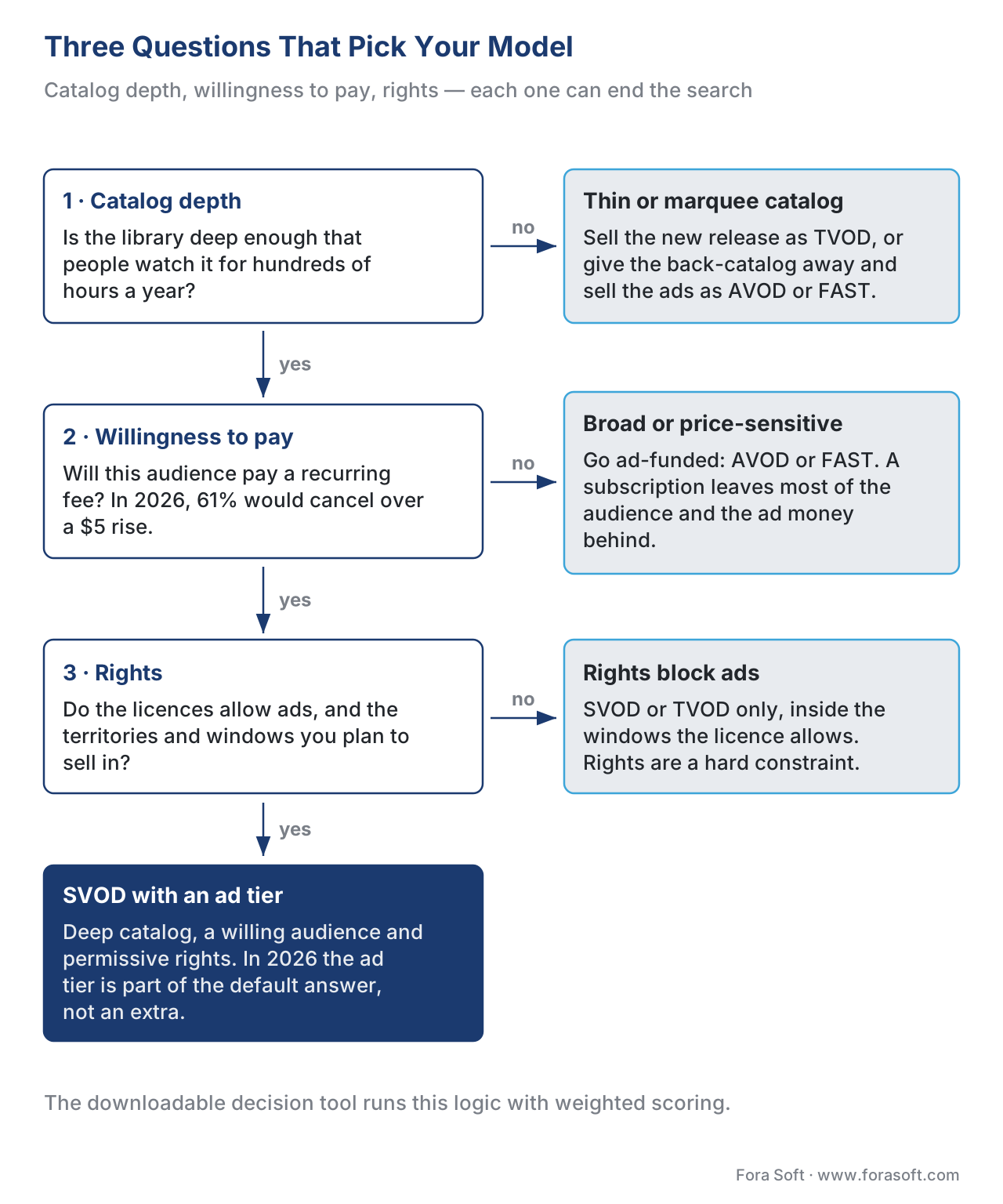 Figure 2. The monetization decision tree. Three inputs — catalog depth, audience willingness to pay, and rights constraints — route to a recommended base model. The downloadable decision tool implements this logic with weighted scoring.
Packaging: good-better-best, and the ad tier as the new default
Once the model is chosen, packaging is how you slice it into the products a viewer can buy. The dominant pattern, borrowed from decades of software and consumer pricing, is good-better-best: three tiers, where most buyers pick the middle one. This is the "Goldilocks effect" — given three options, people avoid the cheapest (feels like a compromise) and the dearest (feels extravagant) and choose the middle, which is exactly where you place the price you most want to sell (pricing research consensus; van Westendorp, 1976).
For streaming in 2026, the three tiers have a near-standard shape:
- Good — the ad-supported tier. Cheapest, or free, with ads. This is no longer a budget afterthought; it is where the growth is.
- Better — the standard ad-free tier. The middle option, the one most pricing is engineered around.
- Best — the premium tier. Higher resolution (4K), more simultaneous streams, offline downloads, sometimes early access.
The headline shift of the last two years is the rise of the ad tier. By March 2026, 68% of US households that subscribe to streaming had at least one ad-supported service, up from 54% a year earlier (Deloitte, March 2026). Ad-supported plans reached roughly 110 million subscriptions and 48% of all US SVOD subscriptions, and accounted for 59% of gross subscriber additions in the first quarter of 2026 on platforms that offer an ad option (Antenna, March 2026). The ad tier is not the cheap seats anymore; it is the front door.
The tool that keeps tiers from cannibalising each other is the price fence — a difference in features, not just price, that makes each tier right for a different viewer. Resolution, number of simultaneous streams, ad load, and offline download are the classic streaming fences. A fence done right means the premium buyer cannot get what they want from the cheap tier, so they pay up; a fence done wrong means everyone buys the cheapest tier and your ARPU collapses.
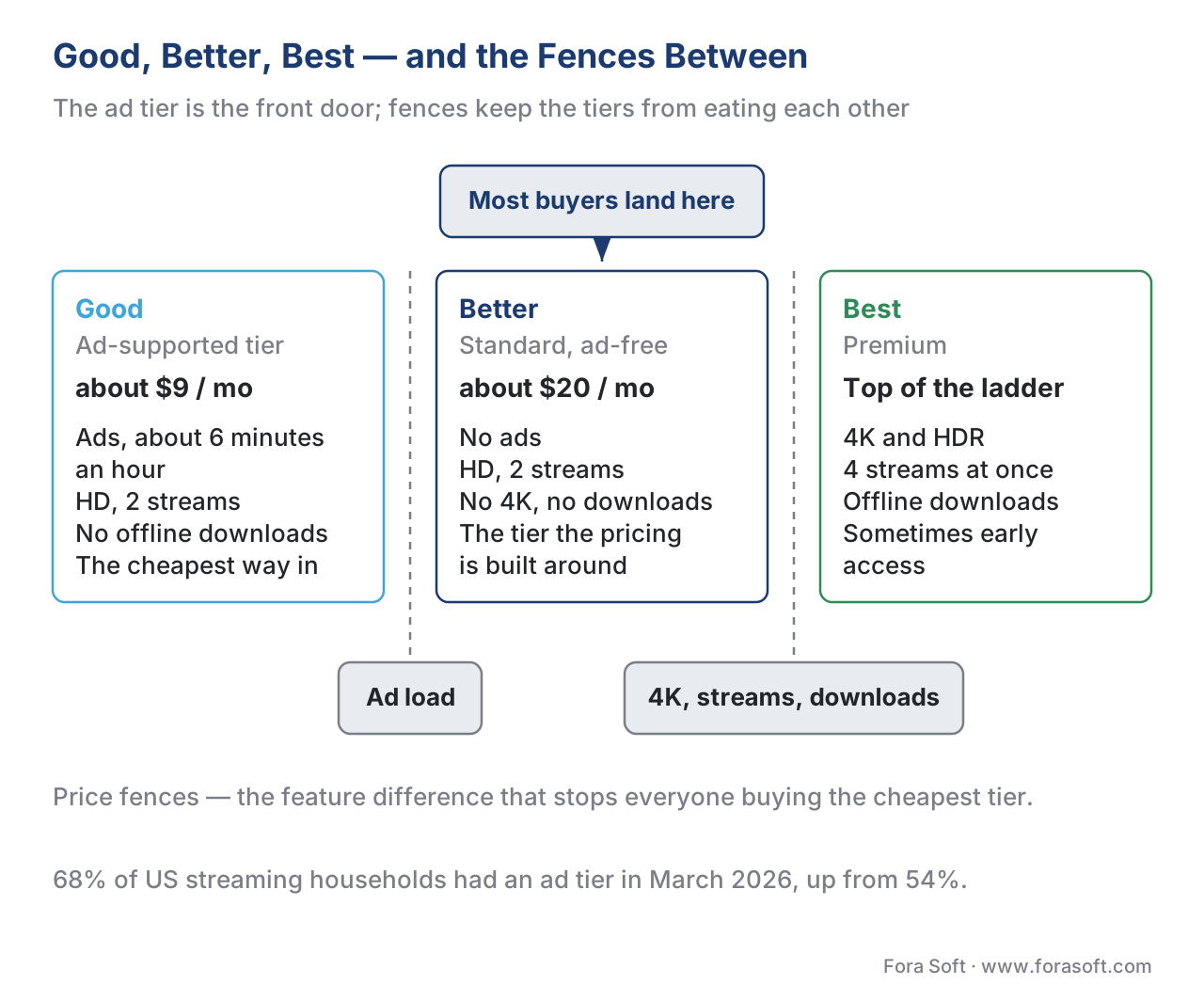 Figure 3. Good-better-best packaging for streaming. The ad-supported tier is the new front door; feature fences (resolution, streams, ad load, downloads) separate the tiers so each serves a distinct viewer and the middle tier captures the most buyers.
Pricing: willingness to pay and the cancel cliff
Pricing is the number on each tier, and it is the layer teams most often set by gut — usually by copying a competitor. There is a better way, and it does not require a data-science team.
The cheapest rigorous method is the Van Westendorp Price Sensitivity Meter (van Westendorp, 1976): you ask a sample of target viewers four questions — at what price is this too expensive, too cheap, getting expensive but still worth it, and a bargain. The crossover points map the range of acceptable prices and the boundaries beyond which you lose people. It is a survey, not a model, and it gives you guardrails for each tier before you commit. Pair it with a willingness-to-pay test on actual price points (the Gabor-Granger method) to fine-tune the number inside the range.
Whatever method you use, respect the cancel cliff. The Deloitte 2026 figure — 61% would cancel on a $5 rise — is the single most important pricing fact in the market right now. It means price increases are not free; each one trades margin for churn, and beyond a threshold the churn dominates. This is why the industry leader's strategy in 2026 was not simply to raise prices but to raise the ad-free price while offering a much cheaper ad tier: when the standard ad-free plan moved to roughly $20 a month, the ad-supported plan sat near $9, giving the price-sensitive viewer somewhere to go other than the cancel button (CNBC, Variety, 2026). The ad tier is a churn shock-absorber as much as a growth engine.
Walk the arithmetic, because it shows why the ad tier can beat the ad-free one even at a lower sticker price. Suppose a viewer on the $20 ad-free plan is compared with a viewer on the $9 ad tier. The ad-tier viewer pays $9 in subscription. If they watch 40 hours a month and see, say, 6 minutes of ads per hour at a $25 CPM (cost per thousand ad impressions), that is 240 minutes of ads, roughly 80 thirty-second spots, or about 80 impressions — at $25 per thousand, only about $2 of ad revenue. Total: roughly $11. But a heavy viewer watching 100 hours a month generates far more ad inventory, and in premium verticals CPMs run higher — sports and live events command $28–32, against $9–13 for kids and family content (industry CPM data, 2026). The lesson is that ad-tier revenue scales with watch time and audience value, while subscription revenue is flat per user. For an engaged, advertiser-friendly audience, the ad tier's blended ARPU can match or exceed the ad-free tier — which is exactly why platforms push it.
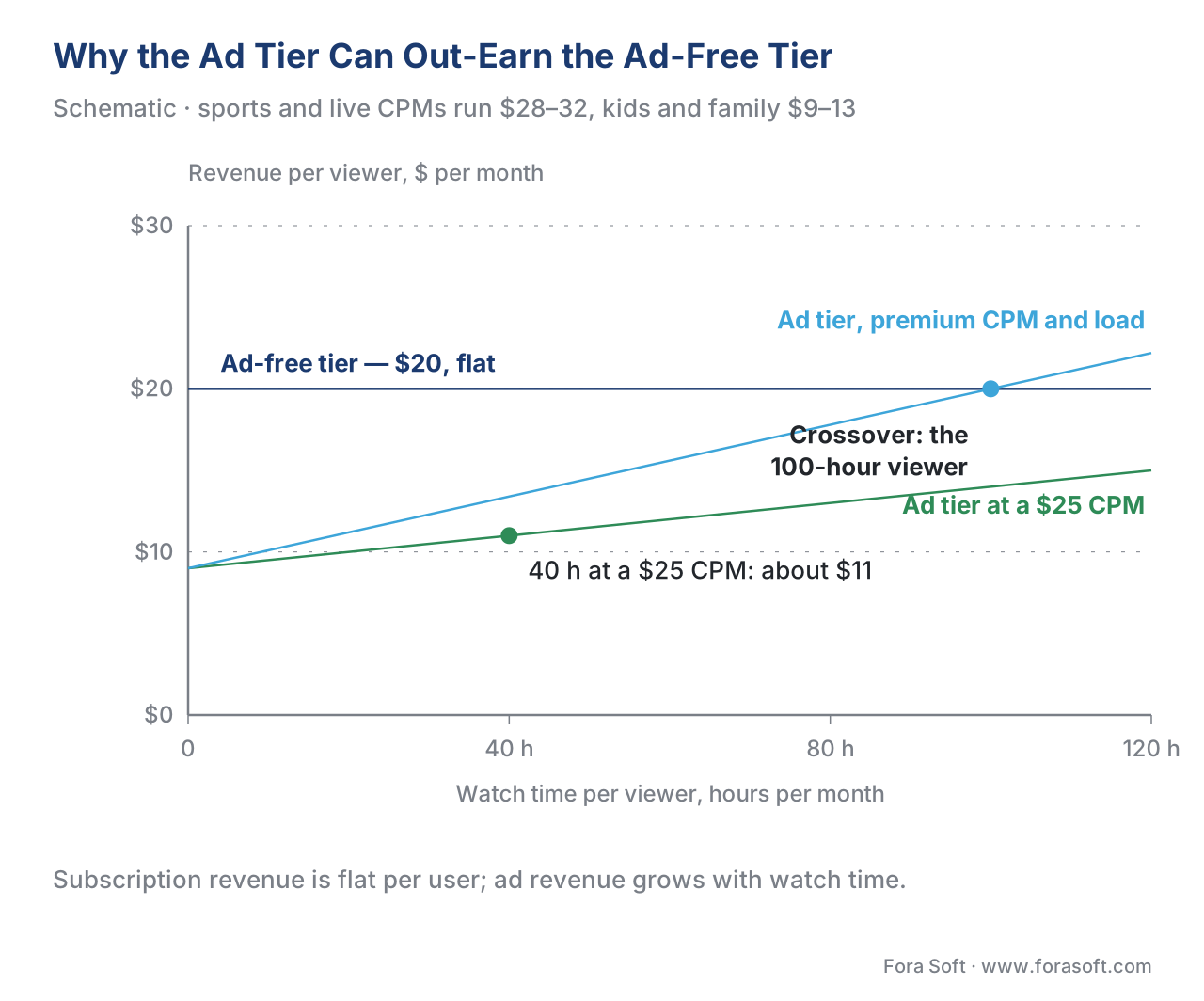 Figure 4. Why the ad tier can out-earn the ad-free tier. Subscription revenue per user is flat; ad-tier revenue rises with watch time and ad value, so for heavy, advertiser-friendly viewers the ad tier's blended ARPU crosses above the ad-free fee.
Bundling: the strongest churn lever in 2026
If pricing is the per-product lever, bundling is the portfolio lever, and in 2026 it is the most effective retention tool in streaming. A bundle sells access to several services for one combined price below their sum, and the effect on churn is large and well documented.
The cross-company Disney+/Hulu/HBO Max bundle, at $16.99 a month with ads, posted an 80% three-month retention rate, against roughly 55–56% for the same services sold standalone; bundle subscribers were reported 59% less likely to churn within twelve months (StreamTV Insider, eMarketer, 2026). Parks Associates projected that bundling would account for essentially all net SVOD subscription growth in 2026. The mechanism is simple: each added service is another reason not to cancel, so the combined product is stickier than its parts, which lifts lifetime value even at a discounted price.
For a new platform, the practical takeaway is twofold. First, if you cannot build a bundle, partner into one — distribution through a larger aggregator's bundle can be worth more than a higher standalone price. Second, an internal bundle (your own SVOD + a live tier, or content + a companion app) borrows the same stickiness. Bundling is not only for the giants; it is a design principle.
The constraints that change the math: the app-store tax and the billing decision
Here is the pitfall that wrecks first-time streaming financial models: the app-store commission. If your iOS or Android app sells subscriptions through the platform's in-app purchase system, Apple or Google historically takes 15–30% of that revenue. On a $10 subscription, a 30% cut is $3 — gone before you pay for content, CDN, or staff. Many founders model revenue at the sticker price and discover the tax only after launch.
The rules are in flux in 2026 and you must cite them by date. Following the long-running Epic Games litigation, US courts moved against Apple's restrictions: by December 2025 the Ninth Circuit largely upheld a ruling that Apple may not stop developers from linking out to their own web payment pages, and in 2026 the remand process continued over what, if any, fee Apple may charge on external-link purchases — with the matter still contested and headed toward possible Supreme Court review (Ninth Circuit, 2025–2026 — active litigation, re-verify before relying on it). The practical state in the US in mid-2026: a streaming app can steer users to pay on the web and keep far more of the revenue, but the exact allowable fee and the rules outside the US remain unsettled. The billing decision — in-app purchase versus web/external billing — is now a real margin lever, not a detail.
There is an accounting wrinkle to plan for, too. Under the revenue-recognition standard ASC 606 (FASB) / IFRS 15, subscription revenue is recognised over the service period, not when the cash arrives. An annual plan paid upfront is booked as deferred revenue and released month by month (FASB ASC 606 / IFRS 15, effective 2018). This matters for how you report growth and for the cash-versus-revenue gap that confuses early investors — design your billing data model to track it from day one.
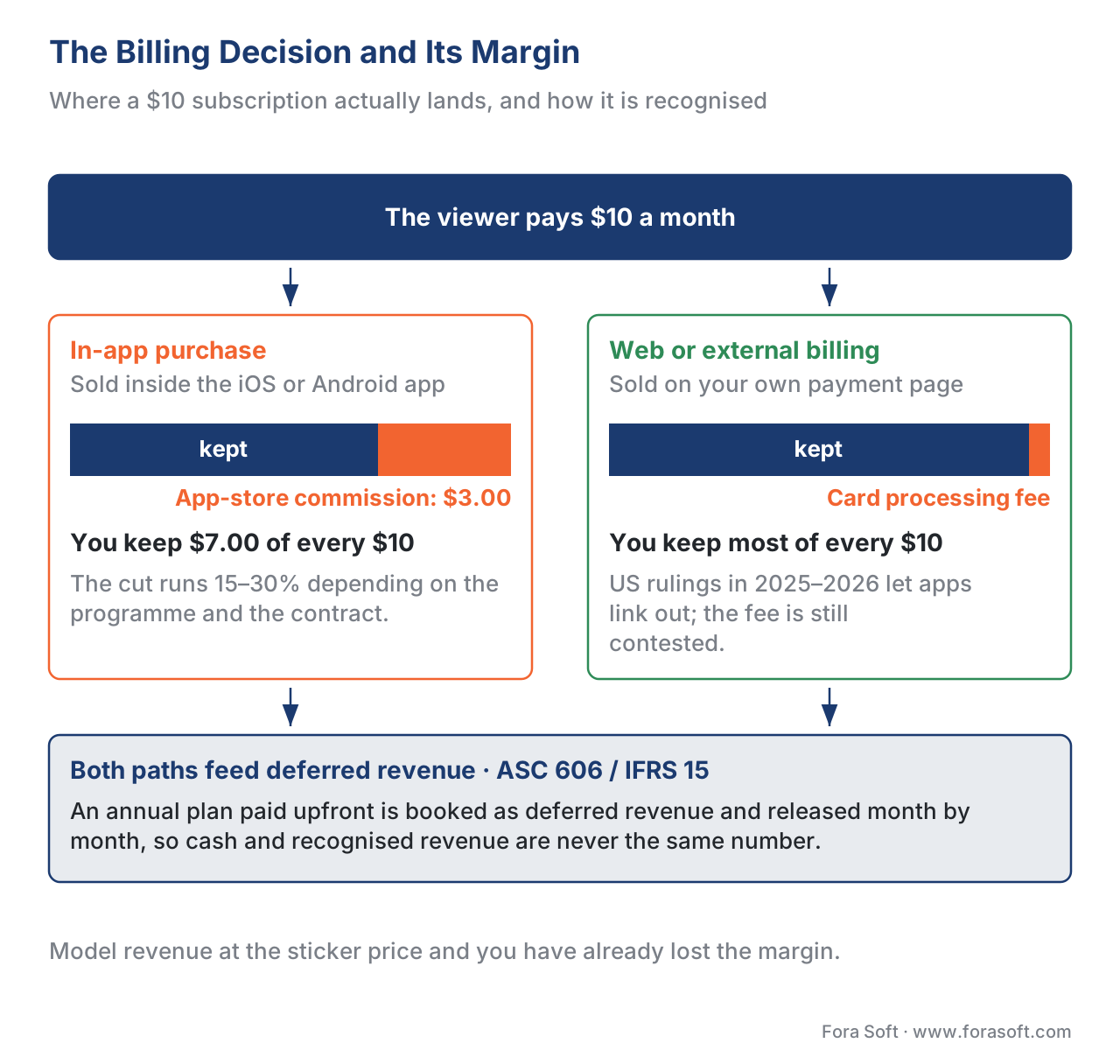 Figure 5. The billing decision and its margin impact. In-app purchase loses up to 30% to the app-store commission; web or external billing keeps far more after processing fees. Both feed revenue recognised over the service period under ASC 606 / IFRS 15.
The law you cannot price around: auto-renewal and "negative option"
A subscription is, in legal terms, a negative option — it keeps charging unless the customer acts to stop it — and regulators are tightening the rules on how you sell and cancel it. This shapes packaging and the cancel flow directly.
In the US the picture is genuinely mixed and must be stated carefully. The Federal Trade Commission's amended Negative Option Rule (the "click-to-cancel" rule, 16 CFR Part 425, amended 2024) would have required cancellation to be as easy as sign-up, but the Eighth Circuit Court of Appeals vacated the rule in its entirety in July 2025 on procedural grounds, so the federal rule is not in force as of mid-2026, though the FTC has signalled it will revisit the rulemaking and continues to bring enforcement actions on deceptive billing (Eighth Circuit, Custom Communications v. FTC, 2025; FTC, 2025–2026). State law, however, fills the gap: California's amended Automatic Renewal Law (Bus. & Prof. Code §17600 et seq., as amended by AB 2863, 2024) and similar statutes in many states require clear disclosure, affirmative consent, renewal reminders, and easy cancellation. A national service must comply with the strictest state rule it touches.
The engineering consequence is concrete: build a real cancellation flow, store affirmative consent and renewal-reminder records, and treat "make it hard to cancel" as a legal risk, not a retention tactic. Design the cancel path as carefully as the sign-up path.
A common mistake: optimising pricing before the model is right
The most expensive error in this whole topic is spending months A/B-testing price points on a monetization model that was wrong for the catalog and audience. A thin catalog priced perfectly as SVOD still churns, because the problem is the model, not the number. Pricing optimisation has sharply diminishing returns until the model fits the three inputs above. Choose the model, validate it against catalog, audience, and rights, then tune packaging and price. A second frequent mistake is modelling revenue at the sticker price and forgetting the app-store tax and the content cost — the two line items that most often turn a "profitable" model into a loss.
How the model feeds back into architecture
The reason monetization belongs at the start is that it reaches back into nearly every other system. SVOD pulls in the billing and entitlement engine and a paywall. AVOD and FAST pull in SSAI and the SCTE-35 ad-signaling plumbing. A premium tier with 4K and offline download pulls in extra renditions on the encoding ladder and offline DRM licences. Concurrent-stream limits become an entitlement and scaling requirement. The monetization decision is, quite literally, the brief for the platform. Get it first, write it down, and let it drive the build.
Free download: Monetization-Model Decision ToolA weighted scorer for the three questions on this page - catalog depth, willingness to pay, rights, geography and ad-sales capability - that returns a recommended SVOD, AVOD, TVOD or hybrid model with a side-by-side ARPU comparison.Where Fora Soft fits in
Streaming platforms succeed or fail on whether the monetization model fits the catalog and scales with the audience, and that is a build problem before it is a pricing problem. Fora Soft has engineered video streaming, OTT/Internet TV, e-learning, and telemedicine platforms since 2005 — 625+ projects for 400+ clients across 20+ years — which means we have wired up SVOD billing and entitlement, AVOD and FAST ad stacks with server-side ad insertion, and TVOD purchase flows on the same platforms. We are vendor-neutral: we translate your monetization decision into the billing, ad, rights, and analytics systems it requires, sized for your concurrency and regional delivery from day one, rather than selling you a fixed stack.


The handbook
Fora Soft Video Engineering Handbook
We wrote a seven-volume handbook, 9,000+ pages, that takes the video stack from a single pixel to production - encoding, delivery, audio and AI - so that someone who works through it can design and build the platform this article prices. Volume 3 is the one to open next to this page: ABR, CDNs, players, DRM and the economics of delivery, which is where an ad tier's margin is won or lost. Volume 1 explains the encoding ladder behind your cost per stream and volume 2 the transport and packaging that carry every tier you sell. Written by Nikolay Sapunov, CEO at Fora Soft.
Not sure whether your catalog should sell as a subscription, an ad tier, or both?
Tell us the catalog, the audience and the rights you hold, and we will walk the same three questions with your numbers, then size the billing, ad and entitlement systems each answer commits you to. 250+ video products shipped since 2005.
See our case studies
Case study
WorldCastLive
Pay-per-view tickets, donations and ad placement on one concert platform - the hybrid this article calls the 2026 default - running at 1.5 Gb/s and 0.4-0.5 s for 10,000 simultaneous viewers.
Case study
TradeCaster
A $99-119/month subscription with a 7-day free trial for 46,000+ traders, plus payouts to streamers who bring their own audience: packaging and price fences on a real catalog.
Case study
Franchise Record Pool
One $19.99/month tier sold across web, desktop, iOS and Android against 720,000+ licensed tracks - the billing surface and the rights window from this article, in one product.
What to read next
Monetization
OTT Monetization: SVOD, AVOD, TVOD & Hybrid Explained
The five models in full, once the decision tree has pointed you at one.
Billing
Subscription Billing and Entitlement: the SVOD Engine
What a subscription commits you to building, from trial to dunning.
Advertising
SSAI vs CSAI: Server-Side vs Client-Side Ad Insertion
What the ad tier commits you to building on the delivery side.
Economics
OTT Platform Cost Model: Build & Run Costs (2026)
The other half of the margin: what the platform costs to run per viewer.
References
- Deloitte, "2026 Digital Media Trends" (Digital Media Monitor), March 2026. US household streaming spend ~$69/month; 68% of SVOD households have at least one ad-supported tier (up from 54%); 61% would cancel over a $5 price rise; ~40% cancelled at least one service in six months. Tier 5 (analyst survey). https://www.deloitte.com/us/en/insights/industry/technology/digital-media-trends-consumption-habits-survey.html — accessed 2026-06-17. Re-check annually.
- Antenna, "State of Subscriptions" / ad-tier data, March 2026. Ad-supported subscriptions ~110 million (excl. Prime Video), ~48% of US SVOD subscriptions; 59% of Q1 2026 gross additions on ad-option platforms were ad tier; 78% of premium SVOD subscribers used an ad plan at least once. Tier 5 (analyst). https://www.antenna.live/insights/ad-tier-demographics — accessed 2026-06-17. Methodology-dependent; refresh at publish.
- FASB Accounting Standards Codification 606 / IFRS 15, "Revenue from Contracts with Customers," effective 2018. Subscription revenue is recognised over the service period; cash collected in advance is held as deferred revenue. Tier 1 (accounting standard). https://www.fasb.org/page/PageContent?pageId=/standards/implementing/revenue-recognition.html — accessed 2026-06-17.
- FTC Negative Option Rule ("click-to-cancel"), 16 CFR Part 425 (amended 2024); vacated by the U.S. Court of Appeals for the Eighth Circuit, Custom Communications, Inc. v. FTC, July 2025. The amended federal rule was vacated in full on procedural grounds and is not in force as of mid-2026; the FTC has signalled it will revisit the rulemaking. Tier 1 (federal rule / court ruling). https://www.ftc.gov/legal-library/browse/rules/negative-option-rule — accessed 2026-06-17. Re-verify — active regulatory area.
- California Automatic Renewal Law, Bus. & Prof. Code §17600 et seq., as amended by AB 2863 (2024). Requires clear disclosure, affirmative consent, renewal reminders, and easy cancellation for auto-renewing subscriptions; expands "automatic renewal" to free-to-pay conversions. Tier 1 (state statute). https://leginfo.legislature.ca.gov/faces/codes_displayText.xhtml?lawCode=BPC&division=7.&title=&part=3.&chapter=1.&article=9. — accessed 2026-06-17.
- van Westendorp, P. H., "NSS-Price Sensitivity Meter (PSM)," ESOMAR Congress, 1976. The four-question price-sensitivity method used to set acceptable price ranges and tier guardrails. Tier 1 (primary methodology literature). https://en.wikipedia.org/wiki/Van_Westendorp%27s_Price_Sensitivity_Meter — accessed 2026-06-17 (method reference; consult ESOMAR for the original).
- Ninth Circuit Court of Appeals, Epic Games v. Apple injunction proceedings, 2025–2026. Apple may not bar developers from linking to external web payment pages; the permissible external-link fee remained contested on remand in 2026 and is subject to further review. Tier 1 (court ruling, active). https://www.macrumors.com/2025/12/11/apple-app-store-fees-external-payment-links/ — accessed 2026-06-17. Re-verify before relying on it.
- The Business Research Company / Research and Markets, "FAST Market Report 2026." Global FAST market $12.28B (2025) → $14.88B (2026), 21.2% CAGR, → $31.82B by 2030; FAST ad revenue exceeding $12B in 2026. Tier 5 (analyst). https://www.researchandmarkets.com/reports/6226730/free-advertisement-ad-supported-streaming — accessed 2026-06-17. Analyst estimate; re-verify.
- StreamTV Insider / eMarketer, "Disney+/Hulu/Max bundle retention," 2026. Bundle posted 80% three-month retention vs ~55–56% standalone; bundle subscribers ~59% less likely to churn in 12 months; Parks Associates projected bundling = ~all 2026 net SVOD growth. Tier 5 (analyst / trade). https://www.streamtvinsider.com/video/disney-hulu-max-bundle-proves-sticky-80-3-month-retention — accessed 2026-06-17.
- Streaming Media, "The State of Streaming Monetization 2026"; MwareTV and FastPix model guides, 2026. ARPU ranges by model (SVOD $8–15, AVOD $3–8, TVOD $4–6 rent / $15–20 buy) and CPM-by-vertical (sports/live $28–32, kids/family $9–13). Tier 5 (trade/vendor). https://www.streamingmedia.com/Articles/Editorial/Featured-Articles/The-State-of-Streaming-Monetization-2026-173815.aspx — accessed 2026-06-17. Ranges vary by region and sell-through.
- CNBC and Variety, Netflix 2026 pricing coverage, May 2026. Standard ad-free plan ~$20/month; ad-supported tier ~$9; the ad tier used to absorb price-rise churn. Tier 5 (trade press). https://www.cnbc.com/2026/05/10/netflix-20-dollar-streaming-plan-price.html — accessed 2026-06-17.
Conflict resolution: where trade sources and analyst posts disagreed, the article followed the primary standard or statute (ASC 606/IFRS 15, the FTC rule and Eighth Circuit ruling, California's ARL, and the Epic v. Apple rulings) and presented all market figures as dated ranges, never as universal numbers, because ARPU, CPM, and adoption vary by region, catalog, and ad sell-through. Of the eleven references, six are tier-1 primary standards/statutes/court rulings or primary methodology literature (3, 4, 5, 6, 7, and the ASC 606/IFRS 15 pairing).
