


Why this matters
If you are a founder, product manager, or first-time streaming CTO, "how does it make money?" is the question that decides your architecture, your headcount, and your runway — and the honest answer is "that depends on which revenue machine you are willing to build and run." Pick subscriptions and you owe your viewers a billing engine, an entitlement service, and a churn-fighting product. Pick advertising and you owe them an ad-decision server, server-side ad insertion, and a measurement layer that proves every impression. Pick transactions and you owe them a payment-and-refund pipeline tied to per-title rights. This article is the orientation map for the entire monetization block: read it first, see how the pieces connect and what each is worth, then follow the links into the deep article on each subsystem. It is the revenue companion to the business-models article, which covers how each model bends your build; here we follow the money itself.
The one idea: monetization is a system, not a price
Most explanations of OTT revenue stop at four acronyms and a sentence each — subscription, advertising, transactional, free-with-ads — as if choosing a model were like choosing a price on a menu. That framing is why so many platforms launch with a revenue model they cannot actually operate. The model is the least expensive part of the decision. The expensive part is the revenue subsystem each model conscripts: a stateful billing engine, or an ad-serving supply chain, or a card-payment pipeline with its compliance burden. Those subsystems are among the highest-risk, highest-cost components of the whole platform, and they are the difference between a service that earns money and one that merely streams it.
So think of monetization as plumbing, not pricing. Money does not appear because you picked SVOD; it appears because, on every play, a chain of systems answered a question correctly — is this viewer entitled?, which ad fills this break?, did this rental clear payment? — and recorded the result accurately enough to bank it and report it. The revenue model decides which chain you build. The rest of this article walks each chain from the money's source to the systems it touches, then shows the arithmetic that tells you whether the chain pays for itself.
One more framing before the models. Across all of them, revenue is audience × yield: how many people watch, multiplied by how much each watching-hour is worth. Subscription raises yield per user and works to keep the audience (fight churn). Advertising lowers yield per user but removes the price barrier, so it chases a larger audience. Transactions take a high yield from a small, motivated audience. Every monetization decision is a bet on which side of that product — audience or yield — your content and market favor.
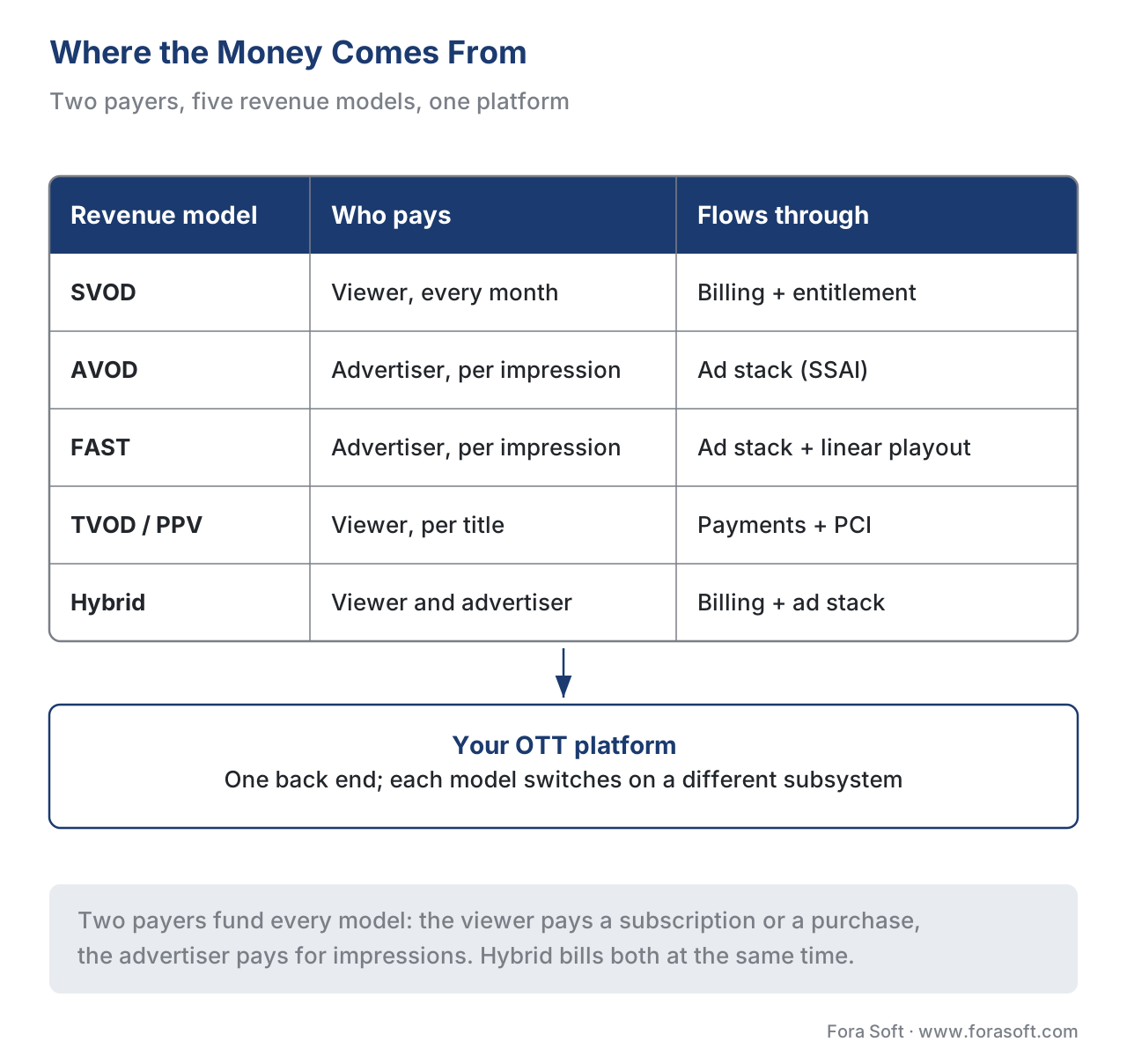 Figure 1. Who pays whom. Each model routes money from a different payer — the viewer's wallet or the advertiser's budget — through a different revenue subsystem before it reaches the platform.
The market in 2026: where the money and the growth are
Before scoping a build, know the shape of the money, because it tells you which engine is worth building well. The figures below are 2026 analyst estimates that vary by methodology; treat them as orientation, not precision.
Global SVOD is the largest pool — roughly $98 billion in 2026 by Statista's worldwide estimate, growing at about 6% a year as the subscription market matures in wealthy regions. AVOD is smaller, near $30–35 billion, but expanding far faster — mid-teens annually — pulled up by connected-TV (CTV, meaning ad-supported apps on internet-connected televisions) inventory. FAST — free, ad-supported linear channels — has grown from nothing to roughly $12 billion globally by 2026 and is the fastest-growing format by percentage. TVOD is a mature, steady pool around $6–10 billion, small but high-margin. By one analyst's split of viewing-revenue share, SVOD still takes about 49%, AVOD about 29%, live around 15%, and TVOD about 7%.
The single most important fact for an architect is what those growth rates imply: the growth is in advertising. The clearest evidence is the subscription giants building ad businesses. Netflix's ad-supported tier passed 250 million global monthly active viewers by May 2026 (up from about 190 million the previous November), worked with more than 4,000 advertisers, and is expected to roughly double ad revenue to about $3 billion in 2026 (Netflix shareholder materials, 2026). When the company that defined pure subscription builds a full ad stack, the lesson for a new platform is plain: design as if you will eventually run more than one revenue machine, even if you launch with one.
SVOD: turning watch-time into a recurring bill
Subscription Video on Demand (SVOD) charges the viewer a recurring fee — monthly or yearly — for access to a library. It is the gym-membership model: one price, walk in as often as you like, the door checks your card. The money is predictable, which is its great virtue, but the system that collects it is the most stateful thing you will build.
The entitlement service is the cash register. Entitlement is the system that answers, on every single play, one question: is this viewer allowed to watch this title right now? It must know their plan, whether their payment is current, how many simultaneous streams they may run, and which regions and titles their plan covers. It is consulted on every play, so it must be fast and never wrong — a false "no" locks out a paying customer, and a false "yes" gives away content you are contractually obligated to protect. This engine, with plans, trials, proration, and the dunning flow (the automated retry-and-remind sequence when a card is declined), is covered in depth in subscription billing and entitlement. The map-level point: SVOD's center of gravity is a stateful, always-consulted billing service the other models need only in lighter form.
The app-store cut is a routing decision, not an afterthought. If a viewer subscribes inside your iOS or Android app, the platform store takes a slice of that revenue. Apple charges 30% in a subscription's first year and 15% from the second year onward; Google Play charges 15% on subscriptions from day one (Apple and Google developer policies, 2026). Both run small-business rates of 15% under \$1 million in revenue, and Google's rates fall further — to 10% on subscriptions in the US, UK, and EEA from 30 June 2026 under its Epic settlement. Because that cut comes off your highest-value revenue, SVOD platforms decide deliberately where the subscription is sold; a web sign-up flow outside the app keeps the full dollar. You cannot retrofit this cleanly — the billing routing and account-linking have to be designed in from the start.
Churn is the metric the whole machine serves. Because the revenue recurs, the thing that kills an SVOD platform is churn — the share of subscribers who cancel each month. Premium SVOD churn ran at a weighted-average of about 4.6% a month in 2025; a platform that holds monthly churn under 2.5% has healthy unit economics (Antenna, 2025). Every system above ultimately exists to reduce churn: fast entitlement so playback never fails, dunning so an expired card does not become a cancellation, and the recommendation layer (see why discovery decides retention) so viewers keep finding the next thing to watch. SVOD analytics are churn analytics, detailed in churn, retention, and subscription analytics.
What SVOD does not need, notably, is an ad stack — no ad-decision server, no SCTE-35 markers, no impression measurement. That entire subsystem is absent from a pure subscription build, which is exactly why the model belongs in the foundation, not the finish.
AVOD: turning watch-time into sold impressions
Advertising-based Video on Demand (AVOD) makes the content free and sells the audience's attention to advertisers. It is commercial radio: you tune in for nothing, and the ads between the songs fund the station. Here the advertiser is the paying customer and the viewer is the audience you sell. Everything that earns money lives in the ad path, and that path is a supply chain of its own.
The ad stack is a platform inside the platform. To monetize a free stream you need three systems SVOD never touches. First, ad signaling: the stream must carry frame-accurate markers that say "an ad break goes here," and the controlling standard is SCTE-35 (ANSI/SCTE 35 2023), the same cueing message broadcast television has used for decades. Second, an ad-decision server that, when a break arrives, chooses which ad to play for this viewer and returns it in the VAST and VMAP response formats from the IAB Tech Lab (VAST 4.3, with CTV-focused addenda through 2024). Third, an insertion mechanism — the choice between client-side ad insertion (CSAI), where the player fetches the ads, and server-side ad insertion (SSAI), where ads are stitched into the video stream at the server so they arrive as one uninterrupted feed. These each get their own article: SSAI vs CSAI, SCTE-35 and ad signaling, and ad serving, VAST/VMAP, and the ad stack. The map-level fact is blunt: AVOD adds an entire revenue supply chain that subscription platforms do not have.
AVOD revenue has four dials, and you must turn all of them. The formula is worth memorizing because every AVOD product decision moves one of its terms:
ad revenue = impressions × fill rate × (CPM ÷ 1,000)
Impressions is how many ad slots your audience generates, set by audience size, watch-time, and ad load (minutes of ads per content hour — typically 4–8 minutes on FAST and AVOD in 2026, against 15–18 on legacy TV). Fill rate is the share of those slots that actually sell — unsold inventory earns nothing. CPM is the price per thousand impressions: roughly \$15–25 for broad FAST/AVOD inventory, \$25–45 for premium ad-supported services bought programmatically, and \$45–85 for audience-targeted buys using first-party data (CTV benchmarks, 2026). Push ad load too high and viewers leave — surveys find roughly 4% of viewers drop per minute of an ad break — so AVOD is a constant tension between more ad slots and less abandonment.
Privacy is now an engineering concern, not a legal footnote. AVOD earns more when ads are targeted, and targeting means processing data about what each viewer watches. In the United States that runs straight into the Video Privacy Protection Act (VPPA, 18 U.S.C. § 2710) — a 1988 law, written for video-rental records, that has become the most active basis for streaming privacy class actions, with over 200 suits filed in 2025. The consequence for your build is concrete: an AVOD platform needs a consent-management layer and disciplined control over what viewing data leaves the platform, covered in privacy and viewing data: VPPA, GDPR, CCPA. AVOD also lives on scale — large free audiences put real pressure on the CDN egress bill without a guaranteed subscription to cushion it.
FAST: AVOD economics on a broadcast chassis
Free Ad-Supported Streaming Television (FAST) is free and ad-funded like AVOD, but delivered as linear channels you tune into rather than an on-demand library you browse. It is broadcast TV reborn on the internet: a grid of channels, a schedule, ad breaks, no bill. FAST reuses the entire AVOD ad stack — same SCTE-35 signaling, same VAST/VMAP decisioning, same SSAI insertion — and adds two things: a linear playout scheduler that assembles a continuous channel from a playlist, and an electronic program guide so viewers can see what is on. We covered FAST's timing nature in the VOD/live/linear/FAST article; here it matters as a monetization shape.
Why does FAST exist if it reuses AVOD's stack? Because the linear format solves two monetization problems at once. It removes the "what do I watch?" friction that suppresses watch-time on a cold AVOD catalog — a channel always has something playing — and it creates predictable, broadcast-style ad avails that media buyers already know how to purchase. The trade-off is yield: FAST inventory is broad and lightly targeted, so it sits at the lower end of the CPM range (\$15–25), with channel-completion rates around 88–93% versus 94–97% on premium AVOD. FAST is the fastest-growing format in 2026 precisely because it monetizes a large, lean-back audience cheaply but reliably. For most platforms FAST is not a separate business; it is a reach-and-acquisition layer in front of a paid tier — a free front door that the hybrid model (below) is built to exploit.
TVOD: turning one title into one sale
Transactional Video on Demand (TVOD) charges per title — a rental for a window, or a purchase to keep. It is the cinema box office or the old rental store: money changes hands for one specific film, one specific time. Pay-per-view (PPV) is the live cousin — a one-off purchase to watch a specific event. Apple TV rentals (commonly \$5.99–\$19.99), premium new-release purchases, and boxing PPVs (\$41.99–\$79.99 per event in 2025) are TVOD.
The system TVOD forces into the build is a payment-and-refund pipeline tied to per-title rights. Unlike a subscription, which charges one predictable amount on a schedule, TVOD takes a discrete card payment at an unpredictable moment, often at a traffic spike (a PPV event sells most of its buys in the hour before it starts). That puts two demands on the architecture: a payment integration that brings a PCI-DSS compliance boundary (the security standard for handling card data) into scope, and an entitlement record that grants exactly the title bought, for exactly the window paid for, and handles refunds and failed events cleanly. These flows are covered in TVOD and transactional flows: rent, buy, PPV.
TVOD's economics are the simplest of the four — revenue = price × transactions, minus payment fees — and its margins are the highest, because there is no ad stack to operate and no recurring service to keep warm. Its weakness is that demand is lumpy and title-dependent: a hit drives a spike, a weak slate drives nothing. That is why in 2026 the pure-PPV model is being absorbed into subscriptions — UFC moved its numbered events from \$79.99 ESPN+ pay-per-views to being included in a Paramount+ subscription, and Netflix stages mega-events (a marquee boxing night) free inside the subscription rather than as a separate charge. TVOD increasingly works best as a high-value add-on to another model, not as the whole business.
The monetization stack: how the block fits together
Step back and the four models share one layered monetization stack — the same conceptual shelves, with each model lighting up a different subset. Reading the stack top to bottom is the fastest way to see how the rest of Block 5 connects, because each layer is a downstream article.
The top shelf is access control — the gate in front of content. SVOD puts a paywall there (give us a card); AVOD and FAST put a registration wall (give us an email) or no gate at all; TVOD puts a purchase gate on each title. How these gates work and talk to entitlement is paywalls, registration walls, and access control. Below it sits the identity and entitlement shelf — the always-consulted record of who may watch what, the SVOD engine from subscription billing and entitlement. Beneath that, the model splits: the advertising shelf (signaling, insertion, and the ad stack) for AVOD and FAST, and the transactions shelf (payments and PCI) for TVOD and PPV. The bottom shelf, shared by every model, is measurement — the revenue, churn, and yield analytics that tell you whether any of it is working, leading into churn and subscription analytics and the final pricing, packaging, and the monetization decision.
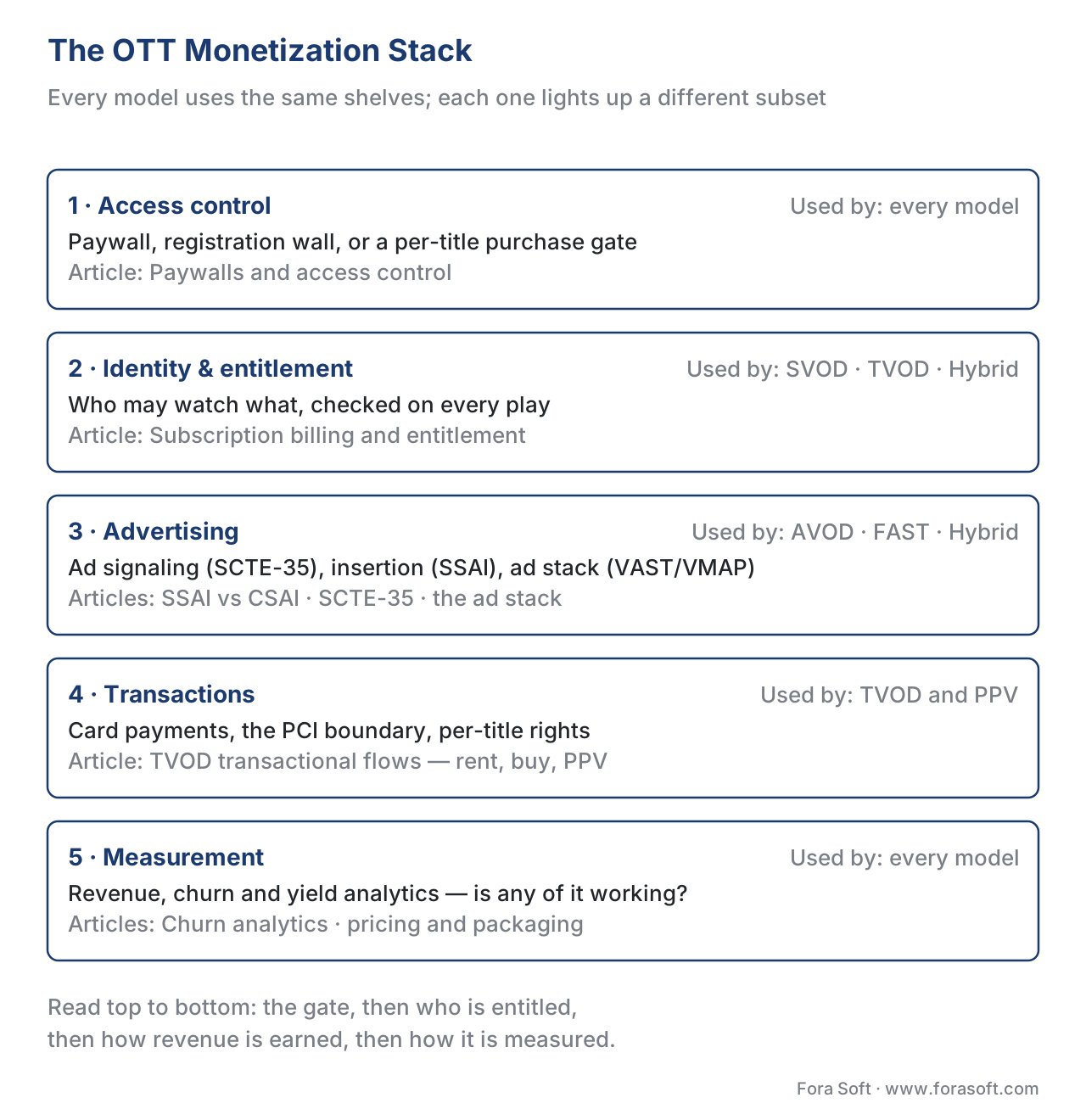 Figure 2. The shared monetization stack. Every model uses the same shelves; each lights up a different subset, and each shelf is a downstream article in this block.
Hybrid: running two revenue machines on purpose
Almost no platform at scale in 2026 runs a single model. The dominant pattern is SVOD + AVOD: a paid ad-free tier beside a cheaper or free ad-supported tier, sometimes called an access-and-revenue model (ARM). Netflix, Disney+, Max, and Prime Video all run an ad tier beside their flagship plan, and that ad tier is the growth engine — Netflix's reached 250 million monthly viewers in under three years. Hybrid is not indecision; it is a deliberate choice to monetize two different viewers — the one who pays to skip ads and the one who watches ads to pay less or nothing — from one catalog.
The cost of hybrid is exactly what the stack above predicts: you build both the billing engine and the ad stack, plus the logic to move a viewer between tiers without losing entitlement or double-charging. That is the highest-complexity option, and it is why a "simple" streaming service rarely is. But the revenue case is strong whenever a meaningful share of your audience will not pay full price — the ad tier converts non-payers into ad impressions instead of losing them entirely. The worked example below shows the arithmetic.
The arithmetic: the same audience, three models
Numbers make the trade-offs concrete. Take one platform with 500,000 monthly active viewers, each watching 20 hours a month, and run it through three models. (These inputs are illustrative but realistic; your figures will differ.)
SVOD — 500,000 subscribers at a \$10 monthly ARPU.
gross   = 500,000 subscribers × $10            = $5,000,000 / month
web-billed, ~3% payment fees                   ≈ $4,850,000 / month net
in-app first year (Apple 30% cut)              = $5,000,000 × 0.70 = $3,500,000 / month net
The store routing alone swings net revenue by \$1,350,000 a month — about \$16 million a year — which is why billing routing is an architecture decision, not a billing-team detail.
AVOD — the same 500,000 viewers, the same 20 hours, monetized with ads.
viewing hours = 500,000 × 20 hours             = 10,000,000 hours / month
ad load 8 min/hour = sixteen 30-second spots   → 16 impressions per hour
gross avails  = 10,000,000 × 16                 = 160,000,000 impressions
fill rate 70%                                   = 112,000,000 sold impressions
revenue at $20 CPM = 112,000,000 ÷ 1,000 × $20  = $2,240,000 / month
On the same audience, AVOD nets \$2.24 million against SVOD's \$3.5–4.85 million — an effective \$4.48 per viewer versus \$10. Advertising on this audience earns roughly half of what subscription does, which is the whole reason AVOD chases far larger audiences or higher-CPM targeted inventory.
Hybrid — split the audience by willingness to pay. Suppose 60% (300,000) take the \$10 ad-free tier and 40% (200,000) take a \$5 ad-supported tier with a lighter 5-minute ad load:
ad-free tier  = 300,000 × $10                          = $3,000,000
ad tier subs  = 200,000 × $5                            = $1,000,000
ad tier ads   = 200,000 × 20h × 10 spots × 70% × $25/1000 = $700,000
hybrid total                                            = $4,700,000 / month
Hybrid earns \$4.7 million — close to pure-SVOD's gross — and captures the 40% who would have refused a \$10-only product. That is the case for hybrid in one number: it converts the non-payers an SVOD-only platform loses into \$1.7 million a month, at the cost of operating both machines.
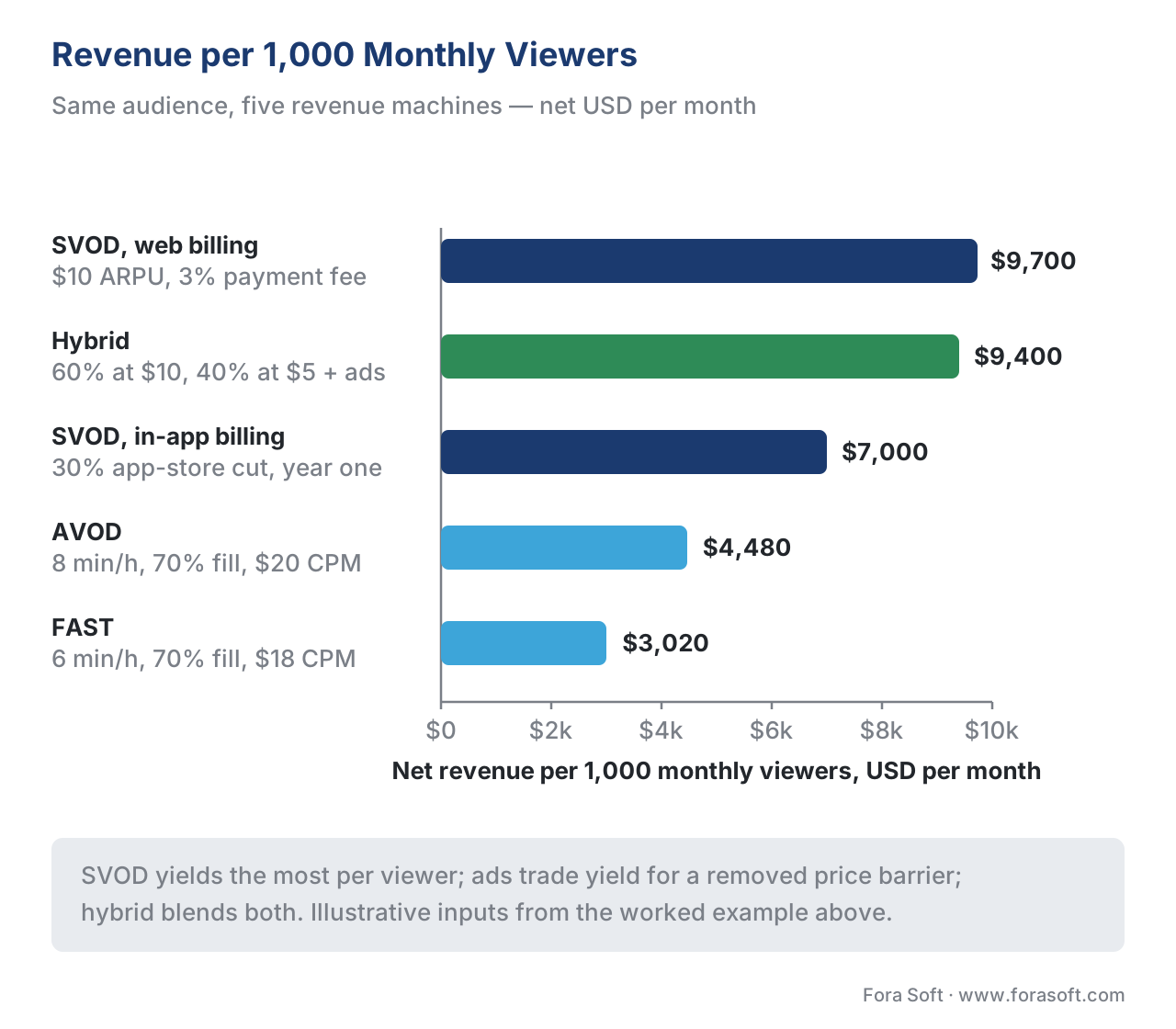 Figure 3. Revenue per 1,000 monthly viewers by model, from the worked example. SVOD yields the most per user; AVOD and FAST trade yield for a removed price barrier; hybrid blends both.
Choosing a model — and the systems you inherit with it
The choice is rarely about which model earns the most in the abstract; it is about which audience-or-yield bet your content and market support, and which revenue machine you can actually staff and run. Premium, exclusive content that viewers will pay for, in a wealthy market, favors SVOD yield. A broad, lean-back catalog with no must-have title favors AVOD or FAST scale. A small number of high-demand events or new releases favors TVOD/PPV margin. A catalog that has both a premium core and a long tail favors hybrid. The full decision framework — tiers, bundles, and how the model feeds back into architecture — is the capstone of this block, pricing, packaging, and the monetization decision.
Whatever you choose, you inherit its subsystems. The table below is the map's payload: each model and the platform systems it forces you to own, with a coverage column so you can see at a glance what a given choice commits you to build.
| Subsystem | SVOD | AVOD | FAST | TVOD / PPV | Hybrid (SVOD+AVOD) |
|---|---|---|---|---|---|
| Billing & entitlement engine | Required | Light (reg-wall) | Light (reg-wall) | Per-title entitlement | Required |
| Ad stack (SCTE-35, VAST, SSAI) | Not needed | Required | Required | Not needed | Required |
| Linear playout + program guide | Not needed | Not needed | Required | Not needed | If a FAST tier exists |
| Payment & PCI pipeline | Recurring only | Not needed | Not needed | Required | Recurring only |
| Consent / privacy (VPPA, GDPR) | Light | Required | Required | Light | Required |
| DRM tier | Often hardware L1 | Often lighter | Often lighter | Hardware for new releases | Mixed by tier |
| Core revenue metric | Churn / ARPU | Fill rate × CPM | Fill rate × CPM | Conversion / title | Churn and fill rate |
Table 1. The monetization-model-to-systems map. "Required" cells are tinted; a model commits you to every Required system in its column.
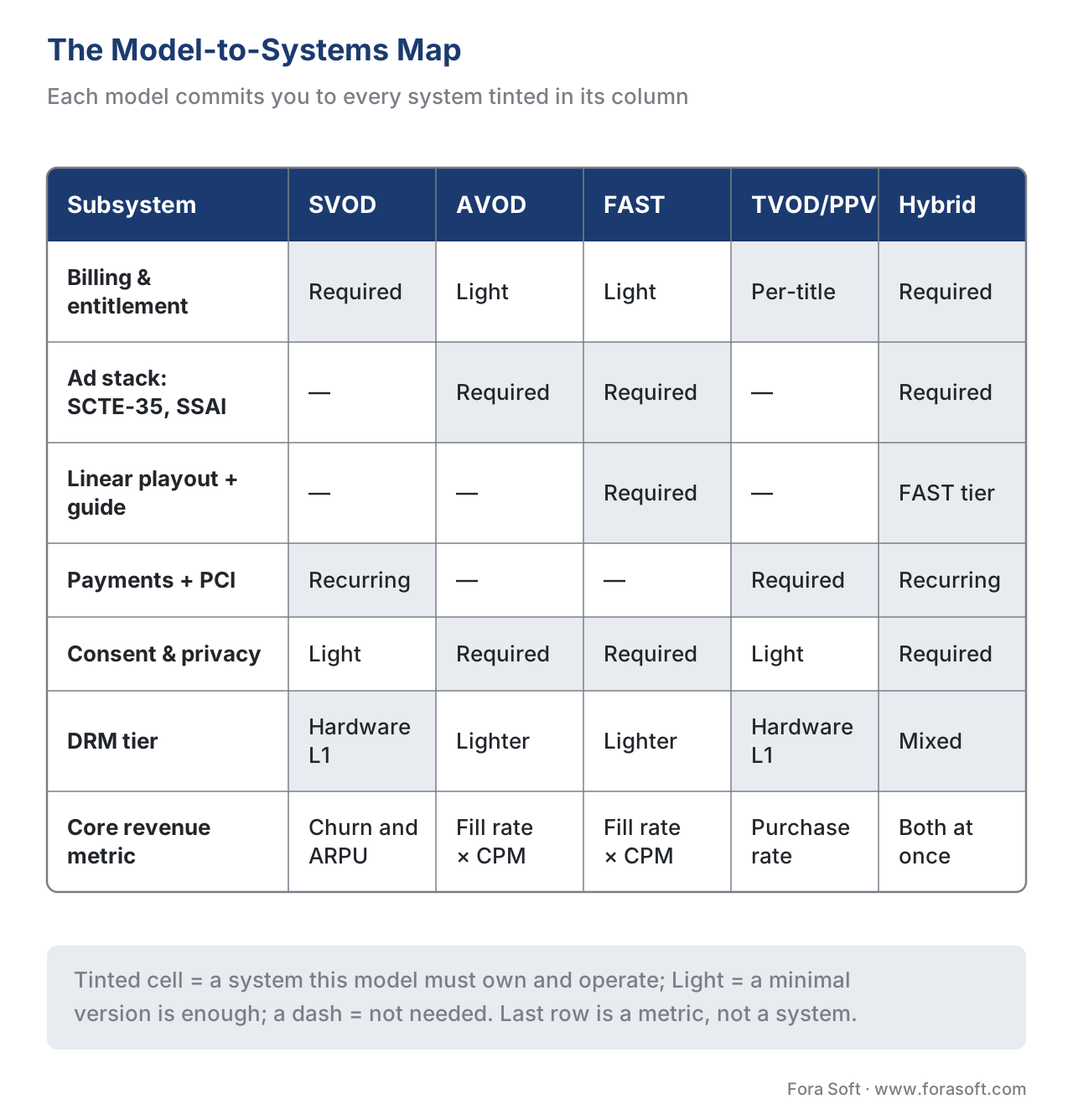 Figure 4. The same coverage map as a diagram — every model's column of required systems at a glance.
A common mistake: counting gross revenue instead of net yield
The single most expensive monetization error is building a model on gross numbers and discovering the net too late. Four traps recur. First, the app-store haircut: a \$10 SVOD subscription sold in-app is a \$7 subscription in your first year — model on \$7 or build web billing. Second, fill rate: an AVOD plan that assumes every ad slot sells is fantasy; unsold inventory at a 70% fill rate quietly erases 30% of the headline revenue. Third, FAST is not free to build: it reuses the ad stack but adds a playout scheduler and a program guide, so "we'll just add FAST channels" is a real engineering project, not a config change. Fourth, CSAI gets blocked: client-side ad insertion is defeated by common ad-blockers, so an AVOD business modeled on client-side ads can lose a large share of impressions it counted on — which is why SSAI is the modern default. In every case the fix is the same discipline: model the net number after the cut, the unsold inventory, and the build cost — never the gross.
Free download: The OTT Monetization Map — One-Page ReferenceThe revenue formula and required-systems checklist for each model — SVOD, AVOD, FAST, TVOD/PPV and hybrid — with 2026 benchmark ranges and the four net-revenue traps, on a single sheet.Where Fora Soft fits in
Monetization is where streaming scale meets money, and getting it wrong is expensive in both directions — an under-built billing engine leaks revenue, an over-built ad stack you don't need burns runway. Fora Soft has built video streaming and OTT/Internet-TV platforms since 2005, across 625+ shipped projects for 400+ clients, which means we have wired most of these revenue machines: subscription billing and entitlement under concurrency, SSAI-based ad insertion with SCTE-35 signaling, and transactional and pay-per-view flows with their payment and rights edge cases. Our stance is scalability-first and vendor-neutral: we start from your audience-and-yield bet and the concurrency you must serve, then build only the revenue subsystems that bet requires — one machine if one is enough, two when a hybrid truly pays for itself.

The handbook
Fora Soft Video Engineering Handbook
We wrote a seven-volume handbook that takes the whole video stack apart, from the pixel to the invoice at the end of the month, and an engineer who works through it can design and build the platform every model on this page runs on. Volume 3 sits closest to this article: CDNs, players, DRM and the economics of delivery — the cost side of the margin you have just modelled. Volume 2 covers the transport, ingest and HLS/DASH packaging that an ad-supported tier splices into, and volume 1 explains the encoding ladder that decides what each stream you sell costs to serve. Written by Nikolay Sapunov, CEO at Fora Soft.
Which revenue model is your platform actually built for?
Tell us who watches you and how you want to charge them, and we will map the model onto the systems it commits you to — billing and entitlement, the ad stack, payments and the PCI boundary — and what each one costs to run. 250+ video products shipped since 2005.
See our case studies
Case study
TradeCaster
A live streaming platform for stock traders with 46,000+ users on $99–$119 monthly plans and a 7-day trial — subscription billing and entitlement doing exactly the job this article models.
Case study
Worldcast Live
Concert streaming at 0.4–0.5 s latency for 10,000 simultaneous viewers, paid for with pay-per-view tickets and donations — the TVOD path, priced per event instead of per month.
Case study
Sprii
A Danish live shopping platform that has moved €365M+ in cumulative sales across 72,000+ live events — transactional video, where the purchase is the revenue event, not the subscription.
What to read next
Access control
Paywalls and access control for OTT
Shelf 1 up close: hard paywall, metered, registration wall — and what each does to signups.
Advertising
SSAI vs CSAI: server-side or client-side ad insertion
How an ad break is actually spliced, and why server-side stitching survives ad blockers.
Transactions
Pay-per-view and TVOD: rent, buy, PPV
The payment, rights and refund edge cases behind one per-title sale.
Pricing
Streaming monetization models: the pricing decision
Once the model is picked: the tier ladder and price points that set ARPU and churn.
References
- Statista — Video Streaming (SVoD) Worldwide market forecast (2026). Tier 5. Worldwide SVOD revenue ~$98.37B in 2026; CAGR 2026–2030 ~5.89%. https://www.statista.com/outlook/dmo/digital-media/video-on-demand/video-streaming-svod/worldwide — accessed 2026-06-17.
- ANSI/SCTE 35 (2023) — Digital Program Insertion Cueing Message. SCTE. Tier 1. The ad-signaling standard (splice_insert, time_signal) that marks ad breaks for AVOD and FAST insertion. https://account.scte.org/standards/ — accessed 2026-06-17.
- VAST 4.3 / VMAP — Digital Video Ad Serving Templates. IAB Tech Lab. Tier 1. The ad-response and ad-break-timing formats returned to an AVOD/FAST player or SSAI stitcher; VAST 4.3 (2022) with CTV addenda through 2024. https://iabtechlab.com/standards/vast/ — accessed 2026-06-17.
- 18 U.S.C. § 2710 — Video Privacy Protection Act (VPPA). United States Code. Tier 1. Controlling law behind AVOD/streaming viewing-data class actions; basis for 200+ suits filed in 2025. https://www.law.cornell.edu/uscode/text/18/2710 — accessed 2026-06-17.
- ISO/IEC 23001-7 — Common Encryption (CENC). ISO/IEC. Tier 1. The encryption foundation for the multi-DRM tier premium SVOD/TVOD content requires; defines the cenc/cbcs schemes. https://www.iso.org/standard/84637.html — accessed 2026-06-17.
- Netflix Q1 2026 shareholder materials (SEC Form 8-K). Netflix, Inc. Tier 5. Ad-tier reach (250M+ monthly active viewers by mid-2026, up from 190M in Nov 2025), 4,000+ advertisers, ~$3B 2026 ad-revenue expectation. https://www.sec.gov/Archives/edgar/data/1065280/000106528026000137/ex991_q126.htm — accessed 2026-06-17.
- Apple App Store — subscription commission and Small Business Program. Apple Developer. Tier 3. 30% first-year / 15% subsequent-year subscription commission; 15% Small Business rate. https://developer.apple.com/app-store/small-business-program/ — accessed 2026-06-17. Vendor policy — re-check at publish.
- Google Play — service fees for subscriptions and in-app purchases. Google Play Console Help. Tier 3. 15% subscription service fee; reduction to 10% (subscriptions) / 20% (IAP) in US/UK/EEA from 30 Jun 2026 under the Epic settlement. https://support.google.com/googleplay/android-developer/answer/112622 — accessed 2026-06-17. Rates changing 30 Jun 2026 — re-verify at publish.
- CTV advertising benchmarks 2026 — CPM and completion-rate ranges. Industry analyst aggregation. Tier 5. FAST/broad AVOD $15–25 CPM; premium AVOD $25–45 programmatic; addressable $45–85; completion 88–97%. https://adwave.com/resources/ctv-advertising-benchmarks — accessed 2026-06-17. Estimates diverge by methodology.
- Antenna — Premium SVOD churn and ARPU, State of Subscriptions (2025). Antenna. Tier 5. Premium SVOD weighted-average monthly churn ~4.6% in 2025; <2.5% as a healthy benchmark. https://www.antenna.live/insights/a-grown-up-streaming-market — accessed 2026-06-17.
- Streaming and CTV ad-load survey (2025). TheStreamable / MediaPost. Tier 5. Ad loads averaging ~9 min/hour across streaming; FAST 4–8 min/hour vs legacy TV 15–18; ~4% viewer drop per ad-break minute. https://thestreamable.com/survey-streaming-ad-loads-9-minutes — accessed 2026-06-17.
- Fora Soft — Streaming Platform Monetisation Strategies in 2026 (overview blog). Fora Soft. Tier 7. Companion overview of SVOD/AVOD/TVOD/FAST/hybrid; the shorter, commercial-intent counterpart this educational article links to. https://www.forasoft.com/blog/article/monetisation-strategies-for-streaming-platforms — accessed 2026-06-17.
Where sources disagreed, the controlling standard or primary filing was followed. SCTE-35, VAST/VMAP, the VPPA statute, and ISO/IEC 23001-7 are cited from the issuing bodies; analyst market and CPM figures (Statista, Antenna, CTV benchmark aggregators) are cited as ranges and dated, never as single universal numbers, per the section's accuracy rules. The Netflix figures are taken from the company's own filing rather than press paraphrase.
