


Why this matters
If you run or are about to build a streaming service, you will spend most of your budget on two things: getting the catalog and getting the subscribers. Both are wasted if viewers open the app, scroll for a minute, find nothing, and close it. For a media founder, product manager, or first-time streaming CTO, discovery is the part of the product that decides whether the catalog you licensed and the subscribers you acquired actually turn into watch time and renewals. This is the anchor article of the discovery block: it makes the business case, defines the three discovery surfaces, and sets the one metric that keeps you honest, before the later articles get into how recommendations, metadata, and search are actually wired.
The one idea: on a big catalog, viewers watch what the system surfaces
Start with the uncomfortable truth that reframes everything else. When a catalog is small — a dozen titles — a viewer can see all of it and choose freely. When a catalog has thousands of titles, no viewer can see all of it, so the platform must choose which slice to show. From that moment on, what a viewer watches is mostly what the system surfaces. The catalog is not the product the viewer experiences; the home screen is.
The numbers from the company that studied this hardest are stark. In their peer-reviewed account of the Netflix recommender system, Netflix's own Carlos Gomez-Uribe and Neil Hunt report that the recommendation system "influences choice for about 80% of hours streamed at Netflix," while "the remaining 20% comes from search" (Gomez-Uribe & Hunt, ACM Transactions on Management Information Systems, 2015). Read that again as a product owner: four out of five hours your service streams are hours the system chose to make easy to find. The catalog made those hours possible; discovery made them happen.
That is why discovery is not a nice-to-have layer added after the player works. The set of systems that decide what to surface — recommendations, search, and the merchandised home screen — is the mechanism by which a catalog becomes watch time. Get it right and the catalog feels deep and personal. Get it wrong and the same catalog feels empty, no matter how much you paid for it.
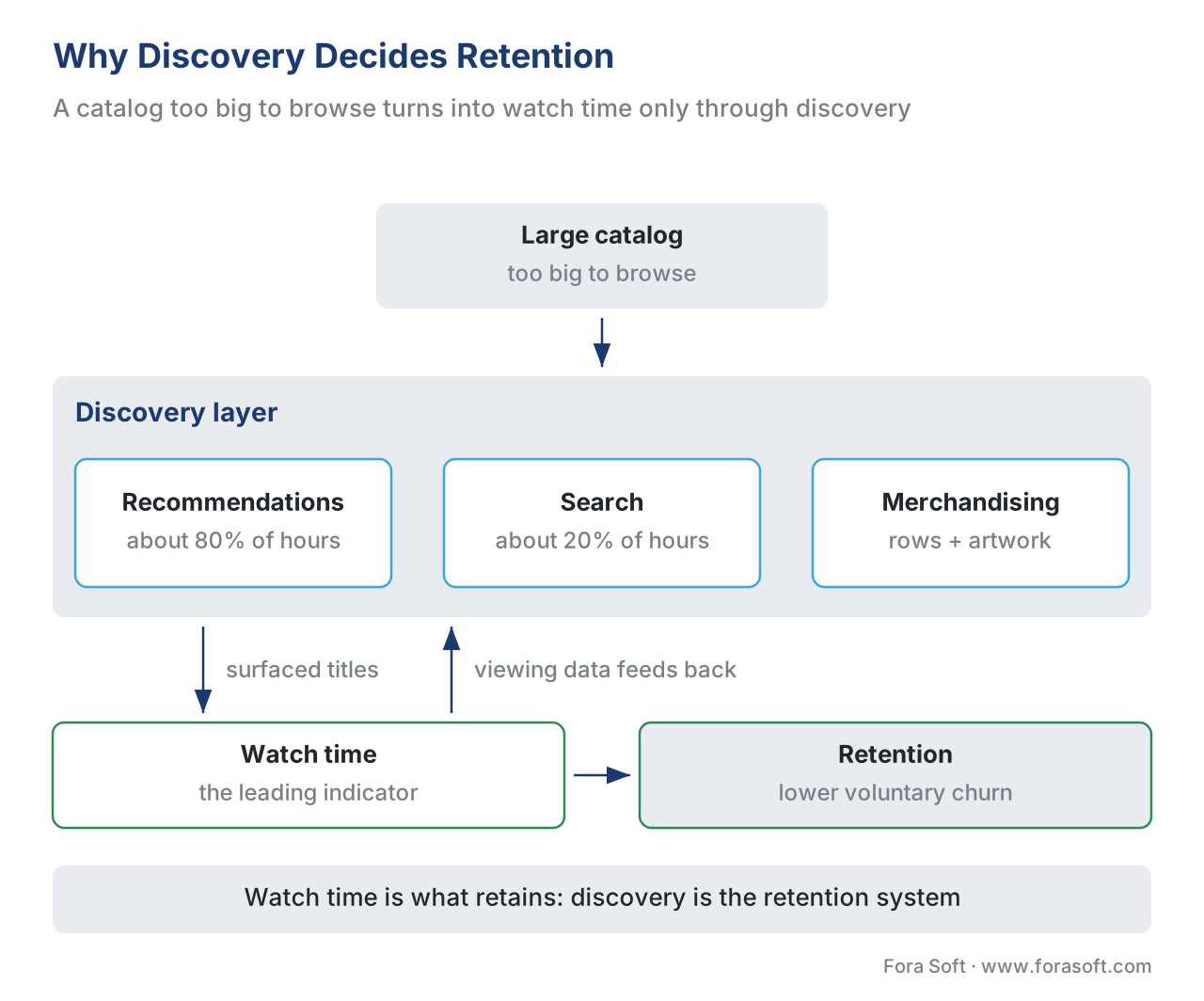 Figure 1. The discovery-to-retention chain. A catalog too large to browse passes through the discovery layer — recommendations (≈80% of hours), search (≈20%), and the merchandised home screen — into watch time, which is the leading indicator of retention. Viewing data feeds back to make the next surfacing better.
The sixty-second clock: why "browse harder" is not what happens
The instinct of a team that built a great catalog is to assume that if a viewer doesn't find something, they will keep looking. They will not. The same Netflix research describes the behaviour precisely: "a typical Netflix member loses interest after perhaps 60 to 90 seconds of choosing, having reviewed 10 to 20 titles (perhaps 3 in detail) on one or two screens. The user either finds something of interest or the risk of the user abandoning our service increases substantially" (Gomez-Uribe & Hunt, 2015).
Think of the home screen as a shop window on a busy street, not a warehouse the customer is committed to searching. The viewer gives you a glance — one or two screens, a dozen or two titles, ninety seconds — and if nothing in the window pulls them in, they walk on, usually to a different app. They do not file a complaint; they do not browse the back catalog; they simply leave. This is the single most important behavioural fact in the whole topic, and most catalog-first thinking ignores it.
The industry-wide data confirms the problem is getting worse as catalogs and the number of services grow. In Gracenote's 2025 State of Play report (Nielsen, surveying 3,000 consumers across six countries), viewers globally spend an average of 14 minutes searching for what to watch; in the US it is 12 minutes, up from 10.5 minutes in mid-2023, and French viewers spend 26 minutes — the length of a whole episode — just looking. Forty-five percent of viewers say the streaming experience is overwhelming. And the abandonment is real: 19% will quit a viewing session when they cannot find something (29% among 18–24-year-olds), and 49% say they would cancel a service over difficulty finding something to watch (Nielsen / Gracenote, 2025). The catalog did not shrink; the path to it got harder.
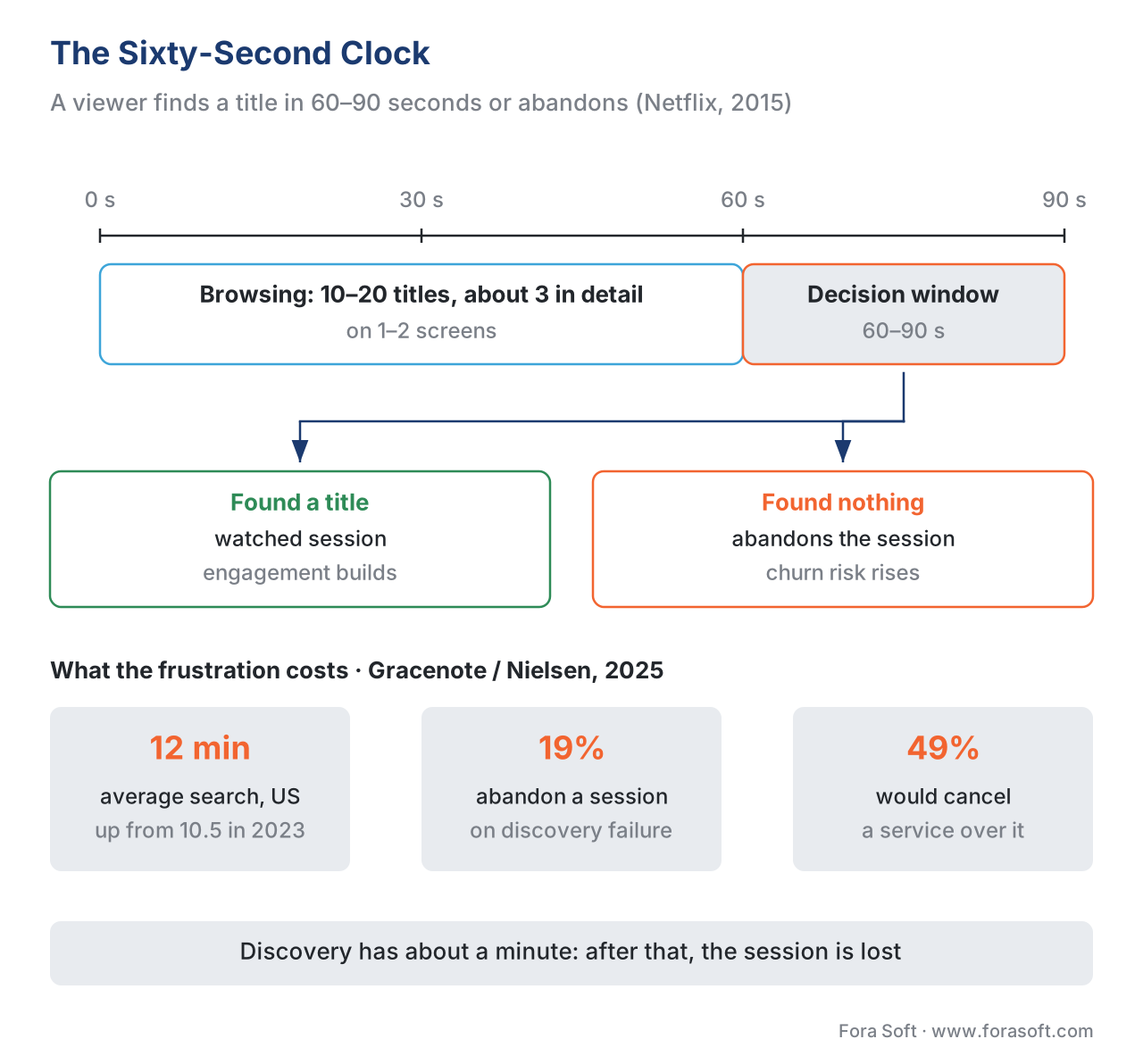 Figure 2. The sixty-second clock. A viewer reviews 10–20 titles in 60–90 seconds; finding one starts a watched session, finding none starts an abandoned session. Repeated abandonment is what turns into churn — and 49% of viewers say they would cancel over it.
From a failed session to a cancelled subscription
A single failed browse is not a cancellation. The damage compounds. A viewer who opens the app three times this week and finds nothing each time has learned something about your service: there is never anything on. That belief is what cancels subscriptions, and it forms long before anyone clicks "cancel."
This is the bridge between discovery and the business. In the language of the churn and retention article, engagement is the leading indicator of retention: a subscriber who watches several nights a week almost always pays next month, and one who has stopped opening the app is most of the way out the door whatever their billing status says. Discovery is the system that produces that engagement. So discovery is, in plain terms, a churn-reduction system that happens to look like a row of artwork.
Netflix's engineers make the causal claim directly, and it is worth quoting because it is rare for a company to state it so plainly: "the main measurement target of changes to our recommendation algorithms is improved member retention," and "over years of development of personalization and recommendations, we have reduced churn by several percentage points" (Gomez-Uribe & Hunt, 2015). They even tie the residual to the other half of the churn story — that the low-single-digit monthly churn that remains is "much of that due to payment failure, rather than an explicit subscriber choice," the involuntary churn that dunning, not discovery, recovers. Discovery's job is the voluntary side: give people a reason to come back.
Walk the value out loud, because the arithmetic is what gets discovery funded. Take a subscription service with 1,000,000 subscribers paying $10 a month. Suppose better discovery lifts engagement enough to cut monthly churn by half a percentage point — from, say, 4.5% to 4.0%. That is 0.005 × 1,000,000 = 5,000 subscribers kept every month, worth 5,000 × $10 = $50,000 in monthly recurring revenue, or about $600,000 a year — before counting the acquisition spend you no longer need to replace them. Half a point is a conservative move; Netflix credits personalization and recommendations with "several percentage points" of churn reduction and estimates "the combined effect of personalization and recommendations save us more than $1B per year" (Gomez-Uribe & Hunt, 2015). On any base of meaningful size, discovery is a seven-figure lever.
The paradox of choice: why a bigger catalog can convert worse
Here is the counter-intuitive part that explains why throwing more titles at the home screen backfires. More choice does not mean more watching. In a classic experiment, psychologists Sheena Iyengar and Mark Lepper set up a grocery tasting table with either 6 jams or 24 jams. The 24-jam table drew a bigger crowd — 60% of passers-by stopped, versus 40% for the 6-jam table — but it converted far worse: only 3% of the people who saw 24 jams bought one, against 30% of those who saw 6 — a tenfold collapse in conversion (Iyengar & Lepper, Journal of Personality and Social Psychology, 2000). Too many options paralyse the chooser; this is the well-documented effect known as choice overload, or the paradox of choice.
A streaming home screen is the jam table at planetary scale. Gracenote's metadata now spans more than 50 million titles across 260+ streaming catalogs (Nielsen, 2025). An undifferentiated wall of thousands of posters is the 24-jam table: it looks impressive and converts badly. The job of discovery is to be the 6-jam table for this viewer — to narrow thousands of titles down to a handful that feel hand-picked, so that choosing is easy and fast. Personalization is not about showing more; it is about showing less, better. That single reframing — "good discovery removes choices" — is what separates a home screen that retains from one that overwhelms.
The three surfaces of discovery
"Discovery" is not one system. It is three surfaces that share data and a goal, and the rest of Block 7 takes them one at a time. Naming them cleanly now prevents the confusion that comes from treating the home screen as a single magic box.
The first surface is recommendations — the personalized rows ("Because you watched…", "Top picks for you") that suggest titles the viewer did not ask for. This is the 80%-of-hours engine, and the recommendation-systems article covers how it is wired at the product level. The underlying model mathematics — collaborative filtering, embeddings, ranking models — belong to the machine-learning layer; we link out to the recommendation-model internals in AI for Video Engineering rather than re-deriving them here, because this section owns the product wiring, not the math.
The second surface is search — how a viewer finds a title they already have in mind, and how the system rescues a near-miss (a typo, a half-remembered name) and hands it back into recommendations. At Netflix search "turns into a recommendations problem as well" (Gomez-Uribe & Hunt, 2015): a search that returns nothing is a dead end, so good search quietly recommends adjacent titles. The search-and-discovery article covers indexing, typo tolerance, and the search-to-recommendation handoff.
The third surface is merchandising — which rows appear, in what order, and which single piece of artwork represents each title. The home screen is itself a recommendation: the order of the rows and the choice of thumbnail are personalization decisions, not fixed design. Netflix personalizes even the artwork, selecting per-viewer among multiple images for the same title using a technique called contextual bandits, so that the poster that represents a film is the one most likely to make you press play (Netflix Technology Blog, "Artwork Personalization at Netflix," 2017). The merchandising article covers row selection, ordering, and artwork.
| Discovery surface | What it does | Primary input | Honest success metric | Counts a "click" as success? |
|---|---|---|---|---|
| Recommendations (rows) | Surfaces titles the viewer did not ask for | Viewing history + metadata | Watch time, completed sessions, return rate | No — only sustained watch counts |
| Search | Finds a known title; rescues a near-miss | Query text + catalog index | Successful play after search, low zero-result rate | No — a result tapped then abandoned is a miss |
| Merchandising (rows + artwork) | Orders rows and picks per-viewer artwork | Context, device, time, history | Play rate that leads to watch time, not bounce | No — a clickbait thumbnail that loses the viewer fails |
Table 1. The three discovery surfaces. All three are judged by the same honest metric — watch time and return, not clicks — and each is owned by its own Block 7 article. The right-hand column is the discipline that keeps discovery from optimizing for the wrong thing.
The metric that keeps discovery honest: watch time, not clicks
The fastest way to ruin a discovery system is to optimize the easy metric. Clicks, taps, and impressions are easy to count, so teams reach for them — and a discovery layer tuned to maximize clicks learns to lie. It learns to put shocking artwork on mediocre titles, to promote the thing most likely to be tapped rather than the thing most likely to be watched to the end. The viewer taps, watches ninety seconds, bounces, and trusts the home screen a little less next time. Click went up; retention went down.
The honest metric is engagement that predicts return: watch time, completed sessions, and whether the viewer comes back next week. It is harder to measure and slower to move, which is exactly why it is the right target. Netflix is explicit that it tunes recommendations toward "medium-term engagement" and "member retention," not toward clicks, and that it proves changes with experiments measured against retention (Gomez-Uribe & Hunt, 2015). The discovery layer should be judged the same way the business is judged — by whether people keep watching — and that judgement is made through honest experiments, which is the subject of the A/B testing article.
There is one more honest-measurement trap worth naming, because it sits underneath discovery and is easy to blame the recommender for. If a title takes too long to start, or stalls mid-play, the viewer abandons — and that abandonment looks like a discovery failure when it is really a delivery one. The quality-of-experience metrics — startup time and rebuffering — are a retention input in their own right: a perfect recommendation behind a spinner still loses the viewer. Discovery and delivery have to be measured together, or each will be blamed for the other's failures.
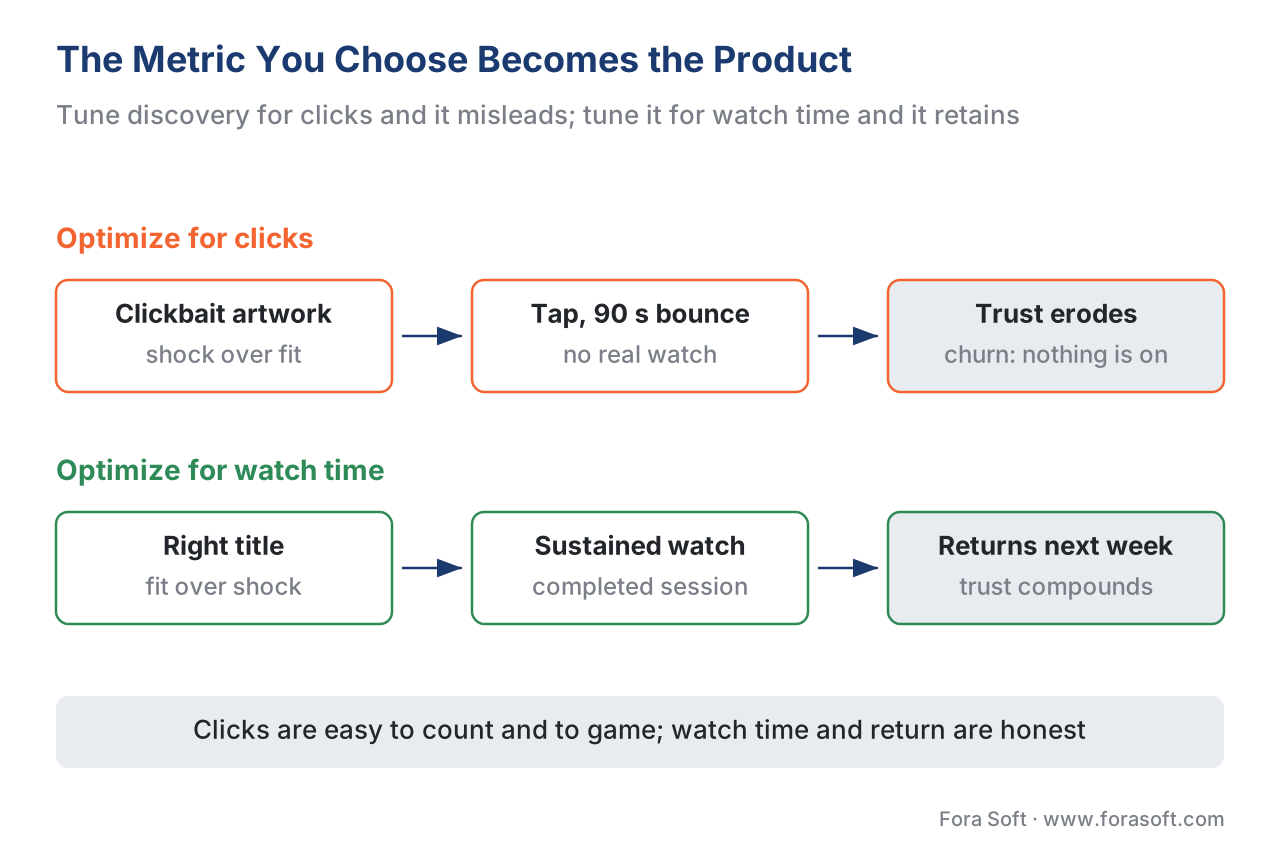 Figure 3. The two things a discovery system can optimize. Tuning for clicks produces clickbait, quick bounces, and eroded trust; tuning for watch time and return produces sustained engagement and retention. The metric you choose becomes the product you build.
A common mistake: treating discovery as a feature, not the retention system
The most expensive product error in streaming is to treat discovery as a late-stage feature — "we'll add recommendations once the player and billing work" — and to staff it as a UI project rather than a data and product system. The symptom is a home screen that is the same for everyone, a search box that returns nothing on a misspelling, and one fixed poster per title. The catalog may be excellent; the service will still feel empty, because every viewer is handed the 24-jam table and left to cope.
The deeper version of the mistake is measuring the new discovery system by clicks and declaring victory when taps rise. As shown above, clicks can rise while watch time and retention fall. The fix is the order of operations this article argues for: treat discovery as the retention engine from day one, build all three surfaces (recommendations, search, merchandising) on a shared personalization data pipeline and a clean metadata foundation, measure it by watch time and return rather than clicks, and prove every change with an experiment tied to retention. Discovery is not the decoration on the catalog; it is the machine that converts the catalog into a business.
Free download: Discovery-and-Retention Audit — One-Page ChecklistThe three discovery surfaces, the sixty-second-window pitfalls, the choice-overload trap, and the watch-time-not-clicks metrics to instrument before launch — on a single sheet.Where Fora Soft fits in
A streaming service lives or dies on whether viewers find something to watch before the sixty-second clock runs out, and that depends on plumbing most teams build last: a clean metadata pipeline, an event stream of plays and completions, and a recommendations-search-merchandising layer wired to watch time rather than clicks. Fora Soft has built video streaming and OTT/Internet-TV platforms since 2005, across 625+ shipped projects for 400+ clients, which means we have wired the metadata and personalization pipelines that feed discovery, connected viewing events to recommendation and search systems, and instrumented the watch-time and retention metrics that tell you whether any of it is working. Our stance is scalability-first and vendor-neutral: we start from the size of your catalog and the engagement you must produce to retain subscribers, then build the discovery layer — or integrate the recommendation and search services — that your catalog and scale actually require.



The handbook
Fora Soft Video Engineering Handbook
We wrote a seven-volume handbook, 9,000+ pages, that takes the video stack from a single pixel to production, and someone who works through it can design and build a streaming service whose discovery layer earns its keep. Start with volume 6: the models, inference and search over a video archive that recommendations and search run on. Volume 7 covers serving those models in production and what they cost per stream-hour, and volume 3 the players and the economics of streaming that watch time pays for. Written by Nikolay Sapunov, CEO at Fora Soft.
Do your viewers find something to watch before the sixty-second clock runs out?
Tell us your catalog size, your apps and what you measure today, and we will map your recommendation, search and merchandising surfaces, wire the viewing-event pipeline behind them, and set up watch-time and retention metrics that show whether discovery works. 250+ video products shipped since 2005.
See our case studies
Case study
Sonar
A discovery feed over 100+ million songs, filtered by genre and taste, with an AI playlist generator and swipe-to-add — recommendations doing the work on a catalog no one can browse.
Case study
Franchise Record Pool
A DJ platform with 720,000+ licensed tracks and 3,000+ new ones every month, where we built the metadata, search and AI playlist layer that turns a huge library into plays.
Case study
Drundoo
A Bulgarian internet-TV platform with 60 live channels, catch-up and a VOD library — a catalog that only keeps subscribers if viewers can find their way into it.
What to read next
Discovery
Content Metadata: the Fuel for Streaming Discovery
The fields every discovery surface reads from.
Discovery
Search and Content Discovery for OTT and Streaming
The 20% of hours that start with a query.
Discovery
Personalized Merchandising: Rows, Artwork & Ordering
Rows, artwork and order: the home screen as a recommendation.
Analytics
Streaming Churn and Retention: the SVOD Analytics Guide
How to measure the retention discovery is meant to protect.
References
- The Netflix Recommender System: Algorithms, Business Value, and Innovation. Gomez-Uribe, C. A. & Hunt, N., ACM Transactions on Management Information Systems, 6(4), Article 13, December 2015. Tier 1 (peer-reviewed, first-party engineering). Source of the "≈80% of hours from recommendations / 20% from search" figure, the 60–90-second / 10–20-title abandonment behaviour, the "retention is the main measurement target" claim, the "reduced churn by several percentage points," and the ">$1B per year" combined value of personalization and recommendations. https://dl.acm.org/doi/10.1145/2843948 — accessed 2026-06-18.
- 2025 State of Play (Gracenote / Nielsen). Nielsen news center, 5 November 2025. Tier 5 (industry survey, 3,000 consumers across BR/FR/DE/MX/UK/US). Source of the 14-minute global / 12-minute US (up from 10.5 in mid-2023) / 26-minute France search-time figures, 45% "overwhelming," 19% session-abandonment (29% for 18–24), 49% would cancel over discovery difficulty, 66% want a cross-service guide, and the 50M+ titles across 260+ catalogs metadata scale. https://www.nielsen.com/news-center/2025/new-gracenote-report-highlights-impact-of-ineffective-content-discovery-on-consumer-happiness-with-streaming/ — accessed 2026-06-18. Survey data — re-verify at publish.
- When Choice Is Demotivating: Can One Desire Too Much of a Good Thing? Iyengar, S. S. & Lepper, M. R., Journal of Personality and Social Psychology, 79(6), 2000. Tier 1 (peer-reviewed primary research). The jam-tasting experiment: 24 options drew more traffic (60% vs 40% stopped) but converted at 3% versus 30% for 6 options — the canonical demonstration of choice overload. https://faculty.washington.edu/jdb/345/345%20Articles/Iyengar%20%26%20Lepper%20(2000).pdf — accessed 2026-06-18.
- Artwork Personalization at Netflix. Netflix Technology Blog, 2017. Tier 3 (first-party engineering blog). Describes per-member artwork selection among multiple images per title using contextual bandits, the basis for the "the home screen — including the poster — is itself a recommendation" point. https://netflixtechblog.com/artwork-personalization-c589f074ad76 — accessed 2026-06-18. Vendor engineering blog — approach is stable; treat specific lift figures from secondary coverage with caution.
- 2026 Digital Media Trends. Deloitte Insights, 2026. Tier 5 (survey). Context for streaming-fatigue and cancel-and-return behaviour referenced via the churn article; corroborates the discovery-frustration-to-cancellation link. https://www.deloitte.com/us/en/insights/industry/technology/digital-media-trends-consumption-habits-survey.html — accessed 2026-06-18. Survey data.
- Choice fatigue leads 20% of viewers to ditch their TV session. StreamTV Insider, 2024–2025. Tier 5 (industry trade press, reporting Nielsen/Gracenote State of Play). Independent corroboration of the session-abandonment-from-discovery-failure figure. https://www.streamtvinsider.com/video/choice-fatigue-leads-20-viewers-ditch-their-tv-session — accessed 2026-06-18.
- Study: Streamers Now Wasting Record Amounts of Time Finding Something to Watch. TV Tech, 2025. Tier 5 (industry trade press, reporting the Gracenote survey). Corroborates the rising search-time trend. https://www.tvtechnology.com/news/study-streamers-now-wasting-record-amounts-of-time-finding-something-to-watch — accessed 2026-06-18.
- Netflix Knows It Only Has About a Minute to Grab Your Attention. NBC News, 2016. Tier 6 (general press, reporting Netflix executives). Secondary corroboration of the 60–90-second browsing window and the 10–20-title browse depth from the Netflix paper; the primary source (ref 1) is preferred and quoted. https://www.nbcnews.com/business/business-news/netflix-knows-how-long-you-ll-search-they-lose-you-n521766 — accessed 2026-06-18.
Where sources disagreed, the peer-reviewed and first-party engineering sources were preferred. The 60–90-second window, the 80/20 recommendation/search split, the retention-as-target claim, and the >$1B value are cited from the primary Netflix paper (ref 1), not from the secondary press that popularised them (ref 8). Choice overload is cited from the original Iyengar & Lepper study (ref 3). Current consumer behaviour is cited from the dated Gracenote/Nielsen 2025 survey (ref 2), corroborated by trade press (refs 6–7) and treated as a benchmark, not a constant. This article does not touch a delivery format, encryption scheme, DRM behaviour, ad-signaling standard, or legal requirement, so no spec-tier citation is required; its core claims are nonetheless grounded in two tier-1 peer-reviewed primary sources.
