


Why this matters
If you are building or running a streaming service, the transactional model is the one that turns a single title or a single night into money without asking the viewer to commit to a subscription — which makes it the natural fit for new releases, premium live events, and catalogs too small to justify a monthly fee. But TVOD hides its hard parts in places non-technical founders rarely look: the payment path (where a mistake means a compliance breach or a blocked checkout), the entitlement logic (where a mistake means a paying viewer can't watch, or a refunded viewer still can), and the app-store tax (where a default choice quietly hands 30% of revenue to Apple or Google). A pay-per-view boxing event in 2026 sells for around $59.99 on DAZN and $79.99 on Amazon Prime Video, and a single event can draw tens of thousands of simultaneous buyers in a few minutes — so the difference between two payment designs can be over a million dollars on one night. This is the builder's guide to getting those flows right, and the companion to the OTT monetization map, which shows where transactional revenue sits among all the ways a platform earns.
The one idea: you pay per title, not per month
Every streaming business model answers one question — how does the viewer pay? Subscription video on demand (SVOD) answers "a flat fee every month for everything." Advertising video on demand (AVOD) answers "nothing, you watch ads instead." Transactional video on demand (TVOD) answers "you pay for the one thing you want, when you want it." That single difference changes the whole build.
Hold onto a simple analogy. SVOD is a gym membership: one price, use it as much or as little as you like, billed every month whether you show up or not. TVOD is a cinema ticket: you pay for one film, you watch it, and there is nothing more to pay or cancel. The membership model has to worry about recurring billing and people quietly leaving (churn). The ticket model has none of that — but it also has no guaranteed income next month, and it has to make every single sale count, because there is no subscription smoothing the lumps.
TVOD comes in three shapes, and the rest of this article is about building each one correctly.
The three transactional shapes: rent, buy, and pay-per-view
The first design decision is what the viewer is actually buying — because each of the three grants a different right, and that right has to be enforced for months or forever, not just at the moment of payment.
Rent gives time-limited access. The industry calls this download-to-rent (DTR): the viewer pays a smaller fee — typically $3.99 to $6.99 for a catalog title — and gets a viewing window rather than ownership. Renting is the dominant transactional mode for films a viewer wants to see once.
Buy gives permanent access. The industry term is electronic sell-through (EST): the viewer pays a larger one-time fee — often $9.99 to $19.99, up to around $24.99 for a new release — and keeps the title in a personal library to re-watch indefinitely. "Buy" is really "own," and "own" is a promise your entitlement system has to keep for years.
Pay-per-view (PPV) sells access to a single event, almost always live — a boxing match, an Ultimate Fighting Championship card, a concert, a conference. The viewer pays once (boxing PPV runs $59.99 on DAZN and $79.99 on Amazon Prime Video in 2026) for the right to watch that event as it happens. PPV is the most operationally demanding shape because it stacks a transaction spike on top of a live-streaming spike, both at the same minute.
A close cousin worth naming is premium video on demand (PVOD): a new release offered to rent or buy at a premium price — $19.99 to $24.99 — in an early window, often 17 to 45 days after a film hits cinemas and well before it reaches any subscription service. PVOD is just TVOD pricing applied to fresh, high-demand content; the 2026 release Obsession reached PVOD at $19.99–$24.99 only 18 days into its theatrical run. It is the clearest case of transactional beating subscription, which we return to at the end.
 Figure 1. The three transactional shapes. Rent is time-boxed access, buy is permanent ownership, and pay-per-view is access to a single live event — each grants a different right your entitlement system must enforce.
The rental window: how a rental actually expires
"Rent for 48 hours" sounds simple, but the timing has two clocks, and getting them wrong is one of the most common TVOD support complaints. Take the model every major store uses, documented by Apple for the Apple TV app: you have 30 days to start watching a rental, and once you press play, you have 48 hours to finish it (Apple, "Rent movies from the Apple TV app," 2026).
So a rental is governed by two separate timers. The availability window (30 days) starts at purchase and asks "have you begun yet?" The viewing window (48 hours) starts at first play and asks "are you still inside your watch period?" A viewer can buy on Monday, start on the 29th day, and still get a full 48 hours from that moment. Both clocks have to be tracked per purchase, per viewer.
The important engineering point is what enforces the expiry. It is not the app politely hiding a button — it is the DRM license. When the viewer starts a rental, the entitlement system issues a license whose validity is time-boxed to the remaining window; when the window closes, the license expires and the player can no longer decrypt the video. Rentals are the textbook case for time-limited and offline-playback licenses, covered in license policy: rentals, offline, output control. The rule to remember: a rental is a clock written into a DRM license, not a flag in your app. If the window lives only in your UI, a determined viewer keeps watching after it should have ended, and you have given content away.
 Figure 2. The two clocks of a rental. The 30-day availability window runs from purchase; the 48-hour viewing window runs from first play. A time-boxed DRM license — not the app UI — enforces the expiry.
How a transaction actually flows — and where the PCI boundary sits
A transactional purchase has to do four things in order: take money, confirm it, grant the right, and unlock playback. Each step is a separate system, and one boundary in the middle decides how much compliance risk you carry.
Walk a web purchase end to end. The viewer hits a paywall — the gate that checks "has this person paid for this title?" (paywalls get their own treatment in paywalls, registration walls, and access control). They enter payment details, which go to a payment processor — a company such as Stripe, Adyen, or Braintree that actually charges the card. The processor confirms the charge and tells your entitlement service — the system of record that maps "this viewer now owns/rents this title" — to create the entitlement. The same entitlement service that powers subscriptions handles this; it is described in subscription billing and entitlement. When the viewer presses play, the player asks the DRM license server for a key, the license server checks the entitlement, and — if the right exists and is still valid — issues the license that unlocks the video.
The boundary that matters is where the raw card number lives. The Payment Card Industry Data Security Standard (PCI DSS) — the security rulebook every business that handles card data must follow, currently version 4.0.1, mandatory since 31 March 2025 (PCI Security Standards Council) — scales its requirements to how much card data touches your systems. The cheapest, safest design keeps the card number entirely outside your servers: the viewer types it into a hosted field or redirect served by the processor, your systems only ever see a token (a meaningless stand-in for the card), and you qualify for the lightest compliance questionnaire, SAQ A. Let your own page or scripts touch the card data and you fall into the heavier SAQ A-EP; store card numbers yourself and you are in the full SAQ D, an audit most streaming teams never want. The rule: tokenize, never store. Let the processor hold the card; you hold the token. That one decision is the difference between a short self-assessment and a year-round audit.
 Figure 3. The transaction-to-playback flow. The card number stays inside the payment processor (the PCI boundary); your platform receives only a token, the entitlement service records the right, and the DRM license server unlocks playback.
The app-store tax: the line item that decides TVOD margin
Here is the number that quietly decides whether a transactional business works: the cut the app store takes. When a viewer buys inside an iOS or Android app using the store's in-app purchase system, the store takes a commission — historically 30% (Apple drops this to 15% for developers under $1M a year through its Small Business Program; Google Play's 2026 structure is 20% for most in-app purchases, 15% for qualifying programs, and 10% plus a 5% billing fee for subscriptions). On a transactional sale, that commission lands on every single purchase, and it is brutal.
Show the math on one pay-per-view event. Take a mid-size live event and round the numbers:
buys                       = 80,000
price per buy              = $59.99
gross revenue              = 80,000 × $59.99 = $4,799,200
Now the same revenue down two payment paths. Path A — sell inside the iOS app via in-app purchase (30%):
app-store commission       = 30% × $4,799,200 = $1,439,760
net to the platform        = $4,799,200 − $1,439,760 = $3,359,440
Path B — sell on your own web checkout (payment processor at ~2.9% + $0.30 per transaction):
percentage fee             = 2.9% × $4,799,200 = $139,177
per-transaction fee        = 80,000 × $0.30   = $24,000
total processing fees      = $163,177
net to the platform        = $4,799,200 − $163,177 = $4,636,023
The gap is about $1.28 million — on one event, with the same audience and the same price. The store takes roughly nine times what a payment processor charges. Run a hundred events or a catalog of rentals a year and the app-store tax becomes the single largest controllable cost in the whole business. The same shape holds at rental scale: on a $5.99 rental the store keeps about $1.80, while a web processor keeps about $0.47.
This is exactly why streaming services route purchases to the web. Apple's reader-app rule explicitly lists video as a reader content type, and the External Link Account Entitlement lets a qualifying app link out to the developer's own website to create or manage an account and access content bought there — the legal basis for the familiar "you can't buy in the app, but you can watch what you bought on the web" pattern used by the big TVOD and subscription services (Apple App Store Review Guidelines; Apple developer documentation, 2026). The catch is that, while using that entitlement, the app cannot offer in-app purchase at all — you choose one lane.
That long-frozen arrangement is changing fast, which is why this section carries a date. After the Epic v. Apple litigation, since April 2025 apps in the US may link to external web payment, and as of mid-2026 the commission Apple may charge on those external purchases is still being fought over in court — an appeals court said in December 2025 that Apple may charge some fee, the rate is undetermined, and Apple's request to pause the changes was denied in May 2026. In parallel, Google's March 2026 settlement with Epic removed anti-steering restrictions worldwide and lowered Play fees, though a purchase completed within 24 hours of an in-app link click still owes the service fee. The direction is clear — store fees are loosening — but the exact rules differ by store, country, and month, so this is the part of any TVOD build to verify at implementation time.
 Figure 4. The app-store tax on one event. The same $4.8M of pay-per-view sales nets roughly $1.28M more through a web checkout than through 30% in-app purchase — the single largest controllable cost in transactional streaming.
The rest of the payment reality: authentication, refunds, and chargebacks
Two more payment realities catch transactional teams off guard.
The first is Strong Customer Authentication (SCA) — a European requirement, under the revised Payment Services Directive (PSD2, Directive (EU) 2015/2366), that most online card payments in the European Economic Area be verified with two of three factors: something the viewer knows (a password), has (their phone), or is (a fingerprint). In practice SCA is delivered by 3-D Secure 2 (the bank's "approve this purchase" prompt). There are exemptions — low-value payments under €30, and risk-analysis exemptions — but the default for a one-off purchase is a verification step (EBA Regulatory Technical Standards, Commission Delegated Regulation (EU) 2018/389). The build consequence: if you sell to European viewers, your checkout must support 3-D Secure 2, or a chunk of payments will simply be declined. A good payment processor handles this for you, which is one more reason not to build card handling yourself.
The second is refunds and chargebacks, where transactional and subscription models diverge sharply. When a viewer buys through an app store, the store owns the refund — Apple and Google process it, and you often learn about it after the fact, so your entitlement service must listen for the store's refund notification and revoke the right when money is returned. When a viewer buys on your web checkout, you own the refund — and you also own the chargeback, a forced reversal the viewer's bank initiates (often weeks later, sometimes as "friendly fraud" where the buyer simply disputes a real purchase). A chargeback costs the sale plus a fee (around $15 at a typical processor) and, if they pile up, your processing rates rise. The non-obvious rule that ties this section to the last one: revoking an entitlement is as important as granting it. A refunded or charged-back viewer who keeps watching is a paid customer you are now paying to serve for free.
Pay-per-view: a transaction spike on top of a live spike
Pay-per-view deserves its own paragraph because it is the hardest transactional case to engineer. A rented film can be bought any time; a PPV event is bought by everyone at once, in the few minutes before the main event starts. That creates two simultaneous spikes: a payment spike (tens of thousands of checkouts a minute, each needing authorization and an entitlement) and a delivery spike (all those viewers pressing play on the same live stream at the same second).
Both spikes are unforgiving because the event happens once — there is no second chance to sell the fight or stream the knockout. The delivery side is the premiere spike problem covered in live event delivery and the premiere spike, and it leans on the concurrency engineering in scaling and concurrency. The payment side needs a checkout that can authorize a flood of cards without falling over, an entitlement service that can write rights as fast as money clears, and a pre-event flow that lets viewers buy early (and authenticate via 3-D Secure before the rush) so the bottleneck is spread out. The teams that run PPV well sell access hours ahead and treat the start time as a delivery event, not a sales event. The teams that learn this the hard way watch a checkout queue eat the first round.
When TVOD beats a subscription — and when it doesn't
Transactional is not a lesser subscription; it is the right tool for specific jobs, and the wrong tool for others.
TVOD wins when the content is fresh, scarce, or singular. A new release in its early window (PVOD) earns more from a $19.99 rental than from one more month of a $9.99 subscription — which is why studios hold premium titles back from streaming services. A live event (PPV) is singular by nature: there is no "watch it next month." A catalog too small to justify a recurring fee can still sell individual titles. High-value niche content — a specialist course, a festival film, a one-off concert — monetizes better per title than buried in an all-you-can-watch tier. And TVOD reaches the viewer who will never subscribe but will happily pay once.
TVOD also has a structural advantage: no churn. A transaction cannot lapse, so there is no monthly cancellation to fight. But that is also its weakness — no recurring revenue. Every month starts at zero; income is lumpy and event-driven; and you pay full customer-acquisition cost to win a single sale rather than a recurring relationship. That is why most real platforms run hybrid: a subscription for the library plus transactional for new releases and live events. Choosing the mix is the subject of pricing, packaging, and the monetization decision; the broader model trade-offs are mapped in SVOD, AVOD, TVOD, and hybrid business models.
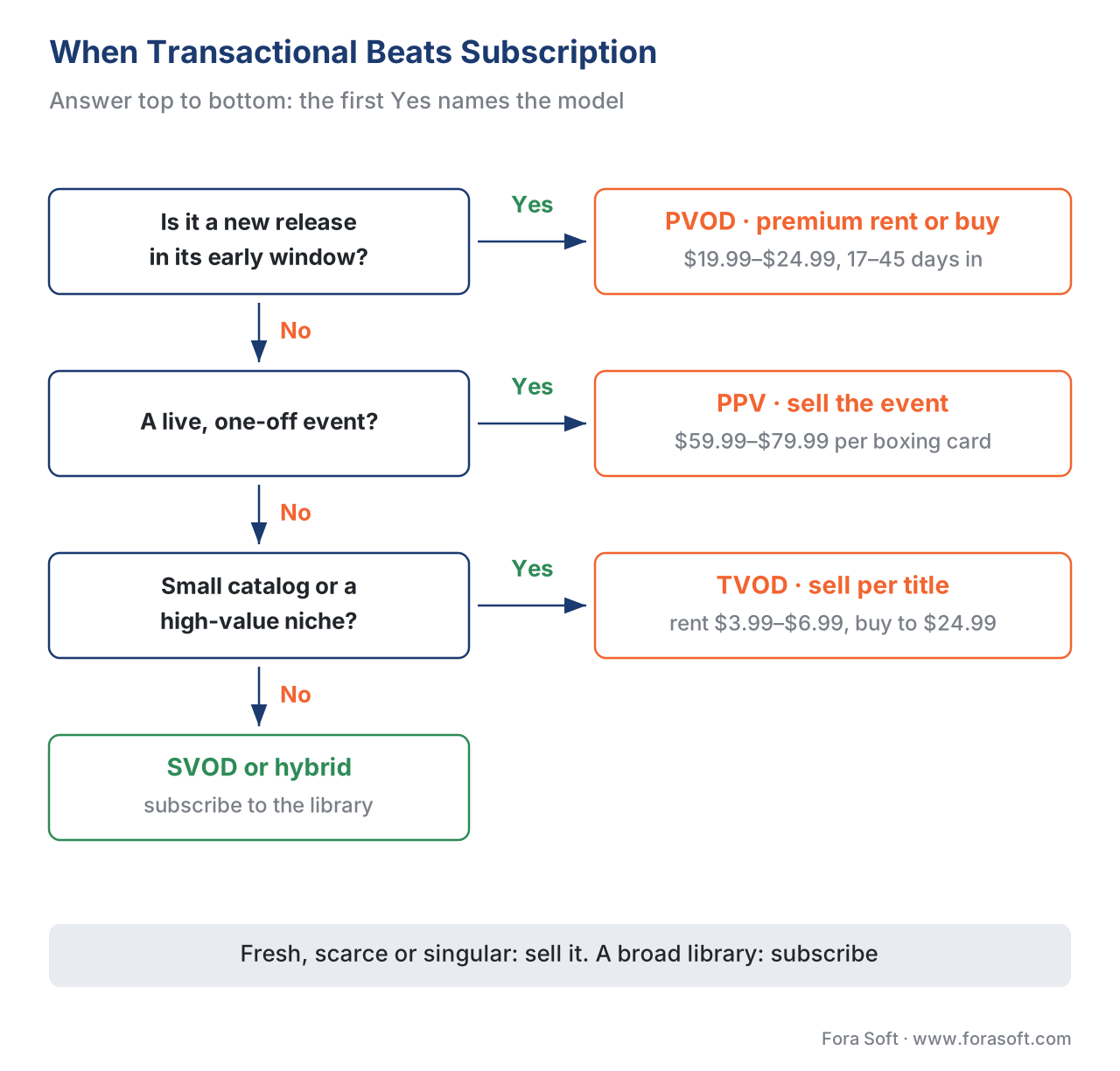 Figure 5. When transactional beats subscription. Fresh, scarce, or singular content — early-window releases, live events, small or high-value catalogs — favors TVOD or PPV; a broad library favors a subscription or a hybrid of both.
A common mistake: treating TVOD as "a paywall and done"
The recurring error is to assume transactional is the simple model — "just put a price on a video" — and to under-build the parts that do not show up in a demo. It backfires in predictable ways. A team enforces the rental window only in the app UI, and discovers viewers keep watching after 48 hours because no DRM license ever expired. A team ships in-app purchase everywhere because it is the default, and hands 30% of every sale to the store when a web checkout would have kept most of it. A team builds its own card form to "own the experience," lands in PCI SAQ D and a year-long audit, then loses European sales because it never added 3-D Secure 2. A team grants entitlements perfectly but never wires up refund and chargeback revocation, and slowly accumulates viewers watching for free.
Each is the same root mistake: transactional looks simple at the paywall and is actually three hard systems behind it — a payment path with real compliance, an entitlement service that must grant and revoke precise rights, and a DRM layer that enforces time-boxed windows. Build those three correctly and TVOD is a clean, churn-free revenue stream. Skip one and it leaks money quietly in exactly the place you are not looking.
Free download: TVOD & PPV — One-Page Transaction ReferenceChoosing the model (rent, buy or PPV), the payment-and-PCI checklist, the app-store-tax playbook, and the entitlement and refund edge cases on a single sheet.Where Fora Soft fits in
Transactional streaming is where payment engineering meets video delivery, and the expensive failures are quiet: a third of revenue lost to an app-store commission that a web checkout would have avoided, a PPV checkout that buckles in the minutes before a main event, a rental that never expired because the window lived in the UI instead of a DRM license, or a compliance scope that ballooned because card data touched a server it never needed to. Fora Soft has built video-streaming and OTT/Internet-TV platforms since 2005, across 625+ shipped projects for 400+ clients, which means we have wired paywalls to payment processors behind a clean PCI boundary, mapped purchases to entitlements and time-boxed DRM licenses, and engineered pay-per-view flows that take the transaction spike and the live-delivery spike at the same minute. Our stance is scalability-first and vendor-neutral: we start from the scale you must hold — the buys per minute, the concurrent viewers, the revenue you cannot afford to leak to fees — and build the rent, buy, and PPV flows that hold up when the event actually happens.

The handbook
Fora Soft Video Engineering Handbook
We wrote a seven-volume handbook, 9,000+ pages, that takes the video stack from a single pixel to production, and someone who works through it can design and build the rent, buy and pay-per-view platform this article describes. Start with volume 3: the DRM license servers and license policy that make a 48-hour rental actually expire, the players that enforce it, and the economics of streaming that the app-store tax bends. Volume 2 covers the live ingest and HLS/DASH delivery behind a pay-per-view main event, and volume 1 the encoding that decides what every rented title costs to serve. Written by Nikolay Sapunov, CEO at Fora Soft.
Rent, buy or pay-per-view: will your checkout, entitlements and DRM hold up on event night?
Tell us what you sell, on which devices and at what price, and we will map the payment path that keeps you at SAQ A, the web-versus-in-app split that protects your margin, and the entitlement and license rules that make rentals expire and refunds revoke. 250+ video products shipped since 2005.
See our case studies
Case study
Vodeo
An iOS movie-rental app for Janson Media with 100K+ users and no subscription: viewers buy in-app tickets and spend them to rent single films and episodes — pure TVOD, sold through the app store.
Case study
Worldcast Live
A live concert platform with pay-per-view tickets, 10,000 concurrent viewers and 0.4–0.5 s latency — the event-night case where checkout and delivery spike together.
Case study
Sprii
A live-shopping platform with 72K+ live events and 21M products sold, where viewers buy during the stream — transactions that have to clear in the minutes a broadcast is on air.
What to read next
Business models
SVOD vs AVOD vs TVOD: OTT Business Models Explained
Where transactional sits next to subscriptions and ads.
Monetization
Subscription Billing and Entitlement: the SVOD Engine
The entitlement service that grants and revokes every right.
DRM
DRM License Policy: Rentals, Offline, Output Control
How the license encodes a rental window the player must obey.
Delivery
Live Event Streaming at Scale: The Premiere Spike
The delivery half of a pay-per-view main event.
References
- Payment Card Industry Data Security Standard (PCI DSS) v4.0.1. PCI Security Standards Council. Tier 1 (controlling standard). Defines cardholder-data security requirements and the self-assessment questionnaires (SAQ A for fully outsourced/tokenized payment, SAQ A-EP, SAQ D) that scale to how much card data a merchant touches; v4.0.1 published June 2024, mandatory since 2025-03-31. https://www.pcisecuritystandards.org/document_library/ — accessed 2026-06-17.
- Directive (EU) 2015/2366 (PSD2) — revised Payment Services Directive. European Union / EUR-Lex. Tier 1 (law). Establishes the Strong Customer Authentication (SCA) requirement for electronic payments in the EEA. https://eur-lex.europa.eu/legal-content/EN/TXT/?uri=CELEX:32015L2366 — accessed 2026-06-17.
- Commission Delegated Regulation (EU) 2018/389 — Regulatory Technical Standards for SCA and common secure communication. European Union / EUR-Lex. Tier 1 (law). Specifies the SCA two-of-three-factor rule and the exemptions (low-value under €30 with cumulative caps, transaction-risk analysis) delivered in practice via 3-D Secure 2. https://eur-lex.europa.eu/legal-content/EN/TXT/?uri=CELEX:32018R0389 — accessed 2026-06-17.
- Rent movies from the Apple TV app. Apple Support. Tier 3 (first-party). Documents the rental model used across the industry: 30 days to start watching, 48 hours to finish after first play. https://support.apple.com/en-us/108816 — accessed 2026-06-17.
- App Store Review Guidelines (§3.1 Payments; reader apps). Apple Developer. Tier 3 (first-party). Defines in-app-purchase commission rules, the reader-app category (video included), and the External Link Account Entitlement for accessing content purchased outside the app. https://developer.apple.com/app-store/review/guidelines/ — accessed 2026-06-17. Rules changing post-Epic — re-verify.
- Distributing "reader" apps with a link to your website / External Link Account Entitlement. Apple Developer. Tier 3 (first-party). The entitlement basis for "buy on the web, watch in the app." https://developer.apple.com/support/reader-apps/ — accessed 2026-06-17.
- Google Play service fees and 2026 billing changes. Google Play Console Help / Android Developers Blog. Tier 3 (first-party). 2026 structure: 20% service fee on most in-app purchases, 15% for qualifying programs, 10% + 5% billing fee for subscriptions; anti-steering removed worldwide following the Epic settlement (announced 2026-03-04; US/UK/EEA rollout by 2026-06-30). https://support.google.com/googleplay/android-developer/answer/112622 — accessed 2026-06-17. Dated/evolving — re-verify.
- Epic v. Apple — external-purchase-link rulings, 2025–2026. MacRumors, TechCrunch, AppleInsider (court-reporting compilations). Tier 5 (institutional/news). Since April 2025 US apps may link to external web payment; the commission Apple may charge on external purchases remained in litigation through mid-2026 (Dec 2025 appeals modification; May 2026 stay denied). https://www.macrumors.com/2025/12/11/apple-app-store-fees-external-payment-links/ — accessed 2026-06-17. Dated — re-verify at publish.
- Strong Customer Authentication / PaymentIntents and 3-D Secure 2. Stripe documentation. Tier 4 (first-party payment vendor). How a processor implements SCA, tokenization, and 3-D Secure 2, and typical pricing (~2.9% + $0.30 per transaction; ~$15 chargeback fee). https://stripe.com/guides/strong-customer-authentication — accessed 2026-06-17.
- DAZN and Amazon Prime Video pay-per-view pricing, 2026. TV Tech, World Boxing News (industry reporting). Tier 5. Boxing PPV at $59.99 (DAZN) and $79.99 (Amazon Prime Video) in 2026; DAZN Ultimate bundle includes 12+ PPV events/year. https://www.tvtechnology.com/news/dazn-rolls-out-ultimate-pricing-plan-that-includes-pay-per-view-boxing — accessed 2026-06-17. Pricing changes — re-verify.
- Premium video on demand (PVOD) windows and pricing, 2026. Industry glossaries and reporting (Cloudinary, INCRMNTAL, trade press). Tier 5. PVOD rental/buy at $19.99–$24.99 in an early 17–45-day post-theatrical window. https://www.incrmntal.com/glossary/pvod-premium-video-on-demand — accessed 2026-06-17.
- Transactional Video on Demand (TVOD): EST and DTR definitions. SymphonyAI media glossary; pay-per-view setup guides (Dacast, Muvi, Uscreen). Tier 6 (orientation/competitor reference). Cross-checked the EST/DTR terminology and typical $3.99–$6.99 rental / up to $24.99 buy pricing; competitor PPV-setup guides consulted for the SERP gap, not as a source for any standard claim. https://www.symphonyai.com/glossary/media/tvod-transactional-video-on-demand/ — accessed 2026-06-17.
Where sources disagreed, the controlling standard or first-party document was followed. PCI DSS (PCI SSC), PSD2 (Directive (EU) 2015/2366), and the SCA RTS (Regulation (EU) 2018/389) are cited from the issuing bodies; app-store commission and external-purchase rules are cited from Apple and Google first-party documentation and dated, because the Epic-driven 2025–2026 changes are actively in flux. PPV and PVOD prices are 2026 analyst/trade figures, cited as dated examples, never as universal numbers. The common "TVOD is the simple model" framing was overridden in favor of the precise build reality: a payment path, an entitlement service that must grant and revoke, and a DRM layer that enforces the window.
