


Why this matters
For a movie or a back-catalogue title, scale is a smooth curve you can grow into; for a title fight, a cup final, a product launch, or a streamed concert, the entire audience shows up at the announced minute and judges you instantly, and there is no second take. The most expensive failures in streaming are not slow encodes or a few percent of rebuffering — they are the premiere that 404s for half the audience at kickoff, the origin that melts in the first ninety seconds, and the single-CDN outage with no fallback during the one event the whole company sold tickets to. This article is for the founder, product manager, or streaming engineer who has to deliver an unrepeatable live event at scale and wants to know where it breaks, which defense stops which failure, and what a realistic readiness plan looks like before the big night. By the end you will be able to explain why a live premiere is a different problem from steady catalogue traffic, size the spike in both requests and terabits, and walk into a launch rehearsal knowing exactly what has to hold.
A one-minute refresher: how bytes reach a player
This article builds on how a CDN delivers video, origin and origin shielding, and scaling and concurrency; here is the one picture you need in front of you.
A streaming platform turns a live feed into many short files. The encoder compresses the picture, the packager wraps it into segments — short files of a few seconds each — and writes a manifest, a small playlist that lists the segments in order. The player downloads the manifest, sees the newest segment, fetches it, and repeats. Those files are served by a content delivery network (the worldwide fleet of caching servers, or CDN, that holds copies of your video close to viewers) so that most requests are answered by a nearby edge cache — a server near the viewer stocked with the most-requested files, the corner store that saves a drive to the warehouse. The warehouse is your origin, the authoritative source the edge fetches from when it does not have a file. The single number that decides whether this is cheap or ruinous is the offload ratio: the share of requests the edge answers from its own cache without bothering the origin. Hold that word — offload ratio — because the premiere spike is, underneath, an attack on it.
The premiere spike: two herds in one minute
Catalogue traffic is forgiving because viewers are independent. One person starts a movie now, another in ten minutes, a third tomorrow; their requests are spread across time and across thousands of different files, so no single server is ever asked for the same thing by everyone at once. A live premiere breaks every one of those assumptions. The audience is synchronized — they all arrive at the announced start — and they are correlated — they all want the same feed, the same renditions, the same newest segment, at the same instant. Synchronized plus correlated is the definition of a thundering herd: a crowd of identical requests landing on one resource in one moment.
The mistake most teams make is treating that as one problem. It is two, and they peak together. The first is the control-plane herd: in the sixty to one hundred and twenty seconds around the start, every client tries to sign in, check entitlement (the service that decides who is allowed to watch), clear the paywall, and fetch its first manifest — all at once. This surge is measured in requests per second, and it lands on your application servers, your identity service, and your database, none of which are the CDN. The second is the data-plane herd: once admitted, every player pulls the same first segments at the live edge in the same instant, then keeps pulling each new segment as it appears. This surge is measured in terabits per second, and it lands on the edge and, if the edge misses, on the origin.
 Figure 1. The premiere spike is two herds at once. In the same minute around the start, a control-plane herd (sign-in, entitlement, first manifest — measured in requests per second) and a data-plane herd (everyone pulling the same fresh segment — measured in terabits per second) peak together. Catalogue traffic never does this.
The two herds need different defenses because they scale on different axes — the control plane on requests per second, the data plane on bandwidth — and that split organizes the rest of this article. It is the same two-planes idea from scaling and concurrency; a premiere is simply the moment both planes spike in the same sixty seconds instead of growing over months.
Why live is the hardest: the cache is always near-cold
Here is the insight that separates live from everything else, and the single most important idea in this article. A thundering herd is survivable when the thing everyone wants can be cached in advance. For an on-demand premiere — a new film dropping at midnight — the segments exist hours early, so you can pre-warm the edge by pushing every file out to the caches before the doors open; when the herd arrives, the edge answers from cache and the origin barely notices. Live takes that escape route away. The segment a million players want right now was created two seconds ago, did not exist before that, and will fall out of the live window in another twenty. You cannot pre-warm a file that does not exist yet.
So the live edge is perpetually near-cold. Every few seconds the packager publishes a brand-new segment that no cache has ever seen, and within a second or two every player at the live edge asks for it. The herd is not a one-time event at the start — it re-forms on every segment, for the entire event, synchronized by the simple fact that all live players are locked to the same live edge and the same clock. A two-hour final with six-second segments has roughly 1,200 of these mini-stampedes back to back. Worse, the players' housekeeping is synchronized too: the HLS specification (IETF RFC 8216) says a live media playlist is refreshed on a fixed cadence — a new version becomes available "no earlier than one-half the target duration" and "no later than 1.5 times the target duration" after the last one — so every player reloads the manifest on roughly the same beat, adding a second, smaller herd of manifest requests phase-locked to the first.
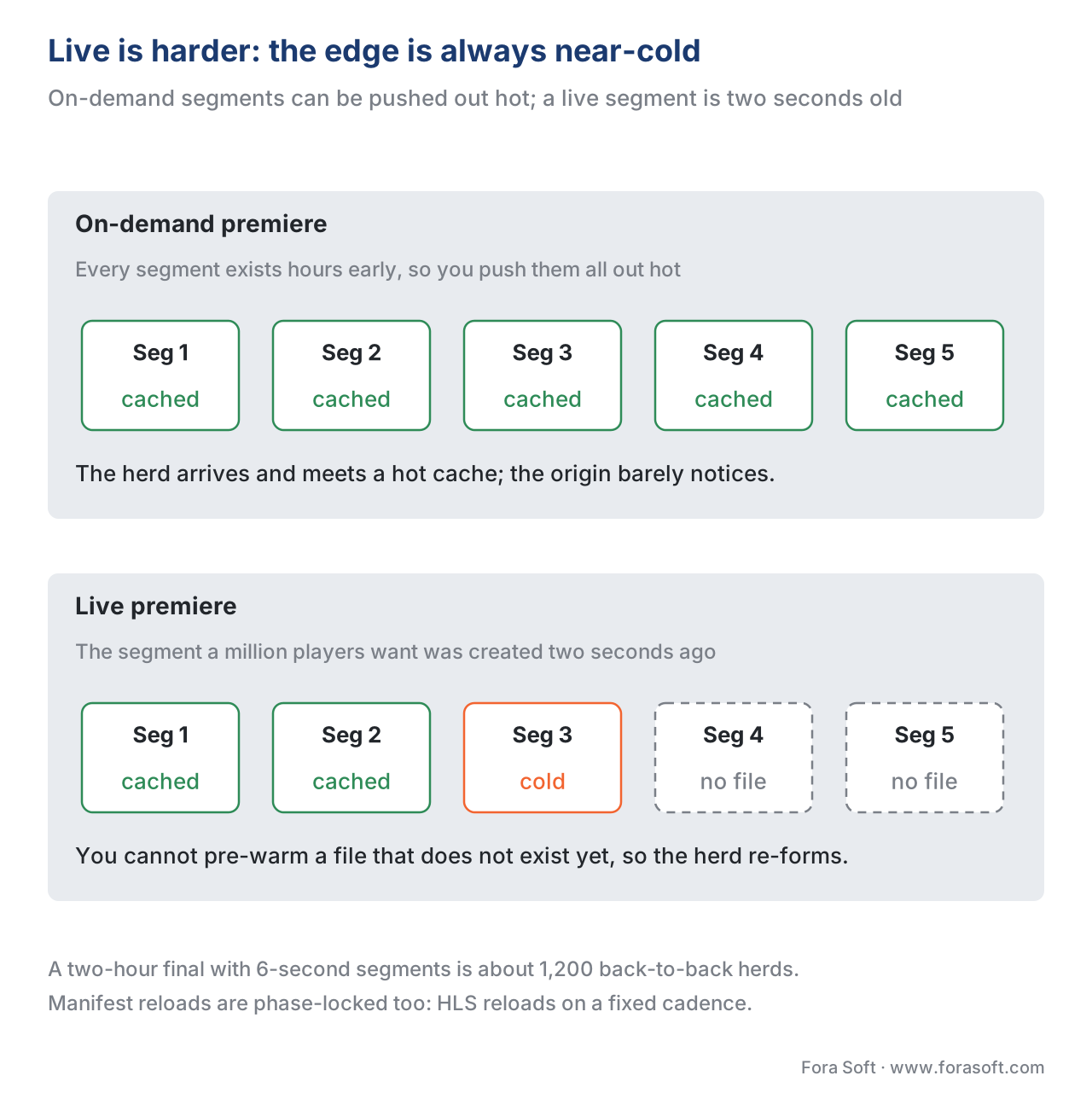 Figure 2. Why live is harder than on-demand. An on-demand catalogue can be pre-warmed into the edge before viewers arrive, so the herd hits a hot cache. A live edge is always near-cold: each new segment is brand-new, so the thundering herd re-forms every few seconds for the entire event.
This is why "just add a bigger origin" never works for live. The origin is not too small; it is being asked the same fresh question by a million callers at once, over and over. The fix is not more origin — it is making sure those million identical questions become one question. That is the job of the next defense.
The first defense: collapse the herd, then shield the origin
The mechanism that saves the origin is older than streaming and beautifully simple. When an edge cache gets a request for a fresh segment it does not have, and a thousand more requests for the same segment arrive while it is still fetching the first from upstream, a well-built CDN does not forward all thousand. It sends one, holds the rest, and when the answer comes back it fans that single response out to everyone who was waiting. This is request collapsing (also called request coalescing). Amazon CloudFront describes the behaviour plainly: when extra requests for the same object arrive "before CloudFront receives the response to the first request, CloudFront pauses before forwarding the additional requests to the origin," then "sends the response from the original request to all the requests that it received while it was paused." A thousand-strong herd becomes a single origin fetch.
Collapsing at one edge is good; collapsing everywhere is what survives a global premiere. A large event is served by hundreds of edge locations, and without another layer each of those edges would still send its own one fetch to the origin — hundreds of identical fetches for every new segment. The fix is an origin shield: a single designated mid-tier cache that every edge fetches through, so the hundreds of edge fetches collapse again into roughly one origin fetch per object. CloudFront's Origin Shield, for example, "can further reduce the number of simultaneous requests that are sent to your origin for the same object," consolidating them so that "as few as one request" reaches the origin. We covered the architecture in depth in origin and origin shielding; the premiere is the event that makes it non-negotiable. An unshielded origin meets a live premiere and dies; a shielded one sees a trickle.
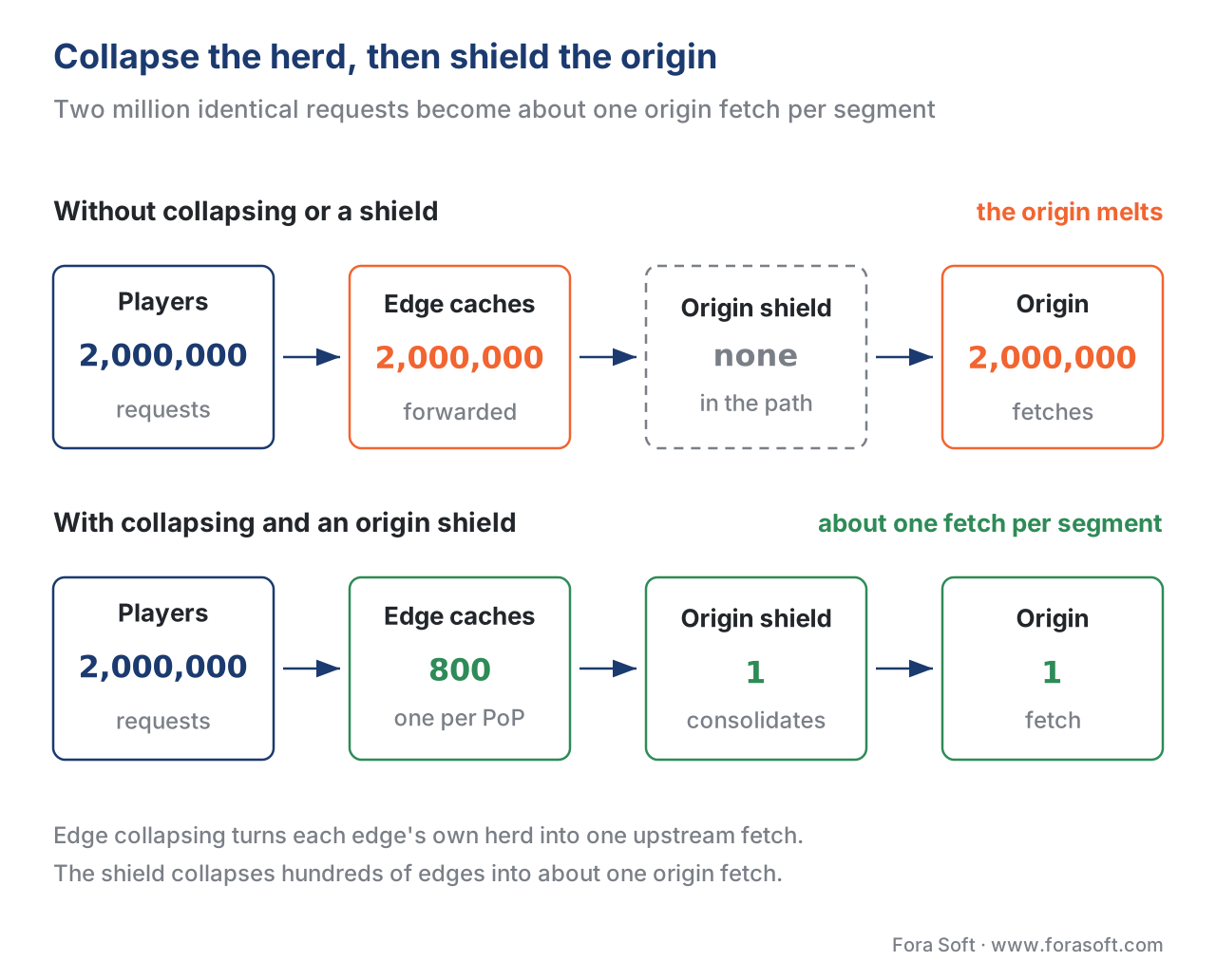 Figure 3. Collapse, then shield. Edge request collapsing turns each edge's herd into one upstream fetch; an origin shield collapses all the edges into roughly one origin fetch per segment. Without it (top), every edge hammers the origin directly and it melts.
Pre-warming and surge capacity: provision ahead of the curve
Collapsing and shielding protect the origin, but the rest of the system still has to be big enough on arrival — and the cardinal rule of live is that you provision ahead of the arrival curve, not in response to it. Autoscaling that reacts to load is too slow for a premiere: by the time the metrics show the spike and new capacity boots, the first ninety seconds — the part the audience remembers — are already over. So capacity is pre-staged.
On the data plane, pre-warming means two things. For any content that exists in advance — the pre-show slate, the intro, on-demand bonus angles — you push the files to the edges before the doors open so they are already hot. For the live feed itself, which cannot be pre-warmed file by file, you instead pre-warm capacity: you tell your CDN the event's date, expected peak concurrency, and regions in advance so it can reserve edge and shield capacity, and you confirm a commit that covers the spike. CDNs ask for this notice precisely because a multi-terabit event arriving unannounced can degrade a region. Standards help here too: Common Media Client Data (CTA-5004) lets players attach prefetch hints and playback state to each request, so the CDN can position the next segment at the edge a beat ahead of the request — turning some of the cold edge warm just in time.
On the control plane, pre-warming means provisioning the identity, entitlement, billing, and ad services for the peak, predictively, before the arrival curve, and load-testing them at that peak in rehearsal. The arithmetic below shows why a control plane sized for "average concurrent viewers" is a guaranteed outage: the average is not the number that arrives in the first minute.
The reliability problem: failover for an event you cannot re-run
Everything above makes the platform big and efficient. None of it helps if the one CDN you chose has a bad night. A live event is the textbook case for multi-CDN — delivering through more than one content delivery network at once — because the cost of an outage is total and the event cannot be repeated. We covered the orchestration in multi-CDN architecture and orchestration; for a premiere the point is reliability, not just reach: if one CDN browns out in a region, viewers move to another without a restart.
What makes this practical in 2026 is a standard rather than bespoke player code. Content steering, standardized as ETSI TS 103 998 (2024) and supported by both HLS (the EXT-X-CONTENT-STEERING tag) and DASH, lets a small steering service tell players which CDN to prefer and move them between CDNs mid-stream — "no custom client plugins, DNS redirects, or CMS integrations," as the specification's authors put it. The player checks a steering manifest, follows the priority it is given, and fails over to the next CDN if its current one degrades, all inside the normal playback loop. For an unrepeatable event, that automatic, sub-restart failover is the difference between a glitch and a refund.
Failover only works if the alternative is genuinely independent. The discipline is to keep the delivery portable — the same segments and manifests served identically from each CDN, each shielding the same origin — and to rehearse the failover before the event, because the worst time to discover that your second CDN was never actually wired up is during the only night it was needed.
Graceful degradation: decide what bends before it breaks
The last defense accepts a hard truth: forecasts are wrong, and some premieres draw an audience no plan sized for. A resilient live platform is built to degrade gracefully — to shed quality or admit viewers gradually — instead of failing hard for everyone. The choice is to decide, in advance, what bends first.
Four levers, in rough order of preference. The gentlest is admission control: a virtual waiting room that holds excess viewers in a branded queue and releases them at a rate the backend can absorb, so the platform stays up for those already in instead of collapsing for everyone. The release rate is a dial operators can turn down if backend systems start to strain, and the waiting room is designed fail-open — if the queue service itself has trouble, the next request is evaluated normally rather than blocked. The second lever is shedding bitrate: temporarily capping the encoding ladder (serving, say, up to 720p instead of 4K) cuts the terabits per second the whole audience consumes, trading a little sharpness for staying on air; this is the live cousin of the ladder decisions in renditions per device. The third is CDN failover via the content steering above. The fourth, the floor under everything, is a static fallback: a held slate or a low-bitrate single rendition that plays when the live path is failing, so the viewer sees "we'll be right back," not a spinner or an error.
The pitfall hiding inside degradation is the retry storm. When something fails, clients retry — and if they all retry on the same fixed timer, the retries arrive as a second, self-inflicted thundering herd that finishes off whatever was wobbling. The fix is exponential backoff with jitter: each client waits a little longer after each failure, plus a small random offset, so the retries spread out in time instead of stacking into another wall. A live platform that hard-fails without backoff does not get one outage; it gets a cascade.
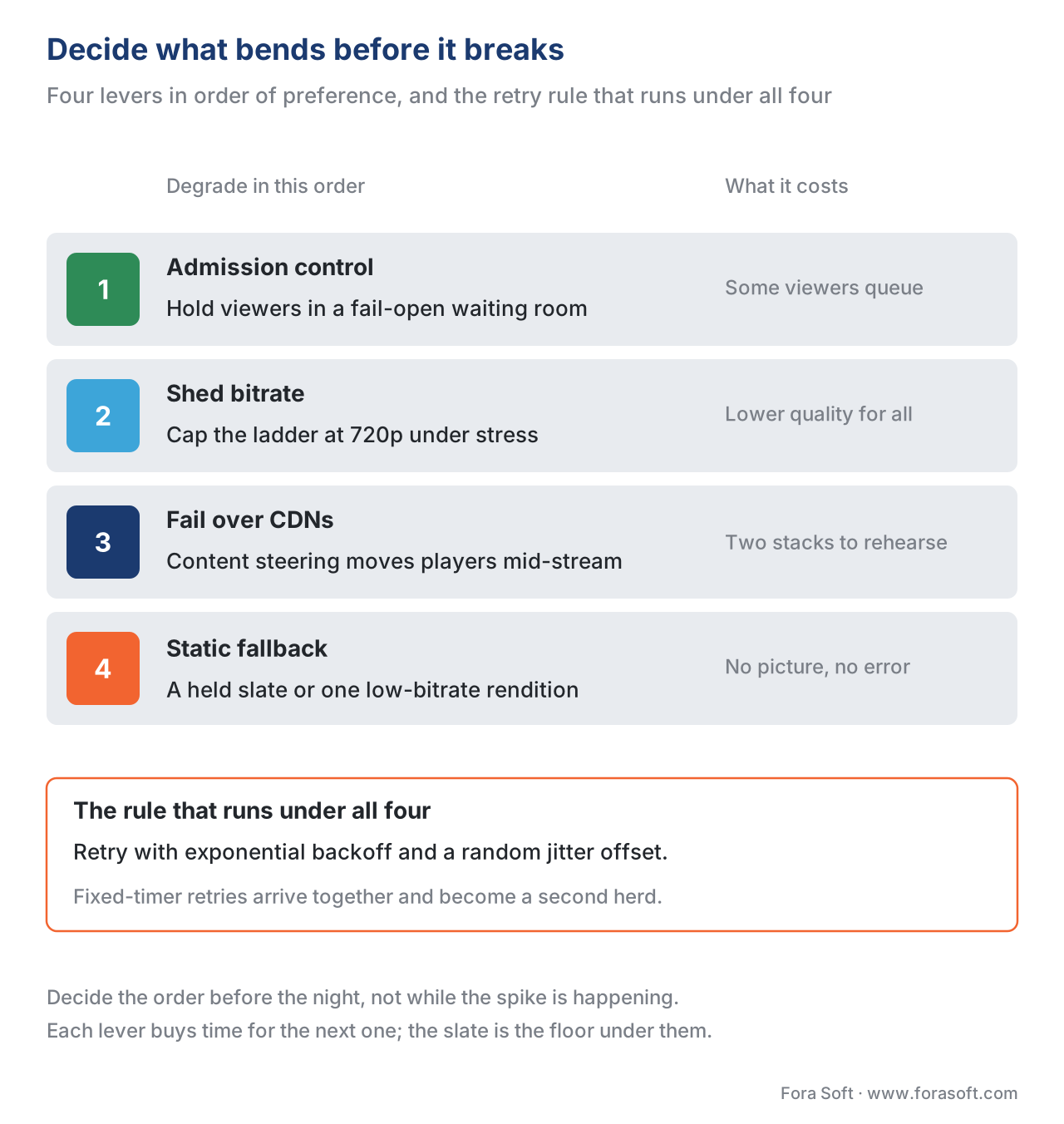 Figure 4. What bends before it breaks. When a spike exceeds plan, degrade in order: hold viewers in a waiting room, shed bitrate to cut terabits, fail over CDNs with content steering, and fall back to a static slate as the floor. Always retry with backoff and jitter so recovery does not become a second herd.
A worked premiere budget: size both herds
Numbers make the stakes concrete. Take an illustrative major event: a peak of 2,000,000 simultaneous viewers — well within reach, given that single-platform live records passed 12 million concurrent in 2025 — at 5 Mbps for a 1080p stream, six-second segments, over a two-hour show. Walk both herds out loud.
The data-plane peak is throughput, and it is just concurrency times bitrate:
Throughput = peak concurrency × per-stream bitrate
           = 2,000,000 × 5 Mbps
           = 10,000,000 Mbps
           = 10 Tbps at the peak
Ten terabits per second is the wall the CDN must hold — and it is why a single CDN's regional capacity is a real constraint, not a formality. Now the thundering herd underneath it. Every six seconds the packager publishes one new segment, and within a second or two all 2,000,000 players ask for that single fresh file:
Per-segment herd  = 2,000,000 requests for ONE object, in ~1–2 seconds
Without collapsing → up to 2,000,000 origin fetches for that one segment
With edge collapsing + origin shield → ≈ 1 origin fetch for that one segment
That contrast — two million origin fetches versus one — is the entire argument for the origin shield, repeated 1,200 times across the show. Next, the manifest herd that runs the whole event. With six-second segments, players reload the live playlist about every half-target-duration, so roughly every three seconds:
Manifest reload rate = concurrency ÷ reload interval
                     = 2,000,000 ÷ 3 s
                     ≈ 667,000 manifest requests / second, sustained
Two-thirds of a million requests a second, continuously, for two hours — that is the steady load the edge must absorb so it never reaches the origin. Finally, the control-plane burst at the start. Say each arriving viewer makes three control calls — sign-in, entitlement, paywall — inside a ninety-second arrival window:
Control burst = (concurrency × calls per viewer) ÷ arrival window
              = (2,000,000 × 3) ÷ 90 s
              ≈ 67,000 requests / second, on identity + entitlement + billing
And the cost, because a premiere is also a bill (see CDN cost engineering). Ten terabits per second for two hours moves a lot of bytes:
Egress = 10 Tbps ÷ 8 × 7,200 s
       = 1,250 GB/s × 7,200 s
       = 9,000,000 GB ≈ 9 PB for the event
At a committed $0.02/GB → ≈ $180,000 for one two-hour show
That is a single event, and because CDN egress is often billed at the 95th percentile, a two-hour spike can quietly set the rate for the whole month — one more reason the spike is a planning problem, not a surprise.
| Defense | Which herd it tames | Mechanism / standard | The trade-off to price |
|---|---|---|---|
| Request collapsing | Data plane (segments) | Edge coalescing — one upstream fetch per object (e.g. CloudFront) | Adds a brief edge pause; needs a stable cache key |
| Origin shield | Data plane (segments) | Mid-tier cache; all edges collapse to ≈1 origin fetch (3.4) | One extra hop of latency on a miss |
| Edge pre-warming | Data plane (pre-show, slate) | Push known files hot before doors open; CMCD (CTA-5004) prefetch hints | Only works for content that exists in advance |
| Predictive autoscale | Control plane (auth, entitlement) | Provision for peak ahead of the arrival curve | You pay for headroom you may not use |
| Multi-CDN + content steering | Both (reliability) | ETSI TS 103 998 / EXT-X-CONTENT-STEERING failover |
Two integrations to keep portable and rehearsed |
| Admission control | Control plane (the gate) | Fail-open virtual waiting room, throttled release | Some viewers wait; queue UX must be honest |
| Bitrate shedding | Data plane (terabits) | Cap the ladder (e.g. ≤720p) under stress | Lower quality for everyone while engaged |
| Backoff + jitter | Both (recovery) | Exponential retry with random offset | Slightly slower individual recovery |
Table 1. The premiere defense stack: which herd each defense addresses, the mechanism or standard behind it, and the cost you accept to get it. No single row is sufficient; a live premiere needs most of the column.
Common mistakes that lose the night
Most premiere failures are not exotic; they are a small number of predictable errors made under deadline.
The first is sizing to the wrong number — provisioning for registered users or average concurrent viewers instead of peak concurrency in the first minute. The average is comfortable; the peak is the event, and it is often several times higher. The second is assuming on-demand pre-warming works for live — building a plan around hot caches and discovering on the night that the live edge is near-cold and the herd is hitting the origin directly. The third is running a single CDN for an unrepeatable event — no failover path, so one provider's regional brownout becomes your refund. The fourth is hard-failing instead of degrading — no waiting room, no slate, no bitrate shedding, so an over-plan audience gets errors rather than a queue, and the synchronized retries become a second herd. The fifth is retrying without jitter — every client backing off on the same timer, manufacturing the very stampede the backoff was meant to prevent. The sixth is enabling low latency without budgeting its request load — turning on LL-HLS or LL-DASH for the event, which multiplies small requests and lowers cache efficiency exactly when the herd is largest, as low-latency delivery warns. And the quiet seventh, the one that turns any of the above from a near-miss into a headline: rehearsing in production on the biggest night — never having load-tested the whole platform at the target peak, so the first real test is the event itself.
The cure for that last mistake is a calendar. Almost everything that makes a premiere hold happens before the event — the capacity commit, the edge pre-warm, the peak load-test, the failover drill — so the readiness work belongs on a timeline that ends on the night, not one that begins there.
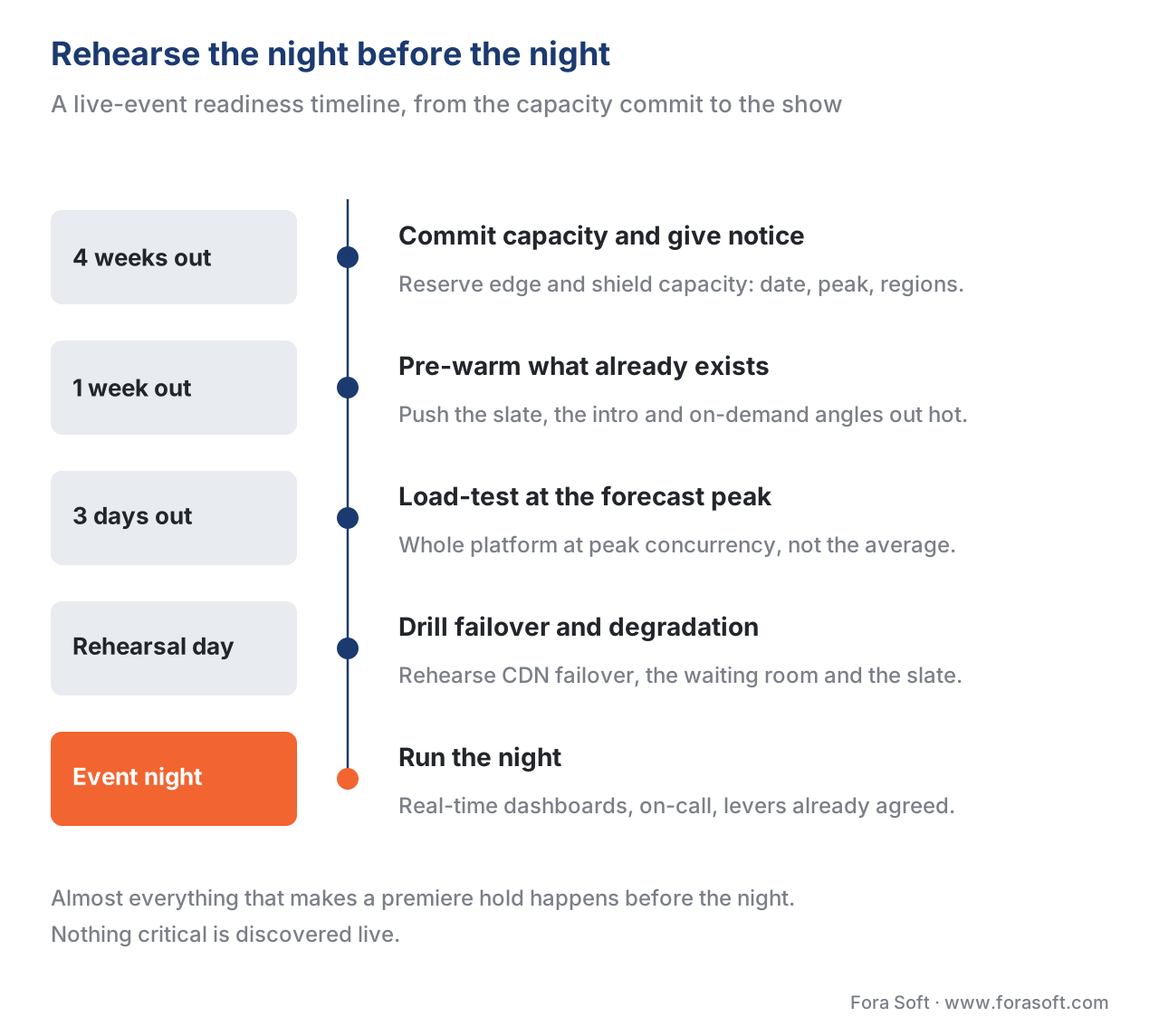 Figure 5. Rehearse the night before the night. The work that makes a live premiere hold is front-loaded: commit capacity and notify the CDN weeks out, pre-warm the edge, load-test the whole platform at peak and drill failover in rehearsal, then run the event with real-time monitoring and on-call. Nothing critical is discovered live.
Where Fora Soft fits in
Live event delivery is a scale-and-reliability problem before it is a streaming one: the real questions are how many viewers arrive in the first minute, how the origin survives a million identical requests for a two-second-old file, what fails over when one CDN has a bad night, and what bends before the stream breaks. Fora Soft has built video streaming, OTT and Internet-TV, live-event, WebRTC, and interactive-video software since 2005, across 625+ shipped projects for 400+ clients, and that experience runs straight through this layer — sizing both the control-plane and data-plane herds from real peak concurrency, hardening the origin with collapsing and an origin shield, wiring multi-CDN failover with content steering so an outage is a glitch not a refund, building the waiting room, slate, and bitrate-shedding that let a stream bend instead of break, and rehearsing the whole platform at peak before the night rather than on it. When a media company has one chance to deliver a premiere to a synchronized audience at scale, that rehearsed, failure-first engineering is the capability we bring.



The handbook
Fora Soft Video Engineering Handbook
We wrote a seven-volume handbook that takes the whole video stack apart, from the pixel to production, across 9,000+ pages — so the person who reads it can design a platform that survives a premiere and then build it. Volume 3 sits closest to this article: CDNs and edge caching, multi-CDN and the player behaviour that failover depends on, and the delivery economics behind a 9 PB night. Volume 2 covers the ingest and packaging that publish the segment the herd is asking for, and volume 1 the encoding ladder you cap when you shed bitrate. Written by Nikolay Sapunov, CEO at Fora Soft.
Planning a premiere you only get one shot at?
Tell us the event, the forecast peak and the screens you have to serve, and we will come back with both herds sized — requests per second on the control plane, terabits per second on the data plane — the collapsing and origin-shield configuration, the multi-CDN failover path, and the list of what has to be rehearsed before the night. 250+ video products shipped since 2005.
See our case studies
Case study
WorldCast Live
Pay-per-view concerts for 10,000 simultaneous viewers at 0.4–0.5 s latency and 1.5 Gbit/s — a synchronized audience that all arrives at the announced minute, which is exactly the spike this article sizes.
Case study
TradeCaster
A live trading platform for 46,000+ users that auto-scales for the load spike at market open — the same arrival curve as a premiere, on a schedule you can provision ahead of instead of reacting to.
Case study
Sprii
72,000+ live events and 88,600 campaigns in a single year, delivered across Cloudflare and Mux — live run often enough that failover and degradation are routine rather than improvised on the night.
What to read next
Delivery
Origin Shield Explained
The layer that turns hundreds of edge fetches into roughly one.
Scale
Scaling from 1,000 to 1,000,000 Viewers
The same two planes, grown over months instead of in one minute.
Delivery
Multi-CDN Architecture and Orchestration
How content steering moves players between CDNs without a restart.
Pipelines
Live vs VOD: Two Pipelines, One Platform
Why the live path cannot borrow the on-demand path's pre-warmed cache.
References
- RFC 8216 — HTTP Live Streaming (HLS) — IETF (R. Pantos, Ed.), August 2017. §6.2.1 sets the live-playlist reload cadence — a new version is made available "no earlier than one-half the target duration" and "no later than 1.5 times the target duration" after the previous one — which phase-locks every live player's manifest reloads into a synchronized request stream; §6.2.2 forbids shrinking a live playlist below three target durations (stall risk). Tier 1 (format specification). https://www.rfc-editor.org/rfc/rfc8216 (accessed 2026-06-16)
- ETSI TS 103 998 V1.1.1 — Content Steering for DASH and HLS — ETSI / DASH-IF, January 2024. The multi-CDN content-steering standard: a steering service moves players between CDNs mid-stream and on failover, compatible with the HLS
EXT-X-CONTENT-STEERINGtag and DASH, with "no custom client plugins, DNS redirects, or CMS integrations." The basis for sub-restart CDN failover during an unrepeatable event. Tier 1 (standard). https://www.etsi.org/deliver/etsi_ts/103900_103999/103998/01.01.01_60/ts_103998v010101p.pdf (accessed 2026-06-16) - CTA-5004 — Common Media Client Data (CMCD) — Consumer Technology Association (CTA-WAVE), 2020. Defines the structured data a player attaches to each media request, including prefetch hints that let a CDN position the next segment at the edge ahead of the request — a pre-warming lever for an otherwise cold live edge. Tier 1 (standard). https://cdn.cta.tech/cta/media/media/resources/standards/pdfs/cta-5004-final.pdf (accessed 2026-06-16)
- ISO/IEC 23000-19 — Common Media Application Format (CMAF) — ISO/IEC. The chunked-CMAF building block under low-latency live; relevant because LL-HLS/LL-DASH chunking multiplies the request rate and lowers cache efficiency precisely during the spike. Tier 1 (format specification). https://www.iso.org/standard/85623.html (accessed 2026-06-16) — confirm current edition before publish.
- Amazon CloudFront Developer Guide — Request and response behavior (request collapsing) — Amazon Web Services, 2026. First-party description of edge request collapsing: additional requests for the same object that arrive before the first origin response are paused, then served the single response — turning a herd into one fetch. Tier 4 (first-party vendor engineering). https://docs.aws.amazon.com/AmazonCloudFront/latest/DeveloperGuide/RequestAndResponseBehaviorCustomOrigin.html (accessed 2026-06-16)
- Amazon CloudFront Developer Guide — Use Amazon CloudFront Origin Shield — Amazon Web Services, 2026. First-party description of the origin shield as a centralized mid-tier cache that consolidates simultaneous requests for the same object so that "as few as one request" reaches the origin; also used to shield an origin in multi-CDN deployments. Tier 4 (first-party vendor engineering). https://docs.aws.amazon.com/AmazonCloudFront/latest/DeveloperGuide/origin-shield.html (accessed 2026-06-16)
- Request Collapsing and the Thundering Herd Problem (Simplified) — OTTVerse, 2023. Industry explainer of the thundering-herd / request-collapsing / origin-shield pattern in a video-CDN context; used for orientation and the corner-store framing, not as a normative source. Tier 6 (educational). https://ottverse.com/request-collapsing-thundering-herds-in-cdn/ (accessed 2026-06-16)
- 2025 livestreaming records: Twitch, YouTube, and Kick hit all-time viewership peaks — Streams Charts, 2025. Current-year concurrency reference: single-event peaks above 9 million concurrent on one platform and above 12 million on another in 2025, grounding the "2,000,000 simultaneous" worked example as conservative. Tier 5 (institutional/analyst). https://streamscharts.com/news/major-livestreaming-viewership-records-2025 (accessed 2026-06-16) — re-verify the latest record on the 90-day re-baseline.
- DDoS Resilience with HTTP caching on CloudFront — AWS re:Post, 2024. First-party guidance that a high cache-hit ratio and request collapsing preserve origin availability "during peak loads or unexpected traffic spikes" — the same mechanics a live premiere stresses deliberately. Tier 4 (first-party vendor engineering). https://repost.aws/articles/ARTocYphbwQnWtTz8FXrwqew/ddos-resilience-with-http-caching-on-cloudfront (accessed 2026-06-16)
Source note (per §4.3.2): the live-player synchronization and the playlist-reload cadence trace to the HLS specification, RFC 8216 §6.2.1–6.2.2 (ref 1); multi-CDN failover to ETSI TS 103 998 content steering (ref 2); the pre-warming/prefetch lever to CMCD CTA-5004 (ref 3); the low-latency request-multiplication caveat to CMAF ISO/IEC 23000-19 (ref 4). The request-collapsing and origin-shield mechanics are cited to first-party CloudFront documentation (refs 5, 6, 9); the thundering-herd framing is oriented by an industry explainer (ref 7) but the mechanism is grounded in the vendor docs. The concurrency figures (ref 8) are current-year analyst data, labelled illustrative for the worked budget. Where popular "just add a bigger origin" advice conflicts with the mechanics, the article follows the spec-and-vendor reality — collapse and shield, do not enlarge — and says why.
