


Why this matters
If you run a streaming product, your CDN is both the reason viewers get a smooth picture and the largest recurring line on your delivery bill — and putting all of it on one provider is a decision you make once and pay for during every outage and every renewal. A single CDN having a bad day is not hypothetical: when a major cloud provider stumbled in October 2025, platforms that delivered through only one network had no recourse until the outage cleared, while those with a second network in place rerouted and stayed up. This article is for the founder, product manager, or streaming CTO deciding whether the added complexity of running two or three networks is worth it, and who needs to understand the orchestration layer well enough to talk to vendors and engineers without being sold a black box. By the end you will be able to ask the five questions that decide a multi-CDN design: how we switch, what we measure, how failover behaves, what the blend does to our cache-hit ratio, and whether our traffic is even large enough to justify any of it.
One CDN is two risks wearing one coat
Start with why anyone runs more than one network, because the costs of multi-CDN are real and you should only pay them for a real reason.
A content delivery network — the global fleet of caching servers, called a CDN, that holds copies of your video close to viewers — is a single company's infrastructure. We covered how one of them works end to end in how a CDN delivers video. When you point your streaming hostname at one provider, you inherit two of its properties whether you want them or not.
The first is that it becomes a single point of failure — the one component whose failure takes down everything downstream of it. CDNs are built for resilience, with health checks and automatic rerouting inside their own network, and a good one delivers on the order of 99.9% availability. But 99.9% is not 100%: that missing tenth of a percent is about 8.8 hours of unavailability a year, and it does not arrive politely spread across quiet nights. A regional fiber cut, a botched config push, a transit-provider dispute, or a denial-of-service attack can degrade or drop a whole region of a single CDN for an hour — and if that is the only network you have, your platform is dark in that region for that hour, during the premiere you cannot re-run.
The second risk is quieter and costs you every month: a single CDN is a pricing trap. CDN delivery is sold by the byte sent to viewers — a recurring charge called egress — and it is the dominant ongoing cost of a streaming platform, which we break down in CDN cost engineering. A vendor that knows it is your only option, and that moving away from it means re-testing your entire delivery setup, has little reason to give you its best rate. The negotiating power that pushes egress prices down — the credible ability to shift traffic elsewhere tomorrow — only exists if somewhere else is already wired up.
Multi-CDN is the architecture that removes both risks at once: deliver through more than one network, and put a decision layer in front that sends each viewer to a network that is up, fast, and reasonably priced right now. The same phrase recurs through this article — steer to the best available — content steered to whichever network is healthiest and cheapest for that viewer at that moment.
What multi-CDN actually means
The term is used loosely, so pin it down. There are two things people call multi-CDN, and only one of them is hard.
The simple version is static split: you send Europe to CDN A and Asia to CDN B because each has the better footprint there, and the assignment rarely changes. This is useful — it solves coverage and capacity — and it is barely more than two contracts and a routing rule. As Amazon's own delivery engineers put it, in that situation "load-balancing between CDNs is fairly simple and static."
The hard, interesting version — the one this article is about — is dynamic multi-CDN: load-balancing traffic across networks based on their instantaneous performance and cost, so that when CDN A's edge in Frankfurt slows down at peak hour, viewers there move to CDN B within seconds, and when CDN B is cheaper for the Brazilian long tail this month, that traffic shifts to it. This is the version that needs an orchestration layer, and it exists to serve four goals, in roughly this order of how often they justify the build:
The first is resilience — survive any one network's bad hour by having another ready. The second is performance — at any moment, some CDN is the fastest in a given city, and the fastest one is not always the same one, so steering to the current best lifts your quality of experience. The third is capacity — at very large scale, a single live event can need more delivery capacity in one region than any one CDN will commit, so you source it from several. The fourth is commercial pull — running two networks lets you blend traffic to hit each one's volume-commit discount and route expensive regions to whoever is cheapest, and it keeps both vendors honest at renewal.
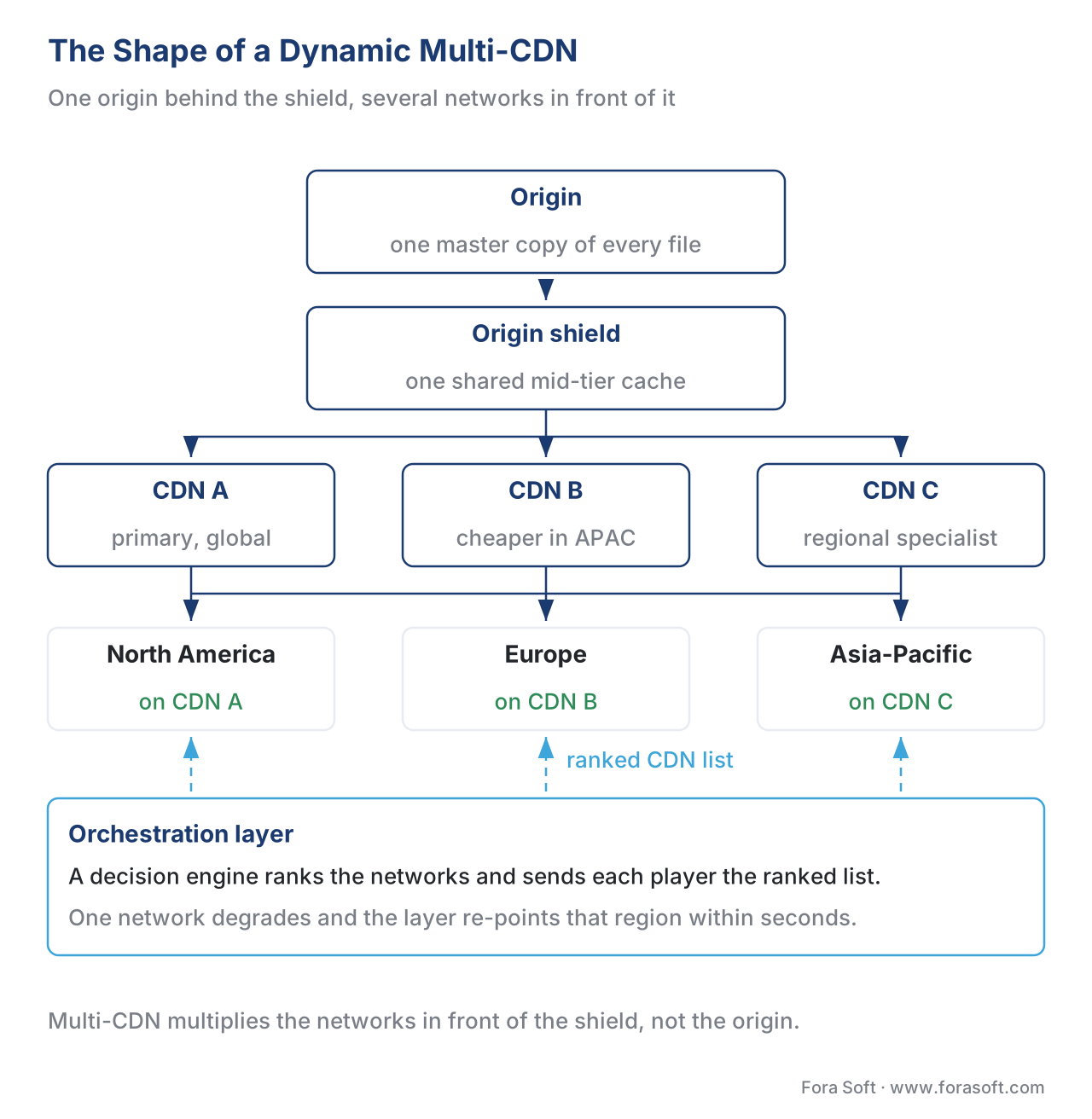 Figure 1. The shape of a dynamic multi-CDN. One origin and shield feed several CDNs; an orchestration layer decides which network serves each region, and reroutes when one degrades. The origin still serves one copy; the networks fan it out.
Notice what does not change. Behind the CDNs, you still have one origin — the authoritative source of your files — usually fronted by an origin shield, the mid-tier cache that protects it from the crowd, which we cover in origin and origin shielding. Multi-CDN multiplies the delivery networks in front of the shield; it does not multiply your origin. That single detail drives both the biggest benefit (the origin feeds many networks from one master copy) and the biggest hidden cost (each network keeps its own cache, so your content has to be cached several times over — the dilution problem we return to below).
The orchestration layer: who decides which CDN serves each request
The word that does the work in "multi-CDN orchestration" is decide. Two or more CDNs is just two contracts; the architecture is the layer that decides, for each viewer or each request, which network to use — and keeps deciding as conditions change.
That layer has two parts, and keeping them separate makes the whole topic legible.
The first part is the decision engine — the logic that scores the available networks and ranks them. It takes in signals (which CDN is fast in this city right now, which is up, which is under its cost commit, which the operator wants to favour or avoid here) and produces an ordered preference list: for this viewer, prefer CDN B, then CDN A, then CDN C. The engine can live in three places — a third-party service, your own server, or the player itself — and where it lives is exactly the choice the next section unpacks.
The second part is the steering mechanism — how that ranked preference actually reaches the player and changes which network it pulls from. A ranking nobody can act on is useless; the steering mechanism is the wire from the decision to the bytes.
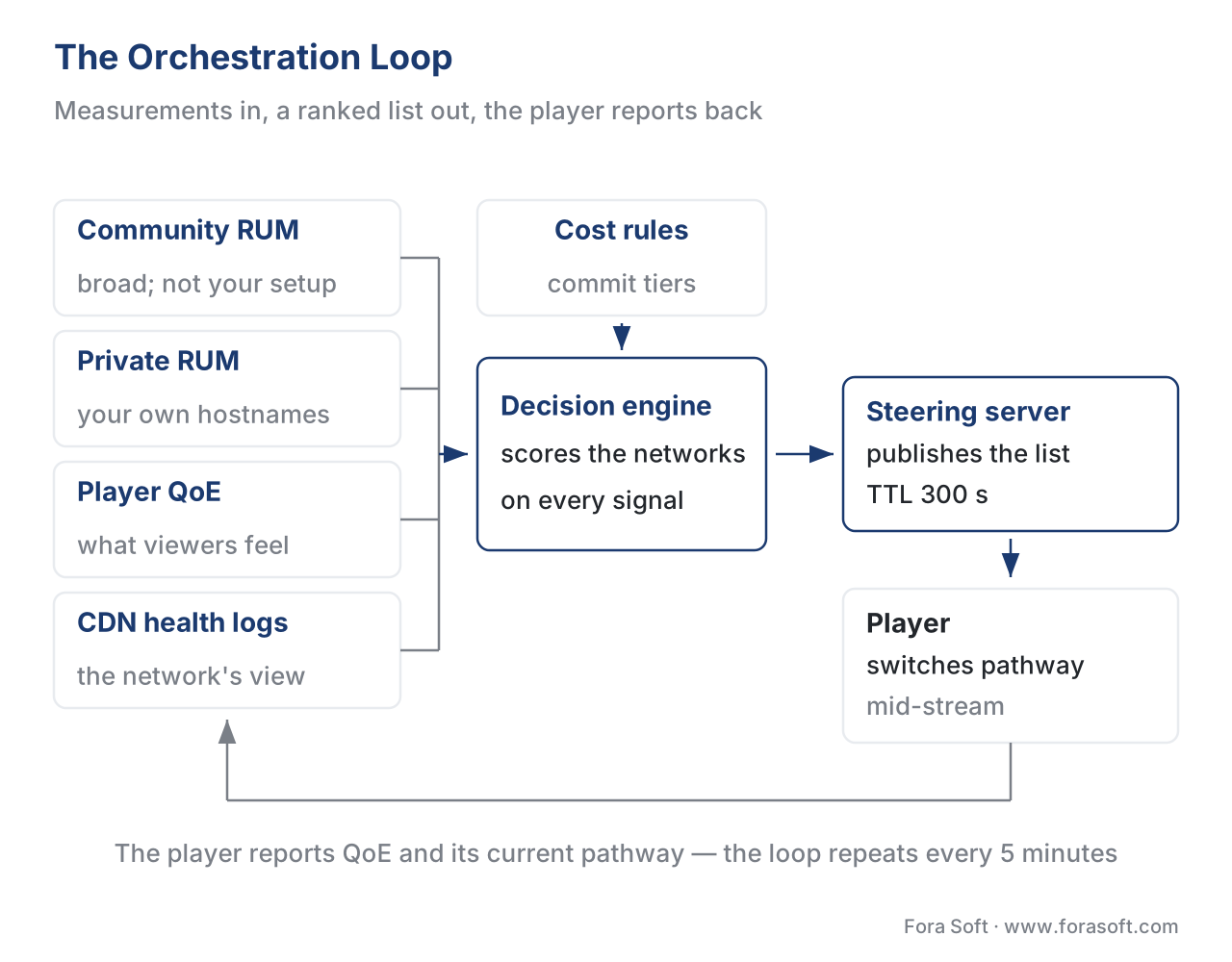 Figure 2. The orchestration loop. Measurements and cost rules feed the decision engine; it publishes a priority list; the steering service hands it to the player, which switches networks and reports back. The loop repeats every few minutes.
Think of the orchestration layer as an air-traffic controller for your bytes. The planes (viewers) can each land at several airports (CDNs). The controller watches weather and runway congestion (performance and load), knows which airports charge what landing fee (cost), and tells each plane which airport to use — and redirects it mid-approach if its first choice closes. The controller does not fly the planes or own the airports; it only decides and signals. That is precisely the orchestration layer's job: it never touches the video bytes themselves, it only decides which network delivers them.
Three ways to switch networks
There are three places the switching decision can be made and enacted, and they trade control against reaction speed. Most real platforms use a combination. Here they are from oldest to newest.
The first is DNS-based switching, the original approach. Recall that when a player wants video, it first looks up the address for your streaming hostname; a DNS-based multi-CDN service answers that lookup with the address of whichever CDN it currently prefers for that viewer. Services such as NS1, Amazon Route 53, and Citrix Intelligent Traffic Management — the product built from the Cedexis real-user-measurement network Citrix acquired in 2018, now part of NetScaler — work this way: they sit in the name-resolution step, before any connection is made, and hand the viewer a chosen CDN. The strength is simplicity and that it works for any content, not just adaptive video. The weakness is granularity and speed: a DNS answer is cached for its time-to-live (often 60 seconds or more), the decision is made once per session at the start, and it is fairly coarse — it moves a viewer, not an individual segment, and it cannot react to a network that degrades two minutes into a stream.
The second, and the one to understand in depth, is content steering — a mid-stream switching method built directly into the two adaptive-streaming formats, and the standards-based answer to DNS's coarseness. Because it is the modern default and the spec most competitors get wrong, it gets its own section next.
The third is client-side (decentralized) switching, where the player itself holds the list of CDNs and the decision logic, measures conditions from its own vantage point, and switches without asking a server. This reacts fastest and needs no round-trip, but it puts the business logic inside player code on every device — web, iOS, Android, and a fleet of TVs and set-top boxes — so every change to the switching rules means updating and reshipping many player builds. The Streaming Video Technology Alliance frames the spectrum cleanly as centralized (a single service or operator-side manifest manipulation does everything), centralized/decentralized (the player chooses against a pre-populated CDN list using third-party analytics from a vendor like Mux, Conviva, or NPAW), and fully decentralized (the player decides from its own data). Content steering is the standardized middle: the player acts, but a server holds the logic.
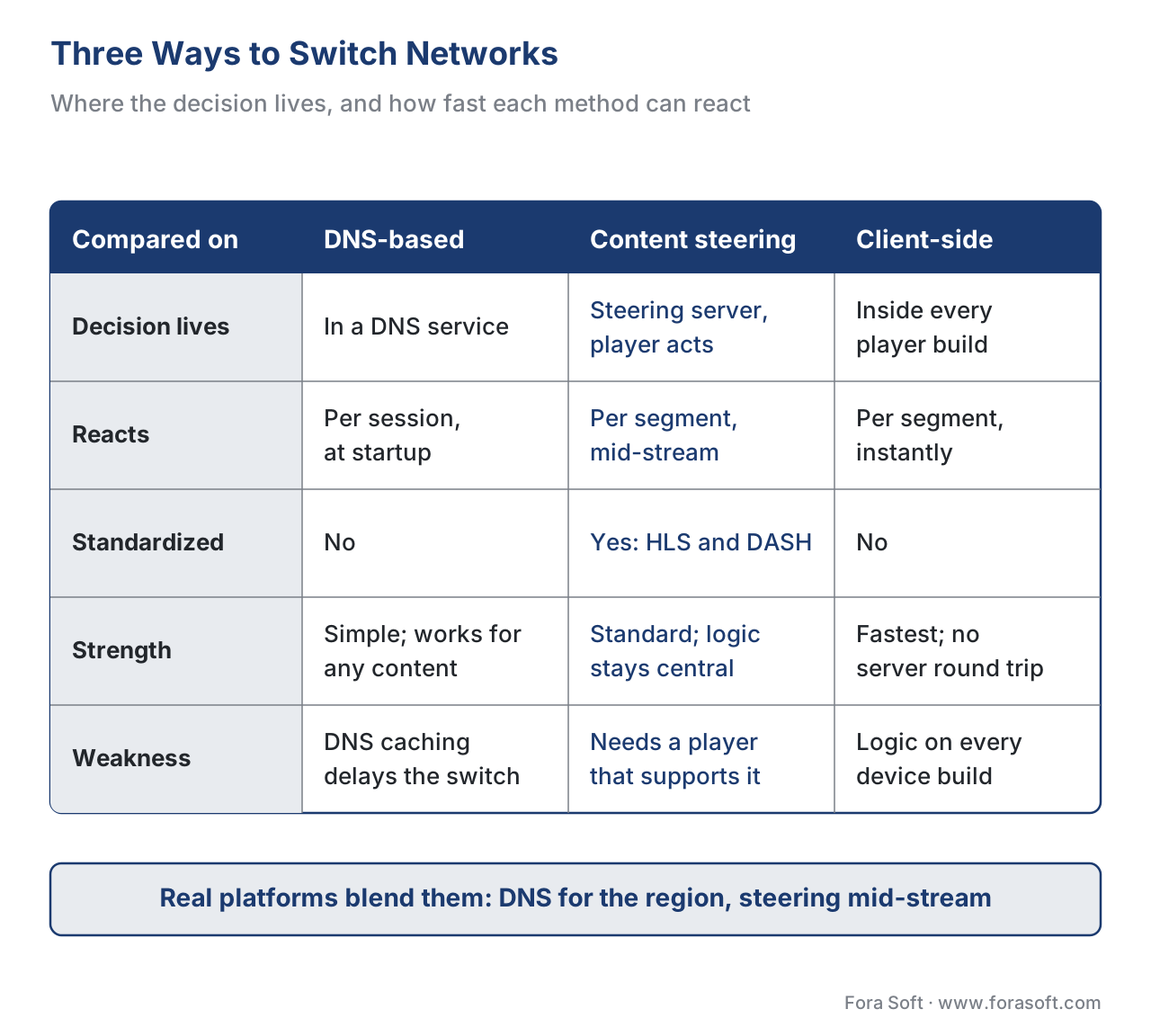 Figure 3. The three switching methods by where the decision lives and how fast each reacts. Content steering is the standardized middle — server logic, player action, per-segment switching. Most platforms blend two.
| Switching method | Where the decision lives | Reaction granularity | Strength | Weakness |
|---|---|---|---|---|
| DNS-based (NS1, Route 53, Citrix ITM) | A DNS/traffic-management service | Per session, at startup; coarse (whole viewer) | Simple; works for any content, not just video | Slow to react mid-stream; DNS caching delays the switch |
| Content steering (HLS / DASH) | A steering server, enacted by the player | Per segment, mid-stream; standardized | Standards-based; logic central, action in player; fast switch | Only HLS/DASH players that support it; needs a steering server |
| Client-side (decentralized) | Inside the player on each device | Per segment, instant; finest | Fastest reaction; no server round-trip | Logic duplicated across every device build; hard to change |
Table 1. The three switching methods, with where each makes its decision and how fast it can react. Real platforms blend them — for example DNS for the coarse regional assignment and content steering for mid-stream correction. "Supported?" caveat: content steering only helps on players that implement it; a smart-TV app on an old runtime may need the DNS or client path.
Content steering: the standardized way to switch mid-stream
Content steering is worth understanding precisely, because it is the part of multi-CDN that finally got a standard, and because the popular write-ups blur what it is.
Here is the plain-language version. Your video is described to the player by a manifest — the small index file that lists the available quality levels and the segment URLs. Content steering adds one line to that manifest pointing at a steering server, and groups the delivery options into pathways, where each pathway is, in practice, one CDN. The player periodically fetches a tiny JSON file from the steering server — the steering manifest — that lists the pathways in priority order. The player uses the first network on the list; if that network starts failing, the player marks it as penalized and drops to the next one; and every few minutes it rechecks the list, because the steering server may have re-ranked the networks since. The video keeps playing through all of this — the switch is just a change in which host the next segment is fetched from.
The mechanism is defined by the format, and naming the spec matters because the details are normative. For HLS, content steering is part of the HTTP Live Streaming specification (the second edition, published 2026, which carries forward RFC 8216): the multivariant playlist carries an EXT-X-CONTENT-STEERING tag with a SERVER-URI pointing at the steering server, and each variant stream carries a PATHWAY-ID that assigns it to a CDN. For MPEG-DASH, content steering is standardized as ETSI TS 103 998 (version 1.1.1, January 2024), developed by the DASH Industry Forum on top of the DASH standard ISO/IEC 23009-1; the manifest (the MPD) carries a ContentSteering element and tags each BaseURL with a serviceLocation naming its CDN, with an optional queryBeforeStart that tells the player to ask the steering server before it even starts. The cross-format steering-manifest itself — the JSON the player rechecks — is described in a shared specification by the HLS author, Apple's Roger Pantos, currently an informational Internet-Draft (draft-pantos-content-steering, last revised March 2026); it is not yet an IETF consensus standard, so treat the JSON shape as stable-but-evolving and re-verify before you build.
The steering manifest is small enough to show in full. Read directly from the specification, this is the whole thing:
{
  "VERSION": 1,
  "TTL": 300,
  "RELOAD-URI": "https://steering.example.com/v1?session=abc123",
  "PATHWAY-PRIORITY": [
    "cdn-a",
    "cdn-b"
  ]
}
Four fields do the work. VERSION is the format version. TTL is how many seconds the player must wait before asking again — the spec recommends 300 seconds (five minutes), and the server can vary it per client to spread its own load. RELOAD-URI is where to ask next time, and it can carry a session token so the steering server knows who is asking. PATHWAY-PRIORITY is the ranked list — here the player should prefer cdn-a, and fall back to cdn-b. When the server wants to move traffic, it simply reorders that array on the next fetch, and players migrate over the following few minutes as their TTLs expire. There is even a PATHWAY-CLONES mechanism that lets the steering server introduce a brand-new CDN at runtime — by cloning an existing pathway and rewriting its hostname — without touching the original manifest, which is how operators add a network mid-event.
Two things make this the right default. First, the logic lives on the server: to change how switching behaves, you edit what one steering server returns, not player code on a thousand device models. Second, it is backward compatible — a player that does not understand the steering tag simply ignores it and plays from its default network, so adding steering does not break old clients. The protocol-level internals — how the player's bitrate estimate feeds the steering query, how penalization timing is tuned — are a deep topic we cover in the Video Streaming section's multi-CDN architecture deep dive; here, the takeaway is that the orchestration layer's decision reaches the player as a re-ordered list it rechecks on a timer.
How the system measures which CDN is best
A decision engine is only as good as the signals it scores. "Which CDN is best right now" is a measurement problem, and there are four kinds of measurement, each with a bias you should know before you trust it.
The first is community real-user measurement (RUM) — performance data collected from real browsers across many websites, the dataset Cedexis (now Citrix ITM) pioneered by running a small JavaScript probe on popular sites that times how fast each CDN delivers a test object. It is broad and easy to consume, and good for spotting a CDN's performance trend. But, as Amazon's delivery engineers warn, it carries two biases when used to compare CDNs for your service: a methodology bias (it measures small hot objects, around 100 KB, while your video is a mix of large warm and cold segments) and a configuration bias (the measured CDN setup is not your setup). Community RUM tells you the weather over the city, not the runway you are about to land on.
The second is private RUM — the same idea, but measuring your own delivery: a probe that times throughput and availability against your real CDN hostnames using object sizes closer to your segments (500 KB and up). It is more representative and the right input for a switching algorithm, at the cost of running it yourself.
The third, and the most honest about what viewers actually feel, is player quality-of-experience (QoE) telemetry — an agent inside your own player reporting the metrics that map to viewer pain: startup time, rebuffering ratio, and the bitrate actually delivered. Built in-house or sourced from a vendor like Mux, Conviva, or NPAW, this measures your content, on your viewers' devices, over the network paths they really use. Its weakness is the mirror of community RUM's strength: in a region with few viewers, you may not have enough data points to decide reliably, which is exactly where community RUM fills the gap. We cover this telemetry in depth in delivery observability.
The fourth is CDN-supplied operational data — the real-time error and performance logs the CDNs themselves provide. It is easy to picture the CDNs as passive networks the operator shuffles traffic between, but a good provider is an active participant: during a live event, its real-time logs let you triangulate a problem against your own player data, and confirm a network has recovered before you steer traffic back to it.
The practical design is to blend these. Player QoE is the truth of what viewers feel; private RUM gives you network-quality numbers where viewers are sparse; community RUM covers the long tail; CDN logs confirm and explain. The decision engine scores the networks from this blend and re-ranks them on a cadence — and the steering manifest's five-minute TTL is the rate at which those re-rankings reach players.
The math, out loud: availability and cost
Two numbers justify multi-CDN, and both reward being walked through slowly, the way the bytes and the dollars actually move.
Start with availability, measured in "nines." One CDN at 99.9% availability — three nines — is unavailable 0.1% of the year:
downtime (1 CDN) = 0.001 × 8,760 hours/year
                 = 8.76 hours/year
Now add a second, independent CDN that can serve the same content, with failover fast enough that a viewer rides through the switch. The platform is only down when both networks are down at the same moment. If their failures were truly independent, the combined unavailability is the product of the two:
combined unavailability = 0.001 × 0.001
                        = 0.000001  (i.e. 99.9999% — six nines)
downtime (2 CDNs) ≈ 0.000001 × 8,760 h ≈ 31 seconds/year
That six-nines figure is the theoretical ceiling, and you should not promise it, because real failures are not fully independent: two CDNs can share an upstream transit provider, both can be fed by the same struggling origin, the steering server itself can fail, and failover is never truly instant. Those correlations and the switch itself drag the real result down to roughly four nines — about 99.99%, or 52 minutes of downtime a year. But four nines against three is still a 10× reduction in outage time, and the difference between "we lost a region for the whole premiere" and "viewers saw a few seconds of buffering as we rerouted." That gap is the resilience case in one line.
Now cost. Carry forward the worked example from how a CDN delivers video: a mid-size service delivering about 2.25 petabytes (PB) — 2,250,000 GB — to viewers each month. Suppose a single CDN, on a pay-as-you-go blend across your regions, costs an effective $0.020 per GB:
single-CDN egress = 2,250,000 GB × $0.020/GB
                  = $45,000 / month
Multi-CDN attacks that bill two ways. First, commit blending: each CDN discounts steeply once you commit a monthly volume, so splitting traffic to clear two providers' commit tiers buys a lower effective rate than one provider's part-commit-part-burst bill. Second, regional cost steering: the premium CDN may charge two to three times more in Asia-Pacific and South America than in North America, so you route that expensive tail to a regional network that is cheaper there. Blend both and an effective rate near $0.014 per GB is realistic — published mid-market CDN rates run roughly $0.01–$0.04 per GB after negotiation, so this sits in range:
multi-CDN egress = 2,250,000 GB × $0.014/GB
                 = $31,500 / month
saving           = $45,000 − $31,500 = $13,500 / month
                 ≈ 30% ≈ $162,000 / year
A 30% reduction is squarely inside the 25–40% range that multi-CDN cost optimization is reported to deliver when expensive regions are routed to alternative providers. The dollar figures are illustrative and dated — per-GB rates are negotiated, regional, and change — so treat the method as the lesson, not the exact numbers, and model your own in the CDN cost engineering article. And note one honest subtraction, which the next section makes precise: splitting traffic can lower your cache-hit ratio, which raises origin traffic, so the true saving is the egress win minus any offload loss.
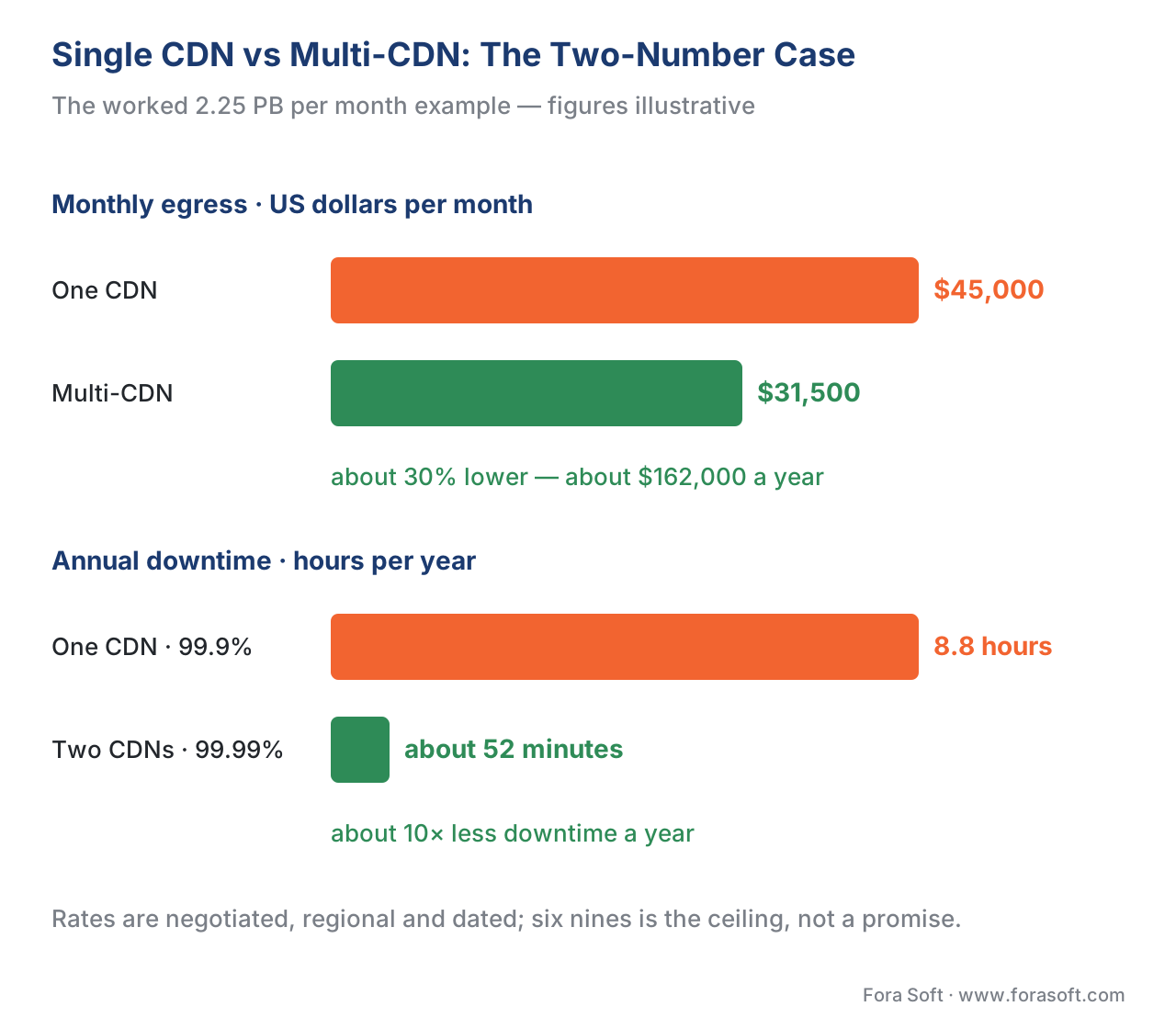 Figure 4. The two-number case for multi-CDN on the worked 2.25 PB service: monthly egress falls from about $45,000 to about $31,500 (≈30%), and annual downtime drops from ~8.8 hours toward under an hour. Figures illustrative; rates negotiated and dated.
The catch nobody mentions: multi-CDN dilutes your cache
Here is the cost that the vendor pitch leaves out, and the reason multi-CDN is not free money.
In how a CDN delivers video we showed that streaming is cheap because of the offload ratio — the share of bytes served from a CDN's cache instead of fetched from your origin — and that a single popular segment, cached once at an edge, can serve thousands of viewers. That economy depends on viewers converging on the same cached copy. Multi-CDN works against exactly that convergence.
When you split a title's audience across three networks, each network has to cache that content independently. The first viewer of a segment on CDN A causes a fetch from your origin to fill CDN A's cache; the first viewer of the same segment on CDN B causes a second fetch to fill CDN B's cache; CDN C, a third. As Amazon's engineers put it plainly, spreading traffic across multiple CDNs "reduces the global cache hit ratio," because your traffic now has to populate several caches instead of one. The effect is worst for catalogs with a long cold tail — video-on-demand and linear TV, where many titles are each watched by relatively few people — and mildest for a hot live event where everyone wants the same segment at the same second on whichever network they are on.
This is the tension at the heart of multi-CDN economics: the egress saving from cost-steering can be partly eaten by the origin-egress increase from a diluted cache. The defenses are concrete. Keep an origin shield in front of the origin so that the several CDNs' misses collapse against one mid-tier cache instead of stampeding your origin — the same shield from origin and origin shielding, now doing double duty. Do not over-split: two well-chosen networks usually capture most of the resilience and bargaining power with far less cache dilution than five. And weigh the split by catalog type — a hot live event tolerates aggressive multi-CDN; a deep VOD library with a cold tail wants a more conservative split. The lesson from the previous article holds here with a vengeance: the offload ratio is the number that decides delivery margin, and multi-CDN is one of the few architecture choices that can quietly push it the wrong way.
A common mistake: the switch stampede and the panacea trap
The most damaging multi-CDN errors are not in the wiring; they are in believing the switch is smarter and more curative than it is.
The first is the switch stampede. Picture a navigation app that sees traffic ahead and tells you to take the next exit — and tells everyone else the same thing at the same instant, so the bypass jams as badly as the road. A naive multi-CDN does exactly this: CDN A degrades, the system moves all affected viewers to CDN B in one step, and now CDN B — which was sized for its normal share — is slammed with double its load and degrades too. The fix is to treat switching as load-balancing, not a light switch: shift traffic in measured proportions, watch the target network's headroom, and accept that the CDN winning by a hair at one instant is not a reason to send it everything. Good orchestration ramps; it does not dump.
The second is the panacea trap — using CDN switching as the first answer to every delivery problem. Switching networks does nothing for a problem that lives in the stream itself: a misconfigured manifest, a bad cache key that forks one segment into thousands of per-viewer copies (see edge caching, cache keys, and tokenized URLs), or a struggling ISP that every CDN in that region peers through. If the root cause is upstream of the CDNs, moving traffic between them just relocates the symptom. As the Streaming Video Technology Alliance puts it, multi-CDN "is not a panacea for delivery problems" — it is one tool in a delivery strategy, and it sits on top of an actual diagnosis, not in place of one.
Three smaller traps travel with these. Feature lowest-common-denominator: your platform can only use features all your CDNs support the same way, so a clever optimization on one network may be off the table once you add a second that lacks it. Token-auth drift: each CDN secures URLs with its own tokenized-URL scheme, so a viewer steered from one to another can be rejected unless your tokens work across both — the industry fix, a Common Access Token standardized by the SVTA and CTA-WAVE, is exactly aimed at this. And the cost of the decision itself: the data analysis that powers smart switching is not free, and a system that spends more analyzing which CDN is cheapest than it saves by switching has missed the point. Every one of these is survivable with design; none of them shows up in a vendor demo.
When multi-CDN is worth it — and when one CDN is the right answer
Because the costs are real, the honest default for a new or mid-size platform is one well-configured CDN with an origin shield, not multi-CDN. A single mature CDN already routes viewers to its best point of presence, reroutes around its own failures within its network, and delivers three-nines availability — enough for most products, and without the vendor-management overhead, the feature lowest-common-denominator, or the cache dilution.
Multi-CDN earns its complexity when one or more of these is true. You operate at petabyte-per-month scale, where a single CDN cannot commit the regional capacity you need for peak events, and where the cache-dilution penalty is small relative to the cost advantage. Availability is contractual — you have signed service-level agreements or your content is live and unmissable (sports, a finale), so the cost of a single network's bad hour is measured in churn and make-goods. Your audience is truly global, spanning regions where no single CDN is best everywhere. Or your egress bill is large enough that a 25–40% cost-steering saving exceeds the cost of running the orchestration. If none of these holds, the second network is complexity you are paying for without using — and adding it can even introduce a new point of failure (the steering layer) to a system that did not need one. The right architecture is the simplest one that meets your resilience, reach, and cost requirements — for many platforms that is one CDN, and the discipline is knowing when you have actually crossed the line into needing two.
Free download: Multi-CDN Decision ChecklistA one-page checklist to work through before you sign a second CDN: whether you have a real trigger (petabyte scale, contractual availability, a global audience, a large egress bill), which switching method fits your players, and which measurement signals to blend.Where Fora Soft fits in
A multi-CDN architecture is a scale decision before it is a technical one: it pays off at petabyte volumes, global reach, and contractual availability, and below that line it is complexity without a return — so the first job is deciding whether you have crossed that line at all. Fora Soft has built video streaming, OTT/Internet TV, e-learning, telemedicine, and video surveillance software since 2005, across 625+ shipped projects for 400+ clients, and that work centers on exactly this kind of scale-and-cost engineering: sizing whether one CDN or several fits a platform's audience and budget, wiring a steering layer that ramps traffic instead of dumping it, keeping an origin shield in front so a multi-CDN split does not wreck the offload ratio, and making tokenized access work across networks so a steered viewer is never locked out. When a media company needs a delivery design whose availability and egress bill both survive a real, growing, global audience, that orchestration engineering is the capability we bring.

The handbook
Fora Soft Video Engineering Handbook
We wrote a seven-volume handbook that takes the whole video stack apart across 9,000+ pages — encoding, delivery, audio, and AI — and the multi-CDN decision you have just read lives in volume 3: ABR and CDN behaviour, cache and offload economics, player logic, and where the egress bill actually comes from. Volume 2 covers the transport and the HLS and MPEG-DASH manifests that content steering switches between, and volume 1 covers the encoder whose renditions fill those caches. Read them and you can size whether a second network pays for itself at your volume, wire the steering layer, and hold your ground with a vendor. Written by Nikolay Sapunov, CEO at Fora Soft.
Is a second CDN worth it at your volume?
Tell us how many bytes you deliver a month, where your viewers are, and what availability you have promised, and we will say whether multi-CDN pays for itself, what the split does to your cache-hit ratio, and how the steering layer should be wired — 625+ projects shipped since 2005.
See our case studies
Case study
Worldcast Live
Concert streaming at 1.5 Gb/s and 0.4 to 0.5 s glass-to-glass for 10,000 simultaneous viewers — the capacity end of delivery, where one network's bad hour is the whole show.
Case study
Sprii
A Danish live shopping platform with 72,000+ live events and 3,000+ brands across Europe, delivered over RTMP, WebRTC, and Cloudflare — the global reach where no single network is best everywhere.
Case study
TradeCaster
46,000+ traders watching live desktops and charts, autoscaled for the market-open spike — the peak-capacity question that decides how much delivery you have to source.
What to read next
Delivery
How a CDN delivers video: origin, edge, and cache
The single network this article multiplies — what one CDN does end to end.
Origin
Origin shield explained: protect your streaming origin
The mid-tier cache that keeps a multi-CDN split from wrecking your offload ratio.
Cost
CDN cost engineering: egress, commits, and the 95th percentile
Where the $45,000 a month comes from, and what commit blending moves.
Observability
Delivery observability: who is buffering and where
The player telemetry the decision engine scores your networks on.
References
- HTTP Live Streaming 2nd Edition (HLS) — IETF / Apple (R. Pantos, Ed.), draft-pantos-hls-rfc8216bis, February 2026. Defines the
EXT-X-CONTENT-STEERINGtag (SERVER-URI) and thePATHWAY-IDattribute that assigns each variant stream to a CDN pathway; the successor to RFC 8216 (2017). Tier 1 (format specification). https://datatracker.ietf.org/doc/html/draft-pantos-hls-rfc8216bis (accessed 2026-06-16) - ETSI TS 103 998 V1.1.1 — Content Steering for DASH — ETSI / DASH Industry Forum, January 2024. The DASH content-steering standard: the
ContentSteeringelement,serviceLocation-taggedBaseURLs,@queryBeforeStart, andSERVICE-LOCATION-PRIORITY. Tier 1 (formal standard, Publicly Available Specification). https://www.etsi.org/deliver/etsi_ts/103900_103999/103998/01.01.01_60/ts_103998v010101p.pdf (accessed 2026-06-16) - ISO/IEC 23009-1 — Dynamic Adaptive Streaming over HTTP (MPEG-DASH) — ISO/IEC, 2022 edition. The DASH standard whose MPD and
BaseURL/serviceLocationstructure content steering switches between. Tier 1 (format specification). https://www.iso.org/standard/83314.html (accessed 2026-06-16) - Content Steering (draft-pantos-content-steering-03) — IETF Independent Submission (R. Pantos, E. Vershen, Apple), revised March 2026. The cross-format steering-manifest JSON (
VERSION,TTLrecommended 300 s,RELOAD-URI,PATHWAY-PRIORITY,PATHWAY-CLONES) and the client penalization algorithm; read directly this run. Informational Internet-Draft — explicitly "not an Internet standard" and not IETF consensus; treat as stable-but-evolving. Tier 2 (standards-author primary). https://datatracker.ietf.org/doc/draft-pantos-content-steering/ (accessed 2026-06-16) - RFC 9111 — HTTP Caching — IETF, 2022. The shared-cache and offload model behind the cache-dilution point: each CDN is a separate shared cache that must be populated independently. Tier 1 (official standard). https://www.rfc-editor.org/rfc/rfc9111.html (accessed 2026-06-16)
- Using multiple content delivery networks for video streaming – part 1 — Amazon Web Services (Achraf Souk), 2019 (updated 2020). The reasons to run multi-CDN (redundancy, performance, capacity, commercial), the drawbacks, the RUM methodology/configuration biases, and the explicit warning that spreading traffic "reduces the global cache hit ratio." Tier 4 (vendor engineering). https://aws.amazon.com/blogs/networking-and-content-delivery/using-multiple-content-delivery-networks-for-video-streaming-part-1/ (accessed 2026-06-16)
- Multi-CDN Delivery — Streaming Video Technology Alliance (J. Thibeault et al.), October 2024. The centralized / centralized-decentralized / decentralized switching taxonomy, content steering vs other approaches, the switch-stampede problem, "not a panacea," and the Common Access Token cross-CDN token effort. Tier 5 (industry alliance). https://www.svta.org/2024/10/24/multi-cdn-delivery/ (accessed 2026-06-16)
- NetScaler (Citrix) Intelligent Traffic Management — Cloud Software Group. RUM-plus-DNS/API global load balancing for multi-CDN, the product built from the Cedexis real-user-measurement network acquired by Citrix in 2018. Tier 4 (vendor engineering). https://docs.netscaler.com/en-us/citrix-intelligent-traffic-management.html (accessed 2026-06-16)
- What Is Multi-CDN? — ioRiver. Vendor-neutral definition of multi-CDN, health-based load balancing, and the availability case for combining independent networks. Tier 5 (institutional). https://www.ioriver.io/terms/multi-cdn (accessed 2026-06-16)
- Implementing HLS / DASH Content Steering at Scale — Y. Reznik et al. (IBC 2023 Technical Papers). A real-world account of deploying content steering across HLS and DASH, including steering-server design and switching behavior at scale. Tier 5 (peer / conference). https://www.reznik.org/papers/IBC2023-Implementing-HLS-DASH-Content-Steering-at-Scale.pdf (accessed 2026-06-16)
- What is Network 95th Percentile? — bunny.net (CDN Academy). The 95th-percentile and commit-vs-burst billing models that make commit blending across CDNs a cost lever; used to frame the cost arithmetic. Tier 4 (vendor engineering — dated, re-verify rates). https://bunny.net/academy/cdn/what-is-network-95th-percentile/ (accessed 2026-06-16)
Source note (per §4.3.2): the content-steering mechanism traces to tier-1 format standards — the HLS 2nd-edition specification for EXT-X-CONTENT-STEERING/PATHWAY-ID (ref 1), and ETSI TS 103 998 on top of ISO/IEC 23009-1 for DASH (refs 2–3); the cross-format steering-manifest JSON is the standards-author primary draft (ref 4), cited with its explicit non-standard status. The cache-dilution claim is grounded in the RFC 9111 shared-cache model (ref 5) and corroborated first-party by AWS (ref 6). Where popular "build a multi-CDN" posts imply switching is a cure-all, the article follows the SVTA's "not a panacea" framing (ref 7) and the AWS cache-hit-ratio warning (ref 6). Cost per-GB figures (ref 11 and mid-market ranges) are vendor/dated and labelled illustrative; the availability arithmetic is first-principles probability with an explicit correlation caveat.
