


Why this matters
The origin is the smallest, most expensive, least replaceable part of a streaming platform — a few servers (sometimes one logical endpoint) that every cache miss in the world eventually reaches — and it is where launches die. A platform can have a 95% cache-hit ratio and still take its origin down, because the 5% that miss can arrive as a synchronized wall during a live start, and because a modern origin often spends real CPU packaging each segment rather than just copying a file. Origin shielding is the cheap, well-understood layer that turns that wall into a trickle, and origin failover is the design that keeps one dead machine from becoming one dead service. This article is for the founder, product manager, or streaming engineer who needs to understand the origin tier well enough to size it, brief a CDN vendor on shielding, and avoid the architecture where a single origin is the single point of failure for the whole catalog. By the end you will be able to draw the path from a viewer's tap to your origin, point to the one consolidation layer that protects it, and say what happens when it fails.
A one-minute refresher: the origin is the warehouse
This article builds on the delivery mechanics in how a CDN delivers video and the cache-key hygiene in edge caching, cache keys, and tokenized URLs; here is the piece you need in front of you.
A content delivery network — the global fleet of caching servers, called a CDN, that holds copies of your video close to viewers — works like a chain of corner stores stocked from one central warehouse. The origin is the warehouse: the one authoritative server that holds the true copy of every file. The CDN's edge servers are the corner stores near viewers. When a viewer requests a video segment (a few seconds of video, addressed by its own URL) and the nearby edge already has it, that is a cache hit — served instantly, cheaply, without touching the warehouse. When the edge does not have it, that is a cache miss, and the edge drives to the warehouse to fetch it first.
Everything good about streaming economics comes from keeping viewers away from the warehouse. The number that captures it is the offload ratio — the share of delivered bytes served from cache rather than the origin. This article is about the warehouse itself: what it actually is, why a crowd can overrun it, and the one shelf of regional depots — the origin shield — you put between the corner stores and the warehouse so the warehouse is asked for each item only once.
What the origin actually is in an OTT platform
The word "origin" hides a distinction that decides everything that follows: a streaming origin is rarely a plain file server. It is usually one of two things, and the second is the dangerous one.
The simple case is a static origin — object storage (Amazon S3, Google Cloud Storage, an on-prem store) holding pre-packaged segments and manifests. A request for segment 42 returns bytes already sitting on disk. Cost per request is mostly the bytes sent out, called egress (what you pay to move data out of the origin), and the spec for those addresses is stable: the HLS playlist defined in IETF RFC 8216 lists each segment as a URI, and MPEG-DASH (ISO/IEC 23009-1) generates segment URLs deterministically from a template, so every viewer asks for the identical address.
The dangerous case is a just-in-time (JIT) packaging origin — a compute service (AWS Elemental MediaPackage and its peers) that does not store finished segments at all. It holds the encoded video once and assembles the right container and encryption on demand: HLS for the Apple device, DASH for the Android device, the cbcs-encrypted variant for the protected stream, the clear variant for the trailer. This is the modern default because it avoids storing every format permutation — we cover the upstream of it in packaging: CMAF, HLS, and DASH. The catch is in the cost shape: AWS notes that "customer origins with processes that require more compute per request, such as just-in-time packaging, can be sensitive to the number of origin fetches." A static origin fears bytes; a JIT origin fears requests, because each miss is a small CPU job, not a disk read. Hold that distinction — it is why shielding matters more for streaming than for almost any other workload.
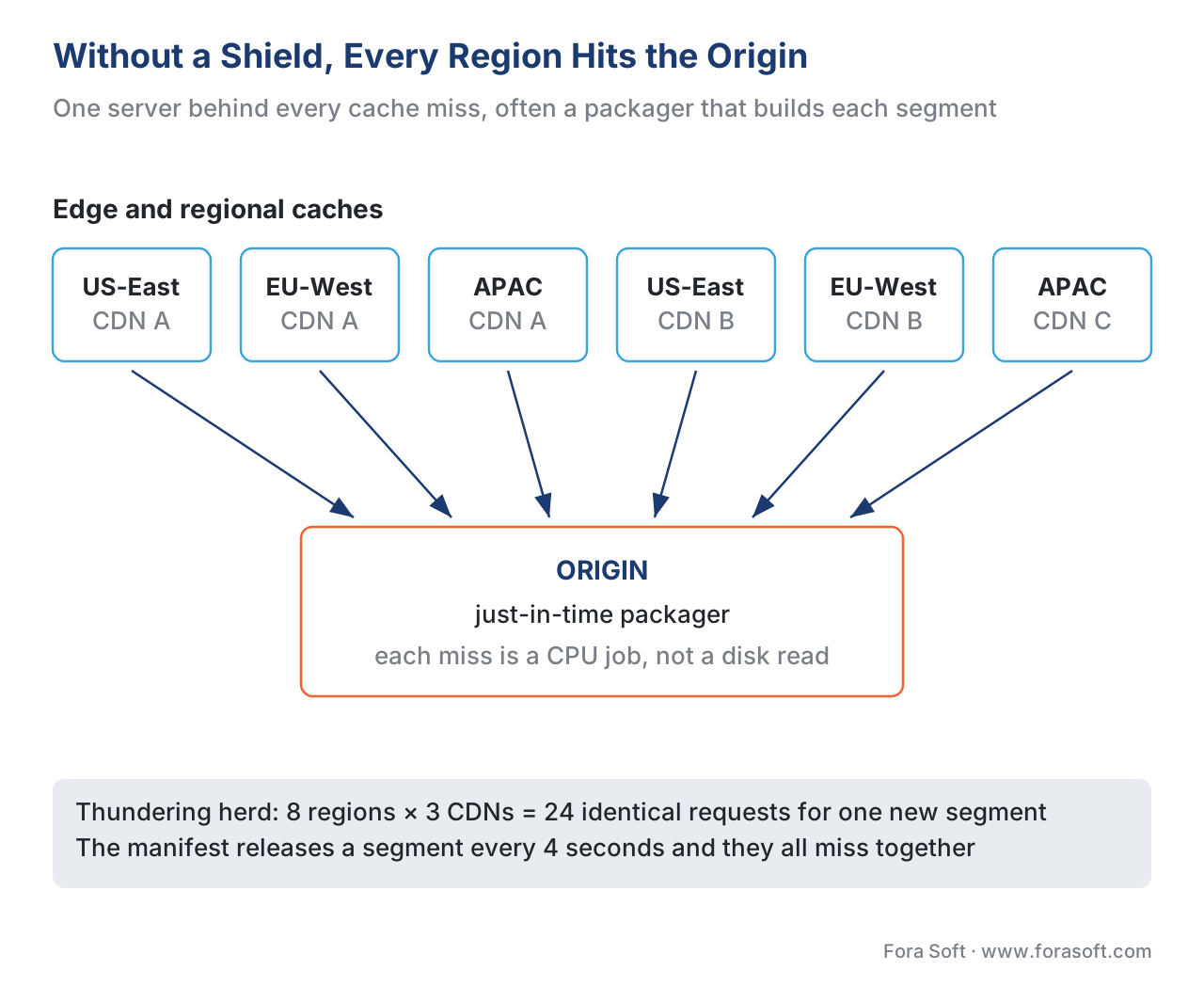 Figure 1. Without a shield, every regional edge cache that misses sends its own request to the one origin. For a just-in-time packaging origin, each of those is a compute job — and a live start makes them all arrive at once.
Why an unshielded origin melts: the fan-in problem
Here is the failure, and it follows directly from the geometry of a CDN. A CDN is wide at the edge — thousands of locations near viewers — and narrow at the origin, which is one place. Traffic fans out to viewers and fans in to the origin. On a cache miss, that fan-in is the whole problem.
A CDN is built in tiers to soften it. Viewer requests hit a nearby edge location first; if that misses, the request goes to a regional mid-tier cache (CloudFront calls these regional edge caches) that consolidates for a whole geography; only if that misses does the request reach the origin. The trouble is that viewers are spread across regions, and, as AWS's documentation puts it, "when viewers are in different geographical regions, requests can be routed through different regional edge caches, each of which can send a request to your origin for the same content." Ten regions cold-missing the same new segment means ten origin requests for one object — before you add a second CDN, each of which fans in separately.
Now add the live premiere, the hardest version. The structure of streaming is a manifest plus short segments, and the HLS spec (RFC 8216) has the live player re-fetch the manifest every few seconds to discover the newest segment. So 100,000 viewers do not arrive smoothly — they request segment 1 in the same second, then segment 2 together a few seconds later, in lockstep, because the manifest releases segments on a clock. Every few seconds the edges cold-miss the brand-new segment simultaneously and reach toward the origin together. Engineers call this synchronized rush the thundering herd (or a cache stampede): a herd of identical requests trampling the one server when a popular object is not yet cached. A static origin chokes on the bandwidth; a JIT origin chokes on the compute — and it chokes during the premiere you cannot re-run.
Walk the arithmetic out loud, because the scale is the point. Take a service streaming a live event to 100,000 concurrent viewers, 4-second segments, delivered through 8 regional caches across 3 CDNs:
Per new segment (released every 4 seconds):
  regional caches that cold-miss it ≈ 8 regions × 3 CDNs = 24
  origin requests per segment WITHOUT a shield ≈ 24
  for a JIT origin, that is 24 packaging jobs per segment,
  ~6 jobs/second sustained — multiplied across every rendition
  in the ladder (e.g. 6 renditions) → ~144 origin jobs/second

With one origin shield in front of the origin:
  the shield collapses all 24 into ONE request per segment
  origin requests per segment ≈ 1   (≈ 6/second across the ladder)
  origin packaging load cut by ~24×
The unshielded origin is asked to do twenty-four times the work for zero extra delivered value — every one of those requests returns the identical bytes. That multiplier is what melts origins, and it grows with every region and every CDN you add.
The origin shield: one consolidation point
The fix is structural and boringly effective: insert one more caching layer, the origin shield, as the single place that is allowed to talk to the origin. Every edge and every regional cache, across every region, routes its origin-bound misses through that one shield. The shield holds a copy after the first fetch; everyone else gets it from the shield. As AWS describes its CloudFront Origin Shield, it is "an additional layer in the CloudFront caching infrastructure" through which "all requests from all of CloudFront's caching layers to your origin go," so "CloudFront can retrieve each object with a single origin request from Origin Shield to your origin."
Two mechanisms do the heavy lifting. The first is the extra cache tier itself: one more place a request can hit before the origin, which mathematically raises the chance of a hit. The second, and the one that tames the thundering herd, is request consolidation (also called request collapsing or coalescing): when many requests for the same not-yet-cached object arrive at the shield at once, the shield sends one request to the origin and makes the others wait for that single response. AWS states it plainly: requests "are consolidated with other requests for the same object, resulting in as few as one request going to your origin." The herd hits the shield, not the origin; the shield knocks on the warehouse door once.
Think of the shield as the regional distribution depot a retail chain puts between its thousands of corner stores and its single national warehouse. The stores never call the warehouse directly. They call the depot; the depot holds one of everything popular and calls the warehouse only for the rare item it lacks — once, no matter how many stores asked. The warehouse, protected behind the depot, stays calm during the holiday rush.
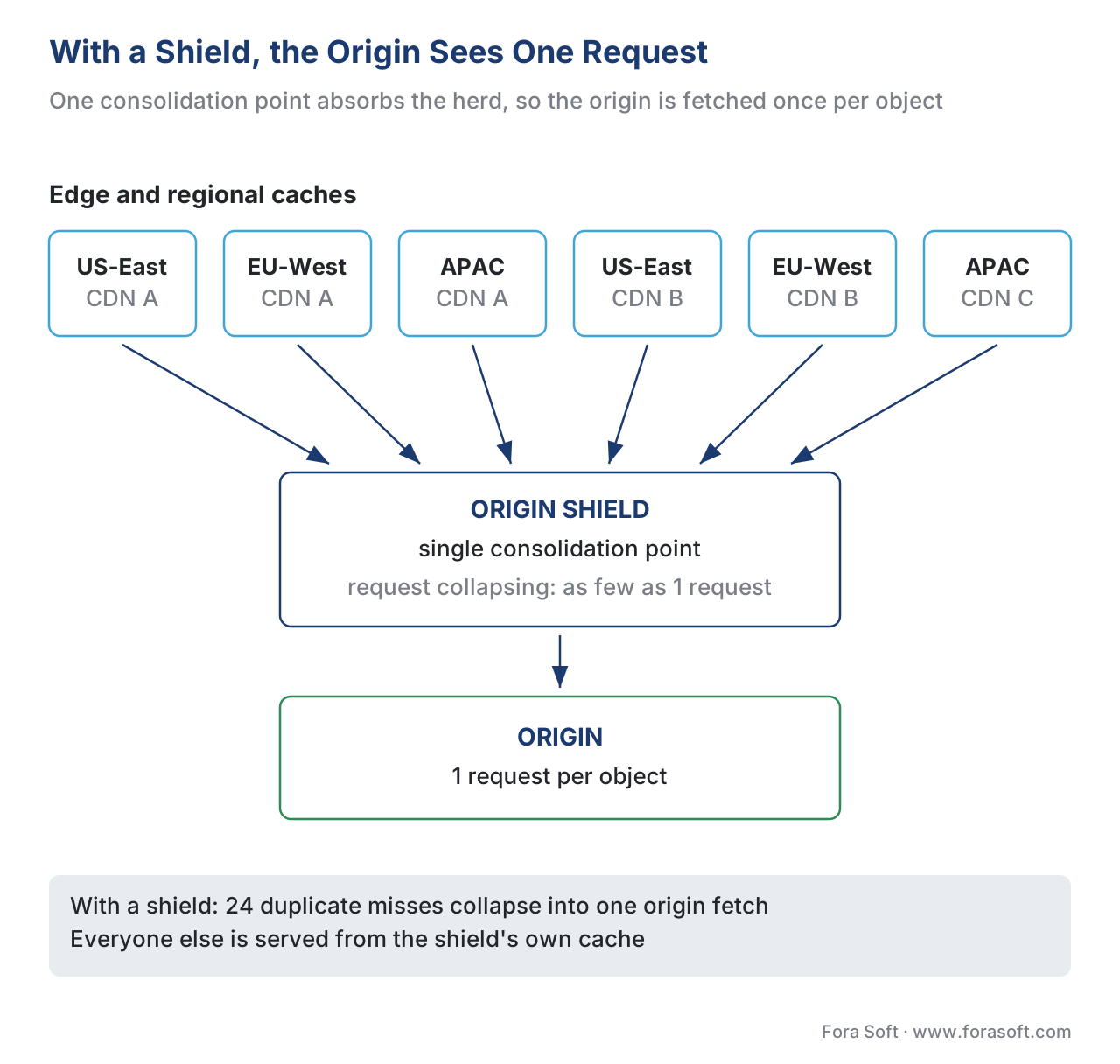 Figure 2. The origin shield is the single consolidation point. Every region's misses route through it; it fetches each object from the origin once and serves all the rest from its own cache, so the origin sees one request where it would have seen dozens.
The offload math: why a small cache gain is a big origin win
The reason shielding pays for itself is that origin load is not linear in the cache-hit ratio — it is linear in the miss ratio, which is the small number, so small improvements swing it hard. Fastly's engineering team puts the case directly: raising the cache-hit ratio "from 90% to 95%… is not merely a 5% improvement; it actually halves your origin load," because the miss rate falls from 10% to 5%, and the misses are exactly what reach the origin. Halve the misses, halve the origin's work.
A shield improves both terms. It adds a cache tier (raising the hit ratio) and it consolidates the remaining misses (so even a true miss usually becomes one origin request, not many). Fastly's measurements of a real customer toggling shielding off show the magnitude: with shielding the origin held at roughly 1.6 GiB/s; with shielding disabled the same origin climbed to 20+ GiB/s of steady-state load — more than a tenfold swing — even though the headline cache-hit ratio barely moved. AWS reports the same direction from the customer side: users running Origin Shield for "live streaming, image handling, or multi-CDN workloads have reported up to a 57% reduction in their origin's load."
There is a measurement subtlety worth naming, because it trips up dashboards. When a request is served from the shield after missing at the edge, a naive cache-hit-ratio calculation can count it as a miss (it missed the edge) even though the origin never saw it. That is why Fastly argues for measuring origin offload — the share of delivered bytes that never touched the origin — rather than request-based hit ratio alone. For a streaming platform the bytes are the bill, so origin offload is the number that maps to money. We pick up that cost thread in CDN cost engineering: egress, commits, and the 95th percentile.
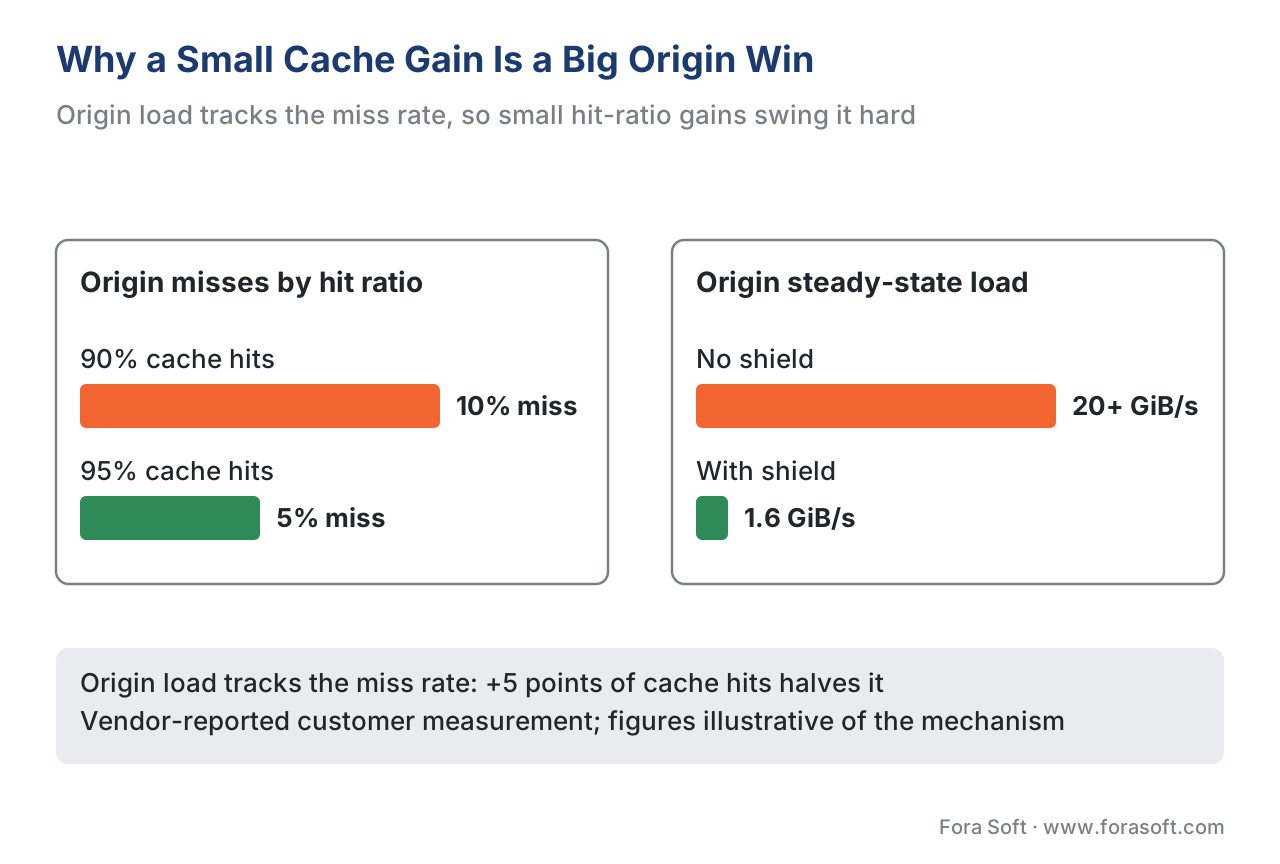 Figure 3. Two levers on origin load. Left: a 90%→95% hit ratio halves origin misses (10%→5%). Right: a measured customer's origin held ~1.6 GiB/s with shielding vs 20+ GiB/s without. Figures illustrative of the mechanism.
How the major CDNs implement shielding
The idea is universal; the names and the knobs differ. Naming four keeps the vendor pitches legible, and the differences matter when you choose where the single consolidation point lives.
Amazon CloudFront — Origin Shield. You enable it per origin and choose one AWS Region for the shield, ideally the Region with the lowest latency to your origin. It reuses CloudFront's regional edge caches, so it inherits their high-availability design (multiple Availability Zones) plus "active error tracking" that auto-routes to a secondary shield location if the primary is unavailable. It is explicitly recommended for JIT packaging and multi-CDN. Pricing is a per-request fee for traffic that goes through the shield as an incremental layer — and note that GET/HEAD requests with a time-to-live under 3,600 seconds count as dynamic and are always charged, which matters for short-TTL live manifests.
Cloudflare — Tiered Cache. Cloudflare divides its data centers into lower tiers (near viewers) and upper tiers; "only the upper-tier can ask the origin for content." Smart Tiered Cache automatically picks the single upper-tier data center with the lowest measured latency to your origin — the shield, chosen for you. Because it "concentrates connections to origin servers" to a few locations, the origin also sees far fewer open connections. One gotcha for streaming origins on public cloud: anycast networking defeats latency probing, so you set a cloud region hint (e.g. aws:us-east-1) so Cloudflare picks the right upper tier.
Akamai — Tiered Distribution. Akamai designates servers near your origin as parents that "cache your content and serve it to other servers" on its platform. You choose a distribution map: Global (optimize end-user latency) or Local (a specific region — "select this if your primary goal is to maximize the offload of your origin server"). For large libraries, Cloud Wrapper extends the same idea with a persistent cache footprint near the origin.
Fastly — Shielding. You designate one Fastly POP as the shield for an origin; edge POPs that miss fetch from the shield POP, which fetches from the origin once. Fastly pairs this with the origin offload metric so you can see the byte-level benefit the request-based hit ratio hides, and Media Shield extends shielding for multi-CDN delivery.
| CDN / feature | What it's called | Single consolidation point chosen how | Multi-CDN support | Reduces origin load? |
|---|---|---|---|---|
| Amazon CloudFront | Origin Shield | You pick one AWS Region (lowest latency to origin) | Yes — CloudFront as origin for other CDNs | Yes — "as few as one request" per object; up to ~57% reported |
| Cloudflare | Tiered Cache (Smart) | Auto-selected lowest-latency upper tier; cloud region hint for cloud origins | Via Bandwidth Alliance / upper tiers | Yes — only the upper tier fetches from origin |
| Akamai | Tiered Distribution | Parent servers near origin; Global vs Local map | Yes — Cloud Wrapper for large libraries | Yes — Local map maximizes origin offload |
| Fastly | Shielding | You designate one shield POP per origin | Yes — Media Shield | Yes — measured via origin-offload metric |
Table 1. The four shielding implementations. The "single consolidation point chosen how" column is the design decision that matters: every CDN funnels origin traffic through one place, but you choose (or it chooses) which place, and that choice should sit near your origin.
Where to put the shield, and the multi-CDN twist
The rule is short: put the shield where it has the lowest latency to your origin, not to your viewers. The shield's job is to sit close to the warehouse so that the rare real origin fetch is fast and reliable, and so that traffic stays on the CDN's fast backbone right up to the origin's doorstep. CloudFront says to choose the shield Region with "the lowest latency to your origin"; Akamai's Local map is "select this if your primary goal is to maximize the offload of your origin server"; Cloudflare's Smart Tiered Cache picks the lowest-latency upper tier and offers the cloud region hint precisely so it lands near your cloud origin. Same instinct, three dashboards.
Multi-CDN sharpens the point into a trap and a fix. If you run more than one CDN — the architecture we cover in multi-CDN architecture and orchestration — then each CDN fans in on your origin independently, so your origin can receive "many duplicate requests for the same content, each coming from a different CDN." Two CDNs can double your origin load for zero extra delivered value. The fix AWS documents is to point your other CDNs at a CDN that shields, using CloudFront (with Origin Shield) as the origin for the other CDNs, so every CDN's misses funnel through the one shield and the true origin sees a single, consolidated stream — plus, as a bonus, "a common cache key across CDNs." Whatever the vendor, the principle holds: in multi-CDN, the shield is the shared front door that keeps every CDN from knocking separately.
Failover and multi-region origins: when one server is not enough
Shielding protects an origin that is up. The other half of origin resilience is the origin that is down — because a shield in front of a single dead origin just caches the outage. Two designs address it, and you usually want both.
The first is origin failover: a primary origin and a secondary the CDN switches to when the primary fails. CloudFront implements this with an origin group — a primary and a secondary plus failover criteria you choose from the status codes 400, 403, 404, 416, 500, 502, 503, and 504. When the primary returns a configured failure (or times out), CloudFront re-sends the same request to the secondary. Two details matter for streaming. Failover happens only for the safe, idempotent methods GET, HEAD, and OPTIONS — which is fine, because video delivery is reads. And the default failover timing is tuned for web pages, not live video, so AWS notes that for "streaming video content, you might want CloudFront to fail over to the secondary origin quickly" by tightening the origin timeouts and connection attempts. A 30-second failover is invisible on a slow web page and catastrophic on a live stream. Reassuringly, the shield and the origin group compose cleanly: a request travels through the primary's shield to the primary, and on failure through the secondary's shield to the secondary.
The second design is the multi-region origin itself: don't run one origin, run two (or more) in different failure domains — different availability zones at minimum, different regions for serious events — kept in sync so either can serve the catalog. The pattern is the same active-passive shape you would use for any critical service: a healthy primary takes all traffic; a warm secondary waits to take over. For the highest-stakes live events, an active-active pair behind a load balancer avoids the failover gap entirely, at the cost of running and synchronizing two live packaging pipelines. The right amount of redundancy is an event-stakes decision: a catalog of on-demand cooking videos and the national final of a sport do not need the same origin design, and over-building the first wastes money while under-building the second ends a broadcast.
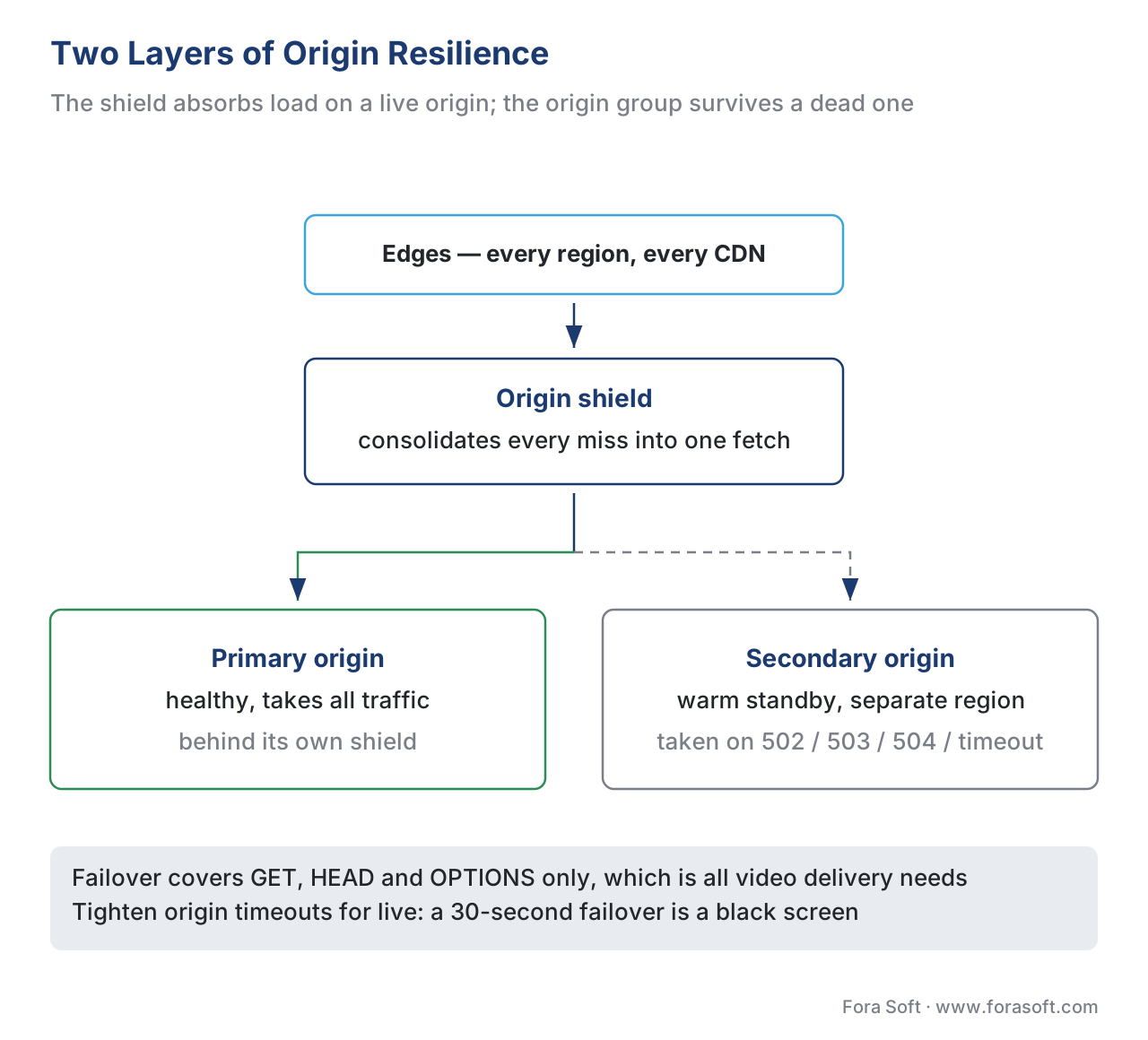 Figure 4. Origin resilience has two layers. The shield consolidates requests to a healthy origin; the origin group fails over to a secondary origin (on codes like 502/503/504) when the primary is down. Tighten failover timing for live.
Common mistakes that take origins down
Most origin meltdowns are design omissions that pass every small-scale test and fail on launch night, when the herd finally shows up.
The headline error is no shield at all — letting every regional cache, across every region and every CDN, fetch from the origin directly, so a live start fans dozens of identical requests into one server. Its expensive cousin is shielding in the wrong place: a shield chosen near your viewers instead of near your origin, which adds a hop without the low-latency origin connection that makes the rare real fetch fast. A third is forgetting the JIT origin is compute, not bytes — sizing the origin for egress while a request flood quietly exhausts its packaging CPU, the failure that an egress-only capacity plan never sees coming. A fourth is a shield in front of a single origin with no failover, which faithfully caches your outage; a shield needs an origin group or a multi-region pair behind it to survive an origin death. A fifth is default failover timing on live, where a 30-second web-tuned failover means half a minute of black screen during the one event you cannot replay. And the quiet sixth is measuring the wrong number — trusting a request-based cache-hit ratio that hides shielding's benefit, instead of watching origin offload and the origin's own load on the delivery-observability dashboard. Every one of these is invisible with one test viewer and obvious when 100,000 arrive together — which is the subject of live event delivery and the premiere spike.
Free download: Origin Shielding & Resilience ChecklistOne page to work through before a launch or a live event: classify and size the origin, place the shield next to it, set TTLs that hold, and design the failover behind it.Where Fora Soft fits in
Origin design is a scale-and-resilience problem before it is a technical one: at a live premiere it is the difference between an origin that hums behind a shield and one server that takes the whole broadcast down, and no amount of edge capacity saves you if the fan-in melts the warehouse. Fora Soft has built video streaming, OTT/Internet TV, live event, e-learning, and video surveillance software since 2005, across 625+ shipped projects for 400+ clients, and that work runs straight through this tier: sizing static versus just-in-time packaging origins, placing the origin shield (or tiered cache) where it actually protects the origin, designing origin groups and multi-region failover so a dead machine never becomes a dead service, and tuning failover timing tight enough for live. When a media company needs an origin that survives its own success — a real, simultaneous, global audience hitting "play" at once — that origin-and-shielding engineering is the capability we bring.



The handbook
Fora Soft Video Engineering Handbook
We wrote a seven-volume handbook that takes the whole video stack apart, from the pixel to the bill at the end of the month, and someone who works through it can design and build a platform like the one this article describes. Volume 3 carries on from here — CDN tiers and cache behavior, players, DRM and the economics of delivery — while volume 2 covers the transport and the HLS and DASH manifests whose four-second clock sets the herd off, and volume 1 explains the encoding ladder whose rendition count multiplies every origin fetch you just counted. Written by Nikolay Sapunov, CEO at Fora Soft.
Is anything standing between your origin and your next live premiere?
Tell us how your origin is packaged and fronted, and we will tell you where it gives way at 100,000 concurrent viewers and what it takes to fix. 250+ video products shipped since 2005.
See our case studies
Case study
Worldcastlive
HD concert streaming at 0.4–0.5 s latency and 1.5 Gb/s, serving 10,000 simultaneous viewers — the synchronized audience that turns every new segment into a fan-in problem.
Case study
TradeCaster
46,000+ traders on $99–$119/mo subscriptions, auto-scaling through the load spike that lands the moment the market opens.
Case study
Mindbox
50+ deployments packaging RTSP camera feeds into HLS with FFmpeg — an origin that spends CPU per request rather than reading finished files off disk.
What to read next
Delivery basics
How a CDN delivers video
The tier model this article protects: origin, edge, cache, and what a miss actually costs you.
Multi-CDN
Multi-CDN architecture and orchestration
Every extra CDN fans in on your origin separately. Here is how the orchestration layer is put together.
Live ops
Live event delivery and the premiere spike
The event that produces the thundering herd, and how to size for it before the night itself.
Observability
Delivery observability: who is buffering and where
Where origin offload and origin load get watched, and why request-based hit ratio hides the win.
References
- RFC 9111 — HTTP Caching — IETF, June 2022. Defines the shared cache (a cache that stores responses "to be used in response to multiple users") and the freshness-lifetime /
max-agemodel that lets a tiered hierarchy of caches — edge, regional, shield — each hold and revalidate a copy. The standard behind why a consolidation tier is coherent HTTP, not a vendor trick. Replaces RFC 7234. Tier 1 (official standard). https://www.rfc-editor.org/rfc/rfc9111.html (accessed 2026-06-16) - RFC 8216 — HTTP Live Streaming (HLS) — IETF (R. Pantos, Ed.), August 2017. Defines the M3U media playlist of segment URIs and the live-playlist reload behavior by which players re-fetch the manifest to discover new segments — the clock that makes 100,000 viewers cold-miss each new segment together (the thundering herd). Tier 1 (format specification). https://www.rfc-editor.org/rfc/rfc8216 (accessed 2026-06-16)
- ISO/IEC 23009-1 — Dynamic Adaptive Streaming over HTTP (MPEG-DASH) — ISO/IEC, 2022 edition. Deterministic segment addressing via
SegmentTemplateandBaseURL, producing identical per-segment URLs across viewers — so every region's edge requests the same object, which is what a shield consolidates. Tier 1 (format specification). https://www.iso.org/standard/83314.html (accessed 2026-06-16) - Use Amazon CloudFront Origin Shield — Amazon CloudFront Developer Guide, 2026. The "additional layer in the CloudFront caching infrastructure" through which all caching layers reach the origin; request consolidation "resulting in as few as one request going to your origin"; regional edge caches as the mid-tier; choosing the shield Region with lowest latency to the origin; high availability via active error tracking to a secondary shield; origin-group compatibility; the incremental-layer pricing model and the <3600s-TTL "dynamic" rule. Tier 3 (first-party CDN engineering). https://docs.aws.amazon.com/AmazonCloudFront/latest/DeveloperGuide/origin-shield.html (accessed 2026-06-16)
- Optimize high availability with CloudFront origin failover — Amazon CloudFront Developer Guide, 2026. The origin group (primary + secondary), the failover status codes (400, 403, 404, 416, 500, 502, 503, 504), failover only for
GET/HEAD/OPTIONS, and the guidance to fail over quickly for streaming by tuning origin timeouts and attempts. Tier 3 (first-party CDN engineering). https://docs.aws.amazon.com/AmazonCloudFront/latest/DeveloperGuide/high_availability_origin_failover.html (accessed 2026-06-16) - Announcing Amazon CloudFront Origin Shield — AWS What's New, October 20, 2020. "A centralized caching layer" that decreases origin operating costs "by collapsing requests across regions so as few as one request goes to your origin per object"; the note that just-in-time-packaging origins "can be sensitive to the number of origin fetches"; automatic failover to secondary Origin Shield Regions; and the "up to a 57% reduction in their origin's load" figure for live streaming / image / multi-CDN workloads. Tier 4 (vendor announcement) — the 57% is a vendor-reported customer figure, labelled illustrative. https://aws.amazon.com/about-aws/whats-new/2020/10/announcing-amazon-cloudfront-origin-shield (accessed 2026-06-16)
- Tiered Cache — Cloudflare Cache (CDN) Docs, updated June 5, 2026. The lower-tier / upper-tier hierarchy in which "only the upper-tier can ask the origin for content"; Smart Tiered Cache auto-selecting the single lowest-latency upper tier; the cloud region hint for anycast cloud origins; and that tiered cache "concentrates connections to origin servers" to reduce open connections. Tier 3 (first-party CDN engineering). https://developers.cloudflare.com/cache/how-to/tiered-cache/ (accessed 2026-06-16)
- Tiered Distribution — Akamai TechDocs (Property Manager), 2026. Parent servers near the origin that "cache your content and serve it to other servers" to reduce origin load; the Global vs Local distribution maps, with Local selected "if your primary goal is to maximize the offload of your origin server"; and Cloud Wrapper for large libraries. Tier 3 (first-party CDN engineering). https://techdocs.akamai.com/property-mgr/docs/tiered-dist (accessed 2026-06-16)
- Origin Offload: A measure of CDN efficiency for reducing egress cost — Fastly Blog, July 1, 2024. The miss-rate argument (90%→95% hit ratio "actually halves your origin load"); the measured customer whose origin held ~1.6 GiB/s with shielding versus 20+ GiB/s without; and the case for measuring byte-based origin offload instead of request-based cache-hit ratio, which under-counts shielding's benefit. Tier 4 (vendor engineering blog). https://www.fastly.com/blog/origin-offload-a-measure-of-cdn-efficiency-for-reducing-egress-cost (accessed 2026-06-16)
- CDN Guide: Origin Shield — CDN Planet, 2026. Vendor-neutral orientation on the origin-shield pattern (a single mid-tier between edges and origin, request collapsing, and origin offload) used here only for framing, not for any spec or numeric claim. Tier 6 (educational) — orientation only. https://www.cdnplanet.com/guides/origin-shield/ (accessed 2026-06-16)
Source note (per §4.3.2): the caching model traces to tier-1 standards — RFC 9111 for the shared cache and freshness that make a multi-tier hierarchy valid (ref 1), with the segment-URL and live-manifest behavior grounded in RFC 8216 for HLS (ref 2) and ISO/IEC 23009-1 for DASH (ref 3). The shielding mechanisms (CloudFront, Cloudflare, Akamai, Fastly; refs 4–9) are cited first-party for "what actually ships" and dated, since CDN feature sets change. The "as few as one request" consolidation behavior is documented identically by AWS (refs 4, 6); the 57% origin-load reduction (ref 6) and the 1.6 vs 20+ GiB/s figures (ref 9) are vendor-reported customer measurements, labelled illustrative of the mechanism rather than universal benchmarks. Where general posts imply an origin "just needs more servers," the article follows the documented consolidation-and-failover model instead.
