


Why This Matters
Most product teams pick "use a multi-CDN" off a slide deck because a peer at a conference said it improved their availability or cut their bill. That is true some of the time and false the rest of the time, and the difference is the architecture choice and the contract terms behind it — neither of which appears on the slide. A multi-CDN deployment done badly is more fragile than a single-CDN deployment, costs more, and produces incident post-mortems with phrases like "we failed over from a healthy provider to a degraded one during the World Cup final". A multi-CDN deployment done well — usually with HLS / DASH Content Steering as of 2026 — earns its keep on every live event and shaves a recurring percentage off the monthly bill. This article is the bridge between the slide and the decision. A product manager finishes it able to ask "which steering layer are we using, and what is the failover criterion?" without bluffing. An architect finishes it with the four-component blueprint, the per-vendor capability map, and the migration checklist. An operations lead finishes it with the failure-mode catalogue and the runbook to test against. The arithmetic at the end shows the recurring savings on a representative 10 PB-per-month workload and what they evaporate to when a single contract clause is wrong.
What a Multi-CDN Actually Is
Start with a careful definition. A single-CDN architecture sends every viewer's segment request to one provider — the same Akamai, Cloudflare, Fastly, CloudFront, or Google Media CDN handles ingest of the cached object from the origin, the hierarchy of caches between the origin and the edge, and the last-mile delivery to the player. A multi-CDN architecture publishes the same content through two or more providers in parallel, and adds a steering layer that decides, per viewer or per session, which provider will serve the next request. The origin remains single in almost every real deployment; what gets multiplied is the path between the origin and the viewer.
The non-technical analogy is a shipping operation that uses three couriers in parallel instead of one. The warehouse — the origin — is unchanged. The package — the cached video segment — is the same regardless of which courier carries it. What changes is the dispatching desk that decides, for each parcel, which courier picks it up. If the dispatching desk is paying attention to which courier is delivering on time today, the operation moves faster than any single-courier setup. If the dispatching desk is sleeping at its post, packages still get delivered — but the operation pays for three contracts and loses the efficiency that any one courier would give if it served everything.
The dispatching desk is what the streaming literature calls traffic steering or CDN selection, and it is where the entire multi-CDN story lives. Everything below — DNS, content steering, client-side, server-side, hybrid — is a way of building the dispatching desk.
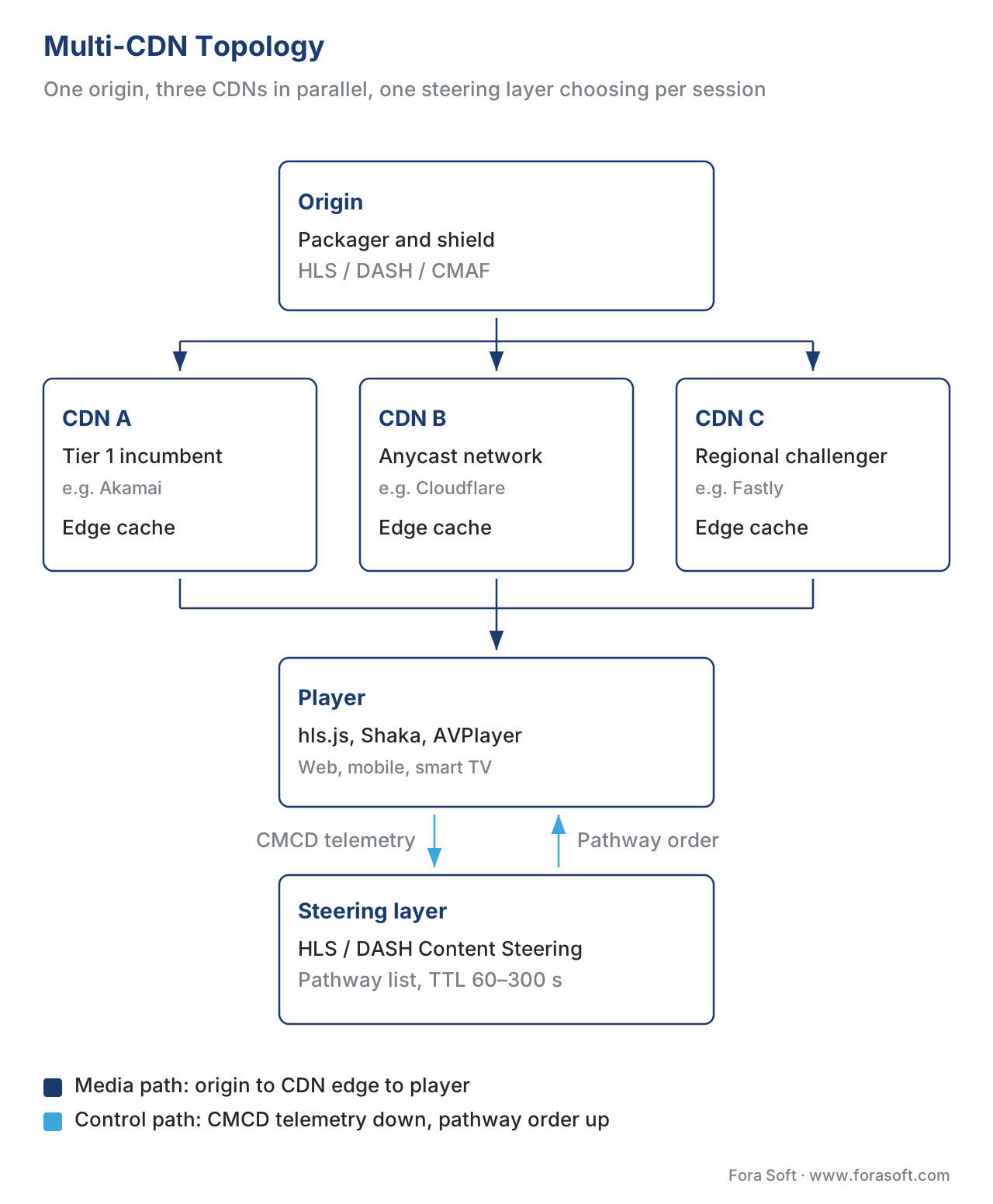 Figure 1. Multi-CDN topology. One origin, multiple CDNs in parallel, one steering layer deciding which provider each request hits.
Why Anyone Adopts Multi-CDN (Three Real Reasons)
The marketing pitch usually says "resilience, performance, and cost". The honest list is shorter and more specific.
Reason 1 — Survive a CDN-level outage. No major CDN has a perfect record. AWS CloudFront had a substantial multi-region degradation in late 2023; Cloudflare had high-profile incidents in 2022 and 2023; Akamai's edge-node failures and Fastly's June 2021 global outage are recent enough to remember. A streaming product that goes dark when a single provider goes dark is in a bad place commercially — pay-per-view refunds, broadcast SLA breaches, social-media optics — and "we use a CDN" is no longer a defence in front of a finance committee that has read the Fastly post-mortem. The first and most defensible reason to adopt multi-CDN is to survive the day one of your CDNs has a regional or global incident.
Reason 2 — Beat any single CDN's regional performance. No single CDN is the fastest everywhere. Akamai often wins on incumbent broadcast routes in mature markets. Cloudflare frequently wins on mid-latency consumer markets where its anycast network has dense presence. Fastly wins on developer-heavy workloads and instant cache purges. Google Media CDN wins where YouTube's existing peering footprint reaches viewers other CDNs reach by transit. A multi-CDN architecture that picks the right provider per region per viewer can produce measurably lower rebuffering than the best single CDN in your contract list. The literature on real-time content steering — both the DASH-IF Implementation Guidelines work and the academic studies presented at Mile-High Video Conference proceedings — quantifies this gain in the low-single-digit percentage points on average and the high-single-digits on the bottom decile of viewers, which is exactly where rebuffering complaints come from.
Reason 3 — Bend the cost curve. A single CDN that does 100 percent of your traffic has all the leverage in renegotiation. Two CDNs sharing the work, each below their commit threshold, give the buyer leverage on both contracts — and create the option to shift traffic from a more expensive provider to a cheaper one when prices drift apart. The cost story has a sharp edge: poorly negotiated multi-CDN contracts can cost more than a single-vendor commit, because each provider's commit floor sits unused. We return to this in the cost section.
These three reasons are not equal. In our experience shipping OTT and live-streaming systems, reason 1 — resilience — is the one that gets signed off at the executive level; reason 2 — performance — is the one that earns the architecture its keep on the QoE dashboards; reason 3 — cost — is the one that needs the most careful financial modelling to actually materialise. A team that adopts multi-CDN for reason 3 alone, without a steering layer that can win on reason 2 or a contract structure that can withstand reason 1's load shifts, will fail.
The Steering Layer — Three Architectures, Each With a Different Failure Mode
DNS-based steering
The oldest architecture and the one most legacy stacks still ship. A DNS server — the user's, the resolver's, or a managed traffic-management product (NS1, Cedexis-now-Citrix-ITM, Akamai Global Traffic Management, Cloudflare Load Balancer) — answers the player's lookup of the manifest hostname with a different CDN's IP or CNAME depending on which CDN the steering policy currently prefers.
The mechanism is simple, vendor-neutral, and works with any player. The problem is reaction time. The DNS response carries a Time-To-Live — abbreviated TTL — and recursive resolvers cache the answer for that TTL. Setting TTL low (30 seconds, 60 seconds) is the conventional workaround, but two things break that workaround. First, some resolvers ignore short TTLs and impose a minimum of several minutes — Internet Service Providers do this routinely to reduce their own DNS query load. Second, the player's operating system has its own DNS cache that the streaming SDK cannot purge mid-session.
The practical implication: when a CDN goes down at 19:32 UTC, a DNS-steered multi-CDN moves the new viewers off the bad CDN within seconds — but viewers who are already mid-session, holding a cached DNS answer pointing at the bad CDN, continue to hit it for up to the resolver's effective TTL. On a major live event, that "tail of viewers stuck on the dying CDN" is the single most painful operational reality of DNS-based multi-CDN, and it is the reason every modern playbook calls for application-layer steering as well.
Client-side steering with a static manifest
The next step up. The player fetches a small configuration manifest from the platform's own service — not a CDN — listing the available CDN base URLs and a static priority order. The player then issues the manifest and segment requests against the chosen CDN base URL. When the player detects errors (a 5xx response, a TCP timeout, a segment fetch slower than a threshold), it falls back to the next CDN in the list.
The mechanism is faster than DNS-based steering at the per-session level — the player makes the switch decision inside its own process, with no resolver caches in the way. The mechanism has its own ceiling. The priority list is static; it cannot react to global health changes mid-session unless the player periodically refreshes the configuration manifest. Failover is reactive (the player has to suffer a failed request before it switches) rather than proactive (the steering decision sees a CDN degrading before any viewer hits it). And every player implementation does this slightly differently, which means the QoE dashboard cannot easily compare like-for-like across iOS, Android, web, and smart-TV apps.
HLS / DASH Content Steering (the 2026 default)
The current standard, and the architecture every new build should default to. Two specifications, intentionally aligned to interoperate.
For HLS, the controlling document is Apple's HLS Authoring Specification, Content Steering section, layered on top of IETF RFC 8216bis. Apple introduced Content Steering in the September 2021 revision of the HLS Authoring Specification and has revised it since; the current revision in 2026 specifies the #EXT-X-CONTENT-STEERING tag on the multi-variant playlist that points at a remote steering manifest URL, and a PATHWAY-ID attribute on each variant that names which CDN serves it.
For DASH, the controlling document is ETSI TS 103 998 (formally adopted from the DASH-IF Content Steering Community Review draft published in late 2022), and DASH-IF maintains the implementation guidelines that the open-source dash.js and Shaka Player both follow. DASH-IF's Content Steering specification was developed in close alignment with Apple's HLS work so that the same steering server can drive both clients.
The mechanism is the cleanest of the three. The player fetches the manifest, sees the steering tag, fetches the steering manifest as a small JSON document, and obtains a list of pathways (CDN base URLs) with an ordered priority. The player then begins fetching segments from the highest-priority pathway. The steering manifest contains a TTL field — typically 60 to 300 seconds for streaming use cases — and the player refetches it on that schedule. The steering server can update the priority list mid-session in response to real-time health, performance, or cost metrics, and the player picks up the new order on the next refresh.
The architecture's two key strengths are mid-session updates and bidirectional measurement. Mid-session updates mean that the steering server can pull viewers off a degrading CDN within minutes of detection, not within the resolver's TTL. Bidirectional measurement, when paired with the Common Media Client Data specification — CTA-5004, published by the Consumer Technology Association — gives the steering server real-time per-session metrics from the player (buffer length, throughput, dropped frames) on every segment request, so the steering decisions can be data-driven rather than blind.
The architecture's weaknesses are real and worth naming. The steering server itself becomes a critical-path component; if the steering JSON endpoint goes down, players fall back to the manifest's pathway order and lose the multi-CDN benefit. The spec is permissive about how players implement the steering logic, and dash.js, Shaka Player, hls.js, and the native Apple AVPlayer all behave slightly differently on edge cases. Coverage on smart TVs lags the web — as of 2026, the major TV platforms (Tizen, webOS, Vidaa) ship content-steering-capable native players, but older firmware in the install base does not always update.
A vendor- and protocol-neutral comparison of the three steering architectures:
| Architecture | Reaction time | Mid-session updates | Player support | Health-data driven |
|---|---|---|---|---|
| DNS-based | Minutes (TTL-limited) | No (new sessions only) | Universal | No |
| Client-side static | Seconds (per failure) | Limited (manifest refresh) | Per-player implementation | Local only |
| HLS / DASH Content Steering | 60–300 s (steering TTL) | Yes (per refresh) | Modern players + late-model smart TVs | Yes (with CMCD upstream) |
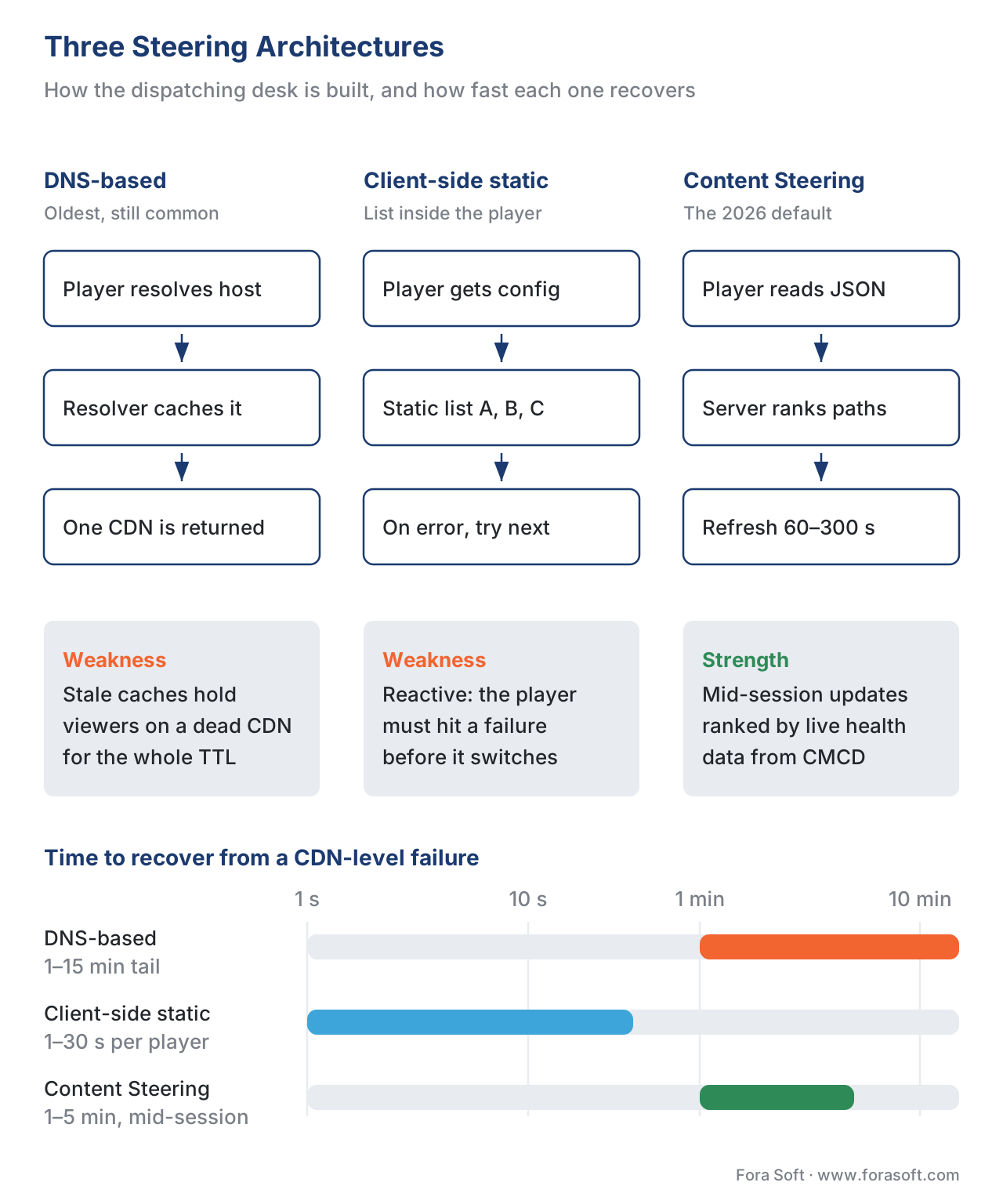 Figure 2. The three steering architectures, with the failure-recovery time scale shown on a common axis.
The Cost Story — Why Multi-CDN Doesn't Save Money by Default
This is the section that gets edited out of conference talks and put back into post-mortems. A multi-CDN architecture does not lower the per-GB cost of delivery on its own. It can lower the bill if the contract structure and the steering policy are aligned, and it can raise the bill — sometimes substantially — if either is misconfigured.
The CDN industry charges video delivery in one of three main shapes, and most contracts blend them.
Per-GB tiered billing is the simplest. The contract specifies a per-GB rate for the first N TB delivered per month, a lower rate for the next tier, and so on. The bill is total egress in the month multiplied by the appropriate tier rate, applied per region (North America, Europe, Asia-Pacific, Latin America, Middle East-Africa) since CDNs have very different cost structures per geography.
95th-percentile billing is the model inherited from raw transit. The CDN samples the throughput in Mbps every 5 minutes for the whole month, sorts the samples, drops the top 5 percent (the highest 36 hours of the month, roughly), and bills against the highest remaining sample — the so-called 95th-percentile peak. The intuition: the 5 percent of the month spent at the most extreme peak does not pay extra; everything else does. This model favours workloads with one short burst per month (a marquee live event) and punishes workloads with consistently high throughput.
Commit + overage is the structure most enterprise contracts use. The buyer commits to a minimum monthly spend — say, $50,000 — at a deeply discounted per-GB rate; usage below the commit is paid at the commit rate (the discount is the point), and usage above it pays an overage rate. The overage rate is the contract clause that determines whether multi-CDN is a financial win or loss. A well-negotiated overage rate sits close to the commit rate (10–30 percent premium); a poorly negotiated one sits 100–200 percent above it, and shifting unexpected traffic to that provider becomes punitively expensive.
Three pricing pitfalls bite every team that ships multi-CDN without modelling carefully.
Pitfall 1: under-commit and stack overages. A team adopts a second CDN and splits traffic 50/50. Their original CDN's commit was sized for 100 percent of the load, so they are now $25,000 under-utilised on commit one (paying for capacity they do not use), and the second CDN's commit was set conservatively, so the bursts into peak go into overage on contract two. The combined bill is higher than the single-CDN baseline. The fix is to renegotiate both contracts to lower commits whose sum equals the total expected traffic — and to leave headroom for steering shifts.
Pitfall 2: the wrong CDN gets the spike. A live event hits at 19:00 local time. The steering policy is configured by static weight to send 40 percent of traffic to the cheaper Tier 2 CDN. The Tier 2 CDN's commit was sized for the baseline; the spike pushes 40 percent of the event into overage at a 200 percent overage premium. The bill for that single event is multiples of what a 100-percent-Tier-1 routing would have cost. The fix is to make the steering policy traffic-aware — push baseline to the cheap CDN, route spikes to the CDN whose overage clause is most favourable, and use IO River-style policies that combine performance and cost in the steering decision.
Pitfall 3: 95th-percentile creep. A workload that previously sat 70 percent of the month near a single 200 Gbps peak — paying for 200 Gbps under the 95th-percentile model — is split between two CDNs. The peak per CDN drops to 100 Gbps; each CDN's 95th-percentile bill is for 100 Gbps. So far so good. But the second CDN is on a 95th-percentile contract with a minimum-commit floor of 150 Gbps. The buyer pays for 200 Gbps on the first contract plus 150 Gbps on the second, for an effective 350 Gbps billed where 200 Gbps would have been on a single contract. The fix is to specify percentile-of-spillover billing instead of a hard floor, or to model the 95th-percentile carefully per provider when negotiating.
The general rule: every multi-CDN proposal should include a cost model that prices the same workload three ways — single CDN A, single CDN B, and the proposed mix — using actual contract rates and actual historical traffic shapes. If the multi-CDN mix is not at least 5 percent cheaper at the median month and at least 0 percent cheaper at the peak month, the architecture is being adopted for resilience reasons only, and the finance presentation should reflect that.
The Math — A 10 PB/Month Workload, Three Architectures
A worked example with shown arithmetic. The workload: an OTT service delivering 10 petabytes of video per month, with a daily peak that pushes 200 Gbps for two hours and a monthly marquee event that doubles the peak to 400 Gbps for four hours.
Architecture A: Single CDN, commit + overage. Commit: $50,000/month for 10 PB at a blended per-GB rate of $0.005/GB. (10 PB × 1024 TB/PB × 1024 GB/TB × $0.005/GB = $52,428,800 in raw arithmetic, but the contracted rate at this volume is closer to the commit floor — call it $50,000 baseline with overage above 10 PB.) Overage rate: $0.008/GB (60 percent premium over commit-implied rate). Marquee event adds 200 TB of egress on top of the baseline 10 PB → 200,000 GB × $0.008/GB = $1,600 overage. Monthly bill: ~$51,600.
Architecture B: 50/50 multi-CDN, badly negotiated. Each CDN committed for 6 PB at $30,000/month. (Total commit $60,000 for 12 PB, of which 10 PB is used; over-committed by 2 PB or 20 percent of expected volume.) Overage rate on Tier 2 CDN: $0.012/GB (poorly negotiated, 150 percent over commit). Marquee event pushes 100 TB onto each CDN; the Tier 1 stays within commit, the Tier 2 spills 100,000 GB into overage → 100,000 × $0.012 = $1,200, but the under-commit waste is $60,000 paid for 10 PB of actual use, or $6,000 of pure commit waste. Monthly bill: ~$61,200.
Architecture C: 70/30 multi-CDN, well-negotiated with content steering. Tier 1 commit: $35,000/month for 7.5 PB at the negotiated rate. Tier 2 commit: $9,000/month for 3 PB at a cheaper $0.003/GB rate (Tier 2 chosen specifically for its competitive per-GB pricing). Overage rates: Tier 1 at $0.0065/GB (30 percent premium); Tier 2 at $0.004/GB (33 percent premium). Steering policy: baseline 70/30 split during off-peak; during the marquee spike, the steering server pushes the extra 200 TB onto Tier 2 (whose overage rate is the lower of the two) → 200,000 × $0.004 = $800. Commits are within 1 percent of actual baseline usage, so commit waste is negligible. Monthly bill: ~$44,800.
The spread: Architecture C saves roughly 13 percent versus single-CDN and roughly 27 percent versus the badly-negotiated multi-CDN. The savings are entirely a function of commits matching reality, overage clauses being tight, and the steering policy being cost-aware. Strip any of those three and Architecture C collapses to Architecture B.
A common mistake is to model multi-CDN at the per-GB blended rate without modelling the commit floors and overage caps. The blended rate looks good on a sales slide; the bill that arrives on the 1st of the month reflects the contract structure, not the blended rate.
The Failure Modes — What Goes Wrong, Specifically
The failure-mode list below is sorted by frequency in the incident logs of streaming teams we have worked with. Every item has a concrete fix.
Failure 1: Aggressive failover ping-pong
The steering policy fails over from CDN A to CDN B when CDN A returns a 5xx; then fails back from CDN B to CDN A when CDN B's segment fetch is 50 ms slower. The result is viewer sessions thrashing between two providers, each switch carrying a cache-miss penalty on the new CDN, each switch resetting any per-session connection state. Rebuffering goes up; everybody loses.
The fix is a damped failover policy. Switch on a sustained signal — three consecutive failed segments or a 30-second moving average above a threshold — not on a single bad segment. Apply a back-off before switching back to the original CDN: 5 minutes of clean behaviour minimum. The DASH-IF Content Steering implementation guidelines call this out specifically; the corresponding Apple guidance recommends a similar dwell time on each pathway before reconsidering.
Failure 2: DNS-cache tail of stuck viewers
A CDN-level incident hits CDN A at 19:00. The DNS TTL is 60 seconds. By 19:01, new viewers should be hitting CDN B. By 19:15, every viewer with a fresh DNS cache is on CDN B — but viewers behind ISP resolvers that override TTL to 5 minutes, viewers on a long-lived player session, and viewers on mobile networks whose carrier-grade NAT caches DNS more aggressively are still hammering CDN A. The dashboard shows traffic still going to the dead CDN; the players still see errors.
The fix is to not depend on DNS for mid-session failover. Application-layer steering — HLS/DASH Content Steering or a client-side configuration with a short refresh interval — moves viewers within the steering refresh interval (typically 60 to 300 seconds) regardless of DNS cache state. DNS-based steering remains useful for the initial provider selection at session start; it should not be the only mechanism.
Failure 3: Cache fragmentation across providers
The same segment is now cached on CDN A and CDN B. Each provider's edge has a cold cache for the share of viewers that newly arrives via the steering decision. Hit ratios drop on both providers during traffic shifts; origin egress spikes during every steering decision; the origin shield's protective effect, the topic of the previous article in this section, is partially defeated whenever a steering decision sends a viewer to a provider that has not seen this segment yet.
The fix is two-part. First, prefer steering decisions that are sticky for the lifetime of a session — switch CDNs at session start, not mid-segment-fetch where possible. Second, size the origin shield to absorb the cache-miss burst during steering shifts, and configure the shield to serve both CDNs from the same cached object so that a steering shift does not turn into an origin fetch. The article on origin shield in this section covers the shield's geometry in detail.
Failure 4: Steering server outage
The steering JSON endpoint goes down. Players fall back to the manifest's default pathway order, which means everybody crowds onto the first pathway. If the first pathway is the more expensive one, the bill spikes; if it is the less performant one in a particular region, QoE degrades for that region.
The fix is to host the steering server with the same availability discipline as the manifest service — multi-region, behind its own load balancer, ideally cached at a small TTL on a separate CDN entirely so that even a steering-server outage falls through to a recent cached steering manifest rather than to nothing. The DASH-IF guidelines describe this exact pattern.
Failure 5: Session stickiness that survives long enough to break
A steering policy binds each session to its initial CDN for the lifetime of that session. Most of the time this is the right call — see Failure 3. But a viewer on a 6-hour live broadcast keeps the same CDN for 6 hours, and if that CDN starts to degrade in hour 4 the stickiness rule prevents the steering server from helping. The viewer rebuffers; the operations team sees the metric and cannot intervene.
The fix is a stickiness rule with an escape clause: bind sessions to their initial CDN by default, but break the binding when sustained QoE signals (long rebuffer events, throughput collapse) cross a threshold. The DASH-IF Implementation Guidelines call this a "hard switch" and provide spec language for the per-pathway selection criteria.
Failure 6: Geographic policy lag
A regional CDN outage hits the Asia-Pacific region. The steering policy is configured to weight geographies but not to detect regional health changes in real time. Viewers in APAC continue to be steered to the affected CDN until the policy is manually updated by a human; meanwhile, North American viewers are unaffected.
The fix is to wire the steering server to a real-time health-monitoring source — synthetic probes, RUM data from CMCD, or a third-party monitoring service — and to express the steering policy as "use CDN X in region Y if its health > threshold Z" rather than as a static weight.
Failure 7: Token signature mismatch across CDNs
The platform signs URLs with a CDN-specific signature scheme. CDN A uses Cloudflare-style signed URLs; CDN B uses CloudFront-style signed URLs. A steering decision that moves a viewer mid-session from CDN A to CDN B sends the player to CDN B with a CDN A signature attached, and the request is rejected.
The fix is to design the signature scheme to be CDN-agnostic — sign the path portion of the URL with a key shared between both CDNs and validated by both providers, or use a token-validation service that sits between the player and any CDN edge. The article on token authentication and signed URLs in this section covers the patterns in detail.
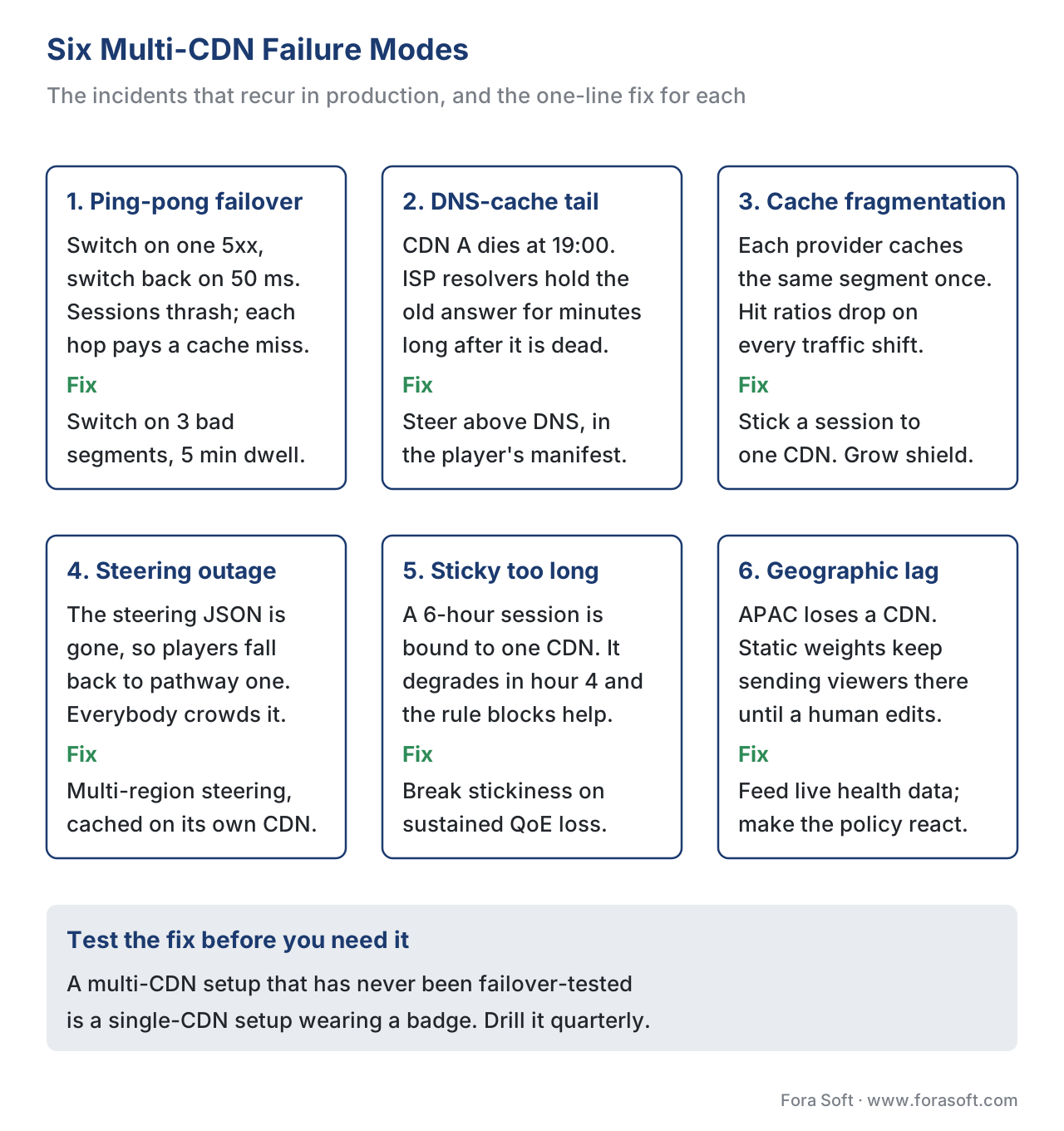 Figure 3. Six failure modes that recur in multi-CDN deployments, with the one-line fix for each.
Vendor and Tooling Landscape (2026)
The multi-CDN tooling market in 2026 has four kinds of players, and a system architecture usually uses one from each.
The CDNs themselves. Akamai, Amazon CloudFront, Cloudflare, Fastly, Google Media CDN, Bunny, CDN77, KeyCDN, CDNetworks, EdgeNext, Tencent Cloud CDN, and Alibaba Cloud CDN are the most-cited combinations in current production multi-CDN deployments. Most architectures pair one tier-1 incumbent with one challenger that is cheaper or stronger in a specific region.
Independent steering / load-balancing platforms. IO River, NPAW's CDN Balancer, Cedexis (now Citrix Intelligent Traffic Management), and NS1 provide the steering decision as a service, often combining synthetic-probe data with RUM (Real User Monitoring) data into the steering policy. These platforms typically integrate as either a DNS-level load balancer or as a content-steering server that the player polls.
RUM / monitoring vendors. Mux Data, Conviva, Bitmovin Analytics, Datazoom, and NPAW provide the per-session telemetry that drives data-aware steering. CMCD (CTA-5004) is the standardised wire format for this telemetry as of 2024; most modern players support it out of the box.
Origin-shield and packager vendors. Multi-CDN architectures put pressure on the origin (every steering shift can produce a cache-miss burst), so the origin shield and packager become more important. Mediapackage (AWS), Unified Origin, Wowza, EZDRM, and self-built packager-shield stacks all show up in production multi-CDN setups.
Free download: Multi-CDN Migration ChecklistThe contract clauses, steering thresholds and failover drills to settle before you move any traffic onto a second CDN.Where Fora Soft Fits In
Multi-CDN architecture is the kind of work where the value is in the operational details, not the slide deck. We have shipped video streaming, OTT, telemedicine, e-learning, and surveillance products since 2005, and in every product where availability and per-GB cost both matter, the multi-CDN design decision shows up early. The teams we have helped tend to fall into one of two camps: the team that has multi-CDN running but cannot tell whether it is helping (no per-CDN QoE breakdown, no cost model, no failover test plan), and the team that is sizing up the first multi-CDN procurement and needs an architect to write the contract clauses and the steering policy. The deliverable in both cases is the same: an architecture review that names the steering layer, defines the failover policy with concrete thresholds, models the cost under three traffic shapes, and includes a quarterly drill plan to keep the failover machinery tested. You can start with our independent architecture review, and our scalable video streaming development team builds the multi-CDN steering and ABR delivery behind it.
The book
Video Streaming: A Complete Guide to Video Delivery: From ABR and CDNs to Players, WebRTC, DRM, and the Economics of Streaming
This article stops at the four components of a multi-CDN and the arithmetic of one 10 PB month. The book takes the delivery half further: how a CDN's cache hierarchy behaves under a steering shift, what that shift costs the origin shield, and how commit, overage and 95th-percentile clauses turn into the invoice that arrives on the 1st. Written by Nikolay Sapunov, CEO at Fora Soft.
Not sure whether your multi-CDN is helping or just costing more?
Send us the steering policy and the contract terms you have now, and we will tell you where the failover breaks, what the traffic split actually costs, and what to test in the next drill. 250+ video products shipped since 2005.
See our case studies
Case study
Worldcast Live
Concert streaming at 0.4-0.5 s glass-to-glass for 10,000 simultaneous viewers at 1.5 Gb/s: the event peak a failover policy has to survive without dropping viewers into a cold cache.
Case study
Sprii
A live shopping platform with 72,000+ events hosted, pushing RTMP and WebRTC out through Cloudflare, Mux, Facebook and Instagram at once: several delivery paths from one origin, each with its own configuration.
Case study
TradeCaster
A trading platform with 46,000+ users that auto-scales through the market-open spike: exactly the traffic shape that decides whether your overage clause or your steering policy pays for the peak.
What to read next
CDN
What a CDN Actually Is, for the Streaming Engineer
Origin, shield and edge inside one provider, before you run three of them in parallel.
Caching
Origin Shielding and Tiered Caching
The shield that has to absorb the cache-miss burst every steering shift creates.
Cost
CDN Cost Economics: 95th-Percentile, Commit, Overage, Transit
The contract clauses behind the three-architecture arithmetic above, one by one.
Security
Token Authentication, Signed URLs, and Origin Protection
Failure 7 in detail: one signature scheme that both CDNs will accept mid-session.
References
- Apple HLS Authoring Specification, Content Steering section — revision 2025-09. Read directly from
developer.apple.com/documentation/http-live-streaming/hls-authoring-specification-for-apple-devices. The normative source for the#EXT-X-CONTENT-STEERINGtag andPATHWAY-IDattribute used by HLS Content Steering. Standards tier 1.
- ETSI TS 103 998 V1.1.1 (2024-09), Content Steering for DASH — the ETSI-adopted form of the DASH-IF Content Steering Community Review draft. The normative source for DASH-side Content Steering. Mirrors the Apple HLS work so that one steering server can drive both clients. Standards tier 1.
- DASH Industry Forum Implementation Guidelines: Content Steering, current version 2025 update. Open document at
dashif.org. The DASH-IF implementation guide that dash.js and Shaka Player follow. Standards tier 1 (DASH-IF implementation guideline).
- Consumer Technology Association CTA-5004 (2020), Common Media Client Data (CMCD) — the standardised wire format for player-to-CDN/steering-server telemetry. Cited as the upstream measurement contract that makes data-aware steering decisions possible. Standards tier 1.
- CTA-5005-A, DASH-HLS Interoperability Specification — the CTA document that aligns DASH and HLS at the wire level, including the content-steering interoperability requirements. Standards tier 1.
- IETF RFC 8216, HTTP Live Streaming — August 2017, with the IETF
draft-pantos-hls-rfc8216bis-*revision currently active. The base HLS specification under which Apple's Content Steering extension is layered. Standards tier 1.
- Stockhammer, T., et al. — Content Steering, 3rd Mile-High Video Conference (2024) — the canonical academic paper on the joint HLS / DASH Content Steering design, explaining the architecture, the steering manifest schema, and the early adoption results. ACM Digital Library reference
10.1145/3638036.3640293. Tier 5 (peer-reviewed academic source).
- Pham, A.-T., et al. — Multi-Regional, Multi-CDN Delivery Optimizations Using HLS/DASH Content Steering Standard, 4th Mile-High Video Conference (2025) — quantifies the QoE gain on a real multi-region deployment using Content Steering, with comparison against static weighting and DNS-based steering. ACM DL
10.1145/3715675.3715791. Tier 5.
- Mux Engineering Blog, Survive CDN Failures with Redundant Streams (2023) — vendor-engineering write-up on production multi-CDN failover patterns; useful as production-deployment counterpoint to the spec's theoretical framing. Tier 4 (vendor blog from production deployer).
- Streaming Video Technology Alliance, Architectures for Multi-CDN Switching — the SVTA's working-group document on multi-CDN switching architectures. The closest the industry has to a vendor-neutral architecture catalogue. Tier 3 (industry working group reference).
- Fastly Post-Mortem, Summary of June 8, 2021 Outage — the canonical recent CDN-outage post-mortem, cited as the historical anchor for the "single CDN can go fully down" reason for multi-CDN adoption. Tier 4 (vendor first-party).
- DASH-IF-CTS-00XX Content Steering, Community Review draft — the original DASH-IF community review document later formalised as ETSI TS 103 998. Cited for the original design rationale. Standards tier 1 (community review predecessor of the final spec).
