


This is engineering guidance, not legal advice. Confirm specifics with qualified counsel.
Why this matters
The two-person video call is the demo; the multi-party consult is the real clinic. A patient who speaks limited English needs an interpreter on the line. A primary-care doctor pulls in a dermatologist mid-visit. An elderly patient's daughter joins to help. A resident is supervised by an attending physician. Each of these is common, each adds a third or fourth person to the call, and each one is a place where a telemedicine product either handles roles, permissions, and consent correctly — or leaks patient data, breaks a federal language-access rule, or simply drops the call because the network could not carry it. This article is written for the founder, product manager, or engineer who has to decide how their platform adds people to a consult: who is allowed in, what they may see and hear, what contract governs them, and how the call survives the extra load.
The room is bigger than two people
In a physical exam room, adding a person is trivial: a nurse steps in, an interpreter pulls up a chair, a family member stands by the bed. The room handles it. A telemedicine product has to recreate that flexibility deliberately, because nothing about a video call adds a fourth chair on its own.
Start by naming the people who actually show up. Beyond the patient and the treating provider, the four common additions are a medical interpreter (for a patient with limited English proficiency or who is deaf or hard of hearing), a remote specialist (a second clinician brought in for their expertise, sometimes called a tele-consult), a caregiver (a family member, guardian, or aide helping the patient), and a supervising physician (an attending overseeing a resident, or a collaborating physician required by state scope-of-practice rules). Each plays a different role, needs different access, and is governed by a different rule.
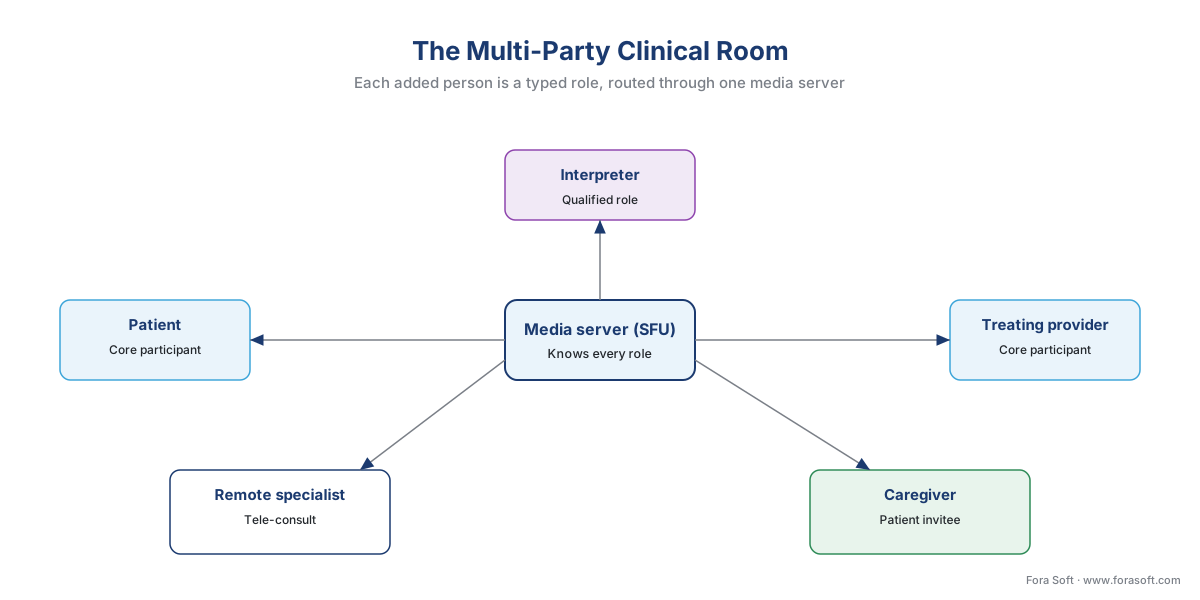 Figure 1. The multi-party room. Patient and provider are the core; the interpreter, remote specialist, and caregiver are added roles, all routed through one media server that knows who each person is.
The mistake is to treat all of these as "extra participants" in one undifferentiated bucket. They are not. An interpreter must hear everything but is not a clinician. A caregiver may see the patient but should not necessarily see another patient's data or the full chart. A remote specialist is a clinician but often from a different organization. A supervising physician needs the full picture. The whole article is really one idea: a participant is not just a video tile — it is a role, and the role decides the engineering and the compliance.
Why two-person plumbing breaks at three
Before the rules, the plumbing. The reason multi-party is a distinct engineering problem, not just "invite one more person," comes down to how the media travels.
The simplest video call is peer-to-peer (P2P): the two devices send audio and video straight to each other. It is cheap and private, and for a one-on-one consult it is the right default, as covered in WebRTC for telemedicine. The problem is what happens when you add people. In a pure peer-to-peer "mesh," every participant must send their stream to every other participant. The upload cost grows with the number of other people in the call.
Here is the arithmetic, shown out loud. Suppose each person sends video at 1.5 megabits per second (Mbps). In a mesh call, each participant uploads one copy of their stream to every other participant, so the upload is:
mesh upload per person = (participants − 1) × stream bitrate
For a 4-person consult — patient, provider, interpreter, caregiver — that is (4 − 1) × 1.5 = 4.5 Mbps of upload from every single device. A patient on home Wi-Fi or a phone on cellular often cannot sustain that, and the call degrades or drops for everyone.
Now route the same call through a Selective Forwarding Unit (SFU) — a media server that receives each person's stream once and forwards it to the others. Each device uploads only one copy:
SFU upload per person = 1 × stream bitrate = 1.5 Mbps
The patient's upload drops from 4.5 Mbps to 1.5 Mbps — a third of the load — and the server absorbs the fan-out. That is why every serious multi-party clinical product uses an SFU once a call can exceed two people. The deeper comparison of P2P, SFU, and MCU topologies for clinical use is in P2P, SFU, MCU for clinical use, and the protocol internals live in the Video Streaming section's SFU, MCU, and mesh topologies explainer. Here the point is narrower: the moment you support a third party, the SFU is what makes the call survivable — and, as we will see, it is also where roles and permissions get enforced.
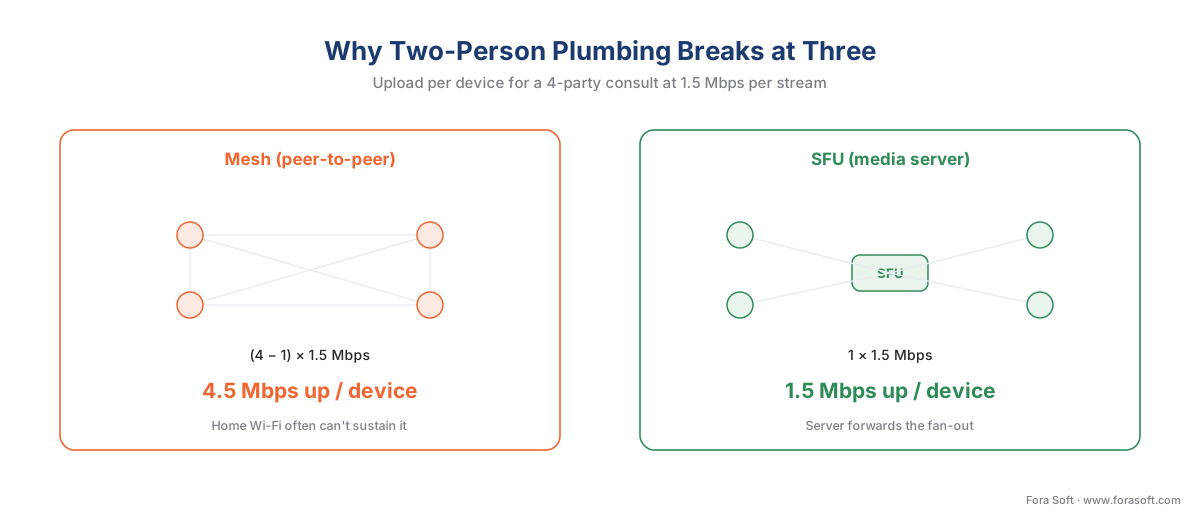 Figure 2. The bandwidth case for an SFU. In a 4-party mesh each device uploads 4.5 Mbps; through an SFU each uploads 1.5 Mbps and the server forwards the rest.
Roles, not tiles: permissions in a clinical call
An SFU does more than save bandwidth. Because every stream passes through it, the server is the one place that can decide who receives what — and that is exactly what a multi-role clinical call needs.
Think of a role as a key that opens specific doors. A consumer conferencing tool gives everyone the same key: every participant sees every other participant, hears everything, and often can see the attendee list. In a clinical call that default is wrong, because it ignores the most important rule in HIPAA's day-to-day operation: minimum necessary. The Privacy Rule requires that when you use or disclose Protected Health Information — any health data tied to an identifiable person — you limit it to the minimum needed for the purpose (45 CFR §164.502(b) and §164.514(d)) [1]. A caregiver helping with a knee exam does not need the patient's full medication history on screen. A remote dermatologist brought in to look at a rash does not need the patient's behavioral-health notes. The role decides the scope.
In product terms, every participant joins with a declared role, and the role carries a permission set: which media streams they send and receive, what on-screen data they see, whether they can record, whether they can admit or remove others, and whether they appear in other participants' rosters. The SFU enforces the media part of this — it can simply decline to forward a stream to a participant whose role should not receive it [5]. The application enforces the data and control part. Underneath both sits the HIPAA Security Rule's requirement for access controls and audit controls on systems holding electronic PHI (45 CFR §164.312(a) and (b)) [2], so every join, every role, and every stream grant is access-controlled and logged — the same audit foundation described in audit logging and access controls for clinical video.
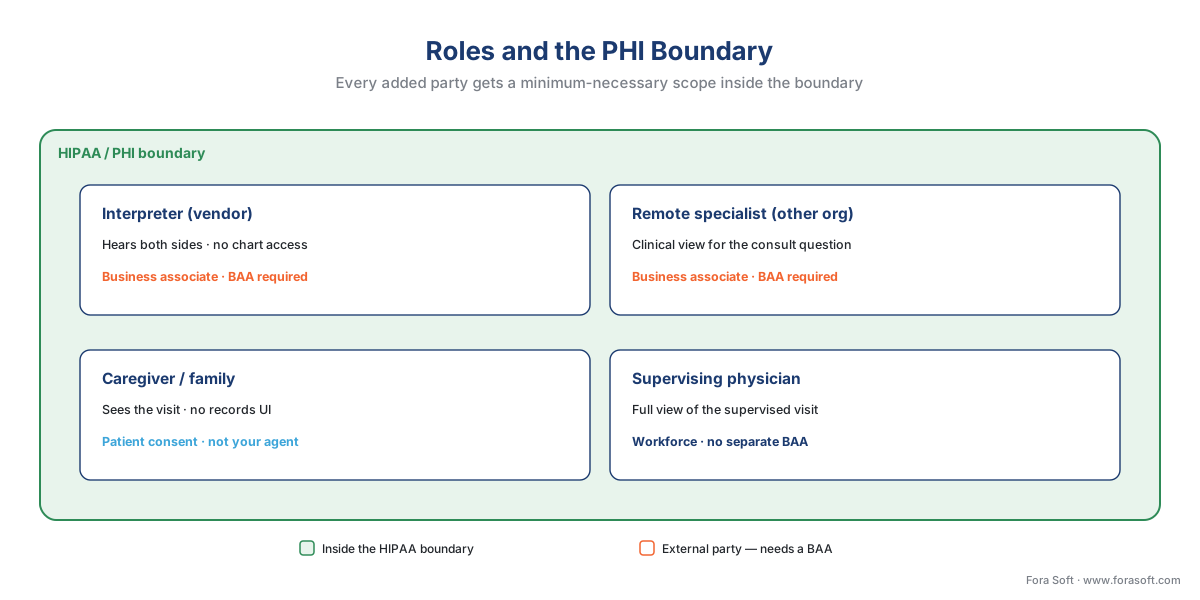 Figure 3. Roles and the PHI boundary. Each added party gets a minimum-necessary scope and is either your workforce or a business associate under a signed BAA. No participant receives more than their role needs.
Workforce or business associate: the contract behind each face
Every added participant falls into one of two legal buckets, and you must know which before they join.
The first bucket is workforce — people under your direct control, like an employed interpreter or a clinician on staff. They are covered by your own policies and access controls; no separate contract is needed, but their access must still follow minimum necessary and be logged.
The second bucket is business associate — an outside person or company that handles patient data on your behalf. The interpreter you reach through a language-services vendor, a remote specialist who belongs to a different practice, the company that runs your video infrastructure: each of these is a business associate and must sign a Business Associate Agreement (BAA) — the contract in which the outside party promises to protect patient data and accepts legal liability for it. This is binary. A vendor either has a signed BAA covering your use or it does not; there is no "mostly covered." HHS guidance is explicit that a service provider handling electronic PHI is a business associate even if it cannot view the data because it is encrypted [3]. Encryption never substitutes for the BAA — the two requirements sit side by side, a point made in full in Business Associate Agreements and HIPAA in plain English for product teams.
The practical rule for a multi-party product: before any external participant type can be added to a call, confirm a BAA is in place with the organization that supplies them. The most common quiet violation here is wiring in a convenient interpreter API or a partner-specialist network without one.
| Added party | Why they join | Minimum-necessary scope | Workforce or business associate | BAA required? |
|---|---|---|---|---|
| Medical interpreter (vendor) | Language access for LEP / deaf patient | Hears both sides; sees faces; no chart access | Business associate (the vendor) | Yes |
| Medical interpreter (on staff) | Language access | Hears both sides; sees faces; no chart access | Workforce | No (covered by your policies) |
| Remote specialist (other org) | Second clinical opinion | Clinical view relevant to the consult question | Business associate | Yes |
| Caregiver / family member | Help the patient participate | Sees/hears the visit; no access to records UI | Neither — a patient invitee, not your agent | No (governed by patient consent) |
| Supervising physician | Oversight of a resident / scope rule | Full clinical view of the supervised visit | Workforce (same org) | No |
Table 1. The four common added parties, their minimum-necessary scope, and whether a Business Associate Agreement is required. A caregiver is a special case: not your business associate, but added only with the patient's consent.
The interpreter rules you cannot get wrong
Language access is where multi-party telemedicine meets a specific federal rule, and where the most damaging shortcuts happen. The rule is Section 1557 of the Affordable Care Act, whose 2024 final rule (published in the Federal Register on May 6, 2024, with the meaningful-access provisions effective July 5, 2024) governs how covered health programs serve patients with limited English proficiency and patients with disabilities [4][7].
Three requirements from the rule shape your product directly.
You must offer a qualified interpreter, free of charge. When interpretation is needed, a covered entity must offer a qualified interpreter, and language assistance must be provided free of charge, accurately, in a timely way, and in a manner that protects the patient's privacy and independent decision-making (45 CFR §92.201(a)–(c)) [4]. "Qualified" is a defined bar — fluency, training, and adherence to interpreter ethics — not "someone who speaks the language."
You may not use family members or children as the interpreter. This is the rule that quietly catches well-meaning products. Section 1557 prohibits relying on an accompanying adult to interpret except in a narrow emergency, or when the patient specifically requests it in private and it is documented; and it prohibits relying on a minor child to interpret except in a genuine emergency while a qualified interpreter is found (45 CFR §92.201(e)) [4]. A telemedicine flow that lets the patient's bilingual teenager translate the visit, or that defaults to "have a family member help," is not just poor practice — it is outside the rule. Build the interpreter as a distinct, qualified role, not as "whoever the patient brought."
If the interpreter joins by video, the video itself has a quality standard. This is the part engineers miss. When a qualified interpreter is delivered through video remote interpreting (VRI), the rule sets explicit technical requirements: real-time, full-motion video and audio over a connection with enough bandwidth to avoid lags, choppy, blurry, or grainy images or irregular pauses; an image sharp and large enough to show the interpreter's and the participant's faces regardless of body position; clear, audible voice transmission; and adequate user training to set up and operate the technology (45 CFR §92.201(f)) [4]. The same standard, rooted in the Americans with Disabilities Act, applies to a sign-language interpreter for a deaf patient (45 CFR §92.202, applying the ADA effective-communication standards) [6][8]. In other words, a grainy, lagging interpreter feed is not merely a bad experience — it can fail the legal standard for meaningful access. Your quality bar for the interpreter stream is a compliance requirement, not a preference, which ties directly to the clinical latency and quality "good enough" bar.
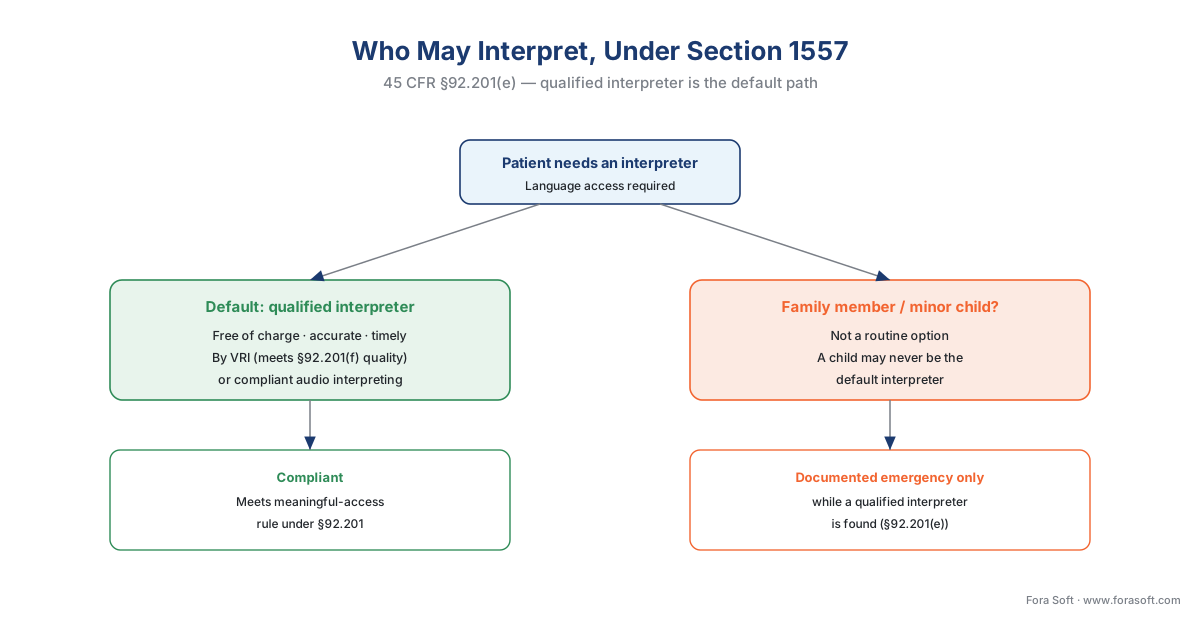 Figure 4. Who may interpret, under Section 1557. The default path is a qualified interpreter over compliant VRI or audio; relying on a family member or a child is restricted to documented emergencies.
There is also a media-engineering wrinkle unique to interpreters: selective audio. An interpreter must hear both the provider and the patient, and both must hear the interpreter, but the provider and patient may not need to hear the interpreter's source-language murmur during simultaneous interpretation. An SFU's per-role stream routing lets you build language or interpreter audio channels — for example, mixing the interpreter into the main audio for consecutive interpretation, or carrying a separate interpreter track for simultaneous interpretation. AI-assisted and machine translation is a separate topic with its own quality and regulatory limits, covered in medical translation and interpreter augmentation; note that Section 1557 requires a qualified human to review machine translation where accuracy is essential [4].
Consent and identity for each added party
Every person added to a consult is a new disclosure of the patient's information, so each one needs two things settled before they join: the patient's consent to their presence, and verification that they are who their role claims.
Consent scales with the party. The patient consents to the visit itself, but adding a caregiver, an interpreter, or a remote specialist is a distinct, documented step — who is joining, in what role, and why — captured before the call, not improvised during it. This builds on the consent and identity model in who is in the room: roles, identity, and consent and the recording and retention rules in patient consent, recording, and data retention. If the call is recorded, a multi-party room multiplies the consent question, because every added voice is now in the record — handle it as described in recording clinical sessions.
Identity verification is per role. A remote specialist's clinical credentials and licensure for the patient's location must be verifiable — the same state-licensing logic that governs any cross-state consult, covered in state and specialty rules. An interpreter's "qualified" status should be on record. A caregiver acting for the patient may be a simple invited guest, or, when they act for the patient legally — a parent of a minor, a guardian, a holder of power of attorney — a personal representative, whom HIPAA treats as standing in the patient's shoes for the information relevant to that representation (45 CFR §164.502(g)) [1]. Minors add their own layer: an adolescent's confidential services and, for substance-use treatment, the special protections of 42 CFR Part 2 can limit what even a parent may see, so caregiver access for a minor cannot be a blanket "parent sees everything" switch [9].
A common mistake to avoid
The single most damaging multi-party mistake is letting an unqualified person fill a regulated role — most often, using the patient's family member or child as the interpreter because it is faster than connecting a qualified one. After the 2024 Section 1557 rule, that is outside the law except in a documented emergency [4]. A close second is leaving an added participant in the room after their part is done: the dermatologist who stays connected while the visit moves to an unrelated complaint, or a caregiver who remains while the patient discusses something private — each is an avoidable over-disclosure under minimum necessary [1]. The structural fixes are the same throughout this article: make every participant a typed role with a scoped, minimum-necessary permission set; require a qualified, contracted interpreter rather than "whoever is there"; verify identity and capture consent per party before the join; and log every entry and exit. Two more quiet traps: wiring in an interpreter or specialist network with no signed BAA [3], and shipping an interpreter video feed that is too low-quality to meet the VRI standard [4].
Where Fora Soft fits in
Fora Soft has built real-time video products since 2005, including telemedicine platforms where the visit is rarely just two people. We treat the multi-party consult the way this article does — as a set of typed roles, not an open conference. The requirement comes first: every added participant joins under minimum-necessary access, an external interpreter or specialist network sits behind a signed BAA, the interpreter is a qualified role that meets the Section 1557 video quality standard, and every join and exit is logged. Then the capability: an SFU-based room that adds an interpreter, a remote specialist, a caregiver, or a supervising physician without overloading the patient's connection, with per-role audio routing for interpreter channels and a roster that shows each participant only what their role needs.
What to read next
- P2P, SFU, MCU: the right topology for a consult, a group session, and a webinar
- Who is in the room: roles, identity, and consent
- Medical translation and interpreter augmentation
Download the Multi-Party Consult Roles & Consent Checklist (PDF)
Call to action
- Talk to a telemedicine engineer — book a 30-minute scoping call to talk through your multi-party telehealth consult plan.
- See our case studies — 250+ shipped projects across video streaming, WebRTC, OTT, telemedicine, e-learning, surveillance, and AR/VR.
- Download the Multi-Party Consult Roles & Consent Checklist — One page: the role and minimum-necessary scope for each added party, the Section 1557 interpreter rules, per-party consent and identity checks, the SFU/audit engineering, and the BAA rule for external participants — to run against your….
References
- HIPAA Privacy Rule — minimum necessary (45 CFR §164.502(b), §164.514(d)) and personal representatives (§164.502(g)) — eCFR / HHS, current as of 2026-06-14. Uses and disclosures of PHI are limited to the minimum necessary; a personal representative may act for the patient for relevant information. Tier 1. https://www.ecfr.gov/current/title-45/subtitle-A/subchapter-C/part-164/subpart-E/section-164.502
- HIPAA Security Rule — technical safeguards (access control, audit controls), 45 CFR §164.312(a)–(b) — eCFR / HHS, current as of 2026-06-14. Systems holding ePHI require access control and audit controls; every participant's access in a multi-party room must be controlled and logged. Tier 1. https://www.ecfr.gov/current/title-45/subtitle-A/subchapter-C/part-164/subpart-C/section-164.312
- Guidance on HIPAA & Cloud Computing — HHS Office for Civil Rights, checked 2026-06-14. A service provider that creates, receives, or maintains ePHI is a business associate even if it cannot view encrypted ePHI; a BAA is required alongside encryption. Tier 1. https://www.hhs.gov/hipaa/for-professionals/special-topics/health-information-technology/cloud-computing/index.html
- Nondiscrimination in Health Programs and Activities — meaningful access for LEP individuals (45 CFR §92.201), incl. (c) qualified interpreter, (e) restricted use of family/minors, (f) video remote interpreting standards — eCFR / HHS, current as of 2026-06-14; source rule 89 FR 37692, May 6, 2024. The controlling language-access rule for interpreters in telehealth. Tier 1. https://www.ecfr.gov/current/title-45/subtitle-A/subchapter-A/part-92/subpart-C/section-92.201
- Section 1557 Final Rule (Nondiscrimination in Health Programs and Activities), 89 FR 37692 — Federal Register, HHS Office for Civil Rights, published 2024-05-06; meaningful-access provisions effective 2024-07-05, policies/procedures by 2025-07-05. Tier 1. https://www.federalregister.gov/documents/2024/05/06/2024-08711/nondiscrimination-in-health-programs-and-activities
- Effective communication for individuals with disabilities (45 CFR §92.202) — eCFR / HHS, current as of 2026-06-14. Applies the ADA effective-communication standards (28 CFR §§35.160–35.164), including VRI, to covered health programs; auxiliary aids free of charge. Tier 1. https://www.ecfr.gov/current/title-45/subtitle-A/subchapter-A/part-92/subpart-C/section-92.202
- A Selective Forwarding Unit (SFU) for multi-party WebRTC — getstream.io engineering guide, checked 2026-06-14. An SFU receives each stream once and forwards selectively, enabling role-based routing and lower per-client upload than a mesh. Tier 6 (orientation). https://getstream.io/blog/what-is-a-selective-forwarding-unit-in-webrtc/
- ADA Title III regulation — auxiliary aids and services / VRI (28 CFR §36.303) — U.S. Department of Justice, checked 2026-06-14. Defines qualified interpreters and the VRI performance standard for effective communication. Tier 1. https://www.ecfr.gov/current/title-28/chapter-I/part-36/subpart-C/section-36.303
- 42 CFR Part 2 — Confidentiality of Substance Use Disorder Patient Records (incl. §2.14 minor patients) — eCFR / SAMHSA, current as of 2026-06-14. Special confidentiality protections that can limit a parent's access to a minor's substance-use records. Tier 1. https://www.ecfr.gov/current/title-42/chapter-I/subchapter-A/part-2
Per the source hierarchy, the interpreter and language-access stance follows the Section 1557 rule text (refs 4–6, 8) over vendor "we sign a BAA" marketing; vendor and engineering sources (ref 7) inform the topology only, never the regulatory claims. Where a vendor framing implied a family member could interpret, the rule text in §92.201(e) overrides it.
