


This is engineering guidance, not legal advice. Confirm specifics with qualified counsel.
Why this matters
Most telemedicine products do not fail in the build; they fail in the gap between "it works in the demo" and "clinicians use it every day on real patients." This article is for the founder, product manager, or clinical lead who has a tested product and now has to put it in front of patients without causing a safety incident, a privacy breach, or a quiet death by clinician non-adoption. Getting this stage right is what turns a working build into a product a health system will keep paying for. The cost of getting it wrong is specific: a pilot with no pre-set success criteria that "succeeds" by acclamation and then collapses at scale, a pilot that handled real patient data without a signed contract and became a reportable breach, or a beautiful product that 80% of clinicians silently route around because it added two clicks to their day.
The technical launch is the easy half
Shipping the software is a solved problem. You have a tested build (covered in testing clinical video), a deployment pipeline, and monitoring (covered in observability and operations). Pushing it to production servers is a Tuesday.
The hard half is everything that is not code. Will a 58-year-old patient on rural mobile data complete a visit without calling the front desk? Will the product produce the clinical outcome you promised the hospital it would? Will the nurse who has done intake the same way for fifteen years adopt a new workflow, or work around it? None of those questions are answered by a green test suite. They are answered by a pilot, by clinical validation, and by a careful rollout — three distinct activities that teams routinely collapse into one vague phase called "launch."
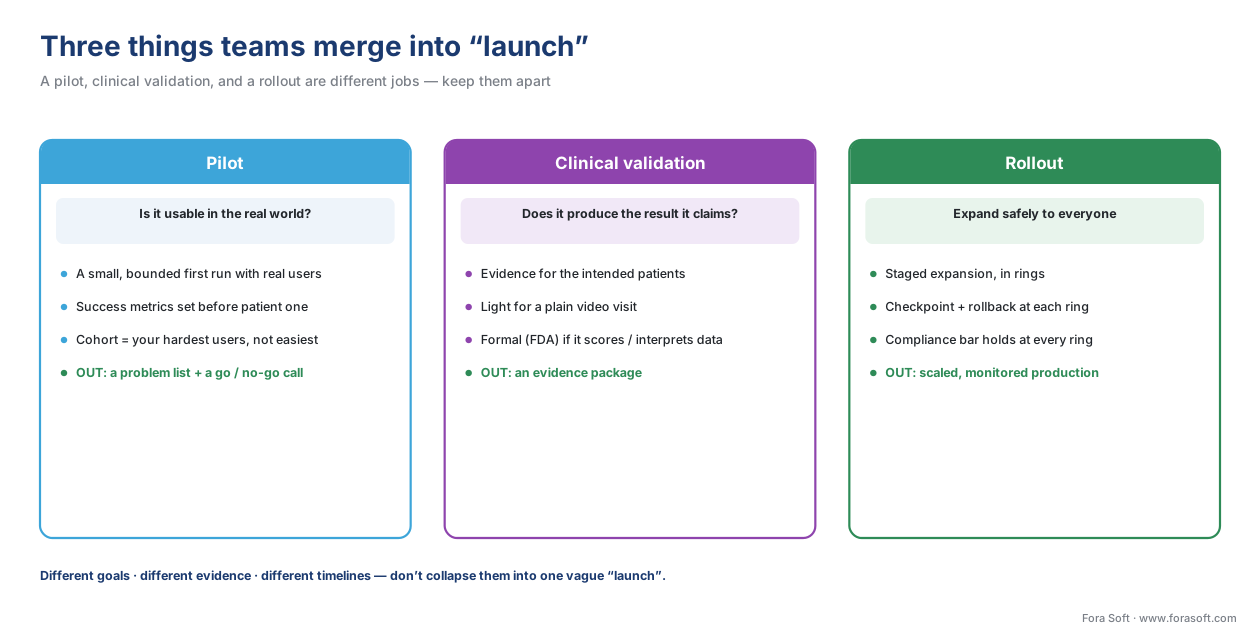 Figure 1. Three things teams merge into "launch." A pilot tests whether the product is usable in the real world; clinical validation tests whether it produces the clinical result it claims; a rollout is the staged expansion to everyone. Different goals, different evidence, different timelines.
Let us define each precisely, because the rest of the article depends on keeping them apart.
A pilot is a small, deliberately bounded first run of the product with real users in real conditions — a handful of clinicians and a defined group of patients, for a set period, with a set of metrics agreed before it starts. Its job is to surface the problems that only appear when real people use the product: confusing flows, broken edge cases, workflow friction, support load.
Clinical validation is evidence that the product achieves the clinical result it claims for the patients it is meant to serve. For a simple video-visit product, "validation" may be as light as confirming visits are completed and clinicians can do their job. For a product that measures, scores, or interprets anything clinical, validation is a formal evidence requirement — and, past a line we will draw, a regulatory one.
A rollout is the staged expansion from the pilot group to the full population — adding clinics, specialties, and patient volume in controlled increments, each with a checkpoint and a way back. It is a risk-management exercise, not a launch party.
The three sit next to each other like this:
| Activity | The question it answers | Evidence it produces | When it is "done" |
|---|---|---|---|
| Pilot | Is the product usable for real users in real conditions? | A problem list and a go / no-go decision | The pre-set success criteria are met or clearly missed |
| Clinical validation | Does the product produce the clinical result it claims? | An evidence package — light, or formal FDA-grade | The intended result is shown for the intended patients |
| Rollout | Can we expand to everyone without raising the risk? | A scaled, monitored production system | Every ring has passed its checkpoint at full volume |
Designing the pilot: decide what "success" means before you start
The single most common pilot mistake is running one without writing down, in advance, what would make it a success or a failure. A pilot without pre-set criteria cannot fail — every outcome gets reinterpreted as a win — which means it also cannot teach you anything. So the first artifact of a pilot is not code; it is a one-page definition of success.
A useful way to choose metrics is to borrow the four domains the U.S. National Quality Forum defined for measuring telehealth: access (does it get care to people who could not get it before?), effectiveness (are the clinical outcomes, safety, and timeliness right?), experience (do patients and clinicians find it meets their needs?), and financial impact (what does it cost, and how is it paid for?). [1] You do not need a measure in every domain, but a pilot that only measures "did it technically work" is measuring the half you already tested.
Concretely, a video-visit pilot might set targets like: visit completion rate above 90%, fewer than one support contact per ten visits, clinician task time within 10% of an in-person visit, and a patient-experience score above a set threshold. Each target is a number agreed with the clinical stakeholders before patient one. The point is not the specific numbers; it is that they exist on paper before the pilot starts.
Pick the pilot cohort to look like your hardest real users, not your easiest. The temptation is to pilot with tech-comfortable staff on the office network — which, as in testing, measures the opposite of production. A pilot cohort should include the patients who will struggle: older, on poor connections, on old devices. A pilot that succeeds only with young patients on fast Wi-Fi has validated nothing about the population telehealth exists to reach.
A worked example: how big does the pilot need to be?
Pilot size is a judgment call, but a little arithmetic keeps it honest. Suppose you want the pilot to catch any problem that affects at least 5% of visits — a camera-permission bug on one device family, say. The chance a single visit misses that problem is 95%, or 0.95. Across n independent visits, the chance you miss it every time is 0.95 raised to the power n. To be roughly 95% confident you would have seen it at least once, you solve 0.95^n ≤ 0.05, which gives n ≈ 59 visits. Round up and run at least 60–100 completed visits before you trust a "no major problems" result for a 5%-prevalence issue. Want to catch rarer problems — 1% of visits — and the same math jumps to about 300 visits. This is back-of-envelope sizing, not a clinical-trial power calculation, but it stops the two-week, twelve-visit pilot from being mistaken for evidence.
The legal fork: is your pilot quality improvement, or is it research?
Here is a line most product teams do not know exists, and it has real consequences. Under U.S. federal rules, an activity is research if it is "a systematic investigation … designed to develop or contribute to generalizable knowledge" (45 CFR §46.102(l), the regulation known as the Common Rule). [2] If your pilot is research and it involves patients (human subjects), it generally must be reviewed and approved by an Institutional Review Board (IRB) — an independent ethics committee — before it starts.
The deciding factor is intent, not activity. The same telemedicine pilot can be one or the other depending on why you are running it. If the purpose is to improve care in your specific setting — to decide whether this clinic should adopt this tool — that is quality improvement (QI), and it generally does not require IRB review. If the purpose is to produce findings you intend to generalize and publish — "telemedicine improves outcomes for this condition" — that is research, and it likely does. [2][3]
 Figure 2. The research-or-QI fork. Ask what the pilot is for. If it exists to improve care in your own setting, it is quality improvement. If it is designed to produce generalizable, publishable knowledge about patients, it is likely human-subjects research and needs ethics-board review first.
This matters for two practical reasons. First, getting it wrong is expensive: running what was actually research without IRB approval can invalidate the data, block publication, and create a compliance problem. Second, the determination is not yours alone to make casually — many institutions require you to use a short self-certification tool or ask the IRB to confirm, precisely because teams talk themselves into "it's just QI" when it is not. [3] The safe move is to decide intent early, write it down, and when the pilot is anywhere near the research line, ask the IRB for a determination in writing before you enroll a single patient.
A non-US note: the same fork exists elsewhere under different names — research ethics committees in the UK and EU, for example — and cross-border pilots may trip more than one regime. Confirm the local rule for every jurisdiction the pilot touches.
A pilot is not a compliance holiday
There is a dangerous instinct that a pilot is a sketch — small, temporary, "not really live" — and so the rules can wait until the real launch. For patient privacy, this is false and it is where pilots most often go wrong.
The moment your pilot touches real patient data — Protected Health Information, or PHI, meaning any health data tied to an identifiable person — the full U.S. HIPAA Security Rule applies. There is no pilot exemption. The Security Rule requires you to protect the confidentiality, integrity, and availability of that data (45 CFR §164.306(a)) and to have performed a risk analysis of how you do so (45 CFR §164.308(a)(1)(ii)(A)) — and it does not say "unless you are only piloting." [4][5] Encryption in transit and at rest, access controls, and audit logging all have to be real on day one of the pilot, not retrofitted before scale.
The contract layer is just as binary. Every outside vendor that will touch PHI during the pilot — the video provider, the cloud host, the analytics or crash-reporting tool — must have signed a Business Associate Agreement (BAA), the contract that legally binds a vendor to handle patient data under HIPAA, before the pilot starts. A common, costly pilot error is wiring in a convenient analytics or error-tracking tool "just to watch the pilot" that never signed a BAA, quietly sending patient identifiers to a company with no legal obligation to protect them. That is a reportable breach whether you had ten pilot patients or ten thousand. The mechanics of who signs what are in our Business Associate Agreement guide; the point here is that the BAAs are a pre-pilot task, not a pre-launch one.
One way to keep a pilot genuinely low-risk is to reduce the data, not the safeguards. If the pilot's questions can be answered with de-identified or aggregate data — completion rates, support volume, timing — collect only that, and keep PHI inside the same protected boundary the production system will use. Shrinking the data shrinks the risk; skipping the safeguards just hides it.
Clinical validation: from "it runs" to "it works," and where the FDA line is
For a plain video-visit product, clinical validation is mostly the pilot doing its job: visits complete, clinicians can examine and decide, outcomes are no worse than in person. But the moment your product measures, scores, or interprets something clinical — reads a vital sign, flags a patient as high-risk, suggests a triage level — "it runs" and "it works" become different claims, and validation becomes a formal exercise.
The clearest framework comes from the FDA's guidance on Software as a Medical Device (SaMD), which breaks clinical evaluation into three questions you must answer in order. [6] First, clinical association: is there a valid, accepted link between your software's output and the clinical condition it speaks to? Second, analytical validation: does the software correctly and reliably process its inputs into the right outputs — does it compute what it says it computes? Third, clinical validation: when a clinician uses that output in real care, does it achieve the intended result for the intended patients? A product can pass the second and fail the third — a score can be computed perfectly and still not improve any decision.
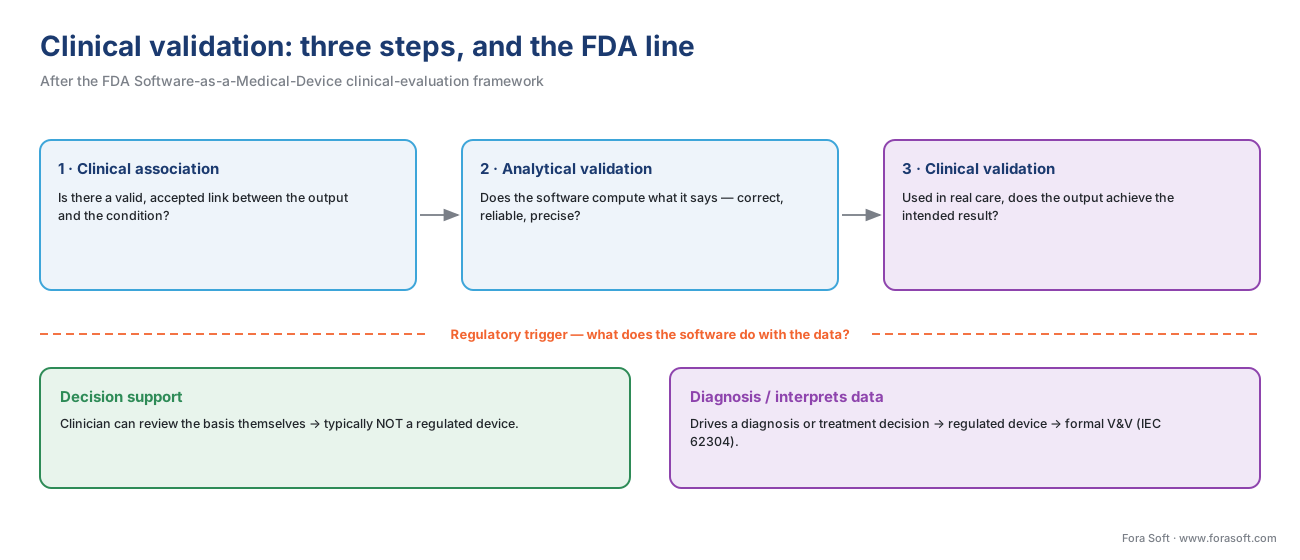 Figure 3. Clinical evaluation in three steps, after the FDA SaMD framework: clinical association, then analytical validation, then clinical validation. The dotted line is the regulatory trigger — software that interprets data to drive a diagnosis is more likely to be a regulated device than software that supports a clinician who can review the basis for themselves.
The regulatory trigger is the line between decision support and diagnosis. Software that gives a clinician information they can independently review tends to sit outside device regulation; software that interprets data to produce or drive a diagnosis or treatment decision is more likely to be a regulated medical device, which turns ordinary quality assurance into formal, documented verification and validation — typically following the IEC 62304 medical-software lifecycle standard, where every requirement traces to evidence it was met. [6][7] The expensive mistake is discovering this line after you have built and piloted the feature. If any pilot feature is drifting toward interpreting clinical data, get a regulatory read before the pilot, not after — retrofitting device-grade validation onto a product built as ordinary software is one of the costliest do-overs in health tech. The clinical-AI version of this question is covered in the compliance and safety layer for clinical AI.
One more validation discipline the FDA framework stresses: clinical evaluation does not stop at launch. Real-world performance should be monitored continuously, because a model or workflow that validated in the pilot can drift as the population and conditions change. [6] That continuous monitoring is an operations job, which is why validation and observability are joined at the hip.
Clinician onboarding and change management: where products actually die
You can have a tested, validated, compliant product and still fail, because the people expected to use it do not. Clinician non-adoption is the most underestimated risk in telemedicine, and it is not a training problem you can solve with a slide deck. It is a change-management problem: you are asking busy people to change a workflow they have done for years, and any product that adds clicks, time, or uncertainty to their day will be quietly routed around.
The established playbooks for this come from the American Medical Association, whose Telehealth Implementation Playbook lays out a roughly twelve-step process built around real clinical workflows, the right stakeholder team, and structured change management for care teams — not just a vendor demo. [8] Its core lessons are consistent with general change-management frameworks (Prosci's ADKAR, Kotter's eight steps): people adopt change when they understand why, see it work for a respected peer, are trained on their actual workflow, and get support when it breaks. [9]
In practice that means a few concrete things. Recruit a clinical champion — a respected clinician who uses the product early and vocally; peers adopt what peers they trust adopt, far more than what management mandates. Train on the real workflow, not the feature list — where the telehealth visit fits between the patient before and the patient after, including the unglamorous parts: scheduling, documentation, billing. Make the support path obvious and fast during the pilot, because a clinician who hits a wall once with no help will not try a third time. And close the loop: collect feedback from staff and patients, change the product, and show that you did — nothing earns adoption like a fix that came from a user's complaint.
Phased rollout: expand in rings, with a way back
When the pilot has met its criteria, you do not flip a switch for everyone. You expand in rings — concentric stages, each larger than the last, each with a checkpoint before the next. A typical sequence: internal/staff users, then the pilot cohort, then a limited release to a subset of real clinics or a percentage of traffic, then general availability. [10] At each ring you watch the same metrics the pilot defined, plus the operational ones — call success rate, error rate, support load — and you only widen the ring when they hold.
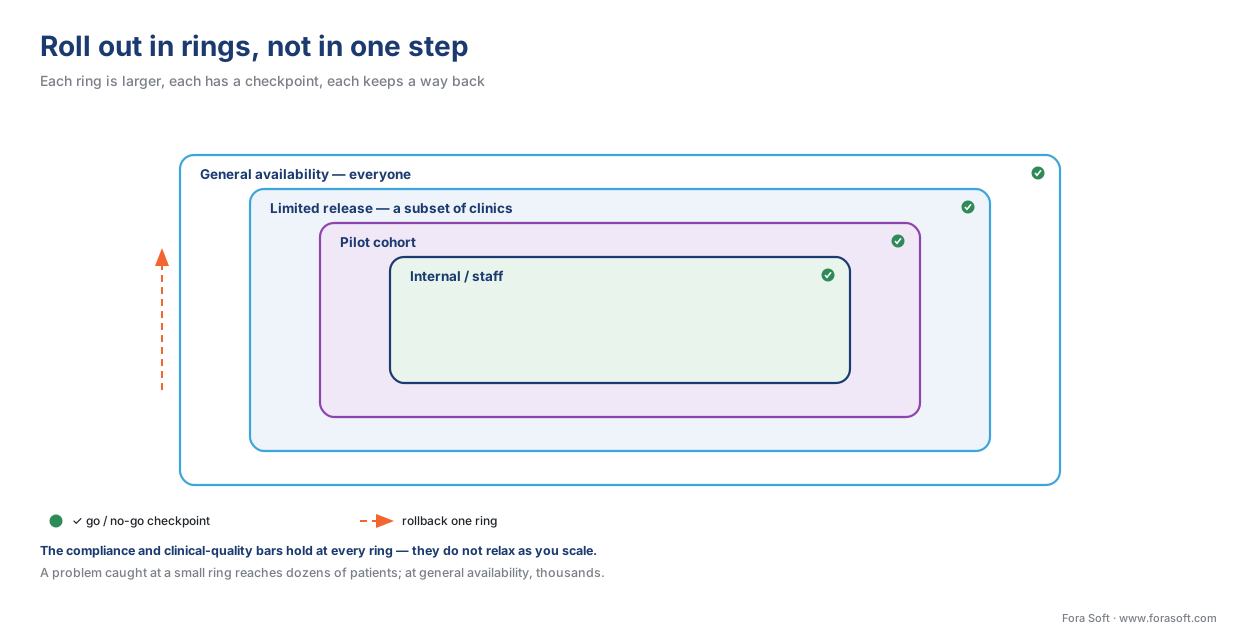 Figure 4. Roll out in rings, not in one step. Each ring is larger than the last, each has a go/no-go checkpoint, and each keeps a rollback path. The compliance and clinical-quality bars must hold at every ring — they do not relax as you scale. A problem caught at the limited-release ring reaches dozens of patients; the same problem at general availability reaches thousands.
The reason for rings is blunt: a problem that slips through reaches a controllable number of patients instead of the whole population. Pair every ring with a rollback plan — a tested, rehearsed way to turn the new version off and fall back to the previous one (or to in-person care) quickly. In a consumer app, a bad release is an annoyance; in telemedicine, the rollback path is a patient-safety control, and it has to be ready before the ring opens, not improvised during an incident.
Two telemedicine-specific gates belong in the rollout, not after it. First, the path to payment: confirm the billing and reimbursement flow actually works for real visits in the rings before you scale volume — Medicare's telehealth payment flexibilities, for example, are currently extended only through December 31, 2027 under the Consolidated Appropriations Act, 2026, and reimbursement and cross-state licensing rules are jurisdictional and change yearly, so the rule that was true at pilot time may not be true at scale. [11] Second, cross-state licensing: as rings add patients in new states, the requirement that a clinician be licensed where the patient is located comes into force; the rollout plan, not a post-launch surprise, is where that gets checked. The reimbursement context is covered in reimbursement rules that shape the product.
The common mistake: the "successful" pilot that was rigged to succeed
The signature failure of this whole stage is the pilot that was designed, usually unconsciously, to succeed: run with enthusiastic staff, on good networks, with new devices, with no success criteria set in advance, for a population nothing like the real one. It produces glowing feedback, the team declares victory, scales to everyone — and the product meets its actual users for the first time at full volume, which is the worst possible moment to discover the camera-permission bug, the workflow friction, and the patients who cannot complete a visit. A pilot that cannot fail has told you nothing; the entire value of a pilot is its power to surface problems while they are still cheap. Design the pilot to find problems, not to confirm a decision you already made, and treat a problem found in the pilot as the pilot working, not the pilot failing.
Where Fora Soft fits in
Fora Soft has built real-time video software since 2005, including telemedicine platforms, and the move from a tested build to real patients is exactly where a specialist earns its keep: instrumenting a pilot so the metrics that matter are captured from the first visit, keeping the compliance boundary intact during the pilot rather than retrofitting it, and rolling out in rings with monitoring and a rollback path. Because this is healthcare, we treat the compliance and clinical-validation questions — the research-versus-QI line, the FDA decision-support-versus-diagnosis line, the BAAs that must be signed before patient one — as part of the rollout plan, not an afterthought. Our work also spans video conferencing, streaming, e-learning, and surveillance, so the live-video failure modes that only appear as you scale rings are familiar ground rather than launch-week surprises.
What to read next
- Testing clinical video: QA for reliability and compliance — the testing that has to pass before a pilot starts.
- Observability and operations for a live telehealth platform — how you watch the metrics each rollout ring depends on.
- The telemedicine launch checklist — the capstone checklist that the rollout runs against.
Call to action
- Talk to a telemedicine engineer — book a 30-minute scoping call to talk through your telemedicine pilot program plan.
- See our case studies — 250+ shipped projects across video streaming, WebRTC, OTT, telemedicine, e-learning, surveillance, and AR/VR.
- Download the Telemedicine Pilot & Rollout Readiness Checklist — One page: the plan for taking a telemedicine product from a tested build to real patients — pilot design and pre-set success criteria, the research-versus-QI determination, the pre-pilot HIPAA and BAA gate, clinical validation and the….
References
- Creating a Framework to Support Measure Development for Telehealth — final report (the four domains: access, effectiveness, experience, financial impact/cost). The U.S. National Quality Forum's telehealth measurement framework, defining the domains a telehealth pilot should measure beyond "did it run." National Quality Forum (NQF). https://www.qualityforum.org/Publications/2017/08/Creating_a_Framework_to_Support_Measure_Development_for_Telehealth.aspx (Tier 5 — institutional measurement framework.)
- 45 CFR §46.102(l) — Definition of "research" (the Common Rule). Defines research as a systematic investigation designed to develop or contribute to generalizable knowledge — the test that separates a research pilot (IRB-reviewed) from quality improvement. Electronic Code of Federal Regulations / HHS Office for Human Research Protections. https://www.ecfr.gov/current/title-45/subtitle-A/subchapter-A/part-46 (Tier 1 — the federal definition that triggers IRB review.)
- 45 CFR 46 FAQs and Quality Improvement Activities guidance. HHS Office for Human Research Protections guidance on when an activity is human-subjects research versus quality improvement, and the role of the IRB determination. U.S. Department of Health and Human Services, OHRP. https://www.hhs.gov/ohrp/regulations-and-policy/guidance/faq/quality-improvement-activities/index.html (Tier 2 — the issuing agency's own interpretation of its rule.)
- 45 CFR §164.306(a) — Security standards: General rules (HIPAA Security Rule). Requires covered entities and business associates to ensure the confidentiality, integrity, and availability of all ePHI they handle — with no exemption for pilots. Electronic Code of Federal Regulations. https://www.ecfr.gov/current/title-45/subtitle-A/subchapter-C/part-164/subpart-C/section-164.306 (Tier 1 — the safeguards that apply from pilot day one.)
- 45 CFR §164.308(a)(1)(ii)(A) — Risk analysis (HIPAA Security Rule, Administrative Safeguards). Requires an accurate and thorough assessment of risks to ePHI — a pre-pilot obligation when the pilot touches real patient data. Electronic Code of Federal Regulations. https://www.ecfr.gov/current/title-45/subtitle-A/subchapter-C/part-164/subpart-C/section-164.308 (Tier 1 — the required risk analysis, no pilot carve-out.)
- Software as a Medical Device (SaMD): Clinical Evaluation — FDA guidance (clinical association, analytical validation, clinical validation; real-world performance). The three-step clinical-evaluation framework and the continuous real-world-performance expectation; the basis for the decision-support-versus-diagnosis line. U.S. Food and Drug Administration / IMDRF. https://www.fda.gov/medical-devices/software-medical-device-samd/clinical-evaluation-software-medical-device (Tier 1 — the clinical-validation framework and device trigger.)
- IEC 62304 — Medical device software — Software life cycle processes. The lifecycle and verification/validation standard for software that crosses the medical-device line. International Electrotechnical Commission. https://www.iec.ch/ (Tier 3 — first-party software-lifecycle standard.)
- Telehealth Implementation Playbook. The American Medical Association's step-by-step guide to telehealth adoption — workflow design, stakeholder teams, change management for care teams, training, and scaling. American Medical Association (AMA). https://www.ama-assn.org/practice-management/digital-health/telehealth-implementation-playbook-overview (Tier 5 — institutional implementation guidance.)
- Change-management frameworks for clinical adoption (Prosci ADKAR; Kotter's 8-step model). The structured-change models behind clinician onboarding: readiness, demonstration by a trusted peer, workflow training, and reinforcement. Prosci / Kotter. https://www.prosci.com/methodology/adkar (Tier 6 — orientation on the change-management method.)
- Phased rollout / deployment rings — staged release to internal, pilot, limited, and broad audiences. The staged-deployment pattern (deployment rings) that limits the blast radius of a bad release; widely used where compliance constrains release speed, including healthcare. Microsoft Learn / industry practice. https://learn.microsoft.com/en-us/windows/deployment/update/waas-deployment-rings-windows-updates (Tier 6 — the staged-rollout pattern.)
- Medicare telehealth payment flexibilities — extended through December 31, 2027 (Consolidated Appropriations Act, 2026); CMS telehealth policy. The current expiry of the major Medicare telehealth flexibilities and the reminder that reimbursement and licensing are jurisdictional and dated. Centers for Medicare & Medicaid Services. https://www.cms.gov/medicare/coverage/telehealth (Tier 1 — the dated reimbursement context for scaling.)
