


This is engineering guidance, not legal advice. Confirm specifics with qualified counsel.
Why this matters
You have built the platform, tested it, and run a pilot. The last step before real patients depend on it is the riskiest, because everything that was theoretical — a real breach clock, a real auditor, a real patient who uses a screen reader — becomes live at the same moment. This article is for the founder, product manager, or engineering lead who needs one trustworthy document to decide "are we actually ready?" and to defend that decision to a board, a hospital partner, or a regulator. It is the capstone of the Telemedicine & Healthcare Video section: it pulls together the HIPAA readiness work, the accessibility audit, the reliability engineering, and the operations runbook into one ordered go-live sequence. Get this gate right and your launch is boring — which, in clinical software, is the highest compliment.
What a launch checklist is — and what it is not
A launch checklist is the final, whole-platform readiness gate. It asks one question across every part of the product: if a real patient and a real clinician use this tomorrow, will it be safe, legal, reliable, usable, and operable? It is deliberately broad. It spans the contract your lawyer signs, the encryption your engineers configure, the captions your designer adds, and the pager your on-call rotation carries.
It is not the same as a HIPAA readiness checklist. A HIPAA readiness checklist — the one we cover in detail in the HIPAA readiness and audit-prep guide — goes deep on one domain: your compliance posture against the HIPAA rules, ready for an audit. The launch checklist treats that entire HIPAA readiness review as a single gate among six. Think of it this way: the HIPAA readiness checklist is the detailed inspection report for the building's wiring; the launch checklist is the certificate of occupancy that confirms the wiring, the plumbing, the fire exits, the elevator, and the front-door lock are all signed off before anyone moves in.
Two ideas make the rest of this article work, so we define them up front.
The first is Protected Health Information, called PHI: any health data that can be tied to an identifiable person — a name next to a diagnosis, a video of a consultation, an appointment record, even an IP address logged against a visit. PHI is the unit of risk in everything below. Wherever PHI flows, a rule follows.
The second is a Business Associate Agreement, called a BAA: the signed contract that lets an outside vendor handle your patients' PHI on your behalf. A BAA is the contractor's written promise — made before they get a key to the building — to protect that data and to tell you fast if they lose it. Under the HIPAA Privacy Rule, you may only share PHI with a vendor once that contract is in place (45 CFR §164.502(e); §164.308(b)). BAA coverage is binary: a vendor either has a signed BAA covering your use, or it does not. There is no "mostly covered."
Launch is a gate, not a date
The single most common launch mistake in clinical software is treating "go live" as a day on the calendar. A date creates pressure to ship whatever is ready by then. A gate flips the logic: you go live when every domain passes, and not before. The date moves; the standard does not.
A healthy go-live is staged, not flipped. You move from internal testing, to a small supervised pilot with real patients, to a limited rollout, to general availability — with a go/no-go checkpoint between each stage and a rehearsed way to roll back if a stage goes wrong. We cover that staged process in depth in pilots, clinical validation, and rollout; the launch checklist is the gate you run before you let the first real patient in, and again, in lighter form, before each ring of expansion.
 Figure 1. The launch checklist spans six domains. Every gate must read green; any single red gate is a no-go for the whole launch.
The six domains are compliance and legal, security, real-time video reliability, integrations, accessibility, and operations. The order matters only a little — you work them in parallel — but the rule is absolute: launch needs all six green. The rest of this article walks each one, with the controlling rule behind every gate.
Domain 1 — Compliance and legal
This domain blocks more launches than any other, and almost never for technical reasons.
Risk analysis done and documented. The HIPAA Security Rule requires a covered entity to conduct an accurate and thorough assessment of the risks to electronic PHI (45 CFR §164.308(a)(1)(ii)(A)). This is not a formality you do after launch. It is the document an auditor asks for first, and the absence of one is among the most commonly cited findings in enforcement actions. The gate: a written risk analysis exists, names the threats to your specific architecture, and lists what you did about each.
Every vendor that touches PHI has a signed BAA. Walk your architecture and list every outside service that could see patient data: your video infrastructure provider, your cloud host, your email and SMS senders, your error-tracking tool, your analytics, your transcription or AI vendor. For each one, the answer to "is a BAA signed?" must be yes — or that vendor must be provably unable to see PHI. We go deep on this contract in the BAA guide. One unsigned BAA on a service that sees PHI is, on its own, a launch blocker.
Breach response is ready before you need it. If patient data is exposed, the HIPAA Breach Notification Rule starts a hard clock: you must notify affected individuals without unreasonable delay and no later than 60 calendar days after the breach is discovered (45 CFR §164.404(b)). "Discovered" means the first day the breach is known, or would have been known with reasonable diligence (§164.404(a)). A vendor who suffers the breach must tell you so you can start your own clock (§164.410). The gate is not "have we had a breach" — it is "if we have one at 2 a.m. on day one, does a written, rehearsed plan tell us exactly who does what?" See incident response and breach notification.
Here is the arithmetic teams underestimate. Suppose a misconfigured storage bucket is found on August 1. The 60-day clock starts that day. Counting forward, your notification deadline is September 30. That is sixty calendar days — not business days — to confirm the scope, identify every affected patient, draft notices, and send them. If your detection is weak and you "discover" the same breach three weeks late, you have not bought three weeks; you have spent three of your sixty before the clock even felt like it was running, because the law dates discovery from when you should have known.
Consent, recording, and retention rules are set. Patients must be able to consent to a visit and to any recording, and your data-retention schedule must match the strictest rule that applies to you. Documentation supporting your HIPAA compliance must be retained for six years (45 CFR §164.316(b)(2)).
Reimbursement and prescribing rules are current and dated. These change every year, so cite the year. As of June 2026, Medicare telehealth flexibilities — including the rule that lets patients be seen at home rather than at a rural facility — were extended through December 31, 2027 by the Consolidated Appropriations Act, 2026, signed February 3, 2026. If you prescribe controlled substances over video, the DEA's flexibility allowing that without a prior in-person visit was extended through December 31, 2026 by its Fourth Temporary Extension, with a permanent "special registration" rule still pending. If reimbursement or prescribing is part of your product, confirm the current date and jurisdiction before launch, because both are scheduled to change. Reimbursement and the rules that shape the product covers this in detail. (Non-US note: in the EU, health data is special-category data under the GDPR; in Canada, PIPEDA and provincial health-privacy laws apply. Map to the jurisdiction where the patient sits.)
Domain 2 — Security
Security is where "encrypted" gets confused with "compliant." Encryption is necessary and not sufficient: a perfectly encrypted tool with no signed BAA is still a HIPAA violation. Keep the two ideas separate as you work this gate.
Encryption in transit and at rest. Every hop that carries PHI is encrypted in transit, and stored PHI — recordings, documents, database fields — is encrypted at rest. The Security Rule names encryption as an addressable specification for both stored ePHI (45 CFR §164.312(a)(2)(iv)) and transmitted ePHI (§164.312(e)(2)(ii)); "addressable" means you must implement it or document a sound reason and an equivalent alternative, not that it is optional. For clinical video, the real-time media itself is encrypted by the WebRTC standard; we cover that in encryption in transit, at rest, and end to end.
Authentication and access control. Patients and clinicians prove who they are before they reach PHI — the Security Rule requires person-or-entity authentication (45 CFR §164.312(d)) — and multi-factor authentication should be on for every clinician and administrator account. Access is least-privilege: each role sees only the data it needs (§164.312(a)(1)).
Audit logging works and is reviewed. The system records who accessed which patient's data, when (45 CFR §164.312(b)), and someone actually reviews that activity (§164.308(a)(1)(ii)(D)). An audit log is the visitor sign-in sheet for patient data; an empty or unread one is worse than none, because it implies a control you do not really have.
Operational logs carry no PHI. This is the gate teams fail quietly. Crash reports, performance traces, and analytics events must be scrubbed of patient data — opaque user IDs only, no names, no diagnoses, no medical record numbers in URLs or error strings — under HIPAA's minimum-necessary standard (45 CFR §164.502(b)). Any monitoring or analytics vendor that could still see PHI needs a BAA.
Independent security testing is done. Before launch, an external vulnerability scan and a penetration test have run, and the serious findings are fixed. The Security Rule already requires periodic technical and non-technical evaluation (45 CFR §164.308(a)(8)); the proposed 2026 Security Rule update would make a scheduled cadence explicit. The methodology in NIST SP 800-115 is the standard reference. See testing clinical video QA.
A note on the 2026 HIPAA Security Rule update. HHS issued a proposed rule (RIN 0945-AA22, published January 6, 2025) that would tighten the Security Rule — making several formerly "addressable" controls required, mandating encryption, MFA, asset inventories, and scheduled testing. As of June 2026 it is still a proposal, not final law, and a large coalition of provider groups has asked HHS to withdraw it. Build to it anyway: every control it proposes is already a defensible best practice, and building to the stricter standard now means no scramble if it finalizes.
Domain 3 — Real-time video reliability
A telemedicine call is not a normal video call. When it freezes, a clinician may miss a symptom, and the platform being down is itself a HIPAA problem, because the Security Rule names availability of patient data as a requirement alongside confidentiality and integrity (45 CFR §164.306(a)). Reliability is a compliance gate, not only an engineering one.
The clinical "good enough" bar is met under bad conditions. Test the call quality not on office wifi but on the networks patients actually use: a weak home connection, a phone on cellular data, an older laptop. The bar is defined in latency, quality, and the clinical "good enough" bar. The gate: a consultation stays clinically usable when the network is poor, not only when it is perfect.
Reconnection and graceful degradation work. Networks drop. The call must recover automatically when a patient walks from wifi to cellular, and degrade gracefully — dropping video before audio — rather than failing hard. See connection reliability, reconnection, and degradation.
The waiting room and surge are tested. Patients arrive early and cluster at the top of the hour. The waiting room holds them without confusion, and the system has been load-tested at several times your expected peak so a Monday-morning surge does not take it down. See scaling clinical video.
Recording, if you offer it, is compliant. Recordings are PHI. They are encrypted at rest, access-controlled, retained on a defined schedule, and only made with consent. The full reference picture is in the telemedicine video reference architecture.
Domain 4 — Integrations
Every external system you connect is a new door, and each door needs both a lock (a BAA, where PHI flows) and a fallback (what the product does when that system is down).
Each integration has a BAA where PHI flows, and a defined failure mode. Your electronic health record connection, scheduling, e-prescribing, payments, and identity provider each either carry PHI under a signed BAA or are provably PHI-free. And for each, you have decided what happens when it fails: if the EHR write-back is down, does the visit still proceed and queue the note, or does it block? A launch checklist forces that decision before a patient is waiting.
Clinical data exchange uses the standard and is tested with real-shaped data. Modern EHR integration uses HL7 FHIR (the current common release is R4) to read and write clinical records. The gate is not "the integration compiles" — it is "a test patient's data flows correctly end to end, including the unhappy paths." HL7 FHIR and EHR integration covers the mechanics.
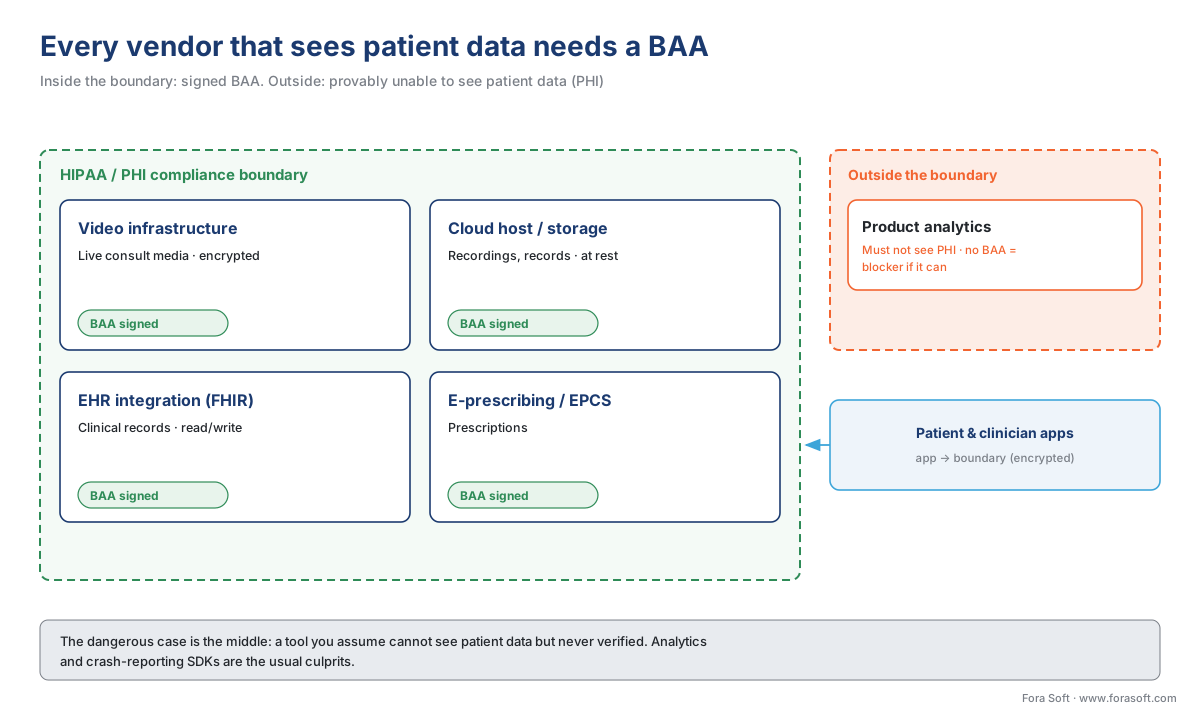 Figure 2. Draw the boundary. Everything inside that can see patient data needs a signed BAA; tools kept outside must be provably unable to see PHI.
Domain 5 — Accessibility
Accessibility is no longer a nice-to-have you schedule for after launch. For most healthcare organizations the deadline has already passed.
The standard is the Web Content Accessibility Guidelines, WCAG 2.1, at conformance Level AA — the widely adopted bar for usable digital products. What changed is that for healthcare it became a dated legal requirement. The federal Section 1557 rule on nondiscrimination in health programs (the final rule was published May 6, 2024) requires that websites and mobile apps used in health programs conform to WCAG 2.1 AA. The compliance deadline for organizations with 15 or more employees was May 11, 2026 — already in the past as of this writing — with smaller organizations required to conform by May 10, 2027. Crucially, if your telehealth platform is provided to a covered health organization, the obligation for the patient's experience still lands on the covered entity, so your product being inaccessible is your customer's violation.
The gate: an accessibility audit against WCAG 2.1 AA has run and the failures are fixed. In practice for clinical video that means live captions are available for consultations (a deaf or hard-of-hearing patient cannot read lips through a frozen frame), the interface works with a keyboard and a screen reader, color is never the only way information is conveyed, and the experience holds up for an elderly or low-vision patient on a small screen. We cover the full audit in WCAG 2.1 AA for telemedicine video and the design specifics in designing for elderly, low-vision, and low-bandwidth users.
Domain 6 — Operations
The platform has to be operable on day one, not just functional in a demo.
Observability is live, and PHI-free. You can see the health of the system — infrastructure, per-consult video quality, and the clinical funnel from scheduled to completed — without patient data leaking into your dashboards. Observability and operations for a live telehealth platform details the three layers to watch.
On-call and escalation exist. Someone is paged when visits start failing, the rotation realistically covers when patients actually use the product (evenings, nights, across time zones), and any crisis-escalation path — for example a behavioral-health platform handing a patient to a 988 line — has its own highest-severity monitor that can never silently fail.
Detection is wired to the breach clock. Your monitoring is also your breach-detection front line. The day an alert should have fired is the day "discovery" begins under the 60-day rule, so the alert must trigger your documented detect-investigate-contain-notify chain, not just an email nobody reads.
Rollback is rehearsed. You have a tested way to pull back a release that goes wrong, and you have practiced it. A rollback you have never run is a hope, not a plan.
 Figure 3. A staged go-live. Each ring has a go/no-go checkpoint against the six domains, and a rehearsed rollback if a stage goes wrong.
The launch-blocking vendors, at a glance
Most launch delays trace back to a single missing vendor contract. This table lists the vendor categories that typically sit on the PHI path, whether they need a BAA, and what happens if the BAA is missing at go-live.
| Vendor category | Typically sees PHI? | Needs a BAA? | BAA available from major vendors? | Missing-BAA verdict |
|---|---|---|---|---|
| Video infrastructure (CPaaS or self-hosted) | Yes — live consult media | Yes | Yes, on healthcare plans | Launch blocker |
| Cloud host / storage | Yes — recordings, records | Yes | Yes | Launch blocker |
| EHR integration / data exchange | Yes — clinical records | Yes | Yes | Launch blocker |
| E-prescribing / EPCS | Yes — prescriptions | Yes | Yes | Launch blocker |
| Email / SMS notifications | Often — if content has PHI | Yes, if PHI in messages | Yes | Blocker if messages carry PHI |
| Error tracking / crash reporting | Only if logs carry PHI | Yes, unless PHI-scrubbed | Sometimes | Blocker unless provably PHI-free |
| Product analytics | Should not | No, if provably PHI-free | Sometimes | Blocker if it can see PHI without a BAA |
| Monitoring / observability | Only if telemetry carries PHI | Yes, unless PHI-scrubbed | Sometimes | Blocker unless provably PHI-free |
The pattern is consistent: a vendor either sits inside your compliance boundary under a signed BAA, or it is provably unable to see PHI. The dangerous case is the middle — a tool you "think" cannot see patient data but never verified. Analytics and crash-reporting SDKs are the usual culprits, because they capture screen contents and error strings by default.
A common mistake that fails launches: the silent PHI leak
The classic late-stage launch failure is not a crash. It is a free analytics or session-replay SDK dropped into the patient app months ago that quietly records the screen — including the visit, the chat, the diagnosis on screen — and ships it to a third party with no BAA. Everything looks fine in the demo. The platform is "encrypted." And it is a HIPAA violation the moment a real patient uses it, because encrypted data sent to an uncontracted vendor is still impermissible disclosure of PHI. The launch checklist catches this precisely because it forces you to walk every outbound data path and answer the binary BAA question for each, instead of trusting that the obvious vendors are the only ones.
Where Fora Soft fits in
Fora Soft has built real-time video products since 2005 — video conferencing, streaming, surveillance, e-learning, and telemedicine — so we treat a clinical launch as a compliance event first and a release second. We help teams run exactly this gate: confirming the risk analysis and the BAA coverage are complete, that the real-time video holds up on the networks patients actually use, that the interface meets WCAG 2.1 AA before the Section 1557 deadline bites, and that observability and breach detection are wired before the first patient connects. The requirement comes first; the capability follows it.
What to read next
- The HIPAA readiness checklist and audit-prep guide
- Pilots, clinical validation, and rollout
- Observability and operations for a live telehealth platform
Call to action
- Talk to a telemedicine engineer — book a 30-minute scoping call to talk through your telemedicine launch checklist plan.
- See our case studies — 250+ shipped projects across video streaming, WebRTC, OTT, telemedicine, e-learning, surveillance, and AR/VR.
- Download the Telemedicine Launch Checklist — One page: the whole-platform go-live gate for a telemedicine product, organized as six pass-or-fail domains — compliance and legal, security, real-time video reliability, integrations, accessibility, and operations — with the….
References
- HHS Office for Civil Rights — HIPAA Security Rule, 45 CFR Part 164 Subpart C. Security standards: general rules (confidentiality, integrity, availability), 45 CFR §164.306(a). Tier 1.
- HHS OCR — Risk analysis (required), 45 CFR §164.308(a)(1)(ii)(A); information system activity review, §164.308(a)(1)(ii)(D); evaluation, §164.308(a)(8). Tier 1.
- HHS OCR — Technical safeguards: access control §164.312(a)(1), encryption at rest (addressable) §164.312(a)(2)(iv), audit controls §164.312(b), person/entity authentication §164.312(d), transmission security / encryption (addressable) §164.312(e)(2)(ii). Tier 1.
- HHS OCR — HIPAA Privacy Rule: business associate contracts, 45 CFR §164.502(e) and §164.308(b); minimum necessary, §164.502(b). Tier 1.
- HHS OCR — HIPAA Breach Notification Rule: notification to individuals and the 60-day deadline, 45 CFR §164.404(a)–(b); business associate notification, §164.410; documentation retention (6 years), §164.316(b)(2). Tier 1.
- HHS OCR — "HIPAA Security Rule To Strengthen the Cybersecurity of Electronic Protected Health Information," Notice of Proposed Rulemaking, RIN 0945-AA22, published January 6, 2025 (proposed, not final as of June 2026). Federal Register. Tier 1.
- HHS — Section 1557 final rule, "Nondiscrimination in Health Programs and Activities," published May 6, 2024; web/mobile accessibility conformance to WCAG 2.1 AA, with compliance dates May 11, 2026 (≥15 employees) and May 10, 2027 (<15 employees). Tier 1.
- W3C — Web Content Accessibility Guidelines (WCAG) 2.1, Level AA. Tier 1 (standard).
- NIST — SP 800-115, Technical Guide to Information Security Testing and Assessment; SP 800-66 Rev. 2, Implementing the HIPAA Security Rule. Tier 1.
- HL7 — FHIR Release 4 (R4) specification, used for clinical data exchange with EHRs. Tier 1 (standard).
- Consolidated Appropriations Act, 2026 (signed February 3, 2026) — Medicare telehealth flexibilities extended through December 31, 2027 (CMS / Medicare Learning Network). Tier 1/2; re-verify annually.
- DEA / HHS — "Fourth Temporary Extension of COVID-19 Telemedicine Flexibilities for Prescription of Controlled Medications," extending flexibilities through December 31, 2026; Federal Register, December 31, 2025. Tier 1; re-verify.
Where popular how-to posts say a video tool is simply "HIPAA-compliant," this article follows the rule (a tool is HIPAA-eligible only under a signed BAA on a qualifying configuration) and treats encryption and compliance as separate facts — overriding the looser vendor framing in the lower-tier orientation sources consulted.
